Evan Brooks had only been at Ridgefield High for seven months, but he already knew which hallways were safe and which ones belonged to people like Carter Haines. The math wing was safe because teachers stood near their doors during passing periods. The library was safe because Mrs. Bell watched everything over the top of her reading glasses. The cafeteria was dangerous because noise gave bullies a place to hide.
Ridgefield High looked friendly from the outside, with clean brick walls, wide windows, and a football field that glowed under Friday night lights. The banners in the main hallway said things like RESPECT, COURAGE, and COMMUNITY, all printed in bold blue letters. Evan used to read those banners when he first transferred, hoping they meant something. By November, he had learned that words on walls did not stop a boy from being shoved into lockers.
Evan was seventeen, quiet, and thin in the way boys often were before their bodies caught up with their minds. He had messy brown hair, serious eyes, and hands that were almost always stained with pencil graphite, machine oil, or glue from the robotics lab. He wore cheap hoodies, carried an old backpack, and spoke only when he had something worth saying. To most students, that made him strange.
To Carter Haines, that made him a target. Carter was the star wide receiver, senior class favorite, and the kind of boy who could say something cruel in front of adults and still make it sound like a joke. His father owned a construction company that sponsored the football scoreboard, and his mother ran the parent fundraiser committee. Teachers called Carter “spirited,” which at Ridgefield was often the polite word for someone too popular to discipline quickly.
Carter had started bothering Evan during the second week of school. It began with comments about his clothes and his quietness. Then Carter found out Evan spent every afternoon in the robotics lab, and the nickname “Robot Boy” spread before Evan could stop it. By October, students Evan had never met were making mechanical arm motions when he walked by.
Evan told himself it did not matter. He had moved to Ridgefield after his parents divorced, and he had promised his mother he would focus on grades, scholarships, and getting through senior year. He did not have time to fight every boy who needed an audience. He thought endurance was the same thing as strength.
The school science and engineering fair was supposed to be his one bright spot. Evan had spent three months building a small rescue robot for the competition. It could roll over rough surfaces, lift lightweight debris with a claw, and send a camera feed to a laptop through a small wireless module. It was not perfect, but it was the first thing at Ridgefield that felt completely his.
His mother, Dana Brooks, had watched him build it every night at their kitchen table. She worked as a billing clerk at a dental office and came home tired, but she still asked questions about wires, motors, and battery packs she barely understood. Evan’s little cousin Mia, who stayed with them after school, named the robot Scout because she said it looked like it was brave enough to enter dark places first. Evan pretended the name was silly, but he kept it.
On the morning of the fair, Evan arrived early with Scout packed carefully in a foam-lined storage box. The gym had been transformed into rows of folding tables, poster boards, extension cords, and nervous students rehearsing presentations under their breath. Blue curtains covered the basketball hoops, and the scoreboard was turned off. For once, the gym did not belong to athletes.
Evan liked that. He liked seeing chemical volcanoes, solar-powered cars, wind turbine models, and nervous freshmen taping last-minute labels to cardboard displays. He set up his table near the middle row, plugged in his laptop, and placed Scout on a small plywood obstacle course he had built from scrap wood. The robot looked small under the bright gym lights, but Evan felt proud when he saw it there.
His engineering teacher, Mr. Alden, stopped by with a clipboard. “Everything ready?” he asked. Evan nodded, though his stomach was tight. “Mostly.” Mr. Alden smiled. “Mostly is how every good invention begins.”
Evan appreciated Mr. Alden because he talked to students like their ideas mattered before they were polished. He was the one who had given Evan access to the robotics closet after school and helped him find a replacement motor when the first one burned out. He knew about Carter too, at least part of it. Evan had never told him everything.
By nine o’clock, students began walking through the gym with teachers, parents, and judges from the community college. Evan gave his presentation three times in the first hour. His voice shook during the first one, steadied during the second, and almost sounded confident during the third. When Scout rolled over the wooden blocks and lifted a small plastic beam, a judge leaned forward and wrote something on her score sheet.
“That’s clever,” she said. Evan tried not to smile too widely. “Thank you.” The words felt small compared to the rush in his chest.
For a little while, he forgot about Carter. He forgot the hallway jokes, the locker bumps, the cafeteria whispers, and the mechanical arm gestures. He forgot he was supposed to be invisible unless someone decided otherwise. He was just a student explaining something he had made with his own hands.
Then the gym doors opened, and the football players came in.
They were supposed to attend as part of their physics class, but they entered like they were visiting another country. Carter led them in a Ridgefield varsity jacket, with Blake Turner and Owen Mills walking on either side of him. Blake was tall, broad, and always laughing before anyone explained why. Owen was smaller, sharper, and usually the one filming things when Carter wanted a moment to travel.
Carter spotted Evan almost immediately. His smile widened. Evan saw it from across the gym and felt the good part of the morning begin to drain out of him. He looked down at Scout and adjusted one of the wheels even though it did not need adjusting.
“Robot Boy,” Carter called, loud enough for several tables to hear. “No way. You brought your little toy to the big show.” Blake laughed. Owen’s phone came out of his pocket.
Evan kept his voice low. “It’s a project.” Carter stopped at the edge of the table and leaned over the plywood course. “Looks like something you made out of a broken vacuum cleaner.” Blake snorted, and a few students nearby looked away, pretending they had not heard.
Owen laughed behind his phone. Evan saw the camera pointed toward the table and felt his face warm. He looked around for Mr. Alden, but the teacher was at the far side of the gym speaking with a judge. The noise of the fair swallowed everything.
Carter reached toward Scout’s claw. Evan moved quickly, placing his hand between Carter and the robot. “Don’t touch it.” The words came out sharper than he expected. Carter’s eyebrows lifted.
“Don’t touch it,” Carter repeated, making his voice thin and nervous. Blake laughed louder. Owen stepped closer, recording openly now. The students at the neighboring tables watched with the stiff expressions of people hoping not to become involved.
Evan kept his hand on the edge of the plywood course. “I said don’t touch it.” Carter looked at Evan’s hand, then at his face. The smile slowly left his mouth, and Evan knew he had made the dangerous mistake of saying no in public.
Carter leaned closer. “You really think this junk matters that much?” Evan’s heart pounded, but he did not move. “It matters to me.” The sentence was simple, and maybe that was why the gym around them seemed to quiet just a little.
Carter looked amused again. “That is the saddest thing I’ve heard all year.” He reached past Evan’s hand and flicked Scout’s claw with two fingers. The robot shifted slightly on the plywood. Evan caught it before it rolled off the edge.
“Stop,” Evan said. This time, his voice carried. Mr. Alden looked over from across the gym, but he was still too far away. Carter noticed the attention and immediately changed his expression into innocence.
“Relax,” Carter said. “I’m just checking out the future of science.” He picked up one of the small wooden blocks from the obstacle course and tossed it lightly in his hand. “What’s this? A rescue mission for ants?”
“Put it down,” Evan said. Carter smiled at the phone. “He’s serious, guys.” Then he set the block on top of Scout’s camera mount, pressing just hard enough to bend it downward. Evan grabbed the block away, and Carter stepped back dramatically.
“Whoa,” Carter said. “Robot Boy has anger issues.” Blake laughed. Owen kept filming. Evan looked down and saw the camera mount crooked now, the tiny wire pulled loose from its clip.
Something in his chest tightened. It was not only embarrassment. It was the sight of months of careful work being treated like trash by someone who had never built anything except fear. Evan’s hands shook as he tried to adjust the camera.
A judge at the next table glanced over. Carter noticed and lowered his voice. “Careful, Brooks. You mess up right now, everybody sees what you really are.” Evan looked up. “And what’s that?” Carter leaned in. “A loser hiding behind wires.”
The words hit hard because they were not creative, but they were practiced. Carter knew exactly how to make a room feel smaller. Evan swallowed and looked at Scout. He thought of his mother clearing dinner plates so he could spread tools across the kitchen table. He thought of Mia saying Scout was brave because it went where people were scared to go.
Carter reached again, this time for the laptop cable. Evan caught his wrist.
The gym seemed to stop around the table.
Carter looked at Evan’s hand on his wrist, then slowly raised his eyes. “Let go.” Evan did not squeeze. He only held firm. “Step away from my project.”
Owen’s grin faded. Blake shifted his weight. A few nearby students turned fully now, sensing the moment had changed.
Carter yanked his wrist free. His face flushed with anger. “You just touched me.” Evan stood straighter. “You touched my project after I told you not to.” Carter laughed once, sharp and humorless. “You’re going to regret trying to act tough.”
Mr. Alden was walking toward them now. Carter saw him coming, and something mean flashed across his face. He grabbed Scout before Evan could stop him.
“No!” Evan shouted.
Carter lifted the robot off the plywood course with both hands. For one second, Evan thought he might drop it. Instead, Carter turned toward Blake and said, “Let’s see if it can rescue itself.” Then he tossed Scout sideways onto the gym floor.
The robot hit the polished wood and skidded under a neighboring table. A wheel snapped loose and rolled across the floor. The camera mount bent flat. One of the small side panels popped open, exposing wires Evan had soldered the night before.
The sound was not loud, but it seemed to cut through the entire gym.
Evan froze.
The judge at the next table gasped. A freshman girl covered her mouth. Mr. Alden stopped for half a second, as if he could not believe what he had just seen. Owen lowered the phone slightly. Blake stopped laughing.
Carter, however, stepped closer to Evan and smiled. “Oops.” Then he leaned in, voice low but still cruel. “Guess it wasn’t built that well.”
Evan looked at Scout lying under the table. The little robot did not move. For three months, he had imagined the fair ending with a ribbon, a handshake, maybe a scholarship recommendation. He had not imagined standing in front of broken parts while Carter smiled.
Carter’s smile widened. “Go pick it up, Robot Boy.”
That sentence changed something.
Evan looked at Carter slowly. His face felt cold now, not hot. The noise around him faded until there was only Carter’s breathing, Owen’s phone, Blake’s nervous silence, and the tiny wheel lying near Evan’s shoe.
For months, Evan had believed that staying calm meant letting Carter walk away. But this did not feel like calm. It felt like surrender wearing a polite mask. He was tired of making himself small enough for cruel people to step over.
Evan picked up the loose wheel first. Then he placed it gently on the table. He walked to the neighboring table, crouched, and pulled Scout from underneath it with both hands. The broken robot felt heavier than before.
When he set it back on the plywood, the whole gym seemed to be watching.
Mr. Alden reached the table. “Carter, office. Now.” Carter lifted his hands. “What? It slipped.” Several students immediately protested.
“No, it didn’t,” the freshman girl said. “He threw it.” The judge nodded. “I saw him.” Owen looked down at his phone, suddenly pale.
Carter’s face tightened. He was not used to witnesses speaking before he could shape the story. “It was a joke,” he said. Evan looked at him then. “No, it was expensive.”
The gym went quiet.
Evan’s voice was still low, but it carried. “It was three months of work. It was parts I bought with grocery-store shifts. It was my mom staying up with me when the motor failed. It was my little cousin naming it Scout because she thought it was brave.” He looked down at the broken robot. “You didn’t throw a joke.”
Carter’s eyes narrowed. “Don’t make a speech.”
Evan looked back at him. “You don’t get to decide what this is.”
The words landed hard enough that students around them murmured. Mr. Alden looked at Evan with surprise and something like pride. Carter stepped closer, his jaw tight. “You’re embarrassing yourself.”
Evan shook his head. “No. You’re just finally being seen clearly.” Carter’s face changed, and Evan knew that sentence had struck the part of him he protected most.
Carter shoved the table with his hip, making Scout rattle against the plywood. Evan moved instantly, blocking the table with his body. “Don’t,” he said. Carter stepped closer until they were nearly chest to chest.
“You think one broken toy makes you brave?” Carter asked. Evan looked at him through the fear and anger and found his voice again. “No. I think breaking it made you weak.”
Carter grabbed the front of Evan’s hoodie.
The gym erupted.
Mr. Alden shouted Carter’s name. Blake backed up. Owen’s phone captured the moment clearly. Evan felt Carter’s fist twist in the fabric near his collarbone, and something old inside him refused to fold.
His grandfather had taught him basic wrestling moves years ago in a backyard in Michigan, mostly as a way to keep Evan active after his parents separated. Evan had not thought about those lessons in months. But his body remembered balance, grip, and leverage.
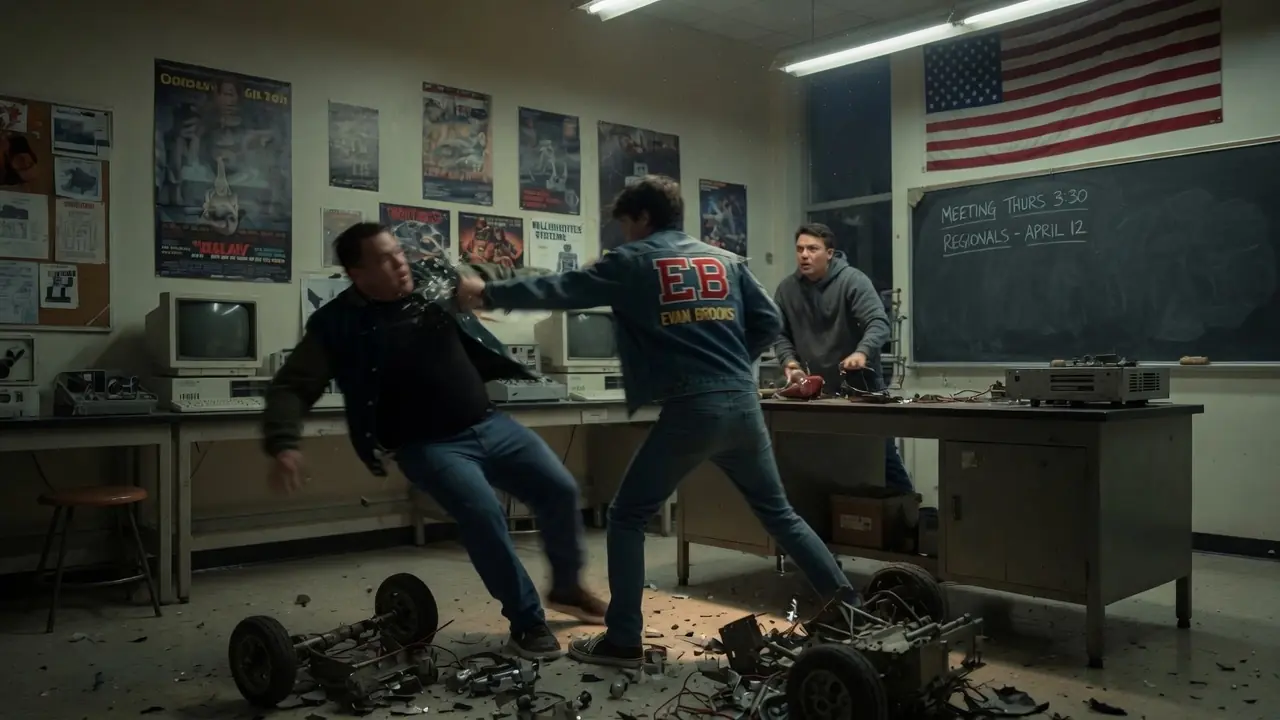
Evan caught Carter’s wrist with both hands, stepped to the side, and turned his shoulder under Carter’s arm. Carter expected Evan to pull backward, not move forward and around. His balance broke.
Evan used Carter’s own momentum to spin him away from the table and down onto the gym mat that had been placed beside a physics display. Carter hit the mat hard enough to lose the air from his lungs, but not hard enough to be seriously hurt. The fall was clean, controlled, and unmistakable.
The whole gym froze.
Carter lay on his back, stunned, staring up at Evan as if gravity had betrayed him. The boy who had ruled hallways with jokes and shoves was now flat on a blue mat beside a cardboard display about solar energy.
Evan stood over him, breathing hard. His fists were not raised. His face was not wild. That made the moment stronger.
“Don’t touch me,” Evan said. “Don’t touch my work. Don’t touch anyone else’s just because you can’t build something of your own.”
The silence lasted one second longer.
Then the applause began.
It started near the engineering tables. A sophomore clapped first, then the freshman girl, then a group of students from the robotics club. Within moments, the sound spread across the gym. Some students stood. Others shouted Evan’s name. A judge clapped slowly, her expression serious and approving.
Mr. Alden stepped between Evan and Carter, but his hand rested gently on Evan’s shoulder. “Step back, Evan.” Evan obeyed immediately. He turned to Scout and placed both hands on the edge of the table, trying to steady himself.
Carter sat up, face red with humiliation. “He attacked me!” he shouted. The words sounded desperate.
“No, he didn’t,” the freshman girl said again, louder this time. “You grabbed him.” Another student added, “And you threw the robot first.” Owen slipped his phone into his pocket, but Mr. Alden pointed at him.
“Phone,” Mr. Alden said. Owen hesitated. “Now.” Owen handed it over with shaking fingers.
Principal Warren arrived three minutes later with the school resource officer and two assistant principals. The gym fair paused around them, though nobody really returned to normal. Carter kept insisting it was an accident. Blake said very little. Owen’s video said enough.
Evan was taken to the office, not as a punishment, Mr. Alden assured him, but because everything had to be documented. Carter went too, walking several feet ahead with an assistant principal beside him. Students watched them leave the gym in a silence that felt nothing like the silence Evan had lived with all year.
Outside the gym, the hallway felt colder. Evan’s hands began shaking once the crowd disappeared. He hated that. He wanted to feel strong all the way through, but strength apparently did not stop the body from reacting after danger passed.
Mr. Alden noticed. “You okay?” Evan looked at the floor. “Scout’s not.” Mr. Alden’s expression softened. “We’ll look at it after this.” Evan nodded, but his throat felt tight.
In the office, Principal Warren reviewed witness statements and the video. Carter’s parents were called. Evan’s mother was called too, and he felt sick when he imagined her leaving work because of this. He expected disappointment. He expected worry so sharp it would sound like anger.
When Dana Brooks arrived, she rushed into the office with her work badge still clipped to her blouse. She saw Evan sitting in the chair, his hoodie stretched at the collar, and crossed the room quickly. “Are you hurt?” she asked.
Evan shook his head. “No.” She held his face with both hands anyway, checking him like he was still eight years old. “Don’t say no just to make me calm.” He swallowed. “I’m not hurt. I’m just angry.”
Dana’s eyes filled, but her voice stayed steady. “Good.” Evan blinked. “Good?” She looked toward the closed office door where Carter and his parents waited in another room. “Anger is not always wrong. Sometimes it tells you exactly where someone crossed the line.”
Evan looked down. “I knocked him down.” Dana sat beside him. “Did you keep hitting him?” Evan shook his head. “Did you protect yourself?” He nodded. She took his hand. “Then we will tell the truth clearly.”
That was what they did. Evan gave his statement. He did not exaggerate, and he did not make himself smaller. He described the comments, the broken project, Carter grabbing him, and the defensive move that put Carter on the mat. Principal Warren listened carefully, and for once, Evan felt like an adult was hearing the whole pattern instead of one loud moment.
“Has Carter bothered you before today?” Principal Warren asked. Evan paused. His mother squeezed his hand once. He looked at the principal and said, “Yes.”
The word opened a door. Evan told her about the nicknames, the hallway shoves, the cafeteria gestures, the times Carter had blocked his way near the gym. He told her about Owen filming him once when he dropped his lunch tray after Blake stuck out a foot. He told her about learning to plan routes through school based on where Carter might be.
Principal Warren’s face changed as he spoke. “I wish you had reported all of this earlier,” she said softly. Evan looked at her. “I reported enough to know people thought it was just joking.” The room went silent.
Mr. Alden, standing near the wall, looked down with a tight jaw. Principal Warren did not defend the school. She only said, “Then we failed to recognize it. I’m sorry.” Evan did not know what to do with that apology, so he only nodded.
Carter was suspended pending a conduct hearing. Owen and Blake received consequences for recording and encouraging the harassment. The science fair judges were told what had happened, and Evan was given the option to withdraw or present again after repairs. At first, Evan almost said withdraw because looking at Scout’s broken camera mount hurt too much.
Then Mr. Alden said, “A rescue robot should be allowed to survive damage.” Evan looked at him. Mr. Alden continued, “Repairing it might be the strongest demonstration you could give.”
So Evan went back to the gym.
The fair had resumed, but the atmosphere shifted when he entered. Students turned. Some clapped quietly. Others looked ashamed. Evan ignored most of it and went straight to his table, where Scout sat broken but not destroyed.
For the next hour, Evan worked with Mr. Alden and two robotics club students. They replaced the camera mount with a spare bracket, soldered one loose wire, snapped the wheel back into place, and reinforced the side panel with thin zip ties. The repair was not pretty. The robot now looked like it had survived something.
Maybe that was fitting.
The judges returned near the end of the fair. Evan stood behind his table, hands still shaking slightly, and began again. “This is Scout,” he said. “It’s a small rescue robot designed to enter unstable spaces after damage occurs.” He paused, then looked at the repaired side panel. “Today, it also demonstrates field repair under pressure.”
One judge smiled. Another wrote something down. Mr. Alden stood nearby with his arms folded, trying not to look too proud.
Scout rolled forward. One wheel wobbled slightly, but it climbed the first wooden block. Then the second. The camera feed flickered on Evan’s laptop, grainy but visible. The claw lifted the small plastic beam from the obstacle course and moved it aside.
The gym applauded.
This time, Evan smiled.
He did not win first place. A junior with a water purification system took the top award, and Evan honestly thought she deserved it. But Scout won the engineering resilience award, a special recognition the judges created after seeing the repair demonstration. Evan accepted the certificate with grease on his fingers and a lump in his throat.
By Monday, everyone at Ridgefield knew what had happened. Clips of Carter hitting the mat spread, but so did clips of Evan’s second presentation. The line that traveled fastest was not from the takedown. It was Evan saying, “You didn’t throw a joke.”
Students repeated it in hallways when someone tried to excuse cruelty as humor. “You didn’t throw a joke.” “You didn’t shove a joke.” “You didn’t record a joke.” The phrase became bigger than Evan, which embarrassed him, but also made him feel less alone.
Carter was absent for three days. Without him, the cafeteria felt different. Blake sat with the football players but barely spoke. Owen kept his phone in his backpack. Evan walked through the lunch line without anyone making robot noises for the first time in months.
At lunch, a freshman from the science fair approached Evan’s table. She was the girl who had spoken up after Carter threw Scout. She held her tray carefully and looked nervous. “Can I sit here?” she asked.
Evan looked around. He had never had a table people asked to join. “Sure.” She sat across from him and introduced herself as Harper Lin. She said Carter had once knocked over her art project in the hallway and told her to “build better walls.” She had never told anyone because she thought nobody would care.
Evan listened. Then he said, “You should tell Mr. Alden or Principal Warren.” Harper looked doubtful. Evan understood. “I’ll go with you if you want.”
She stared at him, surprised. “You would?” Evan nodded. “Yeah.” The word felt simple, but it changed the shape of the lunch table.
By the end of the week, four students had reported past incidents involving Carter or his friends. Some were small on paper but heavy in memory. A slammed locker. A recorded fall. A project “accidentally” damaged. A joke repeated until the target stopped eating in the cafeteria.
Principal Warren called a school assembly the following Tuesday. Students groaned when it was announced, assuming it would be another lecture about kindness with slides and slogans. Evan sat near the middle row, hoping no one would say his name. He did not want to become Ridgefield’s official symbol of anything.
Principal Warren surprised them. She did not begin with slogans. She began by saying, “Cruelty often survives because everyone agrees to call it something else.”
The gym went still.
She spoke about jokes, patterns, bystanders, and the difference between conflict and harassment. She admitted that the school had failed when students felt reporting would not matter. Then she invited students to speak anonymously through statements read by teachers. Harper’s statement was one of them, though no name was given.
Evan listened as stories filled the gym. Students had been mocked for clothes, accents, lunch money, body size, grades, hobbies, and family situations. Some statements were only a few sentences long. Others sounded like they had been held in for years.
Then Mr. Alden stepped to the microphone with Scout on a small rolling cart beside him. The robot had been cleaned, repaired, and reinforced with a new camera bracket. Students murmured when they saw it.
“This is a machine,” Mr. Alden said. “It is wires, wheels, motors, and code. But it also represents hours of effort most people never saw.” He placed one hand on the cart. “When we disrespect someone’s work, we are often disrespecting the hidden hours of their life.”
Evan looked down at his hands.
Mr. Alden continued. “A project can be repaired more easily than trust. That does not mean repair is impossible. It means the person who caused damage does not get to decide when the damage stops mattering.”
The assembly ended in quiet applause. Evan did not speak, but many students glanced at him anyway. This time, the attention did not feel as sharp. It felt like people were finally looking at the full story, not just the moment Carter fell.
Carter returned to school on Wednesday. He did not wear his varsity jacket. That detail traveled through the building quickly. Without the jacket, without Blake and Owen pressed close beside him, Carter looked less like Ridgefield’s untouchable star and more like a senior trying not to hear whispers he had once created for others.
Evan saw him near the lockers before second period. Carter stopped in the hallway, several feet away. Students slowed instantly. Phones stayed mostly down because teachers were nearby, but everyone watched.
“I need to say something,” Carter said. Evan kept one hand on his locker door. “Then say it.”
Carter looked around, uncomfortable. “Not here.” Evan shook his head. “You broke my project in public. If this is about that, say it in public.”
Carter’s jaw tightened, but he did not lash out. Evan could see how badly he wanted to. Instead, Carter looked at the floor for a second, then back up.
“I’m sorry I threw your robot,” he said. The hallway went quiet. “I’m sorry I grabbed you. And I’m sorry for the stuff before that.” His voice was stiff, like each word had to be dragged through pride. “It wasn’t joking.”
Evan studied him. “Why now?” Carter looked annoyed, then tired. “Because everybody saw it.” Evan did not let him escape there. “That’s not why you’re sorry. That’s why you got caught.”
A few students whispered. Carter’s face reddened, but he took the hit. “Yeah,” he said quietly. “That too.”
Evan closed his locker. “I’m not going to tell you it’s fine.” Carter nodded. “I know.” Evan adjusted his backpack. “And I’m not forgiving you just because you finally said the obvious.”
Carter swallowed. “I know that too.”
For a moment, Evan saw something unfamiliar in Carter’s face. Not innocence, not full remorse, but the beginning of shame without an audience to cover it. It was uncomfortable to witness. Evan did not feel sorry for him, but he understood that accountability often looked less dramatic than people expected.
“Then prove it when nobody’s watching,” Evan said. Carter nodded once and stepped aside. Evan walked past him without lowering his eyes.
In the weeks after the fair, Ridgefield shifted in small ways. Teachers took hallway comments more seriously. Students became more careful with recording people. The robotics lab filled with new members, including Harper, who turned out to be excellent at design sketches and terrible at remembering where she placed screwdrivers.
Evan began staying after school again, but now the lab did not feel like a hiding place. It felt like a workshop. He helped younger students with circuits, repaired a broken 3D printer nozzle, and started redesigning Scout with a stronger frame. Mr. Alden said the robot had earned armor.
One Friday afternoon, Carter appeared at the robotics lab door. Every student in the room went quiet. Evan stood from his workbench, ready for trouble. Carter lifted both hands slightly.
“Mr. Alden said I should bring these,” Carter said. He held a plastic storage bin filled with parts. “Old motors, brackets, wheels. From my dad’s warehouse. Stuff they were throwing out.” His voice was awkward. “He said you guys could use them.”
Evan looked at Mr. Alden, who nodded from his desk but did not intervene. Evan walked over and took the bin. It was heavier than expected. Inside were useful parts, real ones, not junk.
“Why are you doing this?” Evan asked.
Carter looked at the students watching. For once, he did not perform. “Because I broke something I didn’t understand.” He paused. “And because saying sorry didn’t cost me enough.”
The room stayed quiet.
Evan nodded toward an empty table. “Put it there.” Carter carried the bin inside, set it down, and stepped back. He looked at Scout on the workbench, now partially rebuilt with a stronger chassis.
“It looks different,” Carter said.
Evan’s voice stayed neutral. “It is different.” Carter nodded. “Better?” Evan looked at Scout, then at him. “Stronger.”
Carter seemed to understand that the answer was not only about the robot. He left without another word.
Spring arrived slowly, bringing rain, muddy soccer fields, and college decision envelopes. Evan was accepted into a state university engineering program with a modest scholarship, and Mr. Alden helped him apply for a summer internship at a local robotics company. His mother cried over the acceptance email at the kitchen table. Mia made a new sign that said SCOUT GOES TO COLLEGE, even though Evan explained that robots did not attend college.
“They should,” Mia said. “Scout is smarter than some people.”
Evan laughed for the first time all day.
At the district engineering showcase in April, Evan presented Scout again. This time, the robot had a reinforced frame, improved camera stability, and a better claw mechanism. The repair marks from the science fair were still visible if someone looked closely. Evan decided not to hide them.
During his presentation, a judge asked why one side panel had a slightly different material than the rest. Evan paused, then answered honestly. “The original panel broke during a school incident. I repaired it with what I had, then realized the replacement was stronger than the first design.”
The judge smiled. “That is often how engineering works.”
Scout won second place overall and first place for practical design. Evan accepted the ribbon without feeling like an impostor. Harper jumped up and down beside the display, and Mr. Alden took too many pictures. Dana sent every photo to relatives who had not heard from her in months.
Near the end of the showcase, Evan saw Carter standing near the entrance with his parents. Carter was not competing. He had apparently come because his younger brother had a project in the junior division. When he saw Evan’s ribbon, he nodded once.
Evan nodded back. It was not friendship. It was not forgetting. It was simply proof that the hallway no longer belonged to fear.
By graduation, Ridgefield had mostly moved on, as high schools always do. New rumors replaced old ones. New arguments filled lunch tables. The football team found new drama before playoffs. But in the engineering lab, Scout sat on a shelf beside Evan’s ribbon, a quiet reminder that some broken things did not return weaker.
At the senior awards ceremony, Principal Warren called Evan’s name for the Innovation and Resilience Award. He walked across the auditorium stage in a clean shirt and tie, palms sweating, while his mother and Mia clapped from the second row. The applause felt different from the day Carter fell. It was not shock or revenge. It was recognition.
Principal Warren handed him a certificate. “Would you like to say a few words?” she asked. Evan almost said no. Then he saw Mr. Alden in the aisle and Harper waving from the robotics club row.
He stepped to the microphone.
“I used to think building things was easier than dealing with people,” Evan said. A soft laugh moved through the auditorium. “Machines make sense. If something breaks, you can usually find the problem. People are harder because sometimes everyone sees the damage, but nobody wants to name what caused it.”
The room settled.
“My project broke this year,” Evan continued. “A lot of people saw that part. But before it broke, there were months of smaller things I tried to ignore because I thought ignoring them made me strong.” He looked across the rows of students. “I was wrong.”
His voice grew steadier. “Strength is not pretending something didn’t hurt. Strength is telling the truth before hurt becomes normal. It is protecting your work, your time, and your dignity, even when someone else thinks they are allowed to treat those things like a joke.”
Mia clapped once too early, then covered her mouth. A few people laughed kindly. Evan smiled, then finished.
“So thank you for this award. But I hope next year, nobody has to break before people believe they were being pushed.” He stepped back from the microphone.
The applause rose slowly, then strongly. Evan returned to his seat with his face warm but his shoulders lighter. He had not planned the speech, but maybe that was why it sounded true.
After the ceremony, Carter approached him in the lobby. He wore a dress shirt and looked uncomfortable among families taking photos. Evan’s mother noticed him and stayed nearby, protective but silent.
“Congratulations,” Carter said.
“Thanks.”
Carter looked at the certificate in Evan’s hand. “You earned it.” Evan studied him for a moment. “I know.” Carter gave a small, almost embarrassed smile. “Yeah. I guess you do.”
They stood in silence. Then Carter said, “I’m going to community college next year. My dad wants me to work part-time at the company too.” Evan nodded. “That’s good.” Carter looked down. “I’m trying not to be the guy I was.”
Evan did not soften the truth. “Trying only matters if it changes what you do.” Carter nodded. “I know.” He held out his hand, uncertain.
Evan looked at it. Then he shook it once. Not because Carter deserved an easy ending, but because Evan no longer needed to hold the anger in his fist to remember what he had learned.
Graduation came two weeks later under a clear June sky. Evan crossed the football field in a blue gown, his cap sitting slightly crooked because Mia had hugged him too hard before the ceremony. When his name was called, Dana stood and cheered with both hands around her mouth. Evan accepted his diploma and looked toward the bleachers, where his family looked prouder than any award could make him feel.
After the ceremony, Mr. Alden found him near the fence. He handed Evan a small box. Inside was Scout’s original broken wheel, cleaned and mounted on a small wooden base. A tiny metal plate read, FIELD TESTED.
Evan laughed, then unexpectedly felt tears in his eyes. “This is ridiculous.” Mr. Alden smiled. “Most meaningful things are a little ridiculous.” Evan turned the base in his hands, remembering the wheel rolling across the gym floor. “Thank you.”
That night, Evan placed the mounted wheel on his desk beside his university acceptance letter. Scout sat nearby, upgraded and ready for the summer showcase Mr. Alden had convinced him to enter. Mia had taped a new paper sign above the desk. It said, SCOUT IS BRAVE, EVAN IS BRAVER.
Evan pretended to be annoyed. He did not take it down.
Years later, Ridgefield students would still talk about the science fair when they passed the engineering lab. Some remembered Carter Haines hitting the blue mat. Some remembered Evan’s broken robot crawling across the obstacle course after being repaired. Some remembered the assembly, the reports that followed, and the phrase that changed how students answered cruel jokes.
You didn’t throw a joke.
But Evan remembered something quieter. He remembered kneeling under the neighboring table to pick up Scout with both hands. He remembered the robot feeling heavier because it carried not only broken wires, but every time he had stayed silent before. He remembered setting it back on the table and deciding the story would not end on the floor.
That was the real moment.
Not the takedown. Not the applause. Not the award.
The real moment was when Evan Brooks looked at something broken, refused to be ashamed of it, and chose to repair it in front of everyone.
Because sometimes courage does not arrive like thunder.
Sometimes it looks like a quiet boy, a bent frame, a loose wheel, and a small machine named Scout rolling forward again.