When Clara Voss reached for the spool of brown thread, her hand was already shaking.
Not enough for most people to notice.
Enough for Amos Reed to notice.
Amos owned Reed’s Mercantile in Coldwater Crossing, Wyoming Territory, and he noticed more than he ever admitted. He noticed who paid in coins and who paid on credit. He noticed whose boots had holes patched with flour sack cloth. He noticed which women came into his store with bruises hidden beneath high collars and left with nothing but sugar, salt, and eyes lowered to the floor.
Clara Voss had been lowering her eyes for nearly three years.
That afternoon, snow tapped lightly against the front windows, though the real storm was still somewhere beyond the ridge. The stove in the corner glowed red. Two women stood at the ribbon counter pretending to compare blue calico. A boy swept sawdust near the flour barrels and kept sweeping the same square of floor because nobody had told him what to do with his fear.
Clara held the thread in one hand and the household list in the other.
Flour.
Lamp oil.
Needles.
Coffee.
Thread.
The list had been written by Judith Voss, her husband’s widowed aunt, in the tight black script of a woman who believed even ink should stand at attention.
Clara had two dollars hidden inside her glove.
Two dollars she had taken from the drawer in her husband’s study.
Not stolen, she told herself.
Borrowed from a life that had stolen everything else.
But when she turned toward the counter, Nathaniel Voss was standing in the doorway.
Her husband removed his hat slowly.
Snow clung to the brim.
He was thirty-eight, handsome in the way cold men often were—clean lines, pale eyes, fine coat, polished boots, a face people trusted because it had never been forced to show the ugliness underneath in public.
The room changed when he entered.
Not loudly.
Not obviously.
But everyone became smaller.
Amos Reed lowered his eyes.
The women by the ribbons suddenly cared deeply about calico.
The boy by the stove stopped sweeping.
Nathaniel crossed the mercantile with unhurried steps and took the list from Clara’s hand.
Then his gaze moved to the thread.
“You took money from my study.”
Clara’s mouth went dry.
“There were forty dollars in the right drawer,” Nathaniel said softly. “Now there are thirty-eight.”
Two dollars.
He had noticed two dollars.
For eighteen months, Clara had been building freedom out of coins too small to matter to anyone but her. A dime slipped from market change. A nickel tucked under a loose stone near the hearth. Fifty cents sewn into the lining of her winter coat. A dollar hidden inside an empty cough syrup bottle behind the flour bin.
She had fourteen dollars and twenty cents in all.
Fourteen dollars and twenty cents against a ranch, a judge, a sheriff, and a husband who counted everything.
It was not enough to start a life.
It was barely enough to prove she still wanted one.
“I bought thread last week,” she said.
“Thread is on Judith’s list.”
“She said there was none left.”
“My aunt handles the household accounts.”
“I used my own money.”
Nathaniel smiled.
Not kindly.
Never kindly.
“You do not have your own money, Clara.”
The words were quiet enough that the whole store had to strain to hear them.
And everybody did.
Nathaniel took her arm.
Not roughly at first.
That was his gift in public. He knew how to make cruelty look like guidance.
Clara went with him because she had learned that going was safer than making him repeat himself. Safer than forcing strangers to choose whether they were witnesses or cowards. Safer than letting the people around her feel guilty enough to look away harder next time.
They were almost to the door when a man spoke from near the flour barrels.
“Let go of her arm.”
The mercantile went still.
Nathaniel turned his head slowly.
The stranger stood half in shadow, one shoulder near the stacked sacks of meal. Clara had seen him twice before from a distance. Once at the livery. Once outside the blacksmith’s shop.
Jonah Creed.
That was the name someone had whispered.
A mountain man.
A trapper.
A former scout, some said.
A man who came down from the northern ridge twice a year for salt, tobacco, cartridges, and tools, then disappeared again into country most men did not survive after October.
He was tall, broad without softness, built by weather rather than comfort. His coat was dark and worn white at the seams. A fur collar framed his weather-browned face. His beard was trimmed short. His eyes were deep gray and steady.
He did not look angry.
That made him more frightening.
Nathaniel released a small laugh.
“Do you know who I am?”
“Yes,” Jonah said.
“Then you know you just made a costly mistake.”
“Might be.”
Nathaniel let go of Clara’s arm then, not because he obeyed, but because he wanted both hands free. He stepped toward Jonah, and every person in the store stepped back without meaning to.
“You come down from your mountain twice a year,” Nathaniel said. “You buy traps, salt, powder, and tobacco. You own nothing here. You vote nowhere that matters. You have no family name worth speaking and no protection worth mentioning.”
Jonah did not move.
“I will give you one chance to walk out that door.”
Jonah looked at Nathaniel’s hand.
“No.”
Nathaniel moved fast.
Clara knew his speed. She had learned it the way a trapped animal learns weather. The tightening of his jaw. The shift in his shoulder. The half breath before impact.
But Jonah Creed moved faster.
He caught Nathaniel’s wrist before the fist completed its arc.
He did not twist.
He did not throw him.
He simply closed his hand.
Nathaniel made a sound Clara had never heard from him before.
Small.
Shocked.
Almost human.
The store heard it too.
Jonah held him there.
“Everybody walks out today,” Jonah said. “That is how this ends. Do you understand?”
Nathaniel’s face flushed dark at the cheekbones.
Jonah’s grip tightened slightly.
“I asked if you understood.”
“Yes,” Nathaniel forced out.
Jonah released him.
For one suspended moment, Nathaniel Voss looked like a man who had been shown a mirror and did not recognize what stared back.
Then he repaired himself.
He straightened his cuff.
Picked up his hat.
Brushed snow from the brim.
His eyes moved from Jonah to Clara and then around the store, silently counting every witness.
“Outside,” he said to Clara.
She obeyed.
She did not look back, but as the door closed behind her, she heard Amos Reed whisper, “God forgive us. Somebody finally stood.”
The ride home lasted six miles and contained no words.
Nathaniel rode ahead on his black gelding, his back stiff, his right hand held close to his coat. Clara followed on a gray mare, watching the white road unspool beneath the horses’ hooves.
The sky had the flat, heavy look of a storm waiting to be invited.
Clara knew silence did not mean mercy.
Silence meant Nathaniel was thinking.
Thinking was always worse.
Voss House appeared through bare cottonwoods just as the light began to fail.
White walls.
Green shutters.
Smoke from three chimneys.
A house people admired from the road because they had never heard the sounds it held after dark.
Judith Voss stood on the porch in a black dress buttoned to her throat.
She was sixty-four, thin as a fence rail, with white hair pinned so tightly it seemed to pull her eyes sharp. She looked first at Nathaniel’s wrist. Then at Clara’s face.
“You are late,” Judith said.
Nathaniel handed his reins to a stable hand and walked past her.
Clara heard only two words as he spoke low to his aunt.
“Creed. Tonight.”
Judith’s expression did not change.
That frightened Clara more than surprise would have.
Dinner was roast beef, potatoes, and silence.
Judith spoke twice about a neighbor’s damaged fence, as if fence posts were the central moral problem of the territory. Nathaniel ate with his left hand. Clara swallowed what she could because hunger made fear harder to manage.
After dinner, Judith went upstairs.
That was the signal.
Clara cleared plates in the kitchen while Nathaniel walked above her, from study to hall, hall to bedroom, bedroom to study. She tracked him by floorboards and breath, by pause and return, the way some people tracked wolves.
Finally he came down.
“Sit.”
She sat.
He stood across the kitchen table, one hand flat on the wood.
“You embarrassed me.”
Clara looked at the grain of the table.
“You made that man think he had permission to interfere.”
“I did nothing.”
“Men do not interfere for nothing.”
“I do not know him.”
Nathaniel smiled, almost gently.
That almost-gentleness had fooled her once.
In the first months of marriage, apologies came with flowers. Remorse arrived with lowered eyes. He made her believe his violence frightened him too.
Now she knew better.
“You expect me to believe,” he said, “that a man put his hands on me in public for no reason?”
“I don’t know why he did it.”
“You don’t know why men do things. That has always been your trouble.”
The blow knocked the chair sideways.
Clara hit the floor hard enough to make pain flash white through her ribs.
Nathaniel crouched beside her.
He preferred crouching.
It made cruelty look intimate.
“Listen carefully,” he said. “That mountain man did not save you. He only changed the order of events.”
The next half hour passed like a storm with a roof over it.
When it ended, Clara lay on the cold kitchen floor and counted Nathaniel’s footsteps as he went upstairs.
Twelve steps.
A pause.
A door closing.
She breathed around the sharpness in her side.
One rib, maybe two.
Again.
She thought of Jonah Creed’s voice.
Let go of her arm.
Four words.
No pleading.
No performance.
No bargain.
Just a statement of a thing that should have been obvious to everyone and somehow had not been.
She rolled onto her side, waited for the kitchen to stop spinning, and pushed herself upright because the floor was cold and because she had learned that nobody came for women who stayed down.
Two nights later, Nathaniel returned early from a business trip to Cheyenne.
He was not supposed to be back for three more days. Judith looked genuinely surprised when his horse came up the drive. Clara noticed.
She noticed everything.
Not because noticing saved her every time.
Because it saved her often enough.
After supper, Nathaniel called her into his study.
The room smelled of cigar smoke, leather, and money. Maps covered one wall, marked with cattle routes and water rights. Ledgers lined the shelves. Behind the desk hung a painting of Voss Ridge in summer, all gold grass and open sky.
Clara hated that painting most of all.
It made freedom look like decoration.
Nathaniel sat behind the desk.
“I have been thinking about your future,” he said.
Clara’s skin went cold.
“My future?”
“Our arrangement is no longer satisfactory.”
She did not speak.
“You are unhappy here.”
He said it as if unhappiness were a stain in the carpet.
“I have tried to be patient,” he continued. “More patient than most husbands would be. But some women are not suited to respectable domestic life. Some women require a different sort of placement.”
Clara looked at him.
He folded his hands.
“I spoke to a man in Cheyenne. Mr. Gideon Rusk. He operates houses near the Idaho mining camps. He is always looking for women who can read, keep accounts, and appear refined when required.”
For a moment, Clara did not understand.
Her mind refused the sentence.
Then it landed.
The room tilted.
Her face did not move.
“You are selling me.”
Nathaniel sighed.
“You make ugly words out of practical solutions.”
“When?”
His eyes narrowed.
“Spring.”
“When?”
“March, if weather permits.”
Clara stood.
Nathaniel stood too.
“Sit down.”
“No.”
The word came out before fear could strangle it.
For one bright second, she saw not anger in his face but astonishment. He had forgotten she possessed a word like that.
“I need to check the kitchen,” she said.
She left before he could decide what to do.
In the kitchen, she gripped the sink and breathed.
March.
No.
Not March.
Nathaniel had returned early from Cheyenne because something had changed. The plan had moved. Or he had lied about the date from the start.
She had days.
Maybe hours.
She went upstairs while the house settled into its nightly silence. Nathaniel remained in the study. Judith’s room was at the opposite end of the upper hall. The stable boy slept above the barn.
Every habit of the house lay mapped inside Clara’s mind.
She lifted the loose board beneath her wardrobe and took five dollars in coins. She removed seven dollars from the lining of her winter coat. Behind the kitchen chimney stone, she found two dollars and twenty cents wrapped in muslin.
Fourteen dollars and twenty cents.
Three years of theft from the life that had stolen her.
In the kitchen drawer, beneath dish towels, Nathaniel kept a Colt revolver because he believed the kitchen belonged to women and therefore nothing dangerous could live there.
Clara loaded it with five rounds.
Her father had taught her to shoot when she was sixteen.
Tin cans on fence posts.
His warm hand correcting her wrist.
His voice saying, “Do not fear the kick, Clara. Respect it.”
Her father had been dead three years.
Nathaniel had taken his land through debt, then taken his daughter through marriage, and now intended to sell what remained of her across a state line.
Clara put the Colt in the inside pocket of her coat.
Then she opened the back door.
The blizzard came in like a living thing.
For three seconds, she stood between warmth and death.
Behind her was a house that would kill her slowly.
Ahead was weather that might do it quicker and without malice.
She stepped outside.
The gray mare was quiet under saddle, though Clara’s hands shook so badly she missed the buckle twice. She led the horse from the barn and mounted in the dark.
For half a mile, she could still see Voss House glowing behind her.
Then the storm swallowed it.
The road vanished beneath wind-driven snow. The world became sound and cold and the mare’s breathing. Clara rode by memory, leaning low over the horse’s neck, one arm held tight against her ribs.
She did not go toward Coldwater Crossing.
The town would not protect her.
Coldwater Crossing had spent three years proving that.
She aimed north, toward Voss Ridge.
Toward the mountain trappers.
Toward the man who had looked at Nathaniel Voss as though Nathaniel were only a man.
Three miles from the house, the mare stumbled.
Clara hit the road shoulder-first and tasted blood. She got up, caught the mare, and mounted again.
A mile later, at a creek crossing glazed with hidden ice, the mare went down hard.
This time Clara flew over the animal’s neck and landed in a snowbank so deep the world disappeared.
When she fought her way upright, the mare was gone.
There was no road.
No town light.
No sound but wind.
Clara walked.
She did not know for how long.
Time became useless.
Her feet went numb, then painful, then distant. Her breath scraped. The cold stopped feeling like cold and began to feel like sleep.
That frightened her because her father had once said that was when winter started lying.
She found a pine tree not by choosing it, but by colliding with its branches. Beneath it, the wind lessened. She sat with her back to the trunk.
Get up, she told herself.
The snow seemed soft.
Get up.
She closed her eyes.
The last thing she heard was not the wind.
It was a man’s voice, far away, saying, “Well, hell.”
When Clara woke, she was warm.
That alone terrified her.
She opened her eyes to a ceiling of rough-hewn logs. Firelight moved across it. Blankets weighed her down. Her feet were wrapped in wool. The air smelled of pine smoke, leather, coffee, and something wild drying near heat.
A man sat beside the fireplace, holding a tin cup.
Jonah Creed.
She tried to sit.
“Don’t,” he said without looking at her. “Your ribs will not appreciate ambition.”
“Where am I?”
“My cabin. North side of Voss Ridge.”
She swallowed.
“How did you find me?”
“Your horse found my line trail. I followed her back.”
“The mare?”
“In the lean-to. Better condition than you.”
Clara stared at him.
He looked at her then. His eyes were the same as in the mercantile, dark and steady, but less hard in the firelight.
Not soft.
Jonah Creed did not look like a soft man.
But there was no hunger in his attention.
No ownership.
No calculation.
That made her want to weep, and because she did not want to weep, she looked away.
“Your name,” she said.
“Jonah Creed.”
“Clara Whitlock.”
He waited.
She added, “Not Voss.”
Jonah nodded once.
“All right, Clara Whitlock.”
The sound of her old name moved through the cabin like a match struck in darkness.
For the first day, she slept more than she woke. When she surfaced, Jonah gave her broth and did not ask questions. When pain sharpened, he handed her willow bark tea and did not hover. When she tried to stand and failed, he turned his back long enough for her pride to gather itself.
On the second evening, she told him Nathaniel was coming.
Jonah was repairing a strap at the table.
“He’ll track me,” she said. “He’ll bring men. Sheriff Bellamy, probably. Maybe Judith.”
Jonah did not look surprised.
“He has money,” Clara said. “He owns people with it.”
“Money gets heavy in deep snow.”
She almost laughed, but the movement hurt.
“I am not asking you to fight him.”
“I know.”
“I mean it. I can leave before morning.”
“You cannot ride twenty miles with broken ribs.”
“I have managed worse.”
Jonah set down the strap and looked at her.
“You said that in the store. Reed offered to carry flour, and you told him you would manage.”
Clara said nothing.
“How has managing worked so far?”
She looked at the fire.
“Poorly,” she admitted.
On the third day, she told him about Cheyenne.
Not all of it at first. Only enough to make the danger clear.
Gideon Rusk.
Idaho.
Mining camps.
A “placement.”
Nathaniel’s clean, practical voice.
Jonah listened without changing expression.
That steadiness gave her courage to tell the rest.
The marriage.
The debt.
Her father’s death.
Judith’s careful voice teaching her to call control protection and fear gratitude.
The money hidden one coin at a time.
The way Coldwater Crossing knew and did nothing because Nathaniel Voss had made cowardice profitable.
When she finished, the cabin was quiet.
Then Jonah said, “Reed told me about you.”
Clara turned her head.
“Amos Reed?”
“He never told it like gossip. Just said things when I came down for supplies. Mrs. Voss had a bruise. Mrs. Voss looked poorly. Mrs. Voss stopped speaking in church. He said your name twelve times over two years.”
“Twelve?”
“I counted.”
“Why?”
“Because somebody should have.”
Clara looked away before her face betrayed her.
For three years, she had believed nobody had seen enough to remember. Now she learned an old storekeeper had been counting her wounds like a prayer he did not know how to answer.
“That does not make him brave,” she said.
“No,” Jonah said. “It makes him ashamed.”
It was a fair answer.
She found she appreciated fair answers more than kind ones.
On the fifth day, the storm cleared.
Sunlight came weak and bright through the single cabin window. Clara stood for the first time without grabbing the wall. Her ribs ached, her feet burned, and her body felt like something borrowed from a smaller, older woman, but she stood.
Jonah was outside chopping wood.
She put on one of his coats and stepped out.
The mountain after snow looked remade. Pines bent under white weight. The air was painfully clean. Above the cabin, the ridge rose gray and sharp into a blue winter sky.
“How far does it go?” she asked.
Jonah split a log.
“The ridge?”
“Yes.”
“Another thousand feet. There is a pass above it. In summer, you can see four ranges from the top.”
“Have you?”
“Most clear mornings.”
She looked up until her ribs tightened from the cold.
“I want to see it.”
“You are not ready.”
“I did not say today.”
He looked at her then.
For the first time, she thought he might smile.
“Then when you are ready,” he said.
On the sixth morning, Clara saw riders below the cabin.
She had been standing at the window because three years in Voss House had made watching approaches as natural as breathing. Five horses moved through the trees, climbing slow but steady.
Her body knew before her eyes confirmed it.
Nathaniel.
Jonah came to the window.
“How long?” she asked.
“Twenty minutes. Maybe less if they push.”
She counted shapes.
Nathaniel on his black horse.
Sheriff Bellamy, heavy in the saddle.
Two Voss ranch hands.
And Judith, straight-backed on a gray mare, black coat buttoned to her throat, white hair bright beneath her hat.
“She came herself,” Clara said.
Her voice sounded different to her.
Not frightened.
Insulted.
Jonah took down his rifle.
“There is a gorge above the cabin,” he said. “Narrow. Rock on both sides. Locals call it Widow’s Cut. They do not know this slope. I do.”
“You want them to follow you up there?”
“I want to give them a choice.”
“And if they choose wrong?”
“Then the mountain will explain it.”
He handed Clara the Colt.
“Load it. Bar the door. If anybody comes in who is not me, you know what to do.”
Clara checked the cylinder.
“My father taught me.”
Jonah paused at the door.
“I figured somebody had.”
Then he left.
Clara barred the door and watched.
Nathaniel reached the flat below the cabin and shouted something she could not hear. Jonah did not answer. One of the ranch hands pointed toward the upper slope. Judith rode forward and gestured sharply toward the cabin.
Clara stepped back from the window.
For one terrible moment, she thought Nathaniel would come straight to the door.
But Nathaniel Voss did not like being ignored.
He looked uphill.
Then he spurred his horse toward the gorge.
All five riders followed.
The mountain swallowed them.
For several minutes, there was nothing.
Then came a crack like a rifle shot stretched into thunder.
A tree giving way.
A rush of snow.
A horse screaming.
Men shouting.
One gunshot.
Then silence.
Clara stood with the Colt in both hands, breathing carefully, counting seconds because counting was something to do besides imagine.
Twenty-nine minutes later, Jonah came down alone.
Snow covered his coat. A cut bled along his jaw. He entered, shut the door, and set the rifle on the wall pegs.
“Judith went into the east ravine,” he said. “She is alive. Angry enough to keep warm.”
Clara gripped the chair.
“Sheriff?”
“Shoulder wound. He will live. The ranch hands took him and ran when the second slide came down.”
“And Nathaniel?”
“On foot in the gorge.”
Clara stared at him.
“Alive?”
“Yes.”
“Why?”
Jonah looked at her.
“Because killing him is not my decision.”
The room seemed to shrink around her heart.
“You can bring him down?”
“Yes.”
“Then bring him.”
Jonah studied her face.
“I want him to look at me,” she said. “And then I want to decide.”
He did not argue.
He was gone forty minutes.
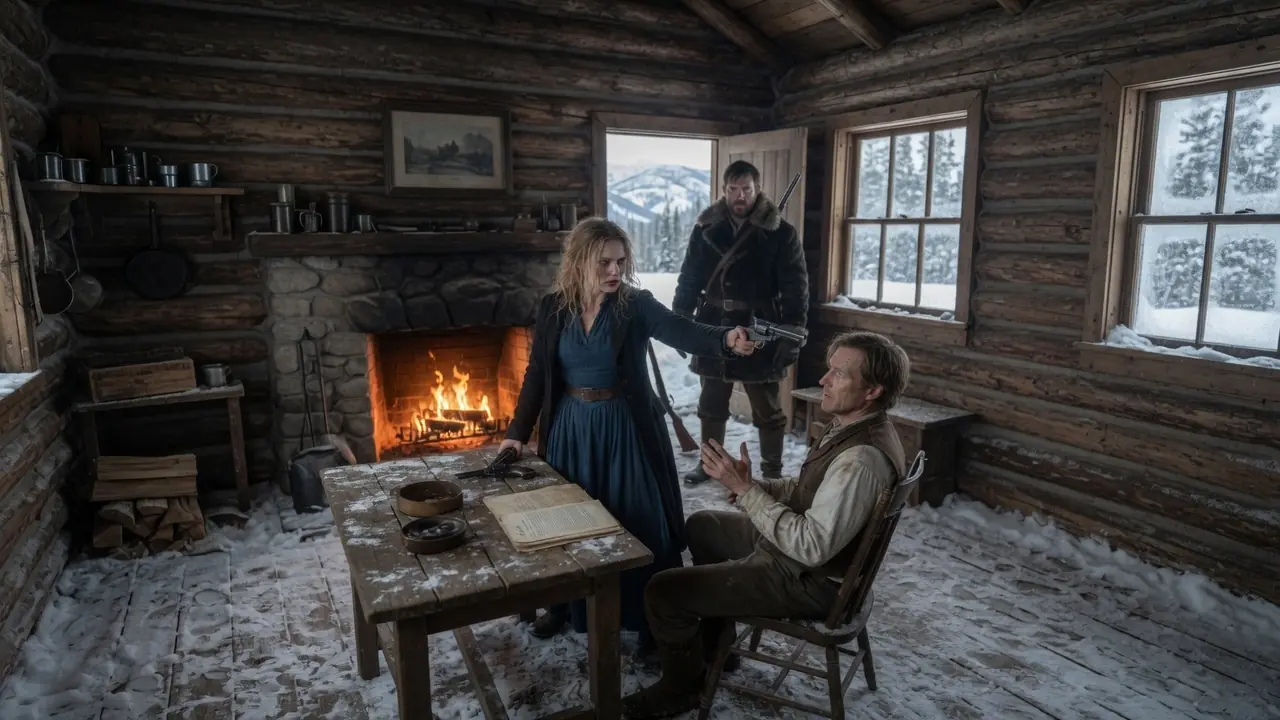
When he returned, Nathaniel Voss walked behind him with his hands bound in front by a leather strap.
Clara watched from the table.
Nathaniel looked smaller without his horse.
Not small.
Never that.
But reduced.
His fine coat was wet. His hair had come loose from its careful part. Snow clung to his boots. His face was pale with cold and rage and something else he had not yet accepted as fear.
Jonah brought him inside and pushed him into the chair across from Clara.
Nathaniel’s eyes went first to the Colt on the table.
Then to her face.
“Clara,” he said.
She nearly flinched at the almost-gentleness in his voice.
Then she remembered the kitchen floor.
“Gideon Rusk,” she said.
Nathaniel blinked.
“The man in Cheyenne. You will tell me exactly where he is and what Judith arranged.”
His mouth tightened.
“You are confused.”
“No.”
“You are hurt and frightened. Creed has filled your head with—”
“No.”
The word stopped him.
Clara leaned forward. Pain flared in her ribs, but she did not move away from it.
“You do not get to name what is happening anymore. You do not get to call selling me a placement. You do not get to call fear marriage. You do not get to call a cage protection.”
Nathaniel’s eyes hardened.
“You are still my wife.”
“I was your prisoner.”
“You belong to me under law.”
“Then the law is sick.”
Jonah stood by the wall, silent.
Nathaniel looked at him.
Clara saw the calculation. Saw Nathaniel searching Jonah for greed, fear, ambition, resentment, some familiar handle by which a man could be turned.
He found nothing.
That frightened him more than the gun.
Clara said, “Judith knew Rusk before you did.”
Nathaniel’s jaw moved.
Clara’s pulse struck hard once.
That was the truth opening in front of her.
“She introduced you,” Clara said.
Nathaniel said nothing.
“She planned it.”
A log shifted in the fire.
Nathaniel looked down.
“She knew him from Denver,” he said finally.
Clara felt cold move through her that had nothing to do with winter.
“Denver?”
“He ran houses there before Idaho.”
“And Judith?”
Nathaniel’s face tightened with contempt, but not for Judith. For the fact that he had to answer.
“My aunt invested in him years ago.”
Clara sat very still.
Judith Voss, with her black coffee and moral instructions.
Judith, who told Clara endurance was dignity.
Judith, who had helped build the words around her prison.
Not an accessory.
An architect.
“There is more,” Jonah said quietly.
Clara turned.
He reached into his coat and took out a leather packet.
“Found it in Judith’s saddlebag after the fall. Thought you should open it.”
Clara took the packet.
Inside were folded papers.
Contracts.
Letters.
Names of women.
Locations.
Amounts paid.
Her hands stopped on one document.
It was a receipt.
Edwin Whitlock’s loan, marked satisfied in full two weeks before his death.
Clara read the line three times before her mind accepted it.
The debt had been paid.
Her father had not died owing Nathaniel Voss eight hundred dollars.
The debt that forced Clara into marriage had been a lie.
She looked at Nathaniel.
His expression told her the truth before his mouth could shape another one.
“You knew,” she whispered.
Nathaniel leaned back slowly.
“Your father was weak. He would have lost the land anyway.”
Clara stood so fast the chair legs scraped the floor.
Three years of fear became one clear line of heat.
“You stole his land.”
“He signed papers.”
“You forged a debt.”
“He was dead.”
“You married me with a lie.”
Nathaniel’s face changed.
The gentleman vanished.
What remained was the thing that had lived beneath him all along.
“And who will care?” he said. “Coldwater Crossing? Reed? Bellamy? The judge? You think a packet of papers changes the world? You stupid girl. Paper only matters when men with power decide it matters.”
Clara picked up the Colt.
Nathaniel went still.
She cocked the hammer.
The sound cracked through the cabin.
For the first time in three years, Nathaniel Voss was afraid of her.
Not annoyed.
Not challenged.
Afraid.
The sight did not give her the pleasure she once imagined it would.
It gave her clarity.
She held the gun on him and thought of her father correcting her wrist. She thought of fourteen dollars and twenty cents. She thought of every woman whose name lay folded inside Judith’s packet. She thought of the old storekeeper counting twelve times and hating himself for counting only.
Then she lowered the hammer.
“No,” Nathaniel breathed, mistaking her mercy for weakness.
Clara smiled then.
Small.
Tired.
Real.
“You think death is the worst thing I can give you because it is the worst thing you understand.”
His eyes narrowed.
She placed the Colt on the table, still within reach.
“The worst thing I can give you is a witness.”
Nathaniel’s face shifted.
“The packet goes to Harwick,” Clara said. “Different county. Different judge. Then to Cheyenne. Then Denver. Every name. Every payment. Every forged paper. Every woman Judith sold and every man who bought silence from you.”
“You will be hunted before you reach the pass.”
“No,” Jonah said.
It was the first word he had spoken to Nathaniel directly since entering.
Nathaniel looked at him.
Jonah’s voice remained calm.
“You will be busy explaining why your sheriff rode armed into federal timber after a wounded woman. Why your aunt carried contracts for women across state lines. Why your land title rests on a paid debt.”
Nathaniel’s mouth opened.
Then closed.
Clara saw him understand.
Not defeat.
Not yet.
But exposure.
For a man like Nathaniel, exposure was its own kind of winter.
Clara took his boots.
He stared at her.
“What are you doing?”
“Teaching you something.”
She took his coat too.
Jonah did not stop her.
“You will walk down to where your men left the sheriff,” Clara said. “You will do it in your socks and vest. You will not die. It is not far enough for that. But for once in your life, the cold will touch you before you can pay someone else to stand in it.”
Nathaniel’s face twisted.
“You vicious little—”
“No,” Clara said. “Vicious would be leaving you in the gorge. Vicious would be selling you and calling it an arrangement. This is a lesson. Walk.”
Jonah cut the binding at Nathaniel’s wrists but kept the rifle in hand.
Nathaniel stood in his socks, shaking with rage more than cold.
At the door, he turned.
“This is not over.”
Clara held Judith’s packet against her chest.
“For me,” she said, “it is.”
Jonah opened the door.
Nathaniel walked into the snow.
They watched until the trees took him.
Only then did Clara sit.
Her whole body began to tremble.
Not from fear exactly.
From the cost of not being afraid until it was safe to shake.
Jonah sat across from her and said nothing.
After a while, she said, “He will come after us.”
“Probably.”
“Judith will build a story.”
“Definitely.”
“The judge in Coldwater Crossing will help them.”
“Likely.”
Clara looked at the packet.
“But Harwick is not Coldwater Crossing.”
“No.”
“And Cheyenne is bigger than Harwick.”
“Yes.”
“And Denver bigger still.”
Jonah’s mouth almost became a smile.
“Paper starts mattering,” he said, “when you carry it far enough.”
The next morning, Jonah brought Judith’s horse down from the ravine.
Judith herself had already found a way to mount and leave, jaw set, dignity wrapped around her like armor. She did not speak to Jonah. She did not need to. A woman like Judith used silence as a construction material.
Clara and Jonah packed before noon.
Two horses.
A rifle.
The Colt.
Sixty-five dollars from Jonah’s tin box.
Fourteen dollars and twenty cents from Clara’s coat.
Food for two weeks.
Judith’s packet wrapped in oilcloth and carried beneath Clara’s shirt.
Before they left, Clara looked up at the ridge.
“You said you can see four ranges from the top.”
“You are still hurt.”
“Yes.”
“The climb is steep.”
“Yes.”
Jonah studied her.
“All right.”
It took her twice as long as it should have.
Her ribs protested every step. Her breath caught. Once, she had to stop and press her hand to a rock while the valley spun below her.
Jonah waited without offering help she had not asked for.
When they reached the top, the world opened.
Coldwater Crossing lay far below, a dark scatter of roofs in a white valley. Voss House was a pale fleck west of town. From that height, the mansion that had once filled her entire life looked smaller than a matchbox.
Beyond it were mountains.
Range after range under a hard blue sky.
North toward Harwick.
South toward Cheyenne.
West toward Oregon, where Jonah said the air smelled of rain and timber and the ocean made its own weather.
Clara stood on the ridge and cried without making a sound.
Not because she was broken.
Because the world was larger than the room where Nathaniel had tried to end her.
Jonah stood a few feet away, looking out over country he already knew, and did not interrupt her first sight of it.
“I used to think escape meant nothing behind me could touch me anymore,” she said finally.
“It does not work that way.”
“No.”
She wiped her face with her glove.
“I will have bad nights.”
“Yes.”
“I will flinch when I should not.”
“Probably.”
“I may trust wrong. Or not trust when I should.”
“That happens.”
She looked at him.
“I am not walking away fixed.”
“No,” Jonah said. “You are walking away alive. Alive is enough to begin with.”
Clara looked west.
“Where does that trail go?”
“Harwick first. Then Cheyenne if you want law. Oregon if you want distance. Both, if you want both.”
“Would you go that far?”
“With the papers?”
“With me.”
Jonah was quiet long enough that she knew he was giving the answer respect.
“If you want company,” he said, “I will go as far as you ask. If you do not, I will get you to Harwick and leave you with the sheriff there.”
No contract hidden inside the offer.
No debt.
No trap.
Just a choice.
Clara breathed in the cold, clean air.
“I want the company,” she said.
Something in Jonah’s face eased.
They rode into Harwick nine days later.
Sheriff Elias Rusk was a thickset man with tired eyes and a manner that suggested he had arrested enough liars to recognize one before breakfast. He listened to Clara in a plain office that smelled of ink, stove ash, and damp wool.
He read the packet twice.
Then he removed his hat.
“Mrs. Voss,” he said carefully.
“Clara Whitlock.”
He nodded.
“Miss Whitlock, I believe this needs to go to the territorial marshal.”
For the first time in three years, a lawman did not ask what she had done to provoke a man.
He asked if she wanted coffee.
The investigation did not fix everything.
Stories never do, no matter how people like to pretend otherwise.
Nathaniel Voss was not dragged from Coldwater Crossing in irons the next morning. Men with money rarely fall that quickly. Judith denied everything with the offended calm of a woman who had practiced innocence all her life. Sheriff Bellamy claimed he had ridden into the mountains to recover a confused wife from a dangerous trapper and had been shot by accident.
But the packet traveled farther than Nathaniel’s influence.
To Cheyenne.
To Denver.
To a marshal whose younger sister had disappeared near an Idaho camp eight years earlier and whose patience for men like Gideon Rusk had run out long before Clara entered his office.
Names were checked.
Ledgers were seized.
Women were found.
Not all.
Never all.
But some.
And some mattered.
By spring, Nathaniel’s water-right hearings had been postponed. His bank loans were under review. His judge developed a sudden interest in retirement. Sheriff Bellamy resigned for reasons printed politely in the newspaper and understood impolitely by everyone else.
Judith Voss left Coldwater Crossing in a covered carriage before dawn and was last heard of in Denver, where the law finally found enough paper to make her silence useful to no one.
As for Nathaniel, he remained in Voss House for a time.
Reduced, but not erased.
Clara learned this from letters forwarded through Sheriff Rusk.
Amos Reed wrote the first one.
Miss Whitlock, he began, because he had been told which name she used now and had enough decency to honor it.
He wrote that Coldwater Crossing was talking. He wrote that some people claimed they had always suspected. He wrote that those people were liars. He wrote that he was sorry.
At the bottom of the letter, in cramped handwriting, he added:
I counted twelve times and did nothing useful with the counting. I will not forgive myself for that. I do not ask you to.
Clara read the letter twice.
Then she folded it and placed it in her trunk.
She did not forgive him.
Not then.
But she kept the letter because honesty, even late, was not nothing.
By summer, Clara reached Oregon.
The country was green in a way that seemed almost excessive after Wyoming winter. Rain came sideways off the coast. Trees grew huge enough to make churches look temporary. The air smelled of salt, cedar, mud, and growing things.
In a town called Alder Bay, Clara rented two rooms above a cooper’s shop and found work keeping accounts for a shipping office whose owner cared more about accurate numbers than whether the person writing them had once been somebody’s wife.
Jonah found work too, at first guiding timber crews through mountain routes, later repairing boats, which amused Clara because he claimed not to trust water he could not jump across.
They did not marry that year.
People asked.
Clara learned to say no without explaining.
Jonah never asked in a way that required an answer. He came by for supper sometimes. Other times he vanished into the high timber for a week and returned with rain in his coat and coffee beans in his pocket because he had noticed she liked the darker roast.
Trust grew slowly between them.
That was the only way Clara trusted growth.
Some nights she woke with her heart hammering, certain she had heard Nathaniel’s footsteps overhead. There was no overhead in her rented rooms, only rafters and rain. She would get up, wrap a shawl around her shoulders, and stand by the window until she could name five real things.
Rain barrel.
Cedar tree.
Harbor bell.
My hands.
My breath.
Sometimes Jonah was there, asleep in the chair after fixing a hinge or staying late over coffee. He never told her she was safe as if safety were a spell that could be spoken over damage. He only woke, stirred the fire, and remained.
Presence.
Not interference.
A year after leaving Wyoming, Clara bought a small ledger with a blue cloth cover.
On the first page, she wrote her name.
Clara Whitlock.
Not Voss.
Below it, she wrote a list.
Ground under my feet.
Work I choose.
A door I can open.
Money no one counts for me.
A voice that is mine.
Bad nights survived.
Good mornings believed.
She looked at the list for a long time.
Then she added one more line.
The world is larger than the room where I was hurt.
Outside, rain struck the window in silver lines. Downstairs, someone laughed in the street. In the harbor, a ship bell rang once, then again, calling men to work before dawn.
Clara closed the ledger and placed it on the table.
The Colt lay unloaded in a drawer nearby. She kept it not because she wanted to use it, but because knowing she could had become part of knowing she belonged to herself.
She stepped out onto the narrow balcony above the cooper’s shop.
The air smelled of ocean weather, serious in its own way.
Behind her lay Wyoming, Coldwater Crossing, Voss House, Nathaniel, Judith, the kitchen floor, the blizzard, the pine tree, the cabin, the ridge.
Not erased.
Nothing real was ever erased.
But distance had done something better than erase.
It had given everything its proper size.
Jonah came up the stairs behind her and leaned one shoulder against the doorframe.
“Storm coming,” he said.
Clara looked at the gray horizon, where clouds gathered over the Pacific like mountains learning to move.
“I see it,” she said.
“You worried?”
She thought about that.
Then she smiled.
“No.”
The wind lifted loose strands of her hair. Rain touched her face, cold and clean. The world ahead was uncertain, and uncertainty still frightened her.
Maybe it always would.
But fear was no longer a locked door.
It was weather.
And weather could be crossed.
Clara Whitlock stood above the street, breathing ocean air, and watched the storm come in.