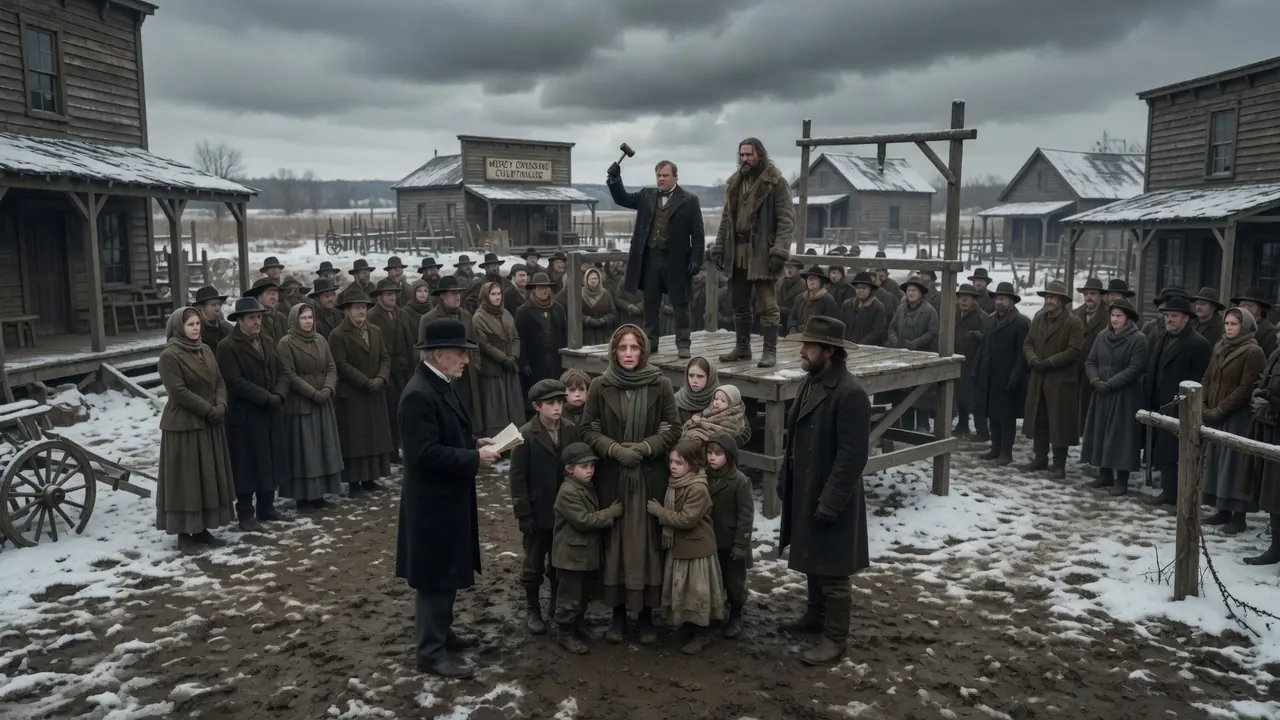
The auctioneer raised his gavel, and Miriam Cole knew she had less than a minute before the law took her children.
The wind came hard across the main street of Mercy Crossing, Dakota Territory, carrying dust, snow grit, and the smell of horse sweat through the crowded square. Men stood with their collars turned up. Women watched from under bonnets. Children peeked from behind skirts, too young to understand why seven other children were clinging to their mother as if their hands alone could keep a family from being torn apart.
Miriam stood on the courthouse steps in a brown wool dress that had been mended so many times the seams looked like a map. Her coat was too thin for January. Her gloves had holes in two fingers. A faded green scarf covered her hair, though loose brown curls had escaped around her face.
She was thirty-nine years old.
She looked older that morning.
Not because of weakness.
Because worry ages a woman faster than time ever could.
Her seven children pressed against her.
Samuel, twelve, trying to stand like a man though his chin trembled.
Clara, ten, holding the baby with both arms.
Peter and Ruth, eight-year-old twins, both red-eyed from trying not to cry.
Matthew, six, clutching Miriam’s skirt.
Annie, four, sucking two fingers and staring at the crowd.
And little Grace, barely fifteen months old, wrapped in a quilt that had once been part of Miriam’s wedding bedding.
The lawman beside the steps shifted uncomfortably.
His name was Deputy Wallace Pike, and he had read the order twice already, each time with less strength in his voice.
“Mrs. Cole,” he said quietly, not looking at the children, “if no suitable husband or guardian claims responsibility today, the court will have to place the young ones with separate households.”
Miriam did not answer him.
She had already begged.
She had begged the judge in private.
She had begged the pastor.
She had begged every merchant who had once eaten her bread, borrowed her husband’s tools, or sent for her when a wife was sick and needed another woman’s hands in the room.
All of them had pitied her.
Pity was cheap.
None of them had claimed her.
Her husband, Thomas Cole, had been dead four months. A wagon accident on a frozen road. A broken axle, a panicked team, a ravine no man climbed out of alive. He left behind seven children, a cabin with leaking corners, and debts Miriam had not known had grown so large.
The bank took the cabin first.
Then the livestock.
Then the stove.
By Christmas, Miriam and the children were living in the empty back room of the livery stable, sleeping under old horse blankets while she washed laundry and baked bread to keep them fed.
The town said it was a shame.
The town did not say it was their shame.
Then Judge Harrow decided the children were at risk.
His solution was simple.
Separate them before hunger did.
Miriam had fought him until her voice broke.
“You cannot split them like kindling,” she said.
The judge looked over his spectacles.
“Then find a lawful household able to keep them together.”
“A household needs a roof. I had one before the bank took it.”
“The debt was valid.”
“So are my children.”
The judge’s mouth tightened.
In the end, Pastor Bell suggested an old frontier arrangement no decent woman wanted spoken aloud.
A marriage claiming.
A public bidding, dressed up as charity and law, where a widowed woman with children could be taken as a wife by any man willing to assume her debts and legal responsibility.
Miriam had laughed when she first heard it.
A dry, stunned laugh.
Then she realized no one else was laughing.
Now she stood on courthouse steps while men looked her over like weathered property.
The first man asked how old the oldest boy was.
“Twelve,” the auctioneer said.
“Old enough to work?”
Miriam’s arms tightened around Matthew.
The man shook his head.
“Too many mouths.”
The second asked whether the twins were healthy.
The third asked whether the baby still needed nursing.
The fourth said he might take two of the children, but not the mother.
Miriam had gone cold all over.
The crowd murmured as if they were watching a horse go unsold.
One man said seven children were a curse.
A woman near the mercantile whispered, “She was plain even before all this.”
Miriam heard every word.
She kept her head up anyway.
A person can be humiliated and still refuse to bow.
The auctioneer’s voice rose again.
“Last call. Widow Miriam Cole and seven children. Debts assumed by claimant. Household to remain intact if lawful marriage is performed before sundown.”
His gavel lifted.
Miriam felt Samuel’s hand find hers.
“Mama,” he whispered.
She looked down at him.
His face was pale.
“I won’t let them take Grace,” he said.
That nearly broke her.
She brushed her thumb over his knuckles.
“You let me do the standing.”
The gavel hovered.
Then a voice from the back of the crowd said, “Three hundred dollars.”
Every head turned.
A man stood beside a black horse at the edge of the square.
He was tall, perhaps forty-five, with broad shoulders under a dark wool coat. His hat brim shaded most of his face, but Miriam could see a weather-browned jaw, a short black beard touched with gray, and eyes that did not move nervously like the others.
Silas Boone.
People knew him, though not well.
He owned land north of town, a hard piece of country near Crow Creek where the wind never seemed to sleep. He came into Mercy Crossing twice a month for supplies. Paid in cash. Spoke little. Drank less. Helped no one unless asked, and sometimes even when he was not.
There were stories about him.
Some said he had been a Union scout.
Some said he had buried a wife and two sons somewhere back east.
Some said he had killed three men in Kansas.
Some said more.
Miriam knew only that he had once fixed the church stove without charging, then left before the pastor could thank him.
The auctioneer blinked.
“Mr. Boone?”
Silas stepped forward.
“Three hundred dollars. I’ll assume the debts.”
The crowd stirred.
Three hundred dollars was more than anyone expected.
More than Miriam’s debts, unless the bank had been lying.
Judge Harrow came down one step.
“Mr. Boone, you understand the terms?”
“I understand.”
“You intend marriage?”
Silas looked at Miriam then.
Not over her.
Not through her.
At her.
“If Mrs. Cole agrees.”
A strange silence followed.
No man had asked that yet.
Miriam stared at him.
Her first thought was not gratitude.
It was suspicion.
Life had taught her that sudden kindness often came with hidden hooks.
The auctioneer cleared his throat.
“The court requires lawful union. Her agreement is implied by participation.”
Silas’s eyes did not leave Miriam’s face.
“I said if she agrees.”
Judge Harrow frowned.
“That is irregular.”
“So is auctioning a mother to keep her children.”
A murmur moved through the crowd.
Miriam felt something inside her shift.
Not trust.
Not yet.
But attention.
Silas took off his hat.
His dark hair was wind-tossed, gray at the temples. There was a scar near his left eyebrow, old and pale.
“Mrs. Cole,” he said, voice steady, “I have land, a house with two empty rooms, a barn, three milk cows, and more winter stores than I need. I do not want a servant. I do not want ownership of your children. I am offering a roof and my name because these people have left you no better choice.”
The crowd went quiet.
Miriam heard Ruth sniff behind her.
Silas continued.
“If you say no, I will still pay the bank enough to keep them from separating the children for thirty days.”
Judge Harrow snapped, “Mr. Boone—”
Silas turned his head slightly.
“Try me.”
The judge stopped.
Miriam studied the man.
He did not smile.
He did not soften his voice to seem kind.
That almost made her trust him more.
Men who performed mercy too prettily usually expected applause.
Miriam looked at her children.
Samuel was staring at Silas like he wanted to hate him and hope in him at the same time.
Clara held Grace tighter.
The twins were silent.
Matthew whispered, “Mama, is he buying us?”
Miriam closed her eyes for one heartbeat.
Then opened them.
“No,” she said, loud enough for those nearest to hear. “He is buying time.”
She looked at Silas.
“If I agree, my children stay together?”
“Yes.”
“You will not send the boys to work another man’s farm?”
“No.”
“You will not separate the girls?”
“No.”
“You will not raise a hand to them?”
His jaw tightened.
“No.”
“You will not raise a hand to me?”
A few men laughed under their breath.
Silas did not.
“No.”
Miriam looked at the auctioneer.
“Then I agree.”
The gavel came down.
The sound cracked through the square.
Not like a sale.
Like a sentence.
By sundown, Miriam Cole became Miriam Boone in the little church at the end of Main Street.
No flowers.
No music.
No white dress.
Pastor Bell looked ashamed as he read the words.
Miriam stood beside Silas with Grace in her arms and six children gathered at her skirts. Silas said his vows clearly. Miriam said hers with a voice that did not shake.
When Pastor Bell said, “You may kiss the bride,” Silas did not move.
He looked at Miriam.
She gave the smallest shake of her head.
He nodded once and turned to the pastor.
“That will be all.”
For the first time that day, Miriam nearly smiled.
They rode north in two wagons after dark.
Silas drove the first with Miriam beside him, Grace asleep in her lap. The older children rode behind with Deputy Pike, who had volunteered quietly after watching the courthouse scene with a face full of regret.
The road to Crow Creek was rough.
Snow lay in the ditches.
The sky was black and star-heavy.
For nearly an hour, nobody spoke.
Then Miriam said, “Why did you do it?”
Silas kept his eyes on the road.
“Because seven children should not be punished for being hungry.”
“That is not an answer.”
“It is the only one I have that matters.”
She turned slightly.
“Do you expect obedience?”
“Yes.”
Her body stiffened.
He glanced at her.
“From the children when the creek floods, from the cows when I call, from myself when anger comes. Not from you as a condition of shelter.”
Miriam looked at him for a long moment.
“You speak strangely.”
“I have been told.”
His house appeared at last, a dark shape against the pale snow.
It was larger than she expected.
Not grand.
But solid.
A log house with a stone chimney, two front windows glowing warmly, and smoke rising into the cold night. A barn stood to the right. A fenced garden slept under snow. Behind it, cottonwoods bent along the creek.
Inside, heat struck Miriam’s face so suddenly her eyes stung.
The main room had a wide hearth, rough shelves, a long table, and a braided rug worn thin in the center. There were hooks for coats. A stack of chopped wood. A cradle near the fire, empty but clean.
Miriam saw that cradle and understood one of the stories might be true.
Silas noticed her looking.
“My youngest slept there,” he said.
She did not ask more.
He pointed down the hall.
“Two rooms there. One for the girls and baby. One for the boys. Mine is upstairs. You may take the room beside the kitchen.”
Miriam looked at him.
“You are not expecting me upstairs?”
“No.”
The relief came so fast she hated that he saw it.
But he only turned away.
“Children are hungry?”
All seven answered yes in different ways.
Silas removed his coat.
“There’s stew.”
That first night, the children ate like small wolves.
Stew.
Cornbread.
Dried apples.
Milk.
Annie fell asleep with bread still in her hand. Peter cried when Silas told him he could have seconds. Clara hid half her cornbread in her pocket until Miriam gently told her there would be breakfast too.
Silas pretended not to notice.
That was kind.
Later, after the children were washed, settled, and asleep in real beds, Miriam stood alone in the kitchen with her hands on the edge of the sink.
She did not cry.
She wanted to.
But tears had become something she saved for when there was time.
Silas entered quietly and placed a folded paper on the table.
“What is that?”
“Marriage agreement.”
Her face hardened.
“Another one?”
“This one is mine.”
She opened it.
The words were written in a careful hand.
Miriam Boone retains authority over her children. Silas Boone makes no claim upon her body, wages, inheritance, or personal possessions. Household labor shall be shared according to ability. If after one year Miriam wishes to dissolve the marriage, Silas Boone will provide transport, $300, and legal statement of good character.
Miriam read it twice.
Then a third time.
Her voice came out rough.
“Why?”
Silas stood near the doorway.
“Because the law did not protect you today. Something ought to.”
She looked at him.
For the first time since the auction, her eyes filled.
“You do not know me.”
“No.”
“Then why trust me?”
“I watched you stand in that square with seven children clinging to you while grown men called you burden. A woman who can survive that without spitting in someone’s face has more character than most judges.”
A sound escaped her.
Half laugh.
Half sob.
She covered it with one hand.
Silas looked away to give her dignity.
That was the first night Miriam slept under his roof.
She did not sleep much.
But her children did.
That was enough.
The first month was not easy.
Nothing about seven children and two strangers in a hard winter house could be easy.
Samuel mistrusted Silas openly.
He chopped wood too aggressively and glared whenever Silas corrected him.
Clara followed Miriam from room to room, afraid if she let her mother out of sight the law might return.
Peter and Ruth fought over blankets.
Matthew had nightmares.
Annie wet the bed twice and cried as if expecting punishment.
Grace developed a cough that kept everyone awake three nights straight.
Miriam worked from before dawn until long after dark.
Cooking.
Mending.
Sweeping.
Washing.
Soothing.
Counting flour.
Stretching beans.
Learning where Silas kept things.
Learning what noises the house made in wind.
Learning that Silas Boone did not shout.
That unsettled her at first.
Men who did not shout sometimes stored fury for later.
But his silence did not feel like that.
It felt like a man who had seen too much noise already.
He worked the land, repaired fences, fed animals, carried water, and taught Samuel how to split logs with the grain instead of against it.
Samuel resisted.
“I know how to chop wood.”
Silas picked up a split piece and showed him the angle.
“You know how to hit wood. Chopping is different.”
Samuel’s ears reddened.
Miriam braced for explosion.
It did not come.
Silas handed him the axe.
“Try again.”
Samuel tried.
The log split clean.
He looked surprised.
Silas nodded once.
“Good.”
That single word changed something in the boy’s face.
Not much.
But enough.
By March, the twins were laughing again.
By April, Annie followed Silas to the barn every morning and named the chickens after women from town she disliked.
By May, Clara began leaving Grace in the cradle while she helped Miriam knead bread.
And Miriam began noticing things.
Silas left coffee for her before she woke.
He fixed the loose step outside the kitchen after seeing her stumble once.
He never entered her room without knocking.
He listened when she spoke.
Truly listened.
Not the way men listened while waiting for their turn.
One afternoon, a rider came from town with a message.
The church ladies were organizing a spring charity supper and wished Mrs. Boone to bake bread.
Miriam read the note.
Then laughed once.
Sharp.
Silas looked up from oiling a harness.
“What?”
“They want bread.”
“You bake good bread.”
“They want forgiveness wrapped in bread.”
He understood.
The same women who watched her nearly lose her children now wanted her loaves on their tables so they could feel decent.
Silas waited.
Miriam looked toward the garden where Samuel and Peter were setting bean poles.
“I’ll bake.”
His brow lifted.
“Will you?”
“Yes.”
She folded the note.
“But not for charity.”
The supper took place in June.
Mercy Crossing had never seen so much bread in one room.
Miriam arrived with Samuel driving the wagon and Clara balancing baskets at her feet. The children were scrubbed clean, dressed in mended but neat clothes. Silas rode beside them on horseback.
People stared as they entered.
Of course they did.
They had expected Miriam Boone to shrink after the auction.
Instead, she looked stronger.
Not softer.
Not prettier in the way gossips cared about.
Stronger.
Her brown dress was still plain, but clean. Her hair was pinned neatly. Grace rested on her hip, round-cheeked and healthy. The older children carried baskets into the church hall.
Pastor Bell hurried forward.
“Mrs. Boone, how generous of you.”
Miriam smiled.
“I brought eighty loaves.”
The room murmured appreciatively.
“And I will sell them for ten cents each.”
The pastor blinked.
“Sell?”
“Yes. The money will start a widow’s fund.”
Silence spread.
“A what?” asked Mrs. Pritchard, the banker’s wife.
Miriam set Grace down beside Clara.
“A fund for women who lose husbands and need time before the town decides to auction them.”
A few men shifted uncomfortably.
Judge Harrow, standing near the lemonade table, stiffened.
Mrs. Pritchard’s mouth tightened.
“That is rather dramatic.”
Miriam looked at her.
“Was the square not dramatic enough for you?”
No one spoke.
Miriam continued, voice calm enough to be deadly.
“The fund will help with food, mortgage interest, seed, livestock feed, or legal fees. No widow with children in this county should have to stand on courthouse steps while men decide whether she is worth shelter.”
Judge Harrow cleared his throat.
“Mrs. Boone, the court acted within territorial law.”
“And I am acting within Christian decency.”
That landed well in a church hall.
Silas stood near the door, arms crossed, saying nothing.
But his eyes held something Miriam had not expected.
Pride.
Samuel stood a little taller.
Mrs. Pritchard glanced around, realizing the crowd had turned curious instead of hostile.
“And who would manage this fund?” she asked.
“I will,” Miriam said. “With Pastor Bell keeping public records and three women elected by contributors.”
“A woman managing money?” someone muttered.
Miriam smiled.
“I managed hunger, debt, grief, seven children, and your judgment. Coins should not frighten me.”
A laugh broke out from the back of the room.
Then another.
The first loaf sold to Deputy Pike.
He placed a silver dollar on the table.
“I’ll take one loaf,” he said. “Keep the change.”
After him came the schoolteacher.
Then the blacksmith’s wife.
Then a rancher who had said “too many mouths” at the auction and could not meet Miriam’s eyes as he paid.
By sunset, every loaf was gone.
The widow’s fund began with $23.40.
Not enough to save anyone yet.
But enough to exist.
That was how most revolutions began on the frontier.
Not with guns.
With a woman making a list and refusing to stop.
Summer brought work.
Miriam organized the fund from Silas’s kitchen table. She wrote letters to nearby settlements. She kept records in a ledger. She learned which families had extra flour and which needed it. She arranged sewing work for widows, egg sales for children, shared plow teams for small farms.
The town did not know what to do with her.
They had called her burden.
Now burden was organizing them.
By August, the fund helped Mrs. Larkin keep her cow after her husband died of fever.
By September, it paid school fees for three children whose mother took in washing.
By October, it bought seed wheat for a widow with two boys and no team.
Each time, Miriam recorded every cent.
No one could accuse her of softness or theft.
Judge Harrow disliked the fund.
The banker disliked it more.
Because women with help were harder to pressure.
That truth became dangerous in November.
The bank filed a complaint claiming Miriam had misused charitable funds.
The hearing was set in the same courthouse where she had been auctioned.
The room filled early.
Some came to support her.
Some came to see her fall.
Silas sat in the front row with all seven children. Grace slept against his chest, one small hand tangled in his beard.
Miriam stood alone at the table.
Judge Harrow looked down at her.
“Mrs. Boone, you are accused of collecting and distributing funds without proper authority.”
Miriam placed her ledger on the table.
“Then let us discuss authority.”
The banker, Mr. Elroy Vance, stood with a smug expression.
“These matters require financial knowledge.”
Miriam opened the ledger.
“Page one. Contributions. Page two. Distributions. Page three. Signed acknowledgments. Page four. Remaining balance held in Pastor Bell’s lockbox.”
Pastor Bell stood.
“That is true, Your Honor.”
Judge Harrow frowned.
Vance’s smile thinned.
Miriam turned another page.
“And here are records of the late fees charged to widows by Mr. Vance’s bank during the past five years.”
The room shifted.
Vance snapped, “That is irrelevant.”
“Is it?”
Miriam lifted a paper.
“This is my husband’s debt statement. Three fees were added after his death but before I was notified. Two were unlawful under territorial probate rules.”
Judge Harrow’s face changed.
Miriam placed another paper down.
“Mrs. Larkin. Same pattern.”
Another.
“Mrs. Ames.”
Another.
“Mrs. Ruth Bellamy.”
The courtroom murmured.
Miriam’s voice stayed steady.
“I was not the first widow your bank tried to break quickly. I was only the first one you sold publicly enough for everyone to remember.”
Vance turned red.
“This is slander.”
“No,” Miriam said. “This is arithmetic.”
A laugh rippled through the room.
Judge Harrow struck his gavel.
“Order.”
But the room had already changed.
Miriam continued.
“The widow’s fund records are open. Are the bank’s?”
Vance said nothing.
Silence confessed before men did.
By the end of the hearing, the complaint against Miriam was dismissed.
By the end of the month, the territorial marshal opened an inquiry into Vance Bank.
By spring, Elroy Vance resigned and left town in a wagon at dawn.
People later said that was the day Miriam Boone shook the whole West.
That was not true.
The West was too large to shake all at once.
But Mercy Crossing shook.
And word traveled.
A widow in Red Fork wrote for advice.
A teacher in Laramie requested Miriam’s ledger format.
A pastor in Montana asked how to start a similar fund.
Newspapers called it the Boone Widow Relief Method.
Miriam hated the name.
“It sounds like medicine,” she said.
Silas looked over his coffee.
“Some medicine works.”
She smiled despite herself.
Their marriage changed slowly.
Not like songs.
Not like novels.
There was no sudden confession under moonlight, no grand kiss in a storm.
There were smaller things.
Silas carving Grace a wooden horse.
Miriam mending his coat without asking.
Samuel calling him “sir” with less anger and then, one day, not saying sir at all.
Silas teaching Clara to shoot a rifle because “every person on land this far out should know how to keep wolves honest.”
Miriam laughing in the garden for the first time in a year.
In the second winter, a fever swept through the creek valley.
Miriam nursed three children, then Silas.
He drifted in and out for two nights.
On the third, he opened his eyes and found her sitting beside him, holding a cool cloth.
“You should sleep,” he rasped.
“You should stop giving orders while half dead.”
His mouth twitched.
“Yes, ma’am.”
She looked at him for a long moment.
“I was afraid,” she said.
His expression softened.
“Of the fever?”
“Of losing the roof.”
He understood what she meant and what she did not yet dare say.
He reached for her hand.
She let him take it.
“You would not lose it,” he said. “The house is in both names now.”
Her eyes filled.
“When did you do that?”
“Last month.”
“You did not tell me.”
“You were busy terrifying bankers.”
A laugh broke through her tears.
He held her hand.
“And because it was already yours in every way that mattered.”
She looked at him then, truly looked.
Silas Boone, the man who had paid $300 in a town square and asked her permission when the law had not. The man who gave her a room of her own. The man who did not mistake quiet for consent. The man who had become, without force, the place her children ran when frightened.
Miriam leaned forward and kissed his forehead.
Not because the pastor told her to.
Because she wanted to.
Silas closed his eyes.
That was the beginning of their marriage in truth.
Years passed.
The seven children grew wild and strong.
Samuel became a carpenter and built the first proper widow’s home in Mercy Crossing.
Clara became a teacher.
Peter and Ruth ran the farm better than most grown men.
Matthew joined the territorial newspaper and wrote articles that made officials sweat.
Annie became a midwife.
Grace, the baby who had nearly been split from them all, grew into a lawyer and argued property rights for widows before men who underestimated her exactly once.
The Boone Widow Fund spread across three territories.
Miriam’s ledger pages were copied, mailed, stained, folded, and carried in saddlebags by women who had been told they were burdens until they learned to count what was owed.
When people told the story years later, they always began with the auction.
How Silas Boone paid $300 for a widow with seven children.
How the whole town stared.
How she stood on the courthouse steps in a mended coat with babies clinging to her skirts.
They liked that beginning because it sounded like rescue.
But Miriam always corrected them.
“Silas did not buy me,” she would say. “He bought the town thirty seconds to remember its soul.”
Then she would add, if the listener seemed worth teaching, “And when it failed, we built something better.”
On her sixtieth birthday, Mercy Crossing held a supper in the church hall.
Not a charity supper.
A celebration.
Women came from three counties. Men too, though some still looked uncomfortable when Miriam stood to speak. Children sat on windowsills. The long tables groaned under bread, stew, pies, pickles, beans, and cakes.
Silas sat in the front row with Grace beside him, now a sharp-eyed young woman with law books stacked under her chair.
Miriam stood near the same table where she had sold the first eighty loaves.
Her hair had gone silver.
Her hands were bent with work.
Her eyes had lost none of their fire.
“I have heard,” she began, “that some people call me the woman who shook the West.”
Laughter moved through the hall.
She smiled.
“That is nonsense. The West is too stubborn to be shaken by one woman.”
More laughter.
“But I have seen a widow keep her cow because neighbors paid attention. I have seen children stay with their mother because someone kept a ledger. I have seen bankers learn that grief makes poor cover for theft. I have seen men discover that a woman who bakes bread may also read contracts.”
Silas smiled.
Miriam looked around the room.
“I was called burden once. In public. Loudly enough for my children to hear.”
The hall quieted.
“I believed it for almost half a day.”
Her voice softened.
“Then a man paid three hundred dollars, not to own me, but to stop the world from splitting my children apart.”
She looked at Silas.
He lowered his eyes, uncomfortable with praise even after all those years.
“And after that, I learned something. A person is not a burden because they need help. A town becomes a burden when it refuses to give it.”
The room remained still.
Miriam lifted her cup.
“So here is to every woman who stood when her knees shook. Every child who held on. Every neighbor who finally spoke. Every ledger kept clean. Every loaf sold honestly. Every roof shared without ownership. And every soul stubborn enough to build mercy where the law offered none.”
The hall erupted.
Silas stood slowly.
The others followed.
Miriam looked at the faces before her, and for a moment she was back on the courthouse steps, January wind tearing at her coat, seven children clinging to her, the gavel raised.
Thirty seconds.
That was all the law had given her.
Thirty seconds to lose everything.
But time, she had learned, could be remade.
Thirty seconds could become a bid.
A bid could become a roof.
A roof could become a household.
A household could become a fund.
A fund could become a movement.
And a woman the town called undesirable could become the reason no other mother in Mercy Crossing ever stood on courthouse steps waiting to be chosen.
After the supper, Miriam found Silas outside near the hitching posts.
The night was cold and clear.
He was looking up at the stars.
“You slipped away,” she said.
“Too many people talking kindly. Makes a man suspicious.”
She laughed.
They stood shoulder to shoulder.
For a long while, neither spoke.
Then Silas said, “Do you ever regret saying yes?”
Miriam looked at him.
The question surprised her.
“Do you?”
“No.”
He answered too quickly, and she smiled.
She looked toward the church hall, where her children were laughing, where women were packing leftover bread for families who had not asked but needed it, where the town that once watched her humiliation now spoke her name with respect.
“No,” she said. “I don’t regret it.”
Silas nodded.
Miriam took his hand.
His fingers closed around hers.
“You paid three hundred dollars for trouble,” she said.
His mouth curved.
“Best money I ever spent.”
She leaned against him.
Inside, someone began singing.
Outside, the wind moved across Mercy Crossing, carrying the sound down the street, past the courthouse steps, past the bank with its new honest owner, past the homes where widows slept without fear of losing their children at dawn.
The West was still hard.
It was still hungry.
Still unfair.
Still full of men who mistook law for justice and pity for mercy.
But it was also changed, at least in that place.
Because Miriam Boone had once stood before a crowd that saw seven children as too many mouths.
And she had shown them that seven children could become fourteen hands, seven witnesses, seven reasons to fight, and seven living proofs that a mother’s worth was never something for men with gavels to decide.