I came home early because I thought my wife deserved something sweet.
That was the stupid, simple truth.
My meeting in Fort Collins ended two hours ahead of schedule. The rain had stopped. The clouds had broken just enough for pale afternoon light to spill over the road, and for the first time in weeks, I felt something almost close to peace.
So I stopped at the little bakery on Maple Avenue and bought Elise’s favorite lemon cakes.
Three small ones, because she always said one was too few and four made her feel judged.
I even bought the pink box with the ribbon, because she liked ribbons and I liked pretending I did not notice things like that.
When I pulled into our driveway in Cedar Hollow, the porch light was on though it was barely four in the afternoon.
That should have been the first warning.
Elise never turned on the porch light until evening.
The second warning was the front door.
Not open.
Not unlocked.
Just not fully closed.
The latch had not caught.
I stood there for a moment with the bakery box in one hand and my keys in the other, staring at the narrow black line between the door and the frame.
“Elise?” I called before stepping inside.
No answer.
The house smelled like rain, vanilla candles, and something metallic I could not place.
I pushed the door open with my foot.
The first thing I saw was her coat.
It lay on the floor near the entry table, one sleeve twisted underneath it. Her tan trench coat, the one she wore when she wanted to look more organized than she felt. One of the buttons had torn loose and sat beside it on the hardwood.
The second thing I saw was her shoe.
Just one.
A black heel lying sideways near the bottom of the stairs.
Then the scarf.
Blue silk.
The one I gave her last Christmas.
It hung from the railing as if someone had pulled it free in a hurry and dropped it without caring where it landed.
I looked up.
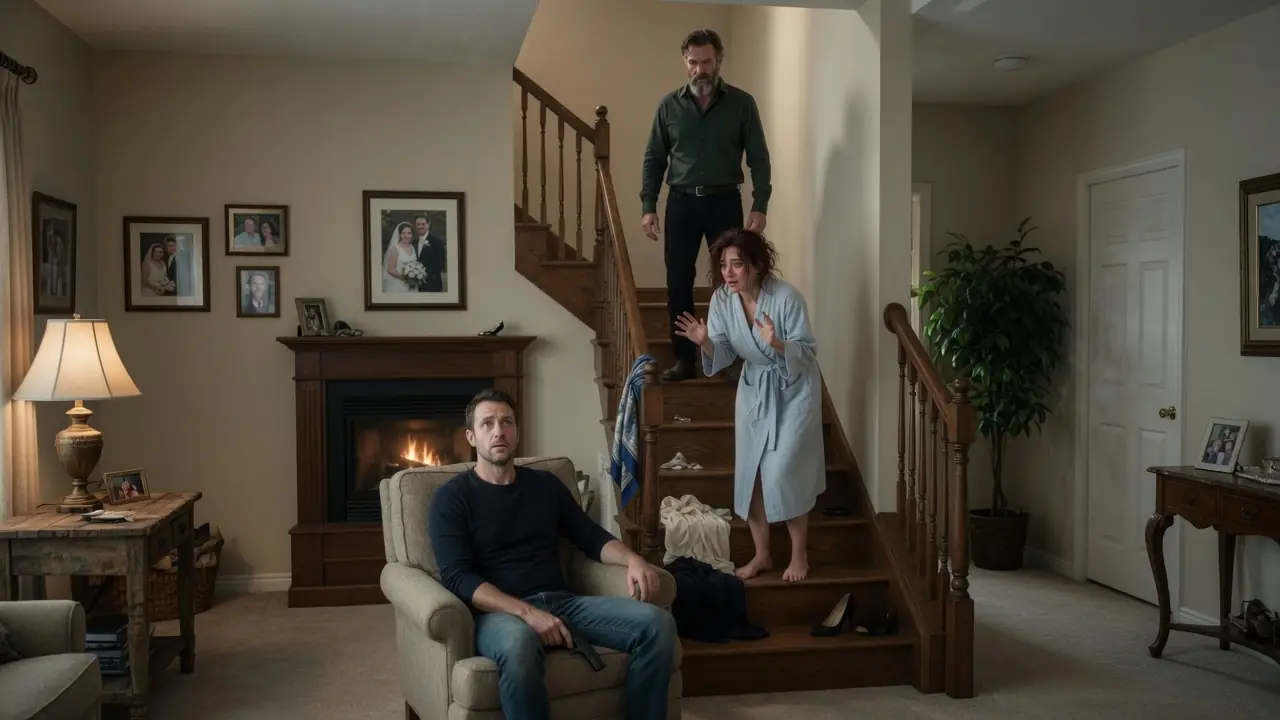
Clothes were scattered along the staircase.
Her cream blouse on the third step.
Her skirt halfway up, bunched against the wall.
One stocking stretched across the banister.
A pearl earring glinting on the landing.
For several seconds, I could not move.
The bakery box grew heavy in my hand.
Outside, somewhere down the street, a dog barked twice. A car passed slowly over wet pavement. The refrigerator hummed from the kitchen.
Normal sounds.
Normal neighborhood.
Normal house.
But the clothes on the stairs turned everything strange.
“Elise?” I called again.
This time my voice cracked.
No answer.
Then I heard a man speak upstairs.
“Don’t come any closer, Nathan.”
I froze.
He knew my name.
That was the part my mind caught first.
Not that a man was upstairs.
Not that my wife’s clothes were spread like evidence across the staircase.
That he knew my name.
My fingers tightened around the bakery box until the cardboard bent.
“Who are you?”
Silence.
Then Elise’s voice came from behind our bedroom door.
“Nathan, please listen before you come up.”
There are sentences that split your life into before and after.
That was one of them.
Before that moment, I was a husband who had come home early with lemon cakes.
After it, I was a man standing at the foot of the stairs, looking at his wife’s clothes, hearing her voice from a room where another man waited.
I set the bakery box on the entry table.
Slowly.
Carefully.
Because if I threw it, I would have to admit the thing inside me was already breaking.
“Elise,” I said, “come downstairs.”
“I can’t.”
The man spoke again.
“She can. But not until you understand why I’m here.”
I laughed once.
“Why you’re here? You’re in my bedroom.”
“I know what it looks like.”
“No,” I said, stepping onto the first stair. “You don’t.”
The bedroom door opened.
Elise stood in the hallway wearing my old gray robe.
Her hair was loose and damp around her face. One cheek was red, not from embarrassment but from where something had scraped it. Her eyes were swollen, but they were not the eyes of a woman caught in an affair.
They were the eyes of someone who had been afraid for a long time and had finally run out of room to hide it.
Behind her stood a man in a dark coat.
He was older than I first expected. Maybe fifty. Tall, broad, with graying hair and a scar that ran from the corner of his mouth down toward his jaw. He held a leather satchel in one hand.
He did not look guilty.
That made me angrier.
“Nathan,” Elise whispered, “his name is Gabriel Rowan.”
The name meant nothing to me.
The man stepped forward slowly.
“I’m not here because of your wife.”
I looked at the robe she wore, the clothes on the stairs, the closed bedroom door behind him.
“You may want to choose a better first sentence.”
Elise started crying.
Not loudly.
Not dramatically.
Just tears slipping down her face like she had no strength left to stop them.
“I was changing when he came,” she said. “He knocked at the back door. I opened it because he said he knew my father.”
“You let a strange man into our house because he knew your father?”
She flinched.
“My father has been dead twelve years.”
Gabriel’s eyes moved to mine.
“And mine has been dead twenty-nine.”
Something in his voice stopped me from taking the next step.
Not fear.
Recognition, maybe.
The kind you feel when a stranger says something with the weight of a family secret.
Gabriel placed the leather satchel on the hallway table and opened it.
Inside were papers wrapped in oilcloth, an old photograph, a silver locket, a cassette tape, and a child’s hospital bracelet.
My anger stumbled.
The photograph was the first thing I noticed.
A little girl sat on a porch swing beside a little boy. The girl had dark curls and serious eyes. The boy held a wooden horse in his lap. He looked maybe four.
At first, I did not know why the photo made my stomach drop.
Then I saw the boy’s left hand.
Two fingers bent slightly inward.
Like mine.
A childhood injury, my mother always said. A car door accident. I never remembered it, but the fingers never straightened all the way.
Gabriel took out the photo.
“That boy is you.”
I stared at him.
“No.”
Elise gripped the robe closed at her throat.
“Nathan—”
“No.”
Gabriel’s expression did not change.
“Your name was not Nathan Wells when that photograph was taken.”
My mouth went dry.
The house felt suddenly too small, every wall leaning closer to hear.
“What did you say?”
Gabriel turned the photograph over.
On the back, in faded blue ink, were three names.
Clara.
Miles.
Evan.
I read the last one twice.
Evan.
Not Nathan.
Gabriel pointed to the little girl.
“That was my sister Clara. She was six. I was fourteen when the photo was taken. And that boy—”
He looked at me.
“—was my brother Evan.”
I could hear my own breathing.
I could also hear Elise crying softly.
“My name is Nathan Wells,” I said.
Gabriel nodded once.
“That is the name they gave you after the fire.”
The word fire passed through the hallway and touched something deep in me.
A flash.
Not memory exactly.
Heat.
A woman screaming.
Smoke low enough to crawl through.
The smell of wet wool and burning pine.
Then gone.
I gripped the railing.
Elise stepped toward me.
I lifted my hand.
“Don’t.”
She stopped like the word had struck her.
Gabriel reached into the satchel and pulled out a yellowed newspaper clipping.
FIVE-YEAR-OLD EVAN ROWAN PRESUMED DEAD IN FARMHOUSE FIRE.
The date below the headline was November 3, 1994.
Today was November 3.
I looked toward the wall calendar in the hallway.
Elise had circled the date in red.
Under it, in her handwriting, she had written:
Tell him tonight.
The floor seemed to move.
I turned to her.
“You knew?”
She pressed a hand over her mouth.
“For three weeks.”
Three weeks.
I had slept beside her for three weeks.
Eaten breakfast with her.
Kissed her goodbye.
Asked why she looked tired.
And she had carried this alone.
“That’s why you’ve been acting strange?”
She nodded.
“I wanted to be certain.”
“Certain that my life was a lie?”
Her face broke.
“Yes.”
The answer was so bare it left no room for anger to push against it.
Gabriel took out the hospital bracelet.
It was cracked with age.
EVAN M. ROWAN.
DOB: 08/17/1989.
My birthday was August 17.
My mother used to say I arrived during the worst heat wave of that summer. That the hospital air conditioner failed. That my father nearly fainted.
Stories.
Soft stories.
Loving stories.
Were they lies too?
I turned away and stared down the stairs at the clothes scattered below. Elise’s blouse. Her stocking. Her coat by the door. The scene still looked like betrayal, but now it felt staged by a crueler hand.
“Why were your clothes everywhere?” I asked.
Elise looked down.
“When Gabriel showed me the locket, I panicked. I was trying to get dressed before you came home, but then someone knocked at the front door.”
My eyes lifted.
“Who?”
She looked at Gabriel.
He answered.
“Your uncle.”
My blood chilled.
“Uncle Peter?”
Peter Caldwell was not my real uncle, not by blood. He had been my father’s business partner and my mother’s closest friend after Dad died. He had been at every birthday, every graduation, every important dinner. He had walked Elise down the aisle because her own father was already gone.
Gabriel’s eyes narrowed.
“He calls himself Peter now?”
I swallowed.
“What do you mean now?”
Gabriel took out another photograph.
This one was older.
Three men standing in front of a feed store. One of them was younger but unmistakable.
Peter.
Same narrow face.
Same pale eyes.
Same way of standing slightly behind other men, as if waiting for them to turn their backs.
On the back of the photo, someone had written:
Silas Crane.
I looked at Gabriel.
“That isn’t his name.”
“It was.”
Elise’s voice shook.
“He came to the front door ten minutes after Gabriel arrived. I looked through the window and saw him. I don’t know why, but I got scared. Gabriel told me not to open it.”
“So you hid?”
“I tried to get dressed first. Then he went around back.”
Gabriel nodded.
“I had to pull her away from the window. That’s how the clothes got scattered. She had them in her arms.”
The image changed again.
Not passion.
Panic.
Not betrayal.
A woman trying to dress while danger circled the house.
I sat down on the stairs.
I did not mean to.
My legs simply stopped holding me.
Gabriel came no closer.
Smart man.
“Why is Peter involved?” I asked.
Gabriel’s face hardened.
“Because Silas Crane was the man accused of setting the fire that killed your family.”
“My family is alive.”
The sentence came out before I could stop it.
Then I remembered.
My father was dead.
My mother lived thirty minutes away in a white ranch house full of quilts, ceramic birds, and photographs of a child she might have stolen.
My throat closed.
Gabriel’s voice softened slightly.
“The people who raised you may have loved you. I’m not here to tell you they didn’t. But love after a lie does not erase the lie.”
That sentence landed somewhere I was not ready to open.
Elise came down one step.
“Nathan, I asked your mother for medical history because of the appointment.”
I looked at her.
“What appointment?”
Her hand went to her stomach.
She did not mean to do it.
The motion was small.
Automatic.
Everything inside me stopped.
“Elise.”
She started crying again.
“I was going to tell you tonight.”
I stood too quickly.
The railing dug into my palm.
“You’re pregnant?”
She nodded.
“How far?”
“Nine weeks.”
Nine weeks.
A child.
Our child.
The lemon cakes on the entry table blurred.
That was what tonight should have been. A baby. Tears. Laughter. Fear of the good kind. Elise handing me some tiny picture I could not understand and pretending she could.
Instead, I stood among scattered clothes and old ghosts.
“I asked your mother about family medical history,” Elise said. “Heart disease. Blood disorders. Anything genetic. She got so upset she dropped the phone.”
“My mother is emotional.”
“She said, ‘That bloodline should have ended.’”
The hallway went cold.
I stared at her.
“What?”
Elise nodded, tears sliding down her face.
“I thought I misheard. Then she called Peter. He called me five minutes later and asked why I was digging into things that had nothing to do with the baby.”
“She told him?”
“She hadn’t told him about the baby.”
I looked at Gabriel.
He looked back like a man who had expected the ground to break and was only surprised it had taken this long.
A sound came from downstairs.
A phone buzzing.
Not mine.
Elise looked toward the entry table.
“My phone.”
She went down carefully, picked it up from beside the bakery box, and stared at the screen.
Her face went white.
“What?” I asked.
She turned the phone toward us.
A message from an unknown number.
A photograph of our staircase.
Taken from outside the front window.
Elise in the robe.
Gabriel in the hallway.
Me sitting on the stairs.
The scattered clothes visible below.
Under the image were five words:
He already thinks the worst.
I felt sick.
Someone had wanted me to come home and see it exactly this way.
The clothes.
The stranger.
The bedroom.
The robe.
The perfect shape of adultery.
“Elise,” I whispered.
She shook her head hard.
“No. Nathan, no. I swear to you, no.”
I looked at her face.
Really looked.
The fear was real.
The exhaustion was real.
The hurt was real too, because I had doubted her and she had known I would.
I closed my eyes.
When I opened them, I looked at Gabriel.
“Why now?”
He reached into the satchel and took out the cassette tape.
The label was written in a hand I recognized.
Not from childhood.
From birthday cards.
From notes taped to garage tools.
From the signature on my first car title.
My father’s handwriting.
For Nathan, when the name stops protecting him.
My hands went numb.
“My father wrote that.”
Gabriel nodded.
“Thomas Wells was not your father by blood. But he left the tape with an attorney in Cheyenne. The attorney died last month. His daughter found the file and contacted me.”
“Why you?”
“Because I’ve been looking for Evan Rowan for twenty-nine years.”
No one spoke.
Rain began again outside, soft against the windows.
Elise came to sit beside me on the stairs, not touching me but close enough that I could feel her shaking.
Gabriel placed an old cassette player on the step below us.
Then he pressed play.
Static filled the hallway.
Then my father’s voice came through.
“Nathan,” he said, and the sound of him alive almost broke me. “If you’re hearing this, then I was either too cowardly to tell you or too dead to try.”
I covered my mouth.
Elise began to sob quietly.
My father continued.
“Your name was Evan Rowan when we found you. You were five years old. You were half-frozen, barefoot, and covered in soot on Route 16 outside Laramie. Evelyn wanted to call the sheriff. I did too. Then Peter came.”
The tape hissed.
“He told us the fire was no accident. He said men were looking for the child who survived. He said if we gave you back, you’d be dead by morning. I believed him because fear makes lies sound practical.”
A pause.
A cough.
My father had recorded this when he was sick.
I could hear it.
“We kept you. We gave you a new name. We told ourselves we saved you. Maybe we did. But we also stole you from whoever still had the right to search.”
Gabriel turned away.
His jaw worked once.
The tape went on.
“Do not trust Peter Caldwell. His real name is Silas Crane. He was there before the fire. He brought you to us after. I never knew whether he saved you or stole you. But I know this: he never does anything without a reason.”
My father’s voice broke.
“I loved you, son. That part was never false. But love does not make a stolen life clean.”
The tape clicked off.
No one moved.
The hallway felt too small to hold what had just been said.
Then the doorbell rang.
Once.
Elise gasped.
Gabriel moved first, crossing to the front window without stepping into view.
He looked through the edge of the curtain.
His face changed.
“Peter.”
My chest tightened.
The doorbell rang again.
Then Peter’s voice came through the door.
“Nathan? Open up. Your mother’s had a bad spell.”
For one terrible second, I almost moved.
My mother.
Sick.
Afraid.
The woman who packed my lunch, sat beside me during fevers, held me when my father died, called every Sunday because she said a quiet house needed voices.
Elise grabbed my wrist.
“Call her.”
I looked at her.
“Call her first.”
Peter knocked.
“Nathan, son, open the door.”
I pulled out my phone with shaking hands and called my mother.
She answered on the second ring.
“Nathan?”
She sounded breathless.
“Mom, are you okay?”
Silence.
Then a whisper.
“Is he there?”
I looked at the door.
“Peter?”
“No,” she said, and began crying. “The other one.”
Gabriel’s eyes sharpened.
I swallowed.
“How do you know there’s another one?”
She sobbed.
“Because Peter told me he came.”
I closed my eyes.
Peter knocked harder.
“Nathan. Now.”
My mother whispered, “Don’t open the door.”
That stopped me.
“Mom?”
“Don’t let him in. And don’t let him take the locket.”
Gabriel looked down at the satchel.
“What locket?” I asked.
She cried harder.
“The one your real mother hid the key inside.”
Peter stopped knocking.
The silence outside became more frightening than the sound had been.
Gabriel pulled the silver locket from the satchel and opened it.
Inside was a tiny photograph of a woman with dark hair holding a baby.
Behind the photo, tucked into the rim, was a small brass key.
He stared at it.
“I never knew.”
My mother whispered through the phone, “I’m sorry. I’m so sorry.”
The line went dead.
A car engine started outside.
Gabriel looked through the curtain again.
“He’s leaving.”
I ran to the window before he could stop me.
A black sedan rolled away from the curb.
Peter did not look back.
For a long moment, I stood there with the phone in my hand, watching the taillights disappear around the corner.
Then I turned to Elise.
“I thought you were cheating on me.”
The words came out raw.
She flinched.
“I know.”
“I saw the clothes and the robe and him upstairs, and I thought—”
“I know.”
“I hated you for about thirty seconds.”
Her eyes filled again.
“That must have been awful.”
I let out a broken laugh.
“For you too, I guess.”
She nodded.
“Yes.”
I crossed the room slowly.
This time when she reached for me, I did not stop her.
She put her hand on my chest.
“I should have told you sooner,” she whispered.
“Yes.”
“I was scared.”
“Yes.”
“That doesn’t make it right.”
“No.”
She nodded, accepting it.
That mattered.
Gabriel looked away, giving us the small mercy of privacy in a room full of secrets.
I touched Elise’s stomach.
Not dramatically.
Just two fingers against the robe.
Nine weeks.
A life neither of us had been allowed to celebrate yet.
“We are not doing any more secrets,” I said.
She covered my hand with hers.
“No more.”
I looked at Gabriel.
“What does the key open?”
He held it carefully.
“My mother used to mention a box in Casper. I thought it was grief talking. She said if I ever found Evan, I should find the box. I never had the key.”
“And Peter wants the locket.”
“Yes.”
“Then the box matters.”
Gabriel nodded.
“Enough for him to stage this.”
I looked at the clothes on the stairs again.
The scene no longer looked like proof of betrayal.
It looked like bait.
A marriage could have cracked there.
A man could have grabbed a gun.
A wife could have run.
A stranger could have been blamed.
Peter had counted on the easiest story being the one I believed first.
He had almost been right.
We left through the back door ten minutes later.
Not because we were cowards.
Because Peter knew the front.
Elise changed in the laundry room while Gabriel checked the yard. I picked up her clothes from the stairs one by one. The blouse. The skirt. The stocking. The scarf. The earring from the landing.
I held the scarf longer than the rest.
Blue silk.
Christmas morning.
Elise laughing because I had wrapped it badly.
A normal memory.
Mine.
Whatever else had been stolen from me, that was mine.
At the back door, Elise looked at the bakery box still sitting on the entry table.
“You bought lemon cakes?”
I almost smiled.
“Three.”
Her face crumpled.
“I was going to tell you about the baby over dinner.”
“I know.”
“I had a little box too,” she said. “Upstairs. With the test inside.”
For some reason, that nearly undid me.
Not the fire.
Not the tape.
Not the hidden name.
A little box upstairs that should have been the beginning of joy.
I picked up the bakery box.
Gabriel stared at me.
“You’re taking cake?”
“Yes.”
He looked like he wanted to argue, then decided he had lived too long to question a man whose life had just collapsed.
We drove to my mother’s house first.
I insisted.
Gabriel objected.
Elise objected more gently.
But I needed to see her face before a bank box told me what kind of woman had raised me.
My mother opened the door before we knocked.
She looked smaller than I remembered, wrapped in a gray cardigan, her hair uncombed, her face wet with tears.
When she saw Gabriel, she almost fell.
“Elena’s boy,” she whispered.
Gabriel went still.
Elena.
My real mother.
The name entered me like a key turning in a lock I had not known was there.
My mother looked at me.
“Nathan.”
I said nothing.
Her lips trembled.
“Evan.”
The name should have made me angry.
Instead, it made me feel five years old and lost.
She stepped aside.
We entered.
Her living room smelled like lavender and old wood. Family photographs covered the mantel. Me at eight with missing teeth. Me at twelve with a baseball glove. Me at seventeen in a graduation gown. Me and Elise on our wedding day.
A stolen life, maybe.
But not unloved.
That was the cruelty of it.
My mother sat in her armchair and told the truth.
Not all of it smoothly.
Not all of it without excuses trying to sneak in.
But enough.
Peter, then Silas Crane, had brought me to their house after the fire. I was burned, coughing, barely conscious. He told them my family was dead and men were coming to finish the job. He said my mother had been involved in something criminal. He said reporting me would be a death sentence.
My parents believed him.
Or wanted to.
They had lost two babies before me.
My mother said that with shame.
Not as defense.
As confession.
“When he put you in my arms,” she whispered, “I thought God had handed me back everything I lost.”
Gabriel’s face hardened.
“My mother searched for him until she died.”
My mother covered her mouth.
“I know.”
He stared at her.
“You knew?”
“Not at first. Later.”
The room went silent.
I looked at her.
“When?”
She could barely speak.
“Three years after. I saw her on the news. Begging for information. She looked so thin. So broken.”
Gabriel stood.
Elise grabbed his arm.
He did not pull away, but his whole body shook.
“And you said nothing?” I asked.
My mother looked at me.
“I was afraid.”
The sentence was too small for the damage it carried.
I looked at the photographs on the mantel.
My whole life.
Every birthday.
Every Christmas.
Every fever.
Every scraped knee.
Every bedtime story.
All built on a silence that began when a grieving woman saw another grieving woman and chose herself.
“I loved you,” she said.
I turned back to her.
“I know.”
Hope flickered in her eyes.
I hated that.
“And you stole me.”
Her face collapsed.
“Yes.”
That was the first fully honest answer she had given.
I sat down because the room had started to tilt.
Elise sat beside me.
Gabriel remained standing.
My mother looked toward him.
“I kept something.”
She rose slowly and went to the hallway closet. She returned with a small wooden box.
Inside were letters.
Dozens.
All unopened.
All addressed to anyone who might know what happened to Evan Rowan.
From Elena Rowan.
Gabriel made a sound I will never forget.
My mother handed him the box.
He took it like it contained bones.
“I could not throw them away,” she whispered.
“But you could hide them,” he said.
She closed her eyes.
“Yes.”
There was no mercy in the room for a while.
Only truth.
And truth, I learned that day, does not always set people free.
Sometimes it simply turns on the light and shows every chain.
The brass key opened box 417 at a private storage facility in Casper, not a bank.
Inside were documents, photographs, and a ledger Elena Rowan had kept before the fire. The ledger named Silas Crane as part of a land fraud scheme that had stolen ranches from widows, migrants, and families too poor to fight in court. My real father had discovered it. Elena had copied the records. The farmhouse burned three days later.
Peter had not saved me out of mercy.
He had saved me because I was supposed to know where Elena hid the key.
But I was five.
Trauma buried the memory.
So he placed me with a childless couple he could control, then watched from the edge of my life, waiting for something to surface.
It never did.
Until Elise got pregnant and asked the wrong questions.
Until my mother panicked.
Until Gabriel finally found us.
Peter disappeared before federal investigators arrived.
Not forever.
Men like him always think disappearance is a talent.
It is usually just delay.
He was arrested eight months later in New Mexico after trying to sell forged land documents under another name.
By then, Gabriel had buried his mother properly beside my real father.
By then, my mother had given a sworn statement.
By then, Elise and I had gone to counseling because love can survive a lie only if both people stop feeding it.
By then, our daughter had been born.
We named her Clara Elise Wells Rowan.
Four names.
Too many, maybe.
But every one had survived something.
The day we brought her home, I saw the staircase again differently.
No clothes scattered.
No shoes overturned.
No scarf twisted around the railing.
Just sunlight on the wood and Elise walking carefully ahead of me, laughing because I carried the baby like she was made of glass and explosives.
The blue scarf hung on the coat rack near the door.
I had put it there on purpose.
A reminder.
Not of suspicion.
Of the day I almost believed the easiest lie.
People love simple stories.
A husband comes home early.
His wife’s clothes are scattered on the stairs.
A strange man is in the bedroom.
The marriage is over.
That is the story Peter wanted.
It would have been clean.
Ugly, but clean.
The truth was messier.
The clothes were not evidence of betrayal.
They were evidence of panic.
The man upstairs was not my wife’s lover.
He was my brother.
The woman who raised me was not innocent.
But she was not empty of love either.
The father I buried had lied.
And loved me.
The name Nathan was not my first name.
But it was still mine because I had lived in it.
The name Evan was not dead.
It had simply been waiting for someone to say it without fear.
Years later, when Elise asks what I remember most about that day, she expects me to say the photograph or the tape or Peter’s voice behind the door.
I never do.
I remember the lemon cakes.
Three of them in a pink box on the entry table.
Untouched until nearly midnight, when the police had gone, Gabriel had fallen asleep on our couch, and Elise and I sat on the kitchen floor because chairs felt too formal for grief.
She opened the box.
The frosting had smudged against the lid.
She handed me one.
“I’m still mad at you,” I said.
“I know.”
“I’m going to be mad for a while.”
“I know.”
“I love you.”
She cried then.
So did I.
We ate lemon cake on the floor of a house that had nearly become a crime scene and somehow became the place where the truth finally entered.
Outside, rain tapped the windows.
Inside, Elise leaned her head against my shoulder.
Upstairs, the bed was still unmade.
The bedroom still smelled faintly of dust, fear, and the old leather satchel Gabriel had carried in.
The clothes were folded now on the chair.
Not hidden.
Not forgotten.
Folded.
Because that is what we do with the things that nearly break us when we are not ready to throw them away.
We fold them.
We place them where we can see them.
And slowly, if we are lucky, we learn which story they really belong to.