Aaron Hayes knew the sound of Eastbrook High School better than most students did. He knew the morning bell before it rang, because the old speaker above the main hallway always clicked twice first. He knew which lockers slammed hardest, which stairwell smelled faintly of rainwater, and which hallway lights buzzed when the building stayed quiet after dark. Other students knew Eastbrook as a school. Aaron knew it as a place his father cleaned every night.
His father, Raymond Hayes, had worked as a custodian at Eastbrook for nine years. Every evening, after the athletes left practice and the teachers locked their classrooms, Raymond pushed a gray cleaning cart through the same halls where Aaron carried his books during the day. He emptied trash cans, mopped cafeteria spills, fixed loose toilet handles, and cleaned muddy footprints from the gym floor after basketball games. Aaron never felt ashamed of his father’s job, but he knew some students wanted him to.
At Eastbrook, money talked even when people pretended it did not. The school sat in a polished Ohio suburb with wide driveways, brick houses, and parents who wore college sweatshirts from places they had actually attended. Aaron lived fifteen minutes away in a small apartment above a laundromat, where the walls shook when the dryers downstairs ran too long. His mother had passed away when he was twelve, and since then, he and his father had become a two-person team.
Aaron was seventeen, tall, quiet, and stronger than he looked. He had dark curls, serious eyes, and a habit of listening before speaking. He wore clean but old clothes, kept his grades high, and spent most afternoons in the woodshop classroom building sets for school plays. He liked tools because they made sense. A loose screw could be tightened. A rough edge could be sanded smooth. People were harder.
The hardest person at Eastbrook was Brent Calloway. Brent was the senior football captain, homecoming king favorite, and the kind of boy whose confidence filled every room before he entered it. His father owned three restaurants downtown and donated money to the booster club every year. Teachers called Brent “charismatic.” Students knew charisma was just the public version of cruelty when Brent wanted a laugh.
Brent had targeted Aaron since sophomore year. At first, it was small. He called him “mop boy” in the hallway, asked if Aaron got a family discount on floor cleaner, and once dropped a gum wrapper beside Aaron’s shoe in the cafeteria and said, “Your dad missed a spot.” Aaron had wanted to answer that day, but his father’s words stopped him.
“Don’t let a small person make you act smaller,” Raymond always said.
So Aaron stayed quiet. He picked up his books when Brent knocked them loose. He ignored the laughter when Brent’s friends pointed at his worn sneakers. He walked away when someone asked if his father cleaned the football team’s locker room after Brent “made it smell like victory.” Silence became Aaron’s armor, but armor could get heavy when you wore it every day.
The week of homecoming made everything worse. Eastbrook became louder, brighter, and meaner under the cover of school spirit. Hallways filled with streamers, posters, glitter, and students wearing theme-day costumes. The football team strutted through the building in jerseys on Friday morning, and every class seemed to pause when they passed. Brent wore number 7, and people slapped his shoulder like he was already a legend.
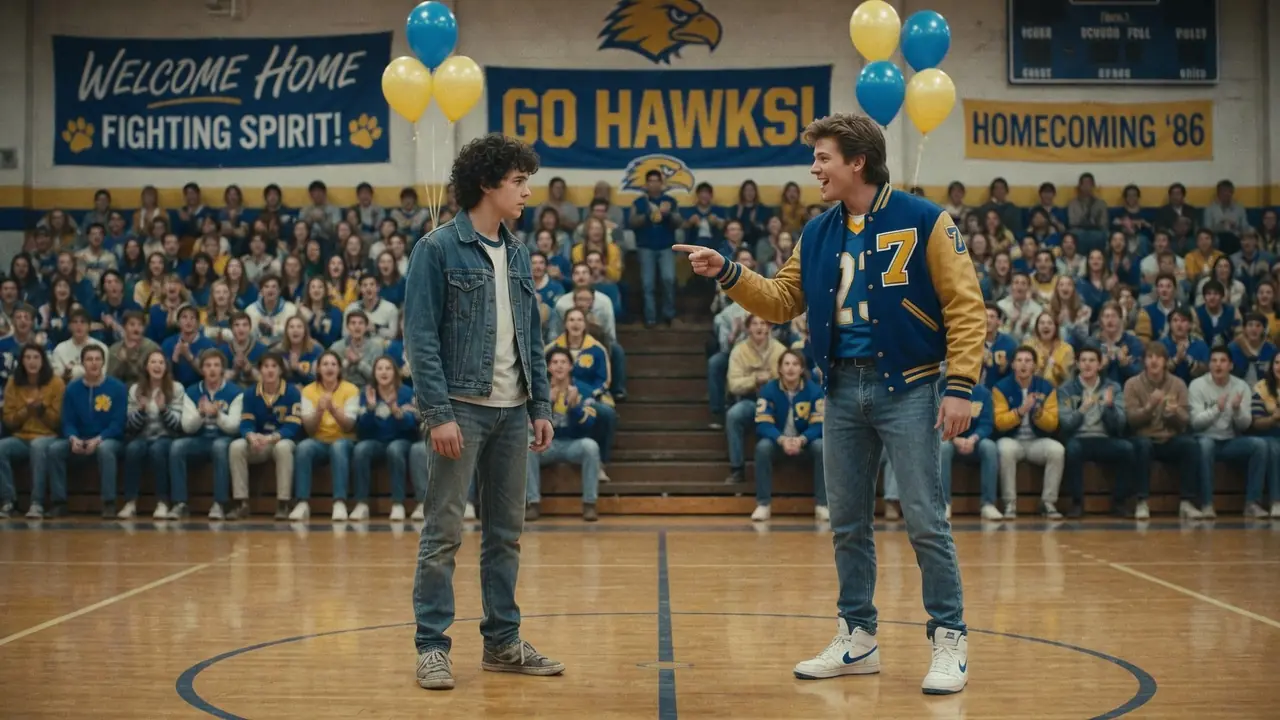
That afternoon, the whole school gathered in the gym for the homecoming pep rally. Blue and gold balloons hung from the bleachers. The marching band sat near the wall with trumpets shining under the lights. Cheerleaders practiced near center court, and teachers tried to keep the senior section from shaking the bleachers too hard. The gym smelled like popcorn, sweat, floor polish, and teenage excitement.
Aaron had helped build the wooden backdrop for the pep rally stage. It showed a giant blue eagle, Eastbrook’s mascot, spreading its wings across a painted gold sunrise. He had stayed late two nights cutting, sanding, painting, and lifting panels while his father cleaned nearby. Nobody at school knew Aaron made it, except Ms. Danner, the drama teacher, and his father.
“You built something they’ll all look at,” Raymond had said the night before, standing beside the finished backdrop with his mop in one hand. “That matters, son.”
Aaron had shrugged. “They won’t know it was me.”
Raymond smiled. “You’ll know.”
Now Aaron sat halfway up the bleachers, watching students cheer in front of the backdrop he had built. His hands rested on his knees. He tried to feel proud, but Brent and his friends were only two rows below him, laughing loudly with the football team. Every few minutes, Brent looked back, noticed Aaron, and smirked.
Beside Brent sat Chase Miller and Ryan Holt, two football players who survived socially by echoing whatever Brent wanted. Chase was big, loud, and quick to shove people in the hallway. Ryan was smaller but meaner with words, the kind of boy who could turn a private insecurity into a public joke. Together, the three of them could make a crowded gym feel like a trap.
The pep rally began with the band blasting the fight song. Students stood, clapped, shouted, and stomped their feet until the bleachers trembled. Principal Morgan took the microphone and gave a speech about pride, teamwork, and tradition. Then the cheerleaders performed, the dance team followed, and the student council announced the homecoming court.
Brent walked onto the gym floor when his name was called for homecoming king candidate. The senior section exploded. He smiled like he owned not only the gym, but every voice inside it. He waved at the crowd, then looked directly at Aaron in the bleachers.
Aaron looked away.
He hated that looking away felt like losing. He hated that staring back might start something. Most of all, he hated that he still cared what Brent could do in front of a crowd.
After the homecoming court walked off, the student council president announced a series of spirit games. Each grade would send volunteers down to compete in silly challenges. There would be a three-legged race, a tug-of-war, and a relay where students carried balloons across the court without using their hands. The senior section cheered louder with every announcement.
Aaron stayed seated. He never volunteered for public games. Crowds made mistakes feel permanent.
Then Brent stood and turned toward him. “Hayes!” he shouted.
Aaron’s stomach tightened.
Brent grinned down at the gym floor, then back at Aaron. “You should go down there. They need someone good with cleaning up messes.”
Chase laughed. Ryan slapped the bleacher seat. A few students nearby turned around, interested. Aaron kept his face still.
“Leave him alone,” a girl behind Aaron muttered. Her name was Leah Parker, a senior from his English class. She had short brown hair, sharp eyes, and the kind of courage that came out quietly but clearly. Aaron had never spoken much to her, but she often sat near him in class and passed him notes when he missed something on the board.
Brent heard enough to smirk. “Relax, Leah. I’m just showing school spirit.”
A few students laughed. Brent’s smile tightened. He looked from Leah back to Aaron, and Aaron could see the decision form in his eyes. Brent had been embarrassed, and now he needed someone else to pay for it.
The next game was announced as the “Eagle Pride Challenge.” Two students from each grade had to race across the gym, put on oversized mascot gloves, grab a foam football, and throw it through a decorated hoop. It was silly, harmless, and exactly the kind of thing Brent could turn into a stage.
The junior class sent two volunteers. The sophomores sent two. Then the seniors started chanting Brent’s name. He stood with fake modesty, lifted both hands, and jogged down to the court. Principal Morgan laughed into the microphone. “Of course, Mr. Calloway wants in.”
Brent took the microphone from the student council president. “I’ll do it,” he said. “But I want Hayes as my partner.”
Aaron froze.
The gym turned toward him.
For a moment, he could hear only the band members shifting in their seats and the buzz of the lights above the court. Brent stood below, smiling up at him with a microphone in his hand. “Come on, Aaron. Don’t be shy. Show us that Hayes family work ethic.”
Laughter scattered through the bleachers.
Aaron did not move. His legs felt locked. He could refuse. He should refuse. But refusing would become its own joke, and Brent knew it. The whole school was watching, waiting to see if the janitor’s son would stay seated.
Leah leaned closer. “You don’t have to go.”
Aaron looked down at Brent, then at the painted eagle backdrop behind him. He had built those wings. He had sanded every rough edge. He had stood in the empty gym with his father at midnight and felt proud of something no one else saw.
His jaw tightened.
“I know,” Aaron said.
Then he stood.
A murmur moved through the gym as he walked down the bleacher steps. Brent clapped slowly into the microphone. “There he is.”
Aaron reached the court and stood beside him. Up close, Brent’s smile looked uglier. Chase and Ryan had come down too, pretending to help with the game equipment. Aaron saw Ryan’s phone already in his hand, camera pointed casually toward the court.
Principal Morgan looked slightly uncertain now. “All right, gentlemen, keep it fun.”
Brent smiled. “Always.”
The game began. The first pair raced across the court, stumbled into the oversized gloves, and missed the foam football throw three times. Everyone laughed in a friendly way. The second pair did better. Then it was Aaron and Brent’s turn.
Aaron tried to focus on the rules. Run to the cone. Put on the gloves. Pick up the foam football. Throw it through the hoop. That was all. Simple.
The whistle blew.
Brent exploded forward with athletic ease. Aaron ran after him, not as fast but steady. They reached the gloves at almost the same time. Brent shoved one glove onto his hand, then “accidentally” stepped on Aaron’s glove before Aaron could pick it up.
Aaron tugged. The glove stayed pinned under Brent’s sneaker.
“Problem?” Brent asked loudly.
The crowd laughed.
Aaron looked at him. “Move your foot.”
Brent lifted his foot slowly, still smiling. Aaron grabbed the glove and put it on. By then, Brent had already picked up the foam football. Instead of throwing it through the hoop, he turned and tossed it at Aaron’s chest.
Aaron caught it awkwardly with the oversized glove.
“Come on, Hayes!” Brent shouted. “Do something useful!”
Aaron heard Chase laughing behind him. Ryan’s phone was raised now, recording openly. The teachers near the scorer’s table watched with uncomfortable smiles, unsure whether to step in because everyone was still pretending this was a game.
Aaron turned toward the hoop and threw the ball. It missed left.
Brent groaned dramatically and put both hands on his head. “Man, even the janitor’s kid can’t clean up.”
This time, the laughter was louder.
Aaron took off one oversized glove and let it fall to the floor. He felt heat in his face and pressure behind his eyes, but he refused to look humiliated. Brent stepped closer, lowering his voice while keeping the microphone near enough to catch some of it.
“What’s wrong, mop boy? Big crowd too much for you?”
Aaron looked at the microphone in Brent’s hand. Then he looked up into the bleachers, where hundreds of students were watching. Some laughed. Some looked away. Leah stood near the front of the senior section, her face tight with anger.
Aaron said, “Give me the mic.”
Brent blinked, then laughed. “What?”
“Give me the mic.”
The gym quieted just enough for the words to spread.
Brent’s grin returned. “You want to speak? This should be good.” He held the microphone out, but when Aaron reached for it, Brent pulled it back like he had done with the foam football. A few students laughed again.
Something in Aaron went still.
For two years, he had let Brent decide when the joke started and when it ended. He had let him turn hallways, classrooms, and lunch tables into stages. But this was different. This gym floor had his work on it. His father was somewhere in the building, probably near the back hallway, making sure the evening custodial crew had supplies. Brent was not only mocking Aaron anymore. He was mocking the man who worked nights so Aaron could graduate.
Aaron stepped forward and took the microphone from Brent’s hand.
He did not yank wildly. He did not shove. He simply gripped it firmly and pulled. Brent, surprised by the calm force, lost hold of it.
The gym went silent.
Aaron brought the microphone to his mouth. His hand shook slightly, but his voice did not.
“You know what’s funny, Brent?” he said.
Brent stared at him, no longer smiling.
Aaron looked around the gym. “My dad cleaned this floor last night. He stayed here until after eleven because the booster club spilled soda near the entrance and someone tracked mud all the way across the court. He cleaned it so all of you could come in today and pretend school spirit means something.”
Nobody moved.
Aaron continued. “My dad empties your trash. He fixes things you break. He unlocks doors when teachers forget keys. He cleans locker rooms after games where people like you get cheered for making a mess.” His voice grew stronger. “And you think that makes him small?”
Brent’s face changed color.
Aaron turned toward the bleachers. “Some of you laugh when Brent calls me mop boy. Some of you look away because you don’t want him turning on you. I get it. I’ve looked away too.” He swallowed, then looked back at Brent. “But my father’s work has more dignity than every cheap joke you’ve ever made.”
A murmur rose through the gym. This time, it was not laughter.
Brent stepped closer, his jaw tight. “Give me the mic.”
Aaron did not move. “No.”
The word landed cleanly.
Brent’s eyes flashed. He reached for the microphone, but Aaron pulled it back. Brent shoved him hard in the shoulder.
The gym erupted with gasps.
Aaron staggered one step but stayed upright. Principal Morgan started forward. Coach Daniels from the football staff shouted Brent’s name. But Brent was too angry to stop. He grabbed Aaron by the front of his shirt and leaned close, forgetting the microphone still pointed between them.
“You don’t get to embarrass me in my gym,” Brent hissed.
Aaron looked at him, calm now in a way that felt almost strange. “It was never your gym.”
Brent swung his arm to shove him again.
Aaron moved first.
He caught Brent’s wrist, turned his shoulder, and used Brent’s forward force against him. It was a clean, controlled move his father had taught him after a group of boys cornered him outside freshman year. Aaron did not hit wildly. He did not lose control. He twisted out of Brent’s grip, stepped aside, and swept Brent’s balance from under him.
Brent hit the gym floor on his back with a loud thud.
For one impossible second, the entire school froze.
The football captain, the homecoming king favorite, the boy who made hallways move around him, was lying on the polished floor his jokes had mocked.
Aaron stood over him, breathing hard, microphone still in one hand. Brent stared up, stunned more than hurt. His perfect confidence had cracked in front of everyone.
Aaron spoke into the microphone one last time.
“Don’t put your hands on me again.”
The words echoed through the gym speakers.
Then the applause started.
It began in the senior section, where Leah stood clapping with both hands above her head. Then others joined. A few juniors stood. The band members began clapping with their instruments in their laps. Within seconds, the sound rolled across the gym like thunder.
Principal Morgan reached Aaron and gently took the microphone, but her face showed she understood exactly what had happened. Coach Daniels helped Brent sit up, though his expression was not sympathetic. Chase and Ryan stood near the sideline, their confidence gone. Ryan had stopped recording.
Brent pushed himself to his feet, face burning red. “He attacked me!”
Leah shouted from the bleachers, “You shoved him first!”
Another student yelled, “We all saw it!”
Then someone near the front added, “And Ryan recorded it!”
Ryan shoved his phone into his pocket too late.
Principal Morgan’s voice cut through the noise. “Everyone, sit down.” The gym slowly obeyed, though the energy did not disappear. She turned to Brent. “Office. Now.” Brent’s mouth opened. “But he—”
“Now,” she repeated.
Coach Daniels pointed toward the side doors. Brent stormed off the court, humiliated and furious, with Chase and Ryan following under a teacher’s watch. Aaron expected to be sent after them immediately, but Principal Morgan turned to him first.
“Are you hurt?” she asked quietly.
Aaron shook his head. “No.”
She looked at him for a long moment, then nodded. “Come with me, please. We need to document this properly.”
As Aaron walked off the court, the applause returned, softer this time but still real. He did not raise his hands. He did not smile like a champion. He looked once toward the back of the gym and saw his father standing near the open doorway.
Raymond Hayes held a mop handle in one hand.
He had seen everything.
Aaron’s throat tightened. He expected worry, maybe disappointment, maybe the old warning about not letting small people make him act smaller. But Raymond looked at his son with wet eyes and lifted his chin in a small nod.
Pride.
That nearly broke Aaron more than the humiliation had.
In the office, the story came out in pieces. Principal Morgan reviewed Ryan’s video, then asked for statements from teachers, students, and Coach Daniels. The video showed Brent stepping on Aaron’s glove, mocking him, refusing to give him the microphone, shoving him, grabbing his shirt, and trying to shove him again. It also showed Aaron defending himself with control and stepping back after Brent fell.
Brent tried to say he had been joking. For once, no one accepted that as an explanation.
By Monday, the entire school knew what had happened. The video had spread, but not in the way Brent wanted. Students replayed Aaron’s speech, especially the line about his father’s work having more dignity than Brent’s jokes. Someone printed it and taped it inside a locker. Someone else wrote it on a whiteboard before first period.
Aaron hated the attention at first. He hated walking through the hallway while people looked at him like he was suddenly new. But the looks were different now. Some were respectful. Some were embarrassed. Some came from students who had laughed before and did not know how to apologize.
Leah found him near the woodshop before English class. “You okay?” she asked.
Aaron nodded. “Mostly.”
“That was brave.”
He looked down. “I was angry.”
“Sometimes brave and angry show up together.”
Aaron smiled faintly. “That sounds like something from a poster.”
Leah shrugged. “Then maybe posters finally got one right.”
Brent was suspended from the homecoming game and removed from the homecoming court. His father complained to the school board, but the video made it difficult to pretend Brent was the victim. Coach Daniels announced a new team conduct policy, and the football players spent Monday practice cleaning the gym bleachers with the custodial crew.
That part became the talk of the school.
Aaron did not see it happen, but his father told him about it that night over dinner. Raymond sat at their small kitchen table, still in his work pants, stirring a bowl of soup.
“Brent Calloway cleaned gum off the bottom row today,” he said.
Aaron looked up. “Seriously?”
Raymond nodded. “Didn’t enjoy it much.”
Aaron almost smiled. “Good.”
His father studied him. “You know, I never wanted you to feel like you had to fight because of me.”
Aaron’s smile faded. “I didn’t only do it because of you.”
“I know.”
Aaron looked at his hands. “I did it because I was tired of pretending it didn’t hurt.”
Raymond was quiet for a moment. Then he reached across the table and placed his rough hand over Aaron’s. “That kind of tired is real, son. I’m sorry you carried it alone.”
Aaron swallowed hard. “I didn’t want to make your job harder.”
Raymond’s face softened. “My job is work. You telling the truth is not a burden.”
Those words stayed with Aaron all week.
Homecoming Friday came with colder air, a gray sky, and a football stadium full of restless students. Brent was not allowed to dress for the game, and for the first time in years, Eastbrook played without its favorite star. The team still won by six points. The crowd cheered, the band played, and afterward, students flooded the field.
Aaron did not go at first. He planned to leave through the side gate and wait for his father near the service entrance. But Leah found him standing behind the bleachers.
“You’re doing the thing,” she said.
“What thing?”
“Leaving before anyone can decide whether you belong.”
Aaron looked toward the field, where students were laughing under the stadium lights. “Maybe I don’t like crowds.”
Leah smiled. “Nobody likes crowds all the time. Come on.”
She pulled him gently toward the field. Aaron followed, uncertain but willing. A few students nodded as he passed. One football player, Marcus Reed, stopped him near the sideline.
“Hey,” Marcus said. “What Brent did was messed up.”
Aaron nodded. “Yeah.”
Marcus shifted awkwardly. “We should’ve said something earlier.”
Aaron looked at him. “Yeah.”
Marcus accepted that without defending himself. “We’re going to be better.”
Aaron did not know whether that was true, but he appreciated that Marcus did not ask to be praised for saying it. “Then be better,” Aaron said.
Marcus nodded and returned to his teammates.
Two weeks later, Principal Morgan asked Aaron if he would speak at a school assembly about respect and dignity in work. Aaron said no immediately. Speaking once in anger was different from walking onto a stage on purpose. But Ms. Danner, the drama teacher, asked him to think about it differently.
“You built the backdrop for the pep rally,” she said, standing in the woodshop doorway. “Everyone saw it, but they didn’t know your hands made it. Sometimes a voice is like that too. People benefit from it without knowing who had to build it.”
Aaron leaned against a workbench. “I’m not a speaker.”
“No,” Ms. Danner said. “You’re a builder. So build the speech like you build everything else. One honest piece at a time.”
He hated how much sense that made.
The assembly happened in early November. The gym looked different without balloons and streamers. Students sat by grade level, teachers stood along the walls, and the giant eagle backdrop was gone, replaced by a plain blue curtain. Aaron waited near the side doors with a folded page in his hand.
His father stood at the back of the gym in his work uniform. He had asked if Aaron wanted him to change clothes before coming. Aaron said no. He wanted the school to see him exactly as he was.
Principal Morgan introduced the assembly, then talked about respect as something shown through behavior, not slogans. Coach Daniels spoke briefly about the football team and accountability. Then Aaron’s name was called.
Walking to the microphone felt harder than standing up to Brent had. There was no anger to carry him forward this time. Only truth.
Aaron unfolded the paper.
“My father cleans this school,” he began.
The gym settled immediately.
“Most of you know that now. Some of you knew it before. A few of you used it like a joke.” He looked across the bleachers, not searching for Brent, though he knew Brent was there. “For a long time, I stayed quiet because I thought silence was dignity. I thought if I didn’t react, cruel people wouldn’t win.”
He paused.
“But silence doesn’t always protect dignity. Sometimes it just protects the people who keep disrespecting it.”
Teachers along the wall grew very still.
Aaron looked down at his paper, then back up. “There is nothing embarrassing about honest work. There is nothing small about cleaning a floor, fixing a sink, emptying trash, building a stage, serving food, driving a bus, stocking shelves, or doing any job that helps other people live their lives. The embarrassment belongs to anyone who looks at that work and sees someone beneath them.”
His voice strengthened.
“I used to think I was defending my father by ignoring the jokes. But I was really letting other people decide what his work meant. My father’s work means sacrifice. It means love. It means showing up after everyone leaves and making the place ready for people who may never say thank you.”
A few students looked toward the back of the gym, where Raymond stood with his hands folded in front of him.
Aaron continued. “I’m not proud that I had to defend myself physically. I wish Brent had stopped when I said no. I wish teachers had stepped in sooner. I wish students hadn’t laughed at jokes they knew were cruel.” He took a breath. “But I am proud that I stopped pretending disrespect was harmless.”
The gym was silent now.
“If you remember one thing, remember this. A person’s worth is not measured by who gets cheered for under bright lights. Sometimes the most honorable person in the building is the one cleaning those lights after everyone else goes home.”
For a moment, nobody moved.
Then Leah stood and clapped.
The applause spread slowly at first, then faster, until the entire gym was on its feet. Students turned toward the back, where Raymond stood frozen, overwhelmed. Teachers clapped. The band clapped. Even some football players stood with heads bowed slightly, as if they finally understood the weight of what they had laughed at.
Aaron stepped away from the microphone, his eyes burning.
Principal Morgan did not rush to speak. She let the applause last.
After the assembly, students approached Aaron and his father. Some apologized. Some thanked Raymond. Some were awkward, repeating simple words like “respect” and “sorry” because they did not know what else to say. Raymond accepted each apology with quiet grace.
Brent did not approach that day.
He came the following week.
Aaron was in the woodshop after school, sanding the edge of a bookshelf for the English classroom. The room smelled like sawdust and varnish. Rain tapped against the high windows. He heard the door open and looked up.
Brent stood there without his varsity jacket.
Aaron set down the sandpaper. “What do you want?”
Brent looked uncomfortable. Without his friends, without the gym, without the roar of the crowd, he seemed less like a villain and more like a boy who had run out of places to hide from himself.
“I need to apologize,” Brent said.
Aaron waited.
Brent swallowed. “For the pep rally. For what I said about your dad. For the stuff before that.” His voice was stiff, but not mocking. “It was wrong.”
Aaron leaned against the workbench. “Why did you do it?”
Brent’s face tightened. “Because people laughed.”
“That’s not why,” Aaron said. “That’s what you got from it.”
Brent looked down at the floor. For a moment, anger flashed in his face, but it faded. “Because I liked feeling bigger than somebody.”
The honesty surprised Aaron.
Brent continued, quieter now. “And because you never acted like you cared. So I told myself it didn’t matter.”
Aaron’s expression hardened. “That was convenient.”
“Yeah,” Brent said. “It was.”
The rain filled the silence between them.
Aaron said, “I’m not going to tell you it’s fine.”
Brent nodded. “I know.”
“I’m not forgiving you today.”
“I know that too.”
Aaron studied him. “Then what are you asking for?”
Brent looked toward the unfinished bookshelf. “Coach says making it right means doing something that costs you time.” He shifted awkwardly. “Ms. Danner said you needed help building shelves for the classroom library.”
Aaron almost laughed. “You want to help me build shelves?”
“No,” Brent admitted. “But I’m here.”
That answer was honest enough to matter.
Aaron handed him a piece of sandpaper. “Start with the rough edges.”
Brent took it. He looked at the wood, then at Aaron. “Seriously?”
Aaron nodded. “That’s where everybody starts.”
For the next hour, they worked mostly in silence. Brent was bad at sanding. He pressed too hard, rushed the motion, and had to redo one entire side because he scratched the grain. Aaron corrected him without cruelty. Brent listened without snapping back.
It did not make them friends. It did not erase two years. But it changed something in the room. Brent was doing quiet work with no applause, and Aaron understood that this was the first useful thing Brent had done for him.
By winter, Eastbrook felt different in small ways. Students greeted Raymond by name instead of walking around him like furniture. The football team had a rotating volunteer schedule to help custodial staff after big games. Some students treated it like punishment at first, but others began to understand how much invisible work held the school together.
Aaron still heard whispers sometimes. Not everyone changed. Some people only learned to hide their cruelty better. But the open laughter had faded, and when someone made a joke about custodians, another student usually shut it down.
Leah started sitting with Aaron at lunch. Then Marcus joined. Then two students from woodshop. The table near the cafeteria windows became a strange mix of people who did not quite fit anywhere else but fit well enough together. Aaron spoke more there than he did in most classes.
One afternoon, Ms. Danner entered Aaron’s bookshelf in a district student craftsmanship showcase. Aaron protested that it was just a shelf. Ms. Danner said, “Good. Then it should be easy for judges to recognize excellent work when they see it.”
The shelf won first place.
Aaron’s father took a picture of him beside it in the school lobby, holding the certificate with an embarrassed smile. Brent walked past with two teammates and paused.
“Nice work,” Brent said.
Aaron looked at him, surprised.
Brent nodded toward the shelf. “Seriously.”
“Thanks,” Aaron said.
There was no joke. No audience performance. Just two words that landed cleanly and left without demanding anything.
By spring, Aaron had applied to a technical college with a strong construction management program. His father helped him fill out financial aid forms at the kitchen table, reading each line carefully. When the acceptance email came, Raymond shouted so loudly that the laundromat owner downstairs banged on the ceiling.
Aaron laughed until his eyes stung.
At graduation, Eastbrook held the ceremony on the football field under a clear evening sky. Students crossed the stage in blue gowns, families cheered from folding chairs, and the band played slightly off-key near the track. Aaron sat with his class, feeling the strange weight of ending something that had hurt him and shaped him at the same time.
When his name was called, he walked across the stage to louder applause than he expected. Leah cheered. Marcus whistled. Ms. Danner clapped with both hands above her head. At the back of the audience, Raymond stood in his best shirt, crying openly and not caring who saw.
Aaron accepted his diploma and looked out over the crowd.
For years, he had moved through Eastbrook trying not to become a target. Now he saw the building differently. The gym where Brent humiliated him had become the place where Aaron found his voice. The hallways his father cleaned had become proof that dignity could survive disrespect. The woodshop had become a doorway to his future.
After the ceremony, families gathered for photos near the field. Brent approached Aaron near the fence, graduation cap in hand.
“Congratulations,” Brent said.
“You too.”
Brent looked toward Raymond, who was speaking with Coach Daniels. “Your dad’s a good man.”
Aaron held his gaze. “I know.”
Brent nodded slowly. “I should’ve known earlier.”
“Yeah,” Aaron said. “You should’ve.”
Brent accepted that. Then he offered his hand. Aaron looked at it for a moment before shaking it once. Not forgiveness wrapped in a bow. Not friendship. Just acknowledgment that the past had been named, and neither of them could pretend it had not happened.
That night, after the celebration, Aaron and his father returned to Eastbrook one last time. Raymond had left his jacket in the custodial office, and Aaron offered to walk in with him. The school was quiet, the hallways dim, the trophy cases reflecting thin strips of light.
They passed the gym doors. Aaron stopped.
Inside, the floor shone under the low lights. The bleachers were folded back. The court looked peaceful without students, balloons, or noise. Aaron stepped inside and stood near center court, where Brent had fallen months earlier and where Aaron had finally stopped swallowing his own voice.
Raymond joined him. “You okay?”
Aaron nodded. “Yeah.”
His father looked around the gym. “I used to worry this place was teaching you to feel small.”
Aaron smiled faintly. “It tried.”
Raymond looked at him. “But?”
Aaron glanced at the polished floor, then at the empty bleachers. “But you cleaned it too well. I could see myself.”
Raymond laughed softly, then pulled his son into a hug. For a moment, they stood together in the quiet gym, father and son, custodian and graduate, two people whose worth had never depended on who recognized it.
Years later, Eastbrook students still talked about that homecoming pep rally. Some remembered Brent hitting the floor. Some remembered Aaron’s speech. Some remembered the way the whole gym stood for Raymond Hayes. But the people who truly understood the story remembered something deeper.
They remembered that a boy who had been mocked for his father’s work stood in front of the entire school and gave that work its rightful name.
Dignity.
They remembered that the janitor’s son did not become powerful because he knocked a bully down. He became powerful because he refused to let cruelty define the people he loved.
And long after Aaron graduated, whenever students walked across the shining gym floor at Eastbrook High, most of them never thought about who cleaned it.
But some did.
Some remembered.
And that made all the difference.