The woman did not even slow down.
That was the first thing Mrs. Dorothy Mae Lawson remembered.
Not the splash of dirty water.
Not the sharp scrape of the metal bucket sliding across the marble floor.
Not even the burning insult that followed.
It was the way the young woman kept walking, as if the mess she had made no longer belonged to her the second it touched someone poorer.
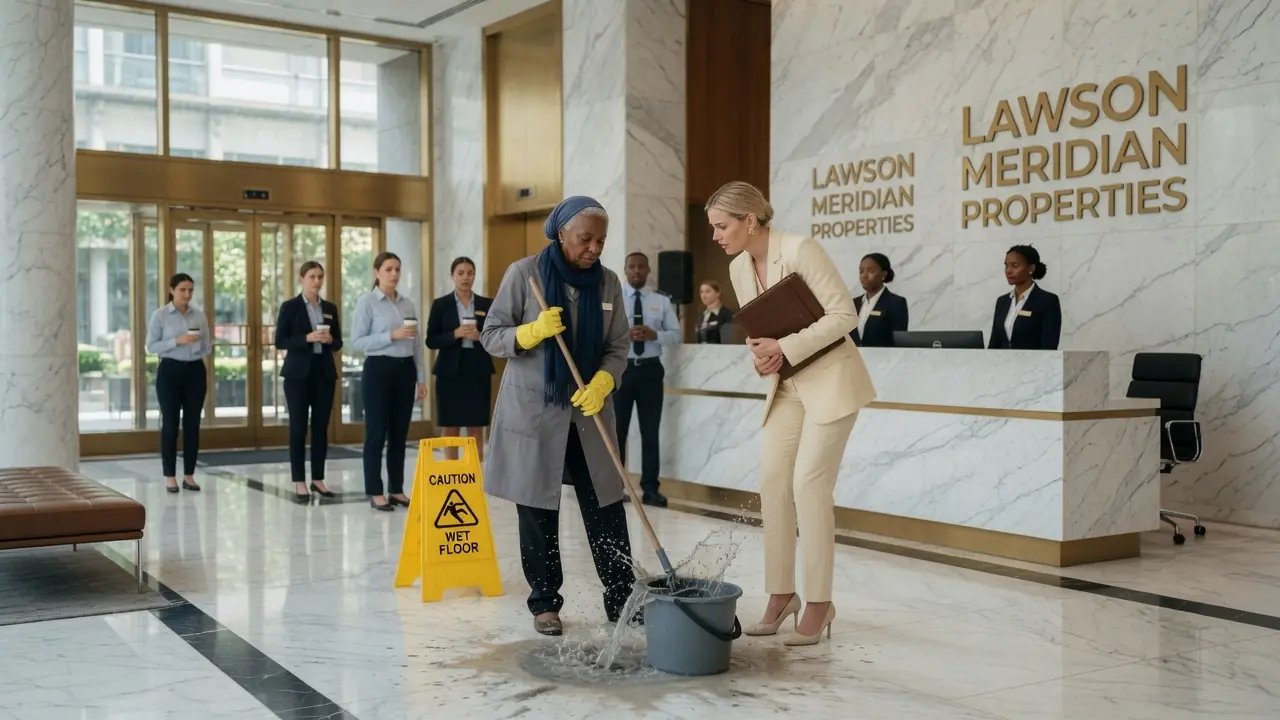
Her cream-colored heel struck the mop bucket so hard it tipped sideways and rolled once before hitting the wall. Gray water spilled across the lobby floor, running over Dorothy’s black work shoes and spreading toward the polished brass legs of the reception desk.
Dorothy reached for the handle, but the woman was already looking down with disgust.
“Oh my God,” she snapped. “Can you people not leave your trash in the middle of the hallway?”
The lobby went quiet.
Not fully silent.
No public place ever becomes fully silent. There was still the soft hum of the elevators, the faint music from the speakers, the sound of a receptionist tapping one key and then stopping.
But the people heard her.
You people.
Trash.
Dorothy was seventy years old, a Black woman with warm brown skin, silver hair tucked beneath a plain navy scarf, and hands that had spent most of their life working before the sun rose. She wore a gray janitorial coat, rubber gloves, and flat shoes with worn soles. She had been mopping the east side of the lobby since six that morning because one of the planters near the entrance had leaked dirt and water across the marble.
She had placed a yellow wet-floor sign beside her bucket.
The woman had walked straight past it.
Now she stood there in a pale blazer, tailored pants, and gold earrings that caught the overhead lights. She held a leather portfolio tight against her chest. Everything about her said she had practiced being impressive.
Dorothy looked at the spilled water.
Then at the woman.
“I’ll clean it up,” she said quietly.
The woman gave a short laugh.
“You should. Someone important could slip.”
Then she turned and continued toward the executive elevators.
Her heels clicked across the floor.
Sharp.
Certain.
Unbothered.
The receptionist, a young woman named Alicia, looked as if she wanted to say something but could not find the courage fast enough.
The security guard shifted behind the front desk.
Two junior employees near the coffee bar stared down into their cups.
Everyone had seen it.
Nobody had stopped it.
Dorothy bent slowly, one hand braced against her knee. At seventy, the body did not forgive sudden movement the way it used to. She set the bucket upright, gathered the mop, and began cleaning the same floor again.
Alicia hurried over.
“Mrs. Lawson, I’m so sorry.”
Dorothy did not look up.
“What are you sorry for, baby?”
Alicia froze.
Dorothy wrung out the mop.
“For what she said?”
“That’s hers to carry.”
Alicia’s eyes filled.
“I should’ve said something.”
Dorothy looked at her then.
Her face was gentle, but her voice held weight.
“Yes. You should have.”
The words were not cruel.
That made them harder.
Alicia lowered her eyes.
Dorothy went back to the floor.
The young woman who had kicked the bucket had already disappeared into the elevator, probably checking her reflection in the mirrored doors, probably thinking about interview answers, salary, stock options, office views.
Not anymore.
Twenty-eight years earlier, Dorothy had been exactly that.
A night cleaner.
A widow with two children.
A woman who took three buses across Chicago in January because the office tower paid fifty cents more per hour than the hotel downtown. She cleaned bathrooms after executives left parties. She emptied trash from conference rooms where men discussed million-dollar deals and left half-eaten steak on paper plates. She vacuumed under desks where young consultants kicked off shoes that cost more than her rent.
Back then, people rarely learned her name.
Some called her “ma’am” when they were raised right.
Some called her “cleaning lady.”
Some did not call her anything.
But Dorothy listened.
That was something people forgot about invisible women.
They heard everything.
She heard how managers spoke when the boardroom doors closed. She heard who lied to clients, who protected workers, who blamed assistants, who took credit for work they did not do. She found discarded memos in trash bins and read them before shredding. She learned contracts from old drafts. She learned budgets from printed spreadsheets. She learned power by watching how people used it when they thought no one beneath them mattered.
At night, after her cleaning shift, she took classes at a community college.
Accounting first.
Then business management.
Then real estate law.
She failed a course once and cried in the bathroom, then retook it the next semester and passed with the highest grade in the class. She saved money. Lost money. Saved again. Bought a small building on a street nobody wanted. Fixed the wiring. Rented it out. Bought another.
Years went by.
Her children grew.
Her hands stayed rough.
Her back grew stiff.
But the woman who had once cleaned offices began owning them.
Now Lawson Meridian Properties owned twelve commercial buildings across three states, including this one. The silver letters above the revolving doors did not say her full name because Dorothy had never liked showing off.
Lawson Meridian.
That was enough.
Most people in the building knew Mrs. Lawson as the founder.
A few knew she still liked to visit properties quietly before major decisions.
Only her closest staff knew that once a year, before final interviews for senior leadership roles, she put on a janitorial coat and spent one morning working in the lobby.
Not to trick people.
To see them.
People revealed themselves around workers they believed could not affect their future.
Dorothy finished mopping the spill. She replaced the wet-floor sign exactly where it had been before. Then she wheeled the bucket through a side corridor into a private service restroom.
Inside, she locked the door.
She removed the rubber gloves and washed her hands slowly under cold water. In the mirror, the janitor’s scarf framed a face lined by years of labor, grief, motherhood, and survival.
She unbuttoned the gray cleaning coat.
Underneath, she wore a soft white blouse, a dark green suit jacket, and a strand of pearls her late husband had bought from a pawnshop for their twenty-fifth anniversary. She removed the scarf, shook out her silver curls, and pinned them back neatly.
Then she reached into the small cabinet by the sink and took out her lipstick.
A deep berry shade.
Her daughter called it “boardroom red.”
Dorothy applied it carefully.
Not because she wanted revenge.
Revenge was too small for what the morning had become.
She wanted clarity.
The final candidate for Director of Operations was waiting upstairs.
Her name was Natalie Whitmore.
Excellent resume.
High-ranking business school.
Three major companies.
Two international restructuring projects.
Glowing references from people who probably never asked how she treated the receptionist.
Dorothy took the private elevator to the twenty-fifth floor.
When the boardroom doors opened, Natalie Whitmore was seated near the far end of the table, arranging her notes with the polished calm of a woman who believed the worst part of her day was already behind her.
Six executives sat around the table.
Human Resources.
Finance.
Legal.
Facilities.
Dorothy’s son, Marcus Lawson, who served as Chief Operating Officer.
And one independent board adviser.
The assistant stepped aside.
“Mrs. Lawson,” she said.
Natalie looked up.
For half a second, her expression remained pleasant and prepared.
Then her face changed.
The color drained from her cheeks so quickly that even Marcus noticed.
Dorothy walked to the head of the table and sat down.
“Good morning, Ms. Whitmore.”
Natalie stared at her.
Her mouth opened slightly.
Then closed.
“Good morning,” she said.
The words came out thin.
Dorothy placed a folder on the table.
“I believe we met downstairs.”
Natalie’s hand tightened around her pen.
The boardroom shifted.
People looked from Dorothy to Natalie.
Natalie forced a smile.
“I’m sorry. I don’t believe so.”
Dorothy looked at her for a moment.
That was the thing about lies. They were often most visible when dressed as politeness.
“No?” Dorothy asked.
Natalie swallowed.
“This is a very busy building. I may have passed you without realizing.”
Marcus leaned back in his chair.
His face gave nothing away, but Dorothy knew her son. He had already understood enough to be angry.
Dorothy opened the file.
“Then let’s begin with a question.”
Natalie sat straighter, grateful for the chance to return to interview language.
“Of course.”
“The Director of Operations oversees nearly nine hundred employees across our properties. That includes reception, maintenance, security, custodial teams, building engineers, supply workers, and administrative staff. Tell us about a time you showed respect to someone whose job gave them no power over you.”
Natalie blinked.
“I’m sorry?”
“It’s a simple question.”
“I treat everyone with respect.”
“Everyone?”
“Yes.”
Dorothy nodded.
“Even janitors?”
The room became still.
Natalie’s neck flushed.
“I believe every role in an organization is valuable.”
“That sounds practiced,” Dorothy said. “I asked for truth.”
Natalie glanced around the table.
“I’m not sure I understand the direction of this question.”
Dorothy pressed a button on the small remote beside her folder.
The screen behind Natalie lit up.
Security footage appeared.
The lobby.
The mop bucket.
The wet-floor sign.
Natalie’s cream heel striking the bucket.
Water spilling.
Her mouth moving.
Then the audio played clearly.
“Can you people not leave your trash in the middle of the hallway?”
The footage stopped.
No one spoke.
Natalie sat frozen.
Her face had gone pale except for two red patches high on her cheeks.
The head of HR, Caroline Price, slowly lowered her pen.
Marcus looked at Natalie with open disgust now.
Dorothy folded her hands.
“Would you like to explain?”
Natalie took a breath.
“It was a stressful moment. I had an important interview, and I was focused. I didn’t realize—”
“That I owned the company?” Dorothy asked.
Natalie’s eyes widened.
“No, that isn’t what I meant.”
“Then what did you mean?”
Natalie looked down.
The room waited.
That waiting was important.
Dorothy had learned long ago that people often confessed more honestly into silence than accusation.
Natalie’s voice dropped.
“I was rude.”
Dorothy said nothing.
“I was dismissive.”
Still nothing.
Natalie swallowed.
“And I was cruel.”
Dorothy’s expression did not change.
“What else?”
Natalie’s eyes filled, but she blinked the tears back.
“I saw a Black woman in a janitor’s uniform and decided she didn’t matter to me.”
The words sat in the room like something heavy finally set down.
Dorothy nodded once.
“That is the first honest thing you’ve said since I walked in.”
Natalie pressed her lips together.
“I am sorry.”
“Are you sorry because you were caught, or because you recognized yourself?”
Natalie flinched.
“I don’t know,” she whispered.
That answer surprised Dorothy.
It surprised the room too.
Natalie closed her eyes for a second.
“I want to say the right thing. I know what the right thing sounds like. But if I’m honest, I think I’m ashamed because I got caught first. The rest is catching up.”
Marcus frowned.
Caroline’s expression softened slightly.
Dorothy studied Natalie.
There was fear there.
But maybe something else beneath it.
Not yet remorse.
Maybe the beginning of it.
Dorothy leaned back.
“Your resume is excellent.”
Natalie looked up, confused by the shift.
“Thank you.”
“Your references are strong. Your numbers are impressive. Your restructuring experience is real.”
Natalie did not speak.
“But if I hired you today into authority, every person below you would pay for the parts of yourself you have not faced.”
Natalie’s eyes lowered.
“And I will not do that to my people.”
The phrase my people landed differently coming from Dorothy.
Not staff.
Not labor.
Not headcount.
People.
Natalie nodded slowly.
“I understand.”
“No,” Dorothy said. “You are beginning to.”
She closed the folder.
“The senior role is no longer available to you.”
Natalie’s face tightened, but she did not protest.
That was wise.
Dorothy continued.
“I am, however, prepared to offer you a different choice.”
Everyone looked at her.
Marcus turned his head sharply.
“Mother.”
Dorothy lifted one finger slightly.
He stopped.
Natalie looked uncertain.
“What choice?”
“A six-month operations fellowship. Entry level. No executive title. No private office. You will report to Facilities and HR. Your first project will be a full review of custodial wages, supply contracts, safety procedures, break rooms, promotion pathways, and complaint protections across our properties.”
Natalie stared at her.
“You’re offering me a job?”
“No,” Dorothy said. “I am offering you work. Do not confuse the two.”
Natalie’s mouth trembled.
Dorothy continued.
“You will apologize to the lobby staff. Not by email. Not through HR. In person. You will apologize to Alicia. To security. To the custodial team. And you will clean the mess you created, if they choose to let you.”
Natalie nodded.
“I will.”
“If you make yourself the victim of your own behavior, the offer is gone.”
“I understand.”
“If you treat this as a redemption performance, the offer is gone.”
Natalie swallowed.
“Yes, ma’am.”
Dorothy held her gaze.
“And if you ever speak to one of my employees that way again, you will not need to wonder whether there is a second chance.”
Natalie nodded again, tears slipping down her face now.
“I understand.”
Dorothy stood.
“Good. The interview is over.”
The boardroom remained quiet after Natalie left.
Marcus waited until the door closed before speaking.
“You should have let her walk out.”
Dorothy gathered her papers.
“I did.”
“You gave her another door.”
“Yes.”
“She called you trash.”
Dorothy looked at him.
“She called a version of me trash. One I know well.”
“That makes it worse.”
“It does.”
“Then why?”
Dorothy was quiet for a moment.
Through the glass wall, she could see Natalie standing in the hallway, wiping her face with the back of her hand like someone who did not want to be seen crying.
“Because punishment is easy when you have power,” Dorothy said. “Discipline is harder.”
Marcus exhaled.
“She may not change.”
“She may not.”
“Then why risk it?”
Dorothy slipped the file into her bag.
“Because if no one had ever given me more than the worst thing I did on my worst day, I would not be sitting at this table.”
Marcus looked away.
He did not agree.
Not fully.
But he understood.
Downstairs, the lobby had already returned to its usual rhythm.
People crossing marble.
Elevators opening.
Phones ringing.
Coffee cups in hand.
The world recovered quickly from moments that wounded other people.
Natalie stood near the reception desk with her blazer folded over one arm. Her cream heels were gone. She held them in one hand. In stocking feet, she looked less like a candidate and more like someone who had finally been forced to feel the floor beneath her.
Alicia stood behind the desk, stiff and guarded.
Rosa, the actual morning custodian, had rolled the mop bucket back out. She was a short Puerto Rican woman in her fifties with strong arms and a face that did not waste expressions.
Dorothy stopped a few feet away.
Natalie turned.
For a second, she looked as if she wanted Dorothy to guide her through it.
Dorothy did not.
Natalie faced Alicia first.
“I owe you an apology,” she said. “You saw what I did, and I put you in a position where speaking up could have cost you comfort at work. I’m sorry.”
Alicia blinked, surprised.
Then Natalie turned to Rosa.
“And I owe you and your team one too. I treated the work like it was beneath me because I thought the person doing it was beneath me. That was wrong.”
Rosa folded her arms.
“Yes, it was.”
Natalie took the hit.
No excuse.
No flinching.
Then she looked at the mop bucket.
“May I clean it?”
Rosa looked at Dorothy.
Dorothy said nothing.
This belonged to Rosa now.
After a long pause, Rosa handed Natalie the mop.
“Wet-floor sign first,” she said.
Natalie nodded.
She set the sign down carefully.
Then she began cleaning.
Badly.
Too stiff.
Too much water.
Wrong pressure.
Rosa corrected her.
“Not like that. You’re just pushing dirty water around.”
Natalie stopped, listened, and tried again.
People passed through the lobby.
Some looked.
Some whispered.
No one laughed.
Dorothy watched from near the reception desk.
There was no pleasure in it.
That mattered.
Revenge would have made the moment smaller.
This felt uncomfortable, unfinished, human.
Six months later, Natalie Whitmore was still at Lawson Meridian.
She did not become Director of Operations.
She worked from a shared office near Facilities, answering to people who did not care where she went to school. Her first few weeks were ugly. Not dramatic ugly. Real ugly. The kind made of awkward silences, mistrust, and the slow humiliation of realizing nobody owed her quick forgiveness.
Custodial staff avoided her at first.
Security watched her.
Alicia was polite and nothing more.
Rosa called her “Miss Heels” for three months.
Natalie accepted it.
She showed up for night shifts to observe cleaning crews.
She learned which gloves split under chemical use.
She learned the supply closet on the ninth floor had poor ventilation.
She learned two buildings had no proper break room for contracted cleaners.
She learned night staff were excluded from promotion notices because the emails went out when they were sleeping.
She learned that “operations” sounded clean in a boardroom because other people absorbed the dirt.
Slowly, she fixed what she could.
Not loudly.
Not with speeches.
With revised contracts.
Better gloves.
Working carts.
Clearer complaint channels.
Paid training.
Language access for safety manuals.
Promotion boards placed where night staff could actually see them.
The first time Rosa asked her for a printed copy of a policy draft, Natalie nearly cried.
She waited until she was in the bathroom.
That was another thing she learned.
Not every feeling needed an audience.
At the end of six months, Natalie returned to the boardroom.
This time, she wore a plain black suit and low shoes.
No leather portfolio.
Just a folder with marked-up pages, handwritten notes, and coffee stains.
Dorothy sat at the head of the table.
Marcus sat beside her.
Natalie presented for forty minutes.
No buzzwords.
No polished nonsense.
Just facts.
Custodial turnover had dropped.
Supply costs had risen slightly, but injury reports had fallen.
Night staff engagement had improved.
Three internal promotions had been approved.
Two vendor contracts had been rewritten.
One property manager had been disciplined for retaliating against a cleaner who filed a complaint.
When Natalie finished, she did not look proud.
She looked tired.
Good work often made people tired before it made them proud.
Dorothy read the final page.
“This is solid.”
Natalie nodded.
“Thank you.”
“What did you learn?”
Natalie did not answer right away.
Dorothy appreciated that.
“I learned that I wanted power because I was afraid of being invisible,” Natalie said. “But I was so busy trying to never be looked down on again that I became someone who looked down first.”
The room stayed quiet.
Natalie continued.
“I also learned that respect is not a value if it only appears when someone important enters the room.”
Dorothy closed the folder.
“That is worth knowing.”
Natalie looked at her.
“I’m sorry for what I said to you.”
“You already apologized.”
“I know. I still am.”
Dorothy held her gaze.
This time, the apology did not reach for rescue.
It simply stood there.
That was better.
A year after the lobby incident, Lawson Meridian changed its leadership hiring process.
Every finalist for an executive position had to spend one full shift alongside hourly workers before the final interview. Not watching from a distance. Working where appropriate. Listening where work required skill they did not have. Writing down what they learned and what policies made that work harder.
Some candidates withdrew.
Dorothy considered that useful information.
At the annual company meeting, she spoke from the stage beneath soft lights.
She did not tell the mop bucket story.
She did not believe in turning shame into entertainment.
Instead, she said, “A company is not judged by how executives behave in front of investors. It is judged by how people are treated when no one thinks the treatment will matter.”
In the back of the room, the custodial team stood beside security, reception, maintenance, and building engineers.
For once, they had been invited as part of the company rather than background support for it.
Natalie stood near Rosa.
Rosa whispered something.
Natalie smiled.
Not too much.
Just enough.
Later that evening, after most people had gone, Dorothy walked through the lobby alone.
The marble floor shone under the warm lights.
A mop bucket stood near the far wall.
A yellow wet-floor sign sat properly in front of it.
Dorothy paused.
For a moment, she saw herself at thirty-nine, back aching, hands cracked from chemicals, uniform damp, invisible to people whose trash she emptied.
Then she saw herself at seventy, brown hands steady around a mop handle, listening to a woman call her trash.
Then she saw Natalie, months later, sitting with night cleaners at midnight, writing down every word as if finally understanding that listening was also labor.
Marcus stepped out of the elevator and joined her.
“You still thinking about her?”
Dorothy smiled faintly.
“I think about everybody.”
“That sounds exhausting.”
“It is.”
He looked toward the mop bucket.
“You were right.”
Dorothy glanced at him.
“About Natalie?”
“About giving her work instead of just punishment.”
Dorothy’s expression softened.
“She did the work.”
“She did.”
They stood together for a while.
The lobby was quiet now.
Just the hum of the building settling into evening.
Marcus said, “Does it still hurt? What she said?”
Dorothy considered lying.
Then decided against it.
“Yes.”
He looked at her.
She touched the pearls at her throat.
“But not the way it would have when I was young.”
“Why?”
“Because now I know trash is what people call things they do not understand the value of.”
Marcus smiled sadly.
“And you?”
Dorothy looked up at the silver Lawson Meridian letters behind the reception desk.
“I learned my value before she entered the room.”
The next morning, Dorothy came into the lobby in her usual suit.
No janitor’s coat.
No test.
Just herself.
Rosa was mopping near the entrance. Alicia was arranging visitor badges. Security was changing shifts.
Natalie came in through the revolving doors with coffee in one hand and a stack of folders in the other. She saw Rosa’s wet-floor sign, stepped carefully around it, and paused.
“Morning, Rosa.”
Rosa looked up.
“Morning, Miss Clipboard.”
Natalie smiled.
“Need help moving those boxes later?”
Rosa studied her.
“Maybe.”
That was not friendship.
Not yet.
But it was something real.
Natalie walked toward the elevators.
Then she saw Dorothy.
She stopped.
“Good morning, Mrs. Lawson.”
“Good morning, Ms. Whitmore.”
Natalie glanced once at the mop bucket.
Just once.
Then she looked Dorothy in the eye.
Not above her.
Not through her.
At her.
Dorothy gave a small nod.
Natalie stepped into the elevator.
The doors closed.
Alicia came around the desk and stood beside Dorothy.
“She’s different now,” the young receptionist said.
Dorothy watched the elevator numbers rise.
“She is becoming different.”
Alicia smiled.
“That sounds like something you’d say.”
Dorothy laughed softly.
“It is.”
Then she looked at the lobby.
At the clean floor.
At the people moving through it.
At the wet-floor sign everyone now walked around.
A year earlier, a woman had kicked a mop bucket and called a Black janitor trash.
Twenty minutes later, she discovered the janitor owned the building.
But that was not the most important part of the story.
The most important part was not the reveal.
Not the embarrassment.
Not even the second chance.
The most important part was the question left behind for everyone who had seen it.
Who do you become when you think the person in front of you has no power?
Dorothy Mae Lawson already knew her own answer.
She had known it before the bucket fell.
Before the insult.
Before the elevator carried Natalie upstairs.
A title could open doors.
Money could buy buildings.
But character was still revealed in the hallway, before anyone important was watching.