I came home early to surprise my wife, thinking I would find Rachel in the kitchen with flour on her cheek and music playing too loudly from the old speaker by the sink.
Instead, I found her clothes scattered across the staircase.
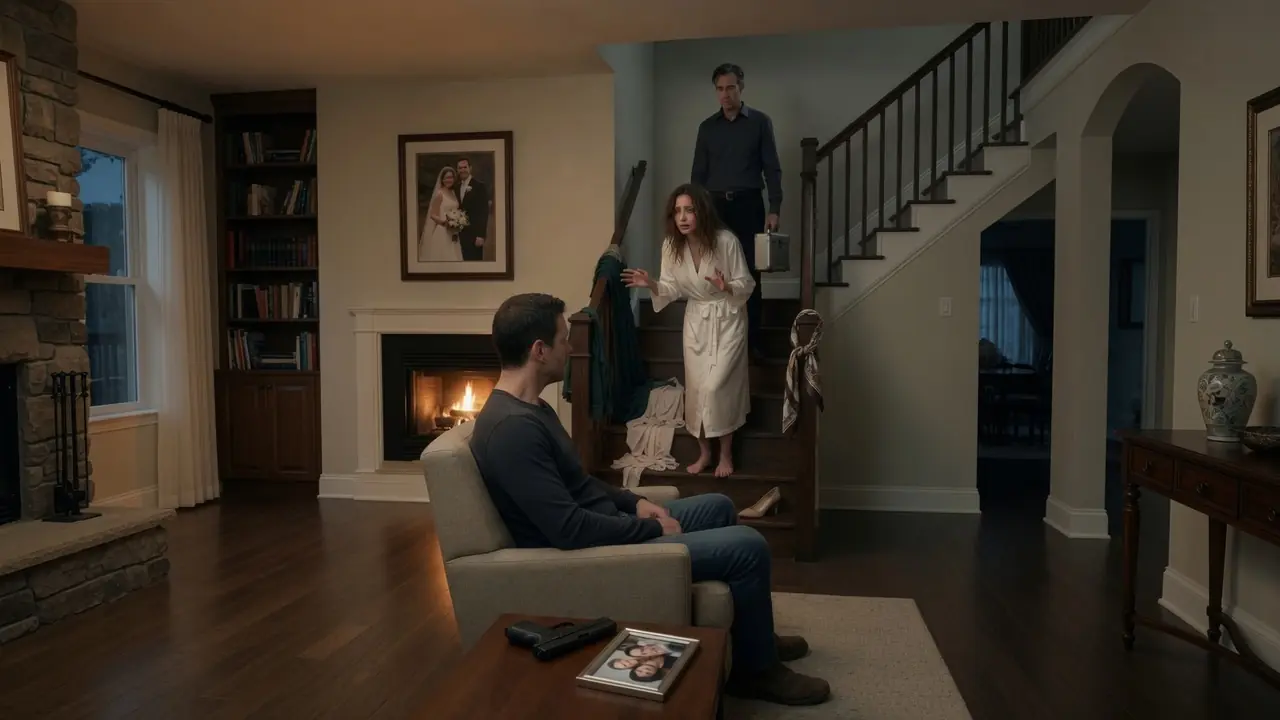
Her green dress hung from the banister like it had been pulled off in a panic. One heel lay upside down on the fourth step. A silk scarf I had given her for our anniversary was twisted around the railing, the way fabric looks after someone has grabbed it and let go too fast.
For a few seconds, I stood in the entryway of our house in Brighton, Colorado, holding a paper bag of groceries and a small box of cupcakes from the bakery she loved.
Outside, the late October wind pushed dry leaves across the driveway. Somewhere beyond our fence, a dog barked. A neighbor’s garage door groaned open, then closed.
Normal sounds.
Normal street.
Normal house.
Except inside, every ordinary noise had gone missing.
I set the groceries on the kitchen counter.
The cupcakes stayed in my hand a moment longer before I placed them beside the sink.
Chocolate with salted caramel frosting.
Her favorite.
I had come home early because my meeting in Denver ended ahead of schedule. I thought I would walk in, hold up the cupcakes, and watch her pretend not to be excited.
I thought maybe we would eat dessert before dinner like irresponsible newlyweds, even though we had been married seven years.
Instead, I stood at the foot of the stairs and looked at my wife’s dress hanging from the railing.
“Rachel?” I called.
No answer.
My voice sounded too loud in the hallway.
I took one step toward the stairs.
Then a man’s voice drifted down from above.
“Stay where you are, Daniel.”
I froze.
The voice was calm.
Too calm.
And it knew my name.
For one impossible second, my mind tried to arrange the scene into something I could understand. Rachel’s clothes on the stairs. A strange man upstairs. Our bedroom door closed. His voice steady, almost familiar, like he had been waiting for me longer than I had been alive.
My hand tightened around the stair rail.
“Who the hell are you?”
There was a pause.
Then Rachel’s voice came from behind our bedroom door.
“Daniel, please don’t come up.”
That was the part that turned my anger into something colder.
Not her clothes.
Not the man.
Her voice.
She sounded terrified.
Not guilty.
Terrified.
“Rachel,” I said slowly, “come downstairs.”
“I can’t.”
The man spoke again.
“She can. But if she does, you need to listen before you decide what you saw.”
I laughed once.
It came out sharp and ugly.
“What I saw? I came home to my wife’s clothes on the stairs and a man in my bedroom.”
The bedroom door opened.
Rachel stepped into the hallway wearing my old navy robe. Her hair was loose and tangled around her face. She was barefoot. Her eyes were red, but not from crying over shame.
From fear.
Behind her stood a man I had never seen before.
He was tall, maybe forty-five, with graying dark hair and a face that looked carved by sleepless years. He wore a black coat and held a metal case in one hand.
He did not look like a lover.
That should have comforted me.
It did not.
Rachel gripped the robe closed at her throat.
I stared at her.
“What he brought?”
The man came one step into the light.
“My name is Isaac Ward.”
The name meant nothing to me.
He opened the metal case.
Inside was not jewelry.
Not money.
Not love letters.
There was an old hospital bracelet resting on faded blue cloth. Beside it lay a black-and-white photograph of a little boy sitting on a porch step, holding a toy airplane in both hands.
The boy had dark hair, serious eyes, and a small crescent-shaped scar under his chin.
My scar.
The one my mother said I got falling from a swing when I was three.
At the bottom of the case lay a brass key, a folded newspaper clipping, a tiny silver rattle, and a cassette tape labeled in handwriting I recognized so suddenly that my stomach dropped.
For Daniel, if God lets the truth outlive me.
I gripped the banister.
“That’s my father’s handwriting.”
Isaac Ward looked at me.
“Yes.”
Rachel covered her mouth with one hand.
I looked again at the photograph.
The boy on the porch had my eyes.
Not similar.
Mine.
I stepped up one stair without thinking.
Isaac closed the case halfway.
“Careful.”
The word snapped my attention back to him.
“You walk into my house, stand upstairs with my wife, and tell me to be careful?”
“I did not walk in uninvited,” he said. “Rachel let me in.”
I looked at her.
She nodded, tears slipping down her face.
“I was going to tell you tonight.”
“Tell me what?”
Her lips trembled.
“That I don’t think your parents are your parents.”
The sentence entered the house and changed every wall.
For a moment, nothing moved.
Not me.
Not her.
Not the stranger holding a box full of my childhood.
Outside, a car rolled slowly past our front window, tires crunching over dry leaves.
“My parents live fifteen minutes from here,” I said. “My father is buried at St. Mark’s. My mother had dinner with us last Sunday.”
Rachel flinched.
“I know.”
“My name is Daniel Price.”
Isaac’s voice was quiet.
“Your name used to be Benjamin Ward.”
I looked at him.
The rage came back then, fast and hot, because fear needed something to wear.
“Get out.”
Rachel stepped forward.
“Daniel—”
“Both of you. Downstairs. Now.”
Isaac did not move.
Instead, he took the newspaper clipping from the case and held it open.
The headline was old, the paper yellowed.
THREE-YEAR-OLD BENJAMIN WARD PRESUMED DEAD AFTER FARMHOUSE FIRE.
The date beneath the article was October 22, 1991.
October 22.
Today.
I stared at the date until it blurred.
Then I looked at the calendar hanging on our kitchen wall below us.
Rachel had circled the date in red.
Under it, in her handwriting, were four words:
Tell him before dinner.
I turned back to her.
“You circled today?”
She nodded.
“Why?”
“Because today is the date in the clipping.”
“You knew this and didn’t tell me?”
“I was trying to be sure.”
“Sure of what? That my whole life was a lie?”
Her face crumpled.
“Yes.”
The answer was so honest it hurt worse.
Isaac came down two steps, slowly, keeping one hand visible.
“There is a DNA test in the case,” he said. “Sibling probability over ninety-nine percent.”
Sibling.
The word had no place in my house.
I was an only child.
I had always been an only child.
I had photographs of birthday cakes with one name written in blue icing. One stocking on the mantel before Rachel. One bicycle in the garage. One school picture clipped to the fridge.
Only child.
My mother said God had given her one son and made him enough.
I looked at Isaac’s face again.
The line of his jaw.
The slope of his nose.
The way his left eyebrow sat slightly higher than the right.
Mine did that too.
“No,” I said.
It was not an argument.
It was all I had.
Rachel came down one step.
“The hospital bracelet has the name Benjamin Ward on it. Your delayed birth certificate was issued when you were five, not at birth. Your childhood medical records before age four are missing. When I asked your mother for family history because of the baby, she panicked.”
I stopped breathing.
“The baby?”
Rachel’s hand went to her stomach before she could stop it.
That motion split the room open.
The anger, the clothes on the stairs, the man in the bedroom, the metal case, the old newspaper—all of it shifted around one impossible word.
Baby.
“What baby?” I asked.
Rachel started crying harder.
“I was going to tell you tonight.”
My grip tightened on the banister.
“How long?”
“Ten weeks.”
The house seemed to tilt backward.
Ten weeks.
A child.
Our child.
The surprise I should have received over dinner, maybe with the cupcakes sitting between us. Rachel smiling nervously. Me staring at an ultrasound picture like a fool. Both of us laughing and crying because that was what the moment deserved.
Instead, she stood on the stairs in my robe while a stranger held the life I had never been told belonged to me.
“I asked your mother for family history,” Rachel said. “Just in case. Heart conditions. Blood disorders. Anything we should know. She got angry.”
“My mother gets overwhelmed.”
“No,” Rachel said. “This was different. She said, ‘That child does not need old ghosts.’”
I closed my eyes.
I could hear her saying it.
Evelyn Price.
My mother.
Soft hair. Church perfume. Hands that shook when she was upset. A woman who saved every birthday card and refused to throw away chipped mugs because “things can still be useful after they’re damaged.”
That child does not need old ghosts.
I opened my eyes.
“And then?”
“She called your uncle Martin.”
A cold line moved down my back.
Martin Vale was not really my uncle by blood. He was my father’s best friend. The kind of man you called uncle because he appeared in every memory.
Uncle Martin taught me to ride a bike.
Uncle Martin took me fishing after my father died.
Uncle Martin walked Rachel down the aisle when her own father refused to attend our wedding.
“He called me ten minutes later,” Rachel said. “He asked why I was upsetting Evelyn. But I had not told him I called her.”
I looked toward the front window.
A black truck sat across the street.
Engine running.
I had not noticed it when I came in.
Isaac saw me see it.
“That truck has been there since before you got home.”
My mouth went dry.
“Martin drives a black truck.”
Isaac’s expression tightened.
“Martin Vale is the reason I stopped using my real last name.”
I looked back at him.
“What does that mean?”
“It means the man you call uncle was the last person seen near the farmhouse before it burned.”
Something in my mind flashed.
Not memory.
Sensation.
Smoke.
Cold dirt under bare feet.
A woman screaming a name that was not Daniel.
Benjamin.
I staggered backward.
Rachel moved toward me.
I lifted one hand to stop her.
Not because I hated her.
Because if she touched me, I might fall apart before I understood what was happening.
Isaac placed the metal case on the coffee table at the bottom of the stairs.
“The tape explains part of it.”
I looked at the cassette.
My father’s handwriting.
For Daniel, if God lets the truth outlive me.
My father had been dead eight years.
Cancer.
Three months from diagnosis to funeral.
At the end, he kept trying to say something when the morphine wore thin. My mother always leaned over him and whispered, “Rest, Tom. Rest.”
I thought she was being gentle.
Maybe she had been keeping him quiet.
A knock sounded at the front door.
Three soft taps.
Then Martin’s voice came through the wood.
“Danny? You home?”
No one moved.
Rachel’s face went white.
Isaac reached into his coat.
“Don’t,” I said sharply.
He stopped, but his eyes stayed on the door.
Martin knocked again.
“Your mom’s had a spell. She needs you.”
Every instinct inside me rose.
My mother.
Sick.
Calling for me.
I took one step toward the door.
Rachel whispered, “Call her.”
I turned.
“She could be hurt.”
“Then call her first.”
Martin’s voice came again.
“Danny. Open up.”
Something in the tone had changed.
Not worried.
Commanding.
I pulled out my phone and dialed my mother with shaking hands.
She answered on the first ring.
“Daniel?”
Her voice was breathless.
“Mom, are you okay?”
Silence.
Then she whispered, “Where are you?”
“At home.”
Another silence.
“Is someone there?”
My eyes moved to Isaac.
“Yes.”
She began crying.
“Do not listen to him.”
I had not said him.
The room went cold.
“Mom,” I said, “how do you know it’s a man?”
She sobbed once.
“Because Martin called.”
The front doorknob turned.
Locked.
Martin knocked harder.
“Danny, now.”
Isaac moved to the side window and looked through a gap in the curtain.
“He is not alone.”
Rachel came down the stairs, clutching the robe closed.
“Daniel,” she said, “please step away from the door.”
My mother whispered through the phone, “I loved you. Whatever they tell you, I loved you.”
The past tense cracked something in me.
“Who am I?” I asked.
She made a broken sound.
Then the call ended.
Martin knocked one last time.
Hard.
Then footsteps moved across the porch.
A moment later, the black truck pulled away from the curb.
The silence after it left was worse than the knocking.
I stood in the middle of my living room, phone in hand, while my wife cried beside the stairs and a man who might be my brother watched me like he had already lived through the moment I was entering.
Isaac picked up the cassette player from the case.
It was small, old, and scratched along one side.
“My mother kept this,” he said. “After she died, I found the case in her storage unit. I have been looking for you for eleven months.”
“Your mother.”
“Our mother.”
The words made my skin tighten.
“What was her name?”
“Clara Ward.”
Nothing moved.
No face.
No voice.
No mother named Clara.
But when he said the name, something deep inside me answered with an image I could not hold.
Hands dusted with flour.
A yellow kitchen.
A woman singing off-key while rain hit a tin roof.
Rachel stepped beside me.
She did not touch me.
I was grateful and hurt by that at the same time.
Isaac put the tape in the player.
“Before I press play, you should know something,” he said. “The man you called father may not sound like the villain you need him to be.”
I looked at him.
“You knew my father?”
“No.”
“Then don’t tell me who he was.”
Isaac’s jaw tightened.
Fair enough.
He pressed play.
For a moment, there was only static.
Then my father’s voice filled the room.
Older than I remembered.
Rougher.
Alive in a way that made my knees nearly give.
“Daniel,” he said on the tape, “if you are hearing this, then I failed to bury the truth deep enough.”
Rachel covered her mouth.
I sat down because my legs stopped working.
My father breathed unevenly on the recording.
“Your name was Benjamin Ward. You were three years old when you came into our house. Evelyn wanted to go to the police. I wanted to go to the police. Martin told us the police were already bought.”
The tape hissed.
“He said your mother had stolen money from dangerous men. He said the fire was not an accident. He said if we returned you, they would kill you too.”
Isaac stared at the player.
His face looked carved from grief.
My father continued.
“I was a coward dressed as a protector. That is the truth. We kept you. We told ourselves love made it right. Love does not make theft clean.”
I pressed my fist against my mouth.
Rachel was crying openly now.
“I loved you like my own son,” my father said. “But that is another true sentence hiding a wicked one. You were never mine to keep.”
My chest hurt.
The tape crackled.
“If Isaac finds you, listen but verify. If Martin is alive, do not trust him. There is a key in the case. Box 219 at First Federal. Inside is Clara Ward’s ledger and the original documents Martin made me hide. Do not give them to police until you know who signed the incident report in 1991.”
There was a pause.
Then my father’s voice broke.
“And forgive Evelyn if you can. She spent her life loving you and fearing the day love would look like guilt.”
The tape clicked.
Stopped.
The room was silent.
For a long time, nobody moved.
Then Rachel’s phone buzzed from the stairs.
She looked toward it.
It buzzed again.
She went slowly, picked it up, and stared at the screen.
Her face changed.
“Rachel?” I said.
She turned the phone toward us.
There was a photo attached from an unknown number.
A picture of our living room.
Taken from above.
All three of us were visible.
Me sitting on the sofa.
Rachel near the stairs.
Isaac beside the coffee table.
The open metal case between us.
Below the image was one sentence.
Tell Benjamin the baby is why we waited.
Rachel dropped the phone.
Isaac moved first.
He scanned the corners of the room, the smoke detector, the bookshelf, the wedding photo over the fireplace.
The wedding photo.
It was crooked.
It had not been crooked when I left that morning.
I stood slowly.
“Daniel?” Rachel whispered.
I crossed the room, lifted the frame from the wall, and found a shallow cut in the drywall behind it.
Inside was a second case.
Smaller.
Newer.
I opened it with hands that no longer felt like mine.
Inside was a flash drive, a folded ultrasound photo, and a note in my father’s handwriting.
My father had been dead eight years.
The note had only six words.
If Rachel is pregnant, trust no one.
Behind me, Rachel made a sound like she had been struck.
Isaac took one step back.
For the first time since I heard his voice upstairs, he looked afraid.
Then the cassette player clicked by itself.
The tape began turning again.
My father’s voice returned, lower now, almost a whisper.
“Daniel, if the second case has opened, then Martin was never the closest danger.”
The words froze the room.
Rachel turned toward Isaac.
Isaac turned toward me.
And somewhere inside the walls of my own house, a phone began to ring.
Not my phone.
Not Rachel’s.
An old landline ring.
One we had not had connected since we bought the house.
It rang again.
Shrill.
Hidden.
Impossible.
Rachel whispered, “We don’t have a house phone.”
I followed the sound to the hallway closet.
Behind the coats.
Behind the vacuum.
Behind a loose panel I had never noticed.
There was a black phone mounted to the wall, its cord plugged into a line that disappeared through a hole drilled into the baseboard.
It rang a third time.
Isaac whispered, “Do not answer that.”
I picked up the receiver.
A man breathed on the other end.
Then Martin’s voice said softly, “Hello, Benjamin.”
My hand tightened around the phone.
Rachel began shaking her head.
Isaac stepped toward me.
Martin continued.
“I know you have the cases. I know Isaac is there. I know Rachel thinks she is protecting you.”
I said nothing.
He laughed quietly.
“You always were a polite boy.”
I forced my voice steady.
“What do you want?”
“What I have always wanted,” he said. “For you to live.”
“You expect me to believe that?”
“No,” Martin said. “I expect you to listen because your wife is carrying the only bloodline Clara Ward’s enemies never managed to erase.”
Rachel gripped the hallway wall.
“Leave her out of this,” I said.
“She put herself in it when she started asking questions.”
Isaac grabbed the phone from my hand.
“What happened to Clara?” he demanded.
The line went silent.
Then Martin said, “Isaac. Still chasing ghosts with a maimed hand.”
Isaac went pale with rage.
“What happened to our mother?”
Martin’s voice cooled.
“Ask Daniel’s wife what she found at Riverside Bank.”
Rachel froze.
I looked at her.
“What does he mean?”
She shook her head, tears spilling.
“I didn’t want to tell you until I understood.”
Martin chuckled through the line.
“Always the noble wife. Always one secret behind the truth.”
I stared at Rachel.
“What did you find?”
She pressed both hands to her stomach.
“A second name,” she whispered. “In the ledger copy.”
“What name?”
She looked at Isaac.
Then at me.
“Evelyn Price.”
My mother.
The woman who raised me.
The woman who answered the phone crying and said she loved me.
I took the receiver back.
“What did she do?” I asked Martin.
He sighed, almost sadly.
“She did what mothers do when men make the world too dangerous. She chose the child she could save.”
Before I could speak, the line clicked dead.
The dial tone filled the closet like a scream with no voice.
I stepped backward.
Rachel reached for me.
This time, I let her touch my arm.
Not because I forgave her silence.
Because I needed something real.
Isaac shut the metal case with a sharp click.
“We go to the bank now.”
“No,” I said.
Both of them looked at me.
I picked up Rachel’s phone from the floor and looked again at the photo taken from inside my own house.
Then I looked at the ultrasound image in the second case.
A child we had not yet named.
A life already caught in a story older than all of us.
“We go to my mother first.”
Rachel’s face went white.
“Daniel—”
“She knows.”
Isaac shook his head.
“She may be part of it.”
“She is part of it,” I said. “That’s why we go.”
Outside, the wind pushed leaves against the front door.
The house no longer felt like mine.
The walls had been listening.
The past had been living behind photographs and inside dead phone lines.
Rachel took off my robe and stepped into the downstairs bathroom with her dress clutched against her chest. When she came out, her face was pale but set.
“I am coming with you,” she said.
I looked at her.
“You lied to me.”
“I kept something from you because I was afraid of what it would do.”
“That is still a lie.”
“I know.”
Her honesty hurt because I had no room to argue with it.
“I will answer for that,” she said. “But not by letting you walk into this alone.”
Isaac picked up both cases.
“Then we move.”
We left the house through the back door.
Not because I was afraid of the front.
Because whoever had watched us from inside those walls expected us to use it.
The sun had dropped behind the houses, leaving the neighborhood in a blue-gray dusk. The air smelled like dry leaves and distant wood smoke. Our normal street looked the same as it had that morning, before I knew my name might not be mine.
Before I knew my wife was pregnant.
Before I knew a dead man could still warn me from behind a wedding photo.
Rachel slipped her hand into mine.
I almost pulled away.
Then I felt her trembling.
I let her hold on.
Not as forgiveness.
As a promise to survive the next hour.
We crossed the backyard, climbed over the low fence into Mrs. Bell’s side yard, and moved toward Isaac’s car parked two streets over.
As we reached the alley, my phone buzzed.
A message from my mother.
Come alone.
Then another.
Please, Benjamin.
I stared at the name.
Benjamin.
It should have felt foreign.
It did not.
Somewhere deep inside me, behind all the years of being Daniel Price, a child turned his head.
Isaac opened the car door.
Rachel looked at me.
“What did she say?”
I showed her the screen.
Her eyes filled.
“Daniel…”
For the first time, the name sounded like a question.
I looked back toward our house.
The front porch light flickered once.
Then went dark.
Inside me, something old and buried finally understood.
I had not come home early and found my marriage ending.
I had come home early and found the trap before it closed.
And whatever waited at my mother’s house, whatever truth sat inside box 219 at First Federal, whatever Martin had kept alive for thirty years, one thing was certain.
The clothes on the stairs were never the scandal.
They were the bait.
And I had almost become exactly the story someone wanted told.
Jealous husband.
Strange man.
Pregnant wife.
Gun in the living room.
Case closed.
But I had stepped away from the gun.
Rachel had said please.
Isaac had brought the case.
My dead father had left a voice behind.
And somewhere between the man I thought I was and the boy named Benjamin Ward, the truth had finally found its way home.