The lion did not tear Emilia apart.
It lowered its enormous head until its golden mane brushed the blood-dark stone, and in the breathless silence of the square, it pressed its brow gently against her trembling hand.
For one impossible heartbeat, no one understood what they were seeing.
The king’s smile froze.
The crowd went so still that the banners above the palace steps seemed suddenly too loud as they snapped in the hot wind. Mothers clutched children against their chests. Soldiers forgot to stand straight. Nobles leaned forward, faces drained of color beneath their powdered dignity.
Far below, in the pit where thousands had died screaming, Emilia stood barefoot on the stone, her torn dress streaked with dust, her dark hair spilled around her shoulders like a storm cloud.
The largest lion remained bowed before her.
Then the second lion stopped pacing.
The third lion lowered itself to the ground.
The fourth lion, scarred across one eye and feared across the entire kingdom as Redfang, gave a low rumbling sound that made the stones vibrate—then bent its head too.
**All four lions knelt.**
A gasp rose from the crowd, not like fear this time, but like the first crack of thunder before rain.
At the pit gate, the guards had gone white.
One dropped his spear.
Another crossed himself.
The captain of the pit guard stumbled toward the iron lock with shaking hands, fumbling so badly that his key struck sparks against the metal.
“Stop,” the king said.
His voice was not loud.
Yet every guard heard it.
The captain froze, key half-turned.
King Cassian rose from his throne.
He was tall, broad-shouldered, still handsome in the hard, polished way of a blade that had never known mercy. A crown of black gold rested on his dark hair, its points shaped like claws. His cloak, red as fresh blood, trailed over the carved steps behind him.
For twelve years, that cloak had been enough to silence judges, priests, generals, and grieving widows.
But now Cassian’s eyes were fixed on the pit.
Not on the lions.
On Emilia.
“You will not open that gate,” he said.
The captain swallowed. “Your Majesty…”
“I said,” Cassian repeated, each word colder than the last, “you will not open that gate.”
The captain looked down into the pit, where the four royal lions remained bowed.
Then, slowly, with the terror of a man choosing between death and something worse, he finished turning the key.
**The gate opened.**
The sound of iron grinding against stone rolled across the square.
The king’s face changed.
It was only for a second, but Emilia saw it.
Beneath his rage was fear.
Real fear.
Not anger wearing a crown. Not pride offended. Fear so old and deep it looked almost childish.
The largest lion lifted its head and turned toward the open gate. Its amber eyes caught the sun, and for a moment Emilia remembered another pair of amber eyes staring at her through rain years ago, when she had been only nine and foolish enough to believe every wounded thing could be saved.
She had found the cub in a hunter’s trap near the ash woods outside her village.
It had been thin, muddy, and furious, snapping at her with milk teeth while blood darkened the leaves around its paw. Her father, Tomas Vale, had warned her never to approach wild creatures. But Emilia had seen more fear than rage in the cub’s eyes.
So she had whispered, “I know. I know it hurts.”
She had wrapped her apron around its head, pried the trap open with a smith’s bar, and carried it half a mile home while it tried to claw her arms to ribbons.
Her father had stood in the forge doorway, hammer in hand, staring at the cub as though Emilia had dragged home a thunderstorm.
“Emilia,” he had said quietly, “what have you done?”
“I couldn’t leave him.”
Tomas had looked into the cub’s eyes, then at the small crescent-shaped scar on Emilia’s palm, the mark she had carried since infancy.
His face had gone strange.
Not angry.
Not surprised.
Afraid.
That night, while the cub slept beside the hearth with its paw bound in linen, Emilia had awakened to hear her father speaking to someone in the forge.
“She has the mark,” a woman whispered.
“She also has a heart,” Tomas answered. “That is more dangerous.”
“She must be told.”
“Not yet.”
“She is nine.”
“She is alive,” Tomas said, and his voice broke. “Let that be enough for a little longer.”
Emilia had never forgotten those words.
**She is alive. Let that be enough.**
Now, standing inside the royal lion pit twelve years later, she finally understood why her father’s voice had sounded like grief.
The largest lion stepped beside her, shoulder brushing her hip.
The crowd murmured.
Emilia turned toward the stairs leading from the pit.
Her legs hurt from the fall. Her ribs burned. One arm throbbed where stone had scraped the skin raw. But she climbed.
Step by step.
Above her, the kingdom watched.
The lions followed.
The first scream came from a noblewoman when Redfang emerged from the pit behind Emilia, his mane dark with old scars. Soldiers raised spears at once, but none struck. No one dared. The lions did not snarl. They walked like royal guards escorting their queen.
Emilia reached the top of the stairs and stepped into the square.
The sunlight struck her face.
For the first time in months, she breathed open air without chains around her wrists.
King Cassian descended from his throne.
“Enough of this trickery,” he said. “Some village girl feeds beasts scraps through dungeon bars, and fools call it prophecy?”
His voice grew stronger as he spoke, as if rage could rebuild what fear had cracked.
“Seize her.”
No one moved.
Cassian’s eyes snapped toward his soldiers. “I gave an order.”
The captain of the palace guard tightened his grip on his sword. His face was pale beneath his helmet.
“Your Majesty,” he said, “the lions knelt.”
“And?”
The captain’s throat worked. “The old law—”
“The old law is ash,” Cassian snarled. “I am the law.”
A whisper moved through the square.
Not loud. Not organized. But everywhere.
“The old law.”
“The lions knelt.”
“Did you see?”
“All four…”
Cassian heard it too. His jaw clenched.
He turned back to Emilia, and for the first time since she had been dragged into his palace, he did not look at her as a possession denied to him.
He looked at her as an enemy.
“Who are you?” he asked.
Emilia did not answer at once.
Her heart was pounding so hard she could feel it in her injured ribs. Months in darkness had taught her many things: how fear smelled in stone corridors, how hunger made dreams sharp, how silence could become a weapon if held long enough.
But it had not taught her how to stand before an entire kingdom and become something she had never asked to be.
She thought of her father’s forge.
The warm orange light.
The rhythm of hammer on iron.
Tomas guiding her hands when she was small. “Steel remembers, little spark. Strike it carelessly, and the flaw stays hidden until the worst possible moment. Strike it true, and it may hold a kingdom together.”
She had laughed then. “Why would I need to hold a kingdom together?”
He had smiled sadly. “Because some things break before we are born.”
Now Emilia lifted her hand.
The square fell silent.
On her palm, beneath dirt and blood, lay the pale crescent scar she had hidden all her life beneath gloves and soot. It curved around a tiny birthmark shaped like a star.
The old priest near the palace steps gave a strangled sob.
He dropped to his knees.
“The Dawnmark,” he whispered.
The word traveled faster than flame.
“The Dawnmark.”
“She bears the Dawnmark.”
“She is…”
Cassian took one step back.
Emilia’s voice shook when she began, but only for the first few words.
“My name is Emilia Vale,” she said. “I am the daughter of Tomas Vale, blacksmith of Ashmere.”
A faint smile touched her lips, full of pain and love.
“And I am also Emilia Aurelia Solenne, daughter of Queen Maribel and King Rowan, heir of the Dawn Throne.”
The square erupted.
Cries, sobs, shouts, prayers.
Some people fell to their knees. Others clapped hands over mouths as if afraid the truth might escape and be taken away again.
Cassian roared, “Lies!”
But his voice no longer ruled the air.
Emilia turned toward him.
“My father carried me from the burning nursery the night you murdered my parents.”
Cassian’s face twisted. “Your father was a traitor.”
“My father,” Emilia said, and now her voice rang clear, “was a smith who gave up his name, his home, and the woman he loved to keep a baby alive.”
The words struck Cassian harder than accusation.
For an instant his eyes flicked toward the far archway behind the throne.
Emilia saw it.
So did Captain Marek of the palace guard.
So did the priest.
That one glance revealed the last door in the king’s house of lies.
Emilia stepped forward.
“Bring out Tomas Vale.”
Cassian went still.
The crowd quieted again, but this silence was different. It was hungry. Waiting.
“I said,” Emilia repeated, “bring out my father.”
Cassian laughed, but the sound came brittle. “Your village blacksmith? You think I keep every peasant who displeases me in a golden chamber?”
“No,” Emilia said softly. “You keep him below the west tower.”
This time the king could not hide the flicker in his face.
Six months ago, when the king’s soldiers had come for Emilia in Ashmere, Tomas had tried to stop them with a hammer and two apprentices.
He had broken one soldier’s jaw and another’s wrist before they overwhelmed him.
Emilia had screamed as they dragged her toward the wagon. Tomas had been on his knees in the mud, blood running from his temple.
“Do not bow,” he had called to her.
A soldier kicked him silent.
For months, Emilia believed he was dead.
Then, three nights earlier, while she lay in the dungeon waiting for the king’s final sentence, someone had slid a scrap of linen beneath her cell door.
On it, written in charcoal, were five words:
**The west tower still breathes.**
No signature.
No explanation.
But Emilia had known the handwriting.
Not her father’s.
The woman from the forge years ago.
The whisper in the night.
The one Tomas had called “Captain” before he remembered Emilia was listening.
Now Emilia looked at the captain of the palace guard.
Marek was staring at her palm as if the scar had reached inside his chest and broken something open.
“You sent the message,” Emilia said.
His eyes lifted to hers.
“Yes.”
Cassian whirled on him. “You?”
Marek drew his sword.
For one terrible moment, everyone thought he meant to attack Emilia.
Instead, he turned the blade upside down and laid it at her feet.
“My queen,” he said.
Then he knelt.
One by one, the soldiers behind him lowered their spears.
Steel points touched stone.
Cassian backed toward his throne, breathing hard.
“This is madness,” he said. “You kneel to a girl because animals performed a circus trick?”
The old priest rose, his face wet with tears.
“The lions of Solenne kneel only to the blood of the first queen,” he said. “You knew this, Cassian. That is why you starved them before every execution. That is why you killed every keeper who remembered their training. That is why you outlawed the old histories.”
Cassian’s eyes flashed.
“I saved this kingdom from weakness.”
“You drowned it in fear,” the priest said.
A sound rose from the crowd.
Not a cheer.
Not yet.
It was something larger and more dangerous: agreement.
Cassian saw the kingdom slipping from his hands.
So he did what tyrants do when words fail.
He grabbed the nearest guard’s spear and hurled it at Emilia.
The throw was sudden, vicious, and deadly.
Emilia saw the flash of iron too late.
Marek lunged.
The largest lion moved faster.
With a roar that split the square, it leapt between Emilia and the spear. The weapon struck its shoulder and glanced aside, cutting a red line through its golden fur.
Emilia cried out.
“No!”
The lion staggered but did not fall.
Cassian ran for the throne steps, where two loyal black-cloaked guards drew hidden daggers and closed around him.
“Kill her!” he shouted. “Kill anyone who bends!”
The square exploded into chaos.
But fear had ruled the kingdom for twelve years, and fear, once broken, turns quickly.
Mothers who had come to watch death pulled their children behind market stalls. Merchants overturned tables to block palace archers. Prisoners’ families seized dropped spears. Palace soldiers hesitated, then turned on the black-cloaked royal enforcers who had terrorized them for years.
Emilia stood in the center of it, frozen for half a breath by the sight of blood on the lion’s mane.
Then the lion pressed its head against her side.
Not weakly.
Commandingly.
Move.
She understood.
Emilia seized Marek’s sword from the ground.
It was heavier than any hammer, but the grip fit her hand.
Tomas had taught her balance. Not swordplay, not noble dueling, but the honest logic of weight and force.
“Every tool has a truth,” he had said. “Find it, and even a small hand can move iron.”
Cassian’s guards charged.
Marek met the first with a crash of steel.
Emilia ducked beneath the second man’s blade, swung with both hands, and struck his wrist with the flat of the sword. Bone cracked. The dagger fell.
She did not stop.
She ran up the steps after Cassian.
The king reached the throne and seized the crown from his own head, holding it like a weapon. His eyes were wild now, stripped of ceremony.
“You think blood makes a ruler?” he spat. “Your father was beloved and soft. Your mother wasted mercy on traitors. They would have led Solenne to ruin.”
“They led it with open gates and full granaries,” Emilia said, climbing toward him. “You led it with pits.”
Cassian laughed. “People obey pits.”
“No,” Emilia said. “They survive them.”
Behind her, the fighting began to turn. The king’s enforcers, terrifying in alleys and prison corridors, were nothing against an entire square rising at once.
Cassian saw it.
His hand slipped behind the throne.
Emilia remembered his glance toward the archway.
The last door.
The hidden thing.
A panel opened in the stone behind him.
From the darkness emerged a man in chains.
Tomas Vale.
Emilia’s world stopped.
He was thinner than she remembered. His beard had gone white in places. One eye was swollen nearly shut, and iron shackles cut into his wrists. But he stood upright.
He was alive.
Beside him, a black-cloaked guard held a knife to his throat.
Cassian smiled again.
There it was—the king she knew.
The man who found the wound and pressed.
“Drop the sword,” Cassian said.
Emilia’s fingers tightened around the hilt.
Tomas looked at her, and even through bruises, his eyes warmed.
“Little spark,” he said.
Her breath broke.
“Father.”
“Drop it,” Cassian repeated, “or I open him from ear to ear.”
The square quieted in ripples as people noticed Tomas on the steps.
Emilia looked from the knife to her father’s face.
Every lesson he had ever given her rose inside her.
Do not bow.
Steel remembers.
Find the tool’s truth.
But love was not steel.
Love was soft places exposed. Love was terror with a name.
Her sword lowered.
Cassian’s smile widened.
“That is what your mother never understood,” he said. “Every heart is a handle. Find the right one, and anyone can be moved.”
Tomas’s gaze sharpened.
“No, Emilia.”
The guard pressed the knife harder.
A bead of blood slid down Tomas’s throat.
Emilia let the sword fall.
It rang against the steps.
Cassian exhaled like a man tasting victory.
“Good girl.”
Then Tomas smiled.
It was small.
Almost apologetic.
And Emilia suddenly saw what Cassian did not.
Her father’s hands were chained in front of him.
His wrists were bloody.
But his fingers were curled around something small and black.
A smith’s nail.
Not a weapon, not to most people.
But Tomas Vale had once opened a royal nursery lock with less.
He moved.
Not against the guard.
Against the chain.
With a twist of his scarred hands, he drove the nail into the shackle hinge and snapped his wrist downward. The weakened iron burst open.
The guard startled.
Tomas struck backward with his elbow, hard enough to break the man’s nose, then seized the knife hand and turned it aside.
Emilia snatched up the sword.
Cassian grabbed the crown with both hands and swung at her face.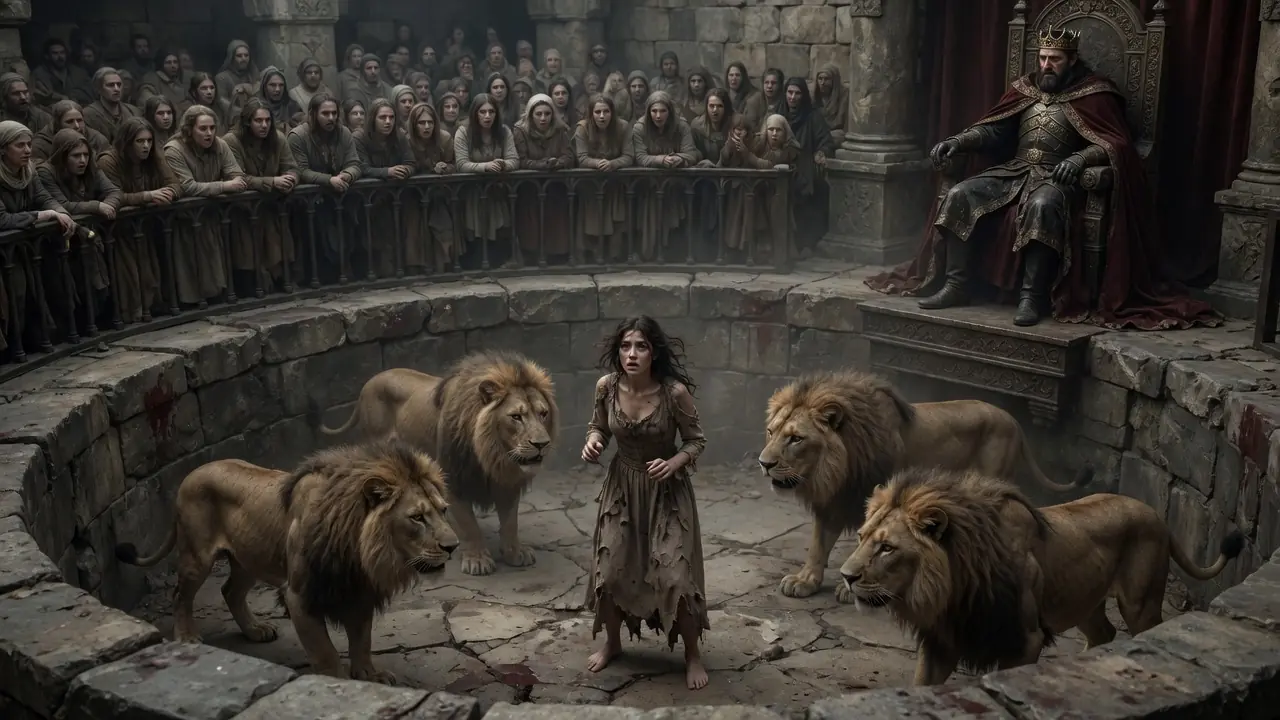
She blocked clumsily. The impact jolted her arms numb.
Cassian was stronger. Fresher. Trained.
He drove her down one step, then another.
“You are nothing,” he hissed. “A blacksmith’s mistake wearing a dead child’s name.”
Emilia slipped on dust and nearly fell.
Below, people shouted.
The wounded lion roared.
Tomas struggled with the guard but could not reach her.
Cassian raised the crown’s jagged points for a final blow.
And Emilia remembered her father holding a horseshoe in firelight.
“The strongest iron is not the hardest,” he had told her. “Hard things shatter. Strong things bend, then return.”
Cassian struck.
Emilia did not block.
She bent.
The crown missed her by a finger’s width and smashed into the stone beside her. One black-gold point lodged between two steps.
Before Cassian could wrench it free, Emilia stepped inside his reach and slammed the pommel of her sword into his chest.
He staggered.
Tomas broke free and tackled the guard.
Marek reached the steps with three soldiers behind him.
Cassian, seeing himself surrounded, ripped the crown loose and backed toward the throne.
“Touch me,” he said, panting, “and you prove you are no better than I am.”
Emilia stood before him, sword in hand, hair wild, dress torn, blood on her palm and dust on her face.
For a moment, the whole kingdom seemed to lean toward her answer.
She thought of the dungeon.
The pit.
The vanished.
The children who had learned not to laugh too loudly in streets.
Then she lowered the sword.
Cassian’s eyes lit with contempt.
But Emilia was not finished.
“I will not kill you in anger,” she said. “I will not make myself your reflection.”
The crowd stirred uneasily.
Cassian smiled.
“Mercy,” he whispered. “Your family disease.”
“No,” Emilia said. “Justice.”
She turned to Marek.
“Open the prisons. Bring the judges he did not execute. Bring the ledgers from the tax vaults, the dungeon records, the names of the missing, and every witness willing to speak.”
Then she looked back at Cassian.
“You wanted the kingdom to witness what happens to those who defy power.”
Her voice grew steady.
“Now it will.”
Marek stepped forward.
Cassian fought like a trapped animal, but three soldiers seized him. The crown fell from his hands and rolled down the steps, clattering once, twice, before stopping at Emilia’s feet.
No one picked it up.
Not yet.
Tomas climbed down to her.
For one suspended second they simply stared at each other.
Then Emilia threw herself into his arms.
He caught her with a sound that was half laugh, half sob. His chains clinked between them. Emilia buried her face against his shoulder, breathing smoke, iron, blood, and home.
“I thought you were dead,” she whispered.
“I promised your mother I would keep you alive,” he said into her hair. “I am stubborn about promises.”
She laughed through tears.
“You should have told me.”
“I know.”
“I was so angry with you.”
“I know.”
“I am still angry.”
“I deserve that too.”
She pulled back and looked at him.
His eyes were full of pride so fierce it hurt.
“But you came,” he said.
“They dragged me.”
“No,” Tomas said softly. “They dragged Emilia Vale. You came as yourself.”
The old priest approached, trembling as he lifted the fallen crown.
A hush fell.
He held it out to Emilia.
“My queen.”
Emilia stared at the crown.
Black gold. Clawed points. Cassian’s shape of power.
She did not touch it.
“Take it away,” she said.
The priest blinked.
“My queen?”
“That crown was made from fear,” Emilia said. “Melt it.”
A murmur passed through the crowd.
Tomas smiled.
Emilia turned to the square, to the people who had been forced to watch her die and had instead seen the world change.
“I was raised in a forge,” she said. “I know what must be done with twisted metal.”
Her voice carried farther now, not because she shouted, but because everyone listened.
“We will melt it. We will mix it with iron from the prison bars. And from it we will make bells.”
Silence.
Then someone in the crowd began to cry.
Not quietly.
Openly.
Another voice shouted, “Bells!”
Then another.
“Bells!”
Soon the word rolled through the square, breaking into cheers.
**Bells from the crown. Bells from the bars. Bells to announce not fear, but freedom.**
The lions roared, and this time the sound did not make the people shrink.
It made them cheer louder.
Weeks later, the trials began.
They were held in the same square where Emilia had fallen.
Cassian sat in chains, not in a pit, not beneath claws, but before witnesses.
Widows spoke.
Former prisoners spoke.
Judges produced hidden records. Servants revealed secret orders. Soldiers confessed what they had done and what they had been commanded to do.
It took months.
Emilia attended every day.
Not because she enjoyed watching Cassian diminished. She did not. His cruelty, once stripped of spectacle, looked smaller than she had imagined. Meaner. Almost hollow.
But she attended because the kingdom had spent twelve years being forced to look away.
Now its queen would look directly.
When judgment came, Cassian was not executed. That surprised many.
Instead, he was sentenced to spend his life rebuilding what he had broken under guard: roads to villages he had starved, homes for families he had displaced, graves for prisoners he had erased. His name was removed from the royal line, but not from the records.
“Do not hide him,” Emilia ordered. “Let children learn what he did. Let them learn how fear disguises itself as strength.”
The west tower became a school.
The dungeons became archives.
The lion pit was filled with earth.
On the first spring after Cassian’s fall, Emilia planted an orchard there with her own hands. Children came from every corner of the city to help. They dropped seeds into soil that had once drunk blood and pressed them down with solemn fingers.
Redfang, the scarred lion, sprawled in the sun nearby while children dared each other to approach him. He tolerated their awe with kingly boredom.
The largest lion, whom Emilia had once rescued as a cub and whom the royal keepers now called Sol, healed from the spear wound. He followed Emilia often, appearing in council gardens, at public hearings, and once, disastrously, in the royal kitchen, where he stole an entire roasted lamb and became a legend among the cooks.
Tomas returned to the forge.
Not because Emilia asked him to.
Because he insisted.
“A queen needs honest hinges,” he said.
“You could live in the palace.”
“I am living in the palace.”
“You are sleeping beside the furnace.”
“Exactly.”
So Emilia had a royal forge built beside the east garden, where the morning light came in gold through open arches. There Tomas worked, teaching apprentices chosen not by birth, but by patience, curiosity, and willingness to burn their fingers learning.
Marek became commander of the guard.
The old priest restored the histories.
And Emilia, who had never wanted jewels or titles, learned the weight of petitions, treaties, harvest reports, border disputes, and the particular exhaustion of being asked to solve three impossible problems before breakfast.
She made mistakes.
She trusted one minister too long.
She spoke too sharply to a grieving farmer and apologized before the whole council.
She cried alone the first time she signed an order sending soldiers to stop raiders in the north.
But every evening, when doubt grew teeth, she returned to the forge.
Tomas would hand her a hammer.
No speeches. No royal comfort.
Just iron, heat, and the old rhythm.
Strike.
Turn.
Breathe.
Strike again.
One year after the lions knelt, the bells were ready.
They hung in the highest tower of the palace, cast from Cassian’s crown and the melted bars of the dungeon cells. Their bronze-dark surfaces bore thousands of tiny engraved names: the known dead, the missing, the rescued, and the nameless.
At the bottom of the largest bell, Tomas had carved seven words.
**Hard things shatter. Strong things return.**
On the morning of the ringing, the entire kingdom seemed to crowd into the capital.
Emilia stood beneath the tower wearing no crown.
Instead, on her brow rested a simple circlet of pale iron, forged by Tomas, shaped not like claws, but like sunrise.
The priest lifted his hands.
The crowd quieted.
Emilia took the bell rope.
For a moment, her scarred palm rested against the braided cord.
She remembered the dungeon.
The pit.
The lion’s breath against her hand.
Cassian’s voice demanding one last answer.
Will you become my wife?
She had said no.
Again and again.
That single word had seemed so small then.
A pebble thrown at a mountain.
But mountains, too, remembered pressure.
Emilia pulled.
The bell rang.
Its voice poured over the city, deep and bright and alive. Another bell joined it, then another, until the palace trembled with music.
People wept openly.
Strangers embraced.
Children shouted.
And far below, Sol lifted his great head and roared along with the bells, as if answering an ancient song.
Emilia laughed, tears on her cheeks.
For the first time since childhood, the sound came easily.
Tomas stood beside her, one arm around her shoulders.
“You hear that?” he asked.
“The bells?”
“No.” He smiled. “The kingdom breathing.”
Emilia closed her eyes.
He was right.
Then Marek approached, carrying a sealed box of dark wood.
“My queen,” he said, “this was found in the old nursery wall during restoration.”
Tomas went very still.
Emilia looked at him.
“What is it?”
His face had gone pale.
“I hoped it had burned,” he whispered.
Emilia opened the box.
Inside lay a small bundle wrapped in faded blue silk.
A letter.
A baby bracelet.
And a miniature portrait.
Emilia lifted the portrait first.
It showed Queen Maribel holding an infant with dark hair and a tiny crescent mark on her palm.
Emilia’s throat tightened.
“My mother,” she whispered.
Then she opened the letter.
The handwriting was elegant but hurried.
*To the loyal hands who find this,*
*If my daughter lives, do not place the crown upon her because of blood alone. Blood is a door, not a destiny. Let the lions judge what fear cannot counterfeit. Let the people judge what blood cannot prove.*
*And if she reaches the throne, tell her this: I did not pray for her to become queen. I prayed for her to become kind without becoming breakable.*
Emilia pressed the letter to her chest.
But beneath it was another page.
Older.
Folded twice.
Tomas made a sound.
“Emilia—”
She unfolded it.
This handwriting was not her mother’s.
It was Tomas’s.
*I have taken the child east. If the king’s men search for a princess, they will find none. I will raise her as my own. I will teach her iron before jewels, hunger before command, and names before numbers. I will not tell her who she is until the world gives me no gentler choice.*
*If one day she hates me for the lie, let this stand as witness: I loved her before I dared name her daughter.*
Emilia could not see the words anymore.
Tomas looked away, ashamed.
“I should have told you sooner,” he said.
She turned to him.
The bells continued above them, bright enough to shake dust from stone.
For a long moment, neither spoke.
Then Emilia took his scarred hand and placed it over the Dawnmark on her palm.
“You did name me daughter,” she said. “Every day.”
Tomas’s face broke.
He bowed his head, and the man who had faced soldiers, dungeons, and kings began to weep.
Emilia held him tightly.
The crowd below did not know what had passed between them. They only saw their queen embrace the blacksmith who had raised her.
And then came the final wonder.
Sol, old golden Sol, climbed the tower steps with the grave determination of a creature who believed architecture existed to inconvenience him. He emerged onto the balcony, shook his mane, and padded toward Emilia.
In his mouth was something small.
A strip of blue silk.
Emilia frowned.
“That came from the box.”
Sol dropped it at her feet.
Wrapped inside was one last object no one had noticed: a plain iron ring, blackened with age.
Tomas stared.
“That was Rowan’s,” he said. “Your father’s wedding ring.”
Emilia picked it up.
Inside, an inscription had survived the years.
*Not crown. Not throne. Home.*
Emilia closed her fingers around it.
And suddenly the twist of her life became clear—not that she had been born royal, not that lions had knelt, not even that a tyrant had fallen.
The truth was stranger and more beautiful.
**She had spent her whole life believing she had been stolen from a palace.**
But she had not been stolen.
**She had been carried home.**
Not to marble halls.
Not to jeweled cradles.
To a forge.
To a father with soot on his hands.
To a village where people knew the price of bread and the sound of honest work.
To the only place where a queen strong enough to heal a broken kingdom could have been made.
Emilia slipped King Rowan’s ring onto a chain and fastened it around Tomas’s neck.
He tried to protest.
She stopped him with a look.
“Not crown,” she said softly.
Tomas touched the ring, understanding.
“Not throne.”
Together, they looked out over the city as bells thundered freedom into every street, every roof, every wounded corner of Solenne.
“Home,” they said.
And below them, the people cheered not for fear, not for blood, and not for a crown.
They cheered for the blacksmith’s daughter who had refused a king.
They cheered for the lost princess who had returned.
They cheered for the queen who melted the bars of a prison into bells.
And as sunlight spilled over the tower, over the orchard that had once been a pit, over the lions sleeping peacefully among children and spring blossoms, Emilia knew the kingdom would still suffer storms, grief, arguments, and scars.
But it would never again be ruled by silence.
Because once, before an entire realm, a girl had stood at the edge of death and given a tyrant her final answer.
**No.**
And from that no, a thousand bells began to ring.