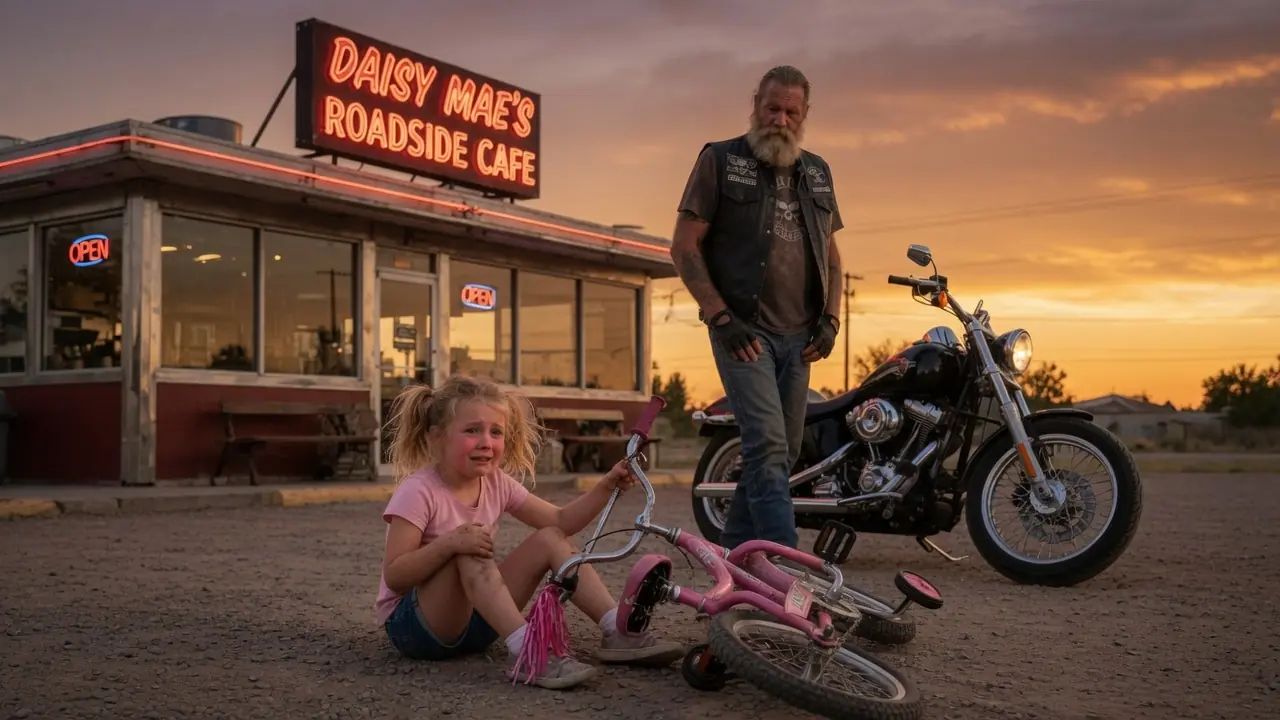
The old biker stood beside his Harley in the parking lot of Daisy Mae’s Roadside Cafe, staring at the tiny pink Band-Aid wrapped around his finger like it was some kind of holy relic.
It looked ridiculous on him.
That was the first thing he thought.
His hand was broad, scarred, and weathered, with swollen knuckles from decades of wrenching bikes, fighting men, and holding on too tightly to things he should have let go. The skin across his fingers was rough and sun-browned. A faded tattoo of an anchor sat between his thumb and wrist, blurred now by age and old mistakes.
And there, across the side of his index finger, sat a pink Band-Aid covered in tiny white hearts.
It was crooked.
Too small.
Childish.
The kind of thing that belonged on a scraped knee after a playground fall, not on the hand of a sixty-eight-year-old biker who had once been called Iron Wade by men who were not easily impressed.
Wade “Iron” Maddox stared at it for a long time.
Then he looked across the parking lot.
The little girl who had given it to him was riding circles around a faded blue bicycle with one training wheel slightly bent. She was maybe six years old, with copper-brown curls bouncing beneath a purple helmet covered in stickers. Her yellow jacket flashed bright beneath the dying evening sun.
She rode like the parking lot belonged to her.
Wide circles.
Wobbly turns.
One foot dragging when she slowed too fast.
Every few seconds, she looked over at Wade and grinned as if they had known each other for years instead of twenty minutes.
“Look!” she shouted. “I’m going faster now!”
Wade lifted his bandaged finger in a silent thumbs-up.
The girl laughed and kept pedaling.
Her name was Nora.
He knew because she had told him three times.
“I’m Nora. I’m six and three quarters. My tooth is loose. My bike is named Rocket, but she is not very fast yet.”
Wade had not asked for any of that.
He had only stopped at Daisy Mae’s because the cafe had decent coffee, cheap pie, and a parking lot wide enough to turn a bike without thinking. He had been on the road since morning, riding without a destination, which was what he did when the silence in his house became too loud.
He had planned to drink coffee.
Maybe smoke, even though the doctor kept telling him not to.
Maybe stare at the highway until the sun went down and decide whether to ride north or just go home.
He had not planned to fix a little girl’s bicycle.
He had not planned to bleed.
He had not planned to remember Mia.
But the day had other plans.
It started with a sound.
Not a crash.
A small metallic scrape.
Then a frustrated little voice saying, “Oh, come on, Rocket. Don’t be dramatic.”
Wade had been leaning against his Harley near the edge of the lot, checking a loose bolt near the saddlebag, when he heard it. He looked up and saw Nora kneeling beside her bicycle near the painted curb.
The front chain had slipped.
The girl stared at it with both hands on her hips.
A paper takeout bag sat beside her on the pavement. Through the cafe window, Wade could see a woman at the counter paying for food, glancing out every few seconds.
Nora crouched lower and poked the chain with one finger.
Grease smeared across her skin.
She frowned.
“You are making very bad choices,” she told the bike.
Wade almost smiled.
Almost.
He looked back at his Harley.
Not his business.
That had become one of his rules.
Do not get involved.
Do not start conversations.
Do not help unless asked.
Help made people expect things. Expectations became attachments. Attachments became grief with a delayed fuse.
Then Nora looked directly at him.
“You know motorcycles,” she said.
It was not a question.
Wade glanced behind him like she might be talking to someone else.
There was no one.
“I know mine,” he said.
“Then you know wheels.”
“That’s a broad category.”
She stood, dusted off her knees, and pointed at the bicycle.
“Rocket is broken.”
“Looks like the chain slipped.”
“Can you unslip it?”
Wade stared at her.
Adults usually avoided him. Children often hid behind their parents when they saw the leather vest, the gray beard, the old scars, the heavy boots, the patches stitched across his back.
Nora did not seem afraid.
That made him uncomfortable.
“Where’s your mom?” he asked.
“Inside getting fries.”
“Ask her.”
“She doesn’t know wheels.”
“You sure?”
Nora looked toward the cafe, then back at him with deep seriousness.
“My mom knows taxes, medicine, and how to make soup when your stomach feels weird. She does not know wheels.”
Wade had no answer for that.
Nora pushed the bike toward him.
“Please?”
The word was polite.
Small.
Confident.
Like she believed the world still rewarded asking nicely.
Wade wished, for one sharp second, that nobody had to teach her otherwise.
He sighed.
“Bring it here.”
Nora’s face lit up.
She rolled the bicycle over while Wade crouched down. His knees complained immediately. He ignored them.
He caught the chain between two fingers and worked it back over the sprocket.
Nora leaned in too close.
“Is Rocket going to live?”
“Back up unless you want grease on your nose.”
She stepped back one inch.
Wade gave her a look.
She stepped back another inch.
“Better.”
He turned the pedal slowly. The chain caught, slipped once, then settled.
“There.”
Nora clapped both hands.
“You fixed her!”
“She needed a tune-up.”
“What is a tune-up?”
“Bike bath with tools.”
“Oh.”
She considered that.
“Can I tune up my brother?”
Wade looked at her.
“Probably not legal.”
Nora giggled.
Then Wade stood.
Too fast.
The loose metal edge of the chain guard caught the side of his finger as he pulled his hand away. It sliced a shallow line across his skin.
Not deep.
Just enough.
Blood welled bright against old skin.
Nora gasped like he had been shot.
“You’re bleeding!”
“It’s nothing.”
“It is not nothing.”
“It’s a scratch.”
“Scratches are blood coming out.”
Wade looked at her.
“That’s one way to describe it.”
Nora dropped her bike gently onto its side and ran to the paper takeout bag. She dug inside with urgent purpose, moved aside a napkin, a small ketchup packet, and what looked like a plastic dinosaur.
Then she pulled out a Band-Aid.
Pink.
Hearts.
She marched back to him.
“Give me your hand.”
Wade almost laughed.
“No.”
She frowned.
“Why?”
“Because I’m fine.”
“You are leaking.”
“It stopped.”
“It has not.”
“It will.”
Nora planted her feet.
“Band-Aids only work if you put them on before the germs move in.”
Wade stared at her.
She stared back.
He had faced men with knives who had less conviction.
From inside the cafe, the woman at the counter looked out. She saw her daughter speaking to the biker. Her expression tightened at first, then softened when she saw Wade standing perfectly still with his bleeding finger held awkwardly away from his jeans while Nora scolded him like a tiny nurse.
Wade sighed.
“Fine.”
He held out his hand.
Nora peeled the wrapper with great ceremony, stuck out her tongue in concentration, and wrapped the little pink Band-Aid around his finger. It barely fit.
She pressed both tiny hands around it.
“Hold still. It has to know where to stay.”
Wade looked down at her small hands around his scarred one.
Something in his chest moved.
A memory he had not invited.
Mia at five years old, standing on a kitchen chair, putting a Band-Aid on his elbow after he scraped it working on an engine.
Hers had blue stars on it.
She had patted his arm and told him, “There. Now your elbow won’t be sad.”
Wade pulled his hand back a little too quickly.
Nora looked up.
“Did I hurt you?”
“No.”
“Then why did your face do that?”
“What face?”
“The sad thunder face.”
Wade looked away.
“I don’t have a sad thunder face.”
“You do.”
She picked up her bike.
“My mom says grown-ups pretend they don’t have feelings because they think feelings make them look smaller, but it actually makes them look confused.”
Wade blinked.
“Your mom says a lot.”
“She reads books.”
“That explains it.”
Nora climbed onto her bicycle.
“Watch me ride.”
“I was leaving.”
“No, you weren’t.”
He almost argued.
Then realized he was still standing there.
Nora pushed off and began making careful circles through the empty half of the parking lot.
Wade watched because he did not know what else to do.
The sun had dipped low, turning the cafe windows gold. Evening traffic moved along Route 17. The neon sign above Daisy Mae’s buzzed faintly, not bright enough yet to matter, but ready for night.
Nora circled once.
Twice.
Then she shouted, “Rocket is better!”
Wade lifted his bandaged finger again.
She grinned.
That was when her mother stepped out of the cafe carrying a white paper bag and two drinks balanced in a cardboard tray.
“Nora, sweetheart, time to go!”
Nora braked too hard, nearly tipped, saved herself, and rode over with pride shining across her face.
“Mommy! He fixed Rocket!”
The woman smiled politely at Wade.
“Thank you, sir.”
“And I fixed him!” Nora added, pointing at his hand.
The woman’s smile widened.
Then she saw Wade’s face.
Really saw it.
The smile faded.
“Sir,” she said gently, “are you all right?”
Wade looked down at the Band-Aid.
The little pink hearts blurred.
For a second, he could not speak.
Nora leaned against her bike, waiting for his answer with complete trust.
Wade swallowed.
“My little girl used to carry these.”
The woman went still.
Nora looked from her mother to Wade.
“Band-Aids?”
“Yeah.”
His voice came out rough.
“She had a whole box. Different kinds. Stars. Dinosaurs. Rainbows. Princess ones she said were not just for girls because dragons also need princesses sometimes.”
Nora smiled at that.
Wade tried to smile too.
It broke halfway.
“She thought Band-Aids fixed everything.”
His thumb brushed the edge of the pink strip.
“Knees. Elbows. Bad dreams.”
The words stuck.
The woman took a slow breath.
“What was her name?”
Wade looked toward the road.
“Mia.”
Nora’s voice softened.
“Where is she?”
Her mother said quickly, “Nora—”
“It’s all right,” Wade said.
But it was not all right.
It had never been all right.
He looked at the little girl.
“She died.”
Nora’s face changed in the honest way only children’s faces can. No polite mask. No careful adult rearranging of discomfort. Just sorrow, immediate and pure.
“Oh,” she whispered.
Wade nodded.
“She was eight.”
The woman closed her eyes briefly.
“I’m so sorry.”
He shrugged, because that was what he did with pain when people offered kindness too directly.
“Long time ago.”
“How long?”
“Twenty-six years.”
Nora frowned.
“That is longer than me.”
“Yes, ma’am.”
Nora looked at the Band-Aid again.
“Did she put them on you?”
Wade let out a breath that was almost a laugh.
“All the time.”
“Were you always bleeding?”
“According to Mia, yes.”
That made Nora smile.
Then her face became serious again.
“Band-Aids only work if you leave them on.”
Wade stared at her.
The words were too familiar.
Mia had said that exact thing once.
Not exactly, maybe.
But close enough that the memory rose whole.
The kitchen.
Rain on the windows.
Mia in pajamas with moons on them.
Wade sitting at the table after a fight outside the bar, one split knuckle bleeding into a dish towel.
His wife, Elena, already asleep upstairs.
Mia sneaking down with her box of Band-Aids.
“Daddy,” she whispered, “they only work if you don’t pick at them.”
He had laughed then.
Promised he would leave it alone.
Three days later, she was gone.
Not from sickness.
Not from something slow enough to prepare for.
A drunk driver ran the red light on Willow Avenue while Elena was taking Mia to school. Elena survived with broken ribs and a concussion. Mia did not.
Wade did not survive in any way that mattered.
He kept breathing.
That was all.
He buried his daughter on a cold Tuesday morning. He blamed the driver. Then the city. Then God. Then Elena. Then himself. There was enough blame to poison every room in the house.
Elena stayed two years.
Then left because, as she said through tears, “I lost Mia, Wade. I can’t keep losing you too.”
He let her go.
He let everyone go after that.
The club became his home because engines were easier than grief and brothers knew how to sit in silence without asking him to explain the shape of his pain.
Twenty-six years.
And here stood a six-year-old girl in a yellow jacket, telling him to leave the Band-Aid on.
Wade’s eyes burned.
He looked down because he did not want Nora to see.
Of course, she saw.
“You’re crying,” she said.
Her mother touched her shoulder.
“Nora, honey.”
But Wade gave a small, broken laugh.
“Guess I am.”
Nora leaned her bike against her hip and opened her arms.
“Do you need a hug?”
Wade froze.
That question was worse than the Band-Aid.
Bigger.
More dangerous.
He had not held a child in more than two decades. Not really. Not since the day before Mia died, when she jumped into his arms because she had lost a tooth and wanted him to inspect the gap.
His hands flexed at his sides.
“I don’t know,” he said honestly.
Nora considered that.
Then she walked over and wrapped both arms around his waist anyway.
She was too small to reach higher.
Her helmet bumped against his belt buckle.
Wade stood stiff as a fence post.
The woman watched, tears in her eyes but no fear in her face.
Slowly, Wade placed one hand on Nora’s back.
Careful.
Light.
Like touching a memory that might vanish.
Nora squeezed him once, then stepped back.
“There,” she said. “That helps too.”
Wade wiped his face with the back of his free hand.
“Yes, ma’am.”
Nora climbed back onto her bike.
“Come on, Mommy. Rocket is hungry.”
“Bikes don’t get hungry,” her mother said softly.
“Mine does.”
The woman looked at Wade.
“I’m Claire, by the way.”
“Wade.”
“Thank you for helping her.”
He lifted the bandaged finger.
“Fair trade.”
Claire smiled sadly.
Then Nora rang the little bell on her handlebars.
It made a tiny bright sound.
“Bye, Mr. Wade!”
“Ride careful.”
“I do! Mostly.”
Claire helped her load the bike into the back of a small green SUV. Nora waved through the rear window as they pulled out of the lot.
Wade stood there until the taillights disappeared into the evening traffic.
Then he looked at his hand again.
The pink Band-Aid was already dirty at the edge.
He should take it off.
That was his first instinct.
Peel it away.
Throw it in the trash.
Pretend the whole thing had been nothing more than a strange moment in a roadside parking lot.
Instead, he left it on.
Band-Aids only work if you leave them on.
He sat on his Harley but did not start the engine.
The cafe sign flickered fully to life.
DAISY MAE’S.
Red neon.
White border.
The parking lot emptied slowly. A couple got into a pickup. A trucker carried pie in a foam container. Rita’s cousin came out to smoke by the dumpster. The sky turned from gold to purple to dark blue.
Still, Wade sat.
He looked at his hand.
Then past it.
Into years he usually refused to enter.
He remembered Mia’s laugh.
Not the memory he let himself keep, polished and safe.
The real laugh.
Too loud.
Snorting at the end.
He remembered the way she said “spaghetti” like “pasghetti” until she was seven and furious when he corrected her. He remembered her serious belief that the moon followed their truck because it was lonely. He remembered her collection of Band-Aids, kept in a plastic lunchbox covered in stickers.
She had carried it everywhere.
Playground.
Grocery store.
Church picnic.
Once, she put a Band-Aid on the bumper of his truck because it had a dent.
“It still counts,” she told him.
He had forgotten that.
Or maybe he had buried it because good memories hurt worse than bad ones.
At 9:17 p.m., the waitress from Daisy Mae’s stepped outside.
Her name was Lorna. Wade knew her from years of stopping in, though they had never had a conversation longer than coffee orders and weather complaints.
She wore a red apron, tired eyes, and the practical kindness of a woman who had seen men fall apart in parking lots before.
“You heading out, Iron?”
He looked up.
“Soon.”
“You’ve been sitting there three hours.”
“Have I?”
“Yes.”
She walked closer, then saw the Band-Aid.
Her eyebrows rose.
“That yours?”
He gave her a look.
“No, I stole it off a kindergarten teacher.”
She smiled.
“That little girl get you?”
“Fixed me, apparently.”
Lorna leaned against the post near the handicap sign.
“She was sweet.”
“Yeah.”
“Her mother said you looked like you’d seen a ghost.”
Wade looked at his finger.
“Maybe I did.”
Lorna did not push.
That was why he kept coming to Daisy Mae’s.
People there had the decency to let silence do its job.
After a moment, he said, “My daughter used to have Band-Aids like this.”
Lorna’s face softened.
“I didn’t know you had a daughter.”
“Most people don’t.”
“What was her name?”
“Mia.”
“Pretty name.”
“She was a pretty kid.”
He swallowed.
“Funny. Bossy. Thought she was a doctor because she had a plastic stethoscope and a lunchbox full of Band-Aids.”
Lorna smiled gently.
“How old?”
“Eight.”
The answer was enough.
Lorna looked toward the road.
“I’m sorry.”
Wade nodded once.
Usually, that was where he ended it.
One word.
A nod.
A wall.
But something had shifted.
Maybe it was the Band-Aid.
Maybe it was Nora’s hug.
Maybe it was just being old enough to be tired of guarding the same wound.
“She died in a wreck,” he said.
Lorna stayed still.
“Drunk driver ran a red light. My wife was driving her to school.”
“Lord.”
“I was supposed to take her.”
The words came out before he could stop them.
Lorna looked at him.
Wade stared at the pavement.
“I was supposed to take her that morning. She asked me the night before. Said she wanted pancakes from the drive-through. I told her maybe. Then I got called to help a brother whose bike broke down two towns over. Came home late. Slept through the alarm.”
His jaw tightened.
“Elena took her instead.”
Lorna’s voice was soft.
“You didn’t cause the crash.”
“No.”
Wade touched the Band-Aid.
“But grief doesn’t care what’s legally true.”
That sentence sat between them.
A truck rolled past on the highway.
The neon hummed.
Lorna crossed her arms against the cold.
“Did your wife blame you?”
Wade almost said yes.
It would have been easier.
But he was tired of easy lies.
“No,” he said. “I did enough for both of us.”
Lorna nodded.
“Grief is greedy that way.”
He glanced at her.
“You know something about it?”
“Lost my son when he was twenty-three.”
Wade went quiet.
“Overdose,” she said. “Everyone wanted to talk about choices. His choices. My choices. Where I failed. What he should’ve done. People love turning death into math if it means they don’t have to feel scared.”
Wade looked at her for the first time fully.
“I’m sorry.”
“Long time ago,” she said.
He recognized the phrase.
The shield.
They both almost smiled.
Lorna nodded toward his hand.
“You going to leave that on?”
He looked at the pink hearts.
“Kid said I had to.”
“Smart kid.”
“Bossy.”
“Smart and bossy often travel together.”
Wade let out a low laugh.
It surprised him.
The sound felt rusty.
Lorna smiled.
“There it is.”
“What?”
“First real laugh I’ve heard from you in ten years.”
He shook his head.
“Don’t make it weird.”
“It is weird. You’re sitting in a parking lot at night staring at a pink Band-Aid.”
“Fair.”
She pushed away from the post.
“Coffee’s still hot if you want some.”
He hesitated.
Then nodded.
“Yeah. I could use a cup.”
Inside, Daisy Mae’s was nearly empty.
Two truckers sat at the far end. A tired couple shared pie near the window. The jukebox played an old country song low enough to be ignored.
Wade took his usual booth.
Lorna brought coffee and a slice of cherry pie.
“I didn’t order pie.”
“I own the pie.”
“You don’t own the cafe.”
“I own my decisions.”
He looked at her.
“Women around here are getting mouthy.”
She smiled.
“Maybe you’re finally listening.”
He huffed.
But he ate the pie.
The next morning, Wade woke before dawn in his small house on Briar Road.
For once, he did not wake from the crash dream.
That alone felt strange enough to make him lie still.
The Band-Aid was still on his finger.
A little frayed.
A little gray around the edges.
But there.
He sat up slowly and looked at it in the weak morning light.
Then he did something he had not done in years.
He opened the hall closet.
On the top shelf, behind winter blankets and a box of old tax papers, sat a pink plastic container with a cracked lid.
MIA was written across the top in purple marker.
He had not touched it since Elena left.
His hands shook as he brought it down.
For a while, he just sat on the hallway floor with the box in his lap.
Then he opened it.
Inside were pieces of a life that had stopped too soon.
A plastic stethoscope.
A stuffed rabbit missing one eye.
A school picture.
A drawing of a motorcycle with wings.
A lunchbox covered in stickers.
Wade opened the lunchbox.
Band-Aids.
Old ones.
The adhesive probably useless now.
Blue stars. Dinosaurs. Rainbows. Cartoon animals. Tiny hearts.
His breath left him.
At the bottom was a folded piece of paper.
He opened it carefully.
It was a drawing.
Him, according to Mia.
A huge man with a beard, though he had not had much of one back then, standing beside a tiny girl. Both had Band-Aids on their knees. Above them, in uneven child letters, she had written:
DADDY IS FIXT TOO.
Wade covered his face.
The sound that came out of him did not feel like crying at first.
It felt like breaking.
Then, slowly, it became something else.
Not healing.
Not yet.
But the first honest movement toward it.
He called Elena that afternoon.
He had not spoken to her in seven years.
Not because they hated each other.
Because grief had turned their love into a house neither of them could live in, and after she left, silence became easier than reopening the door.
She answered on the fifth ring.
“Wade?”
Her voice was older.
Of course it was.
His heart twisted.
“Hey, Ellie.”
No one else called her that anymore, probably.
She did not speak for a moment.
“Are you okay?”
He looked at the pink Band-Aid on his finger.
“No.”
A pause.
Then she said, “Okay.”
He almost laughed.
Trust Elena to accept the truth without trying to decorate it.
“I met a little girl yesterday,” he said.
He told her about Nora.
The bike.
The Band-Aid.
Mia.
The old box.
The drawing.
Elena was quiet for a long time.
Then he heard her crying softly.
“I still have the yellow one,” she said.
Wade closed his eyes.
He knew what she meant.
Mia’s raincoat.
The one with ducks on the pockets.
“She loved that thing.”
“She wore it in the house.”
“She said rain could happen indoors if people were sad enough.”
Elena laughed through tears.
“I forgot that.”
“So did I.”
They stayed on the phone for almost an hour.
Not solving anything.
Not rewriting history.
Just remembering.
For the first time in twenty-six years, Mia’s name did not enter the room like a weapon.
It entered like a child running ahead of them, laughing too loudly, expecting them to follow.
Before hanging up, Elena said, “Thank you for calling.”
Wade swallowed.
“I’m sorry I waited so long.”
“So am I.”
That was all.
It was enough for one day.
Over the next week, Wade kept the Band-Aid on until it finally peeled at the edges and refused to stay.
He removed it carefully and placed it inside Mia’s lunchbox.
Then he added the drawing to a frame and set it on the mantel.
The house looked different with it there.
Not happier.
That would be too simple.
But less empty.
The next Friday, Wade returned to Daisy Mae’s.
He told himself it was for coffee.
It was not.
Nora was there.
She sat in a booth with Claire, coloring on a paper menu while eating fries. Her purple helmet sat beside her on the seat.
The moment she saw him, she waved both arms.
“Mr. Wade!”
The whole cafe turned.
Wade sighed.
“Subtle.”
Nora ran over before Claire could stop her.
“Where’s your Band-Aid?”
“Retired.”
“Did your finger heal?”
He looked at his hand.
“Some of it.”
Nora narrowed her eyes.
“That is not a normal answer.”
“I’m not a normal man.”
“That’s true.”
Claire laughed into her napkin.
Wade sat with them for coffee.
He learned Claire was a nurse. A widow. Nora’s father had died when she was two, in a construction accident. Claire worked long shifts and came to Daisy Mae’s on Fridays because Nora liked the fries and because sometimes a diner full of strangers felt less lonely than a quiet house.
Wade listened.
Really listened.
It occurred to him that grief had been sitting in that parking lot on both sides the whole time.
His just had more leather on it.
Nora showed him a new box of Band-Aids she had gotten from the dollar store.
“These are space ones,” she said. “For serious injuries and aliens.”
“Good to know.”
She gave him one with a tiny rocket.
“For emergencies.”
He put it in his wallet.
The next Friday, they were there again.
And the Friday after that.
Nothing dramatic happened.
That was the miracle.
Nora rode her bike in the parking lot before dinner. Wade checked the chain. Claire drank coffee and pretended not to watch them with a soft expression.
Sometimes Lorna joined them on her break.
Sometimes Wade told stories about Mia.
Small ones.
The safe ones first.
Then harder ones.
The day Mia cut her own bangs.
The day she cried because he killed a spider.
The day she asked if motorcycles dreamed.
Nora always had questions.
“What was her favorite color?”
“Blue.”
“Favorite animal?”
“Dogs.”
“Did she like soup?”
“Only if she could put crackers in it.”
“Did she have a bike?”
“Pink.”
“Was she fast?”
“Terrifying.”
Nora nodded seriously.
“She sounds like my friend.”
Wade’s throat tightened.
“Yeah,” he said. “She would have liked you.”
One evening, Claire walked outside after Nora had ridden ahead to look at a moth near the sign.
“You know she talks about you all week,” Claire said.
Wade looked uncomfortable.
“That so?”
“She says you are her parking lot grandpa.”
He snorted.
“Parking lot grandpa.”
“Could be worse.”
“Could it?”
“She wanted to call you Motorcycle Grandpa.”
“I prefer parking lot.”
Claire smiled.
Then her expression grew gentle.
“Is this too hard for you?”
He watched Nora crouch near the moth, speaking to it like it had an appointment.
“Yes.”
Claire nodded.
“Do you want us to stop coming?”
Wade looked at her sharply.
“No.”
The answer surprised them both with how quickly it came.
He looked back at Nora.
“It’s hard. But not bad hard.”
Claire understood.
Some pain was a door.
Not every door needed to stay closed.
Months passed.
Summer came.
Then fall.
Nora lost the loose tooth and insisted Wade inspect the gap because “you are old, so you know teeth.” Wade told her age did not make him a dentist. She said it should.
He went to one of her school art shows because Claire’s shift ran late and Nora had asked if her “parking lot grandpa” could come.
He stood in a hallway full of construction-paper suns and macaroni frames, feeling absurdly large and out of place.
Nora’s drawing showed a motorcycle, a cafe, and three people under a neon sign.
One of them was him.
Above it she had written:
MY FREND WADE. HE IS TUFF BUT NICE.
He stared at it until his eyes burned.
When Nora asked if he liked it, he said, “Spelling needs work.”
She kicked him lightly in the boot.
Then hugged him.
He framed that one too.
Elena visited in December.
Wade had invited her, then nearly canceled six times.
She arrived with a silver scarf, laugh lines, and a nervousness that matched his own. They stood in his living room surrounded by ghosts neither knew how to greet.
Then she saw the framed drawing.
DADDY IS FIXT TOO.
She touched the frame with two fingers.
“She wrote fixed wrong.”
“I know.”
“You framed it anyway.”
“Best spelling she ever did.”
Elena laughed.
Then cried.
Then he did.
They sat on the couch and talked until dark.
About Mia.
About the years after.
About how they had loved each other and failed each other and survived badly but survived.
No reunion.
No old romance returning in a burst of music.
That was not the point.
They did not need to become husband and wife again to stop being strangers at their daughter’s memory.
Before she left, Elena gave him a small envelope.
Inside was a photograph he had never seen.
Mia at Daisy Mae’s, years ago, sitting in a booth with a milkshake mustache and one hand holding up a Band-Aid.
Wade stared.
“We came here?” he asked.
“Once. You were at a club run. She wanted fries.”
He looked around the room.
“How did I not know?”
Elena smiled sadly.
“There are so many things grief hides.”
He placed the photo on the mantel beside the drawings.
That night, the house felt full.
Not with absence.
With evidence that love had been real.
On the anniversary of Mia’s death, Wade did something different.
For twenty-six years, he had ridden alone to the cemetery. He would stand by the stone, say nothing, leave flowers, and return home emptier than before.
This year, he brought Band-Aids.
A whole box.
Blue stars.
He placed them beside the flowers.
Then he sat on the grass and told Mia about Nora.
About the bike.
About the pink Band-Aid.
About Elena’s phone call.
About the picture on the mantel.
About how he was trying, late and clumsy, but trying.
A breeze moved through the trees.
For once, the cemetery did not feel like punishment.
It felt like a place where he could tell the truth.
“I miss you,” he said.
The words were simple.
He had said them before.
But this time, he added, “And I’m still here.”
That was new.
That mattered.
A year after the day Nora fixed his finger, Daisy Mae’s held a small fundraiser for the children’s hospital.
Claire had helped organize it. Lorna baked pies. The Iron Sons Motorcycle Club, Wade’s club, showed up with twenty bikes and enough leather to make the town nervous until people realized half the bikers were selling raffle tickets and the other half were getting bossed around by Nora.
She wore a vest made of denim with a patch Claire had sewn onto the back.
PARKING LOT CREW.
Wade pretended to hate it.
He loved it.
At sunset, Nora climbed onto a chair outside the cafe and announced she had a speech.
Everyone groaned affectionately.
She unfolded a paper.
“Dear people,” she began.
Wade covered his mouth to hide a smile.
“Band-Aids are important because sometimes people think they are only for cuts, but they are also for reminding people that they should not pick at things that are trying to heal.”
Claire’s eyes filled instantly.
Lorna whispered, “Oh, that baby.”
Nora continued.
“My friend Wade had a hurt heart because he missed Mia. I did not fix it all the way because I am not magic. But I gave him a Band-Aid and then he got better at smiling.”
The bikers went silent.
Every one of them.
Wade looked down at his boots.
Nora finished.
“So you should buy raffle tickets for the hospital because kids need Band-Aids and doctors and maybe motorcycles, but my mom says probably not motorcycles.”
Laughter broke the silence.
Then applause.
Nora climbed down and ran to Wade.
“Was it good?”
He crouched in front of her, ignoring the ache in his knees.
“Best speech I ever heard.”
“Did you cry?”
“No.”
She narrowed her eyes.
“Your beard is wet.”
“Humidity.”
“It is not humid.”
“Must be allergies.”
She hugged him.
He hugged her back without freezing this time.
That was new too.
Years later, people still told the story wrong.
They said an old biker fixed a little girl’s bicycle, and she fixed his heart with a Band-Aid.
It was a nice version.
Simple.
Sweet.
Wrong in the way all simple stories are wrong.
Nora did not fix his heart.
A child should not have to fix what life had broken in a grown man.
What she did was smaller.
And greater.
She reminded him his heart was still there.
Still capable of hurting.
Still capable of remembering without only bleeding.
Still capable of making room for new love without betraying the old.
The pink Band-Aid stayed in Mia’s lunchbox.
The rocket Band-Aid stayed in his wallet until the paper wore thin.
The drawing stayed on the mantel.
So did Nora’s art show picture.
So did the photo Elena had given him.
The house on Briar Road, once a place of dust and locked doors, slowly became a place where people came by.
Rita with pie.
Lorna with gossip.
Elena once every few months for coffee and memories.
Claire when her shift ran late.
Nora whenever she had something important to report, like a loose tooth, a spelling test, or the fact that Rocket had achieved “legendary speed.”
Wade kept riding.
He still looked hard.
Still scared strangers sometimes.
Still wore leather.
Still had scars.
But now, if someone looked closely, they might see a tiny packet of Band-Aids in his saddlebag.
For emergencies.
For children.
For old men who forgot healing needed patience.
One evening, many years later, Nora was twelve and too tall for the old bicycle. Rocket leaned in Wade’s garage now, retired with honor. Nora had a new bike, faster and sleeker, though she insisted Rocket had more personality.
She found Wade sitting on the porch, holding the pink Band-Aid in its clear wrapper, the one from the lunchbox, not the one she had given him.
“Is that Mia’s?” she asked.
He nodded.
“Does it still work?”
He looked at her.
She was older now, but her eyes had the same direct kindness.
“I think so.”
Nora sat beside him.
“How?”
He thought for a while.
Then said, “It reminds me not to tear open what’s trying to close.”
Nora smiled.
“I told you.”
“You did.”
“Band-Aids only work if you leave them on.”
Wade laughed softly.
“Yes, ma’am.”
They sat together as evening settled over Briar Road.
No big speech.
No sudden miracle.
Just a girl, an old biker, and the quiet understanding that some wounds do not vanish, but they can become places where tenderness enters.
That was enough.
More than enough.
The next morning, Wade rode to Daisy Mae’s.
The parking lot had been repaved. The sign had been repaired. Lorna had retired. The cafe had new owners, but the coffee was still strong and the pie still better than it needed to be.
Wade parked near the same spot where Nora had once placed a pink Band-Aid on his bleeding finger.
He sat on the Harley for a moment.
The morning sun glinted off the chrome.
He looked at his hand.
No Band-Aid today.
Just scars.
Just skin.
Just proof that he had kept going.
A waitress stepped outside with a coffee pot.
“You coming in?”
He smiled.
A real one.
“Yeah,” he said. “I think I am.”
He walked toward the door.
Above him, the neon sign buzzed softly, even in daylight.
Behind him, his Harley cooled with small ticking sounds.
Inside his wallet, the rocket Band-Aid waited.
Inside his house, Mia’s box sat open now, not hidden.
Inside his heart, the ache remained.
But it no longer sat alone.
That was the thing Nora had taught him without knowing.
Love does not always come to take pain away.
Sometimes it sits beside it.
Sometimes it brings fries.
Sometimes it rides wobbly circles in a parking lot.
Sometimes it wraps a tiny pink Band-Aid around a scarred old hand and says, very seriously, that healing only works if you leave it on.
And sometimes, under a glowing roadside sign, the toughest man anyone knows finally believes he is still worth fixing.