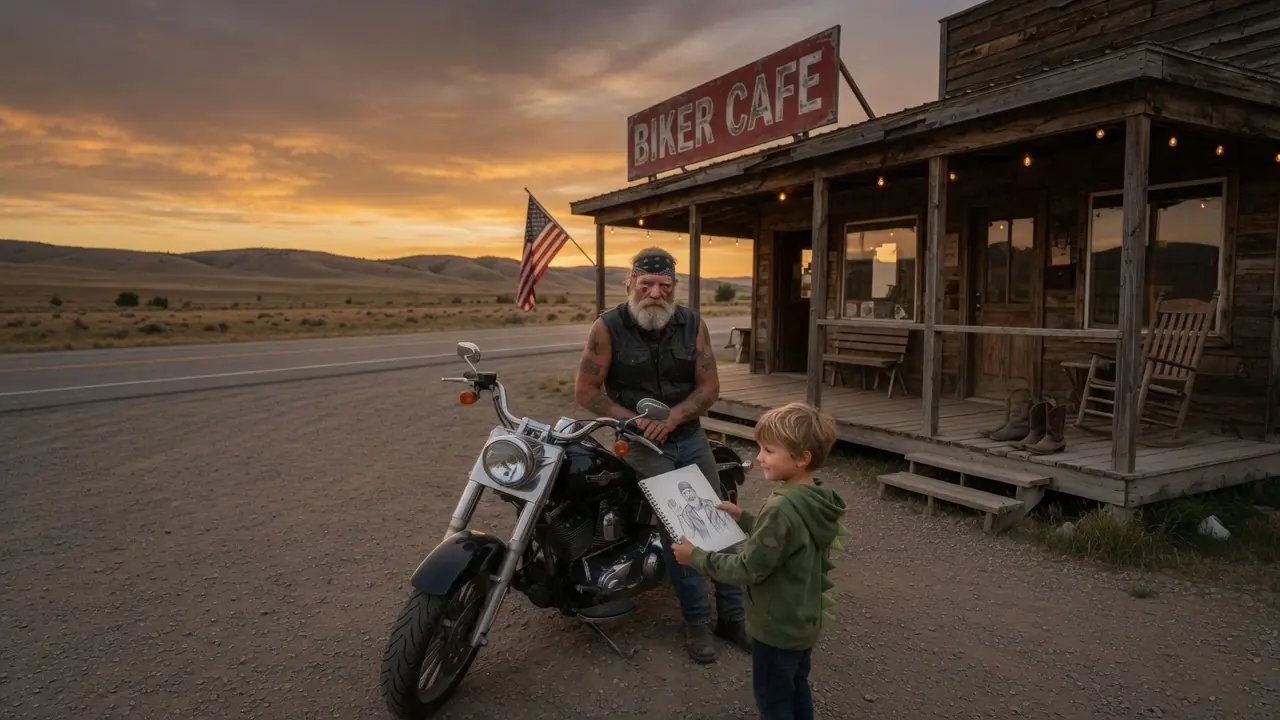
Outside a weathered little biker café on the edge of a Montana highway, the evening sun poured gold across the gravel lot like honey spilled from the sky.
The café was called Rusty Spur.
It sat between two long stretches of empty road, with a faded red sign, a row of motorcycles near the porch, and an old jukebox inside that only played country songs when it felt like cooperating.
Caleb “Bear” Lawson pulled his Harley-Davidson into the last open space beside the fence. The engine growled once, then settled into silence. He sat there for a moment with both boots planted on the ground, gray beard moving slightly in the wind, leather vest creaking as he looked toward the mountains.
Bear was the kind of man people noticed and then quickly decided not to bother.
Sixty-three years old.
Broad shoulders.
Scar above his left eyebrow.
Hands rough from engines, winters, and fights he no longer liked remembering.
A silver chain hung from his neck, tucked beneath his shirt. On the end of it was a tiny brass key.
Nobody asked what it opened.
Nobody had earned the right.
He shut off the bike and swung one leg over, reaching for his helmet, when a small voice came from behind him.
“Mister?”
Bear turned.
A little boy stood a few feet away in the gravel.
He was maybe six years old, skinny knees, sandy hair, one shoelace untied, wearing a green dinosaur hoodie that looked too warm for the evening. In both hands, he held a folded sheet of drawing paper like it was an official document.
Bear looked around.
“You talking to me, little man?”
The boy nodded seriously.
“I made something.”
Bear’s eyebrows lifted.
“For me?”
The boy nodded again.
Behind the café window, a woman in a waitress apron looked up sharply, then pushed through the screen door.
“Eli, honey, don’t run up to strangers.”
The boy did not turn around.
“He’s not a stranger,” he said. “He waves.”
Bear blinked.
The waitress stopped on the porch.
The boy looked back at him.
“You wave at me every Friday when you come here.”
Bear remembered then.
A little boy near the café window.
Small hand pressed to the glass.
Waving at the motorcycles like they were parade horses.
Bear had waved back without thinking, one gloved hand lifted from the handlebars each time.
He had not known the boy was keeping count.
“Well,” Bear said, his voice softer than his face, “I guess that makes us almost friends.”
The boy smiled.
“I drew you.”
Bear froze.
“You drew me?”
The boy opened the folded paper carefully.
It was a pencil drawing.
Not perfect. Not professional.
But good.
Too good for a little boy with an untied shoe.
There was Bear’s motorcycle, larger than life, with smoke lines around the exhaust and two stars drawn near the headlight. There was Bear himself sitting on it, beard rough and wide, sunglasses dark, boots huge, one hand raised in a wave.
But the part that made Bear go quiet was the face.
The boy had drawn him smiling.
Not the polite half-smile Bear gave people when they tried to talk too much.
Not the hard grin he wore around bikers.
A real smile.
The kind he did not remember using anymore.
Bear swallowed.
“You made this?”
The boy nodded.
“My mom says I’m good at noticing faces.”
Bear looked toward the waitress.
She stood halfway between the porch and the parking lot now, worry softening her features. She was young, maybe early thirties, with tired eyes and flour on one sleeve.
“What’s your name?” Bear asked the boy.
“Eli.”
“Eli,” Bear repeated. “Well, Eli, this is mighty fine work.”
“I made another one too.”
He pulled a second paper from behind the first.
Bear took it.
The drawing was simpler this time. Crayon instead of pencil.
A big man with a beard sat on a motorcycle beneath a wide blue sky. Beside him was a little girl with brown hair, holding a red balloon. Above them, in uneven letters, Eli had written:
I HOPE YOUR LITTLE GIRL STILL KNOWS YOU WAVE.
Bear’s hand tightened on the paper.
The air left his chest.
For a moment, the gravel lot, the café, the motorcycles, the sunset — all of it pulled far away.
His voice came out barely above a whisper.
“How did you know I had a little girl?”
Eli looked confused by the question.
“I didn’t.”
Bear stared at him.
“I just thought you looked like a dad.”
The waitress stepped closer.
“Eli…”
The boy shrugged, innocent and earnest.
“Mom says dads who wave at kids usually miss somebody.”
Bear looked down at the drawing again.
The little girl.
The red balloon.
The words.
His hands began to shake.
He hated that.
He hated shaking in front of people.
He had ridden through hailstorms, walked away from bar fights, pulled friends out of wrecked trucks, buried men who thought nothing could kill them. He had held steady through all of it.
But a six-year-old boy in a dinosaur hoodie had drawn a red balloon.
And suddenly Bear Lawson could not breathe.
The waitress saw his face change.
“I’m sorry,” she said quickly. “He didn’t mean—”
“No,” Bear said.
His voice cracked.
He cleared his throat, but it did not help.
“No, ma’am. He didn’t do anything wrong.”
Eli looked up at him.
“Are you sad?”
Bear tried to answer.
Nothing came.
The boy stepped forward and put one small hand on Bear’s leather vest.
It was such a gentle thing that Bear almost stepped back from it.
Almost.
“My dad left before I was born,” Eli said quietly. “But sometimes I draw him anyway.”
The waitress closed her eyes.
Bear looked at the boy.
Something old and buried shifted inside him.
“Mine didn’t leave,” Bear said.
He did not know why he said it.
Maybe because the boy had offered truth first.
Maybe because the sunset had loosened something in him.
Maybe because he had carried the story so long it had started to rot.
“My daughter didn’t leave,” Bear said again. “She got taken away.”
Eli’s eyes widened.
“By bad guys?”
Bear almost smiled.
“Worse. By grown-ups who thought they knew better.”
The waitress reached Eli and placed both hands gently on his shoulders.
“Mr…”
“Bear,” he said.
She blinked.
“That your real name?”
“Real enough.”
She gave a small, sad smile.
“I’m Nora.”
Bear nodded.
Nora looked at the drawing in his hand.
“I’m sorry if he upset you.”
Bear looked toward the mountains.
“No. He just found a door I keep nailed shut.”
The screen door creaked behind them.
Three bikers had stepped out onto the porch, trying very hard not to look like they were listening.
One of them, a tall man named Cutter, leaned against the railing and pretended to check his gloves.
Bear ignored them.
Or tried to.
Eli tugged gently on his vest.
“What was your daughter’s name?”
Bear closed his eyes.
For nine years, he had not said the name in public.
At first, saying it hurt too much.
Later, not saying it became a habit.
Then a punishment.
Now the name rose through him slowly.
“Grace.”
Eli smiled.
“That’s a good name.”
“It is.”
“How old is she?”
Bear stared at the crayon drawing.
“She’d be fourteen now.”
“Do you know where she lives?”
Bear shook his head.
“Not anymore.”
“Why?”
Nora said softly, “Eli, that might be too personal.”
Bear lifted one hand.
“It’s all right.”
He crouched down, knees cracking, until he was closer to Eli’s height.
“When Grace was little, her mom and I fought a lot. Too much. The kind of fighting that fills a house even when nobody’s talking. We got divorced. Her mother moved away. I tried writing. I tried calling. I tried lawyers when I had money. Then I ran out of money. Then I ran out of answers.”
He swallowed.
“I never ran out of missing her.”
Eli listened with the serious face of a child who had not yet learned to look away from pain.
“Maybe she misses you too.”
Bear looked down.
“That’s what hurts.”
“What?”
“Not knowing.”
The words came out rough.
“Not knowing if she misses me, hates me, forgot me, or was told I didn’t care.”
Eli thought about that.
Then he reached into his hoodie pocket and pulled out a red crayon.
“You can write on the back,” he said.
Bear blinked.
“What?”
“On the drawing. You can write her a message. If you find her, you can give it to her.”
Bear stared at the crayon in the boy’s hand.
A red crayon.
Not a pen.
Not a legal document.
Not a court order.
Just a child’s crayon, offered like a tool powerful enough to open a locked life.
Bear took it.
His big fingers looked ridiculous around it.
He turned the paper over and wrote slowly, the letters uneven because his hand would not stop trembling.
Grace,
I still wave.
Dad.
He stared at it after.
Four words.
Nine years reduced to four words and a child’s drawing.
Nora wiped beneath one eye.
Cutter turned toward the parking lot like the fence had suddenly become fascinating.
Eli nodded with satisfaction.
“That’s good.”
Bear laughed, and the laugh broke halfway into something dangerously close to a sob.
He stood, but only because staying crouched hurt too much.
“I should go,” he said.
He did not move.
Nora stepped closer.
“You don’t have to.”
Bear looked at her.
“My daughter used to draw balloons.”
Nora’s face softened.
“Red ones?”
He nodded.
“She had this red balloon from the county fair once. Wouldn’t let go of it. Slept with the string tied around her wrist. Next morning it was halfway deflated, bumping against the ceiling fan.”
He smiled then.
A real smile.
Painful, but real.
“I told her it looked tired. She said, ‘Maybe it just needs coffee, Daddy.’”
Eli giggled.
Bear looked at him and almost lost himself again.
Children could do that.
Knock down walls with laughter.
Nora said, “I have a cousin who works with county records in Missoula.”
Bear’s head turned.
“She helps people find family sometimes. Not in a creepy way,” Nora added quickly. “Just public records, old addresses, court filings. Things like that.”
Bear’s throat tightened.
“Nora, I appreciate it, but I’ve tried.”
“When?”
He looked away.
“Years ago.”
“How many years?”
He did not answer.
Nora’s voice stayed gentle.
“Maybe the world has changed since then.”
Bear looked toward his bike.
He wanted to say no.
No was safe.
No kept hope in the grave where it could not embarrass him.
But Eli was watching him.
Holding the red crayon like a torch.
Bear sighed.
“I don’t even know her last name now. Her mother remarried.”
Nora nodded.
“That’s a place to start.”
Cutter finally pushed off the railing.
“We’ll help.”
Bear glared at him.
“No.”
Cutter ignored that.
“Yep.”
“I said no.”
“And I heard you. Still helping.”
Another biker, Moose, stepped down from the porch.
“You rebuilt my transmission for free when I got laid off.”
“That was different.”
“No, it wasn’t.”
Cutter crossed his arms.
“You sat with Rhino’s wife at the hospital while he was in surgery.”
Bear’s jaw tightened.
“Stop.”
“You drove through a blizzard to pick up my nephew when his truck died outside Helena,” Moose added.
Bear looked at him.
“I said stop.”
Cutter’s voice softened.
“You don’t get to be the only man who shows up.”
Bear looked away.
The sunset was fading now, gold turning amber, amber turning rose.
For nine years, he had told himself the same story.
Grace was gone.
Grace was better off without the mess.
Grace had forgotten.
But the drawing in his hand told a different story.
Not a fact.
Not proof.
A possibility.
Sometimes possibility was more terrifying than grief.
Nora touched Eli’s shoulder.
“Come on, baby. Let’s give Mr. Bear some room.”
But Eli shook his head.
“He needs the hug part.”
Bear blinked.
“The what?”
“The hug part,” Eli said, as if explaining something obvious. “When people get sad and don’t know what to do.”
Before anyone could stop him, the boy stepped forward and wrapped both arms around Bear’s waist.
Bear froze.
He looked down at the small head pressed against his vest.
Then, slowly, he placed one hand on Eli’s back.
The parking lot blurred.
Nora turned away.
Cutter coughed into his fist.
Moose muttered, “Dusty out here.”
Bear closed his eyes.
For nine years, he had imagined Grace’s last hug so many times that the memory had gone thin from use.
Now this little boy, who had no reason to love him, was giving him something close enough to hurt.
When Eli pulled back, he looked proud of himself.
“There.”
Bear wiped his face.
“You always boss grown men around?”
“Only when they need it.”
Cutter barked a laugh.
“That kid’s going places.”
That night, Bear did not ride far.
He went home to his small cabin outside town, parked the Harley under the lean-to, and sat at his kitchen table with Eli’s drawings spread in front of him.
The cabin was quiet.
Too quiet.
It had one bedroom, one crooked bookshelf, one old coffee maker, and a refrigerator covered with magnets from places Bear had ridden through but never really visited.
He opened the metal box he kept beneath the sink.
Inside were pieces of another life.
A photo of Grace at five, front tooth missing, holding a red balloon.
A birthday card returned unopened.
A bracelet made of purple beads.
A custody order folded along the same creases so many times it was soft at the edges.
A tiny brass key.
The one he wore around his neck.
It had once opened a music box shaped like a carousel.
Grace loved that music box.
Her mother had taken it when she left.
Bear did not know why he still had the key.
Maybe because a key was easier to carry than hope.
He placed Eli’s drawing beside Grace’s photograph.
The red balloon in the photo.
The red balloon in the drawing.
His chest tightened.
Then he did something he had not done in years.
He prayed.
Not well.
Not formally.
Just two sentences, spoken into the quiet kitchen.
“If she needs me gone, help me accept it. If she needs me found, show me where to start.”
The next morning, Nora called.
Her cousin’s name was Abigail. She worked in public records and knew how to look without breaking rules. Bear gave what he had: Grace’s full name at birth, her mother’s name, the town where the custody order had been filed, the approximate year they left.
Then came waiting.
Bear hated waiting.
He could fix engines.
He could change oil, patch tires, rebuild carburetors, weld brackets, replace brake lines.
Waiting gave his hands nothing useful to do.
So he worked.
He took extra jobs at the garage. Fixed Moose’s clutch. Tuned Cutter’s bike. Repaired a generator for Nora when the café’s power flickered during a storm. Every afternoon, Eli brought him a new drawing.
Bear on a mountain.
Bear riding through rain.
Bear drinking coffee with a bear.
Bear and a girl with a red balloon.
That last one he kept folded in his vest pocket.
Two weeks later, Abigail called.
Bear was in the garage, elbow-deep in an old engine, when his phone rang.
He wiped his hand on a rag and answered.
“Bear Lawson.”
“Mr. Lawson, this is Abigail Price. Nora’s cousin.”
His throat went dry.
“Yes, ma’am.”
“I found a public school art show notice from last year. One of the student winners was a Grace Ellison.”
Bear closed his eyes.
Ellison.
Her mother’s new last name.
“What city?”
“Billings.”
The wrench slipped from Bear’s hand and hit the floor.
Billings.
Not Oregon.
Not Washington.
Not somewhere across the country.
Billings.
Four hours away.
All these years, his daughter had been under the same Montana sky.
Abigail continued carefully.
“I can’t give you private contact information. But there is a school district office. There are legal ways to request contact through a guardian or family court.”
Bear gripped the phone.
“Was the artwork online?”
“Yes.”
“Can you send it?”
A few seconds later, his phone buzzed.
The image loaded slowly.
A student art exhibition page.
Third place, middle school division.
Grace Ellison, age 13.
The drawing showed a man on a motorcycle seen from behind, riding toward a sunset. Above him, in pencil, a small red balloon floated in the sky.
Bear sat down on an overturned bucket.
His knees gave out before his heart did.
Cutter found him ten minutes later, staring at the phone.
“You okay?”
Bear handed it over.
Cutter looked.
Then looked again.
“Is that…”
Bear nodded.
“She remembers the bike.”
Cutter swallowed.
“And the balloon.”
Bear pressed both hands over his face.
“She remembers.”
After that, things moved carefully.
Not fast.
Fast was dangerous.
Nora helped him find a family attorney in Billings. Cutter and Moose collected money without asking permission and slid an envelope under Bear’s garage door. He tried to give it back. They refused to answer their phones.
The attorney warned him not to show up at the school.
“Write first,” she said. “Give her mother the chance to respond. If she refuses, we file through the court.”
Bear hated it.
He also knew she was right.
So he wrote.
Not an angry letter.
Not a list of accusations.
Not nine years of pain dumped at a child’s feet.
Just the truth.
Dear Grace,
I do not know what you have been told about me.
I do not know whether hearing from me is something you want.
I will respect your feelings, even if they hurt.
But I need you to know I never stopped loving you.
I still have the little brass key from your music box.
I still remember the red balloon at the fair.
I still remember you telling me tired balloons needed coffee.
I have missed every birthday, and I am sorry for all the years I could not reach you.
If you want to write, I am here.
If you do not, I will still love you from where I am.
Dad.
He placed a copy of Eli’s drawing in the envelope.
The one with the message on the back.
I still wave.
Then he mailed it through the attorney.
And waited again.
This waiting was worse.
The first week, Bear barely slept.
The second week, he rode too much and came back with windburned cheeks.
The third week, he stopped pretending not to check the mailbox four times a day.
On a Thursday afternoon, Eli was sitting on the café porch drawing a motorcycle with wings when a dark sedan pulled into the parking lot.
Bear looked up from his coffee.
A woman got out first.
Mid-forties.
Brown hair cut short.
Face tense.
Grace’s mother.
Emily.
Bear stood.
The old anger rose on instinct.
Then he saw the girl stepping out of the passenger side.
And the anger fell dead at his feet.
Grace was taller than he imagined.
Thirteen.
Almost fourteen.
Brown hair pulled into a messy braid.
Green eyes.
A sketchbook clutched against her chest.
For a moment, neither of them moved.
Nine years stood between them, full of missed birthdays and unanswered questions.
Bear did not walk toward her.
He wanted to.
God, he wanted to.
But he stayed where he was.
Because this could not be about what he wanted first.
Grace looked at him.
Then at the motorcycles.
Then at Eli sitting on the porch with his crayon frozen in midair.
Finally, she took one step forward.
“Are you Bear?”
His heart broke gently.
Bear.
Not Dad.
Not yet.
He nodded.
“Yeah.”
Her fingers tightened around the sketchbook.
“Mom said your name is Caleb.”
“It is.”
“Why does everyone call you Bear?”
He swallowed.
“You used to.”
Grace’s face changed.
Emily looked away.
Grace took another step.
“I did?”
“When you were little, you couldn’t say Caleb. Then you heard someone call me Bear at the garage, and that was it.”
Grace looked down.
“I don’t remember that.”
“That’s okay.”
Her chin trembled.
“I remember the bike.”
Bear nodded.
“I saw your drawing.”
“You did?”
“Yeah.”
He reached into his vest and pulled out the folded copy Abigail had printed for him.
“The one with the red balloon.”
Grace’s eyes filled.
“I didn’t know why I kept drawing it.”
Bear’s voice broke.
“You had one at the fair.”
She looked at him sharply.
“A red one?”
He nodded.
“You tied the string around your wrist so it wouldn’t fly away.”
Grace covered her mouth.
“I thought I made that up.”
“No,” Bear whispered. “That was real.”
For one long second, the whole parking lot disappeared.
There was only a father and daughter standing in the Montana light, discovering that memory had survived what people tried to bury.
Emily stepped forward.
“Grace, we don’t have to stay long.”
Grace looked back at her mother.
“I want to.”
Emily’s face tightened, but she nodded.
Bear gestured toward the picnic table outside the café.
“We can sit.”
They sat with space between them.
Nora brought lemonade.
Eli watched from the porch, pretending not to watch at all.
Grace opened her sketchbook.
Inside were drawings.
Horses.
Mountains.
Hands.
A motorcycle from behind.
Red balloons.
Faces she had half-remembered and half-invented.
Then she turned to a blank page.
“I wanted to ask you something.”
Bear braced himself.
“Okay.”
“Did you stop trying?”
The question was quiet.
Not accusing.
Worse.
Wounded.
Bear looked at Emily, then back at Grace.
“I stopped knowing how to keep trying without making things worse for you.”
Grace’s eyes searched his face.
“Did you forget me?”
Bear shook his head.
“Never.”
“Did you want to see me?”
“Every day.”
Grace looked down.
“Mom said it was complicated.”
Bear nodded slowly.
“I believe it was.”
He did not look at Emily when he said it.
“But complicated should not have meant you wondering if I cared.”
Grace wiped her cheek quickly.
Bear wanted to reach for her.
He did not.
Instead, he placed the tiny brass key on the table.
Grace stared at it.
“What is that?”
“The key to your music box.”
Her breath caught.
“The carousel one?”
Bear nodded.
“You remember?”
She nodded slowly.
“I thought I dreamed it.”
“You didn’t.”
Grace picked up the key with trembling fingers.
“I still have the music box.”
Bear closed his eyes.
When he opened them, she was crying.
Not loudly.
Just tears slipping down her face while she held the key.
He said, “I am sorry, Grace.”
She looked at him.
“For what?”
“For every year I wasn’t there. Even if I didn’t know how to get there. Even if I was blocked. Even if I was scared. I’m still sorry.”
Grace’s face crumpled.
That was when she moved.
Not running.
Not throwing herself into his arms like a movie.
Just sliding off the bench and stepping around the table.
Bear stood slowly.
She stopped in front of him.
For a heartbeat, she looked five years old and thirteen at the same time.
Then she wrapped her arms around his waist.
Bear folded around her like a man sheltering a flame from wind.
Across the porch, Cutter turned toward the road.
Moose suddenly became very interested in his boots.
Nora covered her mouth.
Eli whispered, “I knew it.”
The first hug did not fix nine years.
It did not answer every question.
It did not erase Emily’s choices or Bear’s failures or the court papers or the silence.
But it gave them a beginning.
A real one.
After that day, they did not rush.
Grace and Bear wrote letters first. Then phone calls. Then Saturday lunches at Rusty Spur. Then short rides on the Harley around the parking lot, Grace wearing a helmet too big for her while Eli cheered like she was crossing a finish line.
Emily stayed complicated.
Some days apologetic.
Some days defensive.
Bear learned not to use Grace as a courtroom for adult grief.
Grace deserved a father, not a weapon.
So he became one slowly.
He showed up.
Every Saturday.
Never late.
Never empty-handed, though Nora told him seventeen times that pie did not count as parenting.
He learned Grace liked charcoal pencils better than colored pencils. Hated mushrooms. Loved old country songs but pretended not to. Got nervous around loud arguments. Still slept with the carousel music box on her shelf.
On her fourteenth birthday, Bear gave her a new sketchbook.
Inside the cover, he wrote:
For every picture I missed, and every one I hope to see.
Grace hugged him without hesitating that time.
Eli, now fiercely proud of his role in all this, gave her a drawing of three people: Bear, Grace, and himself, standing beside a motorcycle under a rainbow with too many colors.
At the bottom, he had written:
Some families need help finding the road.
Grace laughed.
Then cried.
Then hugged him too.
Years later, people still talked about the night at Rusty Spur when a little boy gave a drawing to a biker and somehow helped him find his daughter.
They told it like magic.
Bear never corrected them.
But he knew it was not magic.
It was noticing.
A child noticed a lonely man who waved.
A mother noticed pain instead of turning away.
Friends noticed when pride was about to keep a man alone.
A daughter noticed a memory she thought was a dream.
And Bear noticed, finally, that grief had not been protecting him.
It had only been keeping him still.
He framed Eli’s first drawing and hung it in his garage office.
The one of Bear on the motorcycle.
The one with the smile.
Beside it, he framed the crayon drawing of the father, the daughter, and the red balloon.
Customers asked about them sometimes.
Bear would look at the pictures, then through the garage window toward the mountains.
“That little boy drew me a map,” he would say.
“A map to where?”
Bear would smile.
“Back to my daughter.”
And on many golden evenings after that, when the sun settled over the Montana mountains and the motorcycles lined up outside Rusty Spur, Bear Lawson could be found at the picnic table with Grace beside him, Eli across from them drawing whatever his heart noticed next, and Nora bringing pie she pretended not to give away for free.
The toughest man on the highway still rode hard.
Still cursed at stubborn engines.
Still looked like trouble to anyone foolish enough to judge by leather and scars.
But when Grace reached for his hand, his whole face changed.
The smile came back.
Not all at once.
Not without ache.
But real.
And if you asked Eli, he would tell you he knew it from the beginning.
Dads who wave at kids usually miss somebody.
And sometimes, if you draw the right picture at the right sunset, you can help them find their way home.