The rain had followed Nathan Mercer for nearly four hours.
It came down hard over downtown Seattle, turning the streets silver and the sidewalks slick beneath the yellow glow of hotel awnings. Cars hissed past the curb. People hurried under umbrellas, heads down, collars raised, faces blurred by weather and exhaustion.
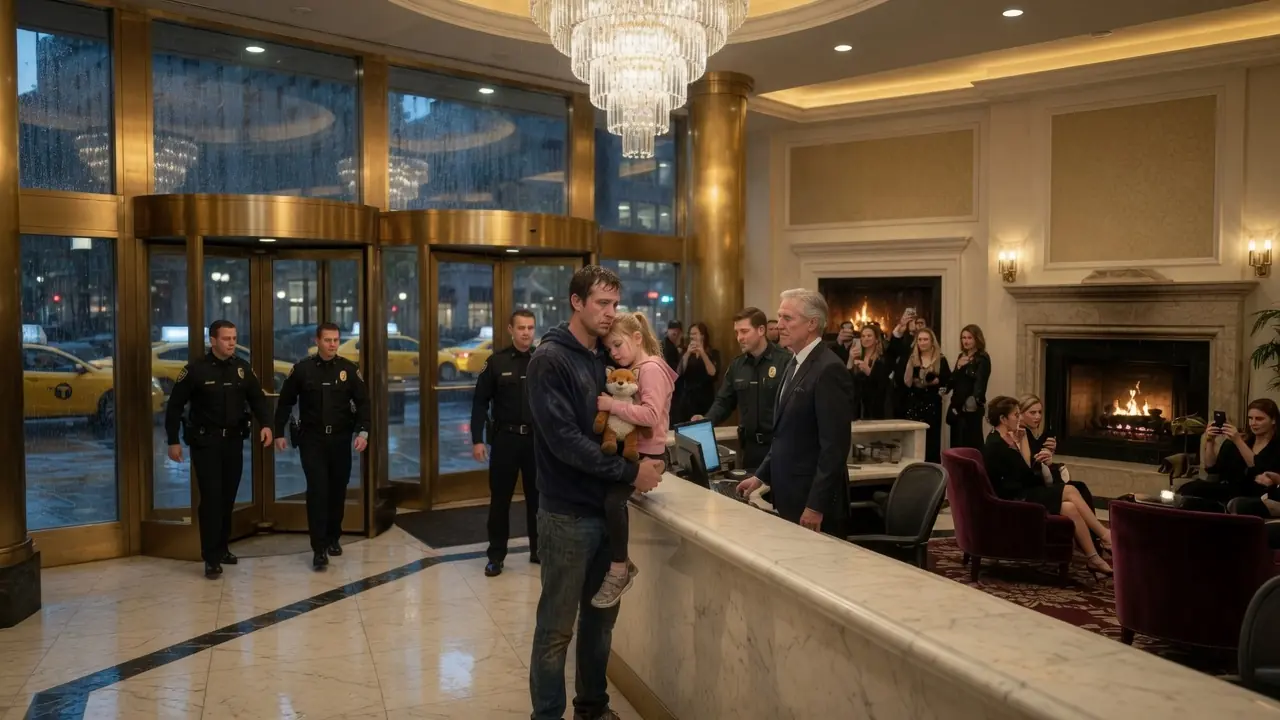
Nathan stepped out of the taxi with his seven-year-old daughter asleep against his chest.
Ellie’s cheek rested on his shoulder. Her small hand was curled into the front of his sweatshirt, and her stuffed fox, Mr. Maple, dangled from one arm by a worn orange tail.
She had been brave all day.
Brave when their flight was delayed.
Brave when their suitcase was sent to the wrong city.
Brave when the rideshare driver canceled twice.
Brave when the first hotel said their booking had vanished from the system.
But somewhere between the airport and downtown, her courage had finally run out. She had fallen asleep against him in the back seat, mouth slightly open, eyelashes damp from tired tears.
Nathan adjusted his grip, paid the driver, and looked up at the glowing sign above the entrance.
The Harrington Grand.
Forty-two stories of glass, brass, and warm golden light.
His hotel.
Not that anyone in the lobby knew that.
And tonight, that was exactly why he had come this way.
Nathan Mercer was not famous in the usual sense. He avoided interviews when he could, sent executives to conferences in his place, and had a gift for making powerful decisions from quiet rooms. But in business circles, his name mattered. Mercer House Hotels had grown from one failing roadside inn into a luxury hospitality group with properties in twelve cities.
He had built the company after his wife died.
Not because grief gave him ambition.
Because grief gave him a reason not to stop moving.
When Laura passed away, Ellie was only two. Nathan learned how to braid hair badly, warm milk at midnight, read bedtime stories through tears, and sign business contracts with one hand while holding a feverish child with the other.
He built hotels because Laura had loved them.
Not the expensive parts.
Not the marble or chandeliers.
She loved the idea of shelter.
A clean bed after a long road.
A safe room in an unfamiliar city.
A door that locked.
A desk clerk who smiled like you were not a burden for being tired.
That was what Nathan had promised himself his hotels would be.
A place where people could arrive at their worst and still be treated gently.
He pushed through the revolving door, carrying Ellie into the lobby.
Warm air wrapped around them. Soft piano music drifted from hidden speakers. The marble floor reflected a chandelier that looked like a frozen waterfall. Behind the front desk, two employees in dark green uniforms moved with careful, polished smiles.
A couple stood ahead of him.
The man wore a tailored coat. The woman had a pearl scarf around her neck and complained that their city-view suite needed to be “at least above the twentieth floor.”
The desk clerk smiled.
“Of course, Mrs. Langford. We will take care of that right away.”
Nathan waited patiently, rain dripping from his sleeves.
Ellie shifted against him.
He kissed her temple.
“Almost there, bug.”
When the couple walked away with their key cards, Nathan stepped forward.
The desk clerk looked up.
His smile paused.
Not disappeared.
Paused.
His name tag read: Julian Price.
Julian’s eyes moved quickly over Nathan’s wet hoodie, worn jeans, muddy sneakers, and the sleeping child in his arms.
“Good evening,” Nathan said. “I need a room for one night. Two guests. Myself and my daughter.”
Julian glanced at Ellie.
Then back at Nathan.
“Do you have a reservation?”
“No. Our original hotel lost our booking. I’ll take whatever you have available.”
Julian tapped at the keyboard.
Too quickly.
“I’m sorry, sir. We’re fully committed tonight.”
Nathan looked past him.
In the brass panel behind the desk, he could see the faint reflection of the reservation screen.
Rooms available.
Fourteen.
He did not react.
“Are you sure?”
“Yes, sir.”
“The couple before me were walk-ins.”
Julian’s mouth tightened slightly.
“They had a prior arrangement.”
“I heard them say they didn’t.”
The smile thinned.
“Sir, as I said, we are fully committed.”
Nathan shifted Ellie higher against his chest.
“My daughter is exhausted. I have a valid credit card. I’m not asking for anything special. Just a room.”
Julian looked over Nathan’s shoulder toward the lobby.
That was when Nathan noticed another employee watching from the concierge desk.
A woman, maybe mid-twenties, with her hair pulled into a neat bun and a name tag that read: Sophie.
She had seen the screen too.
He could tell by the way her face had gone still.
Before Nathan could speak again, a man emerged from the side office.
Tall, narrow, silver-haired, dressed in a charcoal suit with a pocket square folded so sharply it looked weaponized.
“Is there an issue?” he asked.
Julian straightened.
“Mr. Alden, the gentleman is requesting a room, but we are fully committed.”
Nathan turned to him.
“And you are?”
“Victor Alden. General Manager.”
“Mr. Alden, your system shows available rooms.”
Victor’s eyes flicked to Julian.
Just once.
Enough.
Then he smiled at Nathan without warmth.
“Sir, our room inventory is not always as simple as it may appear on a screen.”
“I imagine not.”
“Given the hour, your lack of reservation, and the condition of the lobby, I think it would be best if you found accommodation elsewhere.”
Ellie stirred against Nathan’s shoulder.
He felt her fingers tighten in his sweatshirt.
The condition of the lobby.
Nathan looked down.
Rainwater around his shoes.
A tired child in his arms.
A single father in a wet hoodie standing beneath a chandelier he had paid for.
He looked back at Victor.
“My daughter is asleep. I have not raised my voice. I have not threatened anyone. I have not disturbed your guests.”
Victor’s smile sharpened.
“Sir, you are disturbing them now.”
The words floated across the lobby.
This time, everyone heard.
The couple by the elevators turned.
A bartender stopped wiping a glass.
Sophie lowered her eyes at the concierge desk.
Nathan felt something cold settle under his ribs.
Not anger yet.
Anger would come later.
This was disappointment.
Older.
Quieter.
He had built this company because he believed comfort should never be guarded by cruelty.
And here cruelty stood in a tailored suit.
“I’d like your full name and position,” Nathan said.
Victor blinked.
“Excuse me?”
“For the record.”
Julian shifted behind the desk.
Victor gave a short laugh.
“My name is on my badge.”
“Say it.”
The lobby seemed to hold its breath.
Victor’s face flushed.
“Victor Alden. General Manager of the Harrington Grand.”
Nathan nodded once.
“Thank you.”
Then he walked away from the desk.
Not toward the exit.
Toward the seating area beneath the largest chandelier.
He sat in a deep burgundy armchair, settled Ellie carefully beside him, and wrapped his damp coat around her small body.
She opened her eyes slowly.
“Daddy?”
“I’m here.”
“Do we have a room?”
“Not yet.”
“I’m tired.”
“I know, bug.”
Across the lobby, Victor spoke quietly to Julian. Then he looked toward two security guards near the front entrance.
Nathan saw the nod.
He had seen enough.
There was a difference between one rude employee and a culture that gave rudeness permission.
A rude employee could be corrected.
A culture had to be exposed.
The two guards crossed the lobby.
One was older, stocky, with tired eyes and a name tag reading Alan. The other was younger, taller, and a little too eager. His name was Bryce.
They stopped near Nathan’s chair.
Ellie sat up, rubbing her eyes.
Victor followed them with his hands clasped in front of him.
“Sir,” Victor said, voice low but perfectly audible, “you have been informed that we cannot accommodate you. This is private property. You need to leave.”
Nathan looked up.
“I am sitting quietly with my daughter.”
“You were asked to leave.”
“You denied me service after providing service to walk-in guests who arrived before me.”
Victor’s jaw tightened.
“I will not debate this in the lobby.”
“That is convenient.”
A woman near the fireplace lifted her phone.
Another guest near the bar angled his phone from his lap.
Victor noticed.
His expression changed again.
Not with shame.
With fear of being recorded.
That was when Nathan understood him completely.
Victor Alden was not embarrassed by what he had done.
He was embarrassed that other people might see it.
“Please escort him out,” Victor said.
Ellie looked sharply at her father.
“Daddy?”
Nathan stood slowly, keeping one hand on her shoulder.
“It’s okay.”
But it was not okay.
Children always know.
Ellie looked at Victor.
She was small in her pink travel sweatshirt, leggings, messy ponytail, and rain-damp sneakers. Mr. Maple was tucked under her arm. Her eyes were wide, not frightened exactly, but hurt by confusion.
“Why are you making us leave?” she asked.
Victor did not answer.
Ellie looked around the lobby, trying to understand the adult world in front of her.
“We didn’t do anything bad.”
“No,” Nathan said softly. “We didn’t.”
“We didn’t yell.”
“No.”
“We just need a bed.”
“Yes.”
Ellie turned back to Victor.
“Isn’t that what hotels are for?”
The question hit the room harder than an accusation.
Alan, the older guard, looked down.
Bryce shifted impatiently.
“Sir, we need to move.”
Nathan did not move.
He looked at Victor.
“I want you to say clearly, in front of everyone, why my daughter and I are being removed.”
Victor’s face darkened.
“Because you are refusing to leave after being denied service.”
“Why was I denied service?”
“There were concerns.”
“What concerns?”
Julian spoke too quickly from behind the desk.
“Sir, please don’t make this harder than it has to be.”
Nathan turned his head.
“Hard for whom?”
Julian went silent.
Victor stepped closer.
“Enough.”
Ellie’s hand found Nathan’s fingers.
He felt her trembling.
That ended the test.
Nathan pulled out his phone and called Margaret Hale.
Margaret was the CEO of Mercer House Hotels. Sixty-one years old. Silver-haired. Brilliant. Severe when necessary. Kind when earned. She had known Nathan before the company had a legal department, before the investors, before the magazines, before anyone believed a grieving young widower could build anything but a wall around himself.
She answered on the second ring.
“Nathan?”
“I’m in the Harrington Grand lobby with Ellie.”
Her voice changed.
“What happened?”
“We were denied a room. A walk-in couple was checked in ahead of us. The general manager says we are disturbing guests and has called security to remove us.”
Silence.
Then Margaret asked, quietly, “Who is the manager?”
“Victor Alden.”
Another silence.
“I’m upstairs in the board suite preparing for tomorrow’s review,” she said. “Do not leave the lobby.”
“I wasn’t planning to.”
“I’ll be there in one minute.”
Nathan ended the call.
Victor watched him with irritation sharpened by uncertainty.
“Calling someone will not change hotel policy.”
Nathan put the phone away.
“It already did.”
Victor’s eyes narrowed.
“Excuse me?”
Nathan looked down at Ellie.
“We’re not going anywhere tonight.”
The executive elevator chimed.
It was not loud.
It was the same soft chime the lobby had heard all evening.
But this time, every head turned.
The elevator doors opened.
Margaret Hale stepped out first, still buttoning her navy blazer. Behind her came Priya Desai, Chief People Officer, tablet in hand, expression grim. Beside her was Owen Park, general counsel, wearing the calm, unreadable face of a man already preserving evidence.
Margaret crossed the lobby without looking left or right.
She walked straight to Nathan.
When she stopped in front of him, her face carried something that looked almost like grief.
“Mr. Mercer,” she said clearly, loud enough to reach every corner of the lobby. “I am deeply sorry you and Miss Ellie were kept waiting.”
The room went silent one sound at a time.
Julian’s hands slid off the keyboard.
Victor’s mouth parted slightly.
Bryce, the younger guard, looked from Margaret to Nathan to Victor with dawning panic.
Ellie tugged Nathan’s hand.
“Daddy, who is that?”
Nathan kept his eyes on Victor.
“That’s Ms. Hale. She works with me.”
Margaret turned to face the lobby.
“This is Nathan Mercer,” she said. “Founder and sole owner of Mercer House Hotels. The Harrington Grand belongs to him.”
Nobody breathed.
The woman by the fireplace lowered her phone.
The bartender stared.
The man near the bar whispered, “No way,” then covered his mouth.
Julian went pale.
Victor did not move.
Margaret continued, voice level.
“Tonight, carrying his sleeping daughter, Mr. Mercer was told he did not belong in his own lobby.”
Victor finally found words.
“Mr. Mercer, I had no idea who you were.”
Nathan looked at him.
“I know,” he said. “That is the point.”
Victor swallowed.
“Had I known—”
“That is also the point.”
The sentence cut through the room.
Nathan stepped forward.
Not quickly.
Not loudly.
But with the steady weight of a man who had learned that shouting sometimes lets guilty people focus on volume instead of truth.
“You did not need to know my name to treat me with dignity,” Nathan said. “You did not need to know my bank account, my title, my ownership stake, or my history. You needed only to know that I was a father with a tired child asking for a room.”
Victor glanced at Ellie.
Nathan’s voice hardened.
“Do not look at her now like you suddenly see a child. She was a child when I walked in.”
Victor looked away.
Nathan turned to Julian.
“You told me there were no rooms.”
Julian swallowed.
“I thought—”
“You thought what?”
Julian said nothing.
Nathan waited.
The waiting was worse than anger.
Julian’s eyes filled.
“I made an assumption,” he whispered.
“Yes,” Nathan said. “You did.”
Then he faced Victor again.
“You backed that assumption with authority. Then you called security when I asked you to explain it. That is not hospitality. That is not leadership. That is not a mistake made under pressure. That is a failure of character in a position where character is the work.”
Victor stiffened.
“With respect, Mr. Mercer, I have run this property successfully for five years.”
Nathan asked, “Successfully for whom?”
Victor had no answer.
Nathan looked around the lobby.
“There are people in this room who saw exactly what happened. Some recorded. Some stayed silent. Some wanted to speak but were afraid. I understand fear. But silence protects the wrong person when nobody names the harm.”
Sophie’s eyes filled at the concierge desk.
Nathan saw it.
But he was not done.
“My late wife believed hotels mattered,” he said. “Not because of chandeliers or marble floors, but because people arrive at hotels when they are tired, lost, stranded, grieving, delayed, frightened, or alone. A hotel is supposed to meet people at the door and say, You can rest here.”
The lobby seemed to shrink around his voice.
“She used to say the first job of hospitality is not luxury. It is mercy.”
Ellie leaned into his side.
Nathan rested a hand on her shoulder.
“And tonight, my daughter watched grown adults decide her father looked like a problem before he ever became one.”
Victor’s composure cracked.
“I apologize.”
Nathan studied him.
“Do you?”
“Yes. Of course.”
“You apologize because I own the hotel.”
Victor’s silence answered.
Nathan nodded once.
“Victor Alden, you are terminated effective immediately.”
A small sound moved through the room.
Victor’s face changed from fear to humiliation to anger.
“You are firing me in the lobby?”
Nathan’s expression did not change.
“You removed me in the lobby.”
The words struck hard.
Priya stepped forward.
“Mr. Alden, your system access has been suspended. I will escort you to collect your personal belongings.”
Victor looked at her.
Then at Margaret.
Then at Nathan.
Then around the lobby at the phones, the faces, the staff he had ruled through fear.
Whatever defense he had left abandoned him there.
He adjusted his jacket.
A small, sad gesture.
A man trying to preserve dignity after denying it to someone else.
Then he followed Priya toward the back office.
Julian remained behind the desk, breathing hard.
Nathan walked toward him.
Julian whispered, “Please. I need this job.”
Nathan stopped at the counter.
“So does every housekeeper upstairs. Every cook in the kitchen. Every bellman outside in the rain. Needing a job is not an excuse to use it to make someone feel small.”
Julian wiped his face quickly.
“I’m sorry.”
Nathan looked at him for a long moment.
He thought of his own first job at seventeen, carrying luggage at a roadside inn where the owner told him never to judge guests by the cars they arrived in because sometimes the richest people drove the worst trucks and the loneliest people wore the best coats.
“You are suspended pending review,” Nathan said. “Not fired tonight.”
Julian’s head snapped up.
Nathan held his gaze.
“This is not mercy because you cried. This is accountability because I think you may still be teachable. You will go through retraining. Not customer-service scripts. Not brand language. Values. Bias. power. dignity. If you return to this desk, it will be because you understand the work differently.”
Julian nodded, tears slipping now.
“Yes, sir.”
“And you will write a letter.”
“To you?”
“No. To yourself. About what you saw when I walked in, what story you created, and what that story cost someone else before it cost you.”
Julian could barely speak.
“Yes, sir.”
Nathan turned to the guards.
Alan looked ashamed.
Bryce looked frightened.
Nathan faced Alan first.
“You were uncomfortable.”
Alan swallowed.
“Yes, sir.”
“Why didn’t you say anything?”
Alan looked down.
“I thought I’d lose my job.”
Nathan nodded.
“That fear is real. But in my company, protecting someone from mistreatment is not insubordination.”
Alan’s eyes lifted.
Nathan turned to Bryce.
“And you?”
Bryce opened his mouth.
Closed it.
“I just followed orders.”
Nathan sighed.
History was full of people who believed that sentence cleaned their hands.
“Do not let that be the best thing you can say about yourself.”
Then he walked to the concierge desk.
Sophie stood frozen, tears shining but not falling.
Nathan stopped in front of her.
“You saw it.”
She nodded once.
“You knew.”
“Yes,” she whispered.
“Why didn’t you speak?”
Her face folded with shame.
“Because Victor controls schedules. Because my brother’s tuition is due next month. Because I’ve seen what happens when people challenge him.”
She looked down.
“Because I was scared.”
Nathan’s voice softened.
“That is honest.”
“I’m sorry.”
“I’m not asking for your apology. I’m asking for your courage next time. And I’m asking myself why this hotel made courage feel dangerous.”
Sophie looked up.
Nathan glanced toward Margaret.
“Effective tomorrow, Sophie Lane is interim guest services supervisor while we conduct a full culture review.”
Sophie’s mouth opened.
“Mr. Mercer, I—”
“You recognized the line tonight,” Nathan said. “Now I’m giving you authority to protect it.”
A tear slipped down her cheek.
“I won’t waste it.”
“I know.”
Ellie tugged his sleeve.
“Daddy,” she whispered, “can we sleep now?”
The sound that moved through the lobby was not laughter exactly.
It was release.
Relief with a bruise beneath it.
Nathan bent and kissed the top of her head.
“Yes, bug. We can sleep now.”
Margaret stepped forward.
“The owner’s suite is ready.”
Nathan looked at her.
“No.”
Margaret paused.
Nathan turned toward the desk.
“Give us a standard room.”
Margaret understood instantly.
Nathan added, “The same kind of room I asked for when I walked in.”
The room was on the eleventh floor.
Not the penthouse.
It had two queen beds, a view of rain sliding down the windows, and a small writing desk with a welcome card that had not been prepared for the owner.
Nathan preferred it that way.
Ellie was asleep within five minutes.
She brushed her teeth, placed Mr. Maple beside her pillow, climbed beneath the white duvet, and surrendered to exhaustion with the complete trust of a child who believed her father had handled the danger.
Nathan stood beside her bed for a long time.
Seattle glowed beyond the window.
Below them, the lobby was still awake with consequences.
He should have felt victorious.
He did not.
Victory was too clean a word.
He felt tired.
Angry.
Responsible.
A company is not what its founder says at conferences.
It is what happens near midnight when the founder walks in wearing a wet hoodie and nobody knows his name.
His phone buzzed.
Margaret.
Nathan stepped into the bathroom and answered quietly.
“Preliminary review has started,” she said. “Priya is pulling employee complaints. Owen is preserving footage. Victor’s access is gone. Julian has been relieved for the night.”
“Good.”
Margaret hesitated.
“Nathan, I’m sorry.”
“You didn’t deny me a room.”
“No,” she said. “But I was responsible for the people who did.”
That was why Margaret still had his trust.
Because she understood responsibility correctly.
“We’ll talk in the morning,” Nathan said. “Full leadership review. Every property. Anonymous staff survey. Guest denial audit. Security escalation review. And Margaret?”
“Yes?”
“I don’t want a statement written by legal calling this an isolated misunderstanding.”
“Understood.”
“It wasn’t isolated if the system allowed it to feel normal.”
“I know.”
By morning, the story was online.
Not all of it.
Just fragments.
Nathan standing in the lobby with Ellie beside him.
Victor saying, “Escort him out.”
Ellie asking, “Isn’t that what hotels are for?”
Then Margaret stepping from the elevator and saying Nathan’s name.
By 8 a.m., the clip had spread across social media and local news pages. Some called Nathan a hero. Some accused him of staging it. Some said Victor was only protecting the hotel. Some said people who arrived looking “unprepared” should not expect luxury service. Some said this happened every day and only mattered because the man turned out to be rich.
Nathan read almost none of it.
He sat at breakfast with Ellie in the hotel restaurant, both of them still wearing yesterday’s clothes. Ellie ate pancakes and gave Mr. Maple his own tiny plate. Nathan drank black coffee and watched every staff member approach their table with visible terror.
That bothered him.
Fear was not respect.
Fear was not hospitality.
Sophie approached near the end of breakfast.
She wore the same uniform as the night before, but her posture had changed. Not entirely. Change did not happen that fast. But something in her eyes had steadied.
“Good morning, Mr. Mercer,” she said. “Good morning, Miss Ellie.”
Ellie looked up.
“Hi.”
Sophie smiled.
“I wanted to check whether you needed anything before your meeting.”
Nathan gestured to the empty chair.
“Sit for a minute.”
Sophie hesitated.
“That wasn’t a test,” Nathan said.
She sat.
Ellie pushed a small plate toward her.
“You can have a pancake. They gave me too many.”
Sophie looked at Nathan.
He nodded.
She took one pancake as seriously as if it were a promotion letter.
“Thank you.”
Ellie studied her.
“Were you scared last night?”
Sophie froze.
Nathan started to speak, but Sophie answered first.
“Yes,” she said gently. “I was.”
“Because of the mean manager?”
“Because sometimes adults worry that doing the right thing will make bad things happen to them.”
Ellie considered this.
“But bad things happened anyway.”
Sophie’s eyes softened.
“Yes,” she whispered. “They did.”
Ellie dipped pancake in syrup.
“Then next time you should do the right thing first.”
Sophie let out a small breath that was almost a laugh and almost a sob.
“You’re right,” she said. “I should.”
At 9:30, Nathan walked into the executive conference room on the twenty-fourth floor.
Margaret was there. Priya. Owen. Regional directors on video screens. Department heads from the Harrington Grand sat around the table looking like students waiting outside the principal’s office.
Nathan did not sit at the head of the table.
He stood near the window overlooking the city.
“My wife used to say hotels tell the truth at night,” he began. “During the day, everyone performs. At midnight, people are tired. Guests are impatient. Staff are under pressure. That is when the values get tested. Last night, this hotel told the truth about itself.”
No one spoke.
Nathan turned around.
“I don’t want the phrase brand damage used today. Not once. The damage did not happen because people saw the video. The damage happened because a tired father and child entered our lobby and were treated as if their presence lowered the value of the room.”
Priya wrote something down.
Nathan continued.
“We are going to review hiring, training, promotion, complaint handling, security escalation, and every denied accommodation from the last three years. We are going to find out who felt powerless to speak. We are going to find out who made them feel that way. And then we are going to change it.”
A department head named Graham cleared his throat.
“Mr. Mercer, with respect, staff may feel they can’t enforce standards.”
Nathan looked at him.
“What standards?”
“Guest comfort. Safety. Property expectations.”
“Was I unsafe?”
“No.”
“Was my daughter unsafe?”
“No.”
“Did I threaten anyone?”
“No.”
“Was I loud?”
“No.”
“Then what standard was being enforced?”
Graham looked down.
Nathan let the silence teach the lesson.
“There is a difference between protecting a hotel and protecting the feeling some guests have that certain people should not be near them,” Nathan said. “We will not confuse those again.”
By noon, Victor Alden’s termination was public.
By evening, Mercer House Hotels released a statement written mostly by Nathan himself.
It did not hide behind vague language.
It did not call the incident unfortunate.
It did not say they were disappointed if anyone was offended.
Nathan wrote one sentence three times before leaving it in.
A guest should not have to be wealthy, polished, known, powerful, or perfectly dressed to be treated with dignity at our doors.
The response was immediate.
Emails poured in.
Some from loyal customers.
Some from angry people who said luxury hotels needed to “protect standards.”
Some from former employees telling stories that made Priya cry behind her office door.
Some from guests who had been turned away, ignored, questioned, followed, or made to feel grateful for basic courtesy.
Nathan read those.
Not all.
Enough.
One message came from Julian.
It arrived three days later, forwarded through Priya with the subject line Nathan requested.
The letter was not polished.
Nathan appreciated that.
Julian wrote about seeing a hoodie before a father. Seeing muddy shoes before a tired child. Seeing exhaustion and ordinary clothes and turning them into a story where Nathan was trouble before he spoke. He wrote that he had spent his whole career learning to identify “high-value guests” and had never questioned what that made everyone else.
He wrote about Ellie’s question.
Isn’t that what hotels are for?
Julian ended with:
I do not know if I deserve to come back. But I know I do not want to be the man I was that night.
Nathan sat with the letter for a long time.
Then forwarded it to Priya.
Put him in the program. No shortcuts. No guarantees.
Three months later, Nathan returned to the Harrington Grand unannounced.
Ellie came with him because she insisted.
She wore a yellow raincoat, sparkly sneakers, and carried Mr. Maple under one arm like an old soldier reporting for duty.
“Are we doing another secret test?” she asked as they stepped out of the car.
Nathan smiled.
“Something like that.”
“Should you wear the hoodie again?”
“I thought about it.”
“You look too fancy today.”
He looked down at his blazer.
“Noted.”
The revolving doors carried them into the lobby.
It looked the same at first glance.
Marble.
Orchids.
Piano music.
Gold light.
But Nathan felt the difference before he named it.
Near the entrance, a family stood with mismatched luggage and wet coats. The parents looked exhausted. Two children hovered near them, one crying quietly, the other trying very hard not to. Their shoes were wet from the rain. Their luggage did not match. They looked like people who had spent too much money already and feared spending more.
Sophie saw them before they reached the desk.
She crossed the lobby immediately.
Not fast enough to alarm them.
Not slow enough to make them wonder whether they belonged.
“Hi,” she said warmly. “Welcome in. I’m Sophie. Looks like Seattle gave you a rough arrival.”
The mother laughed weakly.
“That obvious?”
“Only because Seattle likes to test everyone’s shoes.”
The crying child looked down at her wet sneakers.
Sophie crouched slightly.
“And those shoes have been very brave.”
The child sniffed.
The father said, “We don’t want to be any trouble. Our reservation at another hotel got canceled, and—”
Sophie’s smile did not flicker.
“You are not trouble,” she said. “You are guests. Let’s get you warm first, then we will figure out the room.”
She signaled discreetly to a bell attendant.
“Hot chocolate?”
Both children looked at their parents.
The mother’s face crumpled for half a second before she caught it.
“Yes,” she whispered. “Thank you.”
Sophie pretended not to notice the tears so the woman could keep her dignity.
Nathan stood near a column and felt Ellie’s hand slip into his.
They watched Sophie guide the family toward the seating area while another employee brought towels for their coats.
Ellie leaned against Nathan.
“Daddy?”
“Yeah?”
“Is that what it was supposed to look like?”
Nathan watched the little boy accept hot chocolate with both hands.
“Yes,” he said. “That is exactly what it was supposed to look like.”
Sophie glanced up then and saw them.
For one second, surprise crossed her face.
Then she smiled.
Not the frightened smile staff gave owners.
A real one.
Ellie waved Mr. Maple.
Sophie waved back.
Near the front desk, Julian stood in a plain training uniform beside an older supervisor. He was not checking guests in alone yet. He was observing, taking notes, listening.
When he saw Nathan, his face went pale.
But he did not look away.
Nathan nodded once.
Julian nodded back.
It was not forgiveness.
Not yet.
But it was a beginning.
Later, after meetings and inspections and a long conversation with Sophie about the new guest advocacy policy, Nathan and Ellie returned to the lobby. The family from earlier was heading toward the elevators now, children smiling, parents visibly lighter.
The little girl with hot chocolate passed Nathan and stopped.
“Are you the owner?” she asked.
Her mother looked horrified.
“Annie.”
Nathan crouched.
“I am.”
The girl studied him.
“This is a nice hotel.”
Nathan smiled.
“Thank you.”
The girl pointed toward Sophie.
“She said we weren’t trouble.”
Nathan looked at Sophie, then back at the girl.
“She was right.”
The family continued to the elevators.
Ellie watched them go.
Then she looked at Nathan with the serious expression she used when building a thought from the ground up.
“Mommy would like Sophie,” she said.
Nathan’s throat tightened unexpectedly.
Ellie had been two when Laura died. Her memories were pieces: lavender soap, a lullaby, warm hands, a yellow scarf. Nathan had spent years telling her stories so her mother would not become only a photograph.
“Yes,” Nathan said. “She would.”
“Would she like the hotel now?”
Nathan looked around.
At Sophie helping a guest find the light rail.
At Alan opening the door for an elderly man with the same respect he gave the woman in diamonds behind him.
At Julian listening carefully as his supervisor explained something.
At the lobby Laura had never lived to see become what Nathan had promised it would be.
“I think,” Nathan said, “she would say we are finally learning.”
Ellie nodded.
Then she held Mr. Maple up toward the chandelier.
“Mr. Maple agrees.”
Nathan laughed.
For the first time in that lobby, he laughed fully.
Not politely.
Not carefully.
Fully.
Several staff members looked over, startled, then smiled and went back to work.
That night, Nathan did not stay in the owner’s suite.
He and Ellie took a standard room again.
Before bed, Ellie placed Mr. Maple between the pillows and looked at her father.
“Daddy?”
“Yes?”
“If somebody doesn’t know you own something, they should still be nice.”
Nathan sat on the edge of the bed.
“That’s right.”
“And if they’re only nice after they know, that doesn’t count.”
He smiled sadly.
“No, bug. It doesn’t.”
She thought about that, then yawned.
“I’m glad you didn’t yell.”
“Why?”
“Because then they had to hear you.”
Nathan brushed her hair back.
Outside the window, Seattle shone through the rainy dark, bright and restless and full of doors. Some opened easily. Some did not. Some had to be rebuilt by people who remembered what it felt like to stand outside them with a child in their arms.
Nathan turned off the lamp.
In the quiet, he thought of Laura.
He thought of her saying mercy was the first job of hospitality.
He thought of the little girl in the lobby holding hot chocolate.
He thought of Sophie saying, You are not trouble. You are guests.
And for the first time since that rainy midnight, the ache in his chest loosened.
Not because everything was fixed.
Everything was never fixed all at once.
But because one room had changed.
One door had opened wider.
One child had seen her father stand in his dignity and refuse to let the world teach her shame.
That mattered.
Sometimes justice looked like a public firing beneath a chandelier.
Sometimes it looked like retraining, policy, apology, and the slow repair of a broken culture.
And sometimes it looked like a tired family walking into a hotel lobby afraid they did not belong, only to have someone meet them halfway and say, with no hesitation at all:
Welcome in.