Slow.
Heavy.
Patient.
Not like Shadow’s sharp stamping in the sand, not like the frightened clatter of arena horses behind the gates, not like any living creature eager to flee or fight. This sound rose from the darkness beneath the arena with a terrible calm, each step striking the hidden stone passage below as if something ancient had awakened and was climbing back into the world.
Shadow pressed closer to me.
I felt the enormous stallion’s body tremble through my shoulder, and that frightened me more than Tribune Cassius’s spear, more than the guards, more than the thousands of eyes staring down from the stands. Shadow had not trembled when six handlers tried to break him. He had not trembled when Cassius ordered him killed. But now his breath came fast and harsh, and his black ears pinned flat against his head.
The old soldiers who had risen from the secret passage shifted uneasily. They were not young men. Some had gray in their beards, and some carried scars that pulled their mouths crooked when they clenched their jaws. Yet they stood like walls around me, shields lifted, faded cloaks marked with the wolf of Maximus.
Their leader, the man who had knelt before me, slowly stood.
His face had the weathered hardness of stone carved by storms. A deep scar ran from his temple to his jaw, and one of his eyes was milky white. But when he looked at the tunnel, I saw something in him crack.
“No,” he whispered. “Not him.”
The emperor leaned forward from his gilded seat. “Who is below my arena?”
No one answered.
Then the darkness breathed.
A low, ragged sound rolled out of the tunnel, and the crowd recoiled as though the arena itself had growled. Dust drifted through the open iron plate, curling in the sunlight. The air changed. It seemed colder suddenly, filled with the sour smell of old straw, rusted iron, and something wild that had been caged too long.
Another hoof struck stone.
Then a horse emerged from the underground passage.
At first, I thought he was black like Shadow. Then he stepped fully into the light, and I saw that his coat was not black but a deep, bruised gray, darkened by sweat and scars. His mane had been hacked short in uneven tufts. Across his broad chest ran a pale scar shaped like lightning, and one of his eyes was clouded white. The other eye burned amber, sharp and cruelly intelligent.
He was enormous.
Not simply tall, but massive in a way that made even Shadow seem slender beside him. His neck was thick with muscle. His hooves struck the sand like hammers. Around his head and shoulders hung fragments of old war armor: dented bronze plates, broken leather straps, and a half-torn crest that had once belonged to a commander’s horse.
The crowd gasped.
Someone in the upper stands cried, “Mars preserve us.”
The old senator near the imperial box gripped the railing with both hands. His lips had gone bloodless.
“Ravager,” he said.
The name moved through the arena like a sickness.
I had heard that name once before.
My mother had spoken it on the night she died.
I was eight years old then, though I felt younger, small and helpless beside the narrow bed where she lay wrapped in a thin blanket. Rain had battered the roof of the room above the stables. She had been burning with fever, but her hands were cold when she pulled me close.
“Lucius,” she whispered, “listen to me now. There were two horses in your grandfather’s army. Shadow, who carried him through every battlefield. And Ravager, who belonged to the traitor.”
“What traitor?” I had asked.
Her eyes had filled with fear even as fever clouded them.
“The man who smiled at my father’s table,” she said. “The man who called him brother. The man who sold Rome’s soldiers to its enemies, then blamed Maximus when the dead could not speak.”
I had not understood.
I only remembered her trembling when she said the name.
“Cassian.”
Now, standing in the arena two years later, I looked at Tribune Cassius and felt the memory strike through me like lightning.
Cassius.
Cassian.
The names were too close to be an accident.
The old soldier beside me must have seen the realization on my face.
He leaned down and spoke softly, though his voice carried the weight of a battlefield. “Tribune Cassius is the son of Marcus Cassian, the senator who betrayed your grandfather.”
A strange coldness spread through my chest.
Cassius heard him.
His mouth twisted. “Careful, Varro. Dead men’s stories have a way of burying those foolish enough to repeat them.”
So the old soldier had a name.
Varro.
He did not flinch.
“You should have buried us deeper,” Varro said.
Ravager stepped into the sunlight, and behind him came two handlers dressed not like ordinary stablemen, but like soldiers hiding in plain cloth. Chains hung from their hands, though I could tell they had not been leading him so much as following and hoping he would not turn on them.
Ravager tossed his scarred head.
Shadow lunged half a step forward, and the two stallions stared at each other across the sand.
The entire arena vanished around them.
It was as if they remembered a war no one had dared speak of.
Shadow’s nostrils flared. Ravager’s amber eye narrowed. Between them lay years of blood, betrayal, and exile. I felt it without understanding it, the way a child feels a storm before thunder arrives.
Tribune Cassius recovered first.
His fear hardened into rage.
He snatched another spear from a guard and pointed it, not at Shadow this time, but at me.
“Enough!” he roared. “This is treason staged before the emperor himself. Old soldiers crawl from holes, a stable rat waves a stolen token, and a beast bows like a circus trick. Shall Rome be ruled by children and horses now?”
The crowd murmured, uncertain.
Cassius turned toward the imperial box and dropped to one knee, though his voice remained loud enough to reach the highest stones.
“Caesar, I beg permission to end this deceit. The boy is an impostor. These men are rebels. That horse was trained to perform before this spectacle. Give me leave, and I will restore order.”
The emperor did not answer at once.
He was young, perhaps not much older than twenty, with a smooth face that had not yet learned to hide every emotion. His robe was white, his laurel gold, but there was hesitation in his eyes. Around him, senators leaned close, whispering urgently.
One of them, a heavy man with rings on every finger, spoke loud enough for many to hear.
“The tribune is right. Rome cannot be mocked by stable children.”
The old senator who had recognized my mother turned sharply. “And Rome cannot be built on buried murder, Senator Drusus.”
Drusus went still.
Cassius looked up, and something passed between them.
A small thing.
A glance.
But Shadow saw it. He stamped once, hard.
Varro saw it too.
“So,” he said under his breath. “Drusus still lives fat on stolen gold.”
My hands had begun to shake. I gripped Shadow’s mane to steady myself. The stallion lowered his head slightly, as if reminding me he was there.
I had never wanted any of this.
That thought struck me with sudden force. Only that morning, I had woken before dawn to carry water buckets through the stable yard. I had stolen a crust of bread, brushed dust from Shadow’s coat, and listened to him breathe. I had been hungry and tired, but I had known the shape of my world.
Now Rome stared at me as if I were a key to a locked tomb.
I was ten years old.
My mother was dead.
My grandfather was a legend.
And men with spears were deciding whether I should live.
Cassius rose slowly. His eyes fixed on me, bright with hatred.
“Boy,” he said, “tell this crowd what you truly are.”
My throat tightened.
“A stable boy,” I said.
Laughter broke from a few corners of the arena, harsh and nervous.
Cassius smiled. “There. His own confession.”
“And Livia’s son,” Varro said.
“And General Maximus’s blood,” the old senator added.
Cassius turned on him. “You have always loved ghosts, Senator Aelius.”
Aelius.
So that was the old senator’s name.
He lifted his chin. “Better ghosts than traitors.”
Cassius’s face darkened.
Before he could speak, Ravager moved.
It happened so suddenly that even the guards stumbled backward. The huge gray warhorse surged across the sand, chains whipping behind him. Not toward me. Not toward Shadow. Toward the fallen bronze helmet Cassius had lost when Shadow threw him.
Ravager lowered his head, sniffed it once, then crushed it beneath one hoof.
The sound cracked through the arena.
Cassius flinched.
The crowd roared.
Not with laughter this time, but shock, fear, and savage delight.
Ravager lifted his head and stared at Cassius as if he recognized the bloodline of his old master.
Then he screamed.
Shadow answered.
Their voices collided above us, wild and terrible, and for one breath I saw not an arena, but a battlefield beneath a burning sky. Men shouting. Shields splitting. Horses rearing. A general in a wolf-crested cloak raising a sword. Another man smiling as the gates opened to the enemy.
The vision struck so hard I staggered.
Shadow caught me with his neck.
Varro gripped my shoulder. “Lucius?”
“I saw…” I could barely speak. “I saw him.”
“Who?”
“My grandfather.”
Varro’s face changed.
He knelt again, but this time not ceremonially. He knelt as if he needed to bring his eyes level with mine.
“What did he wear?”
“A dark cloak,” I whispered. “With a wolf. His sword had a red stone in the hilt. There was fire behind him.”
Varro’s breath left him.
“The Battle of the Northern Gate,” he said. “No painting shows the sword. No song remembers the fire.”
Senator Aelius heard him and turned toward the emperor.
“Caesar,” he called, voice rising, “there are records beneath this arena. Maximus hid them before he vanished. He wrote that only Shadow would know the blood of his house, and only the rightful heir could open the vault where the truth was sealed.”
Cassius barked a laugh, but it cracked at the edges. “Convenient.”
Aelius pointed down at the hidden stairway. “Then let the boy fail, if he is false.”
A murmur swept through the crowd.
The emperor sat very still.
Cassius stepped toward the imperial box. “Caesar, this is madness. You cannot entertain—”
“I can,” the emperor said.
His voice was not loud, but it cut through the arena.
Cassius stopped.
The emperor stood.
“I was born after Maximus vanished,” he said, looking down at the sand, at me, at Shadow, at the old soldiers, at Ravager. “All my life, I have heard two versions of his name. Hero and traitor. Savior and criminal. Today, beneath my own arena, men thought dead have risen wearing his mark. A horse believed dead bows to a stable boy. Another warhorse appears from a hidden vault. And you, Tribune Cassius, demand blood before questions.”
Cassius bowed his head. “I demand order.”
“No,” the emperor said. “You demand silence.”
The words struck the arena like a thrown blade.
For the first time in his life, Tribune Cassius had been accused before all of Rome—and he could not command the accuser to kneel.
The crowd began to stir again, louder now. Some shouted for the boy to enter the vault. Others shouted for Cassius to be heard. Senators argued openly in the imperial box, robes flashing, rings glinting, faces flushed with panic.
Ravager pawed the sand.
Shadow nudged my shoulder.
I looked up at him, and in his dark eyes I saw not command, but invitation.
He knew what had to be done.
“Lucius,” Varro said gently, “beneath the arena lies the Wolf Vault. Your grandfather built it before his final campaign, when he learned enemies sat in Rome wearing friendly faces. We guarded it for years. But after Livia fled with you, the vault sealed itself. We could not open it. Shadow disappeared. Ravager was taken by Cassian’s men and hidden here, used to frighten any who came too close.”
“Why would Ravager come out now?” I asked.
Varro glanced toward the gray horse. “Because Shadow called, and because the past is tired of being buried.”
I stared into the tunnel.
It looked like a mouth in the earth.
I wanted my mother.
The wanting came so sharply that tears filled my eyes before I could stop them. I remembered her hands, thin and cold, tying the bronze token around my neck. I remembered how she had smiled even when pain twisted her face.
“One day,” she had said, “Rome will ask who you are. Do not answer too quickly. Let your heart answer first.”
But my heart was pounding too hard to say anything.
Shadow bent his head until his forehead touched mine.
His breath warmed my face.
I closed my eyes.
“I’m scared,” I whispered.
Shadow did not move.
He simply stood with me.
That was when I understood something I had not understood before. Courage was not the absence of fear. Courage was walking while fear held your hand.
I opened my eyes and looked at the emperor.
“I will go down,” I said.
The arena erupted.
Cassius lunged forward. “No!”
Ravager swung his massive head toward him, teeth bared.
Cassius stopped so suddenly his sandals slid in the sand.
The emperor raised one hand, and the guards formed a line between Cassius and the tunnel.
“Let the boy pass,” he commanded.
Varro placed a hand over his heart. “We go with you.”
I shook my head, though I did not know why until the words came. “No. Shadow comes. No one else.”
The old soldiers exchanged glances.
Varro’s jaw tightened. “Your grandfather left traps for traitors.”
“Then they will not hurt me.”
“How can you know?”
I touched the bronze token at my chest.
“Because my mother told me Shadow would find me. She did not say an army would save me.”
Varro looked as if the words wounded him.
Then he bowed his head.
“Livia had her father’s spine,” he murmured. “And her mother’s eyes.”
I turned toward the tunnel.
Shadow followed.
But before I reached the first step, Ravager moved into my path.
The great gray horse lowered his head until his amber eye was level with mine. Up close, he smelled of iron, sweat, and old pain. Scars crossed his muzzle. One ear was torn. There were places along his neck where the hair had never grown back.
He was terrifying.
Yet I saw something else beneath the terror.
Not anger.
Not only anger.
Loneliness.
A creature used by cruel men until cruelty became the only language he remembered.
Shadow gave a low sound, warning me not to touch him.
But I thought of all the times nobles had stepped over me as if I were dirt. I thought of all the times kitchen boys had kicked stray dogs to make themselves feel powerful. I thought of Cassius yanking Shadow’s reins, demanding obedience and calling fear defiance.
Slowly, I lifted my hand.
Ravager’s lips peeled back.
The crowd above gasped.
Cassius whispered, “Do it.”
He wanted the horse to kill me.
I heard it in his voice.
But I did not pull away.
“You were there too,” I said softly. “Weren’t you?”
Ravager’s eye flickered.
“You remember my grandfather.”
His breath blasted hot across my fingers.
“You remember the traitor.”
The huge horse trembled.
Behind me, Varro whispered, “Lucius, step back.”
I did not.
I touched Ravager’s scarred muzzle.
For a moment, nothing happened.
Then the great warhorse closed his eye.
A shudder passed through his body, deep and violent, as if some buried chain inside him had snapped.
And suddenly I saw another vision.
Not through my eyes.
Through his.
Night. Rain. The smell of blood. A man in a senator’s cloak leading foreign soldiers through a hidden gate. Ravager young and powerful beneath him, confused by the fear around him. Shadow charging from the smoke with Maximus on his back. Swords clashing. Men screaming. Cassian laughing.
Then a girl’s voice.
Livia.
She was younger than my mother had been in my memories, but unmistakably her. She stood beside Shadow in a burning stable, tears streaking soot down her face.
“Run,” she whispered to the black horse. “Find him one day. Find my son.”
The vision shattered.
I stumbled back, crying.
Shadow pushed against me anxiously. Ravager opened his eye.
Something had changed in him.
The cruelty had not vanished. Scars did not disappear because a child touched them. But the amber eye no longer burned with blind hatred. It watched me with recognition.
“Ravager,” I whispered.
The gray horse lowered his head.
Not a bow.
Not obedience.
A truce.
Then he stepped aside.
And before all of Rome, the horse of the traitor allowed the heir of Maximus to enter the darkness.
Part 4: The Wolf Vault
The stairs beneath the arena were cold.
That was the first thing I noticed. Above us, the sun burned fiercely over Rome, baking the sand and stone, turning armor hot enough to sting skin. But below, the air changed with every step. It grew damp and stale, heavy with the smell of old dust, oil, and iron.
Shadow followed behind me, his hooves careful on the stone.
The roar of the crowd faded until it became a distant sea.
For a while, there was only my breathing, Shadow’s breathing, and the soft clink of the bronze token against my chest.
The stairway curved downward. Torches along the walls suddenly sprang to life as we passed, one after another, blue at first, then gold. I froze when the first flame hissed awake.
Shadow nudged my back.
“I know,” I muttered. “Keep walking.”
My voice sounded too small in that ancient passage.
The walls were carved with wolves.
Not decorative wolves like those on noble cups or victory shields, but lean, watchful creatures with open eyes and bared teeth. They ran along the stone in packs, surrounding names written in Latin. I could read only some of the letters. Stable boys were not taught much, though my mother had shown me words by candlelight when she had strength.
TITUS AELIANUS MAXIMUS.
My grandfather.
Beneath his name were others.
Soldiers. Captains. Men who had followed him.
I reached out and touched one carved name. The stone was cold.
“Were they yours?” I asked Shadow.
He breathed softly against my hair.
I remembered Varro and the old soldiers waiting above. How long had they hidden beneath Rome? How many years had they carried a truth no one wanted to hear? I wondered if my mother had known they were alive. Perhaps she had. Perhaps she had stayed away to protect them, and me, and Shadow.
The passage opened into a round chamber.
At its center stood a great bronze door.
It was taller than three men and shaped with the image of a wolf’s head. The eyes were dark holes. The mouth was slightly open, showing metal teeth. Across the door ran words carved so deeply that dust had gathered in the grooves.
I sounded them out slowly.
“Blood may lie. Power may lie. Rome must not.”
My skin prickled.
Below the words was a small hollow shaped like my bronze token.
I pulled it from around my neck.
My hands shook badly enough that I dropped it once. It hit the stone floor with a small ringing sound that echoed around the chamber like a bell.
I snatched it up and pressed it into the hollow.
Nothing happened.
For one terrible moment, I thought Cassius had been right. I thought I was nobody, the son of a dying woman who had filled my head with stories to make poverty less cruel. I thought the door would remain shut forever, and I would climb back into the arena to laughter, spears, and death.
Then Shadow stepped beside me.
He lowered his head and breathed into the wolf’s mouth.
Deep within the bronze door, something clicked.
The wolf’s eyes filled with light.
A voice spoke from the walls.
It was not a ghostly voice. It was the voice of a man preserved by clever bronze tubes and hidden chambers, roughened by age but still human. Still strong.
“If this door opens, then Shadow has found my blood, and Rome stands again at the edge of a lie.”
I stopped breathing.
Shadow grew very still.
The voice continued.
“I am Titus Aelianus Maximus, general of the Northern Legions, servant of Rome, father of Livia, and enemy of those who sell truth for power.”
My knees weakened.
I had heard my grandfather’s name all my life in whispers, but never his voice. It filled the chamber, low and worn, and something in me reached toward it like a child reaching toward a fire in winter.
“If you are my heir,” the voice said, “forgive me. I leave you not gold, not comfort, not peace, but a burden sharpened by blood. I tried to carry it alone. I failed. Perhaps Rome will listen to a child where it refused to listen to a soldier.”
The bronze door groaned.
Dust poured from its edges.
Slowly, the Wolf Vault opened.
Inside was not treasure.
There were no mountains of coin, no golden statues, no jeweled swords. The chamber beyond the door was long and narrow, lined from floor to ceiling with shelves of wax tablets, sealed scrolls, military records, broken standards, and helmets with names carved inside them.
At the far end stood a stone table.
On it lay a sword with a red stone in its hilt.
The sword from my vision.
Beside it rested a sealed bronze cylinder and a small wooden box.
I walked forward as if in a dream.
Shadow remained near the door, watching the darkness behind us. I wished he would come closer, but some instinct told me he guarded the only way out. I was alone with the dead.
I reached the stone table.
The sword was too large for me. Its blade had been cleaned and oiled, but its edge bore nicks from battle. I touched the red stone. It caught the torchlight like a drop of frozen blood.
The bronze cylinder had my mother’s name scratched into it.
LIVIA.
My heart twisted so sharply I almost stepped back.
For a moment, I could not move.
Then I broke the seal.
Inside was a roll of thin parchment.
The writing was not my grandfather’s. I knew it before I read a word. It was my mother’s hand, careful and slanting, the same hand that had once drawn letters in spilled flour to teach me.
My throat closed.
I read.
My son,
If you are reading this, then Shadow has found you, and I am no longer able to protect you with silence. I wanted you to grow far from the men who destroyed our house. I wanted you to know horses, rain, bread, kindness. I wanted you to be a boy longer than Rome allows boys to remain children.
I am sorry.
Your grandfather did not betray Rome. He discovered that Senator Marcus Cassian, Senator Drusus, and others sold the Northern Gate to enemy forces in exchange for silver, land, and promises of power. Thousands died. To hide their crime, they accused Maximus of treason and declared him vanished. But he did not vanish by choice. He was imprisoned beneath the old military quarter, tortured for names, and finally taken away.
I searched for him for years.
I found only his ring, his bloodied cloak, and Shadow, wounded but alive.
Shadow carried more truth than men did.
He remembered.
He always remembered.
Trust him.
Trust Varro if he lives.
Trust Senator Aelius only if he speaks against his own safety.
Trust no one who asks you to surrender the token.
And know this, Lucius: you are not important because of blood. You are important because truth sometimes needs one living voice to carry it into daylight.
I love you beyond fear.
Mother.
The words blurred.
I pressed the parchment to my chest and bent over it, sobbing so hard my shoulders shook. I had tried not to cry in the arena. I had tried to stand straight before Cassius, the emperor, the crowd, and the old soldiers. But there, beneath Rome, in a vault built by a grandfather I had never met and guarded by a horse who had remembered me before I remembered myself, I broke.
Shadow came to me then.
He stepped quietly across the stone and lowered his head over my back.
I leaned into him and cried into his mane.
“She knew,” I whispered. “She knew I would come here.”
Shadow breathed.
“She should be here.”
The chamber gave no answer.
No answer could have been enough.
After a long while, I wiped my face with my sleeve and opened the wooden box.
Inside lay a signet ring, a braid of dark hair tied with red thread, and a small carved wooden horse.
The horse was worn smooth, one leg chipped.
I knew it.
My mother had once told me my father carved toys before fever took him. I had believed she lost them when we fled. Now I understood she had hidden one here, waiting for me.
Beneath the wooden horse was another folded parchment, older and stained.
This one bore Maximus’s seal.
I opened it carefully.
It was a confession.
Not his.
Cassian’s.
My hands tightened around the parchment as I read names, dates, payments, troop movements, secret orders. There were letters copied in different hands, seals pressed into wax, accounts of gold transferred through temples and merchant houses. There were testimonies from dying soldiers, signed before witnesses. There was a map of the Northern Gate marked with the exact passage through which enemy forces had entered.
At the bottom, in a cramped hand, was a sentence that made my blood turn cold.
The child must die if Livia bears one. No root of Maximus must remain.
I heard Cassius’s voice above me.
Seize the boy.
Kill the beast if you must.
My fear changed.
It did not vanish. It became something sharper.
I gathered the scrolls, but there were too many. I could not carry the truth of an empire in my arms. Then I saw the bronze cylinder beside the sword. It was larger than my mother’s, sealed with wolf marks, and when I opened it, I found a single thick scroll tied with black leather.
On its outside, Maximus had written:
READ ALOUD BEFORE ROME.
I tucked it beneath my arm.
The chamber trembled.
At first I thought it was only my legs shaking. Then dust fell from the ceiling.
Shadow’s head snapped toward the door.
A distant shout echoed down the passage.
Then another.
Metal clashed.
My stomach dropped.
Cassius.
I ran toward the entrance with the scroll clutched to my chest, but Shadow blocked me. His ears were pinned, his lips drawn back. A smell reached us through the passage.
Smoke.
Cassius was trying to burn the vault.
“No,” I whispered.
The voice in the walls suddenly spoke again, fainter now, triggered perhaps by the smoke or the opening of the door.
“If traitors enter by force, take the lower way. Shadow knows the path. Let Rome’s truth come not through gates guarded by liars, but through the earth beneath their feet.”
A section of the wall behind the stone table cracked open.
Cold air rushed in.
Shadow shoved me toward it.
“But the scrolls—”
He shoved harder.
I looked back at the shelves, at the names, at the evidence of all the dead. I could not save it all. The thought was unbearable. All that truth, hidden for years, could vanish in smoke because a frightened man with power preferred ashes to justice.
Then I saw the sword.
I do not know why I grabbed it. I could barely lift it. But I dragged it from the table, tied the scroll to my chest with my tunic cord, and followed Shadow through the lower passage.
Behind us, smoke thickened.
Voices echoed from above.
“Find him!”
“Burn the records!”
“Cassius commands it!”
I ran.
The lower passage was narrow and steep. Shadow had to lower his head and squeeze through places that scraped his sides. The sword dragged against the stone, sending sparks into the dark. I stumbled again and again, skinning my knees, striking my shoulder against walls, biting my tongue when I fell.
But I did not drop the scroll.
The passage twisted beneath the arena. We passed old drainage channels, forgotten cells, and iron doors rusted shut. Through cracks in the stone, I heard the muffled thunder of the crowd above. They did not know what was happening beneath them. Perhaps they thought I was still walking through some sacred vault. Perhaps Cassius had told them I had fled.
At last, the tunnel sloped upward.
Light glimmered ahead.
Not the bright gold of the arena sun, but a dim red glow.
Fire.
We emerged into a chamber beneath the animal pens.
Chaos waited there.
Varro and three of his old soldiers were fighting half a dozen of Cassius’s guards. Torches lay scattered on the straw. Smoke climbed the wooden beams. Ravager stood in the center of it all like a demon from a war painting, striking at anyone who came too close. One guard lay groaning near the wall, shield split in two.
Varro saw me.
“Lucius!”
Cassius stood near the far gate.
His face was streaked with soot, his hair wild, his eyes full of the kind of panic that turns men into monsters. In one hand, he held a torch. In the other, a dagger.
Beside him stood Senator Drusus, sweating beneath his rings.
“Give me the scroll,” Cassius said.
I clutched it tighter.
Varro moved toward me, but Cassius pressed the dagger to the throat of a young stable girl.
Mara.
She was twelve, perhaps, with quick hands and a sharp tongue. She had once shared figs with me when I had gone two days hungry. Now her eyes were wide with terror, and a thin line of blood marked her neck.
“Stop,” Cassius snapped.
Varro froze.
Shadow stepped forward, teeth bared.
Cassius dragged Mara closer. “One more step, and the girl dies.”
The world narrowed to Mara’s face.
She tried not to cry, but tears slipped down anyway.
“Lucius,” she whispered.
I had thought terror in the arena was the worst thing I would ever feel. I was wrong. Terror was worse when it wore the face of someone who had once been kind to you.
Cassius looked at me and smiled.
“There you are,” he said softly. “Not an heir. Not a hero. A frightened little stable rat.”
His words landed where he meant them to.
I was frightened.
I was little.
My hands shook around a sword too heavy for me and a scroll I barely understood. My knees hurt. Smoke burned my throat. My mother was dead, my grandfather was a voice in bronze, and Rome above us was waiting to decide whether truth mattered.
Cassius held out his hand.
“The scroll.”
I looked at Mara.
Then at Shadow.
Then at Ravager.
Ravager stared at Cassius, his scarred body trembling with hatred. Yet he did not move, because even a warhorse could not outrun a dagger already pressed to skin.
“You killed them,” I said.
Cassius’s smile thinned.
“My grandfather. The soldiers at the Northern Gate. You and your father killed them.”
“My father saved Rome from Maximus’s ambition.”
“No,” I said, and my voice grew stronger. “He sold Rome, then wrapped himself in its flag.”
Drusus hissed, “End this.”
Cassius’s hand tightened on the dagger.
Mara whimpered.
I untied the scroll from my chest.
Varro’s face went gray. “Lucius…”
I held the scroll out.
Cassius’s eyes gleamed.
“That is wisdom,” he said. “Children survive when they learn their place.”
He shoved Mara away and lunged for the scroll.
But I did not hand him the scroll.
I threw it into the air.
For one impossible moment, every eye followed it.
Cassius reached upward.
And Shadow struck.
He did not attack Cassius’s body. He struck the torch in Cassius’s hand with his teeth, snapping it away and hurling it into a stone trough filled with dirty water. At the same instant, Ravager surged forward, not at Cassius, but between him and Mara.
Varro moved like an old wolf given youth by rage.
He caught Mara and pulled her behind him.
The scroll fell.
I dove for it.
Drusus got there first.
His jeweled hand closed around the leather tie, and he let out a triumphant cry.
“I have it!”
Then Ravager turned on him.
Drusus froze.
The great gray horse lowered his scarred head until his amber eye filled the senator’s world.
Drusus dropped the scroll.
“Mercy,” he whispered.
Ravager bared his teeth.
Cassius ran.
Not toward the arena.
Toward the private exit beneath the imperial box.
“After him!” Varro shouted.
I snatched up the scroll and stumbled after Shadow, who had already launched himself forward. Ravager followed, his hooves shaking the passage. Varro and the old soldiers came behind us. Mara called my name, but smoke swallowed her voice.
We burst through a service corridor into blinding light.
The arena exploded into noise.
To the crowd, it must have seemed as if the underworld itself had opened. First came Tribune Cassius, running with soot on his face and terror in his eyes. Then came a ten-year-old boy clutching a scroll and dragging a general’s sword. Behind him thundered Shadow, black as midnight, and Ravager, gray as battlefield ash. Behind them came old soldiers with drawn blades and wolf-marked shields.
Cassius sprinted across the sand toward the emperor.
“Caesar!” he screamed. “Treason! The boy attacks me!”
I tried to shout, but smoke had stolen my breath.
Cassius reached the steps below the imperial box and spun toward the crowd.
“He burned the vault!” he cried, pointing at me. “He murdered guards below. He brings beasts against Rome!”
The crowd roared in confusion.
Some believed him. I saw it in their faces. People often believe the loudest voice when fear is shouting beside it.
Senator Drusus stumbled out behind us, robes torn, rings missing, face ashen. “Lies,” he gasped, then seemed to realize what he had said and clapped a hand over his mouth.
Too late.
Aelius seized the moment.
“Speak, Drusus!” the old senator thundered. “Let Rome hear you.”
Drusus shook his head violently.
Cassius glared at him with murder in his eyes.
The emperor stood. “Silence!”
This time, the command struck with real authority.
The arena quieted, though uneasily.
I climbed the steps toward the imperial box. The sword was too heavy, so I left it in the sand below and carried only the scroll. Shadow came with me until the guards crossed spears, but the emperor lifted his hand.
“Let the horse pass,” he said.
No one moved to stop Shadow after that.
Cassius stood below, breathing hard. Sweat carved clean lines through the soot on his face.
I reached the emperor’s platform.
Up close, he looked younger than before.
Not weak.
Just human.
His eyes moved from the scroll to my face.
“What did you find?” he asked.
“My grandfather’s words,” I said.
My voice cracked, and shame burned in me. Then I remembered my mother’s letter.
Truth sometimes needs one living voice.
I broke the seal.
My hands trembled so badly that Senator Aelius stepped forward.
“May I read for him, Caesar?”
Cassius shouted, “No!”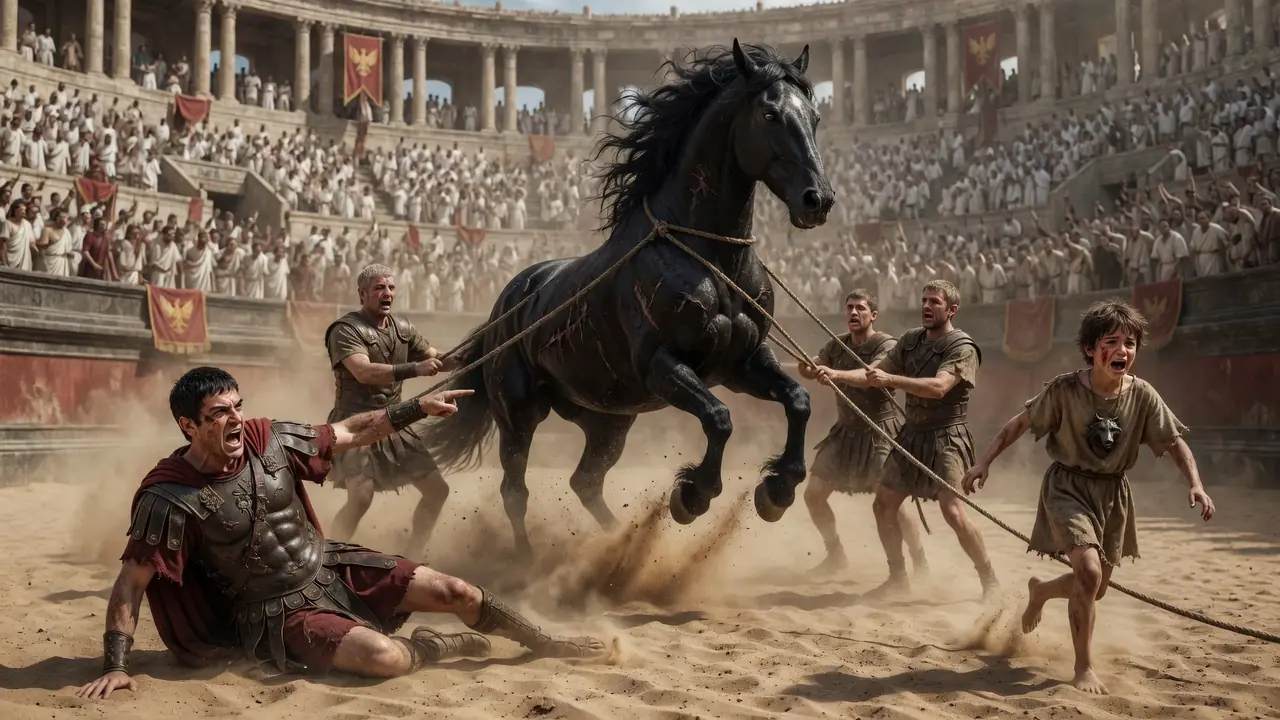
The emperor looked at him. “You object to words written by a dead man?”
“I object to forgery.”
“Then let Rome judge the seal.”
Aelius took the scroll gently from my hands.
He studied the wax.
His face changed.
“This is Maximus’s command seal,” he said. “Unbroken until today.”
He turned toward the crowd.
His old voice rose.
“I, Titus Aelianus Maximus, write these words in the knowledge that my enemies sit near the heart of power. If I am declared traitor, know that the declaration is false. If my daughter Livia is hunted, know that she carries no crime but my name. If my blood survives, let the child be protected not because blood is sacred, but because murderers fear witnesses.”
A murmur moved through the stands.
Aelius continued.
“Marcus Cassian, Senator Drusus Varian, and their allies accepted payment from King Ardan of the northern tribes. In exchange, they weakened the watch at the Northern Gate, delayed the Sixth Legion, and opened the supply road by night. I confronted Cassian with evidence. He confessed before three witnesses, then sent assassins. The witnesses are named herein.”
Varro lifted his sword below.
“I am one!” he roared.
Several old soldiers raised their shields.
“And I!”
“And I!”
Aelius kept reading, voice shaking with fury.
“Their goal was not merely silver. They intended to remove me from command, seize emergency authority, and bind the emperor’s council to their will through fear of invasion. The invasion they invited killed eight thousand Roman soldiers and twice as many civilians.”
The arena groaned.
Eight thousand.
The number seemed too large for silence, too heavy for air.
Cassius’s lips moved soundlessly.
Aelius read on.
“If Rome wishes to survive, let it learn this: a city does not fall first when enemies climb its walls. It falls when liars are honored because truth is inconvenient.”
At those words, Rome stopped being a crowd and became a witness.
The silence that followed was unlike any silence I had ever known. Not empty. Full. Full of rage, grief, shame, and the terrible weight of understanding.
Then Drusus broke.
Perhaps it was fear. Perhaps it was the sight of Ravager watching him from the sand. Perhaps old guilt had lived too long in his flesh and finally found a crack.
He stumbled forward, falling to his knees before the emperor.
“Cassian planned it,” he babbled. “Marcus Cassian planned it. I only signed the transfer records. I never opened the gate. I never touched the general. It was Cassian. Cassian and the tribune. The son knew. He knew where Livia hid. He sent men after her.”
The world tilted.
I heard my own voice, distant and small.
“You sent men after my mother?”
Cassius looked at Drusus with pure hatred.
“Coward.”
Drusus sobbed. “He wanted the boy dead too. Said no root of Maximus could remain.”
My fingers went numb.
For a heartbeat, I was not in the arena anymore.
I was eight again, kneeling beside my mother’s bed, listening to rain and her failing breath. I remembered the bruises she had hidden beneath her sleeves. The nights we moved from stable to stable. The way she startled at footsteps.
Cassius had not only threatened my life.
He had hunted hers until her body could no longer keep running.
I walked down from the platform.
No one stopped me.
Shadow followed.
Cassius watched me approach, and his face hardened into something ugly and desperate.
“You think this changes anything?” he spat. “You are still a child. Rome devours children. Your grandfather learned that. Your mother learned that.”
My chest hurt so badly I could hardly breathe.
“You knew her name,” I said.
Cassius smiled.
It was a terrible smile.
“She begged well.”
Varro roared and lunged, but the guards held him back.
Shadow screamed.
Ravager struck the sand so hard the ground shook.
I stood before Cassius with tears burning my face.
I wanted him to be afraid. I wanted him to hurt the way my mother had hurt. I wanted something so fierce and dark that it frightened me.
But then I heard my mother’s voice.
Do not answer too quickly. Let your heart answer first.
My heart did answer.
Not with mercy.
Not with forgiveness.
With truth.
I turned away from Cassius and faced the emperor.
“He should stand trial,” I said. “Before everyone. With the names read. With the dead counted. With my mother’s letter heard.”
Cassius stared at me as if I had struck him.
The emperor’s expression shifted. “You do not ask for his blood?”
“I ask that he not be allowed to hide behind it.”
Aelius closed his eyes briefly.
Varro lowered his sword.
The emperor looked out over the arena, over the senators, over the soldiers, over the people who had come expecting spectacle and instead found Rome’s buried wound opened beneath the sun.
“Tribune Cassius,” he said, “you are stripped of rank. Senator Drusus Varian, you are seized pending judgment. All records in the Wolf Vault are to be recovered and placed under imperial guard. The old soldiers of Maximus are restored as witnesses under my protection.”
Cassius laughed.
It began softly, then grew until it echoed against the stone.
“Protection?” he said. “You child on a throne. You think you command Rome because men dress you in gold? Half the Senate ate from my father’s table. Half the officers owe their rise to my family. You cannot arrest us all.”
The emperor’s jaw tightened.
Cassius turned in a slow circle, addressing the stands.
“Romans! Will you let your city be ruled by a stable boy’s tears? By a dead general’s scratches? By horses trained to kneel? Today they accuse me. Tomorrow they accuse your fathers, your patrons, your commanders. Is this justice, or revenge dressed as innocence?”
For one dangerous moment, the arena wavered.
Cassius was skilled. Even ruined, he knew how to twist fear. Men in the stands glanced at one another. Some senators pulled back into shadow. Soldiers near the gates shifted uneasily.
Then a voice rang out from the common seats.
“My brother died at the Northern Gate!”
A woman stood, her face lined and fierce, a faded soldier’s cloak clutched in her hands.
“He was nineteen,” she cried. “They told us Maximus betrayed him. They told us to spit when we heard his name. I want the truth read!”
Another voice rose.
“My father too!”
“My sons!”
“My husband never came home!”
The sound grew, spreading through the arena like rain becoming flood.
“Read the names!”
“Read the names!”
“Read the names!”
Cassius turned pale.
The chant shook the stone beneath my feet.
Aelius lifted another scroll from the cylinder, one packed tightly with lines of writing.
He looked at the emperor.
The emperor nodded.
So Senator Aelius began to read the dead.
Not all of them, not that day. There were too many. But he read enough.
Gaius Marcellus, age thirty-two, Sixth Legion.
Publius Nerva, age nineteen, Northern Gate Watch.
Tullia of Ariminum, healer.
Marcus Fabius, standard-bearer.
Decimus, son of a baker.
Aurelia, camp cook.
Flavius, messenger.
Name after name fell into the arena, and with each one, Rome changed.
Not loudly at first.
People wept. Men bowed their heads. Old soldiers struck fists against their chests. Mothers clutched sons. Sons stared at fathers. The dead, who had been buried beneath lies for years, rose in language before the city that had forgotten them.
Cassius tried to speak again.
No one listened.
That was when he broke.
With a sudden movement, he tore free from the guard nearest him, snatched a short blade from the man’s belt, and seized me by the shoulder.
Shadow lunged, but Cassius dragged me close, blade flashing at my throat.
The crowd screamed.
Varro shouted my name.
The emperor stepped forward. “Cassius!”
Cassius’s breath burned against my ear.
“Enough truth,” he hissed. “Let Rome remember this instead: the heir of Maximus died screaming.”
His arm tightened.
The blade touched my skin.
I could not move.
Shadow stood frozen, trembling with the agony of restraint.
And then Ravager came.
Not charging blindly.
Not screaming.
He moved with the terrible speed of a creature who had waited years for one exact moment.
Cassius saw Shadow. He feared Shadow.
He forgot Ravager.
The gray warhorse struck from the side, not trampling me, not crushing me, but driving his scarred head into Cassius’s shoulder with such force that the tribune was thrown backward into the sand. The blade flew from his hand. I fell, rolled, and felt Shadow’s muzzle instantly against my chest, pushing me up, checking that I lived.
Cassius tried to rise.
Ravager placed one hoof on his crimson cloak.
Not on his chest.
Not killing him.
Holding him.
The arena fell silent again.
Cassius stared up into the amber eye of the horse his family had used, hidden, and feared.
Ravager lowered his head.
For one moment, I thought he would crush him.
Instead, the great horse tore the crimson cloak from Cassius’s body and flung it into the sand.
A sound passed through the crowd.
Not a cheer.
Something deeper.
Recognition.
Cassius had lost rank before the emperor. Now he had lost symbol before Rome.
The son of the traitor lay stripped beneath the hoof of the horse that remembered his father’s crime.
Guards rushed in and seized him.
This time, no one hesitated.
Part 5: The Ride Through Rome
By sunset, the arena had changed from a place of spectacle into a court of living memory.
The emperor did not leave. Neither did the people. Torches were lit along the walls as the sky turned violet above the open rim of the arena. The wounded were carried out. The smoke beneath the animal pens was extinguished. Soldiers loyal to the emperor descended into the Wolf Vault with Varro’s men, bringing out scroll after scroll, tablet after tablet, proof after proof.
Some senators tried to depart quietly.
The crowd noticed.
Their names were shouted. Guards blocked the exits. Those who had been smiling at Cassius hours earlier now wiped sweat from their necks and claimed illness, confusion, old age, anything that might soften the eyes watching them.
I sat beside Shadow near the center of the arena, wrapped in a clean cloak someone had placed around my shoulders. Mara sat beside me, alive and shaken, holding a cup of watered wine in both hands. She had not stopped glancing at my throat where Cassius’s blade had left a thin red line.
“You look awful,” she said.
“So do you,” I answered.
Her mouth trembled.
Then she laughed once, but it turned into a sob. I did not know what to do, so I reached for her hand. She grabbed mine tightly.
“I thought he would kill you,” she whispered.
“So did I.”
“That was stupid, throwing the scroll.”
“I didn’t have a better idea.”
“It was still stupid.”
“I know.”
She leaned against my shoulder, and for a while we sat without speaking, two stable children in the middle of an empire’s unraveling.
Ravager stood a short distance away. No one dared approach him except Shadow, and even Shadow did so carefully. The two warhorses faced each other under the torchlight. They did not fight. They did not bow. They simply stood together like old enemies who had survived the men who used them.
Varro came to me after the first carts of records were brought up.
He carried my grandfather’s sword.
“I believe this belongs with you,” he said.
I stared at it. “I can’t even lift it properly.”
“No,” he said, and for the first time, I saw his mouth soften almost into a smile. “But one day you might.”
“I don’t want to be a general.”
His smile faded.
“Good.”
That surprised me. “Good?”
“Rome has enough boys dreaming of swords. It needs one who remembers what swords cost.”
He laid the weapon on the sand beside me.
I touched the hilt, but did not pick it up.
“Varro,” I asked, “what happened to my grandfather?”
The old soldier looked toward the torches. For a long moment, I thought he would refuse to answer.
Then he sat on the sand with a groan, as if his bones had been waiting years to rest.
“We do not know everything,” he said. “After the Northern Gate, Maximus gathered proof against Cassian and Drusus. He meant to present it before the Senate. But men loyal to Cassian ambushed him before dawn. Shadow was wounded. Maximus was taken alive. We tried to follow, but the city gates closed against us. Those of us who survived hid beneath the old military quarter, then here, using passages Maximus had prepared.”
“You never found him?”
Varro’s good eye shone in the torchlight.
“No. Only signs. Blood. A broken chain. His cloak in a drainage tunnel. Some believed he escaped wounded and died beyond the walls. Others believed he was taken north by the same men who bought Cassian.”
“What do you believe?”
Varro looked at Shadow.
“I believe Shadow would know if he were alive.”
My chest ached.
Shadow lowered his head.
I understood.
A horse who remembered everything had grieved long before I knew there was grief to name.
The emperor summoned me when the moon rose.
I walked toward the imperial box with Shadow beside me and Varro behind me. The crowd quieted, not with the sharp silence of fear this time, but something gentler. People leaned forward. Some reached toward me as I passed, not grabbing, only stretching their hands as if touching the air near me meant touching the truth itself.
I did not feel like an heir.
I felt tired.
My knees hurt. My throat burned. My heart felt too full of my mother, my grandfather, Shadow, Ravager, Mara, and all the dead names read aloud until the arena seemed crowded with invisible people.
The emperor had descended from his high seat and stood on the sand.
Without the distance of the platform, he seemed less like a statue and more like a young man trapped inside history’s armor.
“Lucius, son of Livia,” he said.
I bowed awkwardly.
He looked at Senator Aelius, then Varro, then the gathered crowd.
“Rome owes your house a debt it cannot repay.”
I did not know what to say.
Aelius gently whispered, “You may answer, child.”
I swallowed.
“My mother said Rome did not owe me comfort,” I said. “Only truth.”
The emperor’s eyes softened.
“Then truth shall begin tonight.”
He turned to the crowd.
“By imperial order, Titus Aelianus Maximus is restored to honor until the full court confirms what these records show. Livia, daughter of Maximus, is declared innocent of all charges and named under imperial protection, though death has taken her beyond our reach. The soldiers falsely condemned with Maximus shall have their names read in the Forum. Their families shall receive restitution from the seized estates of the guilty.”
A roar rose from the arena.
It shook me.
Not because it was frightening, though it was. But because for the first time, the sound was not hunger for blood or laughter at humiliation. It was grief turning into recognition.
The emperor raised his hand again.
“As for Lucius…”
The arena quieted.
I stiffened.
He looked at me for a long moment.
“You may claim the protection of my house,” he said. “You may be raised among nobles, taught by tutors, trained in law and command. You may take the name Maximus openly.”
The crowd waited.
So did Varro.
So did Aelius.
Even Mara, standing below with a blanket around her shoulders, stared at me.
Once, such an offer would have sounded like stepping into the sun after a life underground. Food every day. Clean clothes. A bed. Books. No more kicks from overseers or sneers from boys with fathers richer than memory.
Yet I thought of my mother’s room above the stables. I thought of Shadow’s warm breath in the dawn. I thought of nobles who smiled while hiding knives. I thought of how quickly men put children into roles they had not chosen.
“I want to learn,” I said slowly. “I want the truth read. I want my mother buried with her name.”
The emperor nodded.
“But I do not want to live in a palace.”
Whispers rippled through the arena.
The emperor tilted his head. “Where would you live?”
I looked at Shadow.
Then at Ravager.
Then at Mara, who looked half ready to call me stupid again.
“With the horses,” I said.
Aelius blinked.
Varro’s scarred face folded into something like pride.
“With protection,” I added quickly, because I was young but not entirely foolish. “And books. And someone to teach me to read all the words in the vault. And Mara should not have to sleep in straw anymore either.”
Mara’s mouth fell open.
The emperor looked as though he wanted to smile but knew the moment was too solemn.
“It shall be done,” he said. “A school and stable shall be established on the grounds of Maximus’s old estate. Children of soldiers killed at the Northern Gate will be educated there, if their families wish it. Varro and his men shall guard it. Senator Aelius shall oversee the records.”
My breath caught.
Maximus’s old estate.
A home I had never seen. A place stolen before I was born.
Cassius, bound and guarded nearby, lifted his head and spat blood into the sand.
“You give estates to stable rats now?”
The emperor’s gaze turned cold.
“No,” he said. “I return stolen ground to the dead, and let the living decide what grows there.”
Cassius laughed bitterly. “You think this ends with me?”
“No,” Aelius said. “It begins with you.”
The trials lasted thirty days.
I will not tell every detail, because some memories are heavy enough without polishing them into story. The records from the Wolf Vault filled entire chambers. Names of the guilty emerged slowly, then all at once. Men who had worn rings and spoken of honor were shown to have sold roads, delayed reinforcements, forged orders, hidden bodies, threatened widows, and hunted a woman whose only crime was carrying a child they feared.
Drusus confessed more than anyone expected. Not because he became brave, but because fear changed direction. Once he feared Cassius. Then he feared the people. He named senators, merchants, officers, and scribes. Some denied everything until their own seals were pressed into evidence. Others wept. A few fled and were caught at the ports.
Cassius spoke little during the trial.
When he did, he smiled.
He said his father had done what was necessary. He said Rome was not ruled by clean hands. He said Maximus had been naive. He said my mother should have surrendered me and saved herself the trouble of dying poor.
That was the only day I had to leave the court.
I walked out shaking, with Shadow beside me and Mara trailing after me, furious on my behalf.
“I should throw a shoe at his head,” she said.
“It wouldn’t help.”
“It would help me.”
I almost laughed.
We stood in the courtyard outside the Senate hall, where sunlight fell across white stone and pigeons strutted as if empires rose and fell for their amusement. Shadow lowered his head, and I leaned against him.
Mara stood beside me, arms folded.
“You don’t have to listen to him,” she said.
“I know.”
“Do you?”
I looked at her.
She kicked a pebble across the stones.
“Because when he speaks, you look like you’re back in that room with her.”
I turned away.
Mara softened.
“I’m sorry.”
“No,” I said. “You’re right.”
The truth was that Cassius had found the cruelest doorway into me. Not fear for myself. Not the weight of Maximus. My mother. Always my mother. He had never defeated her in life; she had kept me hidden, kept the token safe, kept Shadow’s name alive. So he tried to wound her in death.
That evening, Senator Aelius took me to a small hill beyond the city wall.
There, beneath a cypress tree, my mother was buried properly.
Not in the nameless ground where poor women vanished without stone. Not as Livia the fugitive. Not as a stable widow with no past.
A new marker stood beneath the tree.
LIVIA MAXIMA
DAUGHTER OF TITUS
MOTHER OF LUCIUS
SHE CARRIED THE TRUTH WHEN ROME WOULD NOT
I knelt before it.
For a long time, I could not speak.
The sun set slowly behind Rome, turning the city walls red and gold. Shadow grazed nearby. Varro stood at a distance with his head bowed. Mara placed wildflowers near the stone, then quietly stepped back.
I touched the carved letters.
“I went down into the vault,” I whispered. “I found your letter.”
The wind moved through the cypress branches.
“I was scared,” I said. “I’m still scared.”
No answer came, of course.
But for once, the silence did not feel empty.
“I told them your name,” I whispered. “They heard it.”
My tears fell into the dust.
“I wish you had heard them say it.”
A hand rested on my shoulder.
Varro.
“She did,” he said.
I looked up at him.
The old soldier’s face was wet, though he did not wipe it.
“Wherever brave souls go,” he said, “Livia heard.”
The final judgment came three days later.
Cassius and the chief conspirators were condemned. Their estates were seized. Their names were carved not among honorable enemies, but in the public record of treason. The emperor did not grant Cassius the glorious death he seemed to desire. No battlefield. No noble blade. No speech before admiring men.
He was sent to a remote island prison, stripped of title, guarded by soldiers whose fathers had died at the Northern Gate.
Some said it was too merciful.
Others said living without power was a sharper punishment for a man like Cassius than death could ever be.
I did not know what I thought.
I only knew that when he was led away in chains, he looked once at me, and for the first time, I saw no mockery in his face.
Only emptiness.
Ravager watched him go.
The gray warhorse stood near the prison wagon, held by no rope, commanded by no man. Cassius avoided his gaze. But just before the wagon rolled away, Ravager struck one hoof against the ground.
Once.
The sound was final.
After that, the horse turned his back.
It was the last judgment Cassius received in Rome.
The estate of Maximus lay outside the city, beyond olive groves and a road lined with pines. When I first saw it, I expected grandeur, perhaps marble columns and fountains like senators owned. Instead, I found ruins.
The villa had been neglected for years. Vines strangled the walls. Roof tiles had fallen. The courtyard fountain was dry, filled with leaves. The stables were half-collapsed, though still strong enough in places to smell faintly of hay and old leather.
Shadow walked through the gate and stopped.
His head lifted.
A sound came from him unlike any I had heard before.
Soft.
Broken.
He remembered this place.
I touched his neck.
“This was home?” I asked.
He breathed out slowly.
Ravager entered behind us, wary and silent. His amber eye scanned the courtyard, the broken columns, the empty windows. Perhaps he too had been here once, before war twisted men and horses into weapons.
Varro walked ahead, limping slightly.
“There,” he said, pointing to the eastern wing. “Your mother’s rooms. She used to climb from that balcony to avoid lessons.”
Senator Aelius, who had come with us despite complaining about dust the entire journey, smiled faintly.
“She once put a frog in Marcus Cassian’s wine cup,” he said.
I stared at him.
“My mother?”
“Oh yes. She was seven. He screamed louder than the frog.”
Mara burst out laughing.
The sound startled birds from the roof.
I tried to imagine my mother as a little girl running across this courtyard, laughing, unafraid. Not hiding, not coughing, not counting coins for bread. Just Livia, daughter of a general, putting frogs in the cups of men who would one day fear her child.
The thought hurt.
But it also gave something back.
Over the next months, the estate changed.
Not quickly. Nothing truly broken heals quickly.
Soldiers repaired the walls. Families arrived, some shy, some grieving, some suspicious of promises from Rome. Children came with bundles, widowed mothers, old grandfathers, little sisters clinging to their tunics. Many had lost someone at the Northern Gate. Some had grown up being told their fathers died because of Maximus’s betrayal. Now they came to his estate to learn beneath his restored name.
The stables were rebuilt first.
That was my demand.
Aelius said classrooms should come before stalls. I said horses needed shelter before senators needed arguments. Mara agreed with me loudly enough that Aelius surrendered.
Shadow took the largest stall, though he rarely stayed in it. Ravager refused any stall at first and slept under the open sky for weeks. No one forced him. I visited him every evening, bringing apples, oats, and silence.
For a long time, he accepted only the silence.
Then one dusk, as the sky turned purple over the hills, he took an apple from my hand.
Mara, watching from the fence, whispered, “I think that means he has decided not to eat you.”
“Comforting,” I said.
She grinned.
We were taught by stern tutors who seemed determined to make up for every year I had spent carrying buckets instead of reading scrolls. I learned letters properly. I learned history, numbers, law, and the names of rivers I had never seen. I learned how records could lie when men wrote them falsely, and how truth needed guardians as much as gates did.
Varro taught me riding.
That was harder.
Everyone assumed that because Shadow bowed to me, I could ride him like a prince in a victory parade. Shadow himself seemed amused by this mistake. The first time I climbed onto his back, he stood perfectly still until I relaxed, then took one elegant step sideways and deposited me gently into a hay pile.
Mara laughed so hard she fell off the fence.
“You bowed to him!” I shouted at Shadow, spitting hay.
Shadow flicked his tail.
Varro crossed his arms. “Bowing is not the same as agreeing.”
It took months before Shadow allowed me to ride him properly. He never behaved like an obedient horse. He moved with me only when I stopped trying to command him and began listening. I learned pressure, breath, balance. I learned that reins were not for dragging a mouth, but for speaking through hands. I learned that power trusted is greater than power forced.
Ravager watched every lesson.
Then one morning, he approached the practice ring.
Everyone went silent.
He stepped to the mounting block and stood there.
Varro whispered, “Do not.”
I knew what he meant.
Ravager had carried betrayal. He had carried Cassian through the opened gate. He had been chained, hidden, used to frighten and kill. Perhaps no one had ridden him since the war.
He turned his amber eye toward me.
Not inviting.
Challenging.
I climbed the fence.
“Lucius,” Varro warned.
“I know.”
“You do not.”
He was probably right.
I approached Ravager slowly. Shadow stood nearby, tense but not interfering. The gray horse’s scarred sides rose and fell. When I touched his neck, his skin twitched beneath my fingers.
“I’m not him,” I whispered.
Ravager’s ears flicked.
“I’m not Cassian. I’m not Cassius. I’m not even Maximus.”
His eye remained on me.
“I’m just Lucius.”
For some reason, that seemed to matter.
He stood still.
I climbed onto his back.
The world felt different from there. Ravager was broader than Shadow, harder beneath me, his body carrying old tension like a drawn bow. For one breath, nothing happened.
Then he moved.
Not gently.
He exploded forward.
Mara screamed. Varro cursed. Shadow lunged along the fence. The ring became dust, wind, terror. Ravager ran as if trying to outrun memory itself. I clung to his mane, eyes streaming, teeth clenched, certain I would die under the hooves of a horse who owed no kindness to boys.
“Don’t pull!” Varro shouted.
I wanted to pull.
Every frightened part of me wanted to yank the reins, force him, stop him, control him.
Instead, I pressed myself low against his neck.
“I know,” I gasped into his mane. “I know.”
Ravager ran harder.
“I know they hurt you!”
His body shuddered.
“I know they made you carry him!”
The ring blurred.
“But you are not his horse anymore!”
Ravager stumbled.
Not badly, but enough that his rhythm broke.
I held on.
“You are not his,” I cried. “You are not anyone’s.”
The gray horse slowed.
Dust rolled around us.
At last, he stopped near the far fence, sides heaving, head low.
The whole estate stood silent.
I slid off and collapsed to my knees.
Ravager turned his head toward me.
For a terrible moment, I thought he might strike.
Instead, he lowered his scarred muzzle and touched my shoulder.
Mara whispered from somewhere behind me, “That was the stupidest thing you have ever done.”
I laughed then.
I could not help it.
I laughed until I cried, and Ravager stood over me like a battered old storm finally learning it did not have to thunder.
Years did not pass without pain.
Stories often leap from triumph to peace as if the road between them is short. It is not. Rome did not become honest because one scroll was read in an arena. Men still lied. Power still protected itself. Families of the dead still woke from dreams calling names no answer returned. Some spat when they heard Maximus restored, not because they knew the truth, but because old lies can become part of a person’s bones.
I grew.
Slowly, unwillingly, inevitably.
At thirteen, I could read every tablet brought from the Wolf Vault.
At fourteen, I spoke in the Forum for the first time, my knees shaking beneath my tunic while citizens gathered to hear the names of those lost at the Northern Gate. My voice cracked on the fifth name. An old woman in the front row called, “Take breath, child.” So I did, and continued.
At fifteen, I rode Shadow through Rome during the Day of Remembrance, not as a general, not as a prince, but as witness. Ravager walked beside us without harness, and people parted for him in awe. Some reached out to touch his scarred neck. He allowed only children.
Mara became the finest rider at the estate and never allowed anyone to forget it. She also learned law faster than I did and enjoyed correcting tutors in front of visitors. Varro claimed she had the soul of a centurion trapped in the body of a girl who liked figs too much.
Senator Aelius grew older, thinner, and sharper. He taught me that truth without patience becomes noise, and patience without courage becomes surrender. When he died in his sleep one winter, we buried him near the estate library, with a scroll in one hand and, at Mara’s insistence, a frog carved on the bottom of his marker.
The emperor kept his promise longer than many expected.
He was not perfect. No ruler is. But he had seen an arena full of Romans demand names, and the memory marked him. He formed a council to review condemned families, false confiscations, and military betrayals. It did not heal Rome. But it opened windows in rooms that had stunk of secrecy for too long.
As for me, I never fully became comfortable with the name Maximus.
People used it like a cloak they wanted to throw over me. Lucius Maximus, heir of the wolf. Lucius Maximus, rider of Shadow. Lucius Maximus, the boy who made Rome kneel.
But I knew the truth.
Shadow bowed because he remembered my mother.
Ravager yielded because he remembered pain.
Rome listened because the dead had waited long enough.
And I was only the voice that happened to survive.
The clearest ending came not in the arena, nor in the court, nor in the Forum.
It came on a quiet morning five years after the day Shadow bowed.
I was fifteen. The sky was pale blue, the grass silver with dew. The estate had become something alive by then: children reading under olive trees, horses grazing beyond the rebuilt stables, widows managing accounts better than any senator’s clerk, old soldiers teaching young hands how to hold shields and, more importantly, when to lower them.
Shadow was old.
I had tried not to see it. His black coat still shone, and his eyes remained deep and knowing, but his steps had grown slower. He rested more often beneath the cypress trees. Ravager, scarred and stubborn, stayed near him as if guarding a king who had never worn a crown.
That morning, Shadow walked to the hill behind the estate.
I followed.
So did Ravager.
No one else.
Shadow stopped beneath an ancient olive tree overlooking Rome in the distance. The city rose beyond the fields, its walls gold in the dawn. He stood watching it for a long time.
Then he folded his legs beneath him and lay down.
My heart clenched.
“No,” I whispered.
I knelt beside him, pressing my hands to his neck.
He breathed slowly.
Ravager stood behind me, silent.
I knew. Some part of me had known all morning. Perhaps Shadow had too. He had carried a general through war, carried a secret through years, carried my mother’s hope, and carried me from invisibility into history. He had done everything asked of him and more.
Still, I was not ready.
“You found me,” I said, my voice breaking. “You did what she asked.”
Shadow’s dark eye watched me.
“I don’t know how to do this without you.”
His breath warmed my palm.
The wind moved through the olive leaves.
I thought of the arena. The sand. Cassius’s spear. Shadow’s knee bending before all of Rome. I had thought then that the bow was for me. Now I understood it had been for Livia, for Maximus, for every name buried beneath lies, for the child who needed one creature in the world to recognize him.
I pressed my forehead to his.
“Thank you,” I whispered.
Shadow exhaled.
Once.
Twice.
Then the great black stallion went still.
For a while, the world made no sound.
I do not know how long I knelt there. Long enough for the sun to rise fully. Long enough for dew to dry on the grass. Ravager lowered his head and touched Shadow’s neck, then lifted his face toward Rome and gave one long, low cry.
It was not rage.
It was farewell.
We buried Shadow beneath the olive tree, facing the city he had forced to remember.
The whole estate came. Children wept openly. Varro, older and more bent than before, stood with both hands on his sword and did not hide his tears. Mara held mine so tightly our fingers ached. Ravager remained beside the grave until nightfall and allowed no one to lead him away.
On the stone, we carved no grand title.
Only this:
SHADOW
HE REMEMBERED
Years later, people would still tell the story differently.
Some would say I tamed Rome’s wildest horse with magic. Some would say I was born noble and hidden among servants by destiny. Some would say Ravager killed three men in the arena, though he did not. Some would say Cassius begged me for mercy, though he never did. Stories grow teeth, wings, and lies of their own.
So I write this now in my own hand, not as legend, but as memory.
I was a stable boy.
I was hungry often.
I was afraid almost always.
I knew a horse’s name because my mother loved me enough to trust me with it. I carried a token because she died before she could carry it herself. I entered the darkness because Shadow stood beside me. I spoke before Rome because the dead could not.
And yes, once, before thousands of people, Rome’s wildest horse bowed.
But the greater miracle was not that a horse bent his knee.
The miracle was that an empire, for one trembling moment, bent its pride low enough to hear the truth.
And from that day forward, whenever powerful men tried to bury a lie beneath stone, sand, or silence, someone in Rome would remember the stable boy, the wolf token, and the black stallion who bowed only when the truth had finally come home