The first car arrived at 3:47 in the morning. Marcus Webb heard it from his bedroom window, the low groan of a flatbed reversing down Tillman Avenue, the mechanical clunk of hydraulics releasing. He watched a second truck follow the first, then a third. He did not call anyone. He told himself it was not his business, went back to bed, and stared at the ceiling until 6:00.
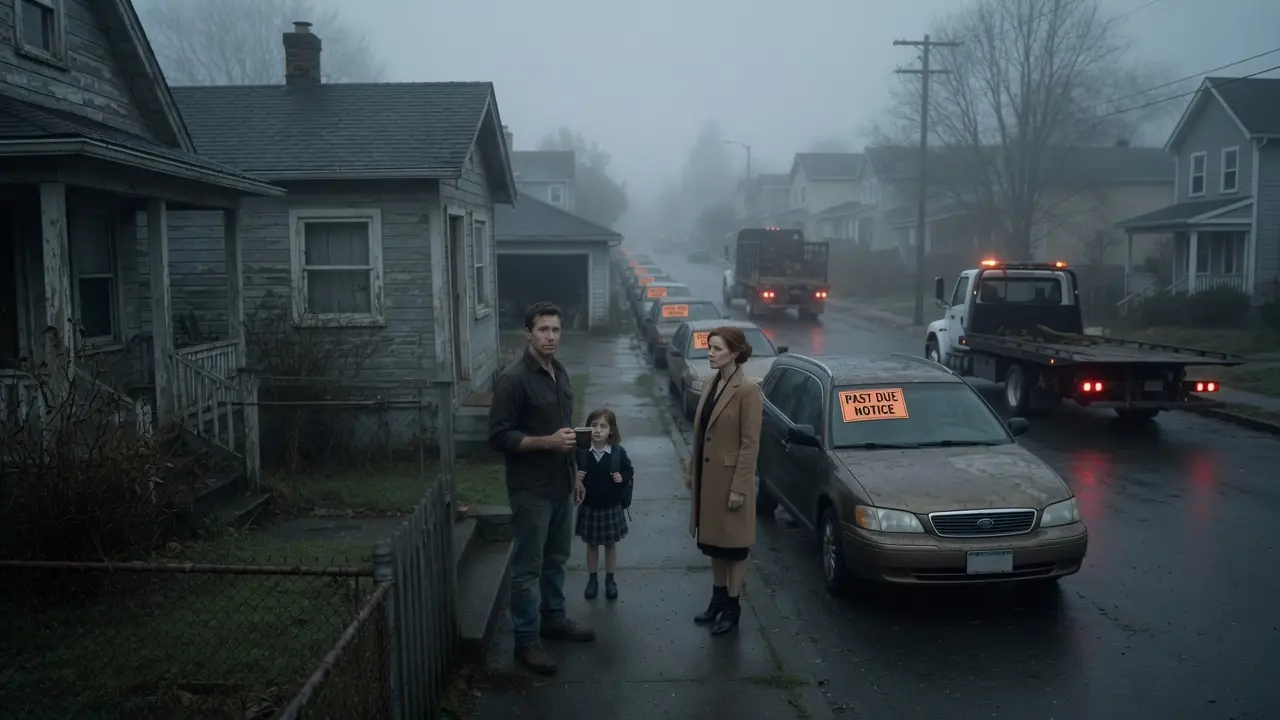
Joel came outside at 6:45 to unlock his garage and stopped at the edge of the front path with his coffee going cold. Fifteen vehicles sat in two uneven rows from his gate to the street. Rusted, dented, stripped, one missing all four tires, one with a windshield punched inward like someone had put a fist through it. Each one had a bright orange tag on the wiper arm. Each tag said the same three words in bold black print: “Past Due Notice.”
His daughter, Maya, appeared behind him in her school uniform.
“Dad,” she said, “are those ours?”
He took a slow drink of his coffee. “Not yet.”
That was the first thing that confused people about Joel Carver. He had a particular way of responding to things that did not announce itself as anything. No visible anger, no visible fear, just a stillness that some people read as resignation and others, the ones who had been paying attention, understood was something else entirely.
Joel had come to Sycamore Falls six years earlier with Maya when she was three and his wife’s funeral eight days behind him. He bought the house on Tillman Avenue because it had a garage wide enough to work in. He ran a small engine repair service: lawnmowers, generators, the occasional motorcycle. He drove a 12-year-old pickup. He paid his taxes in January without waiting for a reminder.
Most people in town had settled on a version of him that was easy to hold: quiet, capable, not particularly ambitious. None of them had looked closely enough to see what that contained.
The woman who arranged the fifteen cars was named Renata Comb. She ran Comb Prestige Motors, two dealerships, and a used car operation generating north of thirty-five million annually. She had started with one lot her father left her and tripled it in seven years through a combination of genuine commercial instinct and a talent for turning other people’s weakness into her opportunity.
She had wanted the house. It sat 300 feet from the new Route 11 commercial corridor, the kind of location that does not appear twice. She had sent two brokers. Joel turned both offers down without explanation or counter.
Renata found this interesting in a way that shaded over several months into irritation. Her assistant pulled everything available on Joel Carver. The file came back thin. Mechanic. Single father. No apparent ambitions. Renata read it twice. Then she said that a man with no apparent ambitions was usually a man hiding something. She told her assistant they needed a different kind of approach.
The fifteen cars cost her under $6,000, sourced from three salvage yards and a county impound auction. Each one was officially tagged beyond economical repair. She arranged overnight delivery through a logistics company she used for fleet transport and had a contact in the city licensing office flag Joel’s property for potential zoning issues.
By 9:00 that morning, someone on the community forum had posted photographs of the driveway with the caption, “Looks like somebody finally ran out of road.” The comments filled up fast, mostly jokes, a few sympathetic, but from a distance.
“Is it bad?” she asked.
“Depends what you do with it.”
“What are you going to do?”
He folded the notice and put it in the drawer with the utility bills. “Go look at some cars.”
He walked the rows three times before dark with a flashlight. He knocked on frames with two knuckles. He pressed his palm flat against panels. His neighbor Marcus watched from the porch across the fence and said nothing, because Marcus had learned over six years that Joel’s silences were productive in a way that was better observed than interrupted.
It was at the eleventh car that Joel went completely still. He had his flashlight on the lower frame rail. He pressed two fingers against it. He stood up and looked at the car from a distance of four feet. Then he put his hand flat on the roof and left it there.
Marcus called over, “You find something?”
Joel looked at him. “You want to come over tomorrow morning? I could use someone to hand tools.”
“What time?”
“5:30.”
“That’s not a normal time.”
“No,” Joel said, “it isn’t.”
He called Diane Okafor that night. Diane was an automotive appraiser working out of Columbus who had known Joel for eleven years from before Sycamore Falls, from a period in his life that almost no one in this town knew anything about. She was one of maybe four people in the world who understood what Joel Carver had actually spent his career doing before he drove into this town with a three-year-old in the passenger seat.
He described each vehicle from memory. He was five in when she interrupted.
“Go back to the eleventh one.”
He did. She went quiet.
“Joel,” Diane said.
“I know.”
“Do you know what that’s worth?”
“I know what it was worth new. I haven’t touched it yet.”
“If the shell is intact.”
“The shell is intact.”
She said a word he rarely heard from her. He let her have the moment, then said he would keep her updated and hung up.
He sat at the kitchen table with a legal pad and put a number beside each car. When he was finished, he looked at the column without adding it up, put the pad in the drawer, and went to check on Maya.
She was awake reading. She looked up when he appeared in the doorway.
“Dad, who are the cars from?”
“A woman named Renata Comb. She wants the house.”
“Are you selling?”
“No.”
“Then what are they for?”
He leaned against the doorframe. “I think they’re meant to be a problem.”
Maya looked at him with her mother’s particular way of measuring things. “Are they?”
“Not the kind she thinks,” he said.
The first car came into the garage on a Wednesday. A Subaru wagon, head gasket, calipers, full fluid service. He had it running by Friday morning. It sold for $4,200 to a nurse who needed reliable overnight transport and thanked him three times in the driveway.
Marcus had started coming over after his shift around 6:00, and Joel would put him to work without much explanation.
“Hold this. Keep tension here. Pass the three-eighths.”
Marcus did what he was asked, understanding that something was being built even if he could not name it precisely.
By the end of the second week, Joel had moved five vehicles. A Honda. A Ram 1500. A Jeep with surface rust that stopped exactly at the surface. The numbers in his notebook were clean. Parts costs tracked to the cent.
Renata received the reports through her licensing contact and filed a secondary complaint with the county environmental review board, citing possible improper oil disposal. The inspector came out on a Tuesday and left forty minutes later. Joel had an enclosed containment system installed three years prior, certified above the minimum standard.
Renata received that report, too. She told her assistant to find another angle.
The next one came through the state dealer commission. Any individual selling more than five personal vehicles per year without a license faced fines of $600 per transaction. Joel had sold seven by the time the letter arrived.
He called an attorney named Garrison Ford the same afternoon, a man who specialized in vehicle commerce and had been referred through Diane. Garrison told him the cars had been deposited without consent, which arguably made them abandoned property under state code. He could have an expedited dealer permit in eight business days. Joel told him to file. Then he went back to the garage.
The eleventh car went into the bay on a Saturday. Marcus sat on a stool in the corner and watched Joel pull the tarp back and stand under the overhead lights for a full minute without touching it.
“What is it?”
“1971 Porsche 911 T. Numbers matching. Original engine, original gearbox, original body. Someone painted gray primer over the factory orange. Whoever dumped this in county impound had no idea what they had.”
Marcus looked at the beat-up shell of it. “How much is it worth?”
“In current condition, forty thousand. Properly restored, with documentation verified and provenance established.” Joel paused. “Eighty-five, maybe ninety-five, depending on the buyer.”
Marcus sat with that. He looked at Renata Comb’s $6,000 mistake sitting under the work lights.
“She didn’t know.”
“No,” Joel said.
He had already picked up a heat gun and was testing the primer layers.
“She didn’t.”
He spent seventeen days on the Porsche. He stripped the primer and found the factory orange underneath, intact and clean in a way that made him stand very still with his hand on the roof for longer than was technically necessary. He refinished it with a matched formula from a specialty supplier. He rebuilt the carburetors at the kitchen table on two evenings while Maya did homework across from him.
She asked on the second evening whether the orange car was going to sell for a lot.
“Yes.”
“How much?”
He told her.
She looked up from her worksheet with her mother’s left-eye squint, the small tuck at the corner of her mouth that meant she was adding something up. Then she said, “So she basically paid you to work.”
Joel set down the part he was inspecting and looked at his daughter. He almost smiled.
“Something like that.”
The collector who bought the Porsche flew out from Pennsylvania, inspected it for two hours, asked Joel eleven technical questions, received eleven complete answers, and wrote a check for $88,000 without negotiating. He said it was the cleanest matching-numbers example he had seen in a decade. He asked if Joel had anything else like it.
Joel said he would keep him informed.
When the check cleared, Joel added up the full column. Fourteen cars sold, one kept, a 1967 Ford Bronco he had decided to hold on to for reasons that were his own. Total net after parts, attorney fees, permits, and sourced components: $143,000.
On the twenty-ninth day of the thirty-day window, he emailed the city licensing office with transfer documentation for fourteen vehicles and a photograph of the cleared driveway. The Bronco sat in his garage as registered personal property. There was no violation. There was nothing left to act on.
Renata received the forwarded copy through her contact. She sat in her office with the river view and the framed magazine covers and asked her assistant what the total gross had been. Her assistant told her.
Renata said nothing for a long time. Her assistant did not fill the silence. Then Renata said, “Who is he, actually?”
Her assistant had found something.
Before Sycamore Falls, Joel Carver had spent eleven years as chief restoration assessor at Whitmore Collector Group in Pittsburgh. He had built their authentication division from a two-person operation to a twelve-person team generating four million annually. He had assessed, authenticated, and brokered vehicles worth more than anything currently sitting in both of Renata’s showrooms.
He had left quietly six years ago. No public record, no published reason, just a gap in a masthead and a man who had decided he was done with that chapter.
Renata said, “Pull our financials.”
The full picture was uncomfortable. Comb Prestige was carrying $3.8 million in variable-rate commercial debt. The rate had adjusted twice. Sales had not kept pace. The primary loan agreement had performance covenants, quarterly benchmarks that, if missed for two consecutive periods, gave the lender the right to renegotiate or flag the account.
Two consecutive quarters had been missed. The third was five weeks from closing.
Garrison called Joel on a Monday. He had made quiet inquiries through a commercial lending contact. The lender on Renata’s note had placed the account on internal watch status, not default proceedings, but they were exploring options to reduce exposure. Given the circumstances, the note would likely be considered at a discount of eight to twelve percent from a qualified buyer.
Joel asked how long the window would stay open.
Garrison said, “Weeks.”
“Then let’s not take weeks,” Joel said.
The money from the fourteen cars, combined with a business line of credit he had established years earlier and never used, gave Garrison what he needed to structure an acquisition approach. Joel spent three evenings going through every term until nothing was unclear. He was not performing confidence. He was simply doing what he always did, starting with what was true and working forward.
The planning commission met on the second Tuesday of the month at town hall. Renata had a standing item on the agenda, the Tillman Avenue development proposal, four months in and through every preliminary review. She arrived with her assistant and two people from her legal team, dressed in the specific way that communicates a settled outcome.
The room was fuller than usual. The Gazette reporter, who had been covering the car story since the morning after the delivery, sat in the third row. Joel arrived after Renata and took a seat in the center section. Collared shirt, jacket, no notepad.
Renata presented the proposal efficiently. When she reached the section on the Tillman Avenue parcel, she named Joel directly and described it as the remaining obstacle to full corridor completion. The room shifted in a way she registered.
The chair opened the floor for comment.
Joel stood. He did not use a microphone. His voice reached the back of the room without effort.
He said he was not selling the house on Tillman Avenue. He said his wife had died when Maya was three and that everything he had built since was built from that house. He said there was no number for it. He said this without anger, the way a person states something they know to be simply true.
A woman in the fourth row put her pen down.
Then Joel said he had a proposal to make.
He said he wished to purchase Comb Prestige Motors’ flagship location on Route 9 at fair appraised value, with all current staff retained under existing contracts. He said he had reviewed the business thoroughly, had financing in place through a structure involving the Hardwick Capital note, and could close within forty days.
He looked at the commission chair, then at the room. Then he sat down.
The silence was the kind a large group makes when they are revising a story they believed they already knew the ending of. It lasted longer than silences in planning meetings usually do.
Joel reached into his jacket pocket and set something on the table in front of him. A small bolt, surface-rusted and smooth, the kind that comes off an old European engine. He left it there.
Renata stood across the hall. She looked at the bolt. She looked at Joel. People were watching her the way they watch someone who has just been handed an accounting they cannot immediately calculate. Her assistant was looking at the floor. The reporter was writing with both hands.
Renata said, after a pause that everyone in the room felt, that she would take the proposal under consideration. She said it without the specific inflection she used when things were already decided. She said it the way someone says something when they genuinely do not yet know.
The deal closed thirty-eight days later. The Route 9 flagship became Carver Automotive, registered to the Tillman Avenue address. The price was the appraised value. Joel had not negotiated it down.
Twenty-four staff members received written confirmation that their contracts would be honored without modification. Three asked to meet with him. He met all three in the break room, drank coffee, answered their questions, and told them he intended to run an honest shop, and that he was not interested in being the biggest operation in the county, only the most trustworthy one.
All three were there the following Monday.
Renata had signed a consulting arrangement as part of the terms. Joel had offered it. She came in on Wednesdays. They sat in the conference room overlooking the service bay and talked about supplier contracts and inventory margins.
She was precise and useful in those conversations. He was attentive. There was no warmth between them yet. There was something more durable than warmth: two people who had arrived at the same table by very different roads, and who both understood what the other brought to it.
On a Saturday afternoon, three weeks after closing, Joel brought Maya to the dealership. They walked the whole building together. She kept her hands behind her back and looked at everything the way she looked at things, like she was taking inventory.
When they had made the full circuit, she stopped in the middle of the showroom and looked up at him.
“Is this ours?”
Joel crouched to her level. He said it was theirs, and it was also the people who worked there, and that his job was to take care of both.
Maya looked at the service bay through the glass.
“Mom would have thought this was funny,” she said. “Somebody trying to bury us in junk and you turning it into all of this.”
Joel was quiet for a moment.
“She would have,” he said.
Maya nodded with the finality of a child who has made her assessment and closed the question. Then she said she wanted to see the parts room.
Joel stood up and took her hand, and they walked together through the clean, well-lit building that had been, nine months ago, somebody else’s certainty about how his story would end.
He had never needed to announce what he was. He had simply kept doing what he knew, quietly and completely, without waste. And everything else, the cars in the driveway, the notices, the escalating pressure, the public meeting, all of it had confirmed what he had understood from the morning he stood on his front path with his coffee going cold.
Some people look at a man who has made himself small and conclude that is all he is. They do not ask why he made himself small. They do not consider what he was protecting or what patience looks like when it has a purpose. And they never think to wonder what happens when a man like that decides he is ready to stop being quiet about it.
Now they knew.
Joel.