The boy had been sitting in the corner booth for nearly an hour before Mason “Crow” Callahan noticed him.
That was not something Mason liked admitting later.
He noticed exits first. Always had. He noticed the two men arguing quietly near the jukebox, the waitress with the limp, the cracked mirror behind the counter, the old Ford outside with one tire too low. He noticed the highway patrol cruiser that rolled past the diner twice without stopping.
But he did not notice the boy.
Not at first.
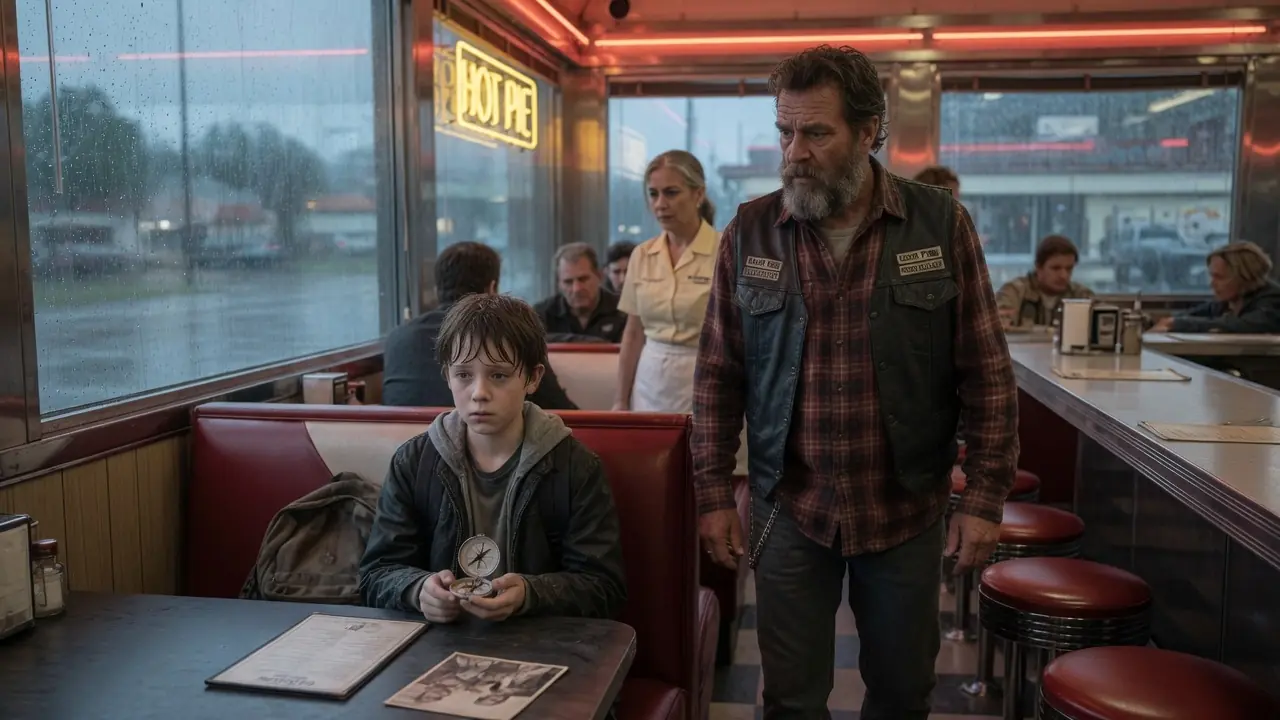
The kid was small enough to disappear inside the red vinyl booth. Maybe twelve. Maybe younger. His brown hair hung over his forehead in damp pieces, and his jacket was too thin for the cold rain outside. A backpack sat beside him, bulging at the seams, like everything he owned had been forced into it and zipped shut before it could object.
He had ordered nothing.
Not coffee. Not fries. Not even water.
He just sat there with both hands wrapped around something on the table, staring down as if he were trying to keep the world from taking it away.
Mason only looked because the waitress did.
Her name was Rita, and she had been working the graveyard shift at Hollow Bend Diner for longer than most people in that town had been sober. She could carry six plates at once, remember every regular’s order, and spot trouble faster than any cop.
She leaned over Mason’s table while refilling his coffee.
“Crow,” she said quietly, “you see that kid?”
Mason did not look up from his plate.
“I see a lot of things.”
“Look properly.”
He sighed and lifted his eyes.
The boy sat in the far corner beneath the flickering neon sign that said HOT PIE. His shoulders were shaking, but he was trying to hide it. His head stayed bowed. Once, he wiped his cheek against his sleeve, quick and ashamed.
Mason’s jaw tightened.
“Where are his parents?”
“That’s what I’m wondering.”
“You ask him?”
“Tried.” Rita glanced back. “He said he was waiting for somebody.”
“Then let him wait.”
Rita gave him a look.
Mason hated that look.
It was the one women gave men when they knew the men were pretending to have less heart than they did.
“Mason.”
He set his coffee down.
“What do you want me to do? I’m not exactly child services.”
“No,” she said. “You’re worse. You’re stubborn enough to get an answer.”
He looked at the boy again.
The kid’s fingers tightened around whatever was on the table. His whole body looked like a question no one had bothered to answer.
Mason swore under his breath.
He was fifty-one years old, president of the Black Pines Motorcycle Club, with a beard going gray at the chin and a left knee that still ached from a wreck outside Amarillo. His leather vest carried patches earned through years of loyalty, blood, and bad weather. He was not a man strangers asked to comfort children.
But Rita had already walked away.
She knew he would go.
That annoyed him most.
Mason pushed his plate aside, stood, and walked across the diner.
The boy heard the boots before he looked up.
Mason stopped beside the booth.
Up close, the kid looked worse. Pale. Hungry. Exhausted. The kind of tired that sleep alone could not fix.
“You planning to buy something?” Mason asked.
The boy flinched.
Mason immediately hated himself for the tone.
The kid looked up with wide gray eyes.
“I’m not causing trouble.”
“Nobody said you were.”
“You sounded like you did.”
Mason stared at him.
Fair.
Rita, from behind the counter, cleared her throat sharply.
Mason slid into the booth across from the boy without asking.
The boy stiffened but did not run.
“What’s your name?” Mason asked.
The boy hesitated.
“Evan.”
“Evan what?”
The kid’s mouth tightened.
“Just Evan.”
Mason nodded once.
“Just Evan. You hungry?”
“No.”
His stomach growled so loudly the lie died in the air between them.
Mason looked toward the counter.
“Rita.”
“Already putting fries down,” she called.
Evan’s cheeks flushed.
“I can’t pay.”
“Didn’t ask.”
“I don’t want charity.”
“Good. I don’t give charity.”
The boy looked confused.
Mason leaned back.
“You can owe me.”
“Owe you what?”
“A story.”
Evan looked down again.
His hands covered the thing on the table.
Mason noticed it now.
A photograph.
Old. Creased. Soft at the edges from being folded and unfolded too many times.
Beside it was a silver compass, small enough to fit in a palm. The metal was scratched. A tiny black crow was engraved on the lid.
Mason stopped breathing.
The rain against the windows.
The coffee smell.
The buzz of neon.
Rita calling orders.
All of it faded.
Only the compass remained.
He had not seen it in twenty-three years.
His hand moved before his mind caught up.
Evan snatched the compass back.
“No.”
Mason froze.
“Where did you get that?”
The boy’s eyes sharpened with fear.
“It’s mine.”
“I asked where you got it.”
“My mom gave it to me.”
Mason’s throat tightened.
“What was her name?”
Evan looked at him carefully.
He had the cautious expression of a child who had learned answers could be dangerous.
“Why?”
Mason pointed at the compass, his finger not quite steady.
“Because I made that mark.”
Evan looked down at the little black crow engraved into the silver lid.
“You?”
“Yes.”
The boy’s face changed.
Not belief.
Not yet.
Hope trying not to stand up too fast.
Rita came over with fries and a burger basket. She set it down gently and looked from Mason to Evan.
“What’s going on?”
Mason did not answer.
His eyes were fixed on the compass.
He remembered engraving it at sixteen with a pocketknife, sitting on the back steps of his mother’s house while his little sister watched like he was doing something sacred.
It was supposed to be a joke.
A cheap compass from a flea market.
His sister had gotten lost walking back from the creek and cried for an hour because she thought the woods had swallowed the house.
So Mason scratched a crow into the lid and told her, “If you ever get lost, follow the crow home.”
She had laughed.
Then she had carried it everywhere.
Until the night she disappeared.
Mason looked at Evan.
“What was your mother’s name?”
The boy swallowed.
“Mara.”
Mason closed his eyes.
The name opened something inside him.
Mara Callahan.
His little sister.
The girl who used to follow him through the woods barefoot because she believed he knew where every path went. The teenager who sang too loudly in the kitchen. The sister who left home after the worst fight of their lives and never came back.
For years, Mason had imagined finding her.
Angry.
Alive.
Older.
Maybe with a husband he would hate. Maybe with a life that did not include him. Maybe with enough bitterness in her voice to match his own.
He had imagined a thousand versions.
None of them included a hungry boy in a highway diner holding her compass.
Mason opened his eyes.
His voice came out rough.
“Mara was my sister.”
Evan stopped moving.
The fries in front of him went untouched.
The entire diner seemed to lean toward them.
Rita whispered, “Oh, Lord.”
Evan’s face went pale.
“My mom said she had a brother.”
Mason could barely speak.
“She did.”
“She said he had a motorcycle.”
Mason gave a broken laugh.
“Still do.”
“She said he was stubborn.”
“Still am.”
Evan looked at the photograph, then turned it around and slid it across the table.
Mason looked down.
His younger self stared back at him.
Nineteen years old. Leaner. Dark hair. No beard. Sitting on a fence rail with one arm around Mara, who was maybe sixteen in the photo, laughing with her eyes squeezed shut. In the picture, Mason wore an old denim jacket, and Mara held the silver compass up like a prize.
He remembered the day.
The county fair.
Summer heat.
Cheap lemonade.
Mara winning a stuffed bear at the ring toss because Mason had secretly bribed the booth guy to make it easier.
He had forgotten the photo existed.
His hands trembled.
“Your mother kept this?”
Evan nodded.
“She kept it in a tin box with letters.”
“What letters?”
“Ones she never sent.”
Mason looked up.
The words struck harder than he expected.
“She wrote letters?”
“All the time.”
“To who?”
Evan’s eyes filled.
“To you.”
Mason’s chest tightened.
The room blurred for a moment.
For twenty-three years, he had told himself Mara left and never looked back.
That was the only way he could survive the guilt.
If she did not want to be found, then failing to find her hurt less.
But letters meant something else.
Letters meant she had looked back.
Maybe every day.
“What happened to her?” Mason asked.
Evan lowered his head.
The answer came softly.
“She died in February.”
Mason did not move.
He heard Rita inhale.
He heard the rain.
He heard his own heartbeat like boots on a hollow floor.
“She died,” he repeated, because the words did not make sense unless he said them himself.
Evan nodded.
“Cancer.”
Mason sat back slowly.
For a few seconds, he could not feel his hands.
Mara was dead.
Not missing.
Not angry somewhere.
Not waiting to be found.
Dead.
The sister he had searched for through road towns and bad addresses and rumors that always went cold.
Gone.
And she had died months ago while he was still imagining the reunion.
Evan wiped his face quickly with his sleeve.
“She told me if I ever needed family, I should find the man in the picture.”
Mason looked at him.
The boy tried to be brave.
He failed.
His mouth twisted, and fresh tears spilled over.
“I tried,” Evan said. “I went to three motorcycle clubs. They laughed at me. One guy told me to go to the police. Another said there were a thousand bikers named Crow.”
Mason rubbed both hands over his face.
He almost laughed at that.
He almost broke completely.
“Kid,” he said, voice shaking, “there probably are.”
Evan gave a small, miserable smile.
“Mom said I would know you because you had sad eyes and acted mean when you were scared.”
Rita covered her mouth.
Mason looked toward the window.
Rain streaked the glass.
He could see his reflection faintly.
Gray beard.
Leather vest.
Hard eyes.
His little sister had seen through him even from twenty-three years away.
“Sounds like Mara,” he said.
Evan finally reached for a fry.
Then stopped.
Mason pushed the basket closer.
“Eat.”
“I don’t know if I can.”
“Try.”
Evan picked up one fry and bit it carefully, like his body had forgotten food was allowed.
Mason waited.
He had a thousand questions.
Where had Mara lived? Who had taken care of her? Who was Evan’s father? Why was the boy alone? Who had brought him this far? Why did he look like he had been sleeping outside?
But the kid was shaking.
Questions could wait.
Food could not.
Rita returned with a glass of milk and a slice of apple pie.
Evan looked up.
“I didn’t order that.”
Rita set it down.
“I did.”
“I can’t pay.”
“Good thing I own the pie.”
Mason looked at her.
“You don’t own the diner.”
“I own what I decide not to charge for.”
Evan stared at the pie.
Then at Rita.
“Thank you.”
Rita touched his shoulder once, light as a feather.
“Eat, baby.”
When she walked away, Mason looked back at Evan.
“Where have you been staying?”
Evan’s shoulders tightened.
“Places.”
“What places?”
“Bus station. Church steps. A shed behind a tire shop for two nights.”
Mason went cold.
“How long?”
“Since last week.”
“Where were you before that?”
Evan looked down.
“My foster placement.”
The word placement came out like something bitter.
Mason’s voice dropped.
“You ran?”
Evan nodded.
“Why?”
No answer.
Mason leaned forward.
“Evan.”
The boy’s hand tightened around the compass.
“The man there hit me.”
The world inside Mason became very quiet.
Rita must have seen his face from across the diner because she called out, “Crow.”
A warning.
Not here.
Not now.
Mason forced himself to breathe.
“What was his name?”
“I don’t want to go back.”
“You won’t.”
Evan looked up too fast.
“You can’t promise that.”
Mason held his gaze.
“Yes, I can.”
“You don’t even know me.”
Mason reached across the table and tapped the photograph once.
“I know enough.”
Evan’s eyes filled again.
Mason softened his voice as much as he could.
“Who was the man?”
“Carl Benton.”
“Where?”
“Eastwood County.”
Rita cursed quietly behind the counter.
Mason knew Eastwood County.
Too many children.
Not enough oversight.
People like Carl Benton loved systems that were too tired to check behind closed doors.
Mason pulled out his phone and called Rafe Knox, the Black Pines club secretary and the only man Mason trusted to handle paperwork without turning it into a fistfight.
Rafe answered.
“What did you break?”
“Nothing yet.”
“That means soon.”
“I need you at Hollow Bend Diner. Bring June.”
Rafe’s voice changed.
June was the club’s lawyer.
Not officially a member, but close enough that men lowered their voices when she entered.
“What’s going on?”
Mason looked at Evan.
“I found Mara’s son.”
Silence.
Then Rafe said, “I’m on my way.”
Mason ended the call.
Evan watched him nervously.
“Who’s June?”
“Someone smart.”
“Am I in trouble?”
“No.”
“But I ran.”
“From someone hurting you.”
“They said I have to go where they put me.”
“They say a lot of things.”
Mason picked up the compass and held it out.
Evan hesitated, then let him touch it.
The lid opened with a soft click.
The needle trembled.
Still working.
Inside the lid, beneath the engraved crow, were tiny initials scratched into the metal.
M.C. + M.C.
Mara Callahan and Mason Callahan.
Mason remembered doing that too.
Mara had complained his initials ruined the crow.
Then she had hugged him anyway.
He closed the compass carefully and slid it back to Evan.
“Your mom ever tell you why she left?”
Evan shook his head.
“She just said people make mistakes when they’re hurting.”
Mason swallowed.
That sounded like her too.
The fight came back in pieces.
Their father had died the year before. Their mother was sinking into pills and grief. Mason was nineteen, angry at everyone, taking club work from men he should have avoided. Mara wanted to leave town with a boy Mason hated on sight.
He told her she was stupid.
She told him he was turning into their father.
He grabbed her backpack and threw it across the room.
She slapped him.
He called her selfish.
She left before dawn.
By the time Mason found the note, the bus station clerk said she was already gone.
He searched for years.
But he also blamed her.
That was the ugly truth.
Blame made missing her easier.
And now there was a boy across from him with her eyes.
A boy who had inherited the consequences of every adult who failed before him.
Mason’s voice was hoarse.
“Your mother was brave.”
Evan looked down.
“She was sick for a long time.”
“I’m sorry.”
“She still laughed.”
Mason smiled faintly.
“Yeah. She would.”
“She sang when she cooked.”
“Badly?”
Evan’s eyes widened.
“So bad.”
Mason laughed then.
A broken, real laugh that came out before he could stop it.
“Mara thought volume fixed pitch.”
Evan laughed too.
It was small, but it changed his whole face.
Mason saw his sister in it and had to look away.
Rafe and June arrived twenty minutes later.
Rafe came first, broad and bald with kind eyes hidden behind the face of a bouncer. June followed in a red raincoat, carrying a leather bag and wearing the expression of a woman who had once made three prosecutors apologize in one morning.
She slid into the booth beside Evan, not too close.
“I’m June Avery,” she said. “I’m a lawyer. I’m not police. I’m not child services. I am here to help you understand what happens next.”
Evan looked at Mason.
Mason nodded.
“She’s safe.”
June’s eyes flicked to Mason.
“Careful with promises.”
Mason corrected himself.
“She’s smart. And on your side.”
June accepted that.
For the next hour, she asked questions gently, precisely.
Evan answered in pieces.
Mara had died in February. A neighbor helped with the funeral. Evan went into foster care because his birth certificate listed no father and no relatives nearby. Mara had written “Mason Callahan” on a form once, but the agency said they could not locate him.
Mason’s jaw tightened.
He had lived in the same county for fifteen years.
But he had also lived under the road name Crow more than his legal name. No wife. No children. No clean social media. No address that looked permanent to a county clerk.
Mara had tried to leave a trail.
The world had not followed it.
Evan had been placed with Carl and Denise Benton.
At first, they were nice.
Then Carl got rough.
Then Denise looked away.
Then Evan found the tin box after a caseworker visit and took the photograph, the compass, and sixty-two dollars Mara had hidden in an envelope marked emergencies.
He got on a bus.
He started asking about bikers named Crow.
Three months, he said.
Not straight through. He had spent time in shelters, church basements, bus terminals, anywhere people did not ask too many questions. He had been robbed once. Chased twice. Helped by a woman in Tulsa who gave him a sandwich and told him to keep his shoes dry.
Mason listened without interrupting.
By the end, his hands were folded so tightly his knuckles had gone white.
June closed her notebook.
“Evan, legally, you are still under state custody. That means we cannot simply hide you.”
Evan went pale.
“I knew it.”
Mason’s head snapped toward June.
She lifted one hand.
“But,” she continued, “we can report the abuse. We can request emergency kinship placement. We can prove Mason is your biological uncle if the records support it. We can keep you from going back to the Bentons tonight.”
Evan stared at her.
“Tonight?”
“Tonight.”
His lower lip trembled.
June softened.
“You did a hard thing getting here. Now let the adults do their part.”
Evan looked at Mason.
“Do you want me?”
The question hit the table like a dropped glass.
Mason could face guns, fists, betrayal, bad roads, prison threats, and men who thought money made them gods.
He had never faced anything as terrifying as that question.
Do you want me?
He looked at the boy.
Hungry.
Cold.
Mara’s son.
Family.
He reached across the table, slowly enough that Evan could pull away.
The boy did not.
Mason placed his large hand over Evan’s small one.
“Yeah,” he said, voice thick. “I want you.”
Evan broke.
He folded forward over the table and cried into both arms.
Mason stood halfway, awkward and helpless, then slid into the booth beside him and wrapped one arm around his shoulders.
The boy leaned into him like he had been holding himself upright for months and had finally been given permission to stop.
Rita turned away behind the counter.
Rafe stared hard at the window.
June pretended to review her notes.
Nobody in the diner said a word.
Some moments deserved witnesses.
Not noise.
The next few days moved fast.
Too fast for Evan.
Too slow for Mason.
June filed the emergency petition. Rafe gathered records. Rita called a friend at the shelter who had seen Evan weeks earlier. Sparrow, the club’s computer man, found Mara’s last known addresses, medical bills, and the hospital records naming Evan as her son.
Mason took a DNA test.
So did Evan.
Not because Mason needed science to tell him.
Because courts did.
The temporary hearing happened four days after the diner.
Mason wore the only suit he owned. It was black, too tight across the shoulders, and made him look like he was attending either a funeral or a trial.
Evan wore a borrowed button-down shirt from Rita’s grandson.
He held the compass the whole time.
The judge was an older woman with silver hair and sharp eyes. She listened to June explain the situation. She listened to the caseworker explain that Mason had not been located because the agency had incomplete family information. She listened to Evan say, in a shaking voice, that Carl Benton hit him and that he was afraid to go back.
Then she looked at Mason.
“Mr. Callahan, are you prepared to take temporary custody of this child while the court evaluates kinship placement?”
Mason stood.
His knee hurt.
His throat hurt worse.
“Yes, Your Honor.”
“You understand this is not symbolic. This is not a gesture. This is daily care, school, medical appointments, structure, accountability.”
“Yes, ma’am.”
“You are president of a motorcycle club?”
The courtroom shifted.
There it was.
The part everyone waited for.
Mason felt Evan tense beside him.
He kept his voice steady.
“Yes, Your Honor.”
“Does that environment expose the child to criminal conduct?”
June started to rise.
Mason lifted one hand slightly.
“I’ll answer.”
The judge watched him.
Mason looked down at his hands, then back at her.
“I’ve done things I’m not proud of. I won’t insult you by pretending otherwise. But the club is not raising him. I am. And if the court says he needs distance from the clubhouse, he’ll have it. If the court says home visits, school enrollment, counseling, parenting classes, I’ll do all of it.”
He glanced at Evan.
“I failed my sister. I won’t fail her son because I’m too proud to learn how to do this right.”
The judge studied him for a long moment.
Then she looked at Evan.
“Do you feel safe with Mr. Callahan?”
Evan gripped the compass.
“Yes.”
“Why?”
Evan swallowed.
“Because my mom said if I found him, I would find family.”
The judge’s face softened only slightly.
But it was enough.
Temporary kinship placement was granted.
Supervised by the court.
Subject to home inspection.
Parenting classes.
School enrollment within ten days.
Counseling.
No unsupervised exposure to illegal activity.
Mason agreed to all of it.
Outside the courthouse, Evan stood on the steps blinking into the sunlight like he did not trust the world to stay open.
Mason stood beside him.
Rafe waited near the curb with the truck.
Evan looked up.
“So I’m not going back?”
“No.”
“For real?”
“For real.”
Evan nodded.
Then, very carefully, he slipped his hand into Mason’s.
Mason looked down at it.
Small hand.
Cold fingers.
Trust arriving before he felt ready for it.
He closed his hand around the boy’s.
The first night at Mason’s house was strange.
The house sat at the edge of town, small and old, with a porch that leaned slightly and a yard full of parts from motorcycles Mason swore he would fix someday. It was not dirty, exactly. But it was a bachelor’s house where dust had negotiated permanent residency.
Rita arrived before them.
By the time Mason and Evan walked in, she had changed the sheets in the spare room, stocked the fridge, thrown away beer bottles, and left a note on the kitchen counter that said:
Children eat vegetables. Figure it out.
Evan read it and smiled.
“Is Rita always bossy?”
“Yes.”
“Are you scared of her?”
“Yes.”
“Good.”
Mason laughed.
The spare room had once been storage. Now it held a twin bed, a lamp, an old dresser, and a stack of folded blankets. Rita had placed a small blue rug beside the bed and a flashlight on the nightstand.
Evan stood in the doorway.
“For me?”
“Unless you think I fit in that bed.”
Evan looked at him, then at the room.
“I never had my own room.”
Mason’s chest tightened.
“Well,” he said gruffly, “now you do.”
Evan stepped inside slowly.
He set his backpack on the bed but did not open it.
That night, Mason discovered children did not simply sleep because adults told them they were safe.
Evan woke three times.
Once from a nightmare.
Once because he thought he heard someone at the door.
Once because he could not find the compass in the dark and panicked so hard he could barely breathe.
Mason found it under the blanket.
He placed it in Evan’s hand.
“Still here,” he said.
Evan clutched it.
“Sorry.”
“Don’t apologize for waking up scared.”
“I’m not supposed to be scared.”
“Who told you that?”
No answer.
Mason sat on the edge of the bed.
“The bravest people I know are scared all the time. They just keep going.”
Evan looked at him through the dark.
“Are you scared?”
Mason almost lied.
Then thought of June’s warning about promises and truth.
“Yes.”
“Of what?”
“Messing this up.”
Evan was quiet.
Then he whispered, “Me too.”
They sat there together in the dark.
Two Callahan men who had found each other too late for Mara, but maybe not too late for themselves.
Weeks passed.
Messily.
Evan started school.
He hated it.
Then tolerated it.
Then admitted he liked science but only if no one made a big deal about it.
Mason learned to pack lunches badly, then better.
He learned Evan disliked mustard, slept better with the hall light on, and froze when adults raised their voices.
He learned parenting was mostly noticing.
Noticing when a child stopped eating.
Noticing when jokes went too far.
Noticing when silence meant tired and when it meant afraid.
The Black Pines club adjusted in ways that would have shocked anyone who thought bikers could not adapt.
The clubhouse stopped hosting loud parties when Evan was there.
Rafe created a swear jar that bankrupted half the members.
Holt taught Evan how engines worked but made him wear safety glasses and explain the tool before touching it.
Rita started bringing vegetables twice a week because she did not trust Mason with nutrition.
June kept everyone legally terrified, which was her natural state.
One afternoon, Evan found a shoebox in Mason’s closet.
Inside were photographs of Mara.
Mason had kept them hidden for years because looking hurt too much.
Evan sat on the floor and opened the box carefully.
Mason stood in the doorway, unsure whether to stop him.
Evan picked up a photo of Mara at twelve, sitting in a tree with scraped knees and a huge grin.
“She looks happy.”
“She was.”
“Were you nice to her?”
Mason leaned against the doorframe.
“Sometimes.”
Evan looked up.
“And sometimes?”
“I was a jerk.”
Evan considered this.
“She said that too.”
Mason winced.
“Of course she did.”
“She said you loved her badly when you were young.”
The words hit deep.
Mason sat on the floor across from him.
“She was right.”
Evan touched the edge of the photo.
“Did she love you badly too?”
Mason thought about it.
Then smiled sadly.
“Sometimes.”
Evan nodded.
“People can love badly and still love.”
Mason looked at him.
“That your mom say that?”
“Yeah.”
The boy’s voice softened.
“She said it about you.”
Mason had to look away.
Some grief was not a knife.
Some grief was water.
It filled every space you forgot was hollow.
The DNA results came back in April.
Confirmed biological relationship.
The court moved from temporary placement to extended kinship guardianship.
There would be more hearings.
More paperwork.
More inspections.
But Evan was not leaving.
After the hearing, Mason drove him to Hollow Bend Diner.
Rita had made a cake.
Chocolate, because Evan liked chocolate.
On top, in crooked white frosting, she had written:
WELCOME HOME, JUST EVAN.
Evan stared at it.
Then laughed so hard he cried.
Mason looked at Rita.
“You’re a menace.”
She shrugged.
“Eat cake.”
That night, after everyone left, Evan sat across from Mason in the same booth where everything had begun.
The photograph lay between them.
The compass too.
Evan looked older now.
Not by years.
By rest.
His face had filled out. His jacket fit. His eyes still carried sadness, but not only sadness.
“Do you think Mom knew you’d take me?” he asked.
Mason traced one finger along the edge of the photo.
“I don’t know.”
“I think she did.”
“Why?”
Evan shrugged.
“She kept saying, ‘Crow always comes home late, but he comes.’”
Mason closed his eyes.
Mara.
Still finding ways to forgive him after death.
He opened his eyes and looked at Evan.
“I wish I had found her.”
“I know.”
“I should have.”
Evan shook his head.
“She told me not to let you live inside should.”
Mason laughed softly.
“That sounds like something she stole from a therapist.”
“She did go to one.”
“Good.”
“She said you probably needed one too.”
“Also true.”
Evan pushed the compass toward him.
“You can keep it for a while.”
Mason stared.
“No.”
“I want you to.”
“Your mom gave that to you.”
“And you gave it to her first.”
The boy’s voice was steady.
“Maybe it belongs to both of us.”
Mason picked it up carefully.
The silver lid was warm from Evan’s hand.
He opened it.
The needle trembled, then settled.
North.
Home.
He closed it and slid it back.
“Then it stays with you. You’re the one still finding your way.”
Evan smiled.
“But I found you.”
Mason swallowed.
“Yeah, kid. You did.”
Years later, people still told the story wrong.
They said a biker found his nephew in a diner.
They said a lost boy walked into a motorcycle club and became family.
They said Mason Callahan took in his dead sister’s son and changed his life.
Some of that was true.
But not all.
Because Evan changed Mason too.
He changed the house.
The club.
The silence.
He made Mason learn the difference between protection and control, between guilt and responsibility, between being feared and being trusted.
He made an old biker keep vegetables in the fridge and emergency contact forms on the counter.
He made the Black Pines clubhouse put up a bulletin board for school art.
He made Rafe attend a parent-teacher conference because Mason was stuck in court, and Rafe came back saying middle school teachers were scarier than federal agents.
He made Rita cry at his eighth-grade graduation.
He made June pretend not to cry at his high school graduation.
He made Mason sit through school plays, science fairs, bad trumpet concerts, and one debate tournament where Evan argued that motorcycles should be considered culturally significant transportation.
He lost that debate.
The Black Pines disagreed with the judges for years.
Evan kept the compass.
Always.
When he turned eighteen, Mason gave him the original pocketknife he had used to scratch the crow into the lid.
“Don’t engrave things that aren’t yours,” Mason said.
Evan smiled.
“Good advice from a man with questionable history.”
“Watch it.”
“Yes, sir.”
At twenty-one, Evan restored Mara’s old letters.
The ones she never sent.
He and Mason read them slowly over the course of a summer.
Not all at once.
Some hurt too much.
In one, Mara wrote:
Mase,
I am still mad at you. I think I will be mad forever. But I also keep looking for crows on telephone wires and thinking it means you are somewhere nearby. That is stupid. I know. I hope you are eating something besides gas station hot dogs. I hope you are less angry. I hope you know I did love you, even when I left.
M.
Mason folded the letter and held it to his chest for a long time.
Evan sat beside him on the porch.
Neither spoke.
There was nothing to add.
The dead sometimes said exactly enough.
On the tenth anniversary of the night at Hollow Bend Diner, Evan returned from college for the weekend.
He was taller than Mason now, which Mason considered offensive. He wore his hair longer, kept a small tattoo of a crow on his left wrist, and studied social work because he said systems did not get to fail children without him becoming a problem.
Mason pretended not to be proud.
Failed.
They went to the diner.
Rita had retired, but she still came in when she knew they were visiting. She sat with them in the corner booth, silver hair pinned up, coffee in hand, acting like she had not saved both of them by making Mason look properly.
Evan placed the old photograph on the table.
Beside it, he placed the compass.
Rita touched the photo.
“Your mama was pretty.”
“She was,” Evan said.
Mason nodded.
“She was trouble.”
Rita smiled.
“Those are often the same.”
They ate burgers.
Fries.
Apple pie.
No one cried until the end.
That was progress.
As they stepped outside, rain began to fall softly over the parking lot.
Evan stopped beneath the diner sign.
“I used to think that night was the end of looking,” he said.
Mason looked at him.
“And now?”
“Now I think it was the beginning of being found.”
Mason did not trust his voice, so he placed a hand on Evan’s shoulder.
The boy was a man now.
But some gestures stayed.
Evan looked down at the compass in his palm.
“The needle still works.”
“Good.”
“Do you think Mom knew it would?”
Mason watched the rain hit the pavement.
“Mara trusted broken things more than she should have.”
Evan smiled.
“Like you?”
“Especially me.”
They stood there under the flickering neon, two men connected by a woman who had left, written, loved, hurt, hoped, and somehow sent her son down enough roads to find the right booth in the right diner at the right time.
Mason thought of the first thing he had said to Evan.
You planning to buy something?
Hard. Stupid. Afraid.
He wished he could take it back.
Then Evan nudged him.
“I know what you’re thinking.”
“No, you don’t.”
“You’re thinking you were rude that night.”
Mason glanced at him.
“I was.”
“Yeah.”
“Thanks.”
“But you stayed.”
Mason looked at the diner window, at the booth where a hungry boy had placed an old photo on the table and changed the rest of his life.
“Yeah,” he said. “I stayed.”
Evan closed the compass and slipped it into his pocket.
“Mom said you would.”
The rain fell harder.
Mason unlocked his truck.
Evan opened the passenger door, then paused.
“Mason?”
He rarely called him that.
Usually it was Crow, or old man, or when he wanted something, Uncle Mason.
“Yeah?”
“Thank you.”
Mason looked at him.
“For what?”
“For becoming family after I found you.”
Mason’s throat tightened.
He gave a short nod.
“You were family before.”
Evan smiled.
“I know. But you became it anyway.”
That sentence stayed with Mason for the rest of his life.
Because blood was a fact.
Family was work.
Mara had sent the fact.
Evan had asked for the work.
And Mason, late as always, had finally arrived.
They drove away from Hollow Bend Diner with the rain tapping the windshield and the compass resting warm in Evan’s pocket.
Behind them, the neon sign buzzed.
Inside, their booth waited for the next lonely person to sit down with a story too heavy to carry alone.
And somewhere beyond grief, beyond regret, beyond all the years they did not get back, Mason liked to think Mara was laughing.
Probably off-key.
Probably too loud.
Probably saying, I told you he’d come.
Sometimes family is not found in grand reunions or perfect timing.
Sometimes it arrives hungry, wet, and scared, holding an old photograph in a diner booth.
Sometimes it wears leather and pretends not to care.
Sometimes it takes years.
Sometimes it is too late for one goodbye but just in time for another beginning.
And sometimes the people we spend our lives searching for send us the ones who still need to be found.