Laughter erupted from the noble archers behind him, bright and cruel beneath the snapping banners. It rolled over the marble tiers, climbed the gilded columns, and spilled beneath the royal balcony where the king’s chair sat empty beneath a canopy of crimson silk.
Eleanor Ashford did not answer.
She only tightened the worn leather wrap around her ancient longbow and stepped into the final lane.
Before her, three hundred paces away, the last target gleamed like a white eye waiting to judge her.
The arena of Alderwyn had seen wars declared, crowns blessed, traitors condemned, and champions made immortal. Its sand was raked smooth that morning, pale as flour beneath a hot summer sun. Every banner bore the black thorn of the royal house, and every noble throat in the crowd seemed eager to cheer for the same young man.
Prince Dylan Thorn.
The kingdom’s darling.
The kingdom’s terror.
He stood in armor black as midnight ink, with gold thread flashing down his cloak and a bow carved from polished yew, ivory, and pure arrogance. His dark hair curled over his brow, his smile was made for statues, and his eyes—blue, fierce, restless—held the look of a boy who had been told too many times that wanting was the same as deserving.
“Did you hear me?” he asked.
Eleanor drew one arrow from her plain leather quiver.
“I heard the wind,” she said.
The nobles laughed harder.
A young lord hid his grin behind a gloved hand. A lady in blue silk whispered loudly enough for three rows to hear, “She thinks she’s still hunting rabbits in the forest.”
Dylan’s smile widened.
“You stand among royal champions now.”
Eleanor finally looked at him.
Her blue eyes were calm and impossibly clear.
For the smallest moment, the prince’s confidence cracked.
It was ridiculous, that crack. Dylan knew it was. This woman looked old enough to have watched mountains grow. Her coat was faded at the elbows. Her gloves were cracked. Her silver braid lay over one shoulder like a rope of winter light. There were lines beside her mouth, sun-browned skin across her cheeks, and a faint tremor in her fingers when she flexed them around the bow.
Everything about her looked poor, old, and forgotten.
**But nothing about her looked afraid.**
The crowd reminded Dylan who he was. They chanted his name, first lazily, then louder, until it bounced between the stone walls.
“Dyl-an! Dyl-an! Dyl-an!”
His pride returned like armor clasped back into place.
“Someone should help her leave before she embarrasses herself,” he said.
No one moved.
On the central platform, Chief Judge Mason Blackwood watched Eleanor with sudden, careful stillness. His gray hair stirred in the wind, but his face remained controlled. His eyes had locked on her left wrist, where her sleeve had slipped back to reveal a dull silver bracelet.
It looked older than the kingdom itself.
It looked like something that should have been sealed inside a royal vault.
Eleanor noticed his stare and calmly pulled her sleeve down.
Mason went pale.
Dylan raised both hands toward the crowd.
“Let her shoot,” he called. “The kingdom deserves entertainment.”
The laughter rolled over Eleanor like distant thunder.
She placed her arrow against the string.
The sound was small.
**But it cut through the arena.**
The crowd began to quiet.
Even Dylan heard it.
Even the banners seemed to stop breathing.
Eleanor set her boots in the sanded lane.
Dylan leaned close and hissed, “That target is farther than the veterans’ mark.”
“I can see it,” Eleanor said.
“You can barely stand straight.”
“I have stood in worse places.”
The words were soft, but something inside Dylan recoiled from them. Not fear, exactly. Recognition. A strange ache passed behind his ribs, as if a locked room in his memory had shifted open by a finger’s width.
He hated the feeling immediately.
The first horn sounded.
Every other contestant had already failed to strike the center. Dylan’s arrow sat two fingers from the golden mark, and the kingdom was ready to crown him legend.
He wanted the record.
He wanted his name carved above every champion who came before him.
He wanted history to forget them all.
Eleanor lifted her bow.
Mason gripped the edge of the platform.
Dylan laughed once more, but this time, his voice shook.
“Careful, old ranger,” he said. “That bow might pull you apart.”
Eleanor drew the string back.
**The silver bracelet beneath her sleeve began to glow.**
A gasp moved through the nearest rows like flame through dry grass.
The bow bent.
The old wood groaned, not with weakness, but with memory. Eleanor’s shoulders settled. Her breathing vanished. For one impossible heartbeat, the arena saw not an old woman, but a shape older than kings: an archer, rooted to the earth, listening to a voice no one else could hear.
The arrow flew.
It did not whistle.
It sang.
The sound rose clean and bright, a silver note over the roar of summer. The arrow crossed the impossible distance, passed so close above Dylan’s own lodged shaft that the feathering shivered—
—and struck the center.
Not near the center.
Not touching the center.
**Dead center.**
The white target split from its heart outward.
The golden mark burst open like a struck sun.
Then the arena bell, silent for twenty-three years, began to toll.
Once.
Twice.
Three times.
The sound poured over the kingdom, deep and ancient, vibrating through bone and blood. Birds erupted from the palace roofs. Horses stamped below the tiers. Somewhere in the royal balcony, one of the queen’s advisors dropped a silver cup, and its ringing fall sounded tiny beneath the bell.
No one laughed now.
Dylan stared at the target.
His arrow, the best shot of his life, had been split perfectly along its spine.
Eleanor lowered her bow.
Mason Blackwood swallowed.
“That shot is unlawful,” he said.
His voice did not carry well enough at first, so he said it again, louder.
“Unlawful! The bracelet flared. Magic was used.”
Murmurs burst across the arena.
Eleanor turned toward the judge’s platform. “The tournament charter forbids charms on arrows, charms on targets, and charms on bowstrings.”
Mason’s jaw tightened.
Eleanor lifted her left wrist.
The silver bracelet glowed faintly beneath the sun.
“It does not forbid memory,” she said.
Dylan’s embarrassment burned into anger.
“Who are you?” he demanded.
“A contestant.”
“You are no contestant.”
“I struck the mark.”
“You cheated.”
Eleanor looked at the split target, then back at him. “Did I?”
The crowd shifted.
That single question, calm as falling snow, did what no insult could have done. It made Dylan feel small.
His face darkened.
Mason raised a hand. “The ancient bell recognizes a royal claim. By law, the archer who wakes it may request one hearing before the throne.”
Eleanor’s eyes never left the judge.
“Then I request it.”
Mason’s mouth thinned. “The king is unwell.”
“The throne is not.”
“The king cannot be moved.”
“Then bring his chair.”
The crowd whispered. In the royal balcony, the empty chair sat beneath its crimson canopy, wide and gold and accusing.
Dylan stepped forward. “Enough. You have had your trick. Take your purse and crawl back to whatever ditch fed you.”
Eleanor’s gaze moved to him, and for the first time, pain touched her face.
It was gone quickly.
But Dylan saw it.
Worse, he felt it.
“Your Highness,” she said quietly, “do you remember the orchard behind the west tower?”
The question struck him harder than any arrow.
He had not thought of that orchard in years. Green apples. Wet grass. A woman laughing as a child missed a target painted on a barrel. Small hands wrapped around a little bow. A warm voice saying, Not with your eyes first, little thorn. With your breath.
Dylan’s throat tightened.
“No,” he lied.
Eleanor nodded as if she had expected the answer.
Mason spoke sharply. “Remove her.”
Royal guards started down the side steps.
Dylan lifted a hand.
They stopped.
He did not know why he stopped them. Anger still beat inside him, but beneath it, something older had woken. The bell had shaken dust from rooms he had boarded shut.
“My father should see this,” Dylan said, loud enough for the arena. “Bring the king.”
Mason’s head snapped toward him.
“Your Highness—”
“Bring him,” Dylan said.
There was enough command in his voice that even Mason Blackwood bowed.
The waiting stretched like wire.
Eleanor stood alone in the lane while the crowd murmured and stared. Dylan paced, his jaw clenched, stealing glances at her when he thought no one noticed.
She looked older now that she was no longer drawing the bow. Tired. The kind of tired that did not come from one morning’s strain, but from years of walking with grief strapped across the shoulders.
Dylan hated that he noticed.
He hated more that he wanted to ask her another question.
Instead, he said, “That bracelet. Where did you steal it?”
“I did not steal it.”
“No commoner wears silverwork from the First Vault.”
“No,” she said. “They don’t.”
His eyes narrowed. “You speak like court.”
“I learned many languages.”
“You speak like you belonged here.”
Eleanor looked toward the empty royal chair.
“I did.”
Before Dylan could answer, a procession emerged beneath the balcony.
The crowd fell silent.
Four physicians in white carried a cushioned litter. Behind them walked the queen’s advisors, though there had been no queen in Alderwyn for fifteen years. That was what everyone called them still: the queen’s advisors, the pale-handed council who had ruled in the absence of a woman whose name had become dangerous to say aloud.
On the litter lay King Aldren Thorn.
Or what remained of him.
Dylan stiffened.
The king’s body seemed too thin beneath the embroidered blankets. His beard had gone white. His skin held a grayish tint, and his eyes stared half-open without seeing. Around his throat hung a black pendant shaped like a thorn, glossy as a beetle shell.
Dylan had visited him every week for years.
Every week, Mason had said the same thing.
The fever has not broken.
The mind wanders.
Do not distress him.
Eleanor took one step toward the litter.
A guard crossed his spear before her.
She stopped.
Her mouth trembled once.
Then she spoke the king’s name.
“Aldren.”
The king’s fingers moved.
Only a little.
Only enough to make the nearest physician gasp.
Dylan’s breath caught.
Eleanor said it again, and this time her voice broke.
“Aldren, wake up. I came back.”
The king’s eyes rolled toward her.
The black pendant at his throat pulsed.
Mason barked, “Seize her!”
Eleanor moved faster than anyone expected.
Her bow rose.
An arrow flashed.
Dylan shouted, “No!”
But the arrow did not strike the king.
It struck the pendant.
The black thorn shattered.
A sound like a scream came from nowhere and everywhere. The physicians fell back. The litter lurched. The king gasped as if he had been dragged from deep water.
Color rushed into his face.
His eyes cleared.
And in front of every noble, every guard, every baker, blacksmith, farmer, child, and courtier in the arena, King Aldren Thorn reached toward the old woman in the sand.
“Eleanor,” he whispered.
The kingdom stopped breathing.
Dylan stared at his father.
Then at the old ranger.
“No,” he said.
It was not a command. It was a plea.
Eleanor’s eyes filled with tears. “Hello, my little thorn.”
Dylan recoiled as if struck.
“No.”
The word came sharper now.
“No. My mother is dead.”
The king struggled upright, shaking violently. “Dylan—”
“My mother betrayed this kingdom,” Dylan said, but his voice cracked. “She poisoned you and fled into the north. Mason told me. Everyone told me.”
Mason Blackwood descended the platform steps slowly.
His composure had returned, but his face looked carved from old bone.
“A cruel performance,” he said. “An enchantress wearing a dead woman’s name, using tricks to distress a sick king and confuse a grieving prince.”
Eleanor turned to him.
For the first time, her calm sharpened.
“Hello, Mason.”
His eyes flicked to the bracelet.
“You should have stayed buried,” he said softly.
Dylan heard it.
So did half the arena.
Mason realized his mistake too late.
The silver bracelet flared again.
Light spread from Eleanor’s wrist, not bright like fire, but pale like moonlight on snow. It spilled across the sand and rose in wavering shapes.
The arena changed.
The crowd saw a chamber lit by stormlight. A younger King Aldren lifted a goblet. A younger Mason Blackwood stood at his side, smiling. A woman with Eleanor’s eyes entered carrying a sleeping child wrapped in blue cloth.
Dylan.
The memory trembled.
Mason’s hand moved.
Black powder fell from his ring into the king’s cup.
The crowd gasped.
The memory shifted. Eleanor screamed as guards dragged her away. Mason stood over a child prince in the dark, speaking softly.
Your mother left you.
Your mother chose power over you.
Your mother does not love anything she cannot rule.
The vision vanished.
Dylan stood white-faced in the sand.
His whole life seemed to tilt.
Mason lifted both hands. “Illusion! Do you think grief cannot be imitated? Do you think a hungry witch cannot steal a queen’s face?”
Eleanor’s tears dried on her cheeks.
“You locked me in Greyglass Tower for fifteen years,” she said. “You wore the king’s signet. You sent false letters in my hand. You taught my son to hate me before he was old enough to spell my name.”
Dylan looked at Mason.
“Tell me she lies.”
Mason’s face softened in the way it had softened when Dylan was six and feverish, ten and furious, fourteen and lonely, eighteen and desperate to become unbeatable.
“My prince,” Mason said gently, “I raised you when she abandoned you.”
Dylan flinched.
Those words had been the foundation of his life.
A mother who abandoned him.
A father too ill to speak.
A court that praised him when he was cruel because cruelty looked like strength from a distance.
He looked at Eleanor. “Why didn’t you come sooner?”
The question was childish, raw, and broken.
Eleanor took it like an arrow.
“I tried,” she said. “Every year. Every winter. Every midsummer. I broke my hands on stone. I learned which guards could be bribed with bread, which locks listened to rain, which ravens remembered names. I sent letters. I carved your name into the wall so I would not forget my own voice.”
“My letters?” Dylan whispered.
Mason’s expression changed.
Only slightly.
But Eleanor saw it.
Dylan saw it too.
“What letters?” he asked.
Mason said, “Your Highness, grief is making you vulnerable.”
Eleanor reached into her quiver and drew out an arrow unlike the others.
It was small.
Too small for her bow.
A child’s arrow, its shaft uneven, its feathers faded blue.
Dylan stared at it.
A memory opened.
He was seven, perhaps eight, standing in the orchard after rain. He had made an arrow himself, badly, with a kitchen knife stolen from the servants’ table. He had scratched one sentence into the shaft because he had not trusted paper.
Mother, if you are alive, hear the wind.
His knees nearly failed.
“I threw that into the river,” he said.
“No,” Mason said sharply.
Eleanor held the little arrow as if it were made of glass.
“It reached me,” she said. “In Greyglass Tower. A fisherman found it tangled in reeds. His daughter was a kitchen maid. She recognized the old queen’s crest carved beneath the paint. She smuggled it north in a sack of turnips.”
Dylan’s face crumpled.
Not fully.
He was too proud for fully.
But enough.
**The cruel prince looked, for one bare second, like a lost boy.**
Mason’s voice hardened. “Guards.”
This time, the guards did not move.
Mason looked at them.
“I said seize her.”
Still no one moved.
Then one of the queen’s advisors, Lady Vael, lifted her hand. A black ring gleamed on her finger.
The guards nearest her stiffened.
Their eyes dulled.
Dylan saw it happen and horror washed through him.
Mason had not merely lied.
He had built a kingdom of puppets.
“Archers,” Mason commanded.
From the noble ranks behind Dylan, twelve bowstrings drew.
Their arrows pointed not at Eleanor.
At the king.
Mason smiled thinly. “The old ways are finished. Alderwyn needs a ruler who can be shaped. A young king with anger enough to frighten his people and grief enough to obey the man who comforts him.”
Dylan turned slowly.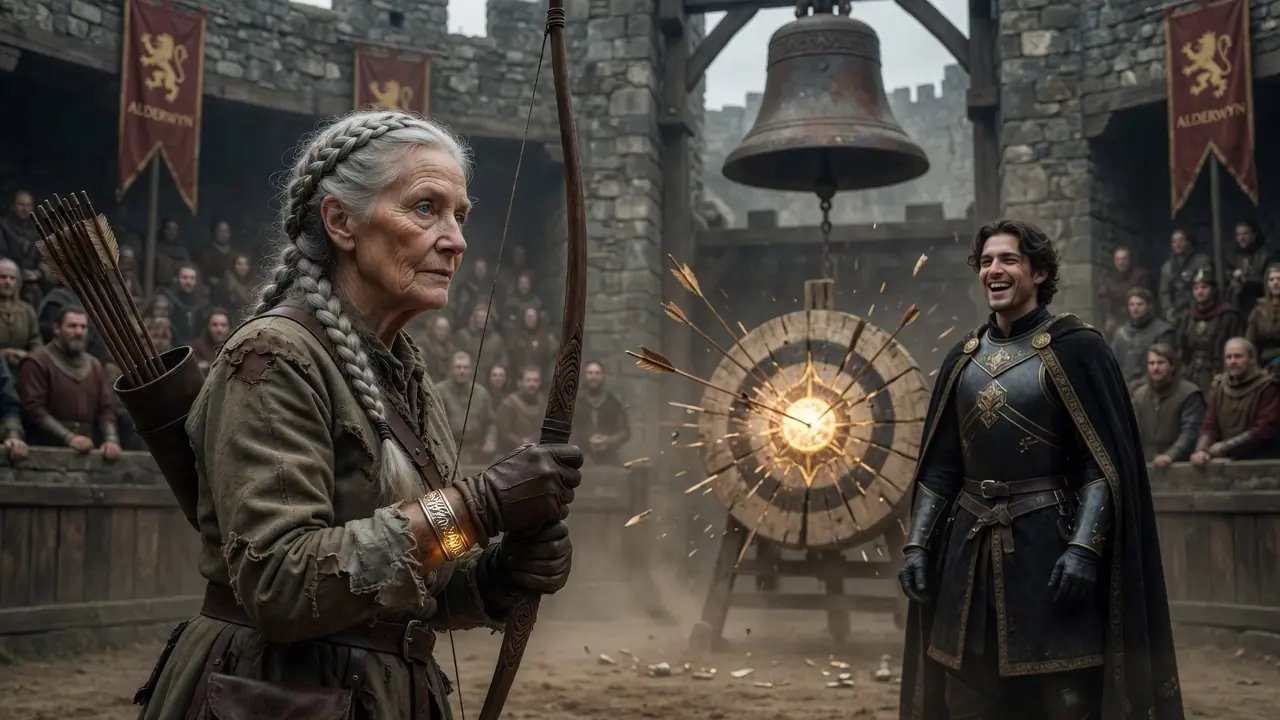
“You mean me.”
“I made you strong.”
“You made me alone.”
“I made you feared.”
Dylan looked at Eleanor, then at his father struggling on the litter, then at the crowd that had cheered his cruelty because everyone had been waiting to see which way power would point.
The black thorn hidden in his own bow grip pulsed once.
He looked down.
A seam had opened in the ivory handle. Inside, lodged like a splinter beneath skin, was a sliver of black glass.
Every time he had gripped that bow, it had warmed.
Every time anger rose, it had seemed to answer.
Dylan remembered shouting at servants and feeling strangely hollow afterward. Mocking boys who missed easy shots. Laughing when nobles laughed. Saying things he regretted before he had even finished saying them.
The sliver had not created his pride.
That would have been too simple.
**It had fed what was already wounded.**
Dylan dug his thumb into the seam and ripped the black glass out.
Pain sliced his palm.
Blood ran down the bow.
The sliver fell into the sand, hissing.
Mason’s smile vanished.
Dylan stepped in front of Eleanor.
The arena saw it.
The prince who had mocked her now stood between her and drawn arrows.
His voice shook, but it carried.
“I was cruel before all of you,” he said. “I was cruel to her. I was cruel because I thought cruelty was the only thing no one could take from me.”
He turned to Eleanor, and every noble in Alderwyn watched the prince bow his head to an old woman in a faded coat.
“I am sorry,” he said.
The words struck harder than the bell.
Eleanor closed her eyes.
The twelve controlled archers released.
Dylan spun, raising his bow though he had no time to nock.
Eleanor did.
Her arrow flew into the canopy rope above the royal balcony.
The crimson silk collapsed like a falling curtain, sweeping between the arrows and the king. The shafts buried themselves in fabric and wood. The crowd screamed. The king’s litter overturned halfway, but Dylan caught one side with his shoulder and kept his father from striking the stone.
“Father!” Dylan gasped.
King Aldren gripped his son’s wrist.
Weakly, fiercely.
“My boy,” he whispered.
Dylan’s eyes burned.
Mason fled toward the central platform.
Eleanor saw where he was going.
Beneath the judge’s stand lay the old witness vault, sealed since the founding of Alderwyn. Only a royal shot could open it. Only Mason knew what he had hidden there: letters, orders, forged confessions, and the true charter naming him protector only until the queen returned.
If he burned it, truth would become rumor.
Rumor could be killed.
Eleanor reached for another arrow.
Her quiver was empty.
Dylan saw.
He looked at his own quiver, filled with polished shafts fletched in gold.
Then he remembered the small blue arrow in Eleanor’s hand.
“That one,” he said.
Eleanor looked at him.
“It was made by a child.”
“It found you once.”
Her fingers closed around it.
Mason reached the platform and tore open a bronze lantern from beneath the judge’s table. Green fire licked up, unnatural and hungry.
“Shoot him!” someone shouted.
Eleanor did not aim at Mason.
She aimed at the stone lion carved above the target, far beyond him, where a tiny crack marked one eye.
Dylan knew that crack.
The orchard memory returned again: his mother laughing, pointing across the practice yard at a stone lion’s eye.
When you can hit what no one else sees, little thorn, you will never need to boast about what everyone can.
Eleanor drew the ancient longbow with the child’s crooked arrow.
The bracelet shone brighter than daylight.
Her arm trembled.
Dylan stepped behind her.
Not touching the bow.
Not stealing the shot.
Only steadying her elbow with his bloodied hand.
For one heartbeat, mother and son breathed together.
“Listen,” Eleanor whispered.
Dylan closed his eyes.
Beyond screaming, beyond bells, beyond Mason’s curses and the scrape of steel, there it was.
The wind.
“I hear it,” Dylan said.
They released.
The little arrow crossed the arena.
It should have tumbled.
It should have failed.
Instead, it flew as if every year of longing had feathered it anew.
It passed over Mason’s shoulder, through the falling green flame, through the split heart of the tournament target, and into the stone lion’s eye.
The arena floor groaned.
The witness vault opened.
A column of silver light rose from beneath the sand.
Inside it spun papers untouched by fire: letters, royal decrees, prison orders, false death notices, confessions sealed with Mason’s private mark.
And one small bundle tied in blue ribbon.
Eleanor walked forward through the stunned arena and lifted it.
Dylan knew before she opened it.
His letters.
Not one.
Not two.
Dozens.
Childish handwriting at first, then sharper, angrier, then colder as years passed.
Mother, I won the winter shoot today. Mason said you would not care, but I wanted to tell you.
Mother, Father did not know me today.
Mother, I hate you.
Mother, I do not hate you.
Mother, if you are alive, why don’t you come?
Mother, I heard the wind today, and for a moment I thought it was you.
Dylan covered his mouth.
The arena blurred.
Eleanor held the bundle against her heart.
“I answered every one,” she said. “Mason kept those too.”
The silver light widened.
Beside Dylan’s letters appeared another bundle: Eleanor’s replies, unopened.
My little thorn, I am alive.
My little thorn, none of this is your fault.
My little thorn, anger is a room with no windows. Do not live there.
My little thorn, I am coming.
Dylan fell to his knees in the sand.
Not because he was defeated.
Because something inside him had finally stopped fighting the truth.
Eleanor knelt before him, joints stiff, face wet, and took his wounded hand.
“You grew up,” she whispered.
He laughed once, brokenly. “Badly.”
“You grew,” she said again. “That was enough.”
Mason Blackwood tried to run.
He did not get far.
Dylan rose, took one plain arrow from a fallen guard’s quiver, and shot without looking grand, without smiling, without waiting for applause.
The arrow pinned Mason’s cloak to the judge’s platform.
Mason stumbled and fell hard into the sand.
The crowd stared at Dylan.
The prince lowered his bow.
“No more blood for your lies,” he said.
The guards surrounded Mason. This time, their eyes were clear.
King Aldren was carried to Eleanor. He reached for her with both hands, and she went to him as if fifteen stolen years were nothing but a door finally opened.
“My heart,” he said.
“My king,” she replied.
“Still?”
“Always.”
Dylan turned away, ashamed to witness something so tender after having lived so long as a blade.
But Eleanor caught his sleeve.
“No,” she said. “Stay.”
So he did.
The kingdom watched its broken royal family sit together in the sand of the tournament ground, beneath torn banners and a ringing bell, while the false judge was dragged away and the summer wind moved softly through the arena.
Weeks passed before Alderwyn understood all it had survived.
Mason Blackwood’s network of charms was broken. The queen’s advisors, some guilty and some bound by black rings, were tried beneath the same bell Eleanor had awakened. Greyglass Tower was opened, and on its walls Dylan found his name carved thousands of times, each mark made by a mother refusing to forget.
King Aldren recovered slowly.
Eleanor recovered more slowly.
Some wounds did not vanish because truth had arrived. Some griefs had to be held, named, and carried together until they grew lighter.
Dylan changed too, though not all at once.
He still had pride. He still spoke too sharply when tired. He still reached for anger when shame frightened him.
But now, when cruelty rose to his tongue, he heard a bowstring.
He heard a bell.
He heard an old woman saying, I heard the wind.
On the first day of autumn, the kingdom gathered again in the royal arena.
The targets had been moved closer for children, farther for veterans, and all lanes stood open—not only to nobles, not only to champions, but to hunters, farmers, guards, shepherd girls, retired soldiers, and anyone with a bow and courage enough to stand before a crowd.
Dylan stepped onto the central platform in simple dark leather instead of black armor.
Eleanor stood beside him, still silver-haired, still lined by age, still wearing the dull bracelet that had outlasted lies.
The crowd quieted.
Dylan looked at them for a long time.
Then he bowed to Eleanor in front of the entire kingdom.
Not a shallow prince’s nod.
A full bow.
“My first shot of the summer tournament was near the center,” he said. “Queen Eleanor’s was true.”
The crowd erupted.
But Dylan lifted a hand.
“And my first words to her were shameful.”
Silence returned.
He swallowed.
“I cannot unshoot an arrow once released. But I can spend my life choosing better aim.”
Eleanor’s eyes shone.
Dylan turned to her. “Will you teach me again?”
A smile touched her mouth.
“Only if you stop blaming the bow.”
A ripple of laughter moved through the arena—warm this time, human, forgiving.
Dylan smiled too.
Not like victory belonged to him.
Like he was grateful to have been spared from becoming the man Mason wanted.
Eleanor handed him a plain wooden arrow.
No gold.
No ivory.
No hidden thorn.
“Breathe,” she said.
Dylan faced the target.
The kingdom held its breath with him.
He drew.
He listened.
The arrow flew.
It struck the center.
Not perfectly.
Not magically.
Just honestly.
The crowd cheered as if honesty were miracle enough.
Dylan turned, searching for Eleanor’s approval, and found tears on her face.
For a moment, he was seven again, standing in an orchard after rain.
For a moment, she was not old, not stolen, not returned from darkness, but simply his mother.
Then the final bell rang once from the tower above the arena, though no one had touched it.
Everyone looked up.
Mason’s old judge’s platform had been dismantled, and beneath it workers had uncovered one last sealed compartment from the founding of Alderwyn. A royal mason brought the box forward and opened it before the king, the queen, and the prince.
Inside lay a single parchment, yellow with age.
King Aldren read it aloud, his voice rough but clear.
“When the bell wakes for an archer scorned, when the proud kneel and the lost are named, Alderwyn shall remember the first law of the thorn: no crown is proven by blood, gold, or fear, but by the hand that lowers itself to lift another.”
The crowd murmured.
Dylan looked at Eleanor.
She looked just as surprised as he did.
Then, beneath the parchment, the mason found one final object.
A tiny silver arrowhead.
On it was engraved a name.
Not Eleanor.
Not Aldren.
Dylan.
The old founders had not predicted a prince.
They had not named a bloodline.
The arrowhead had been carved recently.
Dylan frowned. “Who put that there?”
Eleanor reached for it, then stopped.
Her face changed.
The handwriting on the tag beneath the arrowhead was shaky, childish, and unmistakable.
Dylan recognized it from the letters.
His own.
He had no memory of writing it.
Eleanor read the note aloud.
“If I become cruel, let the arrow find the person who can bring me back.”
Dylan stared.
The final truth settled over him.
Years ago, before Mason’s poison had fully hardened his heart, before grief became armor, a lonely child had sensed the darkness growing around him.
**The person who had summoned Eleanor back to the arena had not been the king.**
**It had not been fate.**
**It had been Dylan himself.**
The prince had mocked the old woman who came to save him because, long ago, he had begged her to.
Eleanor folded the note with trembling hands.
Dylan’s eyes filled.
“You heard me,” he whispered.
Eleanor touched his cheek.
“I told you,” she said. “I heard the wind.”
This time, when the kingdom cheered, Dylan did not lift his hands for praise.
He took his mother’s hand instead.
And beneath the autumn sun, with the bell singing above them and the old lies buried at last, the prince who had once wanted history to forget everyone else learned the joy of being remembered rightly.
Not as the greatest archer.
Not as the proudest prince.
But as the boy who found his way home.
*And the old ranger he mocked became the queen who saved the kingdom with one impossible arrow, one unbroken promise, and a love no prison could silence.*