The first thing Oliver Hayes noticed was the new car in the driveway.
Not because he cared about cars.
He didn’t, not really.
A car got you to work, to school, to grocery stores, to little league practice, and sometimes to the side of the road when the engine decided your paycheck needed humbling. Oliver’s truck had three dents, one cracked taillight, and a heater that only worked if he tapped the dashboard twice and asked nicely.
But the car in his ex-wife’s driveway looked like it belonged in a magazine.
Black. Shining. Low to the ground. The kind of car that looked offended by rain.
Oliver parked his old blue pickup behind it, shut off the engine, and sat there for a moment with both hands on the wheel.
From the back seat, his ten-year-old son’s baseball bag rested against the door.
Eli had forgotten it the weekend before.
Glove. Cleats. Practice jersey. A water bottle Oliver had labeled with black tape because Eli kept losing things with professional enthusiasm.
Tonight was supposed to be a quick drop-off.
That was all.
Drop the bag. Say hello. Leave before anyone could make the air feel expensive.
Through the front window, he could see warm light spilling across the living room of the house he used to enter without knocking. It had been painted since the divorce. The porch had new lanterns. There were white planters by the steps now, filled with flowers someone probably paid another person to keep alive.
Oliver looked at the house and tried not to remember it differently.
Before the divorce, it had been his house too.
Before the custody schedule.
Before the polite texts.
Before the word arrangement entered conversations where love used to be.
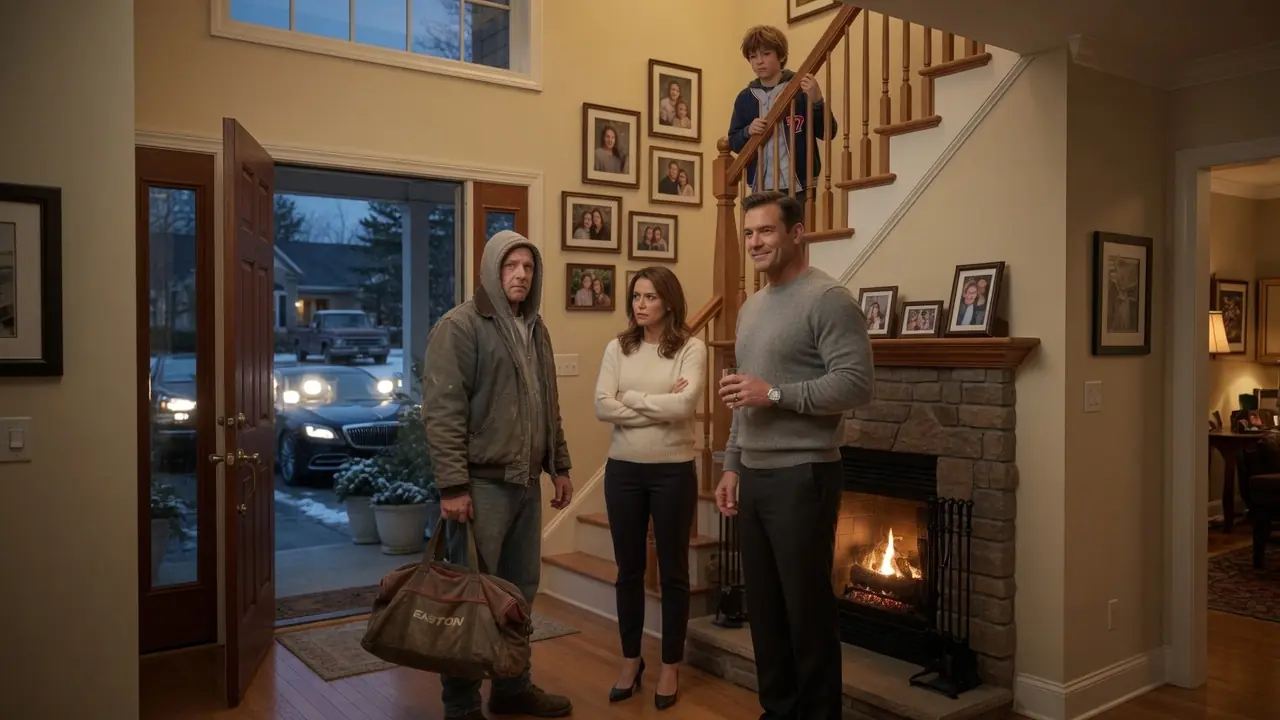
Before Julia remarried Daniel Carrington, a real estate developer with perfect teeth, expensive shoes, and the quiet confidence of a man who never had to check his bank account before ordering dinner.
Oliver took the baseball bag and stepped out of the truck.
The February air in northern Ohio cut through his jacket immediately. He walked up the stone path, careful not to track mud onto the porch, though the porch no longer looked like the kind of place that expected men like him to stand on it.
He rang the bell.
Once.
He could hear movement inside.
Then Eli opened the door.
“Dad!”
The boy launched himself forward before Oliver could set the bag down.
Oliver caught him with one arm, laughing despite himself.
“Hey, slugger.”
“You brought my glove!”
“And your cleats. And the water bottle you swore was not under your bed.”
Eli grinned.
“It was hiding.”
“Very athletic water bottle.”
Eli laughed and took the bag.
He was getting tall too fast. That was the problem with children. They kept growing in places you were not looking. His hair stuck up in the back, and there was a smear of chocolate near his mouth, probably from dessert before dinner, which Julia would have denied and Oliver would have admired.
Behind Eli, Julia appeared in the hallway.
She looked beautiful.
That still annoyed him.
Not because he wanted her back. That ache had burned out into something quieter a long time ago. But beauty made memory less obedient. It kept reminding him of the woman she had been before the arguments, before the bills, before the silences, before two people who once loved each other began speaking like lawyers.
“Oliver,” she said.
“Julia.”
Her eyes moved to his truck in the driveway.
Then to his boots.
Then to the baseball bag.
“Thanks for bringing it.”
“Sure.”
He looked past her into the living room.
A man stood near the fireplace with a glass of something amber in his hand.
Daniel Carrington.
Tall. Broad-shouldered. Gray sweater that probably cost more than Oliver’s work boots. Watch gleaming under the cuff. Smile easy, but not warm.
“Oliver,” Daniel said, stepping forward. “Good to see you.”
Oliver nodded.
“Daniel.”
Daniel looked down at Eli.
“Bud, why don’t you take that bag upstairs? Your mom and I were just talking about dinner reservations.”
Eli hesitated.
Oliver noticed.
He always noticed hesitation.
“Dad, my game is Saturday,” Eli said quickly. “You’re coming, right?”
“I wouldn’t miss it.”
Daniel smiled.
“Big game, huh?”
“Championship,” Eli said. “Well, not championship championship. But Coach says it matters.”
Oliver ruffled his hair.
“Every game matters if there are nachos afterward.”
Eli laughed.
Julia sighed softly.
“What? I’m promoting sports nutrition.”
Eli grinned again, then ran upstairs with the bag.
That left the adults in the hallway.
The temperature changed.
It always did when Eli left the room.
Daniel took a sip from his glass.
“We were actually going to call you,” he said.
Oliver looked at Julia.
“Oh?”
She crossed her arms, not defensively at first. More like she needed something to hold.
“Daniel and I have been talking.”
Those words never led anywhere good.
Oliver waited.
Daniel stepped in smoothly.
“Eli is getting older. He needs consistency. Structure. A clearer sense of where his primary home is.”
Oliver looked at him.
“His primary home?”
Julia said, “Oliver, don’t start.”
“I haven’t started. I repeated a phrase.”
Daniel’s smile stayed in place.
“We’re not trying to cut you out.”
“That’s generous.”
Julia’s eyes flashed.
“Please don’t make everything hostile.”
Oliver gave a short breath.
He looked at the polished floor, the fresh paint, the staircase with framed photographs of Eli now arranged alongside Daniel’s family vacation pictures. He wondered how long it took before a house learned to pretend a man had never lived there.
“What are you asking?” he said.
Julia looked down.
Daniel answered.
“We think it may be best to adjust the weekend schedule.”
Oliver’s jaw tightened.
“To what?”
“Every other weekend instead of every weekend,” Daniel said. “With flexibility, of course.”
Oliver looked at Julia.
She would not meet his eyes.
“That’s less time.”
“It’s more stable,” Daniel said.
Oliver’s gaze moved back to him.
“For who?”
“For Eli.”
“Did Eli say that?”
Daniel’s smile faded slightly.
“He doesn’t need to say it. Children benefit from routine.”
“He has a routine.”
“A split routine.”
“He has a father.”
Daniel set his glass on a side table.
“No one is denying that.”
Oliver laughed once.
“No. You’re just reducing it.”
Julia stepped forward.
“Oliver, Daniel is only trying to help.”
“With what? Fatherhood?”
Daniel’s face hardened.
“Look, I know this is uncomfortable. But someone has to say what everyone is dancing around.”
Julia whispered, “Daniel.”
But he kept going.
“You love Eli. I don’t doubt that. But love is not the same as stability. You live in a rented duplex. Your work schedule changes constantly. You still drive that truck that barely starts. You forget things, you pick him up late, you feed him diner food, and half the time he comes back with grass stains and stories about staying up too late.”
Oliver stood very still.
Each word landed carefully.
Not shouted.
That was what made it worse.
Daniel had arranged the insult like furniture.
Oliver looked toward the stairs.
Eli was not visible.
But houses carried sound.
He knew that better than Daniel did.
“Lower your voice,” Oliver said.
Daniel stepped closer.
“I’m not trying to humiliate you.”
“You’re failing.”
Julia looked between them.
“Oliver, please.”
Daniel’s patience snapped just enough for the truth to show.
“You’re the weekend dad,” he said. “That is not an insult. It is a fact. You get the fun version. Pizza, baseball, movies, late bedtimes. Julia and I handle school, appointments, discipline, homework, future planning. You come in for forty-eight hours and act like showing up with a glove makes you equal.”
The house went silent.
Oliver heard one stair creak overhead.
Julia heard it too.
Her face changed.
“Eli?” she called.
No answer.
Oliver closed his eyes for half a second.
Then he opened them and looked at Daniel.
“Don’t ever call me that again.”
Daniel’s jaw tightened.
“A weekend dad?”
Oliver’s voice dropped.
“Don’t.”
Julia moved toward the staircase.
“Eli, honey?”
Still no answer.
Oliver stepped back toward the door.
Julia turned.
“You’re leaving?”
“I brought the bag.”
“We’re not done talking.”
“I am.”
Daniel shook his head.
“That’s exactly what I mean. You walk away when things get hard.”
Oliver stopped with his hand on the doorknob.
For a second, he almost turned around.
Almost told Daniel about hard.
About working twelve-hour shifts and still learning multiplication tables because Eli struggled with them. About sitting in a truck outside urgent care at midnight when Eli’s fever spiked during “fun dad” weekend. About sewing a button onto Eli’s school shirt at 6 a.m. with a YouTube tutorial because Julia had forgotten to pack a spare. About giving up a higher-paying job two counties away because it meant missing weekday practices Eli did not even know Oliver attended from the far fence.
But some truths were not safe in rooms that had already decided what you were.
So he opened the door.
Cold air came in.
Before leaving, he looked at Julia.
“You know that’s not true.”
She looked away.
That hurt more than Daniel.
Oliver nodded once, stepped onto the porch, and closed the door behind him.
Inside the truck, he sat with both hands on the wheel again.
The porch light glowed behind him.
His phone buzzed.
A text from Eli.
Dad are you mad at me?
Oliver stared at it.
His chest tightened so sharply he had to breathe through it.
He typed back immediately.
Never. Not for one second. I love you. I’ll see you Saturday.
Three dots appeared.
Disappeared.
Appeared again.
Eli replied.
Promise?
Oliver typed:
Always.
Then he drove home with the heater failing halfway.
Saturday came cold and bright.
The baseball field sat behind Roosevelt Middle School, bordered by chain-link fencing, bare trees, and a parking lot full of parents pretending February was a reasonable month for outdoor sports. Frost still clung to the grass in the shade. The sky was a hard, clear blue.
Oliver arrived early.
He always arrived early to games.
Not because anyone noticed.
Because Eli noticed when he was missing.
He parked near the far end of the lot, where his truck would not embarrass anyone who cared about such things. He wore old jeans, a gray hoodie, and his scuffed brown boots. In one hand he carried a folding chair with a cracked armrest. In the other, a small cooler.
Inside the cooler were six water bottles, orange slices, two peanut butter sandwiches, and the chocolate granola bar Eli liked but pretended was for “emergencies.”
Oliver walked to the field and took his usual place near the right-field fence.
Not in the bleachers.
Not among Julia’s circle of parents with stainless steel coffee cups and coordinated coats.
The fence was where he could pace.
Where he could see Eli’s swing.
Where he could shout encouragement without feeling like he was borrowing space from people who thought fathers like him were temporary.
Eli spotted him during warm-ups.
His face lit up.
He lifted his glove high.
Oliver lifted the cooler in return.
Eli laughed from across the field.
That was their signal.
Near the bleachers, Julia stood beside Daniel.
Daniel wore a navy wool coat, leather gloves, and sunglasses even though the sun was behind him. He looked like a man attending a charity polo match by accident. Julia wore a cream coat and kept glancing between Oliver and Eli.
A woman beside Julia said something.
Daniel laughed.
Oliver looked away.
He had learned not to collect pain for free.
The game began.
Eli played second base.
He was quick. Not the strongest hitter, not the fastest runner, but focused in the intense, whole-body way children become when they want to prove something. He checked the stands before every inning.
Sometimes he looked at Julia.
Sometimes at Daniel.
But always, always, his eyes ended at the fence.
At Oliver.
Oliver clapped.
“Good eye, Eli!”
“Stay low!”
“You’ve got it, kid!”
In the third inning, Eli fielded a ground ball cleanly and threw to first for an out. Oliver shouted so loudly that two parents turned to look at him.
He did not care.
Eli grinned into his glove.
Between innings, Daniel walked toward the fence with two coffees in hand.
Oliver saw him coming and wished, briefly, for invisibility.
“Nice play,” Daniel said.
Oliver kept his eyes on the field.
“It was.”
Daniel stood beside him, too close.
“I owe you an apology for the other night.”
Oliver looked at him.
Daniel’s sunglasses hid his eyes.
“Do you?”
Daniel sighed, as if Oliver had made apology inconvenient.
“I shouldn’t have said weekend dad.”
“No.”
“But you understand what I meant.”
There it was.
Oliver almost smiled.
Some people could apologize and insult you in the same breath because they believed tone mattered more than truth.
Daniel continued.
“I’m invested in Eli’s future. I pay for the private batting coach. I got him into the summer league. I’ve talked to people about better schools. I’m not trying to replace you, but practically speaking, I can offer opportunities you can’t.”
Oliver looked at the cooler by his feet.
Then at Daniel’s polished shoes.
“I know what you can offer.”
“Then don’t fight it.”
Oliver turned fully toward him.
“Do you know what Eli eats after he gets nervous before a game?”
Daniel blinked.
“What?”
“Two bites of toast. No butter. If you put butter on it, he says his stomach feels slippery.”
Daniel’s mouth tightened.
Oliver continued.
“Do you know why he taps his bat on the plate three times?”
Daniel said nothing.
“Because when he was six, he struck out three times in one game and cried in the truck. I told him three taps meant three chances to start over. He still does it.”
A voice from the bleachers called, “Daniel?”
Julia was watching.
Oliver lowered his voice.
“Do you know why he hates orange sports drinks?”
Daniel’s jaw worked.
“He likes blue.”
“He hates orange because his mom gave him one after his first dentist appointment and he threw up in my truck. He still apologizes for it sometimes.”
Daniel looked away.
Oliver picked up the cooler.
“You can buy him opportunities. That matters. I’m not pretending it doesn’t. But don’t confuse payment with parenthood.”
Daniel’s face flushed.
“I’m here every day.”
“Then be here,” Oliver said. “But don’t stand beside me and explain my son to me like I met him on weekends.”
Daniel said nothing.
For once, silence improved him.
The game moved into the final inning tied 4–4.
Eli’s team had one runner on second, two outs, and Eli coming up to bat.
Oliver’s stomach tightened.
Across the field, Eli stepped out of the dugout, helmet slightly crooked, bat dragging in the dirt for two steps before he remembered to lift it. He looked toward the bleachers.
Julia stood.
Daniel clapped with both hands high.
Then Eli looked toward right field.
Oliver lifted one hand.
Not big.
Just enough.
Eli nodded.
He stepped into the batter’s box.
Tap.
Tap.
Tap.
Three chances to start over.
The first pitch came high.
Eli watched it.
“Ball one!”
Oliver exhaled.
The second pitch came low.
Eli swung anyway and missed.
Oliver winced.
“That’s okay, bud! Reset!”
Eli stepped back.
He adjusted his helmet.
Looked at the fence.
Oliver tapped his own chest twice.
Breathe.
Eli breathed.
The third pitch came straight over the plate.
Eli swung.
The sound cracked across the field.
Not a huge hit.
Not dramatic in the way movies make baseball dramatic.
Just a clean line drive over the shortstop’s glove.
The runner on second took off.
Parents screamed.
Eli dropped the bat and ran.
The ball rolled into shallow left field.
The runner rounded third.
The throw came home too late.
Safe.
Game over.
Eli’s team exploded.
Children poured from the dugout, shouting, helmets bouncing, gloves flying. Parents stood from the bleachers. Julia clapped with both hands over her mouth, crying. Daniel shouted, “That’s my boy!” without thinking.
Oliver stood still at the fence.
His hand gripped the chain-link so tightly the metal bit into his palm.
Eli’s teammates swarmed him near first base. The coach lifted him briefly. Someone slapped his helmet. Someone yelled about pizza.
Then Eli pulled away.
He looked toward the bleachers first.
Julia was coming down the steps, arms open.
Daniel stood beside her, smiling wide, phone raised to record.
For half a second, Eli ran toward them.
Then he stopped.
His eyes moved past the bleachers.
Toward the right-field fence.
Toward Oliver.
And then Eli ran.
Past the coach.
Past the other parents.
Past Julia.
Past Daniel.
Straight across the grass toward his father.
Oliver barely had time to set down the cooler before Eli hit him full force.
“Dad!”
Oliver caught him, arms closing around his son as Eli buried his face in his hoodie.
“You did it,” Oliver said, voice breaking. “You did it, kid.”
“I tapped three times,” Eli cried.
“I saw.”
“I remembered.”
“I know.”
“I was scared.”
“You did it scared.”
Eli clung tighter.
“I knew you’d be there.”
Oliver closed his eyes.
Around them, the field quieted in pieces.
Not completely.
Children were still shouting. Parents were still talking. But something around the fence had changed.
Julia stood halfway between the bleachers and the grass, tears on her face.
Daniel stood behind her with his phone still raised, no longer recording anything useful.
Eli pulled back enough to look at Oliver.
“You brought the emergency bar?”
Oliver laughed through tears.
“Obviously.”
“And orange slices?”
“I am a professional.”
Eli smiled.
Then, in a voice loud enough for the nearest parents to hear, he said, “I don’t want every other weekend.”
Oliver froze.
Julia heard it.
So did Daniel.
Eli looked suddenly afraid, but he kept going.
“I heard him say it,” he said. “That I should be here more because you’re just the weekend dad.”
Oliver’s heart cracked.
“Eli.”
“You’re not just weekend.” Eli wiped his face with his sleeve. “You’re my dad all the time. Even when I’m not at your house.”
No one spoke.
Oliver crouched so he was eye level with him.
“Listen to me. Adult conversations are not your job to carry.”
“But I heard it.”
“I know.”
“It made me mad.”
“I know.”
“It made me feel like I had to choose.”
Oliver’s throat tightened.
He placed both hands gently on Eli’s shoulders.
“You don’t. You never have to choose between people who love you. If adults make you feel that way, that’s adults failing, not you.”
Eli looked past him at Julia.
“She cried.”
Julia was crying now.
Oliver nodded.
“She loves you.”
“I know.”
“And Daniel cares about you.”
Eli frowned.
“He acts like caring means winning.”
Oliver glanced at Daniel.
The words landed.
Daniel looked down.
Oliver turned back to Eli.
“Sometimes grown-ups get confused about what love is supposed to do.”
“What is it supposed to do?”
“Make you safer. Not smaller.”
Eli nodded slowly.
Then he leaned forward and hugged Oliver again.
Julia approached carefully.
She stopped a few feet away, as if the space belonged to father and son and she no longer had the right to walk into it without permission.
“Eli,” she said softly.
He looked at her.
She knelt, not caring that her cream coat touched the damp grass.
“I’m sorry.”
Eli’s lip trembled.
“Are you taking weekends away?”
Julia shook her head quickly.
“No.”
He looked uncertain.
She looked at Oliver.
Then back at Eli.
“No,” she said again, more firmly. “I was wrong to even consider it without asking how you felt. And I was wrong to let anyone make your dad sound less important.”
Daniel stood behind her.
For the first time since Oliver had known him, he looked unsure what to do with his hands.
Eli looked at him.
Daniel swallowed.
“I’m sorry too,” he said.
Eli did not answer immediately.
Children were honest like that.
They did not rush to make adults comfortable.
Finally, Eli said, “You said he was weekend.”
Daniel nodded.
“I did.”
“That was mean.”
“Yes,” Daniel said. “It was.”
“My dad knows things.”
Daniel’s face changed.
“I know.”
“No, you don’t,” Eli said. “But you can learn.”
Oliver almost laughed despite everything.
Julia covered her mouth.
Daniel stared at the boy, then nodded slowly.
“You’re right.”
Eli reached into the cooler and pulled out the granola bar.
“I’m eating this now.”
Oliver wiped his eyes.
“Emergency confirmed.”
The coach called everyone over for a team photo.
Eli hesitated.
“Can Dad come?”
The coach smiled.
“Family photo after team photo, buddy.”
Eli looked at Oliver.
“Stay?”
“Always.”
Julia stood beside Oliver while Eli ran back toward his teammates.
For a while, neither of them spoke.
Then she said, “I heard what you told him.”
Oliver kept his eyes on Eli.
“Which part?”
“That adults failing is not his job.”
He nodded.
She wiped her face.
“I failed him.”
“We both have.”
She looked at him.
He continued, “Divorce is hard on kids even when people behave perfectly. And we haven’t always.”
“No.”
Daniel stood a few feet away, quiet.
Julia drew a shaky breath.
“I should have stopped him the other night.”
“Yes.”
“I think part of me liked that he made everything sound manageable. Like if I just gave Eli a more structured life, I wouldn’t have to feel guilty about the divorce anymore.”
Oliver looked at her then.
The honesty surprised him.
Julia’s eyes filled again.
“You’re a good father,” she said.
He looked away because the words came too late and still mattered too much.
“I know.”
She almost smiled.
“You do?”
“I had to learn to know it without you saying it.”
That hurt her.
He saw it.
He did not apologize.
Daniel stepped forward.
“Oliver.”
Oliver turned.
Daniel removed his sunglasses.
His eyes looked older without them.
“I was out of line.”
“Yes.”
Daniel nodded.
“I thought money gave me proof.”
Oliver waited.
“Proof that I could offer him more,” Daniel continued. “Proof that I was useful. Maybe proof that I deserved a place in his life.”
Oliver looked toward Eli, who was now being squeezed into a chaotic team photo.
“You don’t earn a place by pushing someone else out.”
“I know that now.”
“I hope so.”
Daniel looked down at Oliver’s cooler.
“Do you make those sandwiches every game?”
“Peanut butter before. Emergency bar after. Orange slices only if he says he doesn’t want them, which means he does.”
Daniel gave a small, embarrassed laugh.
“I didn’t know.”
“No.”
Daniel nodded.
“Maybe you could tell me sometime. Not because I want to replace you. Because I don’t want to hurt him by not knowing.”
Oliver studied him.
There were answers that would have felt satisfying.
No.
Figure it out yourself.
You already said enough.
But Eli was on the field, laughing now, and Oliver had meant what he said.
Children should not have to choose.
So he said, “Maybe.”
Daniel accepted that.
It was not forgiveness.
It was not friendship.
It was a door not fully closed.
After the team photo, Eli dragged all three adults into a picture.
Oliver on one side.
Julia on the other.
Daniel standing beside Julia, slightly behind, not pushing forward this time.
Eli stood in the middle holding the game ball.
“Everybody smile,” the coach said.
Eli looked up at Oliver.
“Dad, don’t do your weird smile.”
“This is my face.”
“It’s weird.”
Julia laughed.
A real laugh.
Oliver looked at her in surprise.
For one second, they were not divorced parents navigating bruised feelings and custody schedules. They were two people who had once made a boy who hit a line drive and then ran toward love without checking who looked richer.
The camera clicked.
Later, in the parking lot, Eli walked between Oliver and Julia, still wearing his uniform, cleats clicking against the pavement.
Daniel carried the bat bag.
Not because anyone asked.
Because he picked it up.
At Oliver’s truck, Eli climbed onto the running board and opened the cooler again.
“Can I take the other sandwich?”
“That was my dinner.”
Eli froze.
“Oh.”
Oliver smiled.
“Take it.”
“No, you need dinner.”
“I’ll survive.”
Eli looked toward Daniel’s black SUV.
Then back at Oliver’s truck.
“Can we all get dinner?”
The adults went still.
“All?” Julia asked.
Eli nodded.
“You, Dad, Daniel, me. Not fancy. Burgers.”
Daniel looked at Oliver.
Julia looked at Oliver.
Oliver looked at Eli.
He could say no.
He would have been allowed.
But Eli’s face held so much hope, not for reconciliation, not for impossible family repair, but for one meal where nobody competed over him.
Oliver sighed.
“Burgers are acceptable sports nutrition.”
Eli grinned.
Daniel said, “I know a good place downtown.”
Eli’s smile dimmed.
Oliver saw it.
Julia saw it.
Daniel saw it too.
He corrected himself.
“Or we can go wherever Eli wants.”
Eli brightened.
“The place with the milkshakes?”
Oliver groaned.
“That place has terrible fries.”
“You always eat them.”
“To gather evidence.”
Julia smiled.
“Milkshakes it is.”
At the diner, they sat in a red vinyl booth near the window.
Eli insisted on sitting beside Oliver first, then moved halfway through the meal to sit beside Julia because he said his fries needed “equal parenting.”
Daniel listened more than he spoke.
That helped.
At one point, Eli explained the three taps.
Daniel looked at Oliver.
“You came up with that?”
Oliver shrugged.
“He was six. It helped.”
Eli dipped a fry in ketchup.
“It still helps.”
Daniel nodded.
“I’ll remember.”
Eli studied him.
“You have to actually remember. Adults say that a lot.”
Daniel smiled faintly.
“Fair.”
After dinner, in the parking lot, Eli hugged Oliver for a long time.
“I’ll see you Wednesday for practice?” he asked.
Oliver looked at Julia.
She nodded.
“Yes,” she said. “Wednesday.”
Eli smiled.
“And weekend?”
“Weekend too,” Julia said.
His shoulders lowered.
“Okay.”
Oliver watched him climb into Julia’s car. Daniel closed the door gently, then turned back.
“Oliver,” he said.
“Yeah?”
“I meant what I said. If you’re willing, I’d like to learn the things I don’t know.”
Oliver looked through the window at Eli, who was pressing his face against the glass to make a ridiculous expression.
“I’ll think about it.”
Daniel nodded.
“Thank you.”
Julia lingered after Daniel walked around to the driver’s side.
“You gave up that Cleveland job, didn’t you?” she asked.
Oliver went still.
“What?”
“The one your boss offered last year. Better pay. Company truck. Benefits.”
He looked away.
“How do you know about that?”
“Eli mentioned once that you said Cleveland was too far from practice.”
Oliver said nothing.
Julia’s eyes filled.
“You never told me.”
“It wasn’t about you.”
“It was about Eli.”
“Yes.”
She wiped her cheek.
“I called you unstable.”
He looked at her.
“You were angry.”
“I was wrong.”
Both could be true.
Oliver placed his hands in his jacket pockets.
“I didn’t give it up to be praised.”
“I know.”
“I gave it up because he still looks for me at the fence.”
Julia nodded.
“I saw.”
They stood in the cold parking lot with years of unfinished apologies between them.
Finally, she said, “No more changes to custody unless all three of us talk.”
“Four,” Oliver said.
She looked confused.
“Eli gets a voice.”
Julia nodded slowly.
“Four.”
That night, Oliver drove home alone in the old blue truck.
The heater sputtered on after three taps.
A miracle.
His phone buzzed at a red light.
A text from Eli.
Best game ever.
Then another.
Not because I won.
Then a third.
Because you were there.
Oliver sat through the green light until the car behind him honked.
He laughed, wiped his eyes, and drove on.
His duplex was small.
The porch light flickered.
A pile of laundry waited on the couch.
The sink had two bowls in it from breakfast.
It was not Daniel’s house.
Not polished.
Not impressive.
But Eli’s glove oil sat on the shelf by the door. A framed photo of father and son at a muddy fall tournament hung crooked in the hallway. In the kitchen, a paper schedule was taped to the fridge with Eli’s games circled in red.
Oliver took the schedule down and added one note under Wednesday practice.
Bring extra water. Tell Daniel about toast.
He stared at the note for a moment.
Then smiled.
Not because everything was fixed.
Everything was never fixed all at once.
But because Eli had run across the field and reminded every adult watching that love was not measured in square footage, private coaches, or polished cars.
Love was the person standing by the fence with old shoes, a cracked cooler, and the exact snack you needed after the biggest hit of your life.
Love was showing up before being seen.
And Oliver Hayes, who had been called just the weekend dad, finally understood something he should have known all along.
He was not a visitor in his son’s life.
He was one of the places Eli ran home to.