The wind came sideways that morning, carrying the smell of wet earth and something else. Something bitter, like smoke from a fire that had burned too long. The kind of wind that finds the cracks in your coat and reminds you that winter is not finished with you yet.
In the great kitchens of Ashworth Manor, the servants moved like ghosts through the gray light, speaking in whispers, because the old duke was dead. Three days dead now, and the house was holding its breath. Nobody cried. That was the strange part.
The Duke of Ashworth had been the kind of man who made rooms go quiet when he entered, but not from respect, from fear. He had owned two thousand acres, forty horses, a house with sixty-seven rooms, and the silence of every person who depended on him for a living.
Now he was gone, and the silence remained, not because they missed him, but because none of them knew what came next.
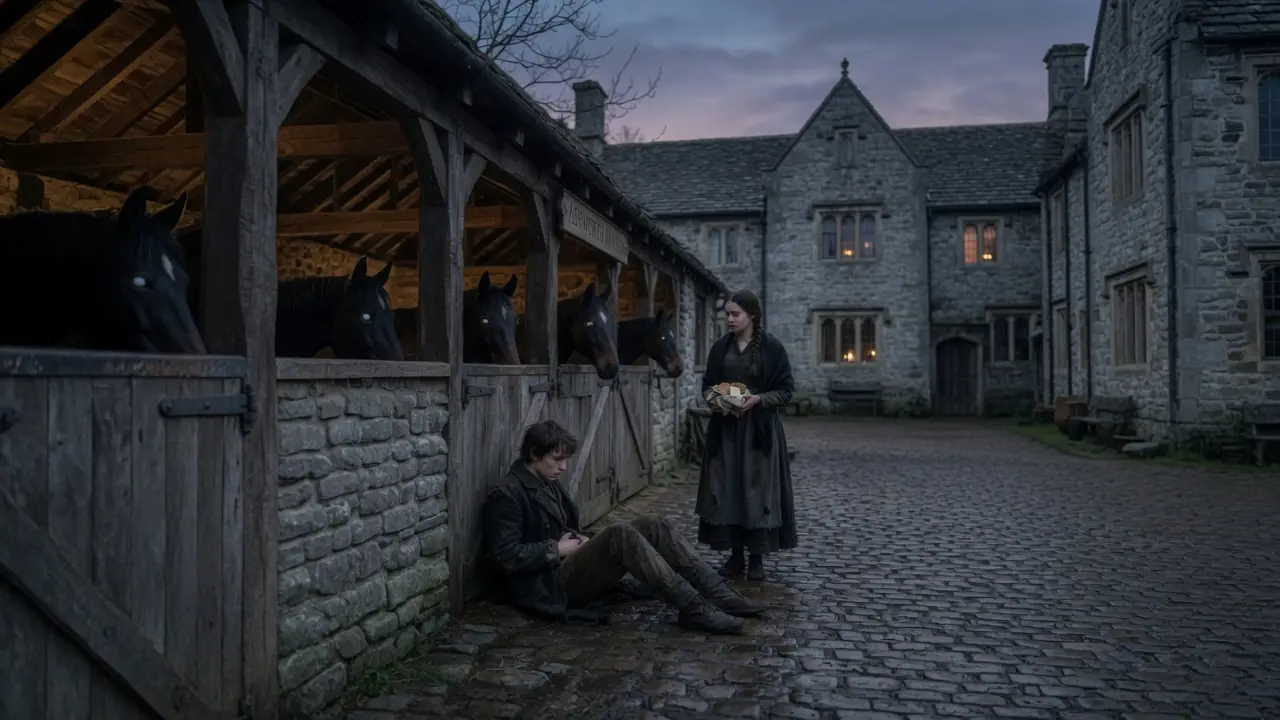
In the stable yard, where the cobblestones were slick with rain and the horses shifted nervously in their stalls, a boy sat on an overturned bucket, eating a crust of bread. His name was Rowan. He was seventeen years old.
His hair was the color of dark honey, and it hung over his forehead because no one had ever thought it important enough to cut properly. His boots had holes. His coat was too thin. His hands were rough and red from cold, and there was a bruise on his left cheekbone, fading from purple to yellow, the kind of bruise that came from a fist and not from a fall.
He was, by everyone's account, useless. That was the word they used. Not lazy, because he worked from before dawn until after dark, mucking stalls and carrying water and brushing the horses until their coats gleamed. Not stupid, because he could read, which was more than most of the stable hands could manage, and he had a quiet, careful way of watching people that suggested he understood far more than he let on.
But useless, because he was an orphan with no family name, no money, no connections, and no future. Because the head groom, a thick-necked man called Barlow, had decided on the boy's first day that he was worthless and had spent the last four years making sure everyone else believed it too.
And because he never fought back, that was what bothered people most. The other stable boys would shove him, trip him, take his food, and Rowan would simply pick himself up and keep working. Barlow would cuff him across the face for some invented failure and the boy would stand there absorbing the blow like a stone absorbs rain and say nothing.
It made people uncomfortable. It made them angry in a way they could not quite explain. They wanted him to shout, to cry, to break, because his silence felt like a judgment and nobody likes to be judged by the person they are mistreating.
Nobody fed Rowan. That was the unspoken rule. The servants ate in the kitchen in shifts, and when the food was portioned out, there was always enough. But somehow there was never enough for him.
Barlow had made it clear years ago that the boy could eat whatever scraps were left, if there were scraps, which there usually were not. So Rowan survived on crusts he found, apples he stole from the horses, and the stubborn, inexplicable refusal of his body to give up.
Her name was Ara Quinn. She was twenty years old, newly hired as a kitchen maid at Ashworth Manor, and she had been in the house exactly nine days when she first noticed the boy in the stable yard. She noticed him because he was the only person on the entire estate who looked hungrier than she felt.
Ara was not beautiful in the way the word was usually meant. She was not delicate or pale or soft-spoken. She was tall for a woman, with dark hair she kept braided and pinned out of the way and hands that were already calloused from years of work.
Her face was sharp, cheekbones like the edge of a blade, a jaw that set itself in a way that told you she had opinions and was not afraid of them. Her eyes were brown, the dark brown of good soil, and when she looked at you, you felt as though she could see the thing you were trying hardest to hide.
She had come to Ashworth Manor because there was nowhere else to go. Her mother had died the previous autumn. A cough that would not stop, and then blood, and then silence.
Her father had been gone since she was small, lost to drink and then to the road. She had a younger sister, Margo, placed with a family in the next village who would keep her fed and schooled as long as Ara sent money every month. Every single month without fail.
So Ara worked. She peeled potatoes and scrubbed floors and carried pots of boiling water and never once complained, because complaining was a luxury for people who had choices.
She kept her head down. She answered politely when spoken to. She did not make friends, because friends required time and energy and trust, and she could not afford to waste any of those things.
But she noticed the boy.
On her ninth evening at the manor, she was carrying a bucket of kitchen scraps to the compost heap behind the garden wall when she passed the stable yard and saw him. He was sitting on the ground with his back against the stable wall, and he was so still that at first she thought he was asleep.
Then she saw his hands. They were wrapped around his own stomach, pressing inward, the way you press against a wound that will not stop bleeding. He was not sleeping. He was trying to hold himself together against the pain of hunger.
Ara stood there for a long moment, the bucket heavy in her hands. Something moved in her chest. Not pity exactly, because pity is soft and useless, and Ara had no patience for useless things. It was something harder than pity, something with edges.
It was the recognition of a suffering she understood in her own body, in her own bones, because she had been that hungry before. She knew what it felt like when your stomach stopped growling and went quiet. Because quiet meant it had given up asking.
She set the bucket down. She went back to the kitchen. She took a bread roll from the basket near the door. Not the fresh ones set aside for the housekeeper's morning tray, but a day-old roll that no one would miss. And she wrapped it in a cloth with a piece of cheese and a handful of dried apples.
Then she carried it out to the stable and set it down beside the boy without a word.
Rowan looked at the food. Then he looked at her. His eyes were gray, not the soft gray of a dove or the flat gray of river stones, but the gray of winter sky just before it snows, bright and pale, and full of something that could not yet be named.
"I did not ask for this," he said. His voice was low and rough, as if he was out of practice using it.
"I did not say you did," Ara replied. And she picked up her bucket and walked away.
She did not think about it as charity. She did not think about it as kindness. She thought about it the way she thought about everything: practically.
There was a hungry person. She had food. The math was simple.
She came back the next night, and the night after that, and the night after that. Always the same. A roll, some cheese, whatever she could take without being noticed. She never sat down. She never stayed to talk. She set the food beside him and left. And Rowan ate it. And neither of them spoke about it to anyone.
On the fifth night, he said, "You will get in trouble."
"I am already in trouble," she said. And something happened at the corner of her mouth. Not quite a smile, but the ghost of one. The memory of what smiling felt like before life had become so serious. "I was born in trouble. It follows me around like a stray cat."
Rowan looked at her, and for the first time something shifted in his expression. The blankness cracked just slightly, like ice on a puddle in early spring.
"Cats choose their people carefully," he said.
Ara paused. She turned back and studied him. Really studied him for the first time. The bruise on his cheek, the sharpness of his collarbone visible through his shirt, the intelligence in those gray eyes that no amount of hunger or cruelty had managed to dim.
"Then I suppose they do," she said, and she left.
This was how it began. Not with a grand declaration, not with a stolen glance across a ballroom or a letter sealed in wax. It began with bread and silence, and the quiet recognition between two people who understood what it meant to be invisible.
Neither of them knew what was coming. Neither of them could have guessed that within a month a sealed letter would arrive at Ashworth Manor bearing the crest of a London solicitor and that the letter would contain a name, Rowan's name, and a truth so enormous that it would shake the foundations of the house itself.
Because the old duke, the one they had buried three days ago, the man who had made an entire estate afraid of him, he had a secret. A secret he had carried for seventeen years, locked in a drawer in his private study, written in ink on paper that had yellowed with age.
Rowan was not an orphan.
Rowan was his son.
And every acre, every horse, every room in that sixty-seven-room house, it all belonged to the boy that no one would feed.
This is that story.
The news of the duke's death traveled slowly, the way all news traveled in that part of the country, by whisper, by rumor, by the careful exchange of glances between people who had learned long ago that speaking openly was dangerous.
The tenants heard first, because the tenants always heard first, then the village, then the neighboring estates, where men in fine coats sat in their studies and calculated what the duke's death might mean for their own fortunes.
At Ashworth Manor itself, the mood was not grief, but dread. The duke had been cruel, yes, but he had been a known cruelty, a predictable one, and there is a strange comfort in knowing exactly how your suffering will arrive each day.
Now that he was gone, the future was a blank page, and blank pages terrified people who had never been allowed to write anything for themselves.
The housekeeper, Mrs. Callaway, ran the household with the grim efficiency of a general managing a retreat. She was a tall woman with iron-gray hair pulled so tightly from her face that it seemed to stretch her features into a permanent expression of disapproval.
She had served the duke for twenty-two years. She knew where every key hung, what every servant earned, and which floorboards creaked.
She did not know how to feel about the duke's death, so she decided not to feel anything at all, and instead focused on making sure the silver was polished and the floors were swept, because disorder was the enemy, and grief was a luxury.
It was Mrs. Callaway who first noticed Ara, not because the girl was doing anything wrong. That was precisely the problem.
In Mrs. Callaway's experience, new kitchen maids either worked too slowly and had to be prodded, or they worked too quickly and had to be watched for theft.
Ara did neither. She worked steadily, thoroughly, and with a quiet competence that suggested she had been doing this kind of work her entire life. She did not gossip with the other maids. She did not steal food. She did not complain about the hours or the cold or the ache in her back.
She was, in short, too good to be true. And Mrs. Callaway trusted nothing that seemed too good to be true.
"That new girl," Mrs. Callaway said to the cook, a round woman named Mrs. Tibbit, who had been at Ashworth even longer than the housekeeper. "The Quinn girl. What do you make of her?"
Mrs. Tibbit was rolling pastry. She did not look up. "She works hard. She keeps quiet. She sends her wages to her sister."
"Nobody is that simple."
"Some people are exactly that simple, Mrs. Callaway. Some people are just trying to survive."
Mrs. Callaway made a sound that might have been agreement or might have been dismissal. She filed the information away in the vast cabinet of her mind in the drawer marked "watch" and moved on to the next item on her list.
The next item on her list was the stable boy. It was not strictly speaking Mrs. Callaway's responsibility to concern herself with the stable staff. That was Barlow's domain.
But Mrs. Callaway's authority at Ashworth Manor was like water. It found every crack. It seeped into every room, and no corner of the estate was truly beyond her reach.
She had known about Rowan since the day the duke had brought him to the house, a thin and silent boy of thirteen, with no surname and no explanation. "Put him in the stables," the duke had said, and that had been the end of the conversation.
Mrs. Callaway had asked no questions. One did not ask the duke questions. But she had watched.
She watched the way the duke never looked at the boy, the deliberate way he avoided the stable yard, the way his jaw tightened on the rare occasions when someone mentioned the stable hands in his presence.
She filed these observations in the drawer marked "do not touch" and she left them there.
Now the duke was dead, and the drawers were opening.
The solicitor arrived on a Tuesday. He came in a black carriage drawn by two black horses, which was either a gesture of mourning or a reflection of his general personality. It was difficult to tell.
His name was Mr. Peton. He was a small, precise man with spectacles and a leather case that he carried with both hands as though it contained something precious, which it did.
He asked to see the duke's study. Mrs. Callaway led him there and waited outside the door because she had been told to wait and because she was not yet certain whether Mr. Peton was an ally or a threat.
She heard the sound of drawers opening and closing, the rustle of papers, and then a long silence. A very long silence.
When Mr. Peton emerged, his face was the color of chalk.
"I need to speak with the entire household," he said.
"That is highly irregular, Mr. Peton."
"The situation, Mrs. Callaway, is highly irregular."
The household assembled in the great hall, a room so large that voices echoed against the stone walls and lost themselves in the vaulted ceiling.
The servants stood in their usual order: the senior staff in front, the junior staff behind, the outdoor workers at the back.
Rowan was there, too, standing apart from the others as he always did, his back against the far wall, his arms crossed over his chest.
Ara stood with the kitchen maids. She could see Rowan from where she was, and she noticed, because she always noticed, that his bruise had healed, but there was a new one, smaller, on his jaw.
Something hot and sharp rose in her chest. She pushed it down.
Mr. Peton cleared his throat. He opened his leather case and removed a single document thick with wax seals and ribbons.
"The late Duke of Ashworth," he began, "left a will."
This was not surprising. Every duke left a will. The surprise was in the details.
"The estate, including all lands, properties, financial holdings, and the title of Duke of Ashworth, is bequeathed in its entirety."
He paused. He looked out over the assembled household with an expression that seemed almost apologetic.
"To his son."
A murmur rippled through the hall.
The duke had no son. Everyone knew the duke had no son. He had been married once, thirty years ago, to a woman named Adelaide who had died without producing an heir. He had never married again. He had no children. He had no family at all, as far as anyone knew.
"The duke's son," Mr. Peton continued, and now his voice was very carefully controlled, "is identified in this will by name, by date of birth, and by a physical description that I am instructed to verify in person."
"The late Ashworth heir is named Rowan."
The silence that followed was not the kind of silence that falls when people are surprised. It was the kind that falls when the world tilts on its axis and everything you thought you knew slides sideways and crashes.
Sixty-two people stood in that hall, and not one of them breathed.
Rowan did not move. He stood against the wall with his arms still crossed and his face showed nothing. Not surprise, not joy, not anger, not understanding. Nothing at all.
He had spent so many years making his face a blank wall that it had become reflexive, automatic, the only defense he had against a world that wanted to see him break.
Then Barlow laughed. It was a short, ugly sound, like a dog barking.
"That boy? The duke's son? You must be joking."
"I assure you, Mr. Barlow, I am not."
"He is a stable hand. He is nobody. He cannot even afford boots that do not have holes in them."
Mr. Peton adjusted his spectacles.
"The circumstances of the heir's upbringing do not affect the validity of the will. The document is properly executed, witnessed, and sealed. It includes a letter in the duke's own hand confirming the identity of the child and the identity of his mother."
He paused.
"A woman named Mary Hail."
At the back of the hall, Rowan's arms slowly uncrossed. His hands dropped to his sides.
Something had happened to his face. The blankness had cracked, and underneath it was not joy or triumph, but something raw and terrible. The look of a boy hearing his mother's name spoken aloud for the first time in years.
Mary Hail.
He knew that name. Of course he knew it. It was the name of the woman who had held him when he was small, whose voice he could still hear in his memory if he closed his eyes and listened hard enough.
The name of the woman who had died when he was ten and left him with nothing but a locket he kept hidden under his shirt, and a promise that he mattered, even when the world told him he did not.
She had told him his father was dead. She had told him they were alone. She had held his face in her hands and said, "You are enough, Rowan. You are more than enough."
And he had believed her, because she was the only person in the world who had ever made him feel like something other than a burden.
She had lied.
His father was not dead.
His father had been alive, living in a house with sixty-seven rooms, sleeping in silk sheets, eating food that was brought to him on silver trays, while his son ate scraps in the stable yard and was beaten by a man whose name his father probably never bothered to learn.
Rowan stood very still, and behind the blankness, behind the crack, something began to burn.
Ara watched him. She could not see his face clearly from where she stood, but she could see his hands. They were clenched into fists at his sides, the knuckles white, the tendons standing out like cords.
She had seen that before, not in Rowan, but in herself. The hands of a person holding so much inside that the body has to lock itself into place to keep from shattering.
The hall erupted into noise. Questions, protests, disbelief.
Barlow was shouting that it was a forgery, a fraud, a trick.
Mrs. Callaway was standing very still, her face unreadable, her eyes moving between Rowan and the document in Mr. Peton's hand.
The maids were whispering, the footmen were staring, the gardener's boy, who was twelve and understood very little of what was happening, tugged at his mother's sleeve and asked if this meant they were getting a new master.
Mr. Peton raised his hand.
The noise subsided, not because he had any authority in this house, but because the document in his other hand had all the authority in the world.
"There will be a formal verification process," he said. "The will specifies certain identifying details that must be confirmed. Until that process is complete, I will remain at Ashworth Manor as the executor of the estate. The household will continue to function as normal. All staff will retain their positions."
He looked directly at Barlow.
"All staff."
Then he looked at Rowan.
"I would like to speak with you privately, if you would come with me."
Rowan did not move.
For a long, terrible moment, Ara thought he would refuse. Thought he would turn and walk out of the hall and disappear into the fields and never come back.
She could see it in the angle of his shoulders, the way his weight had shifted toward the door, the way every line of his body said, "Run."
Then he straightened. He unclenched his fists. He walked forward, past the whispering servants, past Barlow's red and furious face, past Mrs. Callaway's careful eyes, and he followed Mr. Peton out of the great hall without looking back.
Ara watched him go. She watched the way he held his spine straight and his chin level. The way he walked as though the floor might open beneath him at any moment, but he intended to keep walking regardless.
She watched, and the thing in her chest, the hard, sharp thing that was not pity but something fiercer, expanded until it pressed against her ribs.
She did not know what to think. She did not know what to feel.
She knew only this: Last night she had brought bread and cheese to a boy sitting in the stable yard. And this morning that boy was the Duke of Ashworth.
The days that followed the announcement were chaos dressed up as order.
Mrs. Callaway, who understood that chaos was simply order that had not yet been organized, threw herself into the work of keeping the household running while the foundations beneath it trembled.
Meals were served on time, floors were swept, fires were lit. The rituals of the house continued, because rituals are what hold people together when understanding fails.
Mr. Peton took over the duke's study. He worked there for hours each day, surrounded by documents and ledgers, pausing only to request tea, which he drank in vast quantities, or to summon one servant or another for questioning.
He was building a case piece by piece, confirming what the will already stated: that the late duke had fathered a child with a woman named Mary Hail, a seamstress from the village, eighteen years ago. That the duke had provided money for the child's care in secret. That when Mary Hail died, the duke had brought the boy to Ashworth Manor and placed him in the stables, where he could keep him close without acknowledging him.
The cruelty of it was precise and deliberate, like everything the duke had done. He had kept his son within reach, but never claimed him. He had watched the boy grow up in his own house, sleeping in the hay, eating scraps, absorbing blows from a head groom who mistook cruelty for authority.
The duke could have acknowledged Rowan at any time. He could have given him a room, an education, a name.
Instead, he had locked the truth in a drawer and let it sit there, growing heavier with every year that passed, until death finally forced his hand.
Why?
That was the question everyone asked.
Mr. Peton, who had known the duke for two decades, offered no answer.
"The late duke was a private man," he said, which was the polite way of saying the late duke was a selfish and cowardly man who wanted to control a situation even from beyond the grave.
The verification was completed in four days.
A birthmark on Rowan's right shoulder blade, described in the will.
A locket around his neck containing a miniature portrait of Mary Hail that matched a larger portrait found in the duke's private chambers, a room no servant had ever been allowed to enter.
And the boy's age, his appearance, the gray of his eyes, which was the same pale gray that looked out from every portrait of every Duke of Ashworth hanging in the gallery.
It was confirmed.
Rowan was the heir.
And then the real chaos began. Not the kind of chaos you could organize. The kind that lives inside people, in their jealousies and fears and ambitions, in the dark places they thought they had hidden from the world.
The kind that comes when the order of things is upended and the person you kicked yesterday is suddenly the person who holds your future in his hands.
Barlow was the first to change. Not with an apology. The man was incapable of apology. But with a sickening, immediate performance of respect.
The same hands that had struck Rowan's face now held doors open for him. The same voice that had called him useless now said "sir" and "your grace." The same eyes that had looked at him with contempt now followed him with a watchfulness that was even worse.
Because it was not the watchfulness of a servant. It was the watchfulness of a man calculating how to survive.
The other servants followed slowly, clumsily.
The kitchen maids, who had ignored Rowan for four years, suddenly found reasons to carry trays to his new rooms, because Mr. Peton had insisted that the heir be given proper quarters, and Rowan had been moved from the stable to a suite of rooms on the second floor that still smelled of the duke's cologne, which made Rowan's stomach turn every time he opened the door.
The footmen, who had once laughed when Barlow struck the boy, now stood at attention when he passed.
It was grotesque.
Rowan saw it for exactly what it was. He had spent four years studying these people from the bottom of the house, learning who they were when they thought nobody was watching.
He knew which of them were decent and which were cruel, and which were simply afraid.
He knew the difference between respect and performance.
And what he was receiving now was performance. A hollow, desperate mime of loyalty from people who would have let him starve.
All except one.
Ara did not change.
On the night of the announcement, after the hall had emptied and the whispers had faded and the household had retreated to the kitchen to discuss what they had witnessed in the urgent, excited tones of people whose lives have suddenly become interesting, Ara went to the stable yard.
It was empty, of course. Rowan was no longer there. His bucket was overturned in the corner. The straw where he had slept was pressed flat in the shape of a body. A horse whinnied softly in the dark.
Ara stood there for a moment, looking at the empty space where a boy had sat and eaten the bread she brought him.
Then she went back to the kitchen, washed the dishes, and went to bed.
She did not seek Rowan out the next day or the day after that. She did not bring food to his new rooms. She did not find reasons to pass him in the hallway or linger where he might see her.
She went about her work exactly as she had before, peeling, scrubbing, carrying, cleaning, and she said nothing about the duke's son or the inheritance or any of it.
This was not coldness. It was not indifference.
It was the one gift Ara knew how to give: the refusal to treat someone differently because their circumstances had changed.
She had fed him when he was hungry and invisible.
She would not perform devotion now that he was powerful and seen.
Rowan noticed. Of course he noticed.
He noticed everything about her, though he had not yet admitted this to himself.
He noticed that she was the only person in the house who did not look at him differently.
He noticed that her eyes, when they happened to meet his in a hallway or across the kitchen yard, held the same expression they had always held: clear, direct, unimpressed. Not hostile, not cold, simply honest.
It made something ache in him in a way he did not understand and did not have the vocabulary to name.
A week after the announcement, Mr. Peton summoned Rowan to the study.
The room was dark with wood paneling, heavy curtains, and shelves of books that no one had read in years.
The duke's desk was enormous, a great slab of mahogany that seemed designed to make the person sitting behind it feel important and the person standing in front of it feel small.
Mr. Peton sat behind it now, looking distinctly uncomfortable, as though the desk was trying to swallow him.
"We need to discuss your education," he said.
Rowan stood in front of the desk. He had not sat down, though a chair had been offered.
He was wearing new clothes. Mr. Peton had arranged for a tailor from the village, and they fit him strangely, like a costume for a play he had not agreed to perform in.
The fabric was too clean, too smooth against his skin. He kept touching the cuffs of his shirt as if checking that they were real.
"I can read," Rowan said. "And write. And do numbers."
"Who taught you?"
"My mother."
Mr. Peton paused, and something softened in his expression.
"She was a remarkable woman, by all accounts."
"She was."
"Your father—"
"He was not my father." The words came out flat and hard, like stones dropping into water. "He was the man who put me in a stable and let a stranger beat me for four years. That is not a father."
The solicitor was quiet for a moment. He removed his spectacles and polished them with his handkerchief, which was something he did when he needed time to think.
"I understand your anger," he said carefully. "And I will not attempt to excuse the duke's choices. But the estate is yours now, and it is substantial.
"Two thousand acres of farmland and forest. Forty tenant families who depend on the estate for their living. A house that requires a staff of sixty to maintain. Revenue. Debts. Responsibilities.
"You are, as of this moment, one of the wealthiest young men in the county."
Rowan said nothing.
"You will need to learn how to manage it. All of it. I can arrange tutors. Mathematics, law, estate management, social protocol. You will need to understand contracts, land tenure, agricultural policy."
"I know how to shoe a horse," Rowan said. "I know how to mend a fence and birth a foal and doctor a cow with bloat. I know what the tenants need because I've been living the way they live."
He paused.
"What I do not know is why a man with sixty-seven rooms would let his own son sleep in straw."
Mr. Peton put his spectacles back on.
"I do not know either," he said, and for the first time Rowan believed he was telling the truth. "But I knew your father for twenty years. And I can tell you this. He was a man who was afraid of what love would cost him.
"Your mother was beneath his station. Acknowledging you would have meant acknowledging her. And acknowledging her would have meant admitting that the most important thing in his life was a woman society told him he should be ashamed of."
He folded his hands on the desk.
"It was cowardice, your grace. Simple human cowardice."
"Your grace."
The words landed like a slap.
Rowan flinched visibly and then recovered so quickly that Mr. Peton almost missed it.
Almost.
"Do not call me that."
"It is your title."
"I did not ask for it."
"Very few people ask for the things that change their lives most profoundly."
Mr. Peton looked at him over the rim of his spectacles.
"The question is not whether you wanted this, Rowan. The question is what you will do with it now that it is yours."
Rowan left the study and walked through the house.
He walked through the great hall where his father's portrait hung above the fireplace. A tall man with gray eyes and a face that gave nothing away.
He walked through the gallery where generations of Ashworth dukes stared down from gilded frames, all of them with the same eyes, the same jaw, the same expression of guarded authority.
He walked through the library where ten thousand books sat in ordered silence, and the morning room where sunlight fell across empty chairs, and the conservatory where dead plants filled clay pots because no one had watered them since the duke's death.
He walked and walked and walked, and with every room he entered, the weight on his chest grew heavier.
This was his.
All of it.
Every room, every wall, every piece of furniture, and every crack in the plaster, and every cobweb in the corners.
His inheritance.
His prison.
He ended up in the kitchen yard, standing by the wall where he used to sit, looking at the empty bucket that used to be his chair, and that was where Ara found him.
She was carrying a crate of turnips from the root cellar.
She came around the corner and stopped when she saw him.
For a moment they simply looked at each other. The new duke in his new clothes standing in the spot where the stable boy used to sit, and the kitchen maid with dirt on her hands and a crate of turnips balanced on her hip.
"You are in my way," she said.
Rowan blinked.
Then he moved aside.
She walked past him, and he stood there watching her go.
And something happened in his chest that he had never felt before.
A warmth that started in the center and spread outward like the first ray of sun after a long winter. Not joy exactly. Not hope. Something more fundamental than either.
The warmth of being treated like a person instead of a title.
"Ara," he said.
She stopped. She did not turn around.
"Thank you," he said, "for the bread."
Now she turned.
Her face was unreadable, but her eyes, her dark brown eyes, held something that might have been surprise, quickly hidden.
"It was just bread," she said.
"It was not just bread." His voice was quiet. "It was the only proof I had that someone saw me."
Ara stood very still.
The turnips were heavy against her hip. The wind was cold. Above them, the sky was the flat white of a sheet pulled over the world, and somewhere in the house she could hear the clatter of pots and the distant murmur of voices.
"I saw you," she said. "I see you now."
She paused.
"You are still the same person you were last week. The clothes are better, but you are the same."
Then she carried her turnips into the kitchen, and the door swung shut behind her, and Rowan stood alone in the yard, with the wind pulling at his new coat, and the warmth in his chest burning brighter than any fire in any of his sixty-seven rooms.
Over the following weeks, Rowan began his education.
Mr. Peton hired three tutors: a retired schoolmaster named Mr. Griff for mathematics and law, a woman named Miss Alcott, who had managed an estate in the South Country for twenty years and knew more about land management than anyone Rowan had ever met, and a gentleman named Mr. Whitfield, who was tasked with teaching Rowan the social graces expected of a duke—how to address a viscount, how to hold a fork at a formal dinner, how to walk into a room as though he belonged there.
Rowan hated Mr. Whitfield's lessons.
He enjoyed the mathematics and the land management because these were useful, practical, real. He could see how they connected to the lives of the tenants and the health of the estate.
But the social lessons felt like a cage.
"Stand this way. Hold your shoulders like so. Do not speak until you are spoken to, unless you outrank the person, in which case you speak first, unless there is a lady present, in which case the lady speaks first, unless the lady is of lower rank."
It went on and on. An endless set of rules designed to make human interaction as complicated and exhausting as possible.
"The purpose of etiquette," Mr. Whitfield said one afternoon, arranging silverware on a practice table with the focus of a surgeon, "is to signal to others that you are a person of breeding and refinement."
"The purpose of etiquette," Rowan said, "seems to be to make sure nobody accidentally treats a poor person with respect."
Mr. Whitfield looked as though he had swallowed a lemon.
Mr. Peton, who was passing through the room on his way to the study, made a sound that was almost a laugh and then quickly turned it into a cough.
The tenants came next.
Mr. Peton arranged for Rowan to meet them one family at a time in the front parlor.
They arrived in their best clothes, which were still patched and worn, and they sat on the edge of chairs that cost more than they earned in a year, and they looked at the boy who was now their landlord with a mixture of hope and fear.
Rowan understood the fear. He had felt it himself, standing before the duke on the rare occasions when the old man had passed through the stable and Rowan had been unable to get out of the way in time.
The fear that comes from knowing your entire life depends on the mood of one person.
He tried to make them comfortable. He asked about their farms, their families, their concerns.
He listened carefully and took notes in a leather-bound book that Mr. Peton had given him.
He discovered that three of the tenant families had leaking roofs that the duke had refused to repair.
He discovered that the rents had been raised twice in the last four years despite poor harvests.
He discovered that the duke had dismissed the estate physician two years ago as a cost-cutting measure, and that a tenant's daughter had died of a fever that winter because there was no one to treat her.
Each discovery was a stone added to the weight in his chest, but not the same weight as before.
This was not the weight of grief or anger.
It was the weight of responsibility, and it sat differently.
It had purpose.
It had direction.
He ordered the roofs repaired.
He rolled the rents back to their previous level.
He hired a new physician, a young woman from the village, which scandalized Mr. Whitfield and delighted Miss Alcott.
He did these things quickly, decisively, with a quiet authority that surprised everyone except Ara, who was not surprised at all, because she had always known there was something underneath the silence.
Meanwhile, the household was adjusting slowly, clumsily, like a body learning to walk after an injury.
Some of the servants were genuine in their acceptance of the new order.
Mrs. Tibbit, the cook, had always been a practical woman, and she took one look at Rowan's thin frame and declared that her primary responsibility was to make sure the duke ate three proper meals a day, and she did not care if he was a duke or a stable boy, so long as he showed up at her table on time.
Mrs. Callaway was harder to read.
She ran the household with the same iron efficiency, but Rowan noticed that she watched him more closely now, with an expression that was not suspicion but something more complicated, something that looked, if you knew where to look, like guilt.
She had known he was in the stable. She had known Barlow mistreated him. She had filed these facts in her mental drawers and done nothing, because doing nothing was safe, and Mrs. Callaway had built her entire life on being safe.
One evening she came to the study where Rowan was working and stood in the doorway, very straight, very still.
"Your grace," she said. "I owe you an apology."
Rowan looked up from his ledger. He set down his pen.
"For what, Mrs. Callaway?"
"For not intervening. When Barlow—" She stopped. She swallowed. She was a woman who had spent decades perfecting her composure, and now it was cracking, and she did not know what to do with the pieces.
"I should have done something. I saw what was happening. I chose not to see."
Rowan studied her for a long moment.
"You were afraid," he said. It was not a question.
"I was a coward."
"You were afraid," he repeated more gently. "Fear and cowardice are not the same thing, Mrs. Callaway. Fear is what you feel. Cowardice is what you do with it."
He paused.
"My father was a coward. You were afraid. There is a difference."
Mrs. Callaway stood in the doorway and, for the first time in anyone's memory, her composure did not crack. It dissolved entirely, and tears ran down her face, silent and unchecked.
She did not wipe them away. She did not apologize for them.
She simply stood there letting them fall.
And Rowan let her, because he understood that some apologies are not made with words, but with the willingness to finally feel the thing you have been refusing to feel.
"Thank you," she said when she could speak again. "Thank you for being kinder than this house deserved."
After she left, Rowan sat alone in the study for a long time, staring at the portrait of his father above the fireplace.
The gray eyes looked back at him, flat and lifeless in oil paint.
"You could have been kind," Rowan said to the painting. "That is what I cannot forgive. It was not that you could not. It was that you chose not to."
The painting said nothing.
Paintings never do.
Barlow was dismissed the following week.
Rowan did it himself in the stable yard, standing on the same cobblestones where he had been beaten.
He did not shout. He did not accuse.
He simply said, "Your position at Ashworth Manor is ended. You will receive one month's wages and a letter of reference that states the years of your service and nothing else."
Barlow's face turned the color of raw meat.
"You cannot do this."
"I can. I am."
"I served this house for fifteen years."
"And during those fifteen years, you beat a boy who could not defend himself. You took his food. You told him he was nothing. You did this not because you were ordered to, but because you could."
Rowan's voice did not waver.
"I am not dismissing you for what you did to me. I am dismissing you because a man who hurts people weaker than himself is not a man I trust with horses."
Barlow left that afternoon carrying his belongings in a single bag.
The stable hands watched him go in silence, and not one of them said goodbye.
The day after Barlow's departure, Ara was in the kitchen garden pulling weeds between rows of early lettuce when a shadow fell across the soil in front of her.
She looked up.
Rowan was standing at the edge of the garden, wearing his new coat and his old boots. He had kept the old boots with their holes and their mud stains, and no amount of persuasion from Mr. Whitfield could make him give them up.
He looked uncertain, which was an expression she had not seen on him before.
The blankness was gone now, replaced by something more human and more vulnerable, as though the removal of Barlow had taken the last of his armor with it.
"May I sit?" he asked.
Ara looked at the dirt. She looked at his new coat. She looked at him.
"You will ruin your clothes."
"They are just clothes."
She shrugged.
He sat.
They were quiet for a while, the kind of quiet that exists between people who do not need to fill silence with noise.
Ara pulled weeds.
Rowan watched her hands. The careful, competent way she gripped each stem near the root. The efficiency of the motion. No movement wasted.
"I dismissed Barlow," he said.
"I heard. Everyone has heard, I imagine. The entire county has heard. Mrs. Tibbit says the butcher in the village already knew before breakfast."
Almost a smile. The ghost of one anyway. A slight shift at the corner of his mouth that was gone before it fully arrived.
"I should have hit him," Rowan said. "Part of me wanted to."
"Why did you not?"
He thought about this.
"Because he hit me for four years, and I know what it feels like to be on the receiving end. I do not want to become the kind of person who makes others feel that way."
Ara's hands stilled on the weeds.
She looked at him, really looked at him, and Rowan had the sudden unsettling feeling of being seen. Not the way the servants saw him now, as a title and a fortune, but the way she had always seen him, as a person with bones and blood and a name.
"That is a good reason," she said quietly.
Then she went back to her weeds.
Rowan sat in the garden with her for an hour.
They spoke very little.
He handed her tools when she needed them and held the basket while she filled it with pulled weeds and thinned lettuce leaves.
When she stood to carry the basket inside, he stood too.
And for a moment, they were close enough that he could see the freckles across the bridge of her nose. A constellation he had not noticed before.
"Ara," he said.
"Yes."
He wanted to say something. He did not know what.
The words were there somewhere behind his ribs, heavy and formless and impossible to shape.
So he said the only thing he could manage, which was, "You do not have to keep working in the kitchen."
Her expression changed.
The openness that had been building between them during the past hour closed like a door slamming shut.
"I beg your pardon?"
"I mean, you could have a different position. Something less—" He gestured vaguely at the dirt, the weeds, the kitchen. "Hard."
"You think I need rescuing?"
"No, that is not—"
"Because I fed you bread and now you are a duke and you think the story ends with you lifting me out of the kitchen like a character in a fairy tale."
Her voice was not angry.
It was something worse.
It was disappointed.
"I do not need you to save me, Rowan. I need to earn a living. I need to send money to my sister. I need to work."
"I know that. I was not trying to—"
"Then do not."
She took the basket from his hands.
"I am glad Barlow is gone. You did the right thing. But do not confuse what I did—feeding a hungry person—with a debt that needs repaying.
"I fed you because it was the right thing to do, not because I wanted something in return."
She walked away, and Rowan stood in the kitchen garden with dirt on his new coat and the taste of the wrong words in his mouth, and he understood for the first time that the simplest things are the hardest to get right.
He did not seek her out the next day or the day after that.
He gave her space, which was something he understood instinctively because he had spent his entire life needing space and never receiving it.
He threw himself into the estate work instead, studying ledgers until his eyes ached, riding out to inspect fences and drainage ditches with Miss Alcott, meeting with the tenants to hear their grievances, and slowly, painstakingly learning how to be the custodian of something larger than himself.
Miss Alcott was his best teacher.
She was a woman in her fifties with silver-streaked black hair and the weather-beaten face of someone who had spent more of her life outdoors than in.
She did not flatter him, did not soften her criticisms, and did not pretend that he was anything other than a seventeen-year-old boy with no formal education who had been handed one of the largest estates in the county and was expected to run it without driving it into the ground.
"Your first priority," she told him on a cold morning as they rode along the northern boundary wall, "is the soil."
"The soil."
"The soil. Not the house, not the horses, not the social calendar. The soil.
"Because if the soil is healthy, the crops grow. If the crops grow, the tenants eat. If the tenants eat, they can pay their rent. If they pay their rent, the estate survives.
"Everything—every carriage, every silk curtain, every chandelier in that absurd house—comes from the dirt. Remember that, and you will be a better duke than any Ashworth before you."
Rowan remembered.
He began spending his mornings in the fields, walking the rows with the tenants, learning which crops thrived in which soil, which fields needed to lie fallow, which drainage channels were blocked, and which fences were falling.
The tenants were cautious at first, suspicious of this boy-duke who appeared at their doors in muddy boots and asked questions about their turnip yields.
But Rowan's questions were not performative.
He listened.
He wrote things down.
He came back the next week with answers and actions and a genuine, visible interest in the lives of the people who worked his land.
Word spread.
The tenants began to trust him. Not fully, not yet, but the way you trust a bridge you are walking across for the first time, testing each plank, finding it solid, taking another step.
Two weeks after the argument in the garden, Rowan came into the kitchen in the early morning before anyone else was awake.
He was looking for Mrs. Tibbit's leftover bread—old habits—and instead he found her.
She was sitting at the long kitchen table alone in the gray light before dawn.
There was a letter in front of her, and she was crying.
Not loudly. Not dramatically.
Ara did not do anything dramatically.
She was crying the way people cry when they have been holding something in for too long and the container has finally cracked—silently, with her hands flat on the table and her shoulders shaking.
Rowan stopped in the doorway.
He could have left.
He could have pretended he had not seen, given her the privacy she so fiercely protected.
Retreated back upstairs to his sixty-seven rooms and his ledgers and his responsibilities.
That would have been the safe thing to do. The respectful thing, perhaps.
He did not leave.
He came into the kitchen and sat down across from her at the table.
He did not touch her.
He did not speak.
He simply sat there, present and quiet, the way she had been present and quiet all those nights in the stable, offering nothing but the proof that another person was there.
Ara cried for a long time.
When she was finished, she wiped her face with the back of her hand and looked at him.
Her eyes were red and swollen. Her nose was running.
She looked, Rowan thought, like a woman who had been carrying something too heavy for too long and had finally set it down, even if only for a moment.
"My sister," she said. Her voice was raw. "The family she is staying with, they are moving north. They want more money to take her with them. Double what I am paying now."
Rowan was quiet.
"I cannot afford it. Not on a kitchen maid's wages. Not even close."
She pressed her palms against the table, hard, as though trying to push the wood away from her.
"She is twelve years old. She is the only family I have. If I cannot pay, they will leave her behind and she will have nowhere to go.
"Nowhere."
Her voice cracked on the last word, splintering like dry wood.
"How much?" Rowan asked.
Ara looked at him sharply.
"No."
"How much, Ara?"
"I said no."
She stood up from the table, the chair scraping against the stone floor.
"I will not take your money. I am not—I cannot be someone who takes your money. That changes everything. That makes me—It makes this—" She gestured between them, the space between them that was already so complicated, so weighted with history and hunger and bread wrapped in cloth.
"It changes what this is."
"What is this?" Rowan asked.
She stared at him.
The question hung in the air between them, heavy and honest and impossible to answer with the vocabulary either of them possessed.
"I do not know," she whispered.
"But I know that money would ruin it."
Rowan sat with that.
He turned it over in his mind the way he turned everything over, slowly and carefully, examining it from every angle.
And then he said the thing he had been working toward for weeks. The idea that had been forming in the back of his mind, shaped by Miss Alcott's lessons and the tenants' stories and his own memories of what it felt like to have nothing.
"I have been thinking about the estate school."
Ara frowned.
"There is no estate school."
"There will be. I'm going to build one for the tenants' children and for anyone in the village who wants to learn reading, writing, mathematics, practical skills."
He paused.
"I need someone to run it."
Ara stared at him.
"It would be a real position," he continued. "With a salary. A proper salary. Not a gift. Not charity. Work. Hard work. Actually harder than the kitchen, if I am honest. But it would be enough to take care of your sister."
"I am not a teacher."
"You taught yourself to read when no one in your village had books. You taught your sister her letters before she was six. You learn faster than anyone I have ever met. And I have been watching you explain things to the other kitchen maids when they do not understand Mrs. Tibbit's instructions. And you are patient and clear. And you never make people feel stupid for not knowing something."
He stopped.
"I am not rescuing you, Ara. I am hiring you because you are the best person for the job."
The kitchen was very quiet.
Dawn was beginning to break through the high windows, and the light that fell across the table was the pale gold of a new day, tentative and thin, and full of the possibility that things might be different from what they were before.
Ara sat down.
She picked up the letter from her sister and folded it carefully, creasing each fold with her thumbnail, the precise, deliberate motion of a person who is thinking very hard.
"I have conditions," she said.
"Name them."
"I answer to no one but myself in the school. Not you. Not Mr. Peton. Not anyone. If I decide what the children learn, that is what they learn."
"Agreed."
"I will not call you 'your grace.'"
Something happened to Rowan's face.
The almost-smile returned, stronger this time, pulling at the corners of his mouth in a way that changed the geography of his features, softened the sharp lines, warmed the gray eyes, made him look for just a moment like the boy he might have been if his life had gone differently.
"I would prefer it if you did not," he said.
"And you will not set foot in my classroom unless you are invited."
"I would not dare."
Ara looked at him.
The hardness in her expression had not disappeared. It was part of her, the way bark is part of a tree grown over years of exposure, protecting the living wood beneath.
But underneath the hardness, something else was visible.
Not softness. Something more like trust. The first fragile shoot of it pushing up through frozen ground.
"Then I accept," she said.
The school was built in three months.
Rowan hired carpenters from the village and paid them fairly, which was such an unusual practice for an Ashworth duke that the carpenters initially suspected a trick.
The building was simple. One large room with a fireplace at each end, wide windows that let in the light, rows of desks that the estate carpenter built from oak, and shelves along every wall for books.
Rowan ordered the books from London, three hundred of them on every subject he could think of, and when they arrived in wooden crates, Ara spent a full day unpacking them, running her hands over the covers with an expression that Rowan could only describe as reverence.
"You have ordered too many," she said, but her eyes were shining.
"There is no such thing as too many books."
"There is when you have to organize them all."
The school opened on a Monday in May.
Fourteen children arrived, ages six through fifteen, wearing clean clothes and suspicious expressions.
Ara stood at the front of the room with a piece of chalk in her hand and a terror in her heart that she had not felt since the day her mother died.
Because this mattered.
This mattered more than anything she had ever done.
And if she failed, it would not be her own failure.
It would be theirs.
She did not fail.
She was, as Rowan had known she would be, a gifted teacher.
She taught reading by starting with the children's own stories—their names, their parents' names, the names of their animals and their farms.
She taught mathematics by counting real things—eggs, coins, fence posts.
She taught with patience and humor and a firmness that the children respected because it came not from authority but from care.
Within a month, the fourteen students had become twenty-two.
By summer's end, there were thirty.
Parents who had been skeptical—a woman running a school, teaching their boys—arrived to collect their children and found them reading, actually reading, for the first time in their family's histories.
The skepticism melted.
In its place grew something the village and the tenants had not felt in a generation.
Hope.
Rowan visited the school when invited, which was more often than Ara's original conditions might have suggested.
He sat at the back of the room and listened to the children recite their letters.
And something in his face, something that had been locked away for seventeen years, slowly, gradually opened.
He was watching people learn for the first time, and it reminded him of his mother sitting beside him on a narrow bed in a cold room, tracing letters in the margins of a borrowed book.
Her voice warm and steady as she said, "This one makes the sound of wind. This one makes the sound of rain. And this one—this one is your name."
One afternoon after the children had gone home and the school was empty, Ara was wiping the blackboard when she heard footsteps on the porch.
She turned.
Rowan was standing in the doorway, and the late afternoon sunlight was behind him, turning the edges of his hair to gold.
"You should not stand in doorways," she said. "It is indecisive."
He stepped inside.
"I have something for you."
He held out a small wooden box.
Ara set down her cloth and took it.
Inside, nested in cotton, was a brass bell, the kind used to call children to school, polished until it gleamed.
"For the school," he said.
Ara held the bell in her hand.
It was warm from his pocket, warm from being carried close to his body, and the weight of it was exactly right. Heavy enough to mean something, light enough to lift.
"It is perfect," she said, and her voice was steady, but her hands were not.
"Ara—"
She looked up.
"I need to tell you something."
He took a breath.
The air in the schoolroom smelled like chalk and wood and the green scent of the fields outside, and the sunlight made patterns on the floor that shifted with the movement of the trees.
"When I was in the stable, before any of this, before the will, before the title, before any of it, the thing that kept me alive was not hope. I did not have hope. Hope requires believing that things will get better, and I had no reason to believe that."
He paused.
"What kept me alive was the bread you brought me. Not because of the food, although the food mattered, but because every night someone walked out of that kitchen and came to me, and by doing so told me that I existed, that I was real, that I was a person who deserved to eat."
His voice was very quiet now.
"You did not save me, Ara. I know you do not want to hear that word. But you did something harder than saving. You noticed me in a house full of people who had decided I was invisible. You looked at me and saw someone worth a piece of bread."
Ara's eyes were bright.
She was gripping the bell so tightly that the edges of the brass left marks on her palm.
"It was just bread," she whispered. The same words she had said months ago in the kitchen yard.
But they meant something different now.
They meant: I am afraid of what this is. I am afraid of what I feel. I am afraid that if I name it, it will be taken from me the way everything good has always been taken from me.
Rowan heard all of it.
Every word she said and every word she did not say.
He heard it because he spoke the same language.
The language of people who have learned to hide their most important truths behind the smallest possible words.
"It was never just bread," he said.
They stood in the schoolroom with the sunlight shifting around them, and neither of them moved.
The space between them was three feet of air, but it was also four years of hunger and bread wrapped in cloth and a bruise on a cheekbone and the sound of a name spoken aloud—Mary Hail—and the weight of a brass bell in an open palm.
It was everything they had survived and everything they were afraid to want.
Rowan raised his hand slowly, carefully, as though approaching a wild animal, which in some ways he was.
He held it out, palm up, open and empty.
An offering.
Not of rescue. Not of title or fortune or any of the things the world would have expected a duke to offer.
Just his hand.
Just himself.
Ara looked at his hand.
She looked at his face.
She saw the gray eyes, winter-sky gray, full of something that could now finally be named.
She took his hand.
The first touch was a tremor, a vibration that ran from his palm through her fingers and settled somewhere deep, like a tuning fork struck against stone.
Neither of them spoke.
Neither of them needed to.
The conversation was happening at a level below words, in the place where two people who have been alone for too long finally discover that aloneness is not a permanent condition.
Rowan closed his fingers around hers gently, as though she was something that could break, though he knew she was anything but breakable.
She was the strongest person he had ever met.
That was precisely why the gentleness mattered.
"I am afraid," Ara said.
"So am I."
"You are a duke."
"I am a boy who ate bread in a stable."
"The world will not see it that way."
"The world did not feed me," he said. "You did."
The autumn came, and with it the first real test of Rowan's authority.
The neighboring estate, owned by a man named Lord Pennington, had been eyeing Ashworth land since before the old duke's death.
Pennington was wealthy, connected, and ruthless in the way that only men born into power could be. He had never had to earn it, so he did not understand its value, only its utility.
He wanted the northern fields, three hundred acres of the best farmland in the county, and he had spent years pressuring the old duke to sell.
The old duke had refused, not out of principle, but out of spite. He would not sell to Pennington because Pennington had once made a remark about the Ashworth family bloodline at a dinner party, and the duke had the kind of memory that stored insults the way a vault stores gold—permanently, and with interest.
Now the old duke was gone, and in his place was a seventeen-year-old boy with no social standing, no political connections, and no experience in the delicate warfare of the landed gentry.
Pennington saw an opportunity.
He arrived at Ashworth Manor on a Thursday afternoon in October in a carriage that was even more expensive than Mr. Peton's, with two servants and a lawyer and the particular expression of a man who has already decided how a conversation will end.
Mrs. Callaway showed him to the front parlor.
Rowan met him there, wearing the coat that was no longer new but still better than anything he had owned before Ashworth, and the old boots with the holes, which he wore deliberately now, not because he could not afford new ones, but because they reminded him of who he was.
"Lord Pennington," he said. "Thank you for coming."
Pennington looked at him the way a fox looks at a rabbit.
"Your grace."
The title dripped with something that was not quite mockery but was close.
"I was sorry to hear about your father."
"You were not," Rowan said, and the room went very still.
Pennington's smile did not waver.
It was the kind of smile that had been bolted onto his face years ago and never removed.
"I have come to discuss the northern fields. I believe your father and I had been in negotiations."
"You had not been in negotiations. You had been pressuring a dying man to sell land that feeds thirty families. There is a difference."
"The price I am offering is more than fair."
"Fair to whom?" Rowan leaned forward. "Fair to you because you want to graze sheep on land that currently grows wheat? Fair to your accounts? It is not fair to the families who eat because that wheat grows. It is not fair to the village that buys from those families. It is not fair to anyone except the man doing the buying."
Pennington's smile shrank by several degrees.
"You are young," he said, and I mean that kindly. You have been a duke for what? Four months? Five? You do not yet understand how these things work."
"I understand that you want something that belongs to someone else and that you are used to getting it."
Rowan's voice was level, unhurried, and absolutely certain.
"The northern fields are not for sale. Not today. Not next year. Not ever. Those families have worked that land for generations, and they will continue to work it for as long as I have any say in the matter."
"The estate has debts which I am addressing."
"A boy your age managing an estate this size. People talk. They wonder whether the title is legitimate, whether the will was properly—"
"Mr. Peton."
Rowan did not raise his voice.
He did not need to.
The solicitor appeared in the doorway with his leather case.
"Would you show Lord Pennington the verified documentation of my inheritance? I believe he has concerns about its legitimacy."
Mr. Peton opened his case.
He produced the will, the verification documents, the duke's personal letter, and the registry of the birthmark, the locket, and the portrait.
He laid them on the table, one by one, with the careful precision of a man who had been waiting for this moment.
Pennington looked at the documents.
His smile disappeared entirely.
"The estate is not for sale," Rowan repeated. "Are there any other matters you wish to discuss?"
There were not.
Pennington left within the hour, and he did not come back.
The household staff, who had been listening at doors and through walls with the dedicated enthusiasm of people whose livelihoods depend on information, erupted into quiet celebration.
Mrs. Tibbit baked a cake.
Mrs. Callaway allowed herself a small, precise smile.
And Ara, who had been standing in the kitchen doorway during the entire conversation—not because she was eavesdropping, but because the kitchen doorway happened to be within earshot and she happened to be standing there—felt the thing in her chest, the hard, fierce thing, expand again, pressing against the cage of her ribs until it ached in a way that was not pain.
She found Rowan in the stable yard that evening.
He was sitting on the overturned bucket, his bucket, the one he had sat on every night for four years.
And he was not eating bread, because he was no longer hungry.
But he was sitting there all the same, because some places hold you even after you have outgrown them.
"You were listening," he said.
"The walls in this house are thin."
"They are not. They are three feet of stone."
She sat down on the cobblestones beside the bucket.
The evening was cold, and her breath made clouds in the air.
"You were good," she said. "With Pennington. You were very good."
"I was terrified."
"I know. That is why you were good. Brave people are not the ones who are not afraid. Brave people are the ones who are afraid and do the thing anyway."
Rowan looked at her.
The lamplight from the stable door caught her face—the sharp cheekbones, the strong jaw, the dark eyes that saw everything and forgave most of it.
He had been falling for months, slowly, the way a leaf falls from a tree, not a sudden drop but a long spiraling descent, turning in the air, catching the light.
"Ara," he said.
"Rowan."
"I am going to say something, and I need you to let me finish before you argue with me."
Her mouth twitched.
"I make no promises."
"I want you to know—" He stopped. He started again.
"I have spent my entire life being seen by others as something I am not. As nothing. As useless. As an orphan. A charity case. A stable boy. And now as a duke. A title. A fortune.
"Everyone has always looked at me and seen something other than what I am."
He turned to face her fully.
The lamplight made the gray of his eyes shine like water.
"Except you.
"From the very first night, you looked at me and saw a person. Not a problem to be solved or a charity to be given or a title to be courted. A person.
"And you treated me the same way before and after, which is the hardest thing in the world to do, because the world tells us that people's worth changes when their circumstances change, and you refuse to believe it."
Ara was very still.
"I do not love you because you fed me," he said. "I love you because you are the kind of person who would feed someone that no one else could see. And because you are smarter than anyone in this house, including me and Mr. Peton and Miss Alcott combined. And because you are stubborn and honest and sometimes infuriating. And because when you hold a piece of chalk, your face changes and you look like someone who believes the world can be better than it is."
He paused.
"And I would rather sit on this bucket with you for the rest of my life than sit in any room in that house without you."
The stable yard was quiet.
The horses shifted in their stalls.
Somewhere in the house, a clock struck nine.
The wind had died, and the evening was still, perfectly, impossibly still.
The way the world goes still at the moment before it changes.
Ara's eyes were bright with tears she was too proud to let fall.
Her hands were shaking, and she pressed them flat against her knees to stop them, the same way Rowan used to press his hands against his stomach to hold the hunger in.
"I am a kitchen maid," she said. Her voice was barely a whisper.
"You are a teacher."
"I have nothing."
"You have everything that matters."
"People will talk."
"People have been talking about me since the day the will was read. They can talk about this too."
She laughed.
It was a short, broken sound, half laugh and half sob.
And it was the most beautiful thing Rowan had ever heard, because it was real. Not performed, not careful, just real.
"You are impossible."
"I have been told."
She reached for his hand.
She took it the way she had taken it in the schoolroom—deliberately, with full awareness of what it meant and what it would cost.
But this time, she did not just hold it.
She turned it over.
She looked at his palm, at the calluses and the scars and the lines that told the story of a boy who had worked with his hands since before he was old enough to understand why.
She traced one of the lines with her fingertip.
And Rowan's breath caught, and the sound of it, that small involuntary inhale, made her look up.
Their faces were close. Close enough to see the exact shade of gray in his eyes, the silver flecks in them like fragments of something broken and reassembled into something more beautiful.
Close enough to see the new scar on his jaw where Barlow's last blow had landed, the one that would never fully fade.
"I am going to kiss you," Ara said. "And then I am going to go back to the kitchen, and tomorrow I am going to teach thirty children how to read. And none of this changes anything about who I am."
"I would not want it to."
She kissed him.
It was not a fairy-tale kiss. Not the soft, perfect, cinematic kind that happens in stories where everyone is clean and the music swells.
It was a real kiss. Slightly awkward because neither of them had done this before.
Her nose bumped his.
His hand came up to touch her face and missed and touched her ear instead.
They both laughed, and then they tried again.
And this time it was better.
Not perfect, but true.
The kind of kiss that tastes like cold air and possibility and the beginning of something that neither of them can yet fully imagine.
When it was over, Ara stood up.
She brushed the dust from her skirt.
She looked at Rowan, and her face held an expression he had never seen before—open and unguarded and luminous with something that went beyond happiness into territory neither of them had names for.
"Good night, Rowan," she said.
"Good night, Ara."
She walked back to the kitchen.
He sat on the bucket.
Above them, the stars were coming out, not gradually but all at once, as though the sky had been holding its breath too and had finally decided to exhale.
The months that followed were not easy.
Rowan had known they would not be.
He had not been naïve enough to believe that love alone could solve the practical problems of an estate that was recovering from decades of neglect and a social world that had not yet decided whether to accept or reject him.
The neighboring gentry were the hardest to win over.
Lord Pennington, still stinging from his dismissal, spread rumors that the Ashworth will was forged, that Rowan was an impostor, that the entire inheritance was a scheme orchestrated by a clever solicitor.
The rumors had no foundation, but they did not need one.
Rumors never do.
They spread the way fire spreads through dry grass, and they reached the parlors and dining rooms of every estate within fifty miles.
Rowan refused to respond to them.
Miss Alcott urged him to issue a public statement, to present the documentation to the county magistrate, to fight the rumors with facts.
But Rowan had learned something in the stable yard that served him better than any social strategy.
Silence in the face of cruelty is its own power.
The people who mattered—the tenants, the village, the household—knew the truth.
The people who chose to believe Pennington's lies were the people who would have found a reason to reject him regardless.
"You are being stubborn," Miss Alcott told him one morning as they rode the boundary wall.
"I am being patient."
"There is a fine line between patience and stubbornness."
"I have been told that before, too."
Miss Alcott made a sound that was almost a laugh.
"By your teacher, I assume."
Rowan said nothing, but the almost-smile appeared.
And Miss Alcott, who was not a sentimental woman but who had seen enough of the world to recognize something genuine when it crossed her path, felt a warmth in her own chest that she would never have admitted to.
Ara, meanwhile, was building something remarkable.
The school had grown beyond anything either of them had imagined.
She had hired a second teacher, a young man from the village named Thomas, who had been educated at a charity school and had the particular gift of making mathematics feel like an adventure.
She had started evening classes for adults who wanted to learn to read.
She had organized the children into a choir, which sang at the village church on Sundays and reduced Mrs. Tibbit to tears every time.
She also brought her sister to Ashworth.
Margo Quinn arrived on a Saturday in December, a twelve-year-old girl with her sister's dark hair and a smile that could light a room.
Ara had arranged for her to live in a cottage on the estate, one of the cottages Rowan had repaired, and to attend the school as a student.
When Margo saw the school for the first time, she stood in the doorway and looked at the books on the shelves—three hundred of them—and said, "Are these all real?"
"Every one," Ara said.
"Can I read them all?"
"That is rather the point."
Margo threw her arms around her sister, and Ara held her, and the expression on Ara's face—the expression of a person who has been carrying a weight for so long that they have forgotten what it feels like to set it down, and then they set it down and the relief is so immense that it feels like flying—was witnessed by only one other person.
He was standing at the window of the duke's study, looking out across the grounds with gray eyes that were no longer the gray of winter sky but the gray of early spring when the clouds are thinning and the light behind them is growing stronger.
The first Christmas at Ashworth under Rowan's care was unlike anything the house had ever seen.
The old duke had not celebrated Christmas. He had considered it a waste of money and an invitation for the servants to become lazy.
The house had been cold and dark every December for as long as anyone could remember.
Rowan changed this.
He had the house decorated, not lavishly, not the way the wealthy decorated with imported ornaments and excessive gold, but simply—pine branches over the doorways, candles in every window, a tree in the great hall decorated by the school children with paper stars and painted acorns and strings of dried berries.
Mrs. Tibbit cooked for three days straight and produced a feast that drew gasps from the servants and tears from the tenants who had been invited to eat at the house for the first time in living memory.
Rowan sat at the head of the table, his father's table, in his father's chair, in his father's house, and he looked at the faces around him.
Mrs. Callaway, her iron composure softened into something almost warm.
Mrs. Tibbit beaming over platters of roasted goose.
Mr. Peton, who had stayed on as an adviser and was, against all expectations, genuinely enjoying himself.
Miss Alcott, who was teaching the gardener's boy how to crack a walnut with his bare hand.
Thomas, the young teacher, who was telling a joke that was making the footman laugh.
Margo sitting with the other children, her face bright with the particular joy of belonging somewhere for the first time.
And sitting beside him—not because she had been placed there by protocol, but because she had chosen to sit there, and the choice was everything—Ara.
She was wearing a dress that was not new. Ara had refused to let Rowan buy her new clothes, though she had grudgingly accepted a warm scarf for the winter, because even stubbornness has its limits when the temperature drops below freezing.
Her hair was down, which was rare, and it fell over her shoulders in dark waves.
And Rowan found that he could not stop looking at her, not because of how she looked, but because of how she was—present, steady, real.
She caught him staring.
"What?"
"Nothing."
"You are staring."
"I am admiring."
"Admire the goose. Mrs. Tibbit worked very hard on it."
He laughed.
A real laugh, full and unguarded, and the sound of it—so rare, so hard-won—made several people at the table look up in surprise.
The duke was laughing.
The stable boy was laughing.
The boy who had spent four years absorbing blows without making a sound was sitting at a table surrounded by people he cared about.
And he was laughing.
And the sound filled the room the way sunlight fills a space that has been dark for too long—completely, undeniably, and without apology.
Under the table, Ara reached for his hand and held it.
Spring came again, as it does.
The fields turned green.
The school children planted a garden behind the schoolhouse.
The tenants' crops grew strong in soil that had been properly rested and tended.
Pennington's rumors faded, as rumors do, replaced by newer gossip about someone else's scandal.
The county magistrate, who had investigated the will at Pennington's urging, declared it valid and unimpeachable.
The case was closed.
Rowan turned eighteen.
Ara turned twenty-one.
The world continued to spin, and they spun with it, separately and together, building something that neither of them had a name for, because names felt too small.
On a morning in April, exactly one year after the old duke's death, Rowan walked to the stable.
It had changed.
New cobblestones. A repaired roof. A new head groom named Martha, who treated the horses with a gentleness that made them calmer and healthier than they had ever been under Barlow.
The overturned bucket was gone.
Rowan had asked Martha to keep it, and she had, storing it in the tack room with a small brass plate that read "Kept."
He stood in the yard and looked up at the house.
Sixty-seven rooms. Two thousand acres. Forty tenant families. A school. A physician. Repaired roofs and fair rents. A choir that sang on Sundays. A sister named Margo who was reading her way through three hundred books. A solicitor who had become a friend. A housekeeper who had learned to feel. A cook who believed that love began with food.
And a woman who had fed him bread when no one else would.
He reached into his pocket and took out a small box.
Not wooden this time. Leather, worn at the edges, with a brass clasp that was slightly tarnished.
He opened it.
Inside was a ring.
Not gold. Not studded with gems. Not the kind of ring a duke was expected to give.
It was silver. Simple. Engraved with two words on the inside of the band.
"I see you."
He closed the box.
He put it back in his pocket.
He would ask her today.
Not in the great hall. Not at a dinner table. Not in front of an audience.
He would ask her in the place where it had started—the stable yard or the kitchen garden or the schoolroom. Somewhere quiet. Somewhere real.
He found her in the school, as he knew he would.
The children had not arrived yet, and she was at the blackboard, writing the day's lesson in her clear, careful hand.
The morning light came through the windows and fell across the desks, the books, the brass bell that sat on her desk.
The bell he had given her. Polished every week. Rung every morning to call the children in.
She heard him enter and did not turn around.
"You are early."
"I have a question."
"I have lessons to prepare."
"This question is more important."
Now she turned.
She saw his face, and her hand, the one holding the chalk, lowered slowly to her side.
She saw the expression he was wearing, and she recognized it because it was the same expression she had seen on the night he had told her he loved her.
Open and vulnerable and absolutely certain.
"Rowan," she said.
He crossed the room.
He took the box from his pocket and held it out, and his hands were shaking, which was ridiculous because he had faced down Pennington without trembling, had dismissed Barlow without flinching, had taken on an entire estate at seventeen without a moment of visible doubt.
But this—this small leather box, this question, this woman—this was the hardest thing he had ever done, because it was the thing that mattered most.
He opened the box.
Ara looked at the ring.
She read the inscription.
Her breath caught—that small, involuntary sound, the same one Rowan had made in the schoolroom months ago when she had traced the line on his palm.
And the symmetry of it, the echo, made them both aware that they had been building toward this moment since the very beginning, since the first piece of bread wrapped in cloth and set beside a boy on a cold night.
"It is not gold," Rowan said. "It is not what people expect a duke to—"
"It is perfect," Ara said, and her voice cracked on the word. Not from sadness, but from the pressure of too much feeling trying to fit through too small a space.
"Will you—"
"Yes."
She said it before he finished.
She did not need the rest of the question.
She had known the answer since the night she fed a hungry boy in a stable yard.
Though she had not known then that the answer was to this question, or that this question even existed.
She had simply done the right thing, the only thing, the human thing.
And the human thing, it turned out, had led her here—to a schoolroom that smelled like chalk and possibility. To a ring that said "I see you." To a boy with winter-sky eyes who had been broken and rebuilt and was asking her to build the rest of it with him.
She held out her hand.
He slid the ring onto her finger.
It fit exactly right, the way some things do, not because they were designed that way, but because the universe occasionally makes something that belongs.
They were married in June in the village church with every tenant family and every servant and every school child in attendance.
Margo was the maid of honor.
Mrs. Tibbit cried through the entire ceremony and then produced a cake of such staggering beauty that Mr. Peton, who had seen a great many beautiful things in his life as a London solicitor, removed his spectacles and said, "That is the finest cake I have ever witnessed."
Which was the closest Mr. Peton ever came to showing emotion.
Ara wore a white dress that she had made herself, because she had refused to have one made for her, because some things must come from your own hands.
Rowan wore a new coat and his old boots, and when the vicar asked if he would take this woman to be his wife, he said, "I have been hers since the first piece of bread."
And the vicar, who had not been expecting this response, paused, blinked, and then smiled and said, "I will take that as a yes."
They walked out of the church into sunlight, and the children threw paper stars—the same paper stars they had made for the Christmas tree, saved and stored for this purpose by Margo, who had a romantic soul.
And the tenants cheered.
And Mrs. Callaway stood at the back of the crowd with tears running down her face for the second time that year.
And Ara held Rowan's hand and felt the silver ring warm against her skin and thought: This is what it means.
All of it.
The bread and the hunger and the silence and the fear and the school and the books and the bell.
This is what it was all leading to.
Not the ring. Not the wedding.
This—the knowledge that you are seen, that you are known, that you are loved not for what you have or what you can give, but for who you are when you have nothing.
That is the whole story, really.
Not the duke's estate. Not the inheritance. Not the sixty-seven rooms or the two thousand acres.
The story is this: A girl fed a boy because he was hungry.
And in doing so, she told him the truth about himself before either of them knew what that truth was.
The years passed the way years do—not evenly, not smoothly, but in the lurching, unpredictable rhythm of real life.
There were good years and hard years. A drought that killed half the wheat crop and taught Rowan that even the best intentions cannot control the weather. A fire in the east wing of the house that destroyed four rooms and the portrait of the old duke, which Rowan mourned less than he probably should have. An outbreak of fever in the village that the physician contained but that frightened everyone and reminded them how fragile their security truly was.
Through all of it, Ara taught.
The school grew.
A second building was added, then a third.
Students who had begun as children grew into young adults who could read and write and calculate and argue and think for themselves, which was Ara's greatest pride and the village's greatest asset.
Some of them left for the city and found work that their parents could never have imagined.
Some of them stayed and became farmers and teachers and doctors and carpenters who built things that lasted.
Margo, who had read all three hundred books by the time she was fifteen, eventually went to a teachers' college in London, paid for by the estate—which Ara allowed because it was not charity. It was an investment—and returned three years later with a degree and an accent that made the villagers laugh and a fierce determination to teach mathematics to anyone who would sit still long enough.
On a September morning five years after the reading of the will, Rowan sat on the porch of the schoolhouse, watching the children file in through the door, their voices filling the air like birdsong.
There was a child on his lap—his daughter, two years old, with her mother's dark hair and her father's gray eyes and the particular expression of a small person who is not yet sure what the world is but is very interested in finding out.
Ara came out of the school and sat beside him.
The brass bell was in her hand.
She rang it, and the last of the children hurried inside, and the morning was quiet again.
"You are going to be late for your meeting with Mr. Peton," she said.
"Mr. Peton can wait."
"He cannot. He has a train to catch."
"Then he should have scheduled the meeting earlier."
Ara looked at him.
The sharpness was still there. It would always be there, because it was part of her, the bark that protected the living wood.
But the sharpness was tempered now by something softer, something that had grown between them over five years of shared work and shared grief and shared joy.
The way vines grow between the stones of a wall—not weakening the structure, but filling it, making it alive.
"Go," she said, and then more gently, "Go. I will be here when you come back."
Rowan stood.
He handed his daughter to Ara, and the child immediately grabbed a fistful of her mother's hair and made a sound of delight.
He bent and kissed Ara on the forehead, a brief, sure touch that carried in it the weight of every night in the stable yard, every piece of bread, every argument in the kitchen garden, every quiet evening by the fire, every morning watching the sun come up over fields that were green and tenants who were fed and children who could read.
He walked across the grounds to the house.
The old boots were retired now, kept in a glass case in the study alongside the locket that had belonged to his mother—the locket that had proven who he was, the locket that contained the face of the woman who had held him and told him he was enough.
He wore new boots now.
They were sturdy, practical, made by the village cobbler, and they had no holes.
He paused at the door of the house and looked back.
From here he could see the schoolhouse, the fields, the village in the distance, the smoke rising from forty chimneys where forty families lived and worked and ate because the soil was healthy and the rents were fair and someone had once decided that the people who lived on this land were worth more than the land itself.
He could see Ara sitting on the porch with their daughter, the brass bell on the railing beside her, the morning light turning her hair to dark bronze.
She was not looking at him.
She was looking at the school, at the door where her students had disappeared, at the building she had made from nothing but chalk and patience and the stubborn, unshakable belief that every person deserves to be taught.
She was not a duchess in the way the world understood the word.
She did not wear silk or attend balls or manage a social calendar.
She ran a school.
She taught children.
She argued with her husband when he was wrong and told him when he was right and never, not once, treated him as anything other than the boy she had seen in the stable—hungry and invisible and worth a piece of bread.
That was her power.
It had always been her power.
Not money or title or beauty or cunning.
Just the simple, radical act of seeing another person and deciding they mattered.
Rowan watched her for a moment longer.
Then he turned and walked into the house, and the door closed behind him.
And the morning continued as mornings do—ordinary, unremarkable, and full of the kind of quiet happiness that only exists when it has been earned.