"New fish." "Wait," Hartley said. "Smile for me." The slap cracked across the yard, loud, flat, final. 50 men went silent. "Welcome to my house, boy." Blake's head turned slow, back to center.
He said nothing. "Nothing? No words? I like the quiet ones." He leaned in.
"Quiet ones break pretty." A guard watched from the rail, keys swinging. He looked away, slow, like he'd seen this a hundred times. Blake stood still, cheek burning, pulse even. And under the sleeve of his gray uniform, his right hand curled closed, slow, certain, the way it used to before a bell.
The knuckles remembered. Each one had been wrapped in tape a thousand times. Each had ended fights faster than men could blink. He breathed out.
He let the fist open. Not yet. Have you ever watched a man get hit just for walking into a room? Ironwood State Correctional sat two hours past the last gas station, behind three fences and a river of razor wire.
The walls held 1,200 men. The yard smelled of iron, bleach, and old rain. Sound carried strange in there. A cough echoed.
A whisper traveled. And everyone learned fast that silence was a kind of currency. Blake Foster had been inside for nine days. Before Ironwood, his name meant something.
Lightweight champion of the state. 18 wins, zero losses, 14 by knockout. Promoters flew in from two coasts. One slid a contract across a diner table with a number that had six figures and a private jet attached.
Blake read it twice. Then he folded it in half and pushed it back. "My mother's sick," he said. "I'm not leaving." She had stage three.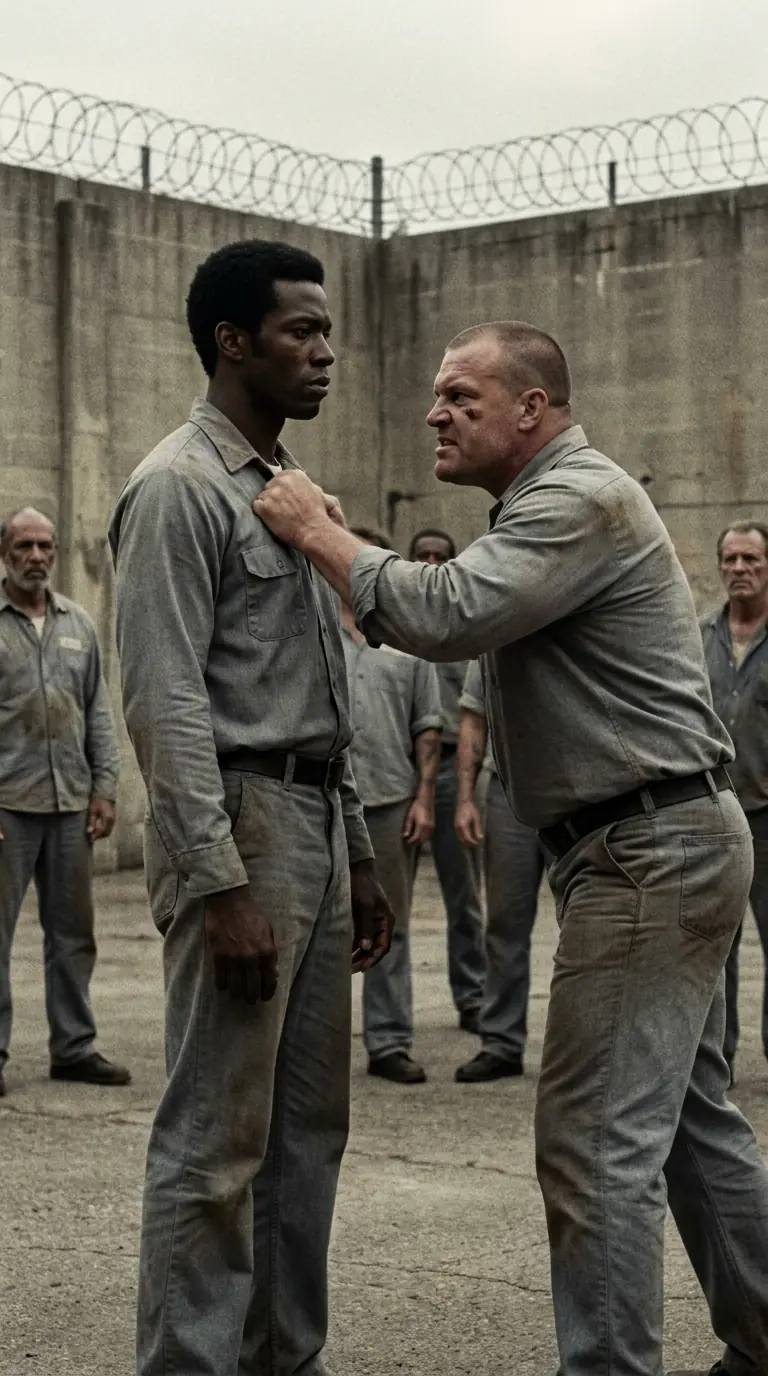
The treatments cost more than he made, so he took night shifts at a warehouse off Route 9. He trained at dawn, worked till dark, sat by her bed in between. He told himself the title could wait. Titles always wait.
Mothers don't. Then came the robbery he didn't commit. A gas station two blocks from his gym got hit at midnight. The clerk described a tall black man with a fighter's build.
Blake was tall. Blake was black. Blake had a fighter's build. The security tape was grainy.
The lineup was rushed. And the public defender had 40 other cases that month. The jury took two hours. The judge gave him six years.
He never raised his voice. Not at the verdict. Not at his mother's face in the gallery. He just looked at his hands.
The ones that had ended fights in seconds. And made himself a promise. In here, those hands stayed down. One swing, even a fair one, could add years.
He would not give them that. He would do his time and go home to her. That was the plan. Wade Hartley was the problem.
Hartley ran Block C like a small kingdom. 6 ft 4, 240 lb, with a neck like a fire hydrant, and a laugh that made new men flinch. He had been inside 11 years for putting a man in a coma over a card game. He liked new arrivals.
He called them tribute. He took their commissary, their phone minutes, their dignity. And when they had nothing left, he took their fear and kept it like a pet. What made Hartley untouchable wasn't his size.
When a camera might catch something, Pruitt remembered it needed cleaning. They never spoke of an arrangement. They didn't have to. A nod here, a blind eye there.
Hartley kept the block quiet, and Pruitt wrote reports that said all was well. So, when Hartley slapped the new man in the yard, he expected the usual. A flinch, a stammer, a tribute paid. He did not know what he had touched.
He did not know that the quiet man's hands had been insured for more than Pruitt earned in a decade. He did not know about the 18 wins, the 14 knockouts, the reflexes drilled so deep they fired before thought. He saw a slim black man with downcast eyes and read weakness. The whole block read weakness.
They were all looking at the wrong thing. They watched Blake's lowered head and missed the stillness underneath it. The kind of calm that isn't surrender. It's a fighter pacing himself.
It's a man counting rounds. Blake lay on his bunk that first week and listened to Hartley's laugh roll down the tier. He thought of his mother's voice on the phone, thinner each call. He thought of the promise.
Keep the hands down. Go home. He didn't know the promise was about to cost him everything. The chow hall ran on rules nobody wrote down.
Where you sat, who you looked at, how long you held a stare. Blake learned them by watching. He took a corner seat, back to the wall, tray in front of him. Gray meatloaf, two slices of bread, a carton of milk he was saving for the calcium.
He almost made it through the meal. Hartley crossed the room slow with two men trailing him like shadows. The hall noticed before Blake did. Forks went still.
Conversations dropped to nothing. By the time the shadow fell across his tray, Blake already knew. "You're in my seat," Hartley said. There were 40 empty seats.
Blake started to rise. He didn't argue. He just reached for his tray to move. Hartley got there first.
One thick hand flipped it. The tray spun and meatloaf, bread, and milk hit Blake square in the chest, then slid down to the floor. The carton burst. White ran down his gray shirt like something split open.
The hall laughed. Not all of them, but enough. Enough that the laughter became its own wall, and Blake stood inside it dripping, alone. "Clean it up," Hartley said.
"You made a mess." Blake looked at him. Just looked. And in that half second, something flickered behind his eyes, fast as a counter punch, then gone. He knelt.
He gathered the bread. He wiped the milk from the floor with a napkin that fell apart in his hand. He did it without a word, the way a man does a thing he has decided to survive. Hartley watched, grinning, feeding on it.
"Good boy." The injustice of it sat in the room like smoke. 200 men and not one stood. Not one said a word. Because every one of them had done the math, and the math always came back to the same answer.
Crossing Hartley cost too much. Blake carried the ruined tray to the bin. His hands did not shake. And by the door, leaning against the frame with his arms folded, Officer Dale Pruitt watched the whole thing.
When Hartley glanced his way, Pruitt did the smallest thing imaginable. He nodded. The slap had been a test. The tray had been a message.
What came next was a campaign. Hartley understood power the way some men understand weather. You don't take it all at once. You take it slow, in pieces, until the other man forgets he ever owned anything.
So he started small, and he made it last. Night one, Blake came back to his cell and found his mattress on the floor, his sheets gone, his family photos slid under the bars and stamped with a boot print. His mother's face stared up at him through a gray smear of dirt. He picked it up.
He wiped it clean with his thumb. He said nothing. Night two, his commissary vanished. The soap, the stamps, the instant coffee he bought with money he didn't have.
He found the empty wrappers on his pillow arranged in a neat little row, a signature. Night three, they came for the letters. Blake wrote his mother every day. He waited on her replies the way a drowning man waits on air.
Hartley learned this because Hartley learned everything. And he made sure the letters stopped arriving. They piled up somewhere they shouldn't and Blake sat through mail call with an open face that slowly closed. Here is what Hartley saw from the inside of his own head.
He saw a man breaking on schedule. He'd done this dozens of times. There was a rhythm to it, a music, and Blake was dancing to it just like the rest. The lowered eyes, the flat voice, the way he flinched at nothing.
To Hartley, silence had only ever meant one thing. Fear. And fear was the sweetest thing the block had to offer. He lay on his bunk at night replaying the sound the tray made, the white milk running down.
And he smiled at the ceiling. This one would break beautiful. They always did. He was reading the wrong man.
Because what looked like fear was something else entirely. It was discipline. It was 18 fights worth of a corner man's voice in his ear. Stay calm.
Don't load up. Wait for the round. Blake wasn't shrinking. He was holding a line, and the line was a promise to a woman in a hospital bed.
And every night Hartley pushed, the line bent and did not break. By night four, the others joined in because cruelty is easier in a crowd. Hartley had a crew, four or five men who fed off his scraps and feared his moods. They took turns.
One bumped Blake hard in the shower line, daring him to turn. One spat in his food. One stood outside his cell at lights out and described in a low and patient voice all the things that happened to men who think they're better than this place. Blake took it.
He took it the way stone takes rain, and Pruitt watched it happen. When he watched it all, there was a camera at the end of C Block tier, mounted high in a steel cage. It saw everything. It should have, but Pruitt knew the schedule of that camera better than the warden did.
He knew when maintenance logged it down. He knew the angle of the blind spot near the showers, the one place the lens couldn't reach. And on the nights Hartley worked, Pruitt found paperwork that needed doing at the far desk, his back to the tier, his radio turned low. Once, a younger guard asked him about it.
"You see what's happening to the new guy in C?" Pruitt didn't look up. "I see a quiet block," he said. "Quiet block's a good block. Don't go making it loud." The younger guard went quiet, too.
That was how it spread. Then, on night five, the phone call came. Blake got four minutes on the tier phone. His aunt's voice came through small and tight, and he knew before she said it his mother had taken a turn.
The treatment wasn't holding. The doctors were using words like comfort and time, words that meant the end was moving closer while he stood behind three fences, unable to reach her. "She asks about you," his aunt said, "every day. She wants to know you're okay." Blake closed his eyes.
Down the tier, Hartley's laugh rolled toward him like a wave. "Tell her I'm okay," Blake said. His voice didn't shake. "Tell her I'm coming home." He hung up.
He stood with his forehead against the cold cinder block and breathed in for four counts, out for four, the way his trainer taught him to do between rounds when his body wanted to quit. One swing. That was all it would take to feel better for one second and lose everything that mattered. More years, more fences, his mother dying alone while he sat in a hole for teaching Wade Hartley a lesson nobody would believe he had the right to teach.
So, he kept the hands down. Hartley found him there against the wall and mistook the posture for defeat. This was, in his mind, the moment, the break. He stepped close and put his mouth near Blake's ear.
"You're learning," he murmured. "Couple more weeks, you'll be carrying my tray, maybe shining my shoes." He patted Blake's cheek twice, soft, the worst kind of soft. "Quiet boys make good pets." In his head, Hartley was already counting the victory. He pictured Blake a month from now, hollowed out, useful, broken in like a pair of boots.
He had never once considered the other possibility, that a man can be quiet because he is kind, that a man can be still because he is strong, that the difference between those two things, fear and control, is invisible right up until the second it isn't. Blake didn't move. He let Hartley walk away laughing. But that night, lying on a mattress on the floor, he did something he hadn't done since the day they read his sentence.
He flexed his right hand in the dark, slow, finger by finger, feeling the old machinery wake. Just checking. Just in case. Two cells down, the camera blinked its red light at an empty wall.
The library was the one quiet place in Ironwood. Hartley didn't read. Blake went for the silence. He found an old man already there, gray-bearded, half glasses low on his nose, a chess book open in front of him.
The man watched Blake sit. He watched the way Blake set his hands flat on the table, and he smiled. "I know those hands," he said. Blake looked up.
"Walter Hayes. I trained fighters for 30 years before this place." He tapped the table. "Saw you take the state title. Round nine.
You dropped Doyle with a check hook nobody saw coming." He chuckled. "I saw it. I've been watching you walk this block like a man holding his breath. "I'm not here to fight," Blake said quietly.
"I know that, too." Walter leaned in. "That's why they think you're weak. Out there, that restraint made you a champion. In here, it's getting you killed, slow." He paused.
"What's your plan?" Blake was silent a long moment. "Keep my head down. Do my time. Get home to my mother." "And if they don't let you?" Blake's jaw tightened.
He didn't answer. He didn't have to. Walter nodded slowly, the way a cornerman nods when the bell is close. ""Then you don't start it," he said.
"But, son, you finish it." Outside, the count whistle blew. It happened on the seventh night. Blake should have seen it in the small things. The crew went quiet at dinner.
Hartley didn't take his food. He just watched Blake across the hall with the patient look of a man who has set a trap and only has to wait. And near the end of the tier, when the lights dimmed for the night count, Officer Dale Pruitt walked his slow walk toward the far desk, sat down, and turned his back to C block. The shower room was the blind spot.
Everyone knew it. The camera at the end of the tier could not reach inside that tiled corner. No lens, no witness, just water and concrete, and whatever a man could do there in the dark. Blake went to wash before lockdown.
He heard the door swing shut behind him. He heard the bolt. He turned. And there they were.
Four of them. Hartley in front, two of his crew flanking, a fourth by the door. The fourth man had something in his hand, low, half hidden. Blake's eyes went to it on instinct, the way a fighter clocks a threat, and he saw it was a phone.
Recording. They wanted this filmed, a trophy, a lesson for the whole block to pass around. "No more pets," Hartley said. He cracked his knuckles.
"Time you learned what happens to quiet boys who don't break." "You don't want to do this," Blake said. His voice was even. "Open the door. Walk out.
Nobody has to get hurt." Hartley laughed. They all laughed. It was the last easy breath any of them would take. The first man came from the right, swinging wild, a haymaker telegraphed from a mile off.
To everyone watching the video later, it looked like the man simply fell. To Blake, time slowed the way it always had, the way it had since he was 16 and first stepped through the ropes. The punch came in slow, a lazy arc, and Blake slipped it by an inch. He didn't even step back.
He just moved his head, let the fist pass his ear, and answered with one short left hook to the body. The man folded around it like a coat off a hook and dropped to the wet floor, gasping. Done. 1 second.
The second man lunged before the first had landed, grabbing for Blake's collar. Blake caught the wrist, turned his hips, and used the man's own weight to spin him into the tile. A short right uppercut met him on the way in. There was a sound, a sharp, clean crack, and the second man sat down hard against the wall and stayed there, eyes swimming.
3 seconds. Hartley roared and charged, all 240 lb of him, arms wide to crush. This was the moment he built for 11 years, the bull rush that had ended a dozen men. Blake didn't meet it.
He pivoted, light on his feet, and let the giant stumble past into empty air. As Hartley turned, off balance, Blake stepped in and threw the punch the old man in the library had named, the check hook. Short, tight, perfect, landing flush on the jaw with the full turn of his body behind it. Hartley's knees vanished.
The big man went down like a building, slow at the top, fast at the bottom, and hit the floor so hard the water jumped. 7 seconds. The fourth man, the one with the phone, stopped recording his trophy and started recording his own retreat. He backed into the corner, hand shaking, camera still pointed because he'd forgotten how to lower it.
"I'm out." He stammered. "I'm out, man. I'm out." Blake looked at him. He was breathing hard, but his hands were already lowering.
He hadn't chased a single one of them. He hadn't thrown a punch that wasn't answering one. Every blow had been the smallest thing required to stop the next, and not one thing more. "Then go." Blake said.
12 seconds start to finish. Four men on the floor, one man standing untouched, his chest rising and falling, water running off his fists. And here is the part the whole world would replay in slow motion. Blake didn't gloat.
He didn't stand over Hartley. He didn't say a word of victory. He walked to the second man, the one against the wall with the swimming eyes, knelt, and checked that he was breathing. Then he stood, turned off the still running shower, and walked to the bolted door.
He worked it open with steady hands and stepped out into the tier, leaving the four of them groaning behind him in the dark. He thought it was over. It was only beginning. Because the fourth man's phone had caught all 12 seconds.
Every slip, every counter, the check hook that dropped the giant, and then the thing that made it impossible to look away. The winner kneeling to check on the man who'd come to hurt him. The video left Ironwood the next morning, smuggled out the way everything leaves a prison, hand to hand, and by nightfall, it was somewhere it could never be put back. The internet did what the internet does.
It exploded. By the third day, the clip had a name. People called it 12 seconds. It ran on phones and subway cars and break rooms and living rooms across the country.
Commentators broke it down frame by frame. A retired trainer pointed at the screen and said, "That's not a brawler. That's a schooled fighter. Look at the footwork." Strangers argued in comment threads that ran 100,000 deep.
Who was he? Why was a man who moved like that locked in a place like that? And why, when he could have done so much worse, did he stop? The instant the danger stopped, the question spread faster than the fight.
People who had never heard the name Blake Foster were typing it now, sharing it, asking each other to find out who he was. A reporter two states away saved the clip and started making calls. Inside Ironwood, none of that was the story yet. Inside, there was only the sound that came next.
Blake had been back on his bunk for less than an hour, his knuckles aching, his mind already turning to the cost of what he'd done when the night cracked open. Boots in the corridor, a lot of them. The metal shriek of the block alarm winding up, red lights strobing across the ceiling, and a voice over the speaker, hard and flat. "Lockdown.
Lockdown. All units." Cell doors began slamming shut down the tier, one after another, closer and closer. Blake sat up. Through the bars, he saw Pruitt walking fast now, no longer at his far desk, his face white and furious, a radio pressed to his mouth.
And Blake understood, in the cold way you understand a punch already thrown, that the men on the floor were going to have their version first. The story they told was simple, and the lie usually is. By morning, the official version had hardened into fact. Inmate Blake Foster, unprovoked, had ambushed four men in the C block showers.
He was dangerous. He was trained. He had concealed a violent history and exploded without warning. Four inmates were in the infirmary, one with a fractured jaw, and the prison had a duty to act.
It didn't matter that the math made no sense. One man, four attackers, a bolted door, a blind spot chosen on purpose. Nobody in the warden's office asked why four men would corner one in the only room without a camera. They had their paperwork, and the paperwork came from Officer Dale Pruitt, who wrote that he had heard a disturbance, responded, and found Foster standing over the victims.
Victims. That was the word they used. Hartley played it from a hospital bed, wired jaw and all. When the internal review came to take a statement, he could barely speak, which made him look even more like prey.
He scrawled his account on a notepad in a shaking hand. He came at us. We tried to stop him. He's an animal.
He underlined animal twice. Warden Garrett Cole read the report and made his decision in under four. Cole was a man who hated two things above all else, paperwork and attention. The video had given him a flood of both.
The quickest way to make it stop, he believed, was to bury the man at the center of it. He signed the order before lunch. Blake was pulled from his cell and taken to the special housing unit, solitary. A concrete box the size of a parking space with a steel door, a slot for food, and a window the width of a hand.
23 hours a day inside, 1 hour, if he was lucky, in a cage that passed for a yard. They told him it was for his own protection. They told him it was pending investigation. They did not tell him how long.
He sat on the bunk and held his own silence in both hands. He thought of his mother, somewhere out past the fences, asking after a son who had just vanished from every phone and every visiting list. He thought of the promise he'd made and kept for 9 days and broken in 12 seconds. And he could not even tell himself he'd been wrong.
He'd had no choice. But the truth never seemed to matter in here. The truth had a fractured jaw and a notepad. And the truth was winning.
Outside the walls, the same fight was tearing the country in half. The video had made Blake famous, but fame is a coin with two faces. For every voice that called him a hero, another called him exactly what Hartley had written. They didn't know him.
They saw 12 seconds and a prison uniform and decided the uniform was the whole story. He was an inmate. He'd put four men in the hospital. Somebody dug up the robbery conviction and posted it without the word alleged, without the grainy tape or the rushed lineup.
Just the headline, "Viral hero is convicted armed robber." The thread turned overnight. People who had cheered now wrote that they'd been fooled. The prison said nothing to correct any of it. Silence served them.
Let the man be a monster in the public eye and no one would ask hard questions about a blind spot in the showers. It might have ended there. A man erased in a concrete box while the world moved on to the next clip. Except the video had reached one more person.
Eleanor Brooks had spent 20 years suing prisons. She ran a small legal aid office with bad coffee and a wall of case files. And she had a particular allergy to official stories that arrived too clean. She watched 12 seconds the way she watched everything, twice.
Slow. The second time with the sound off. And what she saw was not what the headlines saw. She saw a man who never advanced.
She saw counters, not attacks. She saw four aggressors and one defender. And she saw the defender stop the instant he could, kneel, and check a fallen man's breathing. You did not, in Eleanor Brooks's long experience, get that footage from an ambush.
You got it from a man trying very hard not to kill anyone. She drove 4 hours to Ironwood and demanded to see him. They put her in a visiting booth with scratched glass. And when they brought Blake in, thinner than the video, eyes hollowed from the box, she introduced herself in one sentence.
"My name is Eleanor Brooks. I think you're being railroaded and I'd like to prove it." Blake studied her through the glass. He had learned not to hope. "They have four witnesses," he said.
"And a guard's report. And my record. I have a phone video that already made me the villain." "You have a phone video," Brooks said, "that I can read better than they can." She opened her folder. "Tell me everything.
Start with night one." So he did. The mattress on the floor, the boot print on his mother's photo, the letters that never came, the seven nights, the bolted door, and the one detail that made Eleanor Brooks stop writing and look up. "He recorded it himself," she said slowly. "Hartley wanted it filmed.
To humiliate me. To document an execution," she said. "And he documented the opposite." She tapped her pen against her teeth, thinking. "But it's still his word against yours on how it started.
A jury hears convicted felon attacks four men. They fill in the blanks the easy way." She frowned. "I need more than the phone. I need the room.
I need the seven nights before it. I need to show a pattern." "There are no cameras in the showers," Blake said. "That's why they chose it." "No," Brooks agreed, "but there are cameras everywhere else." She started flipping pages faster now. "The tier, the mess hall, the corridor outside your cell.
Seven nights of harassment doesn't leave one piece of footage, it leaves dozens." "Mattress on the floor? That's a corridor cam. Commissary stolen? Tier cam.
Every time one of them came to your cell at lights out..." She looked up, and something sharpened in her face. "Mr. Foster, where I come from, when an institution chooses a blind spot this carefully, it isn't because they only have one camera. It's because they know exactly what all the others would show." She filed the request that afternoon, a formal demand for every minute of footage from C block for the relevant nights.
Three days later, the prison's response landed on her desk. She read it once and went very still. The footage from the C block tier camera for all seven nights was missing. Logged as down for maintenance.
Every night Hartley worked, the lens had been dark. Someone had turned it off. A camera turned off on purpose is not the end of a case. To Eleanor Brooks, it was the beginning of one.
Because a missing tape isn't innocence. It's a confession with the words scratched out. She took the maintenance log to a hearing and stood in front of a review panel, the warden and a state corrections official who had flown in because the video would not stop trending. Garrett Cole had wanted this quiet.
Instead, he had a lawyer with a folder and the whole country watching the door. Brooks began gently. She laid out the official story first in their own words so everyone could hear how clean it was. "Unprovoked.
Ambush. Animal." Then she set the maintenance log on the table. The C-block tier camera, she said, "failed for seven consecutive nights. The exact seven nights my client says he was harassed.
It recovered the morning after the shower incident. Seven nights dark, then suddenly working again." She looked at Cole. "That's either the most precise equipment failure in the history of corrections or someone scheduled it." Cole's jaw worked. "Equipment fails.
It does." Brooks agreed pleasantly, "which is why 8 months ago your facility installed a pilot program. Secondary cameras. Smaller units, separate system, separate drive, mounted to cover the blind spots the old ones missed." She let that sit. Including the corridor outside the C-block showers.
The room changed temperature. Pruitt, standing against the wall, went still in a way that everyone noticed. Because Pruitt had known the old camera schedule by heart. He had not known about the new one.
Nobody on the floor had. It was a memo he'd never read. A second eye he'd never accounted for. Recording quietly while he turned his back at the far desk.
Brooks opened her laptop. She did not play the fight. She played the seven nights. Night one, a grainy corridor feed time stamped.
Three men outside Blake's cell. The mattress dragged out. A boot coming down on something small and square. Night three, Hartley's crew laughing at the mail slot.
Night five, Blake against the cinder block wall with the phone to his ear and Hartley leaning in to pat his cheek twice. Soft. And the seventh night, the corridor outside the showers, four men filing in, Hartley last, throwing the bolt behind him. The timestamp read 9:14 p.m.
"My client," Brooks said quietly, "entered that room at 9:13. Four men followed and locked the door from inside. You will notice no one is dragging anyone. You will notice who turned the lock." She closed the laptop.
"That is not an ambush by one man. That is an ambush of one man." The corrections official was writing fast now. Cole had stopped pretending to be calm, but Brooks wasn't finished. Because the panel still had the easy thought waiting in the back of their minds, the one the headlines had planted.
Convicted felon. Trained fighter. Even cornered, didn't he do too much? Four men in the infirmary, one with a shattered jaw.
Wasn't that the act of someone dangerous? So, Eleanor Brooks reached into her folder and pulled out the thing she had been saving. "You keep calling my client trained," she said. "Let me tell you how trained." She slid a sheet across the table.
"Blake Foster, 18 professional fights, 18 wins, 14 knockouts, state lightweight champion, ranked before his arrest in the national top 15." She let the panel read it. "This is not a man who learned to brawl in a yard. This is a professional athlete whose hands are quite literally registered weapons. Cole frowned.
"You're proving our point. He's dangerous." "I'm proving the opposite," Brooks said, "and in about ten seconds you'll see why." She played the fight then. Once at full speed. Then again, slowed down, frame by frame.
The way the whole internet had already watched it a hundred million times. A fighter at his level, she said, narrating over the slow motion, throws a punch that generates enough force to end a life. He knows it. It's the first thing they teach you.
So, watch what he does with four men trying to hurt him in a locked room with every legal and moral right to defend himself by any means. She pointed. First man. A body shot.
Not the head. The body. Drops him. Doesn't damage him.
Second man. He uses the man's own momentum. Redirects him into the wall. One short counter.
Third man, Mr. Hartley. She froze the frame on the check hook. One punch, clean.
He could have followed up. A man on the floor is a man you can finish. He doesn't. He steps back.
She advanced footage to the final seconds. Blake, untouched, kneeling beside the second man, checking his breathing. "There it is," Brooks said softly. The most dangerous man in the room on his knees, making sure the person who came to hurt him is still breathing.
She looked at each panel member in turn. A man who wanted to hurt them could have crippled four people in 12 seconds. He had the skill. He had the right.
Instead, he used the exact minimum force to survive. And then, he rendered aid. "That is not the record of an animal. That is the most disciplined self-defense any of you will ever see on a screen." For a moment, the room was silent.
The kind of silence Blake knew well. The kind that falls right before a decision. The corrections official turned to Pruitt. "Officer, the pilot cameras, were you aware of them?" Pruitt opened his mouth, closed it.
The pause was its own answer, and everyone heard it. "Where were you," the official continued, "the night of the incident, during the disturbance?" "At my desk," Pruitt said, "doing reports." "With your back to the tier," Brooks added. We have that on camera, too. It came apart quickly after that, the way these things do once the first thread pulls.
The fractured jaw victim statement collapsed against the footage of a man throwing a bolt. The witness accounts, all from Hartley's crew, turned to smoke. And one inmate, who had stayed silent out of fear, an older man named Walter Hayes, stepped forward now that there was finally something to step toward, and told the panel about seven nights of cruelty he'd watched, and could not stop. Blake sat through all of it without moving.
He had learned in the box not to hope. But when the corrections official set down her pen and said the words, pending immediate review of Officer Pruitt's conduct and the conditions in C block, something in his chest loosened for the first time in weeks. He thought of his mother. He thought for the first time that he might actually make it home in time.
Eleanor Brooks gathered her folder, leaned toward the glass partition, and said the only thing that mattered. "They built their whole case," she told him, "on a camera they thought was off." She almost smiled. "They forgot the one watching them." Justice, when it finally moved, moved fast. The footage from the pilot cameras went to the state corrections board, then to the district attorney, then, inevitably, to the press that had been camped outside Ironwood for 2 weeks.
The official story did not survive contact with the truth. Seven nights of corridor footage do not lie. And a locked shower door does not lie. And a man kneeling to check his attacker's breathing does not lie.
Wade Hartley was charged with felony assault, four counts, for the ambush he had filmed himself. His own trophy became the case against him. The wired jaw he had used for sympathy turned out to be the least of his problems. He was already serving time for the coma he'd put a man in years before.
Now the parole he'd been counting on vanished, and the court added 8 years to a sentence he'd thought was nearly done. The king of C block walked out of the hearing in cuffs to a silence from the other inmates that was louder than any cheer. Officer Dale Pruitt did not go quietly, but he went. The investigation into the missing tier footage found exactly what Eleanor Brooks had promised it would.
A pattern of arranged blind spots, ignored complaints, and reports written to protect the man who kept his block quiet. Pruitt was stripped of his badge and charged with falsifying records and willful neglect. The nod he had given Hartley across a chow hall, the smallest thing imaginable, had become the thing that ended his career. Warden Garrett Cole resigned before they could remove him.
The man who hated attention left under the brightest lights of his life, trailed by cameras down the same steps he'd hoped to keep clear. A state monitor was assigned to Ironwood. The pilot camera program, the one accident that had saved an innocent man, was made permanent and expanded to every block. And then there was the conviction that had put Blake inside in the first place.
Eleanor Brooks did not stop at the prison case. She took the robbery conviction apart the way she took everything apart, slowly, in daylight. The grainy tape, the rushed lineup, the 40-case public defender who'd barely read the file. She found the gas station's original footage, the full version, and a clerk who, shown a clear photo at last, said the words that should have been said 3 years earlier.
That's not him. That man was heavier, older. That's not the man. The court vacated Blake Foster's conviction on a Tuesday morning.
Wrongful imprisonment. Immediate release. He walked out of Ironwood through the same three gates that had swallowed him, into a parking lot full of people he didn't know, who had followed 12 seconds of his life all the way to this moment. They were quiet as he passed, the way crowds go quiet around something they sense is bigger than a photo.
He didn't raise a fist. He didn't make a speech. He just kept walking toward the one car that mattered. His aunt was driving.
The passenger seat was empty, reclined, with a blanket folded on it. "She wanted to come," his aunt said, her voice breaking. "She made us bring her this far. She's at the hospital, Blake.
She's holding on. She's been holding on for this. He made it in time." That was the part that mattered, more than the eight years, more than the badges and the resignations and the cameras. He walked into a hospital room that smelled of antiseptic and got down beside a bed where a small woman lay.
And she opened her eyes and saw her son, free, whole, home. She lifted one thin hand to his face, to the cheek that had been slapped in a prison yard a lifetime ago, and she held it there. "I knew," she whispered. "I always knew." He stayed.
The story did not end in that room, though. It had already grown past him. 12 seconds had become something larger than a fight, a question the whole country kept asking out loud. How many quiet men are sitting in blind spots right now?
How many true stories are buried under clean reports? Lawmakers cited the case. A reform bill carried provisions for mandatory camera coverage and independent complaint review. And people started calling it, in the papers and the hearings, the Foster Standard.
Blake Foster never asked for his name on a law. He'd only ever wanted to keep one promise. He'd kept it. He was home.
His mother lived another 14 months. Good months. She was there, in a folding chair by the door, the day Blake Foster opened the gym. It wasn't much at first.
A leased space in a rough part of town, a concrete floor, a ring he built himself from second-hand rope and donated canvas. He hung a single sign over the door. No champion's name, no logo, just two words. Second Corner.
Because everyone, he said, deserves someone in their corner the second time around. The kids came first. The ones the neighborhood had already given up on. The ones teachers called trouble and police called familiar.
Blake didn't ask about their records. He asked about their footwork. He taught them the thing he had learned the hard way in a place with no cameras. That real strength is the power you choose not to use.
"Anybody can throw a punch," he told them. "It takes a fighter to know when not to." Walter Hayes ran the morning sessions. The old trainer had made parole six months after Blake's release, and the first call he made from outside was to the gym. He stood in the corner now with his half glasses and his chess book, barking at teenagers about keeping their hands up.
And he looked, for the first time in 30 years, like a man exactly where he belonged. Then came the others. Men fresh out of prison, blinking in the daylight, carrying records and reputations and nowhere to go. Blake gave them mops and gloves and a reason to show up.
Some of them had been inside places like Ironwood. A few had been Hartleys once and were trying not to be anymore. Blake didn't turn them away. He'd learned that the line between the man on the floor and the man standing over him is thinner than anyone wants to believe.
And that mercy given once tends to come back around. Eleanor Brooks visited sometimes between cases. The Foster standard had passed into law in two states by then and she carried a folder as always full of other quiet men in other blind spots who needed someone to read the footage better than the people who'd buried it. She never ran out of folders.
But she said the gym was the only courtroom she'd ever seen where everybody won. Blake still trained early, alone before the kids arrived. He'd wrap his hands the old way, slow, knuckle by knuckle and hit the heavy bag in the gray light and remember a yard, a slap, a promise. He had walked into that prison a champion nobody knew.
He walked out a man everybody did. And he had decided somewhere in a concrete box that if his name was going to mean anything, it would mean this. A second corner for anyone the world had counted out.