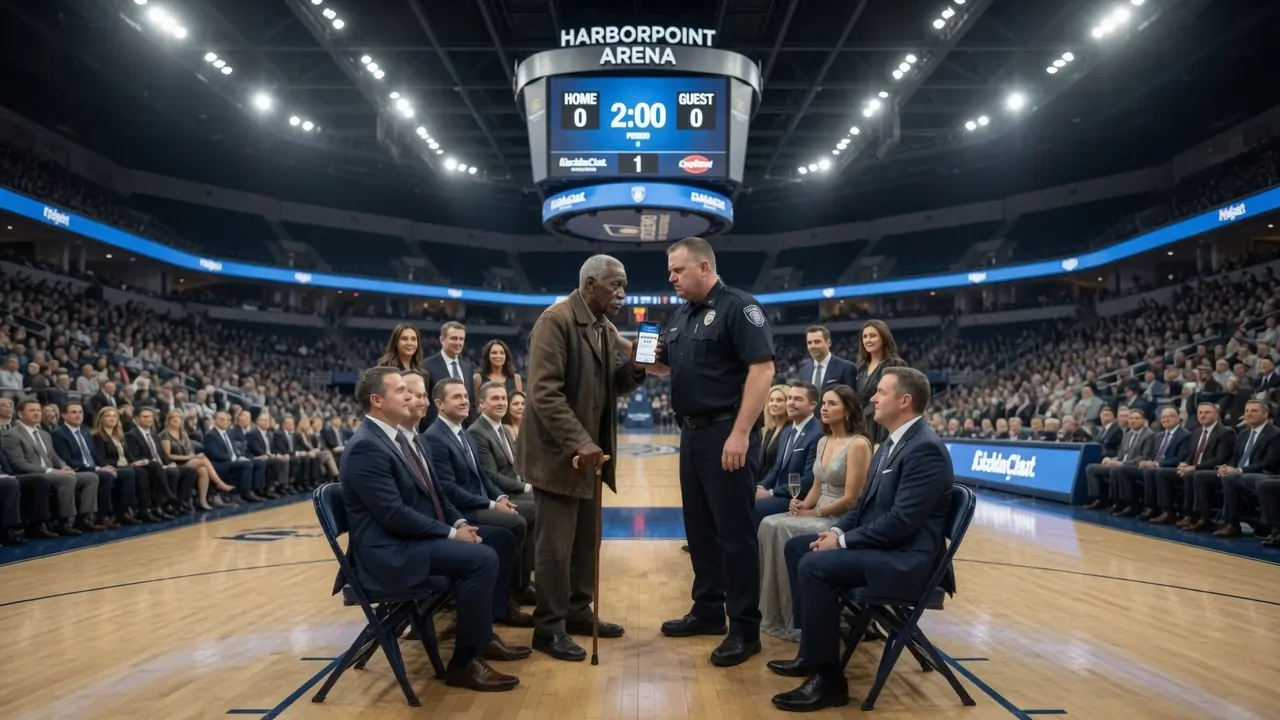
“You are in the wrong section, old man.”
The security guard said it loudly enough for three rows of courtside guests to turn.
His hand was already on the old Black man’s shoulder.
Not hovering.
Not asking.
Touching.
As if the decision had already been made before the old man had a chance to speak.
Elias Monroe looked down at the hand on his worn brown coat, then slowly lifted his eyes to the guard’s face.
He did not look angry.
That made the moment worse.
Angry men could be dismissed as disruptive. Humiliated men could be escorted out as proof of the guard’s authority. But Elias simply looked tired, dignified, and unsurprised, as if he had met this exact hand in a hundred different buildings across seventy-two years of living.
The courtside crowd around him went quiet in patches.
A woman in a silver dress paused with her champagne flute halfway to her mouth.
A man in a tailored blue suit leaned toward his friend and whispered, “How did he even get down here?”
Someone else laughed under his breath.
Elias heard it all.
He always had.
His hearing was still sharp, even if his knees complained on cold nights and his right hand trembled when he held a coffee cup too long.
He was seventy-two years old, Black, tall once but now slightly stooped, with silver hair cut close to his scalp and a narrow gray mustache that made his face look sterner than he intended. His coat was old but brushed clean. His shoes were polished, though the leather had cracked along the creases. In his left hand, he carried a wooden cane with a brass handle worn smooth by decades of use.
The cane was the first thing people noticed.
Then the coat.
Then his age.
Then his skin.
By then, most of them had stopped looking for anything else.
The guard’s badge read: Grant Holcomb.
Grant was white, broad-shouldered, in his early forties, with the stiff posture of a man who mistook suspicion for discipline. He stood over Elias as if the arena itself had deputized him to protect wealth from the embarrassment of proximity.
“This is courtside,” Grant said. “These seats start at fifteen thousand a game.”
Elias glanced at the court.
The Harbor City Titans were warming up under the lights. The ball snapped against the hardwood. Sneakers squeaked. The giant scoreboard above center court glowed blue and silver.
“I know where I am,” Elias said.
His voice was calm.
Low.
Southern around the edges.
That made Grant’s mouth tighten.
“You have a ticket?”
Elias lifted his phone.
“I showed it at the tunnel.”
“Show it again.”
A young white man two seats down snorted.
“Probably screenshotted it from somebody.”
Elias did not look at him.
He opened the ticket.
Section A.
Row One.
Seat Three.
Courtside Club.
Owner’s Lounge Access.
Premium Tunnel Entry.
The ticket could not have been clearer.
Grant barely looked at it.
“Where did you get this?”
Elias finally turned his head fully toward him.
“From the arena.”
“From who at the arena?”
“The system.”
Grant smirked.
“The system?”
“Yes.”
“Old man, these seats are usually owned by people.”
“I am people.”
A ripple of laughter moved behind them.
Not loud.
Worse.
Comfortable.
Elias felt the old familiar separation happen.
There was him, standing in his worn coat beside a seat he had paid for.
And there was the room, deciding together that his dignity was optional.
Grant reached for the phone.
Elias did not hand it over.
“The scanner already cleared it,” Elias said.
“I am asking for it.”
“You can scan it without taking it from my hand.”
Grant’s expression hardened.
“Are you refusing arena security?”
“I am refusing to surrender my property when my ticket has already been validated.”
Grant leaned closer.
“People who belong here do not make this difficult.”
The words moved through Elias like a cold wind.
People who belong here.
He had heard versions of that sentence when he was nine and tried to enter the front door of a library. When he was twenty-six and showed up at a construction site as the lead structural engineer and was sent to the labor line. When he was forty-three and stood in a bank lobby asking why his loan application had been “misplaced” three times. When he was sixty-eight and a hotel receptionist asked whether he was waiting for the shuttle drivers.
He looked at Grant.
“Son, people who belong here built this place.”
Grant gave a short laugh.
“Sure they did.”
Elias felt something inside him settle.
Not break.
Settle.
Like a beam finding its load.
He had not come to HarborPoint Arena that night to create a scene.
He had come to watch.
That was what he had been doing for eighteen months.
Watching.
Documenting.
Testing the building he owned.
Not the basketball team. Not exactly. He owned forty-nine percent of the Harbor City Titans through a private investment group, but what mattered more to him was the building: HarborPoint Arena, the glass and steel palace that sat at the edge of downtown like a monument to money, sport, and civic pride.
Most people knew the arena belonged to HarborPoint Entertainment Partners.
Almost no one knew Elias Monroe controlled HarborPoint Entertainment Partners.
He liked it that way.
At his age, privacy had become more valuable than applause.
Besides, ownership was most honest when no one knew the owner was in the room.
For a year and a half, Elias had been entering his own arena under different names, different seats, different clothes. Sometimes he wore a tailored suit and no one stopped him. Sometimes he wore an old cardigan and security asked for three forms of verification. Sometimes he came with his white attorney and was waved through. Sometimes he came alone and was followed from the premium lounge to his seat.
He had watched Black fans in expensive watches get questioned while drunk white men stumbled past without tickets visible.
He had watched a young Black woman in a designer dress get asked if she was “with catering” by a host holding a tablet with her name on the VIP list.
He had watched staff apologize with vouchers, not accountability.
Elias collected it all.
Dates.
Times.
Badge numbers.
Seat locations.
Video clips.
Complaint logs.
Names.
Phrases.
Patterns.
He did not want a viral apology.
He wanted a system that could not pretend surprise.
That evening, he had chosen Seat Three in Row One deliberately.
Opening night.
Full building.
Board members present.
Sponsors present.
Cameras everywhere.
He intended to sit quietly, observe premium service, and present his findings at Monday’s board meeting with evidence too detailed to dismiss.
He did not plan to become the evidence.
Grant’s hand tightened on his shoulder.
“Stand up.”
Elias looked at the hand again.
“Remove your hand.”
“Stand up, or I will remove you.”
A white woman in pearls leaned away from Elias, as if he had brought danger with him instead of being the one under threat.
The courtside usher, a young man named Ben, stood near the tunnel and did nothing.
Elias looked at him.
Ben looked away.
That went into the old man’s mind too.
People always thought abuse required only the abuser.
It also required the watchers who decided comfort mattered more than truth.
Elias rose slowly with his cane.
The movement took effort.
Grant did not help him.
Instead, he gripped the back of Elias’s coat near the shoulder and guided him out of the row with unnecessary force.
Not enough to throw him down.
Enough to show everyone he could.
Phones came up.
Someone whispered, “Security’s pulling somebody from courtside.”
Another voice said, “Fake ticket.”
Another said, “He should’ve just left.”
Elias kept his chin level.
He had learned decades ago that humiliation became heavier when you tried to outrun it.
So he walked.
Step.
Cane.
Step.
Cane.
Grant pushed him toward the premium tunnel.
At the tunnel entrance, a guest services supervisor arrived fast, heels clicking across the concrete.
Her nameplate read: Marissa Vance.
She was white, mid-thirties, polished, efficient, and visibly irritated that a disruption had reached cameras.
“What is happening?” she asked Grant.
“Invalid courtside access,” Grant said.
Elias turned.
“That is false.”
Marissa looked at Grant first.
Then at Elias second.
That order told Elias almost everything.
“Sir,” she said, “we can resolve this away from the seating area.”
“You can resolve it here by scanning my ticket.”
“We already have a report of a ticketing concern.”
“From the man who ignored the scanner.”
Marissa’s smile hardened.
“Let’s not escalate.”
Elias looked at her.
“Escalate is an interesting word when I am the one being dragged.”
Grant’s jaw moved.
Marissa lowered her voice.
“Sir, we can offer you an excellent seat in Section 112 while we investigate.”
“My seat is courtside.”
“Section 112 is a very good section.”
“My seat is courtside.”
“You need to be reasonable.”
Elias gave a faint smile.
There it was.
The old demand.
Accept less, and we will call you cooperative.
Refuse less, and we will call you difficult.
He reached into his inside pocket and removed a small notebook. He wrote carefully despite the tremor in his hand.
7:08 p.m.
Section A tunnel.
Grant Holcomb — physical removal after valid ticket.
Marissa Vance — offered downgrade instead of verification.
Grant scoffed.
“You writing a diary?”
“No,” Elias said. “History.”
Marissa’s eyes flickered to the notebook.
For the first time, uncertainty crossed her face.
Not enough to change her conduct.
Enough to understand the old man might be less harmless than he looked.
“Sir, if you refuse to comply, we may have to escort you out of the arena.”
Elias closed the notebook.
“Then you should call your legal department first.”
Grant laughed.
“Legal department?”
“Yes.”
“Why?”
Elias looked him in the eye.
“Because they know my name.”
Before Grant could respond, the arena lights dimmed.
The opening video began.
Music thundered.
Fans roared.
On the massive center-hung scoreboard, flames of animated silver swept across the screen. The Titans logo spun in three dimensions. Spotlights cut through smoke machines at court level.
Elias looked up.
And froze.
Not because of the video.
Because of the movement.
The scoreboard, weighing nearly forty tons with its frame, lighting rig, camera mounts, and speaker cluster, hung from a tension system Elias had redesigned five years earlier after acquiring the arena. It was built to tolerate vibration, crowd movement, speaker pressure, and minor seismic shifts.
It was not built to sway like that.
Most people would not have noticed.
They saw light and spectacle.
Elias saw angle.
Load.
Rhythm.
Failure.
The giant board shifted three inches, maybe four, then settled. A vibration traveled through one of the east-side suspension cables. A small tremor in the rigging.
Wrong frequency.
Wrong movement.
His mind sharpened instantly.
The old engineer returned before the old owner did.
He stepped toward the court.
Grant blocked him.
“Where do you think you’re going?”
Elias pointed upward.
“That scoreboard is moving wrong.”
Marissa looked up briefly, then back at him.
“It is part of the show.”
“No. The show is screen motion. The rig is moving.”
Grant shook his head.
“Now he’s an engineer too.”
Elias ignored him.
“Call building operations. Tell them to check the east primary tension line and lock the center-hung rig.”
Marissa stared at him.
“Sir, you need to stop making claims.”
A deep bass note shook the arena as the video reached its climax.
The scoreboard swayed again.
This time Elias heard it.
A metallic groan beneath the music.
Low.
Short.
Almost swallowed by the crowd.
But there.
His blood went cold.
He had heard that sound once before in 1979, on a job site in Atlanta, ten seconds before a temporary steel platform came down and killed two men.
He grabbed Marissa’s arm, not hard, just enough to force attention.
“Listen to me. If you do not call operations now, people may die.”
Grant stepped between them.
“Do not touch staff.”
Elias’s eyes flashed.
“Then do your job.”
Grant shoved him backward.
Not violently enough to drop him.
Enough to make the seventy-two-year-old man stumble.
His cane struck the floor and slipped.
For one terrible second, Elias almost fell.
A Black teenage boy near the tunnel reached out and caught his elbow.
“Sir, you okay?”
Elias steadied himself and looked at the boy.
“Yes. Thank you.”
The boy’s father, seated near the tunnel, glared at Grant.
“You shoved him.”
Grant pointed at him.
“Stay out of this.”
The boy’s father stood.
“I saw what you did.”
Marissa’s radio crackled.
“Premium tunnel, what is the delay?”
She lifted it.
“Guest disturbance at Section A.”
Elias stepped closer to the radio.
“Tell operations to inspect the scoreboard rig now.”
Marissa turned away from him.
“Guest refusing removal.”
That was when Elias understood the situation fully.
The building had chosen authority over evidence.
Again.
He reached into his coat pocket and pulled out a thin black card.
Not his ownership credential.
Not yet.
An emergency access card.
He had kept it from the old construction days, updated every time the building systems changed. Only five people in the arena had one. It granted override access to maintenance corridors, structural sensors, and the arena operations bridge.
He held it up.
“Open the operations channel.”
Marissa stared at the card.
Her face changed.
Not recognition.
Fear of recognition.
“Where did you get that?”
“I issued it.”
Grant gave a disgusted laugh.
“Here we go.”
The opening video ended.
The crowd exploded.
Players ran through smoke.
The scoreboard flashed brighter.
Then the east-side suspension alarm triggered.
Not the public alarm.
A private maintenance chime, heard only through operations headsets and the engineering bridge.
But Elias saw the tiny red indicator blink on a control panel inside the tunnel.
He moved.
Grant reached for him again.
This time, Elias raised the cane between them.
“Touch me again,” he said quietly, “and when this is over, it will be the least intelligent decision you ever made.”
Grant stopped.
Not because he respected Elias.
Because something in the old man’s voice finally sounded like command.
Elias turned and pushed through the tunnel toward the service corridor.
Marissa snapped, “Stop him.”
Grant grabbed Elias’s coat from behind.
The old fabric tore at the seam.
The sound was small.
But the teenage boy recorded it.
So did two other phones.
Elias looked down at the torn coat.
It had belonged to his brother, Samuel, who died before the arena was built. Elias wore it on opening nights because Samuel had loved basketball more than anyone he had ever known.
For the first time that night, anger showed on his face.
“You tore my brother’s coat,” he said.
Grant did not understand what he had done.
“Move.”
Then the arena shook.
Not dramatically.
Not enough for the crowd to panic.
But enough that a few people looked upward.
The scoreboard swayed again.
This time, more visibly.
A cameraman near the baseline lowered his camera.
One of the Titans players pointed up.
Music cut.
The court announcer faltered.
“Ladies and gentlemen, please remain—”
The sentence died when a sharp metallic crack rang through the arena.
It came from above center court.
Then a shower of tiny sparks fell from the east rigging assembly.
The crowd screamed.
Now everyone looked up.
Marissa’s face went white.
Grant let go of Elias.
Elias moved faster than anyone expected a seventy-two-year-old man with a cane to move.
He reached the service door, slapped the black card against the reader, and pushed inside.
The reader flashed green.
Grant stopped dead.
Marissa whispered, “How did that open?”
Elias did not answer.
Inside the corridor, alarms pulsed in red.
A maintenance technician ran toward him.
“Who are you?”
“Elias Monroe. East primary tension alarm. Has the lock engaged?”
The technician’s eyes widened.
“Mr. Monroe?”
“Has the lock engaged?”
“No, sir. The auto-lock failed.”
“Manual bridge?”
“Operations is trying, but the bridge console is frozen.”
Of course it was.
The software upgrade had been delayed twice. Elias had flagged it in a capital review and been told the risk was minimal.
Minimal.
That word had killed more people than panic ever had.
Elias pulled the technician toward the stairwell.
“We need the mechanical override.”
“Sir, that room is three levels up.”
“I know where it is. I built it.”
They climbed.
Elias’s knee burned by the second flight.
His lungs tightened by the third.
He kept going.
Behind him, radios erupted.
“Center rig instability.”
“Clear the court.”
“Evacuation protocol?”
“Do not start a full evacuation under the rig.”
“Where is Monroe?”
“Who?”
“Mr. Monroe is in the building.”
On the court, staff began moving players toward the tunnels. Fans in lower sections stood in confusion. Some tried to run. Ushers shouted for people to stay calm without knowing what calm required.
Grant Holcomb stood frozen at the premium tunnel, watching the old man he had dragged from courtside disappear into the service stairwell with an emergency access card.
Marissa grabbed her radio.
“Operations, confirm identity of Elias Monroe.”
Static.
Then a voice, shaken.
“Elias Monroe is the controlling owner of HarborPoint Arena.”
Marissa closed her eyes.
Grant stared at her.
“What?”
The radio continued.
“He also chaired the structural redesign after the 2019 acquisition.”
Grant’s face drained.
“What?”
“He owns the building.”
The words hit differently the second time.
Not rich.
Not VIP.
Not guest.
Owner.
The old Black man in the torn coat.
The one Grant had accused.
The one he had dragged.
The one he had nearly pushed to the floor.
The one warning them about the scoreboard.
He owned the arena.
And worse, he had been right.
In the mechanical override room above the court, Elias reached the panel breathless but steady.
A younger engineer, Priya Nandakumar, was already there, headset on, eyes wide.
“Mr. Monroe, the east tension sensor is showing load displacement. We have partial slip on Cable E-1.”
“Secondary load?”
“Taking more than designed.”
“How much?”
“Thirty-two percent above tolerance.”
Elias cursed softly.
Priya looked at him.
“We need to lower the rig.”
“No,” Elias said. “Not with the court beneath it and the secondary carrying unstable load.”
“Then lock it?”
“The auto-lock failed.”
“Manual?”
“That’s why I’m here.”
He opened the override cabinet.
Inside were four steel levers and a pressure wheel.
Old technology.
Deliberately old.
When software failed, steel had to answer.
Priya moved beside him.
“The manual lock requires two people.”
“I know.”
“You take primary?”
“My hands still remember.”
The arena below was a sea of noise.
People shouted.
The announcer told fans to remain in place and await instructions.
Security began clearing the court and the first ten rows.
The scoreboard groaned again.
Priya looked through the reinforced window at the hanging structure.
“We have maybe three minutes.”
“No,” Elias said.
He placed his hand on the pressure wheel.
“Two.”
He nodded.
“On my count. Pull E-lock halfway, not full. If you slam it, you shock the cable.”
Priya swallowed.
“Yes, sir.”
“Then transfer load to the west brace.”
“Yes, sir.”
“Then engage secondary clamp.”
“Yes, sir.”
He looked at her.
“Do not answer like a student. Answer like the engineer in this room.”
Her face changed.
“Yes, Mr. Monroe. I understand the sequence.”
“Good.”
They moved together.
Elias turned the wheel.
Pain shot through his wrist.
He ignored it.
Priya pulled the lever halfway.
The floor vibrated.
Below them, thousands of people cried out as the scoreboard dipped six inches.
“Hold,” Elias said.
Priya held.
Elias turned the wheel again.
“Now west brace.”
Priya moved to the second lever.
It resisted.
“Stuck.”
“Angle it left first.”
She did.
The lever moved.
The scoreboard steadied.
One cable above it screamed under redistributed load.
Elias knew the sound.
Metal under protest.
Not failure yet.
But close.
“Secondary clamp,” he said.
Priya grabbed the third lever.
Nothing.
“It’s jammed.”
“Again.”
She pulled.
Nothing.
Elias limped over and placed both hands above hers.
“Together.”
“I don’t want to hurt you.”
“You won’t.”
“Sir—”
“Pull.”
They pulled.
The lever snapped downward.
The mechanical clamp engaged with a deep, heavy boom that echoed through the steel above the arena.
The scoreboard stopped moving.
Not perfectly.
But enough.
Priya looked at the monitor.
“Load stabilizing.”
Elias kept his hands on the lever.
“How much?”
“Dropping. Twenty percent above tolerance. Fifteen. Twelve. Nine.”
He breathed.
For the first time in nearly four minutes, he allowed his body to remember he was old.
His knees weakened.
Priya caught his arm.
“Mr. Monroe?”
“I’m all right.”
“You are not.”
“I am alive. That is close enough for now.”
Below, the arena slowly understood that catastrophe had paused.
Not ended.
Paused.
The crowd remained standing, frightened, confused, recording everything.
Operations confirmed the rig was stabilized. The building would be cleared section by section. The game was postponed. Structural teams were called. Fire and rescue entered through the north loading bay.
Elias leaned against the wall of the override room, sweat cooling beneath his collar.
Priya looked at him with something like awe.
“You saved them.”
He shook his head.
“No. The manual system saved them. I only remembered why we kept it.”
His radio, handed to him by the technician, crackled.
“Mr. Monroe, security director requesting your location.”
Elias closed his eyes.
“Tell him I am exactly where his people tried to keep me from going.”
Nobody answered for a moment.
Then the voice said, “Yes, sir.”
The emergency board meeting began at 11:15 p.m.
Not Monday.
That night.
Elias insisted.
The owner’s conference suite overlooked the empty arena. Outside the glass, the scoreboard hung dark and motionless, locked in place by emergency clamps. Engineers in harnesses moved across catwalks like cautious spiders.
Inside the room sat everyone who suddenly wanted to call Elias Mr. Monroe.
Grant Holcomb sat near the far end of the table, pale and rigid.
Marissa Vance sat beside him, eyes red.
Security Director Paul Redding stood with a folder he had not opened.
Operations President Alan Pierce looked like a man hoping insurance language might save him.
The head of engineering, Priya Nandakumar, sat to Elias’s right at his request.
That mattered.
She had done the work.
She would be heard.
Elias sat at the head of the table with his torn coat folded beside him.
The tear was visible.
He wanted it visible.
Nobody spoke first.
So Elias did.
“I have owned this arena for five years,” he said. “Most of you know that now. A smaller number of you knew it before tonight. None of that matters as much as what happened before you knew.”
He looked at Grant.
“A valid ticket was treated as suspicious because I did not match your idea of a courtside guest.”
Grant opened his mouth.
Elias lifted one hand.
“If your first sentence is about doing your job, save it. I know what job performance looks like. I have fired richer men than you for less damaging failures.”
Grant closed his mouth.
Elias turned to Marissa.
“A supervisor offered me a downgrade instead of verification.”
Marissa looked down.
“You used polite words to make discrimination sound like customer service.”
Her eyes filled.
Elias did not soften.
“Politeness is not dignity. A velvet glove can still push someone out the door.”
He turned to Paul Redding.
“For eighteen months, I sent reports to your department about differential treatment in premium access. What did you do with them?”
Redding swallowed.
“We reviewed them internally.”
“And?”
“We found no conclusive pattern.”
Elias opened a folder.
Paper slid across the table.
“I found one.”
Nobody touched the sheets at first.
Then Priya picked one up.
Her jaw tightened as she read.
Elias continued.
“Black premium guests were subjected to secondary ticket checks at five times the rate of white guests. Black guests in courtside and club sections were more likely to be relocated, delayed, radioed about, or described as ‘agitated’ in reports after asking ordinary questions.”
He looked at Marissa.
“Your name appears on nine relocation approvals where the ticket was valid.”
Marissa’s face crumpled.
He looked at Grant.
“Your badge appears in twenty-three escalations involving Black guests in premium zones. In seventeen, the ticket scanned valid before escalation.”
Grant whispered, “I didn’t know that.”
Elias’s voice turned colder.
“Not knowing your pattern does not mean you do not have one.”
Silence filled the room.
Then Elias placed another folder on the table.
“This is the structural side.”
Alan Pierce shifted.
Elias looked at him.
“The east primary tension line showed irregular vibration during last month’s concert setup.”
Alan’s lips parted.
“I was told it was within tolerance.”
“By whom?”
Alan looked toward his papers.
Elias answered for him.
“By a contractor who requested more time and was denied because this opening game had sponsor obligations.”
Alan said nothing.
Priya looked sharply at him.
Elias continued.
“The software patch for the center-hung rig was delayed twice. The auto-lock failed tonight because the console froze during load displacement. That was not an act of God. That was deferred responsibility.”
Alan’s face went gray.
“The manual system prevented deaths tonight,” Elias said. “The same manual system I was told was outdated when I refused to approve its removal.”
He sat back.
“So here is the shape of our problem. Security ignored evidence because of bias. Operations ignored warnings because of budget and optics. Guest services tried to manage humiliation instead of correcting it. And tonight, those failures met in one hallway.”
No one moved.
Elias touched the torn coat beside him.
“You dragged the owner from courtside. That is what the headlines will say.”
His voice lowered.
“But that is not the scandal.”
He looked around the table.
“The scandal is that you would have done it to anyone you thought had no power, and then you would have called it procedure.”
Marissa began crying silently.
Grant stared at the table.
Elias did not enjoy it.
He was too old to confuse shame with repair.
“Tomorrow morning,” he said, “we announce a full independent investigation into premium access discrimination and structural safety governance. Tonight, Grant Holcomb is suspended pending investigation. Marissa Vance is removed from guest services leadership pending review. Paul Redding and Alan Pierce are placed on administrative leave.”
Alan looked up.
“Mr. Monroe—”
“No.”
The word was not loud.
It did not need to be.
“I will not allow this building to kill someone because leadership learned to speak risk in soft language.”
Priya watched him.
Elias turned slightly toward her.
“Effective immediately, Priya Nandakumar will serve as interim head of arena safety and operations review. She reports directly to me and to the independent board committee.”
Priya’s eyes widened.
“Sir, I—”
“You knew the system. You told the truth under pressure. You pulled the lever when it mattered. That qualifies you more than a title ever did.”
She nodded slowly.
“Yes, sir.”
Elias turned back to the room.
“And we will establish a new standard.”
He opened a final folder.
The Monroe Standard.
A building-wide dignity and safety framework.
“First,” Elias said, “a valid scan means entry. No secondary screening without a specific documented issue, and that issue must be recorded before escalation.”
“Second, staff may not relocate any guest from a paid premium seat without supervisor review, guest consent, and written cause.”
“Third, security cannot make physical contact except in clear safety emergencies or documented refusal after lawful procedure.”
Grant swallowed hard.
“Fourth, all guest incident reports will be audited monthly by race, age, disability status where voluntarily available, section, complaint type, and outcome.”
“Fifth, any discrimination complaint triggers real-time response from a trained dignity officer before the guest leaves the building.”
“Sixth, safety warnings from staff, guests, contractors, or engineers must be logged, tracked, and closed by evidence, not convenience.”
“Seventh, no event can override unresolved critical structural flags.”
Alan looked like that sentence alone ended his career.
Maybe it did.
Elias continued.
“Eighth, all leadership bonuses become tied to dignity metrics and safety compliance. If the building humiliates people, you do not profit. If the building ignores risk, you do not profit.”
Nobody spoke.
Elias closed the folder.
“This arena will not be measured by how it treats celebrities when cameras are on. It will be measured by how it treats an old man in a worn coat when nobody knows his name.”
The next morning, the video spread across the country.
There was the clip of Grant saying, “You are in the wrong section, old man.”
There was Elias showing his valid ticket.
There was Grant dragging him from Row One.
There was the torn coat.
There was Elias warning them about the scoreboard.
There was Marissa ignoring him.
There was the first metallic crack.
There was the scoreboard swaying above thousands of fans.
There was the old man opening the service door with an emergency card.
There was the radio call, captured by a nearby guest’s phone.
“He owns the building.”
By noon, the phrase was everywhere.
The Old Man Who Owned The Arena.
The headline was catchy.
Elias hated it.
He hated how the public loved a twist more than a truth.
People did not want to talk about the many Black guests who had been humiliated without secretly owning anything.
They wanted to talk about Grant’s face when he learned.
They wanted the satisfaction of reversal.
Elias understood the satisfaction.
He also knew it was not enough.
At 3 p.m., he held a press conference in the arena atrium.
He wore the same torn coat.
His staff had begged him not to.
He ignored them.
The tear mattered.
Not because the coat was expensive.
Because it was evidence.
He stepped to the podium slowly, cane in hand, as cameras flashed.
“My name is Elias Monroe,” he began. “I am the controlling owner of HarborPoint Arena.”
The room went quiet.
“Last night, I was removed from a courtside seat after presenting a valid ticket. I was questioned, delayed, downgraded, physically handled, and dismissed when I warned staff about a serious structural hazard.”
He paused.
“I was later recognized as the owner of the building. That recognition changed how people treated me. It should not have.”
Pens moved.
Cameras clicked.
Elias continued.
“This is not a story about one old man being embarrassed. I have survived worse than embarrassment. This is about a building that had begun confusing wealth with worth, procedure with fairness, and silence with safety.”
He looked directly into the cameras.
“For eighteen months, I documented how Black guests and other marginalized fans were treated in this arena. The pattern is real. We will release the data after independent review. We will correct the system publicly. We will not hide behind isolated incident language.”
A reporter raised her hand.
“Mr. Monroe, do you believe the guard was racist?”
Elias looked at her.
“I believe he treated a valid Black guest differently from valid white guests. I believe his decisions were shaped by assumptions he felt entitled to act on. Whether he chooses to name that racism inside himself is his work. Correcting its impact is mine.”
Another reporter asked, “Why did you keep your ownership secret?”
“Because I wanted to know what the building did when it thought no one powerful was watching.”
A third asked, “And what did you learn?”
Elias looked toward the premium entrance.
“I learned it had become very good at smiling while sorting people.”
The clip spread wider than the first.
Some praised him.
Some mocked him.
Some called him bitter.
Some said the guard was only protecting premium guests.
Some said Elias should have dressed better if he wanted respect.
That one made him laugh.
He was seventy-two years old and still people believed dignity had a dress code.
The independent investigation took four months.
It confirmed what Elias already knew.
Premium access discrimination was widespread.
Black guests were far more likely to face additional screening after valid scans.
Older Black guests were more likely to be described as confused or misplaced.
Young Black men were more likely to be labeled aggressive after questioning staff decisions.
Guests with visible disabilities reported being rerouted, delayed, or spoken to like burdens.
Spanish-speaking guests were more likely to be given incomplete directions, then blamed for being in the wrong place.
The safety review was equally damning.
Deferred maintenance.
Ignored vibration reports.
Software delays.
Contractor warnings closed without inspection.
Budget meetings where critical upgrades were reclassified as “post-season priorities.”
The scoreboard incident had not been random.
It had been invited.
Elias released both reports in full.
Sponsors panicked.
Good.
Board members complained.
Better.
Fans were angry.
Best.
Anger meant the public still believed the building could be held to a standard.
At the first open forum after the reports, the line to speak stretched down the aisle.
An older Black woman named Loretta Gaines stood first.
She had been a season ticket holder for nine years.
“I am glad you are fixing it,” she said, gripping the microphone. “But I want to ask why it took them doing it to you.”
The room tensed.
Elias nodded.
“It should not have.”
Loretta waited.
He did not dodge.
“I had stories before mine. I had data before mine. I had authority before mine. I moved too slowly. That is my failure.”
Loretta studied him.
Then nodded once.
“I can respect an honest answer.”
The next speaker was a Latino father whose family had been sent to three different entrances because staff assumed his tickets were for upper deck despite lower-bowl access.
Then a disabled veteran who said no one could tell him which elevator worked.
Then a Black teenager who had been followed in the team store after buying a jersey with birthday money.
Then a white sponsor who said he had never noticed any of this.
The room turned cold.
Loretta Gaines looked at him and said, “That means the building was working for you.”
The sponsor sat down.
The forum lasted five hours.
Elias stayed for every word.
No assistant whispered in his ear.
No handler moved him along.
He was old, and by hour four, his back hurt badly enough that he shifted in his chair every few minutes. He stayed anyway.
If people could carry humiliation for years, he could carry discomfort for an evening.
The Monroe Standard began six weeks later.
It was not a slogan.
Elias hated slogans.
It had rules.
Audits.
Consequences.
Training built from real incidents, including his own, but not centered only on him.
Staff learned that a valid ticket ended suspicion unless evidence began it.
They learned that “I feel like something is off” was not evidence.
They learned that offering a downgrade to avoid discomfort was discrimination with customer-service language.
They learned that touching a guest was not a shortcut to compliance.
They learned that safety warnings from guests must be routed, not ridiculed.
They learned that old people were not automatically confused.
They learned that Black guests in premium spaces were not exceptions.
They learned slowly.
Some learned angrily.
Some left.
Elias considered both outcomes acceptable.
Marissa Vance requested to return after seven months.
Not to leadership.
To complaint resolution.
Elias agreed to meet her.
She entered his office without the polished smile he remembered. She carried a folder.
“I reviewed every relocation I approved in premium areas,” she said.
“And?”
Her voice shook.
“I found myself.”
Elias waited.
She opened the folder.
“I wrote guest became confrontational when they asked why their valid ticket was questioned. I wrote offered comparable seating when the seat was not comparable. I wrote resolved when the guest stopped arguing.”
She looked at him.
“I thought I was good at calming people down.”
Elias said nothing.
“I was good at making people accept less.”
That sentence mattered.
It did not erase what she had done.
But it meant she had stopped hiding from it.
Elias approved a supervised role for her calling guests whose complaints had been mishandled.
“No speeches,” he said. “No asking them to forgive you. No explaining your intentions.”
Marissa nodded.
“What do I say?”
“The truth. You failed them. The arena failed them. You are calling to document what happened and ask what repair would mean.”
“What if they yell?”
“Listen.”
“What if they hang up?”
“Call the next person.”
She did.
The first guest hung up.
The second cursed at her.
The third cried.
The fourth was Leonard Price, a retired postal worker who had been moved from courtside on his birthday because a corporate guest wanted his seat. He listened to Marissa’s apology and said, “You people always found a way to make us feel temporary.”
Marissa wrote that down.
Temporary.
The word became part of training.
No paying guest should be made to feel temporary in a seat they owned for the night.
Grant Holcomb did not return.
The external review found repeated unequal enforcement, improper physical contact, and false incident descriptions. He refused to participate in restorative review, insisted he had been “protecting standards,” and gave an interview to a local radio host claiming Elias had “set him up.”
Elias did not respond publicly.
He had learned long ago that some people mistook accountability for ambush because they had never expected consequences to arrive.
The arena changed.
Not instantly.
Not perfectly.
But measurably.
Within a year, premium access disparities dropped by seventy percent.
Guest complaints were resolved faster and with clearer outcomes.
Black season ticket renewals increased.
Spanish-language signage improved.
Disability access routes were rebuilt.
Engineering alerts were posted weekly to leadership and could no longer be closed without inspection evidence.
A new rule required any unresolved critical safety flag to be read aloud before event approval.
Elias attended those meetings.
Every time.
His cane rested beside his chair.
No one called safety upgrades expensive in front of him unless they were ready to explain the price of a falling scoreboard.
On the first anniversary of the incident, HarborPoint Arena reopened the west premium entrance after renovation.
The velvet rope was gone.
Elias had ordered it removed.
He said it made the entrance look like a judgment.
In its place stood wide, open lanes with clear signs and equal scanning procedures.
Beside the entrance was a plaque.
The first draft had his name too large.
He rejected it.
The second made him sound heroic.
He rejected that too.
The third stayed.
It read:
A VALID TICKET IS ENOUGH.
A WARNING DESERVES TO BE HEARD.
A PERSON’S DIGNITY MUST NOT DEPEND ON WHO THE BUILDING THINKS THEY ARE.
Below that, smaller:
Installed after the HarborPoint Arena access and safety reforms of 2027.
No portrait.
No bronze face.
No old man in a torn coat.
Just the rule.
On reopening night, Elias arrived early.
Same worn coat, repaired carefully along the shoulder.
Same cane.
Same Seat A, Row One, Seat Three.
At the checkpoint, a young security guard scanned his ticket.
Green.
“Welcome to HarborPoint Arena, Mr. Monroe.”
Elias looked at her.
“What would you have said if you did not know my name?”
She smiled politely.
“Welcome to HarborPoint Arena. Your seat is straight through the tunnel on the left.”
He nodded.
“Good answer.”
She looked nervous.
“Ms. Nandakumar quizzes us.”
“She should.”
In his seat, Elias found an envelope.
Inside was a note from the teenage boy who had caught his elbow the night Grant shoved him.
Mr. Monroe,
My dad said I should write this myself. I was scared that night, but I saw you stand up even after they tried to make you feel small. I started engineering club this semester. I want to build safe buildings.
Thank you for not falling.
— Isaiah
Elias read the last line twice.
Thank you for not falling.
He folded the note and placed it inside his coat pocket.
During halftime, the arena camera found him.
The crowd stood.
Applause rolled from the upper deck down to courtside.
Elias did not stand at first.
Then he slowly rose with his cane.
He did not wave like a celebrity.
He pointed toward the west entrance.
Then upward to the scoreboard.
Then to the crowd.
The message was simple.
This is not about me.
This is about the building.
This is about you.
Two years later, HarborPoint Arena became the first major sports venue in the country to publish full annual dignity and safety reports with independently audited data.
Other arenas resisted.
Then copied.
Some did it well.
Some did it for publicity.
Elias did not care who got credit if the doors became fairer.
At a league owners’ meeting, a younger billionaire complained that Elias had “opened a costly door.”
Elias turned to him.
“Doors are supposed to open.”
The room went quiet.
He continued.
“If your business model requires some guests to be quietly humiliated so others feel comfortable, you do not own an arena. You own a warning sign.”
No one argued with him after that.
Three years after the incident, Isaiah, the boy from the tunnel, visited the arena as part of a student engineering program. Elias met him beneath the scoreboard.
The rig above them had been rebuilt fully, with triple redundancy, updated software, and visible inspection tags.
Isaiah looked up.
“Were you scared?”
Elias followed his gaze.
“Yes.”
“You didn’t look scared.”
“That is because I am old. Old men learn which fears deserve display.”
Isaiah smiled.
“Do you ever get tired of people talking about that night?”
Elias thought about it.
“Yes.”
“Then why keep talking?”
“Because people remember stories longer than policies. But policies are what keep stories from repeating.”
Isaiah nodded as if storing the sentence.
Then he asked, “Do you think the guard would have listened if he knew you owned the arena?”
“Yes.”
“That’s messed up.”
“Yes.”
“So what’s the point?”
Elias looked toward the entrance, where guests were streaming in for a college tournament.
“The point is building something where he would have listened before knowing.”
Isaiah looked at the crowd.
“Can you actually build that?”
Elias smiled faintly.
“You can build toward it.”
That was the most honest answer he had.
Years later, people still told the story wrong.
They loved the title.
The Security Guard Dragged An Old Black Man Out Of Courtside — Ten Minutes Later, He Learned The Man Owned The Arena.
They loved the reversal.
They loved imagining Grant’s face.
They loved the idea that the person humiliated had power hidden in his pocket all along.
But Elias never believed that was the real lesson.
The real lesson was not that the old Black man turned out to be important.
He had been important before the credential.
He had been important before the access card.
He had been important before the radio said owner.
The real lesson was that he should not have needed to be important to be treated with respect.
His valid ticket should have been enough.
His warning should have been enough.
His age should have invited care, not suspicion.
His Blackness should not have been read as evidence against belonging.
His coat should not have mattered.
His cane should not have made him invisible.
His calm should not have been mistaken for weakness.
On quiet nights after games, Elias sometimes walked the west premium entrance alone.
He would stand near the plaque and listen.
The building had sounds most people missed.
Air systems.
Distant doors.
Cleaning carts.
Security radios.
The low hum of lights.
Buildings spoke if you had spent your life understanding load and strain.
This one sounded better now.
Not perfect.
Never perfect.
But less false.
One night, long after the crowd had gone, Priya found him standing beneath the plaque.
“You okay?” she asked.
Elias smiled.
“At seventy-five, that question gets complicated.”
She laughed softly.
He looked at the words on the wall.
A valid ticket is enough.
A warning deserves to be heard.
A person’s dignity must not depend on who the building thinks they are.
“Do you think it will last?” she asked.
Elias was quiet for a long moment.
“Not by itself.”
“No?”
“No system stays fair because someone once cared. It stays fair because people keep checking where it bends.”
Priya nodded.
“Then we keep checking.”
“Yes,” Elias said. “We do.”
He stepped outside into the cool night.
The arena lights glowed behind him, reflecting on wet pavement after a late rain.
He held his cane in one hand and Isaiah’s old note in the pocket of his repaired coat.
Thank you for not falling.
Elias had nearly fallen that night.
Not just physically.
The building had nearly fallen too.
Into habit.
Into arrogance.
Into the old comfortable lie that some people belonged naturally and others had to prove it at the door.
But steel could be braced.
Systems could be redesigned.
People could be trained, removed, replaced, challenged, and sometimes changed.
The work was never finished.
That no longer discouraged him.
It clarified the job.
Elias Monroe had owned HarborPoint Arena before anyone at the premium entrance knew his name.
But ownership, he had learned, was not about sitting courtside.
It was not about private lounges or plaques or people suddenly saying sir.
Ownership was responsibility.
For the guest in the old coat.
For the child in the upper deck.
For the woman whose complaint had been filed as attitude.
For the man who wondered if he should have worn a suit to deserve his own seat.
For the engineer whose warning sounded inconvenient until the metal cracked.
For every person who entered a beautiful building hoping, quietly, not to be made small inside it.
Elias walked into the night slowly.
Step.
Cane.
Step.
Cane.
Behind him, the arena remained lit.
At the west entrance, a young guard scanned a ticket and smiled.
“Welcome in,” she said.
No hesitation.
No suspicion.
No search for a reason to doubt.
The guest walked through.
The building held.
And for that night, at least, the rule worked.
Do not wait to learn who owns the room before you respect the person standing in it.