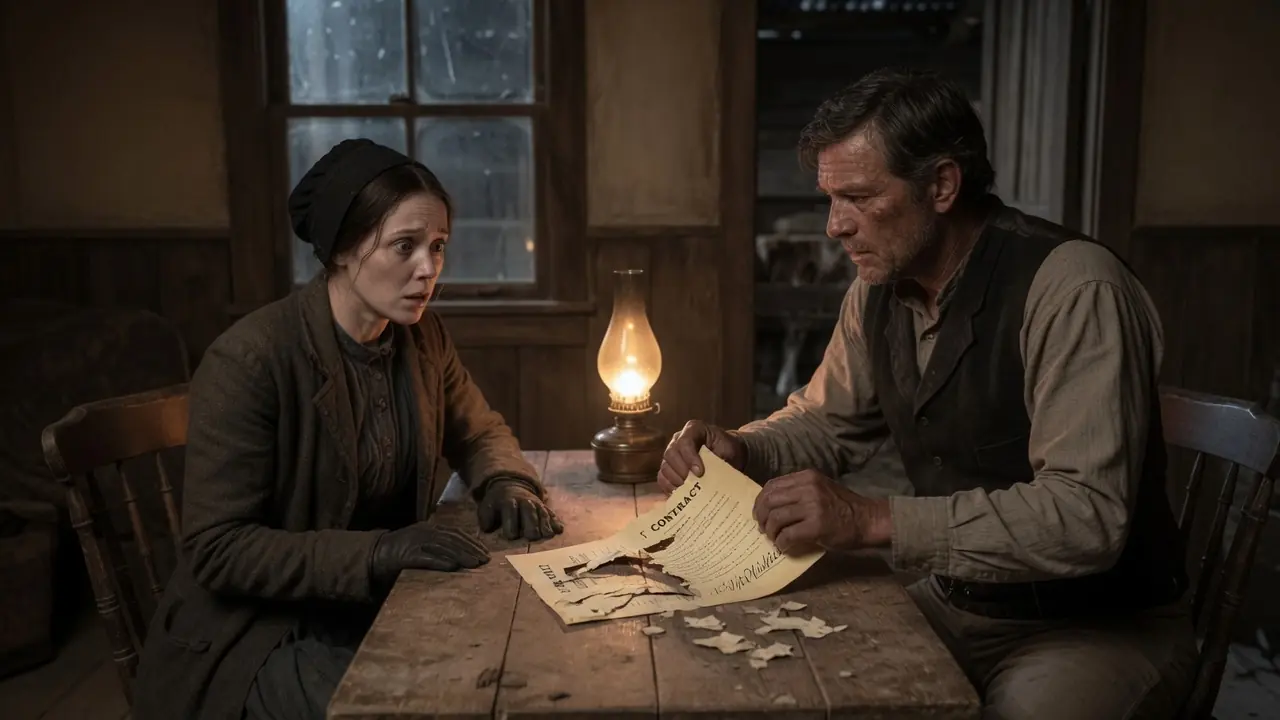
The contract lay on the table between them, yellowed at the edges and stiff from too many hands.
Clara Whitfield stared at it as if it might rise up and bite her.
Outside the ranch house, the New Mexico wind dragged dust across the yard and rattled the loose tin roof of the stable. Somewhere beyond the window, cattle lowed in the fading light. A horse stamped once against the hard-packed ground.
Inside, everything was still.
Across from her sat Silas Crowe, the man her late husband had owed money to.
He was taller than she had expected, broad-shouldered and sun-browned, with dark hair touched by gray at the temples and a face cut by weather more than age. He wore a plain work shirt, rolled at the sleeves, and a black vest worn smooth at the seams. His hands rested on the table, rough and scarred, but strangely careful.
He had not shouted.
That frightened Clara more than shouting would have.
Men who shouted spent their anger quickly.
Quiet men kept it stored.
“I cannot pay you,” she said at last.
Her voice sounded small in the room.
Silas did not move.
Clara forced herself to look at him.
“I sold what I could in Santa Fe. The wagon. My husband’s watch. Two trunks of clothing. It was not enough.”
Still, he said nothing.
She swallowed and looked back down at the contract.
Eight hundred dollars.
Signed by Everett Whitfield.
Her husband.
Dead six weeks now.
Buried under a wooden cross outside Las Vegas, New Mexico, with rain still wet on the soil and three creditors standing at a distance, waiting like buzzards with clean collars.
Everett had been charming when she married him. Handsome. Quick with laughter. Quicker with promises. He had spoken of land, cattle, railroad contracts, a future with a white house and a porch wide enough for children to run across.
Instead, he left her a Bible, two dresses, one cracked comb, and debts hidden inside the lining of his traveling coat.
The biggest had Silas Crowe’s name on it.
Money borrowed for a horse trade that failed before it began.
Clara had walked into the Crowe ranch with one carpetbag in her hand and fear in her throat. She had rehearsed her plea for two days.
Now the words came out exactly as she had dreaded.
“I can work,” she said. “I can cook. Wash. Sew. Tend chickens, milk cows, keep accounts if you need it. I will work until the debt is paid.”
Silas’s jaw shifted.
That was the first sign he had heard her.
Clara sat straighter, holding on to the last thin thread of dignity she had left.
“I am not asking for charity.”
Silas picked up the contract.
Clara’s breath stopped.
His eyes moved across Everett’s signature. Across the amount. Across the terms written in a banker’s narrow hand.
Then, without a word, he tore the paper in half.
Clara gasped.
Silas tore it again.
And again.
The pieces fell onto the table like dead leaves.
“You owe me nothing,” he said.
Clara stared at him.
“I do not understand.”
“Your husband owed me money.”
“Yes.”
“He is dead.”
Her throat tightened.
“Yes.”
“Then the debt died with him.”
Tears burned behind her eyes.
“That is not how men have explained it to me.”
Silas looked at the torn paper.
“Then men have explained it wrong.”
Clara pressed one trembling hand against the table.
“But you lost the money.”
“I did.”
“And you are willing to let it go?”
He looked up.
“No amount of your suffering will put eight hundred dollars back in my pocket.”
The sentence broke something in her.
Not cruelly.
Kindly.
And kindness, after weeks of fear, was almost unbearable.
She covered her mouth, but a sound escaped anyway.
Silas looked away, as if giving her privacy inside her own shame.
Clara had prepared herself for hard labor. For humiliation. For a corner in a barn, perhaps. For years of washing another man’s shirts because her husband had lied better than he loved.
She had not prepared for freedom.
The problem was that freedom did not tell her where to sleep.
Silas stood slowly, his chair scraping against the floor.
He walked to the window and looked out toward the western ridge where the last light was fading purple over the desert.
“You can stay here tonight.”
Clara looked up.
“Only tonight?”
He turned back.
“As long as you need.”
Her heart twisted.
“I will not be kept.”
“I did not offer to keep you.”
“I will not be your servant.”
“I did not ask for one.”
“Then what are you offering?”
Silas studied her for a moment.
“A room. Food. Work if you want it. Wages if you take it. Time to decide where your life goes next.”
Clara stared at him as if he had spoken in another language.
“Why?”
The question came out sharper than she intended.
Silas did not seem offended.
Instead, something old moved behind his eyes.
“Because I know what it is to stand in an empty house after death has taken everything worth hearing.”
Clara looked down.
For the first time since Everett died, she did not feel chased.
That night, Silas gave her the small upstairs room at the back of the house. The bed was narrow but clean. The quilt smelled faintly of cedar. A blue washbasin sat near the window, and someone had placed a sprig of dried lavender on the pillow.
Clara stood in the doorway for a long while, unsure what to do with a kindness she had not earned.
Then she closed the door and sank onto the bed.
She meant only to sit.
Instead, she folded forward and wept into both hands.
Not for Everett.
Not exactly.
She had cried for him already. For the man she thought he was. For the man he might have become if promises could be turned into bread.
Tonight she cried for the woman she had been before finding the debts.
The woman who believed marriage meant safety.
The woman who thought love could not bankrupt you.
Outside, the New Mexico night settled cold over the ranch.
And downstairs, Silas Crowe sat alone at the kitchen table, staring at the torn contract until the lamp burned low.
Morning came pale and quiet.
Clara woke before sunrise out of habit. For a moment, she did not know where she was. Then she saw the slanted ceiling, the cedar quilt, the basin, and remembered.
The ranch.
The contract.
The man who had torn it apart.
She dressed quickly in her plain brown dress and pinned her hair at the back of her neck. When she came downstairs, the kitchen smelled of coffee and corn cakes.
Silas stood at the stove, frying bacon in a black iron pan.
He glanced over his shoulder.
“Coffee’s on the table.”
“You cook?”
“I live alone.”
“That does not always mean a man cooks.”
The corner of his mouth moved.
Not quite a smile.
“Then I am full of surprises.”
Clara sat carefully.
A cup waited for her.
So did a plate.
Bacon. Corn cakes. Beans warmed with onion.
She stared at the food too long.
Silas sat across from her.
“When did you last eat proper?”
“Yesterday.”
He looked at her.
Clara looked down.
“Day before.”
He said nothing, only pushed the plate closer.
That silence was becoming familiar.
Not empty silence.
A silence that did not demand she perform gratitude.
She ate slowly at first, then with more hunger than she wanted him to see.
After breakfast, she rose and gathered the dishes.
Silas said, “Leave them.”
“No.”
His brows lifted.
She met his eyes.
“If I am staying, I will work.”
“I told you this is not payment.”
“Then call it pride.”
He considered that.
“Pride can wear a person thin.”
“So can helplessness.”
At that, he nodded once.
“Fair enough.”
He let her wash the dishes.
Then he showed her the house.
The pantry.
The wash line.
The sewing basket.
The chicken yard.
The pump that stuck unless pulled twice.
The accounts ledger he kept poorly and admitted without shame.
Clara noticed everything.
By noon, she had swept the kitchen, sorted the pantry, mended two torn shirts, and found three mistakes in the feed accounts.
When Silas came in from checking fences, he stopped in the doorway.
“The house looks different.”
“It was dusty.”
“It is a ranch.”
“Dust is not entitled to permanent residence.”
This time, he did smile.
Small.
Brief.
But real.
Clara looked away first.
Something about the smile unsettled her.
Not because it frightened her.
Because it warmed a place in her she had meant to keep frozen.
Days became a rhythm.
Clara woke early. Silas was usually already outside. She made coffee, fed chickens, cooked breakfast, mended, cleaned, recorded expenses, and sometimes helped bottle-feed a calf whose mother had died.
Silas did not hover.
He did not command.
He asked.
That alone marked him as different from most men Clara had known.
“Would you mind writing this order to town?”
“Can you spare time to look over the feed bill?”
“If you are not too tired, the beans need sorting.”
Every request gave her room to refuse.
She rarely did.
Work settled her.
At first, she worked because she refused charity.
Then because the ranch needed it.
Then, slowly, because she liked the way the house answered when she touched it.
Bread rising near the stove.
Fresh curtains washed and hung.
The accounts balanced.
The porch swept clean of sand.
A home did not become a home all at once.
It gathered itself around repeated care.
In the evenings, she and Silas sat on the porch after supper. He smoked sometimes, though never if the wind blew toward her. She sewed or shelled beans. They did not speak much.
But the silence changed.
At first, it had been the silence between strangers.
Then between two wounded people trying not to step on one another’s pain.
Then something easier.
Something like companionship.
One evening, three weeks after her arrival, Silas said, “There is a harvest social in Arroyo Bend on Saturday.”
Clara kept her eyes on the shirt cuff she was mending.
“I am in mourning.”
“I know.”
“Then I should not go.”
“Grief does not require a locked door.”
She looked at him.
He was watching the ridge, not her.
“I am not fit for company,” she said.
“Most company is not fit for company.”
That surprised a laugh out of her.
A small one, but enough.
Silas looked at her then, and the softness in his expression made her fingers stumble over the needle.
“I could take you,” he said. “If you want.”
“And what would people say?”
“That you arrived in a wagon and left in one.”
“You know that is not what I mean.”
He nodded.
“Folks talk.”
“Yes.”
“They talk when a woman is alone. They talk when she is helped. They talk when she refuses help. They talk when rain comes late.”
Clara lowered the shirt.
“You make gossip sound like weather.”
“It is. Annoying, common, and rarely worth building a house around.”
She smiled despite herself.
“I will think on it.”
Saturday came bright and windy.
Clara wore her black dress with the mended sleeve and a narrow ribbon at her throat. It was too plain for a social and too proper for a ranch wagon, but it was the best she had.
Silas waited by the wagon in a clean white shirt, dark vest, and black hat brushed free of dust.
He looked different.
Still quiet.
Still weathered.
But less like a man made only of work.
When he saw her, he removed his hat.
“You look well, Mrs. Whitfield.”
The name struck her oddly.
Mrs. Whitfield.
Everett’s name.
A life that already felt like a room she had left but not locked.
“Thank you, Mr. Crowe.”
They rode to Arroyo Bend as the sun lowered behind the mesa. The town was little more than a main street, a church, a mercantile, a livery stable, and a community hall strung with lanterns.
Music spilled through the open doors.
Fiddle.
Guitar.
Boots on wood.
Inside, people greeted Silas with genuine warmth.
“Crowe.”
“Evening, Silas.”
“Good to see you off that ranch.”
Their eyes moved to Clara immediately.
Curiosity.
Calculation.
A widow in black riding beside an unmarried rancher.
Stories were already being built.
Silas introduced her simply.
“This is Mrs. Clara Whitfield. She is staying at the ranch while she settles matters after her husband’s passing.”
No debt.
No shame.
No explanation.
Clara felt the mercy of that more deeply than anyone knew.
A woman named Abigail Mercer took her hand.
Abigail was plump, kind-faced, and smelled faintly of cinnamon.
“Come sit with us, Mrs. Whitfield. Men are useless at socials unless someone tells them where to stand.”
Silas’s mouth twitched.
Clara followed Abigail to a row of chairs near the wall.
The evening passed gently.
No one asked too much.
Or perhaps Abigail had warned them not to.
Clara did not dance. She watched. She smiled when spoken to. She held a cup of cider she barely drank.
For the first time in months, she felt grief sit beside her instead of on top of her.
On the ride home, moonlight silvered the road.
Silas held the reins loosely.
“You did well.”
“I did nothing.”
“Sometimes that is doing well.”
She looked at him.
“Why did you really tear up the contract?”
He did not answer at once.
The wagon creaked.
A coyote called somewhere in the distance.
Finally, he said, “My wife died seven years ago.”
Clara turned toward him.
Silas kept his eyes on the road.
“Her name was Miriam. Fever took her in three days. We had a boy. Samuel. He was two.”
Clara’s heart tightened.
“What happened?”
“The same fever.”
She covered her mouth.
“I am sorry.”
“I buried them on a Tuesday,” he said quietly. “By Friday, a man came to collect on a debt Miriam’s brother owed me. Said grief did not change money. He had a widow and two children. I took the papers outside and burned them.”
Clara listened, breath held.
“After that, I made a rule,” Silas said. “I do not collect from widows. I do not take bread from children. I do not turn death into profit.”
His voice was even, but Clara heard the old wound beneath it.
“I thought if I made the rule strong enough, maybe the anger would have somewhere useful to go.”
Tears slipped down Clara’s cheeks.
“You are not as hard as you look, Mr. Crowe.”
He glanced at her.
“Yes, I am.”
She smiled through tears.
“No. You are worse.”
“How so?”
“You are kind and pretend it is discipline.”
For a moment, he seemed startled.
Then he laughed softly.
It was a low sound.
Rusty from disuse.
Clara looked away before he could see how much she liked it.
Autumn deepened.
Cottonwoods along the creek turned gold. The mornings grew cold enough for frost. Clara’s hands reddened from wash water. Silas split wood and stacked it high against the side of the house.
Something grew between them without permission.
Not romance at first.
Trust.
And trust, Clara discovered, was far more dangerous.
Romance could be dismissed as loneliness.
Trust asked for a future.
In late October, a rider came to the ranch.
Clara saw him from the porch.
He wore a black coat too fine for trail dust and rode a sleek bay horse that looked cared for by someone else. He dismounted without greeting and tied his horse to the rail as if the place already owed him something.
“I am looking for Clara Whitfield,” he said.
Clara stepped down from the porch.
“I am Clara Whitfield.”
The man removed a folded paper from his coat.
“My name is Victor Sloane. I represent interests in Santa Fe connected to your late husband.”
Cold moved through her.
Silas came from the barn, wiping his hands on a cloth.
“What interests?”
Sloane glanced at him dismissively.
“This is private.”
“It is my porch,” Silas said.
Sloane’s mouth tightened.
He turned back to Clara.
“Your husband owed additional funds. Boarding expenses, gambling markers, and merchant accounts. Total sum, three hundred and seventy dollars.”
Clara’s stomach dropped.
“I have no money.”
Sloane’s eyes ran over her dress.
“I assumed as much.”
Silas stepped closer.
Clara heard the change in his boots against the boards.
Sloane continued.
“There is a hotel in Santa Fe willing to take you on as domestic staff. Your wages would be applied directly until the amount is satisfied.”
Clara felt the old panic rise.
Work.
Debt.
Years swallowed by a dead man’s lies.
“No,” Silas said.
Sloane turned.
“You have no authority here.”
“I have enough to tell you to get off my land.”
“The debt is legal.”
“Did she sign?”
Sloane paused.
Silas’s voice hardened.
“Did she sign?”
“No, but as his widow—”
“As his widow, she is not livestock to be transferred to a hotel.”
Sloane’s face flushed.
“You are interfering in a lawful recovery.”
Silas took one step closer.
“No. I am interrupting a con.”
The word struck hard.
Clara looked at him.
Sloane looked away too quickly.
Silas noticed.
“Let me see the paper.”
“That is unnecessary.”
“Then you can explain it to the sheriff.”
Sloane’s confidence cracked.
Only slightly.
But enough.
Silas held out his hand.
After a tense moment, Sloane handed him the paper.
Silas read it.
Then his jaw tightened.
“This is not a court order.”
Sloane said nothing.
“This is not even a signed claim.”
Silas looked at Clara.
“It is a list.”
Clara’s hands trembled.
Sloane snatched for the paper, but Silas held it out of reach.
“Leave,” Silas said.
Sloane’s eyes narrowed.
“You cannot protect her forever.”
“No,” Silas said. “But I can start today.”
Sloane mounted his horse in anger.
Before riding off, he looked at Clara.
“Men grow tired of charity, Mrs. Whitfield.”
Silas moved so fast Clara barely saw it.
He caught the bridle before the horse could turn.
The bay tossed its head.
Sloane froze.
Silas looked up at him.
“If you come back here to threaten her, bring the sheriff or bring a doctor. You will need one of them.”
Sloane went pale.
Silas released the bridle.
The rider left in a rush of dust.
Clara stood shaking on the porch.
Silas turned to her.
“He will not stop.”
“He might.”
“You do not believe that.”
“No.”
She laughed weakly.
Silas folded the paper and tucked it into his vest.
“We will go to town tomorrow. File with the sheriff. Have it recorded that he attempted false collection.”
Clara stared at him.
“You make everything sound possible.”
“It usually is. Just not painless.”
That evening, Clara could not eat.
She sat on the porch while the sky burned red behind the hills.
Silas came out and handed her a cup of coffee.
She held it but did not drink.
“I cannot stay here,” she said.
Silas leaned against the porch post.
“No?”
“People are already talking.”
“Yes.”
“Now that man will talk too.”
“Likely.”
“And you will be drawn into my troubles.”
He looked out over the yard.
“Seems I already walked in willingly.”
She turned to him.
“Why?”
He did not answer.
So she asked the question she had been afraid to ask.
“Why do you keep choosing me?”
Silas looked at her then.
The sunset cut gold along the side of his face.
“Because you keep expecting to be treated like a burden, and it makes me angry.”
Her throat tightened.
“That is not an answer.”
“It is part of one.”
“Then tell me the rest.”
He set his coffee down.
“When Miriam died, this house became a place I slept. Nothing more. Then you came. You scrubbed dust from corners I stopped seeing. You argued with my ledger. You scolded my chickens like they were church women. You made bread on a Tuesday, and for the first time in seven years, the house smelled like morning instead of memory.”
Clara’s eyes filled.
Silas continued, quieter now.
“I do not know when helping you became wanting you here. But it did.”
She looked down at her hands.
“I am still a widow.”
“I know.”
“I loved Everett once.”
“I know.”
“He lied to me.”
Silas’s voice softened.
“I know.”
“I do not know how to trust what I feel.”
“Then do not rush it.”
She looked up.
He was watching her steadily.
“I am not asking anything tonight,” he said. “I just want you to know the truth has a place on this porch.”
For a long moment, neither spoke.
Then Clara whispered, “I am afraid if I stay, I will need you.”
Silas nodded.
“I am afraid if you leave, I will go back to not needing anyone.”
The honesty of it undid her.
She cried then.
Quietly.
He did not touch her until she reached for his hand.
When she did, he held it gently, as if her grief were not something to fix but something to sit beside.
The next weeks tested them.
Sloane tried to stir trouble in town. He told people Clara was hiding debts. That Silas was being made a fool of. That a widow in a rancher’s house was never as innocent as she pretended.
Some believed him.
Most did not.
Abigail Mercer stood up in church and invited Clara to sit beside her, which in Arroyo Bend was nearly a public declaration of war.
The sheriff reviewed Sloane’s papers and found no enforceable claim.
Silas filed a written complaint.
Sloane left town two days later.
Clara should have felt relief.
Instead, she felt the full weight of her choices settle around her.
She could leave now.
There was nothing binding her to the ranch.
No debt.
No threat.
No contract.
Only a room that had begun to feel like hers.
Only a man who never used kindness as a chain.
Only mornings full of coffee and cattle calls, evenings on the porch, and a heart that had started answering when Silas came through the door.
One cold November evening, Clara found him in the barn brushing down a chestnut mare.
“I have decided something,” she said.
Silas looked over.
“That sounds serious.”
“It is.”
He hung the brush on a nail.
Clara stepped closer, twisting her hands in front of her.
“I am going to stay through winter.”
Silas went still.
“If the offer remains.”
“It remains.”
“As a hired housekeeper,” she said quickly. “With wages. Written clearly.”
His mouth curved faintly.
“You want a contract?”
“Yes.”
“I thought we were tearing those up now.”
She almost smiled.
“Only poisonous ones.”
He nodded.
“We can write a fair one.”
“And I want a lock on my bedroom door.”
The faint smile vanished.
“Of course.”
“And if I choose to leave in spring, I leave.”
“Yes.”
“And if I choose not to…”
Her courage faltered.
Silas waited.
He was good at waiting.
“If I choose not to,” she continued, “then we will discuss what that means.”
Something warm moved through his eyes.
“Spring, then.”
“Spring.”
They shook hands on it, solemn as bankers.
But when his hand closed around hers, neither of them let go as quickly as the agreement required.
Winter came hard.
Snow dusted the high country and turned the ranch mornings silver. The creek froze at the edges. Wind slammed against the house like a drunk trying to get in.
Clara learned to make coffee strong enough for Silas and biscuits light enough to make him look surprised every time.
Silas taught her to shoot at fence posts.
She missed every shot the first day.
The second day, she hit the post once and celebrated so fiercely the horse spooked.
Silas laughed until he had to lean on the rail.
She threw snow at him.
He deserved it.
By Christmas, the house no longer felt like Miriam’s ghost lived in every corner. Clara asked about her sometimes. Silas answered. Not easily, but honestly.
Miriam had loved blue ribbon.
Hated beans.
Sang off-key.
Danced in the kitchen.
Samuel had chased chickens until one chased him back.
Clara listened.
She did not feel jealous of the dead.
She felt honored to know the names that had made Silas gentle before grief made him quiet.
On Christmas Eve, Silas gave Clara a small wooden box.
She opened it carefully.
Inside was a silver thimble.
Plain.
Beautiful.
Her eyes burned.
“My mother’s,” he said. “She said tools should be fine if hands are expected to do fine work.”
Clara closed her fingers around it.
“I have nothing for you.”
“That is not true.”
She looked up.
He was looking at the house.
At the fire.
At the bread cooling near the stove.
At her.
She understood.
Spring came slowly, with mud first, then green.
Clara’s contract ended on the first day of April.
She found Silas on the porch at sunset, the same place where so many truths had learned to breathe.
“I need to speak with you,” she said.
He stood.
“No need. I have your wages ready.”
“This is not about wages.”
He went quiet.
Clara stepped onto the porch.
The air smelled of wet earth and sage.
“I said in winter that if I chose not to leave, we would discuss what it meant.”
Silas did not move.
“Yes.”
“I am choosing not to leave.”
His breath changed.
Barely.
But she heard it.
“I do not want to be kept,” she said.
“No.”
“I do not want pity.”
“No.”
“I do not want to replace Miriam.”
His face softened.
“You never could. You are Clara.”
She swallowed.
“I am afraid.”
“So am I.”
That surprised her.
“You?”
He gave a small, rough laugh.
“Especially me.”
She looked at him, this quiet rancher who had torn up a contract, opened a room, protected without owning, waited without pressing.
“What are you afraid of?” she asked.
“That I will love you and lose you.”
Her eyes filled.
“You have not asked me to marry you.”
“I know.”
“Why?”
“Because I wanted you to stand here free first.”
The words went straight through her.
Free first.
Not desperate.
Not indebted.
Not cornered by gossip or hunger or fear.
Free.
Only then did Silas reach into his vest pocket and take out a small ring.
It was simple gold, worn smooth with age.
“My mother’s,” he said. “You may say no. You may say not yet. You may throw it at my head if that suits your mood.”
A laugh broke through her tears.
“I will not throw it.”
“That is encouraging.”
He held the ring in his palm.
“Clara Whitfield, would you choose to build a life with me? Not to repay anything. Not to quiet anyone. Not because you have nowhere else to go. Because you want to stay.”
She looked at the ring.
Then at the ranch.
Then at the road leading away.
She could walk down that road now.
No man owned her.
No debt followed her.
No paper held her.
And because she could leave, her staying finally meant something.
“Yes,” she whispered.
Silas closed his eyes.
When he opened them, there were tears there.
She had never seen him cry.
He slid the ring onto her finger with hands that trembled more than hers.
They married in the small church at Arroyo Bend with Abigail Mercer crying loudly in the front pew and the sheriff pretending not to.
Afterward, there was coffee, cake, fiddle music, and more people than Clara expected.
No one mentioned Everett.
No one mentioned debts.
No one mentioned contracts.
Silas danced with her once.
Slowly.
Badly.
She laughed against his shoulder and told him he moved like a fence post with boots.
He said fence posts were dependable.
She said dependable was not the same as graceful.
He said he would work on it.
Years later, when Clara stood at the kitchen window watching two children chase chickens across the yard while Silas tried and failed to restore order, she would sometimes think of the day she first arrived.
The contract on the table.
The fear in her throat.
The torn pieces falling like dead leaves.
She had believed then that her life was over, that all that remained was debt, labor, shame, and endurance.
But suffering had not been what she owed.
Not to Everett.
Not to Silas.
Not to the world.
She had owed herself the chance to live past betrayal.
Silas came inside carrying their youngest under one arm like a sack of flour.
“She started it,” he announced.
The little girl giggled.
Clara raised an eyebrow.
“Did she?”
The child pointed toward her brother outside.
“He looked chaseable.”
Silas nodded solemnly.
“A serious offense.”
Clara laughed.
The sound filled the house.
A house that had once held only silence.
Silas set the child down and came to stand beside Clara at the window.
“You are thinking again,” he said.
“I do that.”
“Dangerous habit.”
She leaned into his side.
“I was thinking about the contract.”
His arm came around her.
“That old poison?”
“Yes.”
“What about it?”
She looked at the children.
At the yard.
At the horses.
At the road that had once brought her there with nothing but fear.
“I was thinking how strange it is,” she said, “that the worst paper I ever saw brought me to the best place I ever stood.”
Silas kissed her temple.
“You never owed me a cent.”
“I know.”
“You know it now.”
She smiled.
“Yes. I know it now.”
Outside, the western sky stretched wide and blue over the ranch.
Inside, bread cooled on the table, children laughed in the yard, and the man who had chosen mercy over money held her like she was not a debt repaid, but a life freely loved.
And Clara Crowe, once widowed, frightened, and hunted by another man’s failures, finally understood the truth Silas had known from the beginning.
A woman should never have to pay for a dead man’s lies with her own future.
She should be given a door.
A choice.
A place to stand.
And if she is brave enough, a road back to joy.