The first thing they noticed about Lucas Bennett was the dirt on his shirt.
Not the bouquet of grocery-store daisies in his hand.
Not the way he kept checking the clock above the school entrance.
Not the small purple hair ribbon tied around his wrist because his daughter had asked him to keep it safe that morning.
They noticed the dirt.
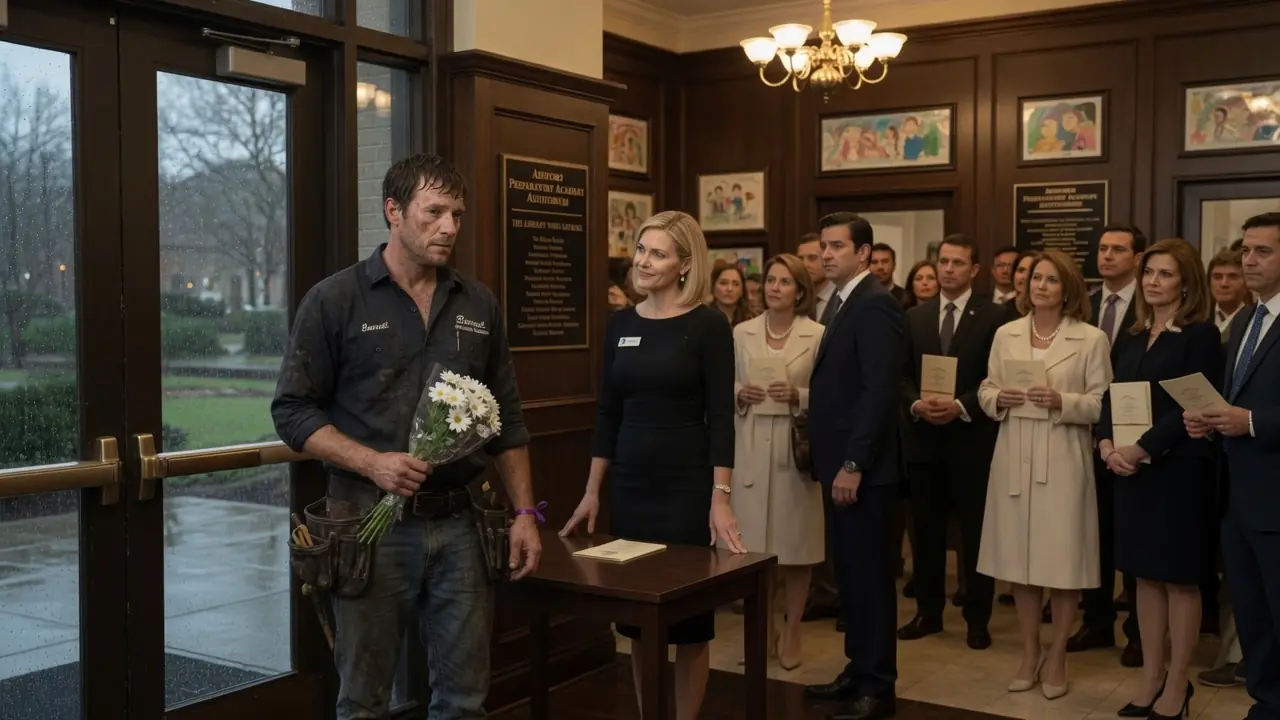
A dark gray streak across the front of his work shirt. Dust along the knees of his jeans. A smear of electrical grease near his left wrist that he had tried to scrub off in the gas station bathroom and failed.
Lucas knew they noticed.
People like that always noticed the wrong thing first.
He stepped through the glass doors of Ashford Preparatory Academy at 6:43 p.m., seventeen minutes before his daughter’s spring performance was supposed to begin.
He had driven straight from a job on the south side of Indianapolis, where the electrical panel of an old laundromat had blown out two hours before closing. He had planned to leave early. He had promised himself all week that tonight he would not be the father running through the doors at the last possible second.
But old buildings did not care about fathers.
Neither did faulty wiring.
So Lucas had stayed until the lights came back on, until the washers started humming again, until the elderly owner grabbed his hand with both of hers and said, “God bless you, Mr. Bennett. I don’t know what I would’ve done.”
Then he had sprinted to his truck.
No time to change.
No time to shower.
No time to go home and put on the blue button-down his daughter, Ava, had ironed for him the night before with intense eight-year-old seriousness.
“You have to look handsome, Daddy,” she had said.
“I always look handsome.”
She had stared at him.
“With no holes.”
So he had promised.
He had meant it.
Now he stood inside her school lobby wearing work boots, stained jeans, and a shirt with Bennett Electrical Services stitched over the pocket.
The lobby smelled like polished wood, fresh flowers, and expensive perfume. Parents stood in clusters beneath framed student artwork and donor plaques, holding programs printed on thick cream paper. The fathers wore suits or quarter-zips with watches that looked heavier than Lucas’s monthly utility bill. The mothers wore dresses, pearls, soft cashmere coats, and the relaxed confidence of people who never had to apologize for arriving in work clothes.
Lucas wiped one hand carefully on his jeans before approaching the front table.
A woman with a sleek blond bob looked up from a clipboard.
Her smile appeared, then paused.
“Yes?” she asked.
“I’m here for the second-grade performance,” Lucas said. “Ava Bennett.”
The woman’s eyes moved over his shirt.
Then his boots.
Then the tool belt still hanging from his hip because he had forgotten to take it off.
“Maintenance check-ins are through the side entrance,” she said.
Lucas blinked.
“I’m not maintenance for the school.”
Her smile tightened.
“Oh. I’m sorry. Are you with the lighting crew?”
“No. I’m Ava’s father.”
The pause after that was short.
Long enough.
“Oh,” she said. “I see.”
Lucas had learned to hate those two words.
They were never just words.
They were a little door closing.
The woman looked at the clipboard again, moving one manicured finger down the list.
“Bennett… Bennett…”
He waited.
Behind him, two women stopped talking.
He could feel their attention move across his back.
“There you are,” the woman said finally. “One seat reserved. Row H.”
“Thank you.”
She handed him a program as if it might come back stained.
Then she glanced at the daisies.
“Those are… sweet.”
Lucas looked at the flowers.
Ava loved daisies. Not roses. Not lilies. Daisies because, according to her, “they look like they’re surprised to be flowers.”
“They’re for my daughter,” he said.
“Of course.”
He turned to go.
Then the woman added, “Sir?”
He stopped.
“Please be mindful that this is a formal school event. We ask guests to keep tools and work equipment out of the auditorium.”
Lucas looked down at the tool belt.
Embarrassment rose hot in his neck.
He had forgotten.
Of course he had forgotten.
He unbuckled it slowly. A pair of pliers clinked against the buckle. The sound seemed too loud in the polished lobby.
“That would be best.”
He set the belt behind the table.
The woman touched it with two fingers and moved it farther away from her papers.
Lucas pretended not to notice.
He was good at that.
Single fathers became good at pretending not to notice. The sideways looks in grocery stores when their daughters’ hair was uneven. The school forms that asked for “mother’s contact” first. The women at birthday parties who smiled too sadly when he said Ava’s mom had passed away. The fathers who did not know whether to include him in conversations or treat him like a cautionary tale.
He pretended not to notice because Ava noticed everything.
And he refused to teach her that shame was something they had to carry just because other people kept handing it to them.
The auditorium doors were open at the end of the hall.
Lucas walked toward them with the daisies in his hand.
Inside, the room glowed warm and golden. Rows of cushioned seats sloped toward a stage decorated with paper stars and painted cardboard trees. A banner overhead read:
Ashford Academy Presents: Voices Of Spring.
Parents filled the room, greeting each other softly, saving seats with scarves and programs. Children’s excited whispers drifted from behind the curtain.
Lucas found Row H.
Seat 12.
The seat beside him was empty, though the woman on the other side had placed her purse there.
He waited a moment.
She noticed him.
Then noticed the ticket in his hand.
“Oh,” she said, removing the purse slowly. “Sorry. I thought someone else was sitting there.”
“No problem.”
She looked at his clothes.
Then at the daisies.
Then at the stage.
“Your child is performing?”
“Yes. My daughter, Ava.”
“That’s nice.”
The conversation died there.
Lucas sat down carefully, holding the flowers upright between his knees. He checked his phone.
6:51.
Nine minutes.
He made it.
Relief moved through him so strongly that for a second he closed his eyes.
He had made it.
Ava would look out and see him there.
That mattered more than anything else in the room.
Three years earlier, his wife, Emily, had died on a Sunday morning in late September.
A brain aneurysm.
No warning.
No long illness.
No time for goodbye speeches, no final letters, no hospital bed where everyone gathered and said the things families said when they knew the end was coming.
One moment Emily was in the kitchen making cinnamon toast for Ava, humming off-key. The next, she had one hand against the counter and a strange look on her face.
By evening, Lucas was a widower.
Ava was five.
For months afterward, she asked if Mommy could hear her when she sang.
Lucas always said yes.
He did not know if it was true.
He needed it to be.
Emily had been a music teacher before Ava was born. She believed children should sing before they learned to be embarrassed. She believed libraries were the closest thing to churches outside of churches. She believed no child should feel poor because they needed help reading.
When the life insurance check came, Lucas could barely look at it.
Money because Emily was gone.
It felt obscene.
His in-laws told him to use it for a better house, a financial advisor, private lessons, a newer truck. Practical things. Sensible things.
Lucas did something else.
He paid off the mortgage on their small house.
Then he set aside enough for Ava’s future.
The rest he placed into a fund under Emily’s name.
The Emily Bennett Reading Room and Scholarship Fund.
At first, it was small.
A shelf of books for a public elementary school.
Then a reading corner.
Then new library furniture for Ashford Academy after a pipe burst ruined half their lower-school library. Lucas did not want his name on anything. He told the board only one condition: the fund had to support children who could not afford books, supplies, tuition assistance, field trips, whatever kept a child from feeling outside the door.
Emily would have liked that.
No.
She would have loved it.
Ashford had accepted the donation through a law firm. Anonymous. Clean. Quiet. No gala speech. No photo with a giant check. No donor dinner where people clapped for grief wearing a suit.
Lucas kept working.
Kept fixing electrical panels and rewiring kitchens and crawling through attic insulation.
Kept packing Ava’s lunch.
Kept learning how to do braids from YouTube.
Kept showing up.
Most days, that was the whole miracle.
The lights dimmed.
The room softened.
A hush moved through the auditorium.
Lucas sat straighter, holding the daisies in both hands.
The music teacher stepped onto the stage and welcomed everyone. Then the curtain opened.
Children stood in three rows under warm stage lights.
Lucas found Ava immediately.
Second row, near the left.
Blue dress.
White cardigan.
Hair in two braids that had taken him twenty-three minutes and one mild panic attack.
She was looking over the audience, searching.
He lifted the daisies slightly.
Her eyes found him.
Her whole face changed.
That smile.
For one second, all the dirt on his shirt, all the whispers in the lobby, all the exhaustion in his bones disappeared.
Ava smiled like the world had kept its promise.
Lucas smiled back.
The first song began.
The children sang about spring rain, flowers, and birds returning. Some were too loud. Some forgot the words. One boy in the front row scratched his ear through an entire verse. Ava sang with her whole face, exactly like Emily used to.
Lucas felt his throat tighten.
The woman beside him glanced over when he wiped one eye.
He pretended to adjust his nose.
By the third song, the children stepped forward one by one to deliver short lines they had memorized.
Ava’s part came after a boy named Henry spoke about sunshine.
She stepped to the microphone.
Lucas leaned forward.
Ava looked out.
For a second, she smiled.
Then her eyes moved past him toward the side aisle.
Her smile faded.
Lucas turned his head.
The blond woman from the front table stood near the auditorium door whispering to a man in a dark suit. He was tall, clean-shaven, with the polished look of school administration. Lucas recognized him from emails.
Headmaster Whitcomb.
The woman gestured toward Lucas.
Whitcomb’s eyes found him.
Lucas felt the old heat rise again.
Not now.
Please, not now.
Ava’s voice came through the microphone, small and suddenly uncertain.
“Spring is when everything that looked gone comes back again.”
She stopped.
The music teacher smiled encouragingly.
Ava looked at Lucas.
Then at Whitcomb.
Then back at Lucas.
Her lower lip trembled.
Lucas mouthed, “You’re okay.”
She swallowed.
“Spring is when…”
Her voice cracked.
A few children turned toward her.
Then Ava began to cry.
Not loudly at first.
Just tears filling her eyes and spilling over while she stood alone at the microphone under the lights.
The room shifted.
Parents murmured.
The music teacher stepped forward.
Lucas stood immediately.
But before he could move into the aisle, Headmaster Whitcomb reached him.
“Sir,” Whitcomb whispered sharply, “may I speak with you outside?”
Lucas looked at him.
“My daughter is crying.”
“I understand, but—”
“No,” Lucas said. “You don’t.”
He stepped past him into the aisle.
Whitcomb put one hand out, not touching him, but blocking enough.
“Sir, please. We need to keep the event moving. There has been concern from several parents about—”
“About what?”
Whitcomb’s eyes flicked toward Lucas’s work shirt.
The answer was there.
Lucas stared at him.
“About me?”
“This is a formal school event,” Whitcomb said quietly. “Some of our families are uncomfortable with service personnel entering the guest seating area.”
Service personnel.
The words were soft.
Polished.
Poisonous.
Lucas looked at the stage.
Ava was crying harder now. The music teacher had one arm around her, but Ava kept looking toward the audience.
Toward him.
The microphone picked up her little voice.
“My daddy came,” she whispered, though she was not speaking to the room. “He came.”
Lucas turned back to Whitcomb.
“I am her father.”
Whitcomb’s face tightened.
“I was told you were a contractor.”
“I am an electrician.”
“Then perhaps there was confusion.”
“No,” Lucas said. “There was judgment.”
The whisper had become audible to nearby seats. Parents were turning now. Phones were lowering. The room, already unsettled by Ava’s tears, seemed to hold its breath.
Whitcomb straightened.
“Mr…?”
“Bennett.”
“Mr. Bennett, I am trying to handle this discreetly.”
Lucas almost laughed.
“Discreetly for whom?”
Before Whitcomb could answer, Ava pulled away from the music teacher and stepped back to the microphone.
Her face was wet. Her hands clutched the sides of her dress.
“Please don’t make my daddy leave,” she said.
The auditorium went silent.
Every adult in the room heard her.
Lucas stopped breathing.
Ava looked toward the side aisle.
“He fixed a building today,” she said, voice shaking. “That’s why his shirt is dirty. He was coming. He promised he was coming.”
The music teacher touched Ava’s shoulder gently, but Ava kept speaking.
“My mommy said people who fix lights are important because nobody sees the dark until the lights don’t work.”
A soft sound moved through the audience.
Lucas covered his mouth with one hand.
Ava’s voice broke.
“He’s not dirty. He’s just tired.”
That sentence did what humiliation had not done.
It broke something open.
Not only in Lucas.
In the room.
The woman who had moved her purse looked down at her lap. A man in the front row shifted uncomfortably. The blond receptionist near the door went pale.
Headmaster Whitcomb looked as if the stage lights had turned on him.
Lucas walked past him.
This time, no one stopped him.
He reached the front of the auditorium and climbed the side steps onto the stage. Ava ran to him before he could even kneel.
He dropped to one knee and opened his arms.
She crashed into him, sobbing against his shoulder.
The daisies bent between them.
“I thought they were making you go,” she cried.
“I’m right here,” he whispered. “I’m not going anywhere.”
“You promised.”
“I know.”
“You almost missed it.”
“I know. I’m sorry.”
“But you came.”
He held her tighter.
“Yes, bug. I came.”
The room stayed silent around them.
Lucas forgot them all for a moment.
He was not standing in a prestigious school auditorium in stained work clothes while wealthy parents judged him. He was holding his daughter on a stage where she had been brave until the adults made bravery too heavy.
That was all.
Then someone began to clap.
One person.
Slow.
Deliberate.
Lucas looked up.
An older woman sat near the center aisle, silver-haired, wearing a navy blazer and pearl earrings. He recognized her too, though they had met only once through a lawyer’s office.
Marian Ellison.
Chair of the Ashford Academy Board of Trustees.
She was standing.
Clapping.
Then the music teacher joined.
Then one parent.
Then another.
The applause spread, not like performance applause, but like apology trying to find a shape.
Lucas did not know what to do with it.
Ava lifted her head.
“Are they clapping for me?”
Lucas smiled through tears.
“They better be.”
Marian Ellison stepped into the aisle.
“Mr. Bennett,” she said, voice clear enough to carry through the auditorium, “please stay where you are for a moment.”
Headmaster Whitcomb’s face changed.
“Mrs. Ellison—”
She lifted one hand.
He stopped.
Marian walked slowly to the front of the room.
Then she turned to face the audience.
“I believe there has been a serious misunderstanding tonight,” she said. “And by misunderstanding, I do not mean an innocent mistake. I mean a failure to understand who belongs in this room.”
The auditorium went still again.
Marian turned toward Lucas and Ava.
“This is Lucas Bennett,” she said. “He is Ava Bennett’s father. He is also the anonymous donor responsible for rebuilding the lower-school library after the flood last year.”
A murmur moved through the room.
Lucas closed his eyes.
No.
Not here.
Not like this.
Marian continued.
“The Emily Bennett Reading Room, where many of your children now spend their mornings, exists because Mr. Bennett donated the funds in memory of his late wife.”
Ava looked at him.
“Daddy?”
He swallowed.
The audience had gone utterly quiet.
Marian’s voice softened but did not weaken.
“And the scholarship fund that has helped twelve Ashford students remain enrolled this year was also established by Mr. Bennett, using the life insurance money left after his wife’s passing.”
This time the silence was not empty.
It was stunned.
The woman who had moved her purse covered her mouth.
The blond receptionist began crying silently.
Headmaster Whitcomb stared at Lucas as if seeing an entirely different man.
Lucas hated it.
Not the truth.
The timing.
The way respect arrived only after status came dressed as proof.
He stood slowly, still holding Ava’s hand.
“I didn’t do it so people would know,” he said.
His voice was rough, but it carried.
Marian nodded.
“I know. That is why they need to.”
Lucas looked out at the parents.
He saw embarrassment. Shame. Curiosity. Maybe admiration now, though that made him more tired than the contempt had.
He lifted the daisies.
“These were six dollars at Kroger,” he said.
A few people blinked, confused by the shift.
Lucas looked down at them.
“My daughter loves daisies because she says they look surprised. I came here with these, not a check. Not a plaque. Not a speech. Just flowers and a promise I nearly broke because someone’s lights went out across town.”
Ava squeezed his hand.
“I am an electrician,” he said. “I work with my hands. I fix things that stop working. Sometimes I arrive with dirt on my clothes. Sometimes I smell like old wiring and crawl spaces. Sometimes I am late because when power goes out, people need help.”
His eyes moved to Whitcomb.
“But none of that made me less her father when I walked in.”
Whitcomb looked down.
Lucas turned back to the room.
“My wife, Emily, believed libraries should make children feel welcome. She believed books belonged to every child, not only the ones whose parents could afford the right fundraiser table. When she died, I had money I did not want because it came from losing her. So I used it for something she would have loved.”
His throat tightened.
Ava leaned into him.
“I didn’t want my name on it because grief is not a marketing opportunity. I didn’t want my daughter to grow up thinking her mother’s death was something we turned into applause.”
The room absorbed that.
Slowly.
Painfully.
“But tonight,” Lucas said, “my daughter cried on stage because grown adults looked at her father and decided he did not fit the room.”
No one moved.
Ava wiped her cheeks with the back of her hand.
Lucas rested one hand on her shoulder.
“So let me be clear. If a school teaches children to sing about spring and kindness and new beginnings, but the adults at the door cannot recognize a father because his shirt is dirty, then the school does not need a better library. It needs a better lesson.”
The applause did not come immediately.
That was good.
Immediate applause would have been easier than thought.
For a few seconds, the room stayed quiet enough for the words to settle.
Then Marian Ellison nodded once.
“Agreed.”
She turned toward Whitcomb.
“Dr. Whitcomb, we will discuss this with the board tomorrow morning.”
His face went gray.
“Of course.”
Marian looked toward the blond receptionist.
“And Ms. Palmer, you will join that meeting.”
The receptionist nodded quickly, tears still on her face.
“Yes, ma’am.”
Lucas did not feel victorious.
He felt tired.
Deeply tired.
Ava tugged his hand.
“Daddy?”
He looked down.
“Can I finish my line?”
His breath caught.
The music teacher stepped forward, tears in her eyes.
“Of course you can, sweetheart.”
Ava wiped her face with both hands, took the daisies from Lucas, and stood at the microphone again.
Lucas stayed beside her this time.
Not behind.
Beside.
Ava looked out at the audience.
Her voice trembled, but she spoke.
“Spring is when everything that looked gone comes back again.”
She paused.
Then she added, softly, “Like lights.”
The audience broke.
Some laughed through tears.
Some cried openly.
Lucas bowed his head.
The program continued, but it was different after that.
The children sang two more songs. Ava held the daisies against her chest the entire time. Lucas stood in the wings where she could see him. No one asked him to move.
When the performance ended, parents gathered in the lobby for refreshments.
This time, people approached him.
That was almost worse.
The same parents who had avoided eye contact now wanted to shake his hand. To thank him. To say they had no idea. To apologize in sentences that tried to avoid naming what they had done.
The woman from his row came first.
“Mr. Bennett,” she said, cheeks flushed. “I’m so sorry. I moved my purse earlier and I—well, I made an assumption.”
Lucas looked at her.
“Yes.”
She swallowed.
“I shouldn’t have.”
“No.”
“I’m sorry.”
He nodded.
“Thank you for saying it.”
She seemed relieved, though he had not forgiven her. Not exactly.
The blond receptionist, Ms. Palmer, waited until the crowd thinned. She approached with his tool belt held carefully in both hands, as if it had become sacred after embarrassing her.
“I owe you an apology,” she said.
Lucas took the belt.
“You owe my daughter one.”
Her face crumpled.
“You’re right.”
She knelt in front of Ava, who stood beside Lucas eating a cookie.
“Ava,” Ms. Palmer said, “I am very sorry. I treated your daddy like he did not belong here. That was wrong.”
Ava looked up at Lucas.
He did not answer for her.
She looked back at Ms. Palmer.
“My daddy always belongs where I am.”
Ms. Palmer nodded, tears falling now.
“Yes. He does.”
That was all Ava needed.
She took another bite of cookie.
Children were sometimes better at receiving apologies than adults because they did not yet feel obligated to make the apologizer comfortable.
Headmaster Whitcomb approached last.
Lucas had expected it.
He still did not want it.
“Mr. Bennett,” Whitcomb said stiffly, “I deeply regret the confusion tonight.”
Lucas looked at him.
“Try again.”
Whitcomb blinked.
“Excuse me?”
“Confusion is when you walk into the wrong classroom. This was not confusion.”
Whitcomb’s face tightened, then loosened under the pressure of Marian Ellison standing several feet away.
He drew a breath.
“I judged you by your appearance. I allowed others to do the same. Then I treated you as if you were a disruption instead of a parent.”
Lucas waited.
Whitcomb looked at Ava.
“And I hurt your daughter.”
Ava looked at him seriously.
“Yes.”
The headmaster looked almost startled by her honesty.
“Yes,” he repeated. “I did. I am sorry.”
Ava held the daisies closer.
“You should let dads sit down even if they’re dirty from work.”
Whitcomb nodded.
“I will remember that.”
Lucas said quietly, “Remember it before you know who paid for something.”
Whitcomb had no answer.
Good.
That was the lesson.
On the way out, Marian Ellison walked Lucas and Ava to the lobby doors.
Rain had started again, tapping softly against the glass.
“I am sorry I revealed your donation publicly,” she said.
Lucas looked out at the parking lot.
“You knew I didn’t want that.”
“I did.”
“Then why?”
“Because humility should not be used as cover for other people’s prejudice,” she said. “You gave quietly. They judged loudly. Tonight, quiet would have protected the wrong lesson.”
Lucas did not answer.
He understood.
He hated that he understood.
Ava leaned sleepily against his side.
Marian looked down at her.
“Your mother would be very proud of you.”
Ava smiled faintly.
“Daddy says that too.”
“He’s right.”
Ava looked at the flowers.
“Can we put these in Mommy’s vase?”
Lucas swallowed.
“Yeah, bug. We can.”
They walked to the truck under the rain.
Lucas helped Ava climb into the passenger seat. She placed the daisies carefully in her lap, then looked up at him.
“Daddy?”
“Yeah?”
“Were people mean because of your shirt?”
He froze with one hand on the door.
He wanted to say no.
He wanted to tell her it was a misunderstanding, that adults were complicated, that she did not need to think about things like class and judgment and the cruelty hidden inside polished rooms.
But Ava had stood on a stage and told the truth into a microphone.
He owed her the same.
“Yes,” he said.
Her face fell.
“Because it was dirty?”
“Because some people forget that work is honorable when it doesn’t come with a desk.”
She thought about that.
“Your work makes lights come back.”
“It tries.”
“Mommy said that mattered.”
His throat tightened.
“She did.”
Ava looked back toward the school.
“Did you really make the library?”
“I helped fix it.”
“With Mommy’s money?”
Lucas closed his eyes briefly.
“With money that came after Mommy died.”
Ava was quiet.
Then she said, “Did it hurt to use it?”
He looked at her.
“Yes.”
“Why did you?”
“Because your mom loved books. And kids. And places where people felt safe.”
Ava looked down at the daisies.
“I like the library.”
“I know.”
“Sometimes I sit in the blue chair and talk to Mommy in my head.”
Lucas gripped the truck door.
“You do?”
She nodded.
“The one by the window. It feels like a good place.”
He had placed that chair there himself.
Blue, because Emily loved blue.
Near the window, because she always said children read better in sunlight.
Lucas turned away for a second, pretending to check the rain.
Ava knew better.
“Are you crying?”
“No.”
“Daddy.”
“A little.”
She reached out and touched his sleeve.
“Mommy would say tears are just feelings leaking.”
He laughed through the ache.
“She did say that.”
Ava smiled.
“Can we get fries?”
“After that much cake?”
“Yes.”
“Your mother would object.”
“She is in heaven. She cannot supervise fries.”
Lucas stared at her.
Then laughed fully for the first time that night.
“You are terrifying.”
“I know.”
They stopped at a drive-through on the way home.
Ava ate fries from the bag and told him every part of the performance as if he had not been there. She told him which boy forgot his line, which girl sang too loudly, which teacher cried, and how the stage lights made everything feel hot.
Then she fell asleep ten minutes before they reached home, head tilted against the window, daisies resting across her lap.
Their house was small.
One story.
White siding.
A porch Lucas still needed to repaint.
A kitchen light he had fixed twice but that still flickered when the dishwasher ran.
It was not Ashford Academy. It was not polished. It did not smell like expensive flowers.
But when Lucas carried Ava inside, it welcomed them without judgment.
He placed her in bed, removed her shoes, and set the daisies in a glass jar on her nightstand. Then he stood there for a long time, watching her sleep.
On the shelf beside her bed sat a framed photo of Emily.
Not sick.
Not pale.
Laughing at the county fair with powdered sugar on her chin.
Lucas touched the frame lightly.
“She did great,” he whispered.
The next morning, an email arrived from Ashford Academy.
Then another.
Then five more.
The board announced a formal review of event protocols, parent access policies, and staff training. Headmaster Whitcomb was placed on leave pending the outcome. Ms. Palmer sent a handwritten apology to Ava, decorated with small daisy stickers.
Lucas read the letter aloud at breakfast.
Ava listened while eating cereal.
When he finished, she nodded.
“That was a good apology.”
“You think?”
“She said what she did wrong. Mrs. Cooper says that’s the important part.”
Mrs. Cooper was the music teacher.
“She’s right.”
Ava scooped cereal thoughtfully.
“Can Ms. Palmer still work there?”
“That’s not up to us.”
“But can people learn?”
Lucas looked at his daughter.
This small girl who had lost her mother, cried on stage, and still left room in her heart for someone else to grow.
“Yes,” he said softly. “People can learn.”
“Good.”
She took another bite.
“Because if everybody who made a mistake had to leave forever, school would be empty.”
Lucas smiled.
“That is alarmingly wise.”
“I know.”
A week later, Ashford Academy held a small dedication ceremony in the library.
This time, Lucas wore the blue button-down Ava had ironed.
It had one small scorch mark near the sleeve where the iron got too hot, but Ava said it made the shirt “memorable.”
The lower-school library was full of sunlight.
Children sat on rugs between shelves. Parents stood along the walls. Teachers gathered near the reading corner. On the far wall, a brass plaque that had previously read simply The Emily Bennett Reading Room had been replaced.
Now it read:
The Emily Bennett Reading Room
Given in love by Lucas and Ava Bennett
So every child may find a place where they belong.
Lucas had argued against adding his name.
Ava had argued harder for it.
“Mommy was yours too,” she said.
He could not win against that.
Marian Ellison spoke briefly.
Not about money.
About welcome.
About the dignity of work.
About the danger of teaching children that worth could be measured by appearance.
Then she invited Lucas to say something.
He nearly refused.
But Ava squeezed his hand.
So he stood in front of the room.
He looked at the children first.
That made it easier.
“My wife, Emily, used to say a library is a house with a thousand doors,” he said. “You open a book, and you can go somewhere else. Be someone else. Learn something that makes the world bigger.”
His voice caught.
He breathed through it.
“She would have liked this room. She would have liked the blue chair by the window. She would have liked that some of you read upside down, though she would have pretended to be shocked.”
A few children giggled.
Lucas smiled.
“I am an electrician. I fix wires. I make lights turn on. That is my job. But Emily believed books turned on another kind of light. The kind inside people.”
He looked around the room then.
At parents. Teachers. Staff.
“That light should not belong only to families who can afford it. It should not belong only to children whose parents look polished when they walk through the door. It should not belong only to people who already feel welcome.”
Ava leaned against the bookshelf, watching him.
Lucas’s voice softened.
“If this room does anything, I hope it reminds every child who comes here that they belong before anyone knows their last name, their address, their parents’ job, or what kind of shoes they wear.”
The room was silent.
Then Ava began clapping.
Naturally, loudly, with both hands over her head.
The children joined.
Then the adults.
Lucas laughed and shook his head.
Later, after the ceremony, Ava led him to the blue chair by the window.
“Sit,” she ordered.
“Yes, ma’am.”
He sat.
She climbed onto his lap even though she was getting too big for it.
“This is where I talk to Mommy,” she said.
Lucas looked at the sunlight falling across the chair.
“What do you tell her?”
“Stuff.”
“What stuff?”
“Private stuff.”
“Fair.”
She leaned back against him.
“But sometimes I tell her you’re doing okay.”
Lucas closed his eyes.
For a moment, he could almost feel Emily there. Not as a ghost. Not as a miracle. Just as memory made warm by the place she would have loved.
Ava touched the edge of his sleeve.
“Daddy?”
“Yeah?”
“If people laugh at your shirt again, I’ll tell them you make lights come back.”
He kissed the top of her head.
“That might be the best thing anyone’s ever said about me.”
She smiled.
“It’s true.”
Years later, people would still talk about the night of the spring performance.
Some would remember the embarrassment. Some would remember the apology. Some would remember the announcement about the library fund. Some would remember the little girl crying into the microphone, asking them not to make her father leave.
But Lucas remembered something else most clearly.
The moment Ava looked out from the stage and found him.
Before the whispers.
Before the headmaster.
Before the applause.
Before anyone knew he had given anything.
She saw him.
Dirty shirt, tired eyes, work boots, daisies in hand.
And she smiled because her father had come.
That was the only recognition he had needed.
Everything after that was for the adults to learn.
Because a single father should not have to be wealthy to be respected.
A working man should not have to be a donor to be allowed a seat.
A child should never have to defend the dignity of the parent who shows up for her.
And sometimes the man people mistake for someone who does not belong is the one who quietly built the room everyone else is proud to stand in.