The first thing they laughed at was the wrapping paper.
Not loudly.
Not at first.
Just a small sound near the kitchen island, half hidden behind crystal glasses and polite smiles, the kind of laugh people make when they want cruelty to pass for good manners.
Ethan Harper heard it anyway.
He stood in the entryway of the Whitmore house with one hand around a small, carefully wrapped box and the other resting on his daughter’s shoulder. His coat was still damp from the cold rain outside. His boots had been wiped twice on the welcome mat, but a little mud still clung stubbornly to the edges. He could feel every eye in the foyer noticing it.
The house looked exactly the way he remembered and somehow worse.
Tall windows. Pale stone floors. White roses in a vase too large for any normal table. A staircase curving upward like something out of a bridal magazine. The air smelled of vanilla candles, expensive perfume, and the sort of money that never had to announce itself because everyone else did it for them.
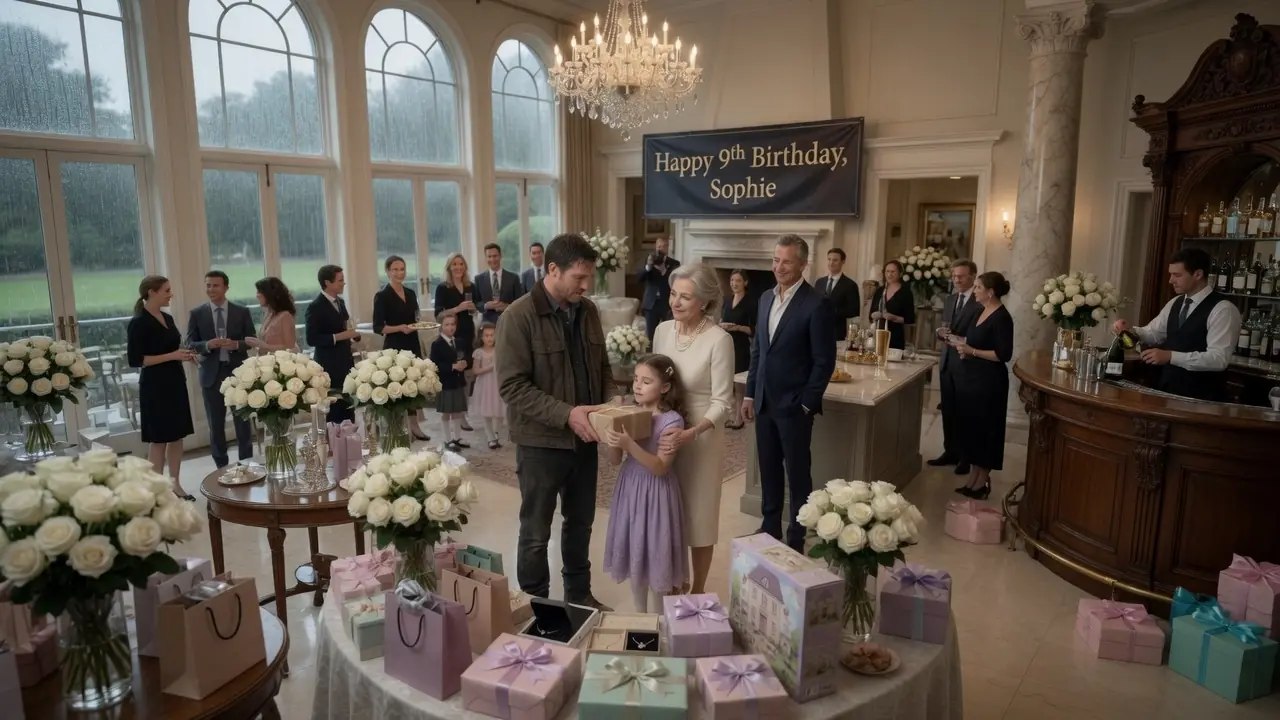
Above the fireplace in the great room hung a banner in gold letters.
Happy 9th Birthday, Sophie.
His daughter looked up at it and smiled.
For that smile alone, Ethan decided he could survive the evening.
Sophie Harper was nine years old today. She wore a lavender dress her grandmother had bought her, white tights, and shiny shoes she kept trying not to scuff. Her brown hair had been curled, probably by her aunt before Ethan arrived, and pinned with two pearl clips that made her look older than he wanted her to look. In one hand she held a little silver gift bag from someone else. In the other, she held tightly to Ethan’s sleeve.
She did that only when she felt unsure.
He noticed.
He always noticed.
“Daddy,” she whispered, “is my bow crooked?”
He looked down at her.
“It’s perfect.”
“You didn’t check.”
“I don’t need to. You’re wearing it.”
She rolled her eyes in the dramatic way she had inherited from her mother.
That hurt, but gently.
Some hurts had softened over the years.
Some had not.
Across the foyer, Margaret Whitmore stood with a glass of white wine in one hand and an expression that made Ethan feel like something tracked in from outside. She was Sophie’s grandmother. His late wife’s mother. A woman who had never forgiven him for marrying her daughter, and had somehow become even less forgiving after her daughter died.
“Ethan,” Margaret said.
Not welcome.
Not good to see you.
Just his name, shaped into an obligation.
“Margaret.”
Her eyes moved to the box in his hand.
It was wrapped in brown kraft paper because that was what he had at home. Sophie had decorated it herself the night before with little stars drawn in blue marker, but she had not known it was her gift. She thought she was helping him wrap something for his workshop.
Margaret’s mouth tightened.
“You brought something.”
“It’s her birthday.”
“Yes,” Margaret said. “We’re aware.”
A man near the kitchen island chuckled softly.
Ethan recognized him as Trent Caldwell, Margaret’s new favorite person: successful, divorced, smug, and somehow always standing near expensive cheese. He had been introduced to Sophie last Christmas as “a good family friend,” though Ethan suspected Margaret had larger plans for him and her younger daughter, Allison.
Trent lifted his glass toward the package.
“Handmade wrapping. That’s charming.”
The word charming did not mean charming.
Sophie looked up at her father.
Ethan smiled like nothing had happened.
“It took us twenty minutes to get the stars right.”
Sophie’s face brightened.
“You used my stars?”
“Every single one.”
Her grip on his sleeve loosened.
That was enough.
The house was already full of people. Relatives. Friends of the Whitmores. Neighbors from the country club. Parents of children from Sophie’s school. A hired photographer moved quietly around the room, capturing balloon arches, floral arrangements, and children eating frosting with their fingers while adults pretended not to notice.
Ethan had not wanted to come.
He had wanted to take Sophie to the little diner near their house, order pancakes for dinner, let her wear pajamas under her coat, and give her the gift at their kitchen table where no one would measure its worth against a mountain of glossy boxes.
But Margaret had insisted.
“Sophie deserves a proper birthday,” she had said on the phone three weeks earlier.
A proper birthday.
Ethan knew what she meant.
A birthday with catering.
A birthday with a cake taller than some toddlers.
A birthday with gifts that arrived in department store bags instead of being built at a kitchen table after midnight by a father with sawdust still in his hair.
He had almost refused.
Then Sophie asked if he would be there.
Not if she could go.
Not if Grandma’s house would have the big chocolate fountain again.
Just, “You’ll come too, right, Daddy?”
So he came.
Because after Lily died, Ethan made one promise to himself and one promise to his daughter.
He would show up.
Even when it hurt.
Even when he was tired.
Even when the room treated him like a reminder no one had asked for.
Lily Harper had been dead for three years.
Cancer took her in seven months, though sometimes Ethan still felt like it took her in one breath. One day she was standing in the kitchen teasing him for burning toast. The next, there were scan results, appointments, surgical words, quiet hallways, and a bed by the window where she became lighter each week until holding her hand felt like holding paper warmed by the sun.
Sophie had been six.
Old enough to understand that Mommy was sick.
Too young to understand that some goodbyes do not come with second chances.
On Lily’s final clear day, when the pain medicine had not yet pulled her too far away, she had asked Ethan to bring her the old sketchbook from the cedar chest.
Not her jewelry.
Not letters.
The sketchbook.
It was full of drawings she had made over the years. Little cartoons. Silly scenes. Sophie as a baby with wild hair. Ethan standing at the stove holding a smoking pan. Their old dog, Murphy, wearing a crown. A hundred tiny memories that would have meant nothing to strangers and everything to the people who lived them.
“When she’s older,” Lily whispered, “make sure she remembers the funny parts.”
Ethan had leaned close because her voice was so thin.
“She’ll remember you.”
“She’ll remember being sad,” Lily said. Her eyes filled. “People always remember the sad part. Promise me you’ll help her remember I laughed. Promise me she’ll know I wasn’t only sick.”
He promised because she needed him to.
He promised because he had no idea how to do it, but he would have promised to move the moon if it made her breathe easier.
After the funeral, Margaret wanted the sketchbook.
“She should be with her family,” Margaret said.
Ethan stared at her.
“She is with her family.”
“You know what I mean.”
He did know.
That was the problem.
To Margaret, Ethan had always been the interruption. The contractor’s son who met Lily at a street fair. The man with calloused hands and no family name worth printing on invitations. The husband who kept Lily in a modest house with a patched porch instead of the neighborhood Margaret thought her daughter deserved.
Margaret believed Lily had married beneath herself.
Then Lily died, and Margaret seemed to decide the universe had proved her right.
Ethan kept the sketchbook.
He kept it in the top drawer of his bedroom dresser, wrapped in one of Lily’s scarves. For three years, he opened it only when Sophie was asleep and the house felt too quiet.
Until six months ago, when Sophie came home from school crying because a girl in her class had asked if she remembered what her mother’s voice sounded like.
Ethan found her in the hallway, sitting with her backpack still on, face buried in her knees.
“I don’t know if I do,” she sobbed. “I remember things she said, but I don’t know if I remember the sound.”
That night, after Sophie fell asleep against him on the couch, Ethan opened the cedar chest.
Inside were old home videos. Voice memos. Birthday recordings. Phone clips. Lily singing badly while making pancakes. Lily reading to Sophie. Lily laughing at Murphy knocking over a laundry basket. Lily whispering into the camera, “Soph, if you’re watching this someday, your dad is pretending he doesn’t cry at dog movies, but he does.”
Ethan watched all of them.
Then he began to build.
Not quickly.
Not cleanly.
He worked nights after long shifts at the cabinet shop. He scanned Lily’s drawings. He traced them carefully. He added captions from memory. He printed photographs. He copied recipes in Lily’s handwriting from old index cards. He transcribed voice notes into little speech bubbles. He arranged pages and rearranged them until the story felt less like a memorial and more like a door.
A book.
For Sophie.
Not expensive.
Not polished like the gifts stacked under Margaret’s white Christmas-style birthday tree.
But true.
He titled it:
The Things Your Mom Wanted You To Remember.
Now it sat inside the brown-paper package in his hand while people in the Whitmore house laughed at the wrapping.
Margaret clapped her hands softly.
“Everyone, cake in ten minutes. Children, gifts after cake.”
Sophie’s eyes widened.
“After cake?”
Ethan whispered, “A terrible system.”
She giggled.
“Daddy.”
“What? Gifts before cake is clearly more efficient.”
“That is not how parties work.”
“Then parties need better management.”
She laughed again, and for a moment Ethan saw Lily so clearly he had to look away.
Margaret approached them after Sophie ran toward a group of children near the balloon arch.
“She looks happy,” Ethan said.
“She is,” Margaret replied. “We’ve worked very hard to make today special.”
There it was.
We.
As if Ethan had not spent the morning making Sophie heart-shaped pancakes before school. As if he had not braided her hair twice because the first try came out lopsided. As if he had not cleaned frosting from the sleeve of the lavender dress when Sophie bumped the cupcake box in the car. As if special meant only what could be delivered by caterers.
“You did a lot,” Ethan said carefully.
Margaret’s eyes moved over his coat.
“You might have dressed for the occasion.”
He looked down at himself.
Dark jeans. Clean shirt. Brown jacket. Boots.
“I came from work.”
“Exactly.”
He let out a slow breath.
“Margaret, not today.”
Her expression sharpened.
“Not today? Ethan, every day is not the right day with you. We cannot mention school tuition. We cannot mention Sophie’s future. We cannot mention stability. We cannot mention that a little girl needs more than a father who spends half his life covered in sawdust and the other half pretending that love pays bills.”
The words landed quietly because she kept her voice low.
That made them worse.
Ethan looked toward Sophie.
She was laughing with two girls near the balloons, unaware for the moment.
“Love does not pay bills,” he said. “That’s why I work.”
Margaret sighed.
“You know what I mean.”
“I usually do. I just keep hoping I’m wrong.”
Her mouth tightened.
Before she could answer, Trent Caldwell appeared beside her with a plate of shrimp he had no intention of eating.
“Everything all right here?”
Ethan almost smiled.
Men like Trent loved arriving halfway through tension so they could look brave without understanding anything.
“Fine,” Ethan said.
Trent glanced at the package again.
“Big gift?”
“Personal one.”
“Ah.” Trent nodded with false respect. “Those are the best kind when budgets are tight.”
Margaret looked into her wine.
Ethan’s jaw tightened.
“My budget is fine.”
“Of course,” Trent said quickly. “No offense meant.”
Offense meant, then.
Ethan looked at him.
“People say that when they’re done offending.”
Trent’s smile faded.
Margaret stepped in.
“Ethan, please. Not in front of guests.”
He gave a short laugh.
“I’m not the one performing.”
Her eyes flashed.
Then Sophie called from across the room.
“Daddy! Come see the cake!”
He turned away from them without another word.
The cake was ridiculous.
Four tiers, pale pink, decorated with sugar butterflies and tiny edible pearls. At the top sat a fondant crown with Sophie’s name in gold.
Sophie looked at it with the awe of a child who had never been told that too much could sometimes be less.
“It’s huge,” she whispered.
“It may have its own zip code,” Ethan said.
She laughed and leaned against him.
Margaret stood on Sophie’s other side, smiling for the photographer.
“Isn’t it beautiful, darling?”
Sophie nodded.
“Can Daddy cut it?”
The room shifted.
It was slight, but Ethan felt it.
Margaret’s smile froze.
“Well, sweetheart, the caterer usually—”
“I want Daddy to do it,” Sophie said.
Ethan looked at Margaret.
Margaret looked at the photographer.
The photographer looked at the cake as if it had become politically complicated.
Finally, Margaret said, “Of course.”
Ethan stepped forward, took the silver cake knife, and helped Sophie cut the first slice. Her small hand rested over his, and for one second, the whole house disappeared.
He remembered another birthday.
Sophie turning five.
Lily standing behind them in the kitchen, bald from treatment and wearing a scarf covered in lemons because she said sad illnesses deserved cheerful fruit. Sophie’s hands sticky with frosting. Lily laughing because Ethan cut the cake so crooked the slice collapsed.
“Mommy would say you’re doing better this time,” Sophie whispered.
Ethan swallowed.
“She’d still make fun of me.”
“She always did.”
“Because she loved me.”
Sophie nodded seriously.
“She said teasing is love with sprinkles.”
Ethan laughed, but it came out rough.
Across the room, Margaret looked away.
After cake, the gifts began.
That was when the room became a theater.
Children gathered on the rug. Adults circled with drinks. The photographer crouched near the fireplace. Gifts were carried to Sophie one by one, each more extravagant than the last.
A designer coat from Aunt Allison.
A tablet from Margaret and her husband, Charles.
A necklace with a tiny diamond heart from Trent, though he insisted it was “from the whole family.”
A riding helmet for the horseback lessons Margaret had already booked without asking Ethan.
An enormous dollhouse from a neighbor.
Gift cards.
Shoes.
A smartwatch.
A stack of things so expensive that Sophie began to look overwhelmed instead of happy.
Ethan watched her smile politely.
She was a good girl.
Too good sometimes.
That worried him.
Children who lose a parent often learn to manage adult feelings before they learn to manage their own.
Margaret loved each gift loudly.
“Oh, Sophie, look at that.”
“How lovely.”
“Isn’t that generous?”
“Say thank you to Mr. Caldwell, sweetheart.”
Ethan stood near the back, holding his brown-paper package.
He waited.
He did not mind waiting.
Then Trent noticed.
“Looks like Dad still has one.”
The room turned.
Sophie’s eyes found the package, and her face brightened.
“That one has my stars!”
Ethan smiled and stepped forward.
“It does.”
Margaret’s gaze dropped to the brown paper.
Her expression flickered with embarrassment before she smoothed it away.
“How sweet,” she said.
Trent chuckled.
“After all that, this better be good.”
A few adults laughed.
Again, not loudly.
Enough.
Sophie’s smile faltered.
Ethan saw it.
He knelt in front of her and placed the package in her lap.
“You don’t have to open it here,” he said quietly.
Sophie looked confused.
“But it’s my birthday.”
“I know.”
“Then I want to open it.”
Margaret said, too quickly, “Perhaps later, darling. You have so many wonderful gifts already.”
Sophie looked at her grandmother.
“But Daddy brought it.”
The room quieted.
Ethan did not look at Margaret.
He looked only at his daughter.
“Open it if you want to, bug.”
She began carefully pulling at the tape.
The brown paper tore.
Someone near the back whispered something Ethan could not hear.
He caught only the end.
“…probably made in his garage.”
Trent murmured, “At least it’s authentic.”
Another little laugh.
This time Sophie heard it.
Her hands paused.
Ethan felt something inside him go cold.
He looked up.
Not at everyone.
At Trent.
“Say it louder.”
The room went still.
Trent lifted his brows.
“I’m sorry?”
“You had something to say about my daughter’s gift. Say it loud enough for her to understand whether she should be ashamed of it.”
Margaret’s voice cut in.
“Ethan.”
“No.” His voice stayed calm. That was important. He had learned long ago that if he raised it, they would stop hearing the words and start judging the volume. “She heard people laughing. She knows it’s about the package. So if anyone in this room thinks a gift from her father is funny because it didn’t come from a store with tissue paper and a ribbon, say it clearly.”
Nobody spoke.
Trent set his drink down.
“You’re being sensitive.”
Ethan nodded.
“Yes. I am. She’s nine.”
Sophie looked at him with wide eyes.
Margaret’s face flushed.
“Enough. This is a child’s birthday party.”
“Then maybe the adults should act like it.”
A silence spread through the room.
Charles Whitmore, Margaret’s husband, cleared his throat near the mantel but said nothing. He rarely did. He had made a career of silence, both in finance and in family conflict.
Sophie looked down at the half-unwrapped package.
“Daddy,” she whispered, “is it okay?”
Ethan’s chest hurt.
He softened instantly.
“It’s more than okay.”
She finished tearing the paper.
Inside was a handmade wooden box.
Small.
Smooth.
Polished with care.
On the lid, Ethan had carved three tiny shapes: a moon, a sunflower, and a dog wearing a crown.
Sophie gasped.
“Murphy.”
Ethan smiled.
“King Murphy, technically.”
She traced the carving with her fingertips.
The adults were quiet now, though Ethan could still feel judgment shifting into curiosity.
“Open it,” he said.
Sophie lifted the lid.
Inside was the book.
Bound in deep blue cloth, with silver letters on the cover.
The Things Your Mom Wanted You To Remember.
For a moment, Sophie did not move.
Then she looked up at Ethan.
Her eyes had changed.
“Mommy?”
He nodded.
The room altered around that one word.
Even Margaret went still.
Sophie lifted the book with both hands like it might break if she held it wrong.
“Did you make this?”
“Yes.”
“All of it?”
“With help from your mom’s old drawings.”
Sophie opened the first page.
A photograph of Lily smiled up from it.
Not the sick Lily everyone remembered at the end.
The real Lily.
Messy bun. Paint on her cheek. Laughing at something outside the frame.
Beside it, in Ethan’s handwriting, were the words:
Your mom laughed with her whole face. When she thought something was really funny, she would cover her mouth and then laugh harder because hiding it made it worse.
Sophie touched the picture.
Her lips parted.
The next page held one of Lily’s sketches: Ethan standing at a stove, smoke rising from a pan while baby Sophie sat in a high chair looking unimpressed.
Under it was a caption.
The Great Pancake Disaster of 2016. Your dad said they were “rustic.” Your mom said smoke alarms were not applause.
A sound came from Sophie.
Half laugh.
Half sob.
She turned another page.
There was Lily’s handwriting copied from a recipe card.
Blueberry muffins for rainy mornings.
A note below it said:
She always added extra vanilla and pretended it was an accident.
Sophie turned another page.
A photo of Lily holding Sophie as a toddler in the backyard.
Then another: Lily wearing sunglasses indoors.
Then a scanned drawing of Murphy the dog in a cape.
Each page held a memory.
Not grand ones.
Not hospital ones.
Small ones.
The kind children lose first.
How Lily sang the wrong words to songs.
How she called squirrels “tiny criminals.”
How she used to kiss Sophie’s forehead three times because one kiss was “just a down payment.”
How she hated folding fitted sheets and claimed they were “a government test.”
How she used to dance in the kitchen with Sophie standing on her feet.
How she cried during commercials with old dogs.
How she said the moon looked lonely and should have a porch light.
The room had gone silent.
No whispers.
No glasses clinking.
No polite laughter.
Only the soft turn of pages.
Then Sophie reached a page with a small envelope glued to it.
Her name was written on the front.
Sophie.
Her hands began to tremble.
Ethan moved closer.
“You don’t have to open that here.”
She looked at him.
“Is it from Mommy?”
He nodded.
Margaret made a small sound near the fireplace.
Ethan did not look at her.
Sophie opened the envelope carefully.
Inside was a printed transcript beside a small QR code Ethan had added.
There was also a note in Lily’s handwriting. Shaky. Written from bed.
My sweet Soph,
If you are reading this, you are probably older than I can imagine right now. Maybe you have lost some of the sound of me. That is okay. Memories change shape. Love does not.
I asked your dad to help you remember the funny parts because I do not want to become only the person everyone misses sadly. I want you to know I was silly. I was stubborn. I burned garlic bread more than once. I cheated at board games but only when your dad was winning.
And I loved being your mother more than anything I ever did.
Your dad will try to be strong. He is good at that. But he is also softer than he pretends. Be patient with him. He is learning how to love you for both of us, and that is too much work for one heart, but if anyone can do it, he can.
If anyone ever makes you feel like his love is less because it comes in lunchboxes, repaired shoes, bedtime stories, and tired hands instead of shiny things, do not believe them.
Your dad’s love is the roof over your head. It is every morning he gets up even when he misses me. It is every small thing he does when no one is clapping.
That is the kind of love that stays.
Happy birthday, my darling girl.
Remember me laughing.
Love,
Mommy.
By the time Sophie reached the end, she was crying so hard she could barely breathe.
Ethan pulled her into his arms.
She clung to him, book pressed between them, small shoulders shaking.
“I remember,” she sobbed. “I remember her laughing, Daddy.”
“I know, bug.”
“I thought I was forgetting.”
“You’re not.”
“I forgot the squirrel thing.”
He laughed through tears.
“She really hated squirrels.”
“She called them criminals.”
“Tiny criminals.”
Sophie laughed and sobbed at the same time.
Around them, adults stood frozen in their expensive clothes.
A few were crying.
Allison covered her mouth.
Charles looked down at the floor.
Margaret stood by the fireplace, pale and trembling.
The photographer had lowered the camera.
Trent Caldwell looked deeply uncomfortable, which was the closest Ethan had ever seen him come to decency.
Sophie pulled back and wiped her face with both hands.
Then she looked around the room.
Children stared. Adults stared. Everyone had been pulled into a grief they had dressed too nicely to expect.
Sophie held the book to her chest.
“This is my favorite gift,” she said.
No one spoke.
Then Trent, trying to recover something like dignity, said lightly, “Well, that’s certainly very sentimental.”
Ethan closed his eyes.
Margaret turned on him.
“Stop talking.”
The room froze again.
Trent blinked.
“I only meant—”
“I know what you meant,” Margaret said.
Her voice shook.
Not with anger alone.
With shame.
She walked toward Sophie slowly, as if approaching a frightened animal.
“Sophie,” she said.
Sophie leaned into Ethan.
Margaret noticed.
The pain crossed her face plainly.
“I did not know about the letter.”
Ethan said nothing.
Margaret looked at him then.
“You had Lily’s sketchbook.”
“Yes.”
“She asked for it.”
“She left it for Sophie.”
Margaret’s mouth trembled.
“You should have told me.”
Ethan’s voice stayed quiet.
“You wanted pieces of Lily. I was trying to keep her whole.”
Margaret flinched.
The sentence did not sound cruel.
That made it worse.
For three years, Margaret had built a shrine out of grief. Framed portraits, charity luncheons, memorial plaques, scholarship dinners where Lily’s name was spoken in speeches written by people who never saw her cry over a burned casserole. Margaret remembered Lily as beautiful, brilliant, tragic.
Ethan remembered that Lily snorted when she laughed too hard.
Only one of those versions could give Sophie her mother back.
Margaret looked at the book in Sophie’s arms.
Then at the gifts scattered around the room: tablet, necklace, dollhouse, riding helmet, boxes and bows and tissue paper shining under chandelier light.
For the first time that evening, the room seemed embarrassed by its own abundance.
Margaret knelt carefully in front of Sophie, though the movement looked painful for her pride.
“May I see one page?” she asked.
Sophie looked at Ethan.
He nodded.
“It’s yours,” he said. “You decide.”
Sophie hesitated, then opened the book to the squirrel page and turned it toward her grandmother.
Margaret stared at the little drawing.
Lily had sketched a squirrel with a burglar mask and a tiny sack over its shoulder.
The caption read:
Your mom said squirrels were thieves with excellent marketing.
Margaret made a sound.
It might have been a laugh.
It broke into a sob halfway through.
“She drew that at our cabin,” Margaret whispered. “She was sixteen. She said a squirrel stole her muffin.”
Sophie’s eyes widened.
“You remember?”
Margaret touched the edge of the page with one finger.
“Yes.”
“What happened?”
Margaret looked at Ethan.
Then at Sophie.
“She chased it across the deck with a broom.”
Sophie gasped.
“Mommy did?”
“She did,” Margaret said, tears slipping down her face. “And then she tripped over a lawn chair.”
Sophie laughed.
A real laugh.
Wet with tears, but bright.
Ethan felt it move through the room.
Something loosened.
Not fixed.
Loosened.
Margaret sat back on her heels.
“I forgot that,” she whispered.
Ethan understood then.
She had forgotten the funny parts too.
Not because she did not love Lily.
Because grief had made her memory formal.
Funeral-safe.
Speech-ready.
Too polished to breathe.
Sophie turned another page.
“This one says Mommy danced with me on her feet.”
Margaret nodded, wiping her face.
“She used to do that with me when she was little.”
“She did?”
“Yes.”
“Can you show me?”
The question hung there.
Margaret looked startled.
Then afraid.
Then old.
“I don’t know if I remember how.”
Sophie slid off Ethan’s lap and held out one hand.
“We can try.”
Margaret looked at Ethan.
He nodded once.
Slowly, Margaret stood. Sophie placed her tiny shoes over her grandmother’s polished heels, and Margaret held her hands. Someone had turned the music down earlier. Now all that filled the room was a soft instrumental version of a song Ethan did not know.
Margaret took one careful step.
Then another.
Sophie laughed.
“You’re bad at it.”
Margaret laughed through tears.
“I know.”
“My daddy is bad at dancing too.”
“Your mother was the only graceful one,” Ethan said.
Sophie looked back at him.
“Come here, Daddy.”
He hesitated.
The room watched.
For once, he did not feel judged.
Only seen.
He stepped forward.
Sophie grabbed his hand with one of hers and Margaret’s with the other.
For a strange, fragile moment, the three of them stood in the middle of a birthday party that had nearly become another lesson in class and cruelty, holding between them a little girl who had lost too much and still wanted everyone she loved in the same room.
Margaret looked at Ethan.
Her face was wet.
“I have been unkind to you,” she said.
The honesty startled him.
He did not answer quickly.
“Yes,” he said.
She nodded, accepting it.
“I thought if I proved I could give Sophie more, it would mean I had not failed Lily.”
Ethan’s throat tightened.
“You didn’t fail Lily.”
Margaret looked toward the book.
“I think I failed the version of her that laughed.”
He did not know what to say to that.
So he said the only true thing.
“She would have forgiven you faster than I can.”
Margaret closed her eyes.
“That sounds like her.”
Across the room, Trent cleared his throat, perhaps preparing to say something inappropriate. Charles Whitmore finally moved. He placed one hand on Trent’s shoulder and said quietly, “Go home.”
Trent looked offended.
“Charles, I—”
“Now.”
Trent looked around, saw no allies, picked up his coat, and left without another word.
Sophie barely noticed.
She had returned to the book.
Children gathered around her now, curious in the honest way children are.
“Is that your mom?” one girl asked.
Sophie nodded.
“She’s in heaven.”
“My grandma is in heaven,” the girl said.
Sophie considered that.
“Maybe they know each other.”
“Maybe.”
Another child pointed to Murphy’s drawing.
“Why is the dog wearing a crown?”
“Because he was king,” Sophie said solemnly.
“He looks weird.”
“He was weird.”
The children giggled.
Sophie smiled down at the page.
And Ethan saw it.
The gift had done what Lily asked.
It did not make Sophie miss her less.
Nothing could do that.
But it gave shape to the missing.
It gave her laughter to hold beside the grief.
Later, after guests began leaving, Sophie sat on the floor near the fireplace with the book open across her lap. Her expensive gifts remained around her, half-forgotten, glowing beneath ribbons and tissue paper.
Margaret came to stand beside Ethan near the kitchen.
For a while, neither spoke.
Then she said, “I thought handmade meant you had nothing else to give.”
Ethan looked at her.
She kept her eyes on Sophie.
“I was wrong.”
He nodded.
“Yes.”
She took that too.
“I have spent three years afraid that if Sophie loved you most, there would be less of Lily left for me.”
Ethan’s expression softened despite himself.
“Sophie loving me doesn’t take Lily from you.”
“I know that now.”
“She needs you,” he said.
Margaret looked at him.
“But not like this.”
“No,” he said. “Not like this.”
Margaret swallowed.
“I booked riding lessons without asking you.”
“I know.”
“I should not have.”
“No.”
“I will cancel them unless Sophie asks for them.”
“Thank you.”
The words were plain.
Not warm.
Not yet.
But real.
Charles approached them slowly.
He had been quiet all night, as usual, but his face looked different now. Less distant.
“Ethan,” he said.
“Charles.”
“I should have stopped some of this earlier.”
Ethan did not pretend not to understand.
“Yes.”
Charles nodded.
“I am sorry.”
Ethan looked toward Sophie.
“She’s the one who matters.”
“I know.”
“Then show her.”
Charles looked down.
“I will.”
It was not a dramatic reconciliation. Real life rarely offered those cleanly. No one fell to their knees. No one erased years of judgment in one speech. Margaret did not become kind overnight. Charles did not become brave in a single evening. Ethan did not forgive every slight because people cried at the right page.
But something had shifted.
That mattered.
At the end of the night, Sophie carried the book herself.
Margaret offered a gift bag to protect it from the rain.
Sophie shook her head.
“I want to hold it.”
Ethan helped her into her coat at the door.
The lavender dress had frosting near the hem now. One pearl clip had fallen out somewhere. Her shiny shoes were scuffed. She looked more like his little girl again.
Margaret stood in the foyer.
“Sophie,” she said softly, “may I come over next weekend and tell you more stories about your mom?”
Sophie looked up at Ethan.
Again, asking permission.
He gave a small nod.
Sophie smiled.
“Can we make muffins?”
Margaret’s face crumpled slightly.
“The blueberry ones?”
“With extra vanilla.”
Margaret nodded.
“Yes. With extra vanilla.”
Outside, the rain had stopped.
The night air was cold and clean, and the wet driveway reflected the porch lights. Ethan opened the passenger door of his old truck and helped Sophie climb in.
She placed the book carefully on her lap.
As he buckled her seatbelt, she looked at him.
“Daddy?”
“Yeah, bug?”
“Were they laughing at your present?”
Ethan paused.
He could have softened it.
He wanted to.
But Sophie had heard enough lies disguised as politeness.
“At first,” he said.
Her face changed.
“Why?”
“Because some people forget that expensive and important are not the same thing.”
She thought about that.
“Grandma forgot?”
“Yes.”
“Did she remember?”
He looked back at the house.
Margaret stood in the doorway, arms folded around herself, watching them.
“I think she started to.”
Sophie looked down at the book.
“This is the best present I ever got.”
“I’m glad.”
“Did Mommy really say your love is the roof?”
His throat tightened.
“She did.”
Sophie looked around the truck. At the cracked dashboard. At the old blanket folded in the backseat. At the little air freshener shaped like a pine tree.
“Our roof leaks sometimes.”
Ethan laughed despite the tears in his eyes.
“I fixed that.”
“Mostly.”
“Wow.”
“I’m just saying.”
He kissed her forehead.
“Your mother would be very proud of that insult.”
Sophie smiled.
Then her expression turned serious.
“Daddy?”
“Yeah?”
“Are you tired from loving me for both of you?”
The question broke him in a place he thought had already broken.
He rested one hand against the side of the truck and breathed carefully.
Sophie watched him, worried.
He forced a smile, but not a fake one.
A true, tired one.
“Sometimes,” he said. “But tired doesn’t mean I want to stop.”
She nodded slowly.
“I can help.”
“You already do.”
“How?”
“You remind me why I’m doing it.”
She accepted that with the solemn dignity of a queen.
Then she hugged the book to her chest.
On the drive home, Sophie asked him to tell her the squirrel story again. Then the pancake story. Then the story about Murphy stealing an entire sandwich from the coffee table and hiding behind the laundry basket as if no one could see his tail.
By the time they reached their small house, she was asleep with one hand on the book.
Ethan carried her inside.
Their home was not like the Whitmore house.
The porch creaked. The living room rug had a stain shaped vaguely like Texas from when Sophie spilled grape juice two years earlier. The kitchen cabinets needed repainting. The hallway light flickered when it rained. There were shoes near the door, mail on the counter, and a laundry basket he had meant to fold that morning.
But when Ethan laid Sophie in bed and placed the book on her nightstand, the house felt fuller than it had in years.
Not healed.
Fuller.
He stood there for a long while.
Sophie slept curled on her side, mouth slightly open, hair messy, one hand near her face.
She looked so much like Lily at that age that sometimes it hurt to look at her.
Then he remembered what Lily had said.
People always remember the sad part.
He smiled softly.
“Not just the sad part,” he whispered.
The next Saturday, Margaret came over with a bag of blueberries and a nervous expression.
She arrived overdressed, of course. Wool coat. Pearl earrings. Shoes not made for Ethan’s uneven porch.
Sophie ran to the door.
“Grandma! We need extra vanilla.”
Margaret looked past her at Ethan.
“May I come in?”
It was the first time she had ever asked instead of entering like the house was a charity project she had funded.
Ethan stepped aside.
“Yes.”
The muffins were messy.
Sophie dropped flour on the floor. Margaret cracked an egg badly and got shell in the bowl. Ethan rescued the batter twice. They argued over how much vanilla counted as extra. Margaret told the squirrel story with more dramatic detail than Ethan expected, including a part where teenage Lily shouted, “Stop, criminal!” across the cabin deck.
Sophie laughed so hard she had to sit on the floor.
Margaret laughed too.
Not politely.
Not like a woman at a memorial luncheon.
Like a mother remembering her daughter alive.
After the muffins went into the oven, Margaret stood alone with Ethan by the sink.
“I cannot undo how I treated you.”
“No.”
“I wish I had understood earlier that you were keeping promises I never knew she asked of you.”
He dried his hands on a towel.
“I wasn’t doing it perfectly.”
“Neither was I.”
That was the closest they had ever come to agreement.
Margaret looked toward Sophie, who was sitting at the table drawing Murphy with a crown.
“May I help with the next book?”
Ethan blinked.
“The next book?”
“Sophie said there should be another one. The Things Mommy Would Think Are Funny Now.”
Ethan looked at his daughter.
She was humming softly while coloring.
His chest tightened.
“I think Lily would like that.”
Margaret nodded.
“I think she would too.”
They did not become a perfect family.
No such thing existed.
Margaret still corrected Sophie’s posture too often. Ethan still bristled when she offered money. Charles still struggled to speak before silence became harm. Allison still bought gifts too expensive for normal occasions. And Ethan still sometimes went home after family dinners feeling like he had survived a weather system.
But Sophie changed.
That was what mattered.
She asked about Lily more.
Not only the sad questions.
Funny ones.
“Did Mommy ever get in trouble?”
“What was her worst haircut?”
“Did she snore?”
“Did she like pickles?”
“Would she think my teacher is boring?”
Some questions made Ethan laugh.
Some made him cry later, alone.
All of them meant Lily was no longer trapped in the hospital bed at the end of the story.
On Sophie’s tenth birthday, the party was at Ethan’s house.
Margaret suggested a venue once, then stopped when Sophie said, “I want pancakes for dinner and Mommy stories.”
So they had pancakes.
Some slightly burned.
They called them rustic.
Margaret brought blueberry muffins with extra vanilla. Charles repaired the porch step before anyone asked. Allison helped hang balloons. Even Trent Caldwell was gone from their lives entirely, which Ethan considered a gift beyond price.
After dinner, Sophie opened presents at the kitchen table.
There were store-bought gifts, of course.
Books.
A new backpack.
Art supplies.
A jacket she had been wanting.
Then Margaret handed Sophie a wrapped package in plain brown paper covered in blue marker stars.
Sophie gasped.
“You did stars.”
Margaret smiled, uncertain.
“I tried.”
Sophie opened it.
Inside was another book.
The Things Mommy Would Think Are Funny Now.
Ethan looked at Margaret.
She had tears in her eyes.
“I wrote down the muffin story,” she said. “And the dance story. And Charles added one about Lily putting salt in his coffee when she was twelve because he said women could not beat men at chess.”
Charles cleared his throat.
“She did beat me.”
“Because she cheated?” Ethan asked.
Charles smiled faintly.
“Because she was better.”
Sophie hugged the book.
Then she climbed into Ethan’s lap even though she was getting too big for it.
He held her anyway.
“Daddy,” she whispered.
“Yeah?”
“Mommy is still here in the funny parts.”
Ethan closed his eyes.
“Yes, bug. She is.”
Across the table, Margaret covered her mouth.
Ethan looked at the people gathered in his small kitchen.
The Whitmores, who had once treated him like the least valuable part of Sophie’s life, were sitting beneath a flickering hallway light, eating imperfect pancakes from mismatched plates, reading memories from handmade books wrapped in brown paper.
He thought about the first birthday party.
The laughter at his gift.
Trent’s smirk.
Margaret’s shame.
Sophie’s small voice asking if it was okay.
He had wanted to protect her from that moment. To erase it. To make sure she never knew adults could be so careless with a child’s heart.
But maybe children did not only need protection from painful moments.
Maybe sometimes they needed to see truth survive them.
Sophie had learned that night that love did not need glossy paper to be valuable.
Margaret had learned grief was not the same as memory.
Ethan had learned that keeping Lily alive for Sophie did not mean keeping her to himself.
And everyone in that room had learned, in one way or another, that the richest gift at a birthday party might be the one people laughed at before they understood it.
Years later, Sophie would still keep the first book on her shelf.
The blue cloth grew faded at the corners. Some pages loosened. A blueberry muffin recipe gained a permanent fingerprint stain in the margin. The squirrel drawing became family legend. The letter from Lily was read so many times the fold softened almost to tearing.
Whenever someone asked Sophie what the best birthday gift she ever received was, she never mentioned the tablet, the necklace, the dollhouse, or the riding helmet she never used.
She always said, “My dad gave me my mom laughing.”
And that was the truth.
Ethan had walked into that grand house with muddy boots, a brown-paper package, and a heart full of promises he was barely strong enough to carry.
They had laughed at him.
They had judged the wrapping.
They had mistaken handmade for poor, quiet for weak, grief for failure, and tired hands for lesser love.
But when Sophie opened the box, every polished thing in the room became small.
Because love, real love, was not measured by price tags.
It was measured by what someone preserved when loss tried to take everything.
It was the father who worked all day and built a book all night.
The mother who used her last strength to leave laughter behind.
The little girl who learned she had not forgotten.
And the family who finally understood that the man they had looked down on had been carrying the most precious part of Lily all along.