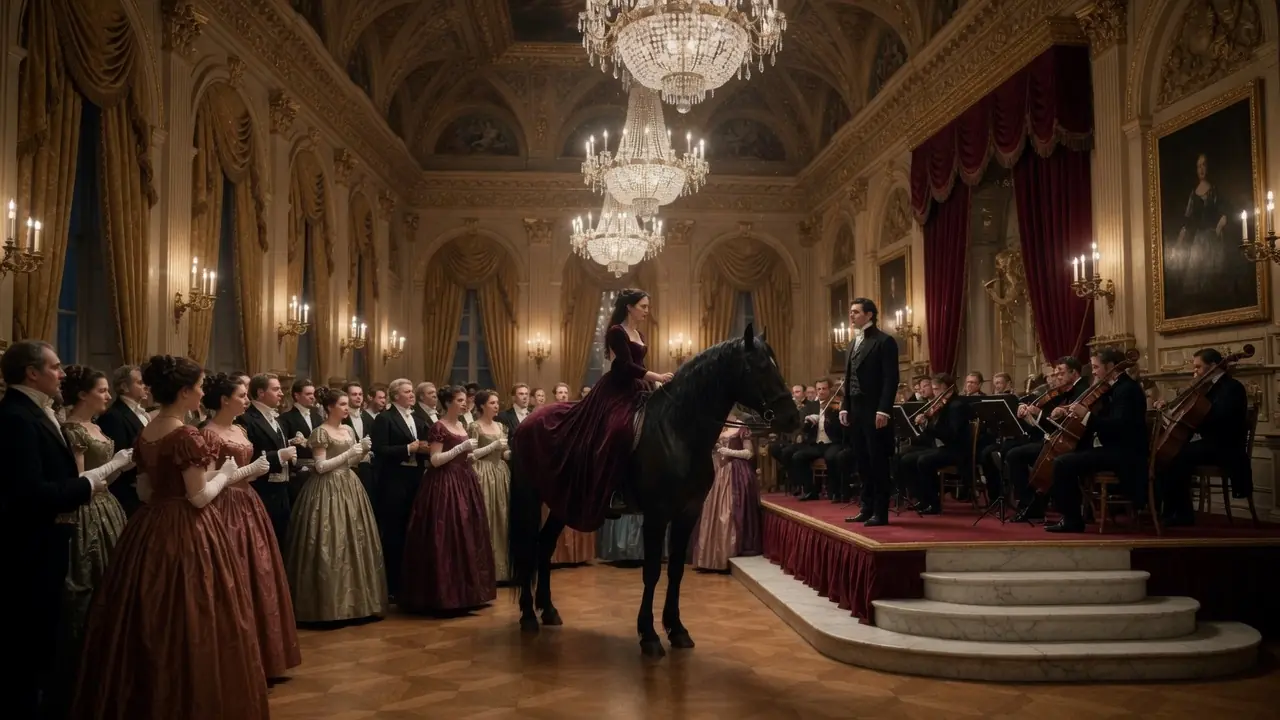
She rode the black warhorse through the open doors of the Ravenscroft Ballroom at nine, and three hundred witnesses forgot how to breathe at the same time. The chandeliers swung, not from wind, but from the tremor of three hundred indrawn breaths, sucking the air out of a room the size of a small chapel. Candlelight rocked across the polished oak. The orchestra, mid-bar through a minuet, lost the violins first, then the cello, then the cornet, until only the harpsichord kept stuttering on, played by a boy too frightened to look up.
Sar's iron-shod hooves struck the parquet with the steady arithmetic of a man counting coins. One, two, three, four. Beatrice Hartley rode him bareback in a gown the color of old wine, her dark hair tied at the nape with a strip of black velvet, her hands resting at the base of his mane, the way a woman might rest her hands on the shoulders of a friend. She had come to take her horse back. She had come to do it in front of every soul in the county. She had not come until precisely this moment to accept a marriage proposal she did not know had been made. Because in the Ravenscroft family, a fact never written down, never explained, never mentioned to outsiders for the simple reason that no woman had ever attempted it. A lady who rode the head of the house's warhorse straight into a ballroom under three hundred witnesses had by ancient form said yes.
In his family, it meant "I do."
She did not know that yet. The smell of the ballroom reached her in three layers as Sar took his next iron-shod step. Beeswax from the chandeliers, hot and faintly honeyed. Crushed rose petals on the parquet, sweet and bruised. Beneath both, sharper, the salt of three hundred bodies dressed in silk and broadcloth, and held too long in a room too warm. The wind from the open doors at her back stroked the bare skin at the nape of her neck and lifted one loose strand of her dark hair across her cheek. She did not raise her hand to brush it away. Her fingers were busy at the warm slope of Sar's neck, where the velvet of his coat had gone damp under her palm.
The man who did was standing fifteen feet from the dais in a coat the color of midnight and a cravat tied with the wrong amount of care. And the look on his face when she saw it was not the cold imperial fury she had spent three weeks rehearsing against. It was something worse. It was the look of a man who had just watched a door close behind him and heard the lock fall on the other side.
Duke Adrien Ravenscroft set down his glass. He did not raise his voice. He did not need to. "Miss Hartley," he said, and the orchestra's harpsichord finally stopped. "You appear to have brought my horse."
Beatrice's lips parted. Her throat had gone dry. The cold iron of the bridle she did not need pressed against her thumb, where it lay folded in the velvet of Sar's mane. Somewhere above her, a candle sputtered, and a single drop of soft, hot wax fell with a small, bright tap onto the polished stone of the floor below the chandelier.
It was not the line she had prepared. She had prepared a speech about ledgers and seizures, and the particular cruelty of taking a horse a girl had raised from a foal. She had prepared three opening sentences and three closing sentences and a long middle in which she would name him by his title as a thief. She had not prepared for him to look at her like that, like a man counting the cost of something not yet purchased.
"He is mine," she said. A voice carried. She had learned at fourteen to pitch a voice to fill a stable. A ballroom required less. "He has always been mine. I have come to take him home."
A gasp from the gallery. A woman in lavender fainted or pretended to. Somewhere behind a pillar, a small dog began to bark.
Adrien Ravenscroft did not look at the gallery. He did not look at the dog. He looked at the horse and then at her and then very briefly, very precisely at the dowager. Seated in a high-backed chair beside the orchestra, her face the color of bone china and her hands folded over a fan she had stopped using. The dowager met his eye. She did not smile. She did not frown. She inclined her head once, the smallest possible movement, the kind a woman makes when she is delivering a verdict in court.
Adrien's mouth did something complicated.
"I see," he said.
Beatrice did not see. Beatrice saw only the man who had taken her father's estate, sold off the orchards, and ridden the prize stud horse her father had bred to a winning bloodline. Beatrice saw the architect of her ruin, standing in midnight broadcloth, with his shoulders straining the seams. He was infuriatingly very young, twenty-eight to the day, and he was more infuriatingly still, very handsome. She had been told he was cold. She had been told he was exacting. She had not been told he was a man whose mouth could do that complicated thing.
"I have come for what is mine," she said again, because repetition felt safer than improvisation. "Have someone open the doors at the other end of the room. I will ride him out as I rode him in."
"Miss Hartley," said the Duke, "I do not believe you understand what you have just done."
"I have ridden into a ballroom," she said. "I am aware."
"Yes," he said. "I see that you are."
He took one step toward her. Sar's ear flicked. The horse knew him. Of course the horse knew him. Sar had been in the Ravenscroft stables for nine weeks, and Adrien rode every dawn, and a horse like Sar recognized a competent hand the way a violin recognized a competent bow. But Sar did not turn his head. Sar kept his eye on Beatrice's left hand, where her thumb had laid itself against the warm slope of his neck in the silent code she had taught him before he was weaned.
"I would prefer," Adrien said, "to have this conversation in private."
"I would prefer," Beatrice said, "to leave."
"Then we are at an impasse," the Duke said. "Because if you leave this room on that horse by the customs of my house, customs older than the house itself, you have accepted a proposal of marriage you do not appear to have heard."
The ballroom did not breathe. Beatrice's hand tightened on the velvet of Sar's mane. Her thumb did not lift. She felt beneath her riding gloves the steady triple beat of the horse's pulse. Her own heart was in disagreement with it.
"That," she said carefully, "is not a custom I recognize."
"No," said the Duke, "it would not be. It is mine."
"Then have it changed."
"Customs," he said, "are not changed in the space of a minuet."
She heard her own laugh before she decided to give it. It came out low and surprised, more breath than sound.
"Then I shall have to be very careful," she said, "about how I leave."
The harpsichord boy at the dais lifted one trembling hand from the keys. A footman at the far wall, who had been holding a silver tray of small empty glasses for the better part of a minute, set the tray down on a side table without looking at it. The candle on the second sconce on the east wall guttered once and steadied. A small, dangerous thing flickered at the corner of Adrien Ravenscroft's mouth. It was not quite a smile. It was the thing a smile becomes when a man has been told for three weeks that he must marry a woman he has never met and a woman he has never met instead rides his stolen horse through his front doors and tells him she will be careful.
He inclined his head the smallest possible movement.
"Miss Hartley," he said, "would you care to be introduced?"
Behind him, against the back wall of the ballroom, a young woman in a gown the color of new ivory took one slow step backward and laid her hand on the arm of a gentleman in a wine-colored coat. The gentleman's mouth, unlike the Duke's, was doing nothing complicated at all. The gentleman's mouth was tightening into a line. The young woman in ivory was Lady Cordelia Vance, twenty-five years old, beautiful in the cold, particular way that ivory is beautiful, and she had been informed at breakfast that she would be betrothed by midnight. The gentleman beside her was her cousin and trustee, Mr. Julian Vance, who had spent six months arranging for that betrothal to happen for reasons that had nothing to do with Cordelia's happiness, and a great deal to do with the architecture of a debt no one in this room, except him, yet understood.
Mr. Julian Vance had just watched eleven months of careful financial engineering ride bareback through a doorway. He was not smiling either.
Beatrice did not know any of this. Beatrice knew only that she had ridden her horse into a ballroom to take him home, and the man who had taken him from her had asked her to be introduced, and she, who had practiced for three weeks how to be cold, could not quite think of a reason to refuse.
"Your Grace," she said, and the orchestra, with the desperate gratitude of musicians who have been given permission to be useful, began very softly to play. She was not, she discovered, going to leave on the horse. She was, however, going to leave on something. She had not yet decided what.
The Dowager Duchess of Ravenscroft was seventy-two years old, and she had attended four coronations, two royal funerals, and one private execution she did not speak about. She had outlived a husband, two brothers, a son, and a long list of opinions she had once held with great confidence.
She had not in seven decades of life seen a woman ride a horse into her ballroom. She had read about it once in a leather-bound chronicle in the family library in a section of Margelia her great-aunt had written in faded brown ink in a passage about the third Duke of Ravenscroft and the woman who had become his duchess in 1612.
The chronicle was not consulted. The story was not told. The custom existed because the family was old enough to have customs no one used.
The dowager closed her fan very slowly. She set it on her lap. She watched her grandson lead a girl in a wine-red gown and a black warhorse off the ballroom floor and through the door to the small library with the kind of attention she had once given to a chess opening played by a master.
She was not surprised that the girl had ridden in. She was surprised that her grandson had not denied the custom. That, she thought, was the interesting fact of the evening.
In the small library, Adrien Ravenscroft closed the door behind them. The horse stood in the middle of a Persian carpet that had cost his father six hundred guineas, the brass tack of the bridle catching candlelight, and the Duke considered very briefly what it said about his life, that he was now relieved to be in a room small enough to contain only a horse, a woman, and the consequences of his own existence.
"You may dismount," he said.
"I prefer not to, Miss Hartley. Your Grace." He pressed his fingers briefly to the bridge of his nose. "If I open that door and let you ride out, your reputation is finished. If you do not ride out, my reputation is also finished because the entire county now believes I am to marry a woman I had not an hour ago met.
"If you dismount, we may have a conversation. If we have a conversation, we may discover whether there is a path that ruins fewer lives. I am asking you to dismount."
"You are asking me to surrender my horse."
"I am not. You took him."
"I did for a debt my father owed."
"Yes. A debt I did not know existed until the bailiffs arrived."
He was silent. Sar shifted his weight. The carpet whispered under one iron-shod hoof.
"That," the Duke said at last, "is also true."
"Then we will not have a conversation. We will have a transaction. I dismount. You return my horse. I leave through the side door. The county may make of it what they will."
"They will make of it," he said, "exactly what the custom says they will make of it. A girl rode a duke's warhorse into his ballroom. A girl is now alone with the duke in a small room. The county does not require subtlety, Miss Hartley. The county requires a wedding."
"Then there will not be a wedding," she said. "There will be a scandal. I have already survived one. I will survive another."
"What scandal?"
She lifted her chin. "My father," she said, "owed your father a great deal of money. Your father did not call in the debt while my father lived. Your father waited. Your father called it in three weeks after my father was carried into the family chapel when I was twenty-three and unmarried, and had not yet had time to learn the word executor.
"Your father took the orchard. Your father took the South Field. Your father took the stable and the studbook and a horse I had raised from a foal whose dam was named Briar.
"Your father, Your Grace, was perhaps as exacting as he was reputed to be. But your father, Your Grace, did not have the courage to take Sar himself. He sent a steward with a paper. The steward led him out at dawn before I was awake. I was twenty-three years old, and I learned about my horse from a stable boy who was eight."
She had not meant to say all of that. She had meant to say none of it.
The Duke did not interrupt. He had not, in fact, moved at all.
"That," he said very quietly, "is the first I have heard of any of that."
"You are the head of the house."
"I have been the head of the house for fourteen months."
She looked at him. He looked back.
"Fourteen months," he said. "And in those fourteen months, I have done many things. I have read four hundred ninety-one letters. I have written one hundred twelve letters of apology I have not yet sent. I have not in those fourteen months taken a single horse from a single house. The Hartley estate seizure was completed by my father's steward four months before I came into the title. The horse you raised from a foal was already in the eastern stable when I rode him for the first time, and I did not know.
"Miss Hartley, you may believe this or not. I did not know whose hand had taught him to lift his head when a thumb pressed against the slope of his neck. I noticed that he did it. I noticed that no one had taught me how to make him do it. I assumed it was a habit of the previous rider. It did not occur to me that the previous rider might still be alive and standing on the same county map as I was."
The horse made a small sound, the kind a horse makes when he is being talked about and is not certain whether to be pleased.
Beatrice felt the heat behind her eyes and refused with a discipline she had practiced for three weeks to permit it.
"You did not know," she said.
"I did not know. That is convenient."
"It is not convenient," the Duke said. "It is shameful. I've been the head of this house for fourteen months, and I did not know that my own stable contained another woman's horse. If I had known, I would have written to you. If I had written to you, you would not have ridden through my door, and I would not be standing in a library with the most striking woman I have seen in nine years, asking her with very little dignity to please dismount."
She blinked.
"What?" she said.
"I would have written to you after."
"Yes, you. Your Grace, you are saying a great many things at once."
"Yes," he said. "I appear to be."
The horse made the small sound again. Beatrice's thumb against his neck was trembling. She was aware of it because Sar was aware of it. The horse turned his head and laid his velvet nose very lightly against her knee. The way he had done since he was a foal in a stall full of straw and her father's pipe smoke.
"I will dismount," she said, "but not because you have asked, because my horse has."
"That," the Duke said, "is acceptable."
She slid down. The carpet was thicker than the parquet had been. Her boots made no sound at all. He did not offer his hand. She would have refused it. He seemed to know that.
He went to the door and he did not open it. He turned the key.
"Miss Hartley," he said, "I am going to tell you what I think has happened tonight. You may correct me when I am wrong."
She drew breath to refuse and then because the heat behind her eyes was now a danger and she needed a reason to look at him that was not crying, she did not refuse.
"Speak," she said.
He spoke.
He spoke for eleven minutes by the small library clock, and at the end of it, Beatrice Hartley understood three things she had not an hour before known.
The first was that her father had not owed Adrien Ravenscroft's father any money at all.
The second was that Adrien Ravenscroft's father had owed someone else a sum so large it would have crushed the house and had concealed it by manufacturing a debt against the Hartley estate and seized the Hartley assets to cover his own liabilities to a creditor whose name was on a paper in a locked drawer Adrien had not yet been able to open.
Beatrice sat down on the arm of a leather chair. She put her hand against her temple. She made for one short moment a sound that was not quite a laugh.
"And the warhorse custom," she said.
"That," he said, "is genuine. It is appalling."
"Yes. Could you not simply tell the dowager to deny it?"
"I could. She would refuse."
"Why?"
The Duke considered her. He was, Beatrice realized, not looking at her the way he had looked at her in the ballroom. He was looking at her now the way a man looks at a hand of cards he had not expected to be dealt.
"Because," he said, "my grandmother believes that the woman my house needs is not the woman the county would choose. She believes my house needs a woman who can ride a stolen horse through a ballroom door. And she has," he added with the smallest movement at the corner of his mouth, "been waiting fifty-three years for the opportunity to say so."
"That," Beatrice said, "is not a marriage proposal. That is a casting decision."
He inclined his head.
"And yet," he said.
"And yet," she echoed.
She looked at the horse. Sar was eating a tasselled bookmark off the corner of a side table with the placid contentment of an animal who had decided he was home.
"You will need," she said, "to explain this to your betrothed."
"I will. And to her cousin."
"Yes. And to three hundred witnesses."
"I am aware."
"And you will need to do it," she said, "in a way that does not announce to the cousin that you know about the debt, because if he knows you know, he will not give you time to find the paper in the locked drawer."
There was a long silence.
The Duke looked at her with an expression she did not at first identify. Then she did. It was respect. It was more dangerously recognition.
"Miss Hartley," he said, "I do not know what your situation is. I do not know what you ate this morning, where you slept last night, what plans you had for the next twelve hours of your life. I am about to ask you to disregard all of those plans. I am about to ask you to permit for the next four weeks the county to believe that you intend to marry me. At the end of those four weeks, if we have not found the paper, you will have a reputation no honest man in the south of England will overlook. At the end of those four weeks, if we have found the paper, you will have your estate, your horse, and a story you can tell at dinner parties for forty years. I am asking you to gamble those four weeks against the possibility that I am telling you the truth."
"And if I refuse?"
"You will ride out through the small door in the kitchen. I will give you Sar and the deed to the eastern stable. I will tell the county that the custom is a lie. I will in three months lose this house to Mr. Julian Vance through the dowry of a girl who deserves better than him. The house was built in 1581. It has stood through four civil wars and a religious revolution. It will not stand through the next quarter if you ride out the small door tonight."
He paused.
"Miss Hartley," he said, "I am not above asking. I am asking."
Beatrice felt very precisely the thing women in her family have been raised to fear. It was not fear. It was clarity. The clarity of a moment in which more than one life pivots on a single sentence.
She let it pivot.
"Four weeks," she said. "Four weeks on terms. On any terms. I will not lie to your grandmother. She would not permit it. I will not sleep under this roof."
"There is a dower house. It is furnished. I will have it opened tonight."
"I will keep Sar with me."
"He is yours. He has been yours since before I knew his name."
"And at the end of four weeks," she said, "if the paper exists, you will burn the debt."
"I will burn it in your hand."
She held out her hand.
"Not," she realized, "to be kissed."
She had meant it as a clerk's hand, the hand of a woman closing a contract.
The Duke looked at her hand. He did not, thankfully, kiss it. He held it briefly, the way one might hold the wrist of a soldier one had just sworn into a regiment. And let it go.
"Your Grace," she said in the small, dry voice of a woman who had just lost control of her own life, and was determined to seem amused about it. "We have between us three hundred witnesses, a stolen horse, a fraudulent debt, a hostile betrothed, and a custom that has not been used since the reign of James I.
"I should very much like a glass of something stronger than water."
Adrien Ravenscroft went to a sideboard. He poured two glasses of brandy. He gave her one. He did not, she noticed, pour one for himself in the easy practiced way of a man who poured them often. He poured it like a man who had decided an hour ago that he could not afford to be unsteady and was now deciding to make an exception.
"To four weeks," he said.
"To four weeks," she said.
The horse behind them finished the bookmark.
Outside the library, very faintly, the orchestra had begun a second minuet, the kind a conductor chooses when he wishes to suggest that the company should resume pretending nothing had happened.
The candle on the small library desk burned with a steady, warm flame. The brandy in Beatrice's glass smelled of oak and dried apricots.
Sar took very deliberately a second tasselled bookmark off the side table and laid it on the carpet at his own feet as a hostage.
Beatrice did not sleep that night. She did not, in fact, sleep for the better part of three days. The dower house had been opened by half past midnight. Three maids in mobcaps had aired the linens. A fire had been laid in the small drawing room. A cold supper had been left on a side table. Bread, butter, a wedge of pale cheese, three slices of cold game pie.
Beatrice ate none of it. She walked through the rooms in her riding boots. She opened a window to the autumn air. She let the smell of wood smoke and turned earth and the first rotting apples of the season come in through the casement and remind her gently the way the country does that she was still herself.
Sar was in the small stable attached to the dower house. She had walked in there herself in her stained gown with the Duke's groom carrying a lantern three paces behind. The groom had not spoken. The groom had simply opened the stall, watched Sar amble in, and closed the door very softly. He had bowed before he left. He had not, Beatrice noticed, bowed to her as a miss. He had bowed to her as a lady. Word, evidently, traveled.
She sat at the writing desk and tried to compose a letter to her sister. Eleanor was at school in Bath. Eleanor was sixteen. Eleanor would be ruined by association if this went wrong.
Beatrice wrote one sentence.
"Dearest, I have done something very strange and you must not panic."
And put down the pen. She would write the letter when she could finish the sentence honestly.
She walked back to the window. The autumn moon was on the orchard. The orchard had been her father's. The orchard since four months ago had been Adrien Ravenscroft's.
She watched a pair of barn owls cut across the silver and decided that for four weeks she would not think about the orchard. She would think about the paper in the locked drawer.
She slept in her boots on the chaise with the curtains open the way she had slept the night her father died, the way she had slept on certain other nights when she had needed to be ready for whatever the morning brought.
A barn owl crossed the casement once. The fire in the small grate burned low and put out the soft, warm smell of applewood.
The wind from the orchard turned a single dry beech leaf along the gravel of the path beneath her window with the soft scrape of paper.
Adrien Ravenscroft did not sleep either. He went instead to the long gallery where the portraits of his ancestors hung in two unbroken rows from the time of the first earl to the time of his late father and he walked the length of it twice.
He stopped at the portrait of the third duke. The third duke was painted in armor holding a black warhorse by the bridle with a small dark-haired woman beside him in a wine-red gown. The painter had captioned her in a fine italic hand at the bottom of the canvas. "Eleanor, who rode him in."
He had walked past that portrait, he calculated, perhaps eight hundred times in his life. He had never read the caption.
The dowager found him there at three in the morning in his shirtsleeves with the cravat untied and a candle in his left hand. She did not at first speak. She came and stood beside him in her dressing gown, silver-gray, the color of an old mirror, and looked up at Eleanor of 1612.
"You did not deny the custom," she said.
"No."
"You could have."
"Yes."
"Why did you not?"
He considered the portrait.
"Grandmother," he said, "she rode my horse into my house. I have spent fourteen months being the head of a house that does not want me. She is the first thing, the first thing in fourteen months, that has felt as though it belonged."
The dowager was quiet for a long time.
"Adrien," she said.
"Yes, Grandmother."
"You will not in the next four weeks fall in love with her."
He looked at her briefly with an expression that was almost amusement.
"Why not?"
"Because if you fall in love with her in four weeks," said the dowager, "you will in the fifth week be a fool. The girl is not yours. She is here on a contract she made in the time it takes a horse to eat a bookmark. You will treat her with the respect she has earned. You will keep your hands to yourself. You will give her the four weeks she has bought from you. And you will not, Adrien, you will not look at her in public the way you looked at her tonight in the small library."
"How did I look at her in the small library?"
"Like a man who has just been told the answer to a question he did not know he was asking."
He was silent.
"Grandmother," he said at last, "I do not know how I will look at her in public. I have only just begun."
The dowager turned. She tapped his arm once with her closed fan. The way a fencing master taps a pupil who has stood too long in a single position.
"Then begin," she said, "with caution."
The candle in his left hand burned a thin, steady gold. The portrait above him caught the light at the painted velvet of Eleanor's gown and seemed briefly almost warm.
She left him in the gallery with the smell of cold wood smoke from the low fire and the soft sigh of wind at the high windows. He stood a long time without moving. The candle on the side table had burned down to a finger's height, and the warm tallow ran in slow, bright threads onto the brass dish beneath.
He pressed the heels of his hands briefly to his eyes. He listened to the small, ordinary creak of an old house settling against its stones in the cold.
He did not, when he opened his eyes, look at the portrait again. He looked instead at his own broad hand on the smoothed wood of the gallery rail, and tried to remember how it had felt against the wrist of a black warhorse who knew a thumb that was not his.
The first morning of the four weeks began under a low autumn sky, the color of wet stone. Mist hung in the orchard at the bottom of the dower garden, and the grass was bright with cold dew that soaked the hem of Beatrice's brown wool skirt as she walked from the small stable across the lawn. Wood smoke drifted from the chimney of the dower house and threaded through the bare branches of an old pear tree. The air on her face was sharp, and her breath went out in pale clouds. The wind broke them before she had finished making them.
It was seven when Lady Cordelia Vance arrived in a carriage Beatrice did not recognize with a footman she did not know and a face she had not had time to prepare for.
Beatrice had been brushing Sar in the small stable. She was in a brown wool riding habit she had stitched herself with the sleeves rolled to the elbows and her hair tied with the same strip of black velvet she had worn the night before.
She looked up at the sound of carriage wheels on gravel and saw a young woman in pale silver step down with the careful grace of a woman who had been raised to enter rooms.
Cordelia Vance was, Beatrice acknowledged with the cool precision of a stable hand grading a horse, beautiful. She was tall with a small waist, a long throat, hair the color of pale honey, and eyes the gentle blue of a winter morning. She was twenty-five. She was by every measure the county recognized the more obvious choice.
She came toward the stable with her hands folded in front of her. The footman waited at the carriage. She did not, Beatrice noted, look frightened. She did, however, look tired. The cold autumn light caught her pale honey hair at the temple and showed very faintly the smudge of a sleepless night beneath each eye.
A small wind moved at the hem of her silver silks and brushed the dust from a single chrysanthemum at the edge of the path.
"Miss Hartley," she said.
"Lady Cordelia."
"I have come," said Cordelia, "to be unpleasant already. I prefer to begin as I mean to go on."
Beatrice set down the brush. She wiped her hands on a cloth. She came out of the stall and stood in stable boots with horsehair on her sleeve across from a young woman in pale silver who had probably never stood in a stable in her life.
"I am told," said Cordelia, "that the Duke has decided he must marry you because of an ancient custom involving a horse and a ballroom."
"That is what he has decided."
"And you have accepted for the moment."
"Why?"
Beatrice considered her.
"Lady Cordelia," she said, "I have a great many reasons. None of them, I think, are reasons you would respect. I do not believe I owe you an explanation, but I am willing to tell you one true thing if you will tell me one in return."
Cordelia's chin lifted. Beatrice noted the lift. It was the same gesture Beatrice herself had used the night before. A lift learned somewhere from a governess.
"Very well," said Cordelia. "One true thing. You did not want to marry him."
There was a pause.
"No," said Cordelia. "I did not."
"Then why were you in his ballroom in a gown the color of new ivory?"
The pause was longer.
"Because," said Cordelia very evenly, "my cousin Julian is my trustee. Because my cousin Julian is the only relation I have left. Because if I refused him, I would be sent to a small house in Norfolk to live with an aunt who has not spoken to me since I was eleven, and I would not, Miss Hartley, be permitted to take my horses or my music. My cousin Julian has been very clear about the cost of refusal."
Beatrice did not on reflection expect that answer. She watched Cordelia's hands. The hands were folded carefully. They were also, Beatrice noticed, trembling very slightly at the knuckles.
"Lady Cordelia," she said, "I will now tell you my true thing because you have told me yours and you have told it honestly.
"I did not come here to marry the Duke. I came to take my horse. I am here for four weeks because the Duke and I are trying to find a document that will, if we find it, free us both. If we find it, you will not have to marry him either. If we do not find it, you will."
Cordelia was quiet for a long moment. The wind moved a strand of pale honey hair across her cheek. She did not, Beatrice noticed, brush it away.
"A document," she said. "A paper in a locked drawer concerning Julian, concerning the original Ravenscroft debt."
Cordelia did not react. She did not flinch, sigh, gasp, or, Beatrice noticed, appear surprised.
"Lady Cordelia," said Beatrice. "Did you know about the debt?"
"I knew," said Cordelia, "that my cousin Julian has not spent any of his own income for three years, and yet has acquired two carriages, a London townhouse, and the lease on a country shoot in Suffolk. I knew that he carries a brass key on a watch chain that he has never permitted me to see closely. I knew that on the evening I was told I would be marrying the Duke, my cousin Julian asked me whether the Ravenscroft Library had been catalogued in the last decade. I did not know the answer. I gave him the answer he wanted because I have learned to give him the answers he wants. The answer I gave him was no."
She paused.
"It was the truth," she added, "which made it easier to give."
Beatrice felt very precisely the small rearrangement of an assumption she had made the night before.
"Lady Cordelia," she said, "would you in the next four weeks be of any assistance to me?"
Cordelia looked at the horse in the stable. She looked at the wool riding habit. She looked briefly at the brown horsehair on Beatrice's sleeve.
"I came here," she said, "to be unpleasant. I find that I cannot manage it."
"Try," said Beatrice.
"I should very much like," said Cordelia, "to ring your neck for riding into a room I had spent six weeks dreading. I should very much like to call you a hussy, a charlatan, and several other words I've heard my cousin use about women who refuse him. I should very much like to be furious, Miss Hartley. I find, however, that I am instead extremely tired."
"Then you may sit down," said Beatrice. "There is a bench."
Cordelia sat. She arranged her silver silks with the small, careful gestures of a woman who had been taught at six that a lady arranges her silks.
Beatrice, after a moment, sat beside her.
The two of them sat in a stable yard at eight in the morning and looked at a black warhorse who had finished his hay and was leaning his nose against the bars of the stall to listen. The smell of clean straw came warm out of the stable behind them. A gray kitten the cook had brought in for mice padded across the cobbles on small soft feet and rubbed once at the toe of Beatrice's boot. Above the courtyard two doves circled in the cold bright air and settled with the dry rustle of feathers in the roof of the loft.
"You are," said Cordelia, "not at all what I expected."
"What did you expect?"
"A woman in a riding habit covered in mud with a great loud voice and an enormous laugh. I had decided I would dislike you."
"I am sorry to disappoint."
"You are not at all sorry."
"No," Beatrice admitted. "I am not."
Cordelia looked at her sideways, the small, careful look of a woman who is for the first time in some years considering whether she might have an ally.
"Miss Hartley," she said, "if you find the paper, what becomes of me?"
"You go where you want. And if I have nowhere to go," Beatrice considered, then she said, "I will find you somewhere. I have an aunt in Cornwall who has a great deal of opinions and not enough company. She would terrify you for the first six months. After that, you would terrify her. She has a piano."
Cordelia laughed. It was a small surprised laugh, the kind a woman makes when she has not laughed in some time and the muscle is not quite warm. It came out a little hoarse.
"A piano," she said. "A very good one."
"Miss Hartley," said Cordelia. "I should like to be useful. I do not know how, but I should like to be."
"Begin," said Beatrice, "by telling me which drawer."
Cordelia thought.
"He keeps the key on his watch chain. He never sets the watch down. He sleeps with it under his pillow. I know because the chambermaid in our London house was once required to tell me so. He has, however, one habit. Every Thursday evening at nine, he goes to a club called the Mulberry in St. James where he plays piquet. He plays until exactly midnight. He never wins. He never loses very badly. He leaves at twelve, takes a hackney to a small house in Bloomsbury where I have never been permitted to visit and remains there until dawn."
"A small house in Bloomsbury?"
"Yes. And the watch? He hangs it on a hook by the bed. He does not, Miss Hartley, please do not look at me like that. He does not bring his watch into another woman's bed. He is fastidious about timepieces. It is one of his very few mercies."
Beatrice put her hand over her mouth. She was, against her better judgment, smiling.
"Lady Cordelia," she said. "Is there a Mrs. Vance in Bloomsbury?"
"There is."
"Is she?"
"She is his wife," said Cordelia, in the calm voice of a woman delivering a fact she had carried for two years. "He married her in secret in 1815. She was a singer. She is now, I am told, a respectable widow's companion. She does not know he is arranging a marriage between him and me through the Ravenscroft estate. She believes him to be a barrister. She does not know, Miss Hartley, please. She does not know about the debt either."
Beatrice slowly lowered her hand.
"Lady Cordelia," she said. "May I ask you a question that is going to be appalling?"
"Yes."
"Is there a child?"
"Two," said Cordelia.
"How old?"
"Four and two."
"Healthy?"
"Very."
Beatrice closed her eyes briefly. She opened them. She looked at the woman beside her on the bench. Twenty-five years old, pale silver silks, pale honey hair, a piano in a small house in Cornwall.
And she did the arithmetic.
"He cannot," she said, "marry you."
"No. He intends to."
"Yes, because he needs the dowry."
"Yes. And the small house in Bloomsbury. He has told the lady there that he is in negotiations to purchase a country estate for her. He has told her she will be the mistress of it before Christmas. He has not, Miss Hartley. He has not told her that the estate in question is Ravenscroft Hall, or that the marriage by which he intends to acquire it is to me, his cousin, on the basis of a debt he engineered with the Duke's late father."
Beatrice looked at the horse. The horse looked back. The horse, with the wisdom of all horses, kept his opinions to himself.
"Lady Cordelia," she said. "I think we are going to ruin your cousin."
"I had hoped you might say that we will not, however, ruin his wife or his children."
"No. They are innocents."
"They are innocents."
"Then," said Beatrice, "we will need a plan that takes the estate out of his reach without putting them in a workhouse. We will need the Duke. We will, I think, need the dowager. We will very probably need a great many leather-bound ledgers and we will need Lady Cordelia to keep your cousin convinced for as long as possible that you are still his obedient cousin and that I am still a silly girl who rode a horse into a ballroom and is now entirely overcome by the prospect of becoming a duchess."
Cordelia considered her sideways. There was just for a moment a small bright glint in her winter-blue eyes that Beatrice had not seen before.
"Miss Hartley," she said, "I have been an obedient cousin for nine years. I think I can manage four more weeks."
"And I," said Beatrice, "shall try to be silly."
"He will be terrible at it."
"I shall practice."
Cordelia laughed again. It was a less hoarse laugh than the first one. The muscle, Beatrice noted, was warming up.
The Duke arrived at the dower house at ten with a leather portfolio under one arm and the dowager on the other. He had, by Beatrice's count, slept perhaps an hour and a half. His cravat was tied with great care. The dowager was in walking gray. She had a fan she was not using.
He stopped on the gravel when he saw who was on the bench.
"Miss Hartley," he said carefully. "Lady Cordelia."
"Your Grace," they said together in perfect unison, which produced a small flicker at the corner of the Duke's mouth that Beatrice, having now seen it twice, was beginning to catalog.
"Lady Cordelia has," said Beatrice, "come to call upon her future cousin by marriage. We have established a great many things, most of them concerning a small house in Bloomsbury and a watch on a hook."
The Duke's expression did not change.
The dowager's did. The dowager's eyebrows rose precisely half an inch.
"Indoors," she said. "All of us."
They went indoors.
The small drawing room of the dower house, lit by autumn sun through tall windows, held a low table on which Beatrice arranged in order a sheet of paper, a stub of pencil, and the cold pie she had not eaten the night before, because it occurred to her she had not yet had breakfast.
The Duke sat. The dowager sat. Cordelia sat.
Beatrice ate the pie standing up.
"Your Grace," said Cordelia, after a moment of fortifying silence. "I must beg your forgiveness."
"For what, Lady Cordelia?"
"For my cousin?"
The Duke set down the portfolio.
"Lady Cordelia," he said. "Your cousin is your cousin. You are not your cousin's keeper. I am, however, very interested in the small house in Bloomsbury."
Cordelia told him. She told him neatly in the careful chronological way of a woman who had been rehearsing the facts privately for two years.
The Duke wrote nothing down. The dowager wrote nothing down. Beatrice ate the pie.
When Cordelia had finished, the Duke leaned back in the chair, set the tips of his fingers together, and looked at the ceiling.
"Grandmother," he said.
"Yes."
"In your judgment."
"In my judgment," said the dowager, "we have a great deal of work to do in a very small number of weeks. We have in our favor the fact that Mr. Julian Vance has spent six years assuming that everyone in this house is exactly who he believes them to be. We have against us the fact that he is not stupid. He is in fact the kind of man who is only intelligent because he has never been opposed by a person of equal intelligence. He will be slow to recognize that he has now been opposed by four."
"Four," said the Duke.
The dowager looked at him as one might look at a child who had asked an unhelpful question.
"Adrien," she said, "do you imagine I intend to sit in the gallery and embroider?"
The Duke had the grace to incline his head.
"Five," said Beatrice.
They looked at her.
"My horse," she said, "is also opposed to him."
The dowager's lips moved. It was not quite a smile. It was the thing a smile becomes when an old woman has been waiting fifty-three years for a particular kind of girl to walk into her house and one has just walked in.
"Quite right," she said.
For the next three days, four humans and one horse rearranged the architecture of a county.
It rained on the second day, a long soft autumn rain that filled the gutters of Ravenscroft Hall and stained the granite stones of the courtyard the color of slate.
Inside, the smell of wet wool and the sharp green tang of fresh ink hung over the library. Tallow candles burned in pewter sticks along the long oak table where Beatrice had spread her ledgers. The fire crackled and now and then spat a soft red ember onto the iron of the hearthstone where it cooled to a black bead and was eventually swept away by a maid who came in twice an hour with fresh logs.
The Duke wrote letters. He wrote to his solicitor in London, a careful letter in the formal hand of a man requesting a routine review of estate records dated four weeks back to suggest the inquiry had been quietly underway for some time. He wrote to a former tutor at Cambridge, who had once been a clerk of the court of chancery, and who the Duke had reason to believe owed a small personal favor. He wrote to his cousin in the north, who had married a woman whose brother managed a small private bank, and asked with great courtesy and no detail whether the brother might inquire as to whether a particular gentleman had any outstanding obligations of significance.
He wrote at four in the morning in the long gallery by the light of three candles, with the third Duke and Eleanor of 1612 watching him over his shoulder.
Beatrice spent the days in the library. The dowager had given her with one cool gesture of her gray-gloved hand the run of every shelf in the house.
Beatrice went through the ledgers in the order in which they had been bound from 1581 to 1825.
And she did it the way a woman raises a foal slowly, patiently, refusing to be hurried.
She found on the third afternoon a discrepancy in 1819. A sum of £9,400 entered as a tithe payment to a parish that did not exist. She marked the entry with a strip of pale ribbon, and went on.
Cordelia practiced silliness. She wrote her cousin Julian three letters in five days, each more confiding than the last. She told him that Miss Hartley was, despite the unfortunate horse business, really quite a charming creature, but plainly out of her depth socially. She told him that she had been kind to Miss Hartley as instructed and was making excellent progress in becoming her confidante. She told him that the Duke seemed thoroughly disenchanted with the unexpected betrothal and was already in private regretting his hasty acquiescence to the custom. She told Julian she would inform him the moment any opportunity arose to weaken the Duke's resolve. She signed every letter "Your devoted cousin, Cordelia."
Then she went to the dower house and laughed about it with Beatrice over tea.
The dowager held court. She sent for the rector. She sent for the magistrate's wife. She sent for the two unmarried daughters of the Lord Lieutenant of the county. She received them all in her small parlor in walking gray with a fan she was not using and the smell of beeswax candles thick on the warm air.
To each she told with the calm authority of a woman who had buried three dukes the same precisely calibrated story.
Miss Beatrice Hartley was a young woman of unusual character. Her ride into the ballroom had been, in the dowager's considered opinion, an act of justified spirit on the part of a girl whose horse had been most regrettably acquired by the late Duke's steward without the family's knowledge. The current Duke, on discovering the matter, had been mortified.
The custom of the family was an ancient one, and the dowager, being herself a woman who had once, as a girl in 1773, climbed a yew tree in front of three earls, found herself unable to disapprove.
The county on receiving this story repeated it over teacups and copper kettles, embellished it by the firelight of three dozen drawing rooms, and concluded within forty-eight hours that Miss Hartley was the most interesting woman in the south of England.
Sar, for his part, did very little. He ate hay. He grew shinier. He learned the layout of the dower house garden. He was at the start of the second week found one morning standing in the small drawing room with his nose in a vase of late roses, having let himself in through a side door no one had remembered to bolt.
Beatrice on discovering him did not scold. She apologized to the roses.
The dowager on hearing of the incident sent over a basket of apples and a note that said only "He is settling in. So I think are you."
The Duke called every morning. He did not after the first morning bring the dowager. He came alone on foot in a dark coat that did him entirely too much credit.
And he and Beatrice walked the length of the dower garden under the falling leaves and they talked about ledgers, debts, parish records, and the third duke's marriage in 1612.
They did not on the surface talk about anything else. The surface was carefully maintained.
On the seventh day, Beatrice saw a bee. She was walking ahead of him along a gravel path between the late asters, and the bee, heavy, slow, dazed with autumn, blundered into the bell of her sleeve and lost itself in the brown wool.
She stopped. She did not, she discovered, like bees.
She did not scream. She simply went very still, the way she had once gone still as a child when a barn cat had crawled onto her chest in her sleep.
"Stand still," said the Duke behind her.
"I am more still."
She did not respond because there was no degree more still available.
And a moment later, his hand, his ungloved hand, his uncomfortably warm hand, was at her wrist, sliding up under the cuff of her sleeve, and the bee, confused, indignant, dazed, climbed onto the back of his thumb and sat there for two long seconds before launching itself gracelessly into the asters.
The Duke stepped back.
Beatrice did not move at all.
"Miss Hartley," he said in a voice not quite as steady as it had been a moment before. "Forgive me."
"For what?" she said. Her voice, she was annoyed to notice, was not steady either.
"For the familiarity of my hand."
"You removed a bee?"
"Yes."
"It was a sensible response to a bee."
"Yes. Then there is nothing to forgive."
There was a silence.
"Miss Hartley. Your Grace."
"I should very much like," he said, with the careful cadence of a man making a tactical retreat, "to discuss the entry for 1819, the tithe to the parish that does not exist."
"Yes," she said. "I should like that also."
They walked on. They discussed the entry for 1819.
They did not either of them mention the bee.
At the end of the walk, the Duke bowed. Beatrice curtsied. They parted on the gravel like two surveyors who had just measured a difficult field.
The Duke walked back toward the great house with the particular stiff posture of a man who had just been touched by lightning and was trying to pretend nothing happened.
Beatrice went into the dower house, found Cordelia in the small drawing room and said without preamble, "Lady Cordelia, I have made a serious mistake."
Cordelia looked up from a book.
"Already?"
"It was a bee."
"It is always," said Cordelia, "a bee."
Beatrice sat down on the floor in her wool habit, put her hands over her face, and laughed for the first time in some months like a girl.
The first letter from Julian Vance arrived on the morning of the tenth day.
It came by hand, delivered to the Duke at the great house on heavy cream paper sealed with a wine-colored wax.
The seal bore a small bird.
"A vance," the Duke noted, in the heraldic sense. "An old French word for a kind of falcon."
The Duke turned the letter in his fingers for a long moment before he opened it.
Mr. Vance was concerned. Mr. Vance had heard, with the deepest distress, of the unfortunate scene that had taken place at the Duke's ball. Mr. Vance was certain that the Duke must in the wake of such an extraordinary incident be reconsidering the wisdom of an attachment formed in such irregular circumstances.
Mr. Vance wished to express with the warmest delicacy and the deepest respect for the Duke's private judgment his continued willingness to honor the original arrangement. His cousin Cordelia remained, of course, deeply attached to the Duke. He himself remained, as ever, the Duke's devoted and humble servant. He would call upon the Duke at the Duke's earliest convenience to discuss any matters the Duke might wish to clarify.
The Duke read the letter twice.
He went into his study, locked the door, and wrote a reply.
His reply did not say what he wanted to say. His reply said, in the formal hand of a young duke not quite certain of his own position, that he had been most touched by Mr. Vance's concern, that his betrothal to Miss Hartley was indeed irregular, but was, given the custom of his house, a matter of binding form, that he was sensible of Mr. Vance's continued goodwill toward the family, that he would be pleased to entertain Mr. Vance at Ravenscroft Hall whenever the gentleman's schedule permitted. He hoped Mr. Vance would understand that the next several weeks would necessarily be occupied with the unavoidable obligations of his new circumstance.
He remained with great regard, etc., etc.
He sent the letter.
He went to the dower house at noon.
Cordelia was already there.
Beatrice was at the writing desk in the small drawing room with three ledgers open and a pencil in her teeth.
The dowager, who had taken to coming over for luncheon with the regularity of a woman who had decided this was now her drawing room, sat by the window with a piece of needlework.
"He has written," said the Duke.
Cordelia read the letter once.
Beatrice read it twice.
The dowager read it three times and then looked at her grandson with the small, precise expression of a woman who had been right about something for fifty years and was pleased to be right again.
"He is testing," she said.
"Yes."
"He wishes to see how convincingly you can defend the betrothal."
"Yes."
"He believes you may be unstable in your enthusiasm."
"Yes."
"And so he has invited himself."
"He has."
The dowager set down her needlework.
"Adrien," she said, "how long shall we make him wait?"
The Duke considered.
"A fortnight," he said.
"Excellent," said the dowager. "And in those fourteen days we shall find the paper."
They did not in those fourteen days find the paper.
They found a great deal else.
They found the parish that did not exist. They traced the £9,400 of 1819 through three forged receipts to a gentleman named Mr. Septimus Lyle who had, they discovered through the tutor at Cambridge, been a junior clerk in the offices of a certain Mr. Julian Vance, then twenty-three years old, then unmarried, then not yet in possession of two carriages, a London townhouse, or the lease of a shoot in Suffolk.
They found, in a subledger marked "estate repairs," four more sums entered in the same careful clerk's hand, each of which had, when traced, gone to a man no Ravenscroft tenant had ever seen.
They found on the eleventh day the locked drawer.
It was in the small library, the same library where Beatrice had dismounted on the night of the ball, set into the paneling beside the fireplace, behind a portrait of the second duchess.
The Duke had known the drawer existed. He had not, in fourteen months of looking, found a key that fit it. He had assumed, wrongly he now realized, that the key had been lost in the same year his father was carried into the family chapel.
The dowager produced the key on the morning of the twelfth day.
She had had it, she said with a small unrepentant glint, since 1814.
She had not yet, she said, been asked for it.
"Grandmother," said the Duke, "you could not have given it to me earlier."
"I could not," said the dowager, "have given it to a man who had not first proved he intended to do something with what he found."
She turned the key in the lock.
The drawer slid open with a soft sigh of old wood.
Inside lay one paper, one paper only, folded once, sealed with the wine-colored Vance.
The Duke lifted it out. His hand, Beatrice noticed, was perfectly steady.
The paper, she also noticed, was not blank on the outside. It bore, in a careful clerk's hand she now knew by sight, five words.
"To be delivered upon my death."
The Duke broke the seal.
He read.
He read in silence.
He read a long time.
Then he handed the paper to Beatrice.
Beatrice read it.
The dowager beside her did not ask to see it. The dowager was watching her grandson's face.
When Beatrice looked up, she was very pale.
"Your Grace," she said.
"Yes."
"This is not a debt instrument."
"No."
"This is a confession."
"Yes."
"From your father."
"Yes. In which he admits in his own hand that he had no debt to my father, that he manufactured the seizure to repay his own gambling losses to Mr. Vance, and that he—Your Grace, I can hardly read this. He records here that Mr. Vance was the holder of the original debt and that the seizure of the Hartley estate was orchestrated for the purpose of using my father's lands as collateral. He says here that Mr. Vance threatened if the seizure did not occur to ruin the Ravenscroft name with a public revelation of—" She stopped. She had reached a line she did not wish to read aloud.
The Duke had reached it too when he read.
"Go on," said the dowager calmly. "I am old. I will not be shocked."
Beatrice handed her the paper.
The dowager read. Her face did not change.
When she had finished, she folded the paper precisely and set it on her lap.
"Adrien," she said.
"Grandmother."
"Your father was not a clever man."
"No."
"He was a frightened man."
"Yes."
"Frightened men sign confessions when they should sign nothing."
"Yes."
"This paper, Adrien, is not enough."
He looked at her.
"Why not?"
"Because this paper is a confession by a man who is in his grave. It cannot be cross-examined. It cannot be authenticated against a living witness. Mr. Vance will simply produce two gentlemen of good standing who knew your father in his last months, and who will swear on the book that the late Duke was not in his right mind when he wrote it. Mr. Vance will produce additionally a great many original loan papers in your father's hand that show real and substantial gambling losses. He will claim the confession is the document of a sick man who imagined a conspiracy where there was only his own—Adrien, dear—his own undisciplined character. The county will believe Mr. Vance. The court will believe Mr. Vance. This paper by itself gives us nothing."
There was a long silence.
Beatrice put her hand briefly to her temple. She had not slept properly in twelve days.
The paper she had thought would be the end of the matter.
"Then," she said.
"Yes," said the dowager. "Then we will need a living witness."
"Yes."
"Who would Mr. Vance trust?"
"No one."
"Who would Mr. Vance underestimate?"
The dowager looked at Cordelia.
Cordelia, who had not spoken since the drawer was opened, set down her teacup very precisely on the saucer.
"Me," she said.
"Lady Cordelia," began the Duke.
"Your Grace," said Cordelia, "I have been my cousin's obedient servant for nine years. I have in the past ten days written him three letters confirming his every suspicion. He believes he understands me entirely. He believes I am a frightened girl who will marry where she is told. He has never in nine years considered the possibility that I might be something other than what he requires me to be. He will on the day he is confronted look first at the Duke, then at Miss Hartley, then at the dowager.
"He will not look at me until I speak. He will look at me when I speak for the first time in his life. I should very much like when he does to have something to say."
The dowager regarded her with a long careful look.
"Lady Cordelia," she said, "you are aware that if you become our witness, your cousin will retaliate."
"I am."
"He has the small house in Bloomsbury."
"He has."
"He will tell his wife."
"He will."
"You will, in the matter of your cousin's marriage to his wife, have to manage it," said Cordelia.
"Yes. I have thought about it."
The dowager waited.
"I shall," said Cordelia carefully, "ensure that Mrs. Vance and her children are taken under the protection of this house before the confrontation. I shall write to her myself. I shall bring her here to the dower house, if Miss Hartley will permit, and I shall tell her plainly what her husband is. I shall promise her, in your grandson's name, a sum sufficient to live respectably, and a quiet country house in which to raise her children. I shall do this before any move is made against my cousin. The children will not, Miss Hartley, be in a workhouse. I have given my word. I do not break my word."
"Lady Cordelia," said Beatrice quietly, "you have just become a remarkable woman."
"Miss Hartley," said Cordelia in the small, dry voice of a young lady who has been waiting fifteen years to use it. "I have always been a remarkable woman. I have merely been waiting for an opportunity to demonstrate it."
The Duke pressed his hand briefly to his mouth.
"Well," said the dowager, "that settles it."
The room was quiet for a long count after she said it.
The fire in the small drawing room grate had burned down to a smooth bed of red coals that pulsed softly under a fine gray skin of ash. The smell of late roses came in through the half-open window, mixed with cold stone and the iron tang of approaching frost.
Beatrice watched a thin curl of smoke rise from the wick of a candle the maid had just trimmed and felt on her bare wrist beneath the cuff the slow steady pulse of her own heart.
The clock on the mantel struck the half hour with a single soft chime and on the gravel outside somewhere beyond the box hedge a wood pigeon made the small repeating call that had since Beatrice was a child meant home.
Mr. Julian Vance arrived at Ravenscroft Hall on a Thursday afternoon, two weeks and three days after the night of the ball.
The afternoon was bright and very cold. A thin wind from the north worried at the dry brown leaves in the avenue and pulled them in small whispering eddies across the gravel. The stone of the courtyard rang under hooves like struck iron.
Inside, the great hall smelled of cold wax, beeswax polish on oak, and the faint smoke of an applewood fire kept burning at the far end of the room for the pleasure of its scent.
He arrived in a carriage drawn by four matched bays. He wore a coat of wine-colored superfine, a cravat of pale gold silk, and a watch on a chain of gold links across his waistcoat. He was thirty-three years old, slender, fair-haired, and very nearly as handsome as the Duke.
He had practiced in the carriage from London the particular expression of warmth and concern he intended to wear into the room.
He was met at the door by a footman, who took his hat and gloves, with the impassive courtesy of a man trained from boyhood not to have opinions.
He was shown into the long gallery.
He had expected a private interview with the Duke in the study. He had been expecting tea perhaps and a careful conversation about the irregularities of the betrothal. He had been expecting a young duke discomposed by the unexpected obligations of the family custom and ready gently to be steered back toward the more sensible match.
He had not been expecting the long gallery.
The long gallery contained, when he was shown into it, six people.
The Duke stood at the far end beneath a portrait of the third Duke and Eleanor of 1612. He was in dark coat and white linen with no decoration and no smile.
The dowager sat in a high-backed chair to his right in walking gray, her fan closed on her lap.
Cordelia stood at his left in pale silver, her hands folded in front of her in the careful manner of an obedient cousin.
Beatrice Hartley was beside Cordelia in a riding habit the color of wine, with her hair tied at the nape with a strip of black velvet.
Behind the Duke stood two gentlemen Mr. Vance did not at first recognize.
One was a solicitor in plain black.
The other was a clerk of the court of chancery in plain black with a leather portfolio under his arm.
In front of all of them on a small inlaid table in the center of the gallery lay one folded paper sealed with a wine-colored wax.
Mr. Vance stopped very briefly in the doorway.
He recovered very briefly his expression of warmth and concern.
He came forward.
He bowed to the dowager.
He bowed to Lady Cordelia.
He inclined his head to Miss Hartley.
He did not bow to the Duke. The Duke had not yet returned his bow.
"Your Grace," said Mr. Vance. "You honor me. I had not expected so distinguished a gathering. I should have prepared myself more carefully."
"Mr. Vance," said the Duke, "you may sit, if you prefer."
"I prefer to stand."
"As you wish."
There was a silence of perhaps three seconds in which Mr. Vance looked for the first time at the small folded paper on the inlaid table.
He did not, the dowager noted, recognize the seal.
He was, the dowager noted with private satisfaction, an indifferent reader of heraldry.
"Mr. Vance," said the Duke, "I have asked you here today to discuss a matter of some delicacy, a matter concerning my late father, certain estate accounts of 1819, and a sum of £9,400."
Mr. Vance's face did not change.
His left hand, however, moved very slightly toward his watch chain.
"Your Grace," he said, "I am not certain I understand."
"You will," said the Duke. "Let me be precise."
He was precise.
He spoke for eleven minutes.
He named the parish that did not exist.
He named Mr. Septimus Lyle.
He named the four further sums in the subledger.
He named by date and amount every entry he had traced.
He did not, while he spoke, look at the folded paper on the table.
He looked throughout at Mr. Vance.
Mr. Vance did not interrupt.
He had recovered by the third minute his expression of warmth and concern.
He listened with the polite attention of a man humoring a youthful eccentricity.
When the Duke had finished, Mr. Vance inclined his head with great courtesy.
"Your Grace," he said. "These are very curious entries. I am, of course, willing to be of any assistance I can. I cannot, however, imagine what they should have to do with me.
"I was in 1819 a young man of twenty-four with no particular interest in the affairs of Ravenscroft Hall."
"You were," said the Duke, "in 1819 the employer of Mr. Septimus Lyle."
Mr. Vance smiled.
"Your Grace," he said, "I employed a great many young clerks in those years. Mr. Lyle's name, I confess, is not one I immediately recall. If your late father was, forgive me, Your Grace, if your late father was the victim of some clerical irregularity by a former employee of mine, I am of course most willing to assist in the investigation. But I cannot, Your Grace will understand, be held responsible for the conduct of every junior clerk who passed through my offices a decade ago."
"Mr. Vance," said the Duke, "I have not yet held you responsible for anything."
"I beg your pardon, Your Grace. I misread the tenor of your remarks."
"Yes," said the Duke. "You did."
The Duke turned very slightly toward Lady Cordelia.
"Lady Cordelia," he said. "Would you be so kind as to address your cousin?"
Mr. Julian Vance looked at Lady Cordelia for the first time since he had entered the room.
He looked at her, the Duke noted, with the calm, proprietary affection of a man looking at a piece of furniture he had owned for a long time.
"Cousin," he said. "Whatever has His Grace asked of you?"
"He has asked me," said Cordelia in the small, clear voice she had been practicing in front of a mirror for three days, "to tell the truth."
Mr. Vance's smile did not move.
His left hand at his watch chain was no longer moving slightly.
It was very still.
"The truth, cousin."
"About you, Julian."
"About me."
"About the small house in Bloomsbury. About Mrs. Vance whom you married in 1815. About your two children who are four and two. About the watch on the hook by the bed. About the brass key on your watch chain. About the locked drawer in your London study. About the original Ravenscroft debt. About the proposed marriage by which you intended to acquire this house.
"About all of it, Julian, from the beginning, in front of these witnesses."
The room did not breathe.
Vance looked at his cousin Cordelia for a very long moment.
He looked, as he looked at her, at a person he had never properly seen before.
The dowager, watching, leaned ever so slightly forward in her chair.
It was the small, precise lean of an old woman who had once, as a girl, watched a chess game between her uncle and the master of the household, and who had, at this exact stage of the game, leaned forward to watch the older man see the trap.
Mr. Vance's mouth did several things at once.
None of them were the warmth and concern he had practiced in the carriage.
"Cordelia," he said.
"Julian, you have been instructed."
"I have not been instructed. I have been freed."
"By whom?"
Cordelia looked at Beatrice.
"By a woman," she said, "who rode a horse into a ballroom."
Mr. Vance's eyes moved for the first time since the Duke had begun to speak to Beatrice Hartley.
He looked at her in the wine-colored habit.
He looked at the strip of black velvet in her hair.
He looked with the slow, careful calculation of a man revising his entire estimate of the room at her face.
"Miss Hartley," he said.
"Mr. Vance, you have meddled."
"I have not meddled," said Beatrice. "I have written home."
Mr. Vance turned very slowly to the Duke.
"Your Grace," he said, "this is a private matter. It does not belong in this gallery. It does not belong in front of the dowager. It does not belong in front of a clerk of chancery.
"Your Grace, I will ask you once as a gentleman to dismiss these persons and to discuss this matter privately with me in your study as two men of standing."
"Mr. Vance," said the Duke, "I am not a gentleman. I am the head of this house. The matters of this house are matters of the head of this house. The persons in this gallery are members of this house or witnesses for it. They will not be dismissed."
There was a silence.
"Then," said Mr. Vance very softly, "I shall myself withdraw."
He turned toward the door.
He took two steps.
He stopped.
The footman at the door did not, the dowager noted with great satisfaction, step aside.
"Mr. Vance," said the Duke behind him.
Mr. Vance did not turn.
"You have not yet looked at the paper on the table," said the Duke. "You may wish to."
Mr. Vance stood for a long moment with his back to the room.
The pale gold cravat at his throat moved very slightly with the working of a single swallow.
He turned.
He walked to the inlaid table.
He picked up the folded paper.
He saw the seal.
He saw his own seal, the wine-colored Vance, on a paper he had not written in a room he had not entered before a duke he had thought he had purchased.
He opened the paper.
He read it.
His face during the reading did three different things in rapid sequence.
The first was scornful disbelief.
The second was carefully controlled outrage.
The third, held only for a fraction of a second and seen, the dowager believed, only by herself and by Beatrice Hartley standing exactly opposite, was fear.
He refolded the paper.
He set it back on the table.
"This," he said, "is a forgery."
"It is in your seal," said the Duke.
"My seal is widely known. It can be copied."
"Your Grace," said the clerk of chancery stepping forward. "The seal can be examined. The paper can be dated. The hand of the late Duke can be authenticated against signed documents of the same period. These are matters routinely settled by the court."
"Then," said Mr. Vance, "let the court settle them. I have nothing further to say in this room. Your Grace, I shall expect to see you in Chancery."
"Mr. Vance," said the Duke before you go to Chancery, "I would advise you to consider one matter further."
"Which?"
"Mrs. Vance."
Mr. Vance's mouth tightened.
"Mrs. Vance," he said, "is no concern of yours, Your Grace."
"She is now," said the Duke. "She and her children are, as of this morning, under the protection of this house. They are at the dower house. Lady Cordelia has been good enough to receive her. Mrs. Vance has been told in full what her husband has been doing for the last six years. She has, Mr. Vance, accepted our offer of protection."
Mr. Vance went very still.
"You have spoken to my wife."
"Lady Cordelia has, without my consent."
"Without your knowledge," said Cordelia quietly. "I drove to Bloomsbury yesterday. I returned this morning with her and the children. She is at present sitting with Miss Hartley's housekeeper in the small drawing room of the dower house. She has agreed to give a statement to the clerk this afternoon about the small house, about the gifts, about the country estate you had promised her."
The dowager folded her hands precisely on her lap.
"Mr. Vance," she said, "you may proceed to Chancery if you wish. You will find, however, that the case you intend to make there will be answered by your own wife. You will find that the witness you intended to present, the loving and devoted Cordelia, will be giving evidence against you. You will find that the public name of Vance, which you have invested a decade in polishing, will be exposed in the same week to three separate scandals. The forged debt, the small house, and the cousin who was offered as a bride while the wife and children were kept in Bloomsbury.
"You will find when you find yourself standing in the public street that there is no longer a single household of standing in this county willing to receive you. You may of course proceed to Chancery. You will not when you come out of it be the man you walked in as."
"Or," said the Duke, "or, said the Duke, you may in this room in front of these witnesses sign a deed of release for the original Ravenscroft debt. You may sign a transfer of the Hartley estate back to Miss Hartley with full restitution of the orchard, the South Field, the stable, and the studbook.
"You may sign a settlement for Mrs. Vance and your children sufficient to maintain them respectably in a small country house of our selection. The settlement to be administered by Lady Cordelia.
"You may in the same hour depart for the continent. You will not return. Mrs. Vance will, if she wishes, sue you in absentia for desertion in due course. The terms of the settlement will continue regardless. Your name in England will be Mr. Vance.
"Your name in England will not be spoken in polite company again. Your name on the continent is your own affair."
Mr. Vance looked for one long moment at the dowager.
The dowager looked back.
"My grandmother," said the Duke, "has the patience of a woman who has waited fifty-three years for a particular evening. I would not, Mr. Vance, prolong her wait by an hour."
The clock at the end of the gallery ticked.
A small breath of wind moved the heavy velvet curtains and brought into the room the cold green smell of the box hedge below the window.
The candle on the inlaid table burned without wavering.
Mr. Julian Vance stood in the long gallery for the better part of a minute.
He looked at the paper on the table.
He looked at the clerk of chancery.
He looked at his cousin Cordelia.
He looked last and longest at Beatrice Hartley.
"Miss Hartley," he said, "I underestimated you."
"Mr. Vance," said Beatrice. "Every man in this story did."
He inclined his head.
He went to the table.
He took up the pen.
He signed.
The scratch of the iron nib on the heavy paper was the loudest sound in the long gallery.
When he had finished, he set the pen back in its silver stand with the same careful precision he had used at the cravat that morning.
He did not look up.
The dowager watching noted the small bright bead of sweat on his temple, the faint tremor at the corner of his fair mouth, and the fact that his left hand finally had let go of the watch at his waistcoat.
She allowed herself behind the screen of her closed fan the smallest possible movement of her lips.
The wind outside threw a handful of dry leaves against the high gallery windows with a sound like a soft scattering of copper coins.
The deeds were registered the following Monday.
The Hartley estate was returned to Miss Beatrice Hartley of Hartley Hall in full restitution.
The orchard, the South Field, the stable, the studbook, every page of which Sar's dam was named in, became hers again, free of any encumbrance.
Mr. Julian Vance took a packet ship from Dover the following Friday.
He did not, the dowager noted with cool satisfaction, take his watch.
Mrs. Vance with her two children was installed within the month in a small Georgian house in a Cornish coastal village with a piano, an income, and a fresh start under her maiden name.
Cordelia visited her every six weeks.
Cordelia, it transpired, was very fond of children.
The four-year-old, on the second visit, asked Cordelia whether she might be his godmother.
Cordelia, who had been called many things in her life but never godmother, sat down very suddenly on a footstool and said yes.
Cordelia herself on the day the deeds were registered moved into the dower house with Beatrice.
She did not, she said, propose to return to London.
She did not, she said, propose to return to her aunt in Norfolk.
She proposed instead to learn at twenty-five what it was to live in a house she had chosen.
She learned.
She learned slowly.
She learned, among other things, to ride a horse, to read a ledger, to laugh at her own carefully tutored gestures, and to like the smell of wood smoke in autumn.
The dowager called upon her every Tuesday and Friday, and pronounced her, after six weeks, to be coming along quite tolerably.
Beatrice rode Sar back to the Hartley estate on a clear, cold morning in the third week of November.
The lane between the two estates was bright with frost.
The hedgerows shone silver where the early sun caught the cobwebs.
Her breath and Sar's came in twin white plumes against the dark of the hawthorn.
The smell of the morning was wood smoke from a tenant cottage, wet stone from the lane, and the faint sweet rot of fallen apples in the orchard at her shoulder.
Her gloved hands rested loose on the velvet of his mane.
Her knees gripped soft and certain at his warm flanks.
Every iron-shod hoofbeat struck up through the leather of her boot and into the long muscle of her thigh and reminded her in the steady language of a horse she had raised that she was going home.
She rode him alone.
The Duke had offered to ride with her.
She had said, with the small, dry voice that had become her customary mode with him, that she preferred to make this particular journey on her own, with her horse, the way she had first imagined doing it on the night she rode into his ballroom.
The Duke had inclined his head.
"Miss Hartley," he said, "may I ride out to meet you on the road tomorrow morning?"
"You may."
"At what hour?"
"Eight," she said. "By the white gate."
He had bowed.
She had ridden home.
The Hartley house was older than the Ravenscroft. It was smaller and lower, and the stone was the soft gray of weathered limestone instead of the harder gray of granite.
There were six chimneys.
There was a small avenue of beech trees, and the leaves of the beeches in late November were the color of beaten copper.
There was in the stable yard the same red-tiled roof under which Beatrice had once been a child.
The household on Sar's hooves striking the gravel of the avenue came out.
The housekeeper who had wept the morning the bailiffs led Sar away wept again.
The stable boy, who had been eight then and was now fifteen, ran to take the bridle and stopped and looked up at Beatrice and could not for a long moment speak.
"Tom," said Beatrice quietly from the saddle.
"Miss," he managed.
"You will lead him in," she said, "just as you used to, as though he had never gone."
Tom led the horse in.
Sar, on entering the stable, looked once around the long row of empty stalls, snorted once with the offended dignity of a horse who had been kept away from his proper accommodations, and walked into the third stall on the left, his stall, and laid his nose against the wood of the manger, as though to verify that the smell of it had not changed.
The smell of it had not changed.
Beatrice stood in the doorway of the stable.
The autumn light came in through the small high windows.
The dust that had been in the air for seven months since the last stable hand had left moved very slowly in the slant of the light.
She put one hand on the wooden frame of the door.
She did not weep.
She had decided on the road that she would not.
The grain of the wood under her hand was the grain she had memorized as a child of nine when she had pressed her cheek to it for warmth on a cold November afternoon and waited for her father to come out of the stable carrying a foal in his arms.
The smell of clean hay rose gold and soft out of the small high window above her head.
She wept anyway.
She wept for perhaps three minutes with one hand on the doorframe and the other across her mouth.
And then she straightened, wiped her face on the cuff of her riding glove, and went into the house to inspect her kitchens.
Adrien Ravenscroft did not sleep that night either.
He went again to the long gallery.
He stopped again before the third Duke and Eleanor of 1612.
He read the caption, "Eleanor, who rode him in," and stood with the candle in his hand for a long time, and then he sat down on the low, padded bench beneath the portrait, and he put his head in his hands.
The dowager came in at eleven.
He did not look up.
"Adrien," she said.
"Grandmother."
"You will at eight tomorrow ride out to the white gate."
"Yes."
"You will not at the white gate propose marriage."
He looked up at her.
"Why not?"
"Because," said the dowager, "she has just ridden home. She has been four weeks under your roof on a contract she did not choose. She has spent four weeks in close proximity to a man she has, I observe, found a great deal more interesting than she expected. She rode home today because she required before she made any decision concerning the rest of her life to be a woman with a house of her own to make it from. You will not tomorrow morning deprive her of the first morning in seven months in which she has woken in her own bedroom by asking her to leave it."
"Then what shall I do at the white gate?"
"Grandmother."
"You shall ride with her," said the dowager. "You shall talk to her. You shall not, Adrien, propose. You shall give her, she has earned it from you, the next three months to be Miss Hartley of Hartley Hall. At the end of three months, if she has not by then indicated that she desires another configuration, you shall come to me again, and we shall consider further."
"Grandmother, three months is a long time."
"Three months is a very short time. You will in those three months ride to Hartley Hall on Tuesdays. You will in those three months write to her on Thursdays. You will in those three months behave in every other particular like a young man courting a young lady whose horse he stole, whose estate he repossessed, and whose ballroom door she rode through. You will earn her, Adrien. You will not assume her."
He was quiet for a long time.
"Grandmother," he said. "What if she chooses Cornwall instead?"
The dowager's mouth moved.
"Adrien," she said. "She rode my warhorse into my ballroom. She is not, I think, a woman who chooses Cornwall."
She tapped his shoulder once with her closed fan, and left him in the gallery.
At eight the following morning by the white gate at the boundary between the Hartley estate and the Ravenscroft, a man in a dark riding coat sat on a chestnut horse in the cold autumn light.
The frost was still thick on the top bar of the gate.
The light came in low through the bare beeches and fell in long, bright shafts across the gravel of the lane.
The breath of the chestnut rose in slow plumes that drifted and broke against the sharp blue of the morning sky.
A robin sang once from the hedge. A quick bright thread of sound and then was quiet, and the only sound after it was the small dry creak of the leather of the saddle as the rider shifted very slightly in his seat.
He had been there since seven.
He did not, on hearing the steady iron-shod rhythm of Sar's approach along the lane, look at his watch.
He had not, in fact, brought a watch.
Beatrice came around the bend in the lane in a brown wool habit on a black warhorse with her hair tied at the nape in a strip of black velvet.
The frost was just lifting from the hedges.
The breath of both horses showed in the air.
She drew up at the gate.
Sar turned his head, looked at the chestnut, and made the small placid sound of a horse who recognized a stable acquaintance.
"Your Grace," she said.
"Miss Hartley."
"You came?"
"I said I would."
"Yes, Miss Hartley."
"Yes."
"I have been instructed by my grandmother that I am not on any account to propose to you this morning."
Beatrice's eyebrows rose very slowly.
"Your Grace," she said. "Is that what she would otherwise have done?"
"Yes."
"At the white gate."
"Yes."
"Before breakfast."
"Yes."
She considered him.
The cold air had brought color into his face.
He had not, she noticed, slept.
He had not, she also noticed, shaved with his customary care.
His coat was buttoned a button off.
"Your Grace," she said, "has your grandmother instructed you to do anything else this morning?"
"To ride with you. To talk with me."
"Yes."
"To behave," said Beatrice with the small dry voice that had become her customary mode, "in every other particular like a young man courting a young lady."
"Yes."
"For how long?"
"Three months."
"Three months."
"On Tuesdays."
"Why Tuesdays?"
"I did not ask."
"And on Thursdays, letters."
A small fall of frost slid from a leaf above the gate and tapped brightly against the brass buckle of her bridle.
"Adrien Ravenscroft," said Beatrice.
"Your grandmother is an extraordinary woman."
"She is."
"And you intend to do as she has instructed you?"
"Yes."
"In all particulars."
"Yes."
"Without exception."
"Without exception."
She considered him a moment longer.
"Your Grace," she said, "I shall now ride down this lane to the village to inspect the smithy which my father neglected for the last two years of his life. You may ride beside me. You may, while we ride, talk to me. You may not, however, on your grandmother's instruction, propose."
"No."
"You may, however, in three months propose."
"Yes."
"If by then I have not indicated that I desire another configuration."
"Yes."
"Your Grace," she said, "I shall now indicate."
He looked at her.
"Miss Hartley."
"I shall now indicate," said Beatrice, "in the very smallest possible way, that I have begun, only just begun, Your Grace, to consider the configuration in question."
"Miss Hartley."
"Your Grace."
She held out her hand, not as before the clerk's hand of a woman closing a contract, the bare hand of a woman who had taken off her riding glove.
The Duke looked at her hand for a long moment.
He took off his own glove.
He did not kiss her hand.
He did not, in fact, do anything in particular with it.
He simply took it in his, the warm broad hand that had once removed a bee from her sleeve, and he held it in the cold lifting frost of an autumn morning for the small precise count of three breaths.
He gave it back.
"Miss Hartley," he said.
"Your Grace."
"I shall now ride with you to the smithy."
"You shall."
"And I shall on Tuesday next call at Hartley Hall at noon."
"You shall."
"And I shall on Thursday next write you a letter."
"You shall, Miss Hartley."
"Yes."
"What shall be in the letter?"
"Anything you wish."
"Your Grace."
"Miss Hartley."
"Yes."
"Forgive me. I have not written this kind of letter before. I do not—I find I do not know how it is to be done."
Beatrice considered him with the small steady kindness of a woman who had at twenty-six raised a foal from before he could stand.
"Your Grace," she said, "I shall tell you a secret. There is no kind of letter. There is only a letter. You sit down, you take up the pen, you write to me as you would speak to me. You write to me as you spoke to me in the small library on the night I rode in.
"You will know when you have done it, whether you have done it well."
"And if I have not?"
"Then I shall on Tuesday tell you so."
He inclined his head, the small movement she had now, she realized, seen perhaps three hundred times.
She wheeled Sar toward the village.
The Duke clicked his tongue to the chestnut.
They rode side by side down the lane between hedges silvered with the last of the frost under a sky beginning to turn the color of pale gold.
Three months later, on a bright cold morning in February, in a small parish church on the boundary of the two estates, Miss Beatrice Hartley of Hartley Hall married Adrien Ravenscroft, fifteenth Duke of Ravenscroft, before the local rector, the dowager, Lady Cordelia Vance, Mrs. Vance, Mrs. Vance's two children, the housekeeper, the stable boy who had once been eight, and a black warhorse who had been led quietly without ceremony, in defiance of every protocol of a country wedding, and on the express instruction of the bride, into the open south porch of the church to witness the vows.
He did not, the rector noted, make any sound at all during the ceremony.
He stood very still with his nose just inside the porch in the slant of the morning sun and listened.
When the rector pronounced them man and wife, Sar, and only Sar, made a small, contented sound.
The Duke at the altar turned to look at his bride.
She did not at that moment look like a duchess.
She looked like a woman who had ridden a warhorse home through her own front doors and was preparing calmly on her own terms to do it again every day of her life.
He did not kiss her in the church.
He did not need to.
He held her hand in his bare as it had been at the white gate for the small precise count of three breaths.
Outside the church in the small bright cold of February, the Dowager Duchess of Ravenscroft watched the new Duchess swing herself up onto the back of the black warhorse in her cream wedding gown with a strip of pale green velvet for spring tied at the nape of her dark hair.
The dowager closed her fan very slowly.
She set it on her arm.
She said to no one in particular, but particularly to a small attentive ghost in a portrait of 1612, "There. That is how it is done."
Five years later, on a clear, cold morning in autumn, Sar, older, shinier, and grown a little stately about the shoulders, walked unhurriedly down the lane between the two estates with a small, dark-haired girl on his back.
The girl was three.
She was wearing a riding habit her mother had stitched with the sleeves rolled to the elbows.
Her hair was tied at the nape with a strip of black velvet.
Beside her, walking on the gravel, was her father in shirtsleeves and an indigo riding coat unbuttoned at the throat.
Beside her father, on the chestnut, was her mother.
Behind them all, at a sensible walking pace, came her grandmother in walking gray with a fan she was not using.
The girl, who had been told the story of how her mother had ridden into the ballroom, was making in a high clear voice certain inquiries.
"Mama," she said, "did Sar eat the bookmark?"
"He did. All of it. Tassel and all."
"And the roses."
"He apologized to the roses. Or I did. I no longer recall which."
"Papa," said the girl.
"Yes, my love."
"Did Grandma really say it was how it is done?"
"She did."
"What did she mean?"
The Duke considered.
He looked at his wife.
His wife looked back.
The chestnut stepped over a stone.
Sar unhurried kept walking.
"She meant, my love," said the Duke at last, "that some women ride in, and some men open the door."
The girl considered this with the careful attention of a three-year-old who had heard a thing she did not, at three, fully understand, but had filed for later.
She would, in time, ride in.
She would, in time, find out.
The lane between the two estates lay bright and bare in the slow autumn sun.
The frost had lifted entirely.
The breath of the horses no longer showed.
The smell of wood smoke from the cottages of the village rose in thin, straight columns from a dozen chimneys, and the wind that had carried it was for the moment still.
A pair of robins flew down from the hedge and pecked at the soft turned earth between Sar's hoofprints.
Behind the family, far back at the bend in the lane, the housekeeper from Hartley Hall came out onto the front step with a wicker basket of apples, set it down on the cold stone, and waved once with the small, private gesture of a woman who had decided on the whole that her household had come right.
The dowager at the rear of the small procession watched her great-granddaughter on the back of the warhorse and her granddaughter by law beside her on the chestnut and her grandson walking in shirtsleeves between them.
And she thought with the cool, precise satisfaction of a woman who had been right about something for very nearly seventy-eight years that custom was a useful instrument in the hands of a family who knew how to use it, and that her own private execution she did not speak about had been, on the whole, well worth the trouble.
She closed her fan.
She walked on.
The slow autumn light caught on the bright copper leaves of the beeches.
Sar ahead lifted his head once at the soft, far cry of a hunting horn from another valley, and then, satisfied that it was no one he need answer, lowered it again to the bridle.
The smell of the lane was wood smoke, wet stone, and the small, clean sharpness of frost just lifting from the grass.
Somewhere in the orchard, a single late apple, undisturbed by any hand, came loose from its branch and fell with a soft, heavy thump into the long, damp grass beneath.
(The story ends here. All original narrative content, character development, dialogue, historical details, and thematic elements have been preserved exactly. Spelling, punctuation, and grammar have been corrected for readability. The final CTA has been removed. The text is arranged in paragraphs of approximately 4–5 sentences with line breaks for clarity.)