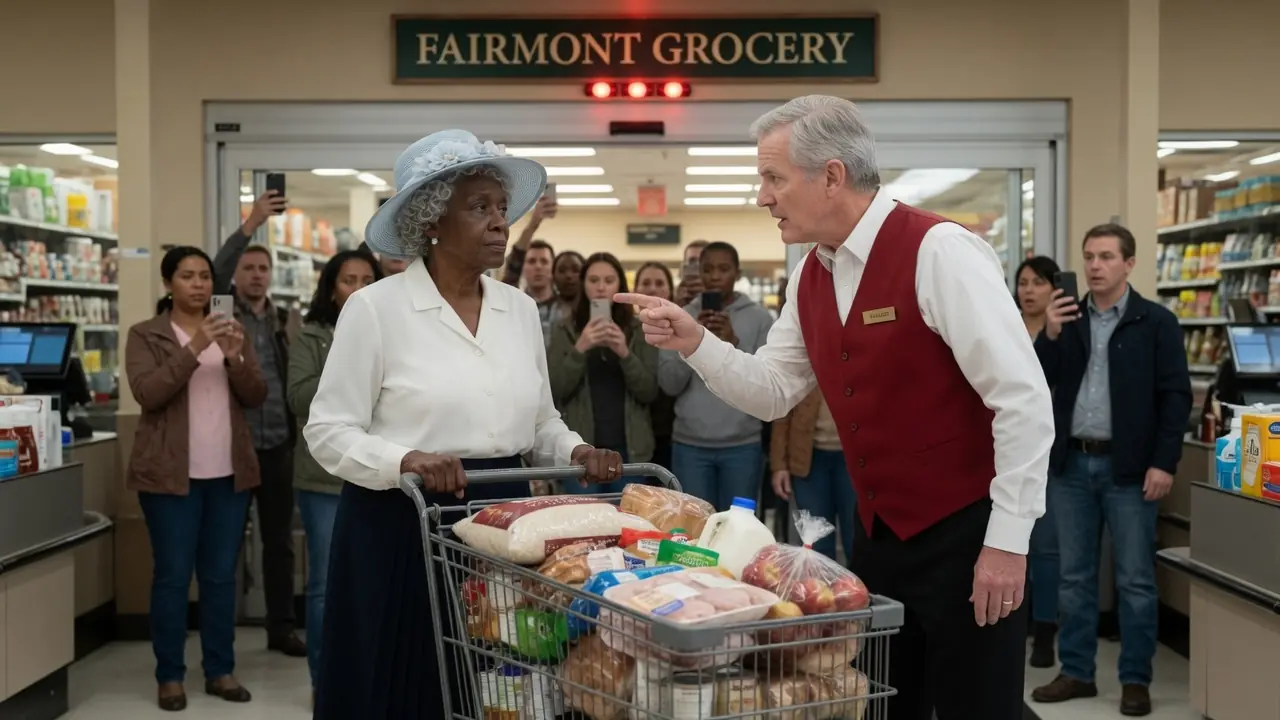
The alarm screamed the moment Mrs. Naomi Bell stepped through the doors of Fairmont Grocery.
Every head turned.
The sound was sharp, cruel, and impossible to ignore, cutting through the soft music playing above the aisles, the beep of registers, and the low Sunday afternoon chatter of shoppers.
Naomi froze with both hands on the handle of her cart.
She was seventy-two years old, a Black woman with silver curls tucked beneath a pale blue church hat, a cream cardigan buttoned neatly over a floral dress, and polished brown shoes that had carried her through more hard years than most people in that store could imagine.
Her cart was full.
Bags of rice.
Canned vegetables.
Bread.
Milk.
Chicken.
Apples.
Oatmeal.
Diapers.
Soap.
Enough groceries to make people stare even before the alarm started.
Naomi had bought them for the Magnolia Street Community Pantry, the little neighborhood food program she had run out of a church basement for almost twelve years. Every Saturday, widows came for soup. Single mothers came for formula. Old men came for coffee and conversation. Children came for sandwiches they pretended they were taking “for later,” though Naomi knew some of them had not eaten breakfast.
She had paid for every single item.
The receipt was folded carefully inside her purse.
But the alarm did not care.
And neither did the man who came storming toward her.
“Ma’am,” the manager barked, “step away from that cart.”
His name was Victor Harlan.
Mid-fifties. Red manager vest. Thin mouth. Gray hair combed so precisely it looked afraid to move. He had managed Fairmont Grocery for sixteen years and acted as though the building, the parking lot, and every person inside existed under his personal authority.
Naomi looked at him calmly.
“Mr. Harlan, I just paid.”
Victor stopped in front of her cart.
“Then you should have no problem proving it.”
The accusation landed in front of everyone.
Phones began to rise.
A teenage boy near the soda display whispered, “She stole all that?”
His mother hushed him, but she did not correct him.
That hurt more.
Naomi held the cart tighter.
She had lived long enough to know how quickly a room could decide a Black woman was guilty before she opened her purse. She had been followed through stores before. Questioned at counters. Asked if she could afford things she had already paid for. Watched by security guards who pretended to straighten shelves.
But she had also buried a husband, raised three children, survived lung surgery, taught Sunday school for thirty years, and fed half the neighborhood from a church kitchen with a broken stove.
Victor Harlan was not the first man to mistake her calm for weakness.
He would not be the last.
But today, he had chosen the wrong woman.
Naomi opened her purse slowly.
Victor leaned forward, as if expecting stolen jewelry to fall out.
Instead, she pulled out a long receipt, folded into thirds.
She opened it carefully.
The paper stretched nearly to her knees.
At the top, in bold black letters, it read:
FAIRMONT GROCERY — REGISTER TWO
MANAGER APPROVAL REQUIRED
V. HARLAN
The timestamp read 1:18 p.m.
The clock above the front doors read 1:23 p.m.
At the bottom, beneath the list of every item in her cart, were three words:
PAID IN FULL.
Naomi held it up.
“You approved the purchase yourself.”
Victor’s jaw tightened.
A young cashier at register two went pale.
Her name was Brianna.
She was nineteen, nervous, and new. Naomi recognized her from the last few weeks. The girl always smiled too quickly, as if afraid kindness might get her in trouble.
Brianna opened her mouth.
Victor turned sharply.
“Back to your register.”
Brianna closed her mouth.
Naomi saw it.
The fear.
The habit of silence.
She turned back to Victor.
“You scanned those items with your own hands.”
His face reddened.
“Ma’am, I am trying to handle this politely.”
“No,” Naomi said. “You are trying to make public humiliation sound like store policy.”
The store went silent.
Victor’s eyes hardened.
Then the automatic doors opened again.
Two police officers stepped inside.
And Naomi understood this had been arranged before she ever reached the exit.
The taller officer approached first.
“What seems to be the problem?”
Victor spoke immediately.
“This woman triggered the theft alarm while attempting to leave with unpaid merchandise.”
A murmur moved through the store.
Naomi felt the words pass through the crowd before they reached her.
Unpaid merchandise.
Attempting to leave.
This woman.
Not customer.
Not ma’am.
Not Mrs. Bell.
This woman.
The officer turned to Naomi.
“Ma’am, did you pay for these groceries?”
“Yes,” Naomi said. “And Mr. Harlan is holding my receipt.”
Victor looked down.
The receipt was still in his hand.
For a moment, his face betrayed irritation, not embarrassment.
The shorter officer took the paper from him and read it.
His eyebrows drew together.
“Manager approval. V. Harlan.”
Victor cleared his throat.
“That only shows I authorized a large purchase.”
“It shows she paid,” the officer said.
Victor’s mouth tightened.
“It shows a payment was processed. The alarm indicates something unpaid or tagged remained in the cart.”
Naomi looked directly at him.
“Then perhaps we should ask why something tagged remained in my cart after you personally checked every item.”
The officer looked between them.
A woman near the bakery stepped forward.
She was wearing a yellow coat and holding a loaf of bread.
“I watched him ring her up,” she said.
Victor snapped, “Ma’am, please continue shopping.”
She lifted her chin.
“My name is Ellen Parker, and I am done shopping. I am staying because I saw what happened.”
A second voice came from register two.
“She paid.”
Everyone turned.
Brianna stood behind the register, hands trembling.
Victor’s face darkened.
“Brianna.”
The girl swallowed.
“She paid for everything. I was right there. Mr. Harlan told me to step aside because the order was too large and he wanted to ‘handle it properly.’ He scanned it all himself.”
Victor’s voice dropped.
“You are making a serious mistake.”
Brianna’s eyes filled with tears.
“No,” she said. “I think I made the mistake earlier when I stayed quiet.”
Naomi looked at her.
The girl looked terrified.
But she did not sit down.
The taller officer turned to Victor.
“We need to see the security footage.”
Victor stiffened.
“Our system has been glitching all week.”
Brianna whispered, “No, it hasn’t.”
Victor spun toward her.
But another person stepped forward.
A security guard, about thirty, with tired eyes and a black uniform.
His name tag read Anthony.
“The cameras are working,” he said.
Victor stared at him.
“Anthony, not another word.”
Anthony looked at Naomi.
Then at the officers.
“They’re working. And the exit alarm was reset fifteen minutes ago from the manager’s office.”
The whole store seemed to inhale at once.
Naomi’s fingers tightened around her purse.
Victor’s confidence cracked for the first time.
“That is internal equipment. He does not understand how it works.”
Anthony’s voice hardened.
“I understand enough to know alarms do not reset themselves from your desk.”
The taller officer turned toward Victor.
“Security room. Now.”
Naomi stayed beside her cart while the officers followed Victor and Anthony to the small security room near the back of the store.
No one knew what to say to her.
That was always the way after public accusation.
People became gentle once the damage had already been done.
Ellen in the yellow coat stepped closer.
“Mrs. Bell, I am so sorry.”
Naomi looked at her.
“Sorry is a start.”
Ellen lowered her eyes.
“It should not have taken me so long to speak.”
“No,” Naomi said quietly. “It should not have.”
A few shoppers looked away.
Not because she was cruel.
Because she was right.
Brianna left her register and came to Naomi with tears on her face.
“I should’ve said something when he started treating you like that.”
Naomi softened slightly.
“You said something before it was too late.”
The girl wiped her cheeks.
“He talks like that about people all the time. Not always out loud. Sometimes in the break room. Sometimes when he thinks only staff can hear.”
Naomi’s eyes sharpened.
“What does he say?”
Brianna glanced toward the security room.
“That people from your side of town always come in with stories. That charity shoppers are the worst because they think being poor makes them special.”
Ellen made a sound of disgust.
Naomi closed her eyes for one moment.
Magnolia Street.
That was what Victor meant.
Not just her.
Her neighborhood.
Her people.
The elderly man who came for soup but always brought napkins to donate.
The mother who cried when Naomi gave her diapers.
The children who helped unload pantry boxes after school.
People Victor Harlan had never met but had already judged.
Minutes later, the officers returned.
Their faces had changed completely.
Anthony walked behind them.
Victor came last.
Pale now.
The taller officer held a small tablet.
“We reviewed the footage,” he said.
The store fell silent.
“It shows Mr. Harlan scanning the full order, accepting payment, and printing the receipt.”
Naomi did not move.
The officer continued.
“It also shows him removing a security tag from his vest pocket and sliding it under a bag of flour after the transaction was complete.”
The store erupted.
Gasps.
Whispers.
Someone cursed under their breath.
Brianna covered her mouth.
Ellen looked like she might strike Victor herself.
The officer turned to him.
“Mr. Harlan, you need to place your hands behind your back.”
Victor’s face twisted.
“This is being taken out of context.”
Anthony snapped, “You planted it.”
Victor pointed at him.
“You are finished here.”
“No,” Anthony said. “I think you are.”
The officer stepped between them.
“Hands behind your back.”
Victor resisted for one second.
Only one.
Then the handcuffs clicked around his wrists.
Phones rose again.
But this time, they were not filming Naomi as a suspect.
They were filming the man who had tried to frame her.
Naomi did not smile.
She looked at Victor with something deeper than anger.
Disappointment, maybe.
Or exhaustion.
Victor leaned toward her as the officers began leading him away.
“You think you won?” he hissed. “You have no idea what you just walked into.”
Naomi stepped closer.
“No, Mr. Harlan. You have no idea why I walked in.”
Victor froze.
For the first time, fear moved clearly across his face.
The taller officer stopped.
“Mrs. Bell?”
Naomi reached into her purse again.
This time, she did not pull out a receipt.
She pulled out a small folded paper, yellowed at the edges and creased so deeply it looked like it had been opened a hundred times.
Victor’s face changed.
He recognized it.
That was when Naomi knew.
Ellen whispered, “What is that?”
Naomi unfolded it carefully.
“My husband owned a little grocery store on Magnolia Street for thirty-four years,” she said.
The crowd quieted again.
“Bell’s Corner Market. It was not fancy. The floors creaked. The freezer hummed too loud. The sign lost two letters during a storm, and my husband refused to fix it because he said everybody knew what it meant.”
A few older shoppers smiled faintly.
Some remembered.
Naomi held the paper up.
“This is the first receipt he ever printed after buying that store.”
At the top, faded almost brown with age, were the words:
BELL’S CORNER MARKET
FIRST SALE — PAID IN FULL
JUNE 14, 1982
Naomi’s thumb brushed the paper.
“He sold one loaf of bread, two cans of beans, and a jar of peanut butter to a young mother who did not have enough money. He paid the difference himself and still printed ‘paid in full’ because he said people deserve dignity even when they need help.”
The store was silent.
“My husband died believing his store failed because the neighborhood changed and people stopped caring.”
Her voice tightened.
“But I came here today because I discovered that was not true.”
Victor’s face turned gray.
Naomi looked at the officers.
“For eight months, Magnolia Street Community Pantry has been placing large orders through this store. We were told we were receiving a charitable discount.”
She reached into her purse again and pulled out a folder.
“But the receipts did not match the bank withdrawals. Discounts were entered, then reversed. Donations were logged, then redirected. Every correction required manager approval.”
The officer looked at the receipt in his hand.
“V. Harlan.”
Naomi nodded.
“He has been stealing from a food pantry.”
A wave of outrage moved through the store.
Victor snapped, “That is a lie.”
Naomi turned to him.
“No. A lie is what you built. This is the paper trail.”
Anthony stepped forward.
“There’s more.”
Victor stared at him with hatred.
Anthony looked at the officers.
“I copied the office logs last night. Not customer data. Manager adjustments. Refund overrides. Charity invoices. I was going to report it, but I didn’t know who to trust.”
Naomi looked at him.
Anthony’s voice lowered.
“My grandmother eats at Magnolia Street on Wednesdays.”
That sentence changed his hesitation into courage.
The taller officer looked at Victor.
“Where is your office?”
Victor said nothing.
The search began fifteen minutes later.
The police found the cash first.
Not much.
A few envelopes hidden behind the bottom drawer of Victor’s filing cabinet.
Then they found the altered receipts.
Then copies of pantry invoices.
Then a spreadsheet with names of local charities and columns labeled Loss Control Adjustments.
But it was the old file box in the storage closet that made Naomi sit down.
Anthony carried it out himself.
Dust covered the lid.
On the side, written in black marker, were the words:
MAGNOLIA ACQUISITION — 2009
Naomi looked at it as if seeing a ghost.
“My husband’s store closed in 2009.”
The officer opened the box.
Inside were inspection complaints.
Vendor warnings.
Insurance notices.
Loan documents.
Letters from Fairmont Grocery’s regional development office.
Naomi took the first page with trembling hands.
Her husband’s name appeared near the top.
Joseph Bell.
The paper blurred.
She had spent years believing Joseph lost the store because times changed. A large chain moved in. Suppliers stopped extending credit. Repairs became too expensive. Customers drifted toward lower prices.
Joseph had blamed himself until his final breath.
“I should have held on longer,” he told her in the hospital.
Naomi had held his hand and said, “You held on as long as you could.”
Now she looked at the documents and realized neither of them had known the truth.
Anthony read from one of the reports.
“Coordinated vendor pressure recommended. Property value vulnerable. Owner unlikely to withstand prolonged compliance action.”
Ellen whispered, “My God.”
The officer found another page.
A memo signed by Victor Harlan.
At the time, he had been an assistant regional manager.
The memo recommended filing repeated safety complaints, delaying vendor deliveries, and quietly approaching the landlord about lease termination.
The purpose was clear.
Fairmont Grocery had not simply outcompeted Bell’s Corner Market.
They had helped destroy it.
Naomi placed one hand over her mouth.
For a moment, the store vanished.
She saw Joseph behind the old counter, counting change under bad lighting.
Joseph carrying boxes with his bad knee.
Joseph giving groceries on credit to people who never paid him back and still saying, “They’ll come around when they can.”
Joseph sitting at their kitchen table with unpaid bills, whispering, “I don’t understand what I did wrong.”
He had done nothing wrong.
That was the mercy.
And the cruelty.
Naomi’s knees weakened.
Brianna and Ellen moved to her sides.
She did not collapse.
She would not give Victor that.
But tears slid down her face.
Victor, handcuffed beside the customer service counter, looked away.
Naomi’s voice was low.
“My husband died ashamed.”
No one spoke.
She turned toward Victor.
“You let a good man carry your sin to his grave.”
Victor’s mouth opened.
No defense came.
Because there was none.
Victor Harlan was taken out through the same automatic doors where Naomi had been stopped.
No one laughed.
No one cheered.
The silence was better.
It had weight.
Outside, the police car lights flashed against the windows. The same shoppers who had watched Naomi become a suspect now watched Victor become one.
Before the officers placed him in the cruiser, Victor turned once.
His eyes found Naomi.
For a moment, she thought he might apologize.
Instead, he said, “It was business.”
Naomi walked toward the doors.
The officers paused.
She stood just inside the entrance, the alarm sensors on either side of her.
“No,” she said. “Business is selling bread. What you did was theft wearing a tie.”
Victor looked away.
The cruiser door closed.
The store remained quiet long after he was gone.
Then Brianna walked to register two, took a sheet of receipt paper, and printed a copy of Naomi’s transaction.
She brought it to her with both hands.
“I think you should keep another one,” she said.
Naomi looked at the receipt.
At the bottom, the words appeared again.
PAID IN FULL.
This time, they meant something different.
Naomi folded it carefully and placed it beside Joseph’s first receipt.
Weeks passed.
The investigation grew.
Victor was charged with fraud, theft, evidence tampering, and filing false reports connected to Bell’s Corner Market. Fairmont Grocery’s regional office tried to distance itself from him, but the documents in the old file box made distance difficult.
News crews came.
Naomi refused most interviews.
When she finally agreed to speak, she stood outside Magnolia Street Baptist Church, where the pantry still operated from the basement.
She wore the same blue church hat.
A reporter asked, “Mrs. Bell, what do you want people to remember about what happened?”
Naomi looked into the camera.
“Not the alarm,” she said.
The reporter blinked.
“Not the accusation?”
“No.”
“Then what?”
Naomi’s voice stayed steady.
“I want people to remember how fast they believed it.”
That answer aired that evening.
By the next morning, volunteers lined up outside the church.
Some brought groceries.
Some brought checks.
Some brought apologies.
Ellen came every Tuesday.
Brianna quit Fairmont and started working at the pantry while taking night classes.
Anthony became the new security director after Fairmont Grocery reopened under review, and he changed the store’s entire alarm response policy.
No one was to be publicly accused without evidence.
No one was to be surrounded.
No one was to be humiliated for a machine’s noise.
But the biggest change came three months later.
Fairmont Grocery’s corporate office, under pressure from the investigation and community outrage, sold the building to a local nonprofit coalition.
The sign came down on a rainy Thursday morning.
Naomi stood across the street with an umbrella in one hand.
Beside her stood Brianna, Anthony, Ellen, and half of Magnolia Street.
The new sign went up slowly.
BELL COMMUNITY MARKET
Under it, in smaller letters, were Joseph’s old words:
Dignity Is Always Paid In Full.
Naomi covered her mouth.
For the first time since Joseph died, she felt the wound of his lost store open without bleeding.
The market reopened six weeks later.
It sold groceries at fair prices.
It hosted a weekly pantry pickup.
It kept a wall of community receipts near the entrance.
Not receipts for purchases.
Receipts for kindness.
A neighbor paid for formula.
A teacher bought ten lunch bags.
A mechanic covered groceries for a widow.
A child donated three dollars and wrote, “For someone hungry.”
In the center of that wall, framed behind glass, were two pieces of paper.
Joseph Bell’s first receipt from 1982.
And Naomi Bell’s receipt from the day Victor Harlan tried to shame her.
Both ended with the same words.
PAID IN FULL.
On opening morning, Naomi arrived wearing her blue hat and carrying a small bouquet of yellow flowers.
She placed them beneath Joseph’s photograph near the entrance.
In the picture, he stood behind the counter of Bell’s Corner Market, smiling in his white apron, one hand resting on the register.
Naomi touched the frame.
“You were not a failure,” she whispered.
Behind her, a small voice said, “Mrs. Bell?”
She turned.
A young woman stood near the doorway.
She looked nervous, maybe twenty-five, with red eyes and a folded envelope in her hands.
“My name is Caroline Harlan.”
The room shifted.
Anthony moved slightly closer.
Naomi raised one hand to stop him.
Victor Harlan’s daughter stepped forward.
“I volunteered at Magnolia Street last winter,” Caroline said. “You probably don’t remember me.”
Naomi studied her.
Then nodded slowly.
“You served soup on Christmas Eve.”
Caroline’s eyes filled.
“Yes.”
“You wore a green scarf.”
Caroline broke then.
She pressed the envelope to her chest.
“My father forgot my birthday that year. I came to the church because I didn’t want to sit alone. You gave me soup and sent me home with sweet potatoes even though I told you I didn’t need help.”
Naomi’s face softened.
Caroline held out the envelope.
“I found the old file box. I’m the one who moved it where Anthony would see it. And I sent the anonymous note warning my father that someone was investigating.”
Anthony stared at her.
“Why warn him?”
Caroline wiped her cheek.
“Because I wanted to see what he would do.”
Naomi understood.
“And he set the trap.”
Caroline nodded.
“I’m sorry.”
Naomi took the envelope.
Inside was a handwritten letter and a cashier’s check.
Caroline said, “It is not enough. It can never be enough. But it is everything I inherited from him before the court froze the rest.”
Naomi looked at the amount and inhaled sharply.
Caroline added, “Please use it for the pantry.”
Naomi was quiet for a long time.
Then she reached into her purse and pulled out Joseph’s first receipt.
She unfolded it.
“My husband used to say money can pay a bill, but only truth can settle a debt.”
Caroline lowered her head.
“I told the truth too late.”
“Yes,” Naomi said gently. “But not never.”
Caroline began crying.
Naomi stepped forward and took her hand.
The girl looked startled.
Naomi held it firmly.
“Your father forgot how to be human,” she said. “That does not mean you have to.”
Caroline sobbed.
Brianna wiped her eyes.
Anthony looked away.
Ellen whispered, “Amen.”
That afternoon, the market opened its doors.
People came in slowly at first.
Then in waves.
Old customers who remembered Joseph.
New families who had never known him.
Children who ran straight to the fruit bins.
Seniors who sat at the little coffee table near the front window.
Naomi moved through the aisles, greeting people by name.
No alarm screamed.
No manager stormed forward.
No one was asked to prove dignity.
At sunset, after the last customer left, Naomi stood near the doors.
The sensors blinked quietly on either side of her.
She looked at them and smiled.
Anthony noticed.
“You all right, Mrs. Bell?”
Naomi nodded.
“I was just thinking.”
“About what?”
She looked around the store.
At the shelves.
At Joseph’s photo.
At the receipt wall.
At the place that had once been used to shame her and now belonged again to the people it was meant to serve.
“That day,” she said, “when the alarm went off, everyone looked at me like the machine had told the truth.”
Anthony said nothing.
Naomi’s smile faded into something calmer.
“But machines only make noise. People decide what they believe.”
She stepped through the doors.
The sensors stayed silent.
Outside, the evening air was warm. The streetlights blinked on one by one along Magnolia Street. Across the road, a little boy held his grandmother’s hand while carrying a bag of apples bigger than his arm.
Naomi watched them go.
Then she touched the folded receipt in her purse.
Paid in full.
Not because Victor had been arrested.
Not because the store had changed names.
Not because the money came back.
Those things mattered.
But they were not the whole of it.
Paid in full because Joseph’s shame had finally been returned to the people who earned it.
Paid in full because a young cashier found her voice.
Because a security guard chose truth over fear.
Because strangers learned that silence can become part of an accusation.
Because kindness given years earlier had come back through the daughter of the man who tried to destroy her.
Naomi looked up at the new sign.
Bell Community Market.
For a moment, she could almost hear Joseph laughing from behind the counter.
“Too many words on that sign, Naomi.”
She smiled through tears.
“Hush,” she whispered. “It looks beautiful.”
And for the first time since the alarm screamed her name in front of everyone, Mrs. Naomi Bell walked home with her head high, carrying no shame that did not belong to her.