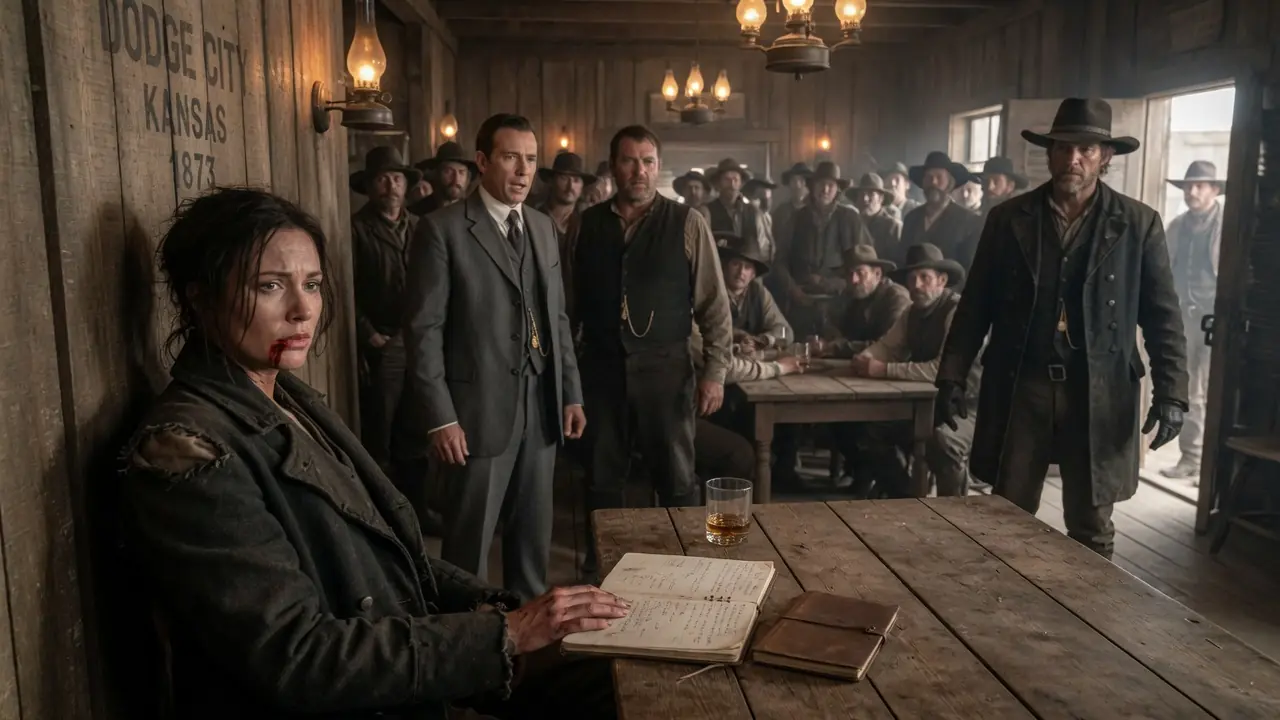
Friday night in a saloon packed to the walls, lantern light amber and low, every table full, the air thick with tobacco and the particular tension of men who have been drinking long enough to stop being careful. Piano somewhere in the back, going quiet note by note until it stopped altogether. Nobody remembers exactly when the music stopped. They remember the sound that replaced it. A fist, a woman's face against the wall, the crack of it going through that room like something breaking that was not supposed to break in public.
And then nobody moved. Forty people at those tables. Men who had ridden hard country, men who had seen worse than this, men who had guns on their hips and reasons to use them and chose in that moment to sit very still and watch.
She was pressed against the planked wall with a nail in her shoulder she didn't know was there yet, and she was not looking at the man who had just hit her. She was looking at something past him, past the frozen tables, past the held breath of the whole room, at the door that was opening.
The man who came through it, the one nobody in that room had expected, the one with the warrant on his name and the dark hat pulled low. He did not come through it fast. He came through it the way a man comes through a door when he has already decided what happens next. Both hands were visible, those dark leather gloves catching the amber lantern light.
He stopped. He let the room find him, and the woman against the wall, bleeding into her coat, did something that nobody in that saloon expected. She reached into her pocket.
Hold that image. We are going back three weeks, and when this room comes back around, you will understand exactly what she was reaching for and why it mattered more than anything else that happened that night.
Three weeks before that door opened, St. Louis in early October of 1873 smelled of the river and of commerce, which is to say it smelled of muddy water and aspiration in roughly equal proportion.
Eliza Voss had worked at Marchman and Sons Mercantile for six years. Four of those years she had spent as a floor clerk, learning the layout of a business the way you learn the layout of a house you don't own, where the weight sits, where the rod is, where the thing that looks solid is being held up by something you cannot see from the front.
The last two years she had spent keeping the actual books, designing the actual accounts and solving the actual problems that arose when figures from different departments failed to reconcile at month's end, all under an arrangement in which the name above the door received the credit and she received a salary that was fair by the standards of the time, which were not particularly high standards.
She was thirty-one years old. She had buried her mother the previous spring, which left her with no immediate family in St. Louis and a set of obligations that had reduced themselves over six careful weeks to none.
She was not a woman given to sentiment about circumstances. She was a woman given to arithmetic about circumstances, which she had found considerably more useful in every situation she had encountered so far.
The letter from Jonas Reed arrived in the same month as her mother's death, forwarded through a matrimonial correspondence service that a woman at the mercantile had mentioned without particular advocacy. Jonas Reed of Dodge City, Kansas, was seeking a wife of reasonable disposition and some working knowledge of practical matters.
He was a rancher. He had 160 acres on the north edge of town, a house that was functional and a barn that was considerably better than the house, and in his writing that Eliza found more persuasive than sentiment would have been. He didn't describe himself as lonely. He described the land, the weather, the condition of his fences, and what he expected the next year's yield to look like.
She appreciated that. She answered the first letter. He answered her answer. They exchanged four letters over six weeks, and in the fourth one, written in the second week of September, Jonas mentioned a name almost as a secondary observation, the way a man mentions a thunderhead that hasn't turned yet, but that he has been watching with attention he hasn't shared with anyone.
The name was Harlan Crew. He mentioned him in connection with a piece of equipment financing he had recently arranged, and he mentioned him with the particular flatness of tone a careful man uses when he knows something does not compute, but cannot yet identify which entry is wrong.
Eliza filed that paragraph in a specific part of her memory, separate from the rest of the letter. It was the part where she kept things that did not fully close. She had learned over six years of bookkeeping that a thing that doesn't close is not nothing. It is an entry waiting for the rest of its context to arrive.
She packed one carpet bag. She packed a small leather notebook her grandmother had called a cuaderno. The word from a language that had no business being in Kansas, but that she had never been able to replace with an English equivalent that carried the same meaning. The cuaderno held her working figures and her current entries, and a discipline she had been building since she was nine years old.
She packed two dresses, a bone-handled penknife that had been her father's, a copy she had made of the Marchman accounts, which the elder Marchman did not know existed, because she had learned early that you do not leave the only copy of anything important in someone else's hands.
She boarded the stage at dawn on the 15th of October. She did not know, sitting in that westbound coach watching Missouri give way to the flat early geometry of Kansas, that Jonas Reed had been dead for eight days.
Dodge City announced itself with smell before it announced itself with sight. Cattle, coal smoke, the particular dry particulate of Kansas dust that settled into the back of the throat with the permanence of something that intended to stay.
The stage rolled in on a Thursday afternoon and Eliza stepped down with her carpet bag and looked across the faces at the depot for a man who matched the description Jonas had offered in his second letter.
What she found instead was a man in a gray suit with a gold watch chain that caught too much light for a day that was overcast. He introduced himself as Harlan Crew. He held his hat at his chest in a way designed to communicate respect and managed instead to communicate calculation.
Which was a distinction most people didn't catch and that Eliza caught in the first ten seconds of looking at him.
He told her Jonas Reed had died of fever nine days prior. He said nine, though a more careful reckoning would have said eleven. And Eliza noted that specific discrepancy, the way she noted all discrepancies without announcement, without visible reaction, in the column reserved for things that would need to be returned to.
He expressed condolences with the practiced economy of a man for whom condolences had become a regular professional function. Then without pause, he produced a document.
The document described a loan of $340 secured against Jonas Reed's land with the property reverting to the Crew Land and Banking Company upon the borrower's death without a recognized heir. The notarization stamp was from Crew's own office. The signature was Jonas Reed's. The date on the loan instrument was two weeks after the last letter Jonas had sent to St. Louis, which meant that when Jonas wrote about Harlan Crew with that particular flatness, the document Crew was now presenting had not yet existed.
Eliza read the document twice. Crew waited with the expression of a man accustomed to watching people read things they were not expected to fully understand and then nod.
She did not nod. She asked three questions. What was the rate of interest on the instrument? Who had witnessed the signing? And whether the property transfer was recorded in the county registry or in Crew's own office registry because those were not the same institution and both of them standing at that depot in the October dust knew it.
Something behind Crew's face adjusted. Not his expression. His expression stayed exactly where he had placed it. Something beneath it. The way the current of a river shifts when the bed below changes and the surface hasn't caught up yet.
He told her the matter was straightforward. He told her her correspondence contract was invalid under Kansas territorial law upon the death of the contracting party. He told her he might be able to assist with accommodation while she arranged her return to St. Louis. He had a hotel and there might be cleaning work available temporarily until she sorted her affairs.
What he was offering, stripped of every courtesy layered over it, was a confined space with a comfortable chair inside it.
Eliza said she would need to think on it. She thanked him for meeting the stage. She carried her carpet bag across the street to the rooming house, paid two nights in advance with what she had, sat on the edge of the bed and worked through everything Crew had said in the exact order he had said it.
The way she worked through columns that failed to reconcile at month's end, methodically, without impatience, looking for the entry that didn't belong.
The numbers did not close. She didn't yet have all of them, but she had enough to know something was missing and she had learned over six years that a missing entry is never missing by accident.
He came in from the west on the second day after Eliza arrived and Dodge City registered him the way certain towns register certain arrivals. A general tightening of atmosphere, conversations that dropped half a register, eyes that moved toward the wanted board outside the sheriff's office and then moved away before they could be caught doing it.
The notice on the board was three years old. The name was Cole Deveraux. The charge listed was assault and property destruction. The dollar amount was $200, sufficient in 1873 to be taken seriously, and insufficient to attract serious hunters.
The specific details of the incident, what property, what assault, under what circumstances, were not described on the notice because the notice had been drawn up in a local office under a local stamp, and local offices in Dodge City, Eliza had already begun to understand, tended to carry the same signature on everything that came out of them.
Cole Deveraux was perhaps thirty-eight. He wore a hat with a flat brim pulled low and a dark coat that had been expensive some years back and had since been reduced to functional. And he wore a pair of leather gloves the color of dark tobacco leaf that he had not removed as far as anyone in the hotel dining room could determine. Not at the livery, not at the water trough. Not when he lifted his cup at a corner table of the hotel dining room, Crew's Hotel, where Eliza had accepted the cleaning work because she needed to be inside that building, and this was the only legitimate way to get there.
He looked at her once. Not the way a man looks at a woman he is evaluating in the ordinary sense. The way a man looks at a woman whose name he already knows and whose situation he has already considered and about which he has already formed a view he has not yet decided to share.
Then he looked away.
She kept working and filed it in the same column as the interval discrepancy and the notarization stamp and the rate of interest Crew had declined to specify. The column of things that did not yet have enough context to be understood, but that were not under any reasonable accounting coincidences.
The account books were in the back office of Crew's Hotel in a cabinet that locked with a mechanism identical to the one on her grandmother's sewing chest in St. Louis. She had opened her grandmother's lock with a hairpin at age nine. The process was not complicated.
On the third night, it took her six seconds. She was not searching for anything specific. She was searching for the shape of a discrepancy, the kind of search you conduct when you know something in the ledger is wrong, but you don't yet know which line to pull.
The hotel ledger was ordinary, aggressively, deliberately ordinary, the kind of ordinary that requires maintenance to sustain, that announces itself through an excess of cleanliness.
But at the back of the same cabinet behind the hotel ledger was a second book, smaller, bound in dark leather of a quality very close to her cuaderno, which she noted with the dispassionate interest she brought to most things she noticed.
It was not a hotel ledger. It was a record of property transfers. Thirteen of them going back eleven years. Each entry carried the same architecture, a name, a property description, a loan amount, a date, a second date, and a cause.
The column Crew had assigned the causes he had titled with the flat bureaucratic precision of a man who understands that ordinary language is its own form of concealment. Simply, circumstances, fever, accident, unknown cause, fever, drowning, accident, fever.
Thirteen entries, thirteen names, thirteen transfers to the Crew Land and Banking Company, each completing within nine to fourteen days of the listed date of death.
Jonas Reed was the fourteenth entry. The transfer date column was blank.
She understood why it was blank. She had arrived on the stage, read a document twice, asked three questions, and declined to nod. She had introduced a variable that was not supposed to be in the calculation.
She did not take the book. Taking it would announce that she had found it, and that announcement would collapse whatever time she had left.
Instead, she did what she did with all numbers she wasn't ready to use yet. She transferred them entry by entry into the cuaderno in her own hand, full column headings, every date, every interval, every specific detail she could capture before the lamp oil ran low.
She replaced the book exactly as she had found it, relocked the cabinet, and returned to her room.
She sat on the edge of the bed and read through what she had written until it arranged itself in her mind not as horror, she had crossed that threshold somewhere around the ninth entry, but as evidence.
Thirteen names, a pattern with enough regularity to have a structure, a structure with enough consistency to have an author.
She was not the first woman Crew had expected to process through the fourteenth entry. She was simply the first one keeping her own books.
On the fifth day, Crew's behavior shifted in a way most people would not have identified. His face was running the same expression it always ran, and he had been running it long enough that the muscles had settled into it without effort.
But Eliza had spent six years reading men who believed their faces were sealed to examination, and she caught the half-second pause before he spoke, the deliberate management of hands that had moved freely the day before.
He found reasons to be in rooms she was cleaning. He asked questions that had nothing to do with hotel operations, whether she had family expecting regular correspondence, whether she had written back to St. Louis yet, whether she was finding Dodge City accommodating.
Each question arrived packaged as casual. Each one was a probe for the same information. How isolated was she? And was anyone positioned to notice if she stopped communicating?
She answered each one without answering any of them.
On the sixth day, he told her the room was needed for a paying guest. The cleaning work had been a temporary arrangement, he said, and he was sorry it had ended sooner than hoped.
He said all of this in the register of a man performing an apology for something that is not, in any structural sense, an apology.
She was on the street with her carpet bag within the hour because she had not unpacked beyond what she needed each day.
The rooming house proprietor across the street had a family visit requiring Eliza's room. By Thursday, it was Monday. No family was in evidence.
She spent that night in the livery. The stable boy accepted two coins and a promise she'd be gone before business hours.
She lay in the hay with the cuaderno open across her knees and worked through what she had and what she still needed.
What she still needed was a legal venue that did not bear Crew's signature. What she still needed was two more days because she had overheard, correctly, outside the general store that Judge Aldus Crane of the third circuit passed through Dodge City every thirty days, and his next pass was Saturday. The day after tomorrow.
Two days. A notebook full of thirteen names. The lamp burning low in the hay.
What would you do with that? Would you find the first eastbound stage and take it? Write to someone back east and wait three weeks for a reply that might not come? Or stay in that livery with the lamp and keep writing until you had something no judge in any territory could set aside?
Stay with me. Because the night that changed everything was still coming, and it came the way most necessary things come, not when it was planned, but when it could not wait any longer.
There are sounds that travel in Dodge City. The piano in the Long Branch carries half a block in any direction on a still night. The Thursday freight wagon clattering up Front Street is a sound the whole town learned years ago to sleep through.
And the sound of Harlan Crew's voice at volume, a sound he deployed rarely, precisely because he understood its effect, that sound moved through the walls of the Kansas Cowboy Saloon on a Friday evening, and reached the street before the words inside it had finished forming.
Eliza had gone to find Sheriff Reeves, who was not in his office on Friday evenings, and was reliably not in his office on Friday evenings. She had the cuaderno in the inner pocket of her coat.
She had not planned a scene. She had planned to place what she had in the hands of a man with a badge before Judge Crane arrived the next morning.
Because she had worked through the logic in the livery the previous night and arrived at a clean conclusion. Crew would find a way to prevent her reaching the judge directly unless someone with official standing was already holding her evidence first.
What she had not accounted for was Crew being in the saloon. He hadn't expected her either.
She could see the three seconds of recalibration before he spoke. Three seconds in which the room was already watching. Because a woman entering that particular establishment at that hour was in itself an event and everyone present had already oriented toward her before Crew opened his mouth.
What he said in those first seconds she received as though from a distance. Something about her contract. Something about the private records of his hotel. Something about women and legal matters and the proper ordering of things in a frontier town.
The specifics dissolved in the sound of her own blood behind her ears.
What registered was the architecture of it. This was not a private threat. This was a public declaration. He was establishing the version of events before she could establish hers. The way a man with resources can do when he arrives first and understands that the first version told in a room full of witnesses carries structural advantages over every version that comes after.
He had miscalculated what she had done with the previous forty-eight hours.
She had already opened her mouth when his hand moved. Not toward her, but toward the arm of the man beside him. Virgil Stokes, who was large and not given to reflection and who read the signal correctly and turned and swung.
And the sound of his fist against the side of Eliza Voss's face was the sound the story opened with. The crack that cut through the last note of the piano and went flat against every surface in the room and brought all forty people in it to stillness.
She hit the wall. The nail caught her shoulder. The floor rose toward her and she held it off by fixing her eyes on a specific point, not Stokes, not Crew, not the frozen tables full of men who had made their choice by not making one.
The door at the back of the room, which was opening.
Cole Deveraux did not come through that door fast. He did not come through it with a hand on anything, or with the theatrical certainty of someone who has rehearsed an entrance.
He came through it the way a man comes through a door when he already knows everything on the other side, when he has been standing outside long enough to hear what has been happening inside, and has already worked through every available response, and arrived at the one he intends to use.
Slowly, both hands visible. The dark tobacco-colored gloves catching the amber light of the overhead lanterns, exactly as they had in the image this story opened with, because that image was real. And this is the moment it came from.
He stopped just inside. He let the room see him. He let the wanted notice in every memory present do what it was going to do.
Then, into the silence that had been attempting to reconstitute itself around the shape of what it had just witnessed, he said Harlan Crew's name.
Not a shout. Not a command. The way you say a name when what you're actually communicating is, I know exactly what this is. I know exactly what you are. I know what this goes back to, and how far back it goes, and we are both going to stand here and acknowledge all of it before either of us says another word.
Crew's face moved through four expressions in two seconds. Eliza, her shoulder bleeding into her coat, her ears still ringing, watched all four of them from her position against the wall.
The fifth thing that happened was Eliza Voss straightening up, reaching into the inner pocket of her coat, pulling out the cuaderno, and laying it open on the table that held Sheriff Reeves's whiskey glass.
That was what she had been reaching for. That was what nobody in the room had seen coming.
The sheriff looked down at it. The room looked at the sheriff looking at it.
Cole Deveraux had not moved from the door. He didn't need to. The room had already undergone one of those invisible transfers of weight that happened in enclosed spaces when the power in them suddenly no longer belongs to the person who arrived holding it.
Crew started to speak.
Eliza said, without raising her voice, that the notebook held copies of records from his private cabinet, that those records listed thirteen property transfers completing within a consistent interval after each owner's death, and that the fourteenth entry bore the name Jonas Reed with the transfer date still blank.
She said Judge Crane was due in Dodge City the following morning, and she intended to present these records to him directly along with additional corroborating materials in her possession.
Then she said to Sheriff Reeves, without looking at Stokes or at Crew, she would like the assault recorded by name.
The sheriff looked at the cuaderno. He looked at Crew. He looked at the door where Cole Deveraux was standing with the stillness of a man who has identified every exit in the room and chosen not to use any of them.
He reached for his pencil.
The night air outside the saloon was cold in the abrupt way Kansas goes cold in October, with no negotiation offered and none expected.
Eliza stood at the edge of the boardwalk, not because she had chosen that location, but because her legs had arrived at a decision at that point, and she had chosen not to argue with them.
Cole came out three minutes after her. He had stayed long enough to make clear to Stokes and two other men near the bar that the question of whether anyone else wanted to advance the matter remained technically open, and that he had not yet formed a preference either way.
The three men had formed one. They had formed the preference of staying exactly where they were.
He stood beside her. Neither of them spoke for perhaps a full minute, the kind of silence that isn't uncomfortable and isn't easy, the kind that's waiting for both people to arrive at the same moment before anything useful can be said.
She spoke first.
She said, "You knew Jonas Reed."
He said, "Jonas Reed was my brother, half brother, same father."
She had already assembled the outline of this from the available pieces. She waited for what the outline was missing.
Their father had owned 160 acres north of town twelve years ago. He had taken a loan from a man who had not yet called himself a banker, but functioned as one, who extended credit at intervals that were survivable in good years and catastrophic in bad ones, who controlled his own notary stamp and had owned the sheriff since before the war ended.
The father had died. "Fever," said the circumstances column. The land had transferred.
Cole had been twenty-six. He had not been quiet about what he understood had happened. The assault charge, the warrant, the amount posted on the wanted board, those were the direct product of his not being quiet about it.
He had left Dodge. He had not gone far enough to stop watching it.
Over the years, he had gotten word that Jonas, fifteen years old when the land was taken, grown into a quietness that Cole had sometimes read resignation, but that was in fact something more patient and more deliberate than resignation ever is, had taken a different approach entirely.
Jonas had found a piece of ground outside Crew's orbit, had built on it carefully without drawing attention, had written through a mutual contact to a woman in St. Louis, who was known for being good with numbers and who was looking for a reason to move west.
Cole stopped talking.
She understood what the stopping meant. Jonas had not chosen her at random from a correspondence list. Jonas had chosen her deliberately for specific reasons, with a specific need in mind.
He had known that something might happen and he had wanted someone positioned to see it clearly if it did. Someone who would arrive with the cuaderno already in hand and the habit of reading what other people treated as background noise.
She said, "The word?"
"He wrote it to me in a letter, the cuaderno. He said his grandmother used it, too."
Cole said, "He told me about the letters."
She said, "He knew this could go wrong."
Cole said he knew Crew wouldn't leave him enough room for it to go right.
The sounds of the saloon resettled behind them. Dodge City went on with its Friday.
The two of them stood in the dark at the edge of it, and Eliza's breathing moved with the measured evenness of someone running a calculation they don't want to interrupt.
Two days, one judge, thirteen names, and the fourteenth waiting.
She did not sleep that night. There was nowhere sufficiently secure for sleep, and beyond that, there was no time she could afford to spend on it.
Cole had a room with a widow named Hapscomb on the edge of town, not in Crew's hotel, not in any establishment operating within Crew's network, which in Dodge City in 1873 narrowed the options without eliminating them entirely.
He gave Eliza the room and sat in the hallway outside the door with his coat on, not because he had explained it as courtesy, but because the hallway provided a sight line to the stairs, and the question of whether Crew would move before morning had not been answered to his satisfaction.
Eliza sat at the small desk by the window and worked.
The cuaderno held copies of the thirteen entries. What it did not hold, in any form a circuit court judge would find legally persuasive, was the structural argument, the demonstration of pattern, the kind of construction that transforms a list of names into a demonstrable course of repeated conduct.
A list of names is a list of names. A demonstrated pattern with consistent methodology, corroborating dates and statistical regularity, is something a court can examine and act on.
She knew the difference. She had spent six years building documents that had to survive challenge by men with attorneys and the patience to deploy them.
She had learned that the most durable argument is not the loudest one. It is the one that a hostile reader cannot find a way through. You do not tell a hostile reader what to conclude. You construct the numbers so that the only available exit leads them where you need them to go.
She wrote for four hours, structured entries, not narrative prose. Name, date of loan, property value, loan amount, date of death, interval between loan and death, date of transfer, interval between death and transfer.
She ran the intervals across all thirteen entries. Eleven years of data. The average time between loan origination and the borrower's death was four months and twelve days. The variance across those thirteen instances was small, notably specifically small, the kind of small variance that in accounting indicates either extraordinary coincidence or a controlled process, and that the arithmetic itself makes no judgment between, but that a competent reader is fully equipped to assess.
She wrote that observation down, not as accusation, as mathematical notation.
Then she turned to the second part.
Jonas Reed had assembled his own record over three years of patient listening and more patient silence. He had reconstructed eleven of the thirteen names from public records, community memory, and the particular institutional knowledge that small towns develop about their own losses without ever formally acknowledging them.
He had written this record in a hand considerably less organized than Eliza's, but complete in everything essential, and he had sewn it, along with two other documents, into the lining of a carpet bag he'd sent ahead to the stage depot, addressed to Eliza Voss of St. Louis, to be held for the named party upon arrival.
The depot agent had assumed it was her luggage. He had handed it to her when she stepped off the stage, along with her own bag, without comment.
She had carried both bags across the street to the rooming house without yet knowing what was sewn into the lining of the second one.
She had found it on the second night, when the stitching at the base caught her thumbnail as she lifted the bag from the floor.
Inside the lining were three things.
The first was a copy of the original land deed belonging to Cole and Jonas's father, filed in 1859 with every notation intact.
The second was Jonas Reed's own written account of what he believed had happened to the thirteen men and women whose names he had spent three years reconstructing. Not an accusation, but a record. The kind a careful man makes when he understands he may be the only one keeping it.
The third was a letter.
It was addressed to Eliza Voss by name. It said, "If you are reading this here, something has gone wrong. Everything I know is sewn in with this letter. I chose you because Jonas told me you count things other people walk past. I hope I chose right."
It was not signed by Jonas. It was signed by a name she had not known until Cole told her outside the saloon. Their father, a man the Circumstances column recorded as having died of fever in 1861.
A man who had not died of fever in 1861. A man who had died the previous March in a rooming house in Abilene of a heart that had been carrying twelve years of Dodge City until it could not carry them anymore.
Who had lived long enough to learn what Jonas was building. Who had not lived long enough to see it through.
She held the letter for a time, long enough for whatever needed to settle to settle.
Then she placed it with the rest of the documents and kept writing.
At six in the morning she had forty-one pages. Pattern analysis in the first section, corroborating original documents in the second, Jonas's record in the third, and a final page listing three Dodge City residents Jonas had identified as having witnessed at least one of the thirteen property transfers, and who might, if approached by someone carrying judicial authority rather than a coat with a nail tear in the shoulder, be persuaded to speak on the record.
She folded the forty-one pages into the cuaderno. She washed her face at the basin. She went to wait for Judge Crane's stage.
It was during the ninety minutes in which Judge Aldous Crane reviewed her materials in the back room of the county land office, not Crew's, the county's, a distinction she had established with the county recorder, a man named Featherston, who had his own quiet history with Harlan Crew, and who was not reluctant to provide a private room on short notice.
The coal told her the last piece. He told her because she asked. She asked because Jonas's notes contained a reference to a land claim from 1831, forty years prior, in a county that no longer existed under that name, and she needed the context to understand where it fit in the architecture of everything else.
Harlan Crew had been twelve years old in the spring of 1831. His family had owned land in a county south of what was now Dodge City, land his father had built on over twenty years of the kind of work the frontier demanded without offering apology for demanding.
A land speculator from the east had identified a technical error in the original territorial filing, the kind of error that was endemic to frontier land claims of that era, and that was routinely set aside because the purpose of territorial law was to settle the land, not to unsettle those who had already settled it.
The speculator had not set it aside. He had found a judge willing to enforce it, and the Crew family had lost their land in a proceeding that lasted four days, and in which they had no meaningful opportunity to respond.
Crew had been twelve years old. He had stood and watched his father be processed by a mechanism constructed from paper, notary stamps, and the cooperation of a man in a position of authority.
He had spent the next forty years building the same mechanism. He had aimed it at everyone else in reach.
She sat with that, not as a path to exoneration. Nothing in front of Judge Crane required her to form a view on what Crew deserved in any larger sense, but she sat with it because it was true, and she had a long habit of sitting with true things even when they were inconvenient, because the arithmetic of a situation does not change depending on whether you find it comfortable to look at directly.
Then she picked up the cuaderno and went back into the room where Crane was waiting.
Crane read without expression. When he finished, he went back and read three specific pages a second time.
Then he set the document on the table between them and asked one question. Was the original ledger, the one in Crew's cabinet, still in place or had Crew had opportunity to move it?
She said it depended on whether Reeves had told him what had happened the previous night. If he had, the ledger might be gone. If Reeves had been afraid enough to stay quiet, it was likely still there.
Crane said, "And you have the intervals calculated."
She said, "I have the intervals calculated."
He was quiet for a moment.
Then he said something that was not directly relevant to the legal matter before him. He said that in thirty-one years of riding circuit through six territories, he had encountered three previous situations where a man had constructed a mechanism for taking land from people who did not know they were being processed by one.
He said that in all three previous cases, someone had kept records, had preserved something, but that in all three cases that person had been a man connected to someone already holding institutional power.
He said he was looking at the fourth case.
She said she was looking at the intervals.
He made a sound that understood what a laugh was without fully committing to being one.
The county deputy reached Crew's office before any warning could travel. The original ledger was in the cabinet behind the hotel ledger with the lock that opened in six seconds.
It had not been moved because Crew had not expected a woman who kept her own books, had not expected those books to already be in the hands of a circuit judge before breakfast, and had not expected the specific combination of someone who counted things other people walked past, and a man who had been waiting twelve years for the right night to stop waiting.
The three witnesses Jonas had identified appeared before Crane within two hours of being asked. The former land agent, the woman from the telegraph office, the retired assayer who had valued three of the thirteen properties at the time of their transfer.
When the weight of power in a town shifts, the people who have been waiting for it to shift move faster than most observers expect.
Crew had attorneys. They arrived and argued. Crane listened to each objection with the unhurried attention of a man who has heard most of the available objections and formed settled views about which ones contain genuine substance.
He overruled all three. He noted the jurisdiction argument for the formal proceedings in Wichita, where it would be addressed before a full court with the complete record.
By mid-afternoon, Harlan Crew was in the custody of the county deputy. His accounts were frozen. A list of affected property owners and surviving families was being assembled directly from the ledger that had been in the cabinet behind the hotel ledger in the back office with the lock that opened in six seconds.
Crane signed a second order recognizing Eliza Voss's correspondence contract with Jonas Reed as a valid prior legal instrument predating the loan document Crew had presented at the stage depot on the afternoon of her arrival.
The property of Jonas Reed was to be administered by Eliza Voss as the recognized next of kin equivalent under the terms of the original contract.
She read the order twice. She didn't nod. She didn't need to.
Sheriff Reeves appeared at the land office sometime in the middle of the afternoon and filed the assault report from the previous evening naming Virgil Stokes without being asked.
People adapt. The direction of a current changes and the ones who are waiting to see which way it ran make their adjustments quickly and without drawing attention to how long they were waiting to make them.
Cole had spent most of the afternoon at the margins of things, visible when needed, absent from every process that belonged to someone else.
Eliza had seen him twice through the window. Both times the tobacco leather gloves were on his hands easy at his sides.
The third time she looked, he was in a brief exchange with Crane on the steps of the land office.
She found out later what had been said. Crane had asked him directly whether the warrant, originating from Crew's notarization, issued under a justice of the peace whose own appointment bore the same providence, was a matter Cole wished to have reviewed in light of the day's proceedings.
Cole had said he hadn't given it much thought.
Crane said he would take that as consent to proceed.
The sun was a long way down the western line and still going when she found him at the edge of Front Street where the road stopped being a street and became the plain without announcement or transition.
He was standing beside the gray horse with the white thumb mark across the nose, not holding the reins, the horse having learned long ago that it didn't require tending.
He was looking west. In Kansas at that hour, if you're standing somewhere you can see that far, that is what you do.
She came to stand beside him. Not beside him the way companions stand when they've arrived at ease. Beside him the way two people stand who have been inside the same weather and have come out the other side of it together, which carries its own kind of standing that doesn't have a common name.
She said, "You never take those off."
He looked down at his hands, the dark tobacco-colored gloves.
He said, "Not in public."
She waited.
He pulled the left one off first, then the right. He held both in one hand and looked at the other.
The palms were scarred in the specific pattern of someone who had held something burning beyond the point where ordinary judgment would have let go. Rope tissue, paler than the surrounding skin, the permanent shape of a decision made under pressure and lived with in every ordinary motion since.
She didn't ask. She had the pieces.
He said, "When they took the land, the barn went up. I tried."
She said, "Did you save anything?"
He said, "The horse."
She looked at the gray with the white mark, not the horse from 1861. That horse was twelve years gone, but she understood what he was telling her, and she didn't correct the connection because the connection wasn't loose. It was the most precise thing he had said all week.
She said, "I came out here to marry a man I had never met. I read his letters four times through each time they arrived, and I believed I knew something real about him. I knew enough. He left me something to find, and that tells me I knew the right things about him."
She said, "I don't know yet whether I'm staying. I know what the papers say I'm entitled to. That is a different question from what I want to do with it."
He said, "Those are pretty different questions."
She said, "Yes, they are."
The wind came off the plain the way it comes in October in Kansas, low, continuous, moving dry grass in directions it hadn't been, and setting it down somewhere it didn't start, without explanation and without apology.
She said, "I'm not asking you to be anything you're not."
He said, "I don't know what I'd be if I stayed somewhere long enough to find out."
She said, "That sounds like something a person could look into."
He didn't say anything for a while.
She said, "Jonas is the reason you came here."
He said, "Yeah."
She said, "And you're still here."
He didn't answer that.
He held the gloves in his right hand and looked out at the plain, and after a while she said she needed to ride out to the Reed property before the light was entirely gone because she hadn't seen it yet, and there was still enough day left, and she borrowed a horse from the livery.
She said, "If you want to come out, I could use someone who knows the ground."
She did not add anything to that.
She walked back toward the stable.
She heard the gray horse behind her after about half a minute.
There was no declaration in it. There was nothing requiring one.
Some figures, when you set the right ones beside each other, simply close.
Six months is enough time in Kansas for the land to announce what it intends to do.
The Reed property north of town had solid fencing on the east side and needed work on the west, and the outbuildings required a winter sustained attention before they would be reliable.
The soil Eliza tested in three places by the third week of November, pressing a thumb in, reading what came back up, was the right kind of Kansas soil for the right kind of intentions. The kind that wanted something planted in it and would return on the planting with the patience of something that had been waiting for the right terms for a long time.
The formal proceedings against Harlan Crew were set for the following spring in Wichita before a court with full jurisdiction and the complete record. Crane had submitted the forty-one pages with his own annotations as the primary evidentiary foundation.
Three of the thirteen reverse transfers had already completed. The remaining ten were moving at the rate that courts in the territory moved, which was not fast, but which was moving in the right direction, and Eliza had learned to work with the right direction.
Crane had vacated Cole Deveraux's warrant in the same order that issued against Crew. Two lines. The original complaint, he wrote, had been filed by a notary whose authority derived from the office of the accused, which rendered the instrument void from its origination.
The wanted notice outside the sheriff's office came down one morning. Who took it down, nobody said, and nobody found it necessary to establish.
The dark tobacco-colored gloves were folded on the kitchen table of the Reed property on the morning Eliza wrote her first letter back to St. Louis to the elder Marchman informing him that the accounting capacity he had taken credit for across six years had found a purpose he had not anticipated and could not have arranged.
She wrote without rancor and without ornament in the clean declarative register of a woman who has arrived at a position and intends to hold it.
Outside at regular intervals, the sound of a hammer on a fence post came from the direction of the west side.
She had not asked him to stay. She had noted, with the precision that had always been her nature, that he had.
The cuaderno sat at the edge of the desk its pages nearly full. She would need a new one before long.
She had already written the first column heading in her mind clear as ink on dry paper. This place. This year. What we are building.
She picked up her pen and kept going.
(The story ends here. All original narrative content, dialogue, character details, and thematic elements have been preserved exactly. Spelling, punctuation, and grammar have been corrected. The final CTA and meta-commentary have been removed. The text is arranged in paragraphs of approximately 4–5 sentences with line breaks for readability.)