Eli Turner always believed the school library was the safest place inside Jefferson Heights High. The cafeteria had too many voices, the gym had too many boys trying to prove something, and the hallways belonged to whoever could laugh the loudest. But the library was different. It smelled like paper, dust, printer ink, and the lemon cleaner Mrs. Whitaker used every Friday afternoon.
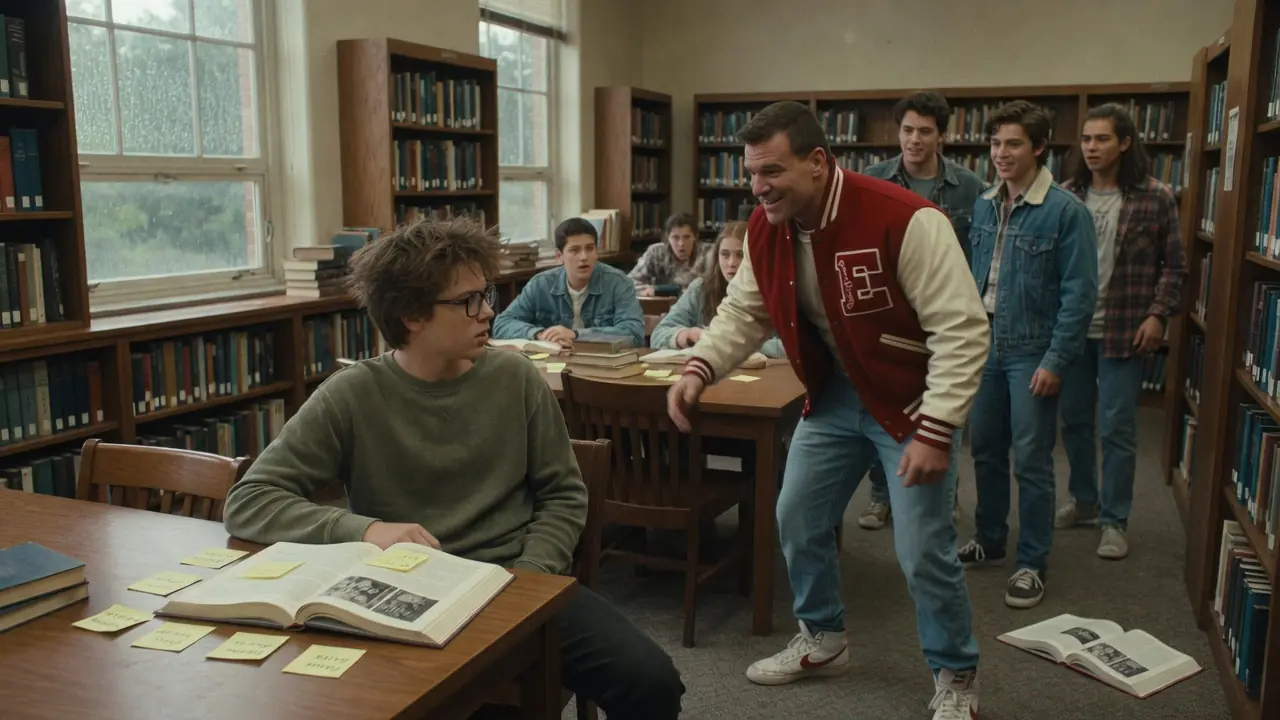
Eli sat at his usual table near the back window, where sunlight fell across the wood in a pale square. He wore a faded green sweater, black jeans, and the same rectangular glasses he had repaired twice with a tiny screwdriver from his mother’s sewing kit. His backpack was open beside him, filled with note cards, sharpened pencils, and a thick history textbook with yellow sticky notes along the edges. In front of him lay the book he had checked out three days earlier, a biography of Frederick Douglass that he needed for his senior research paper.
Most students at Jefferson Heights knew Eli as the quiet kid with glasses who always had a book in his hand. Teachers loved him because he turned in assignments early and never caused trouble. Students ignored him when they could, which Eli usually preferred. Being ignored was not kindness, but at least it gave him room to breathe.
The trouble was that Mason Drake did not like ignoring people. Mason was a senior linebacker, broad-shouldered, loud, and proud of the way students moved aside when he walked down the hall. He had a square jaw, expensive sneakers, and a laugh that always sounded like someone else was about to become the joke. Mason was not the smartest person in the room, but he was very good at finding the person least likely to fight back.
Eli had been that person since sophomore year. Mason called him “Professor,” “Four Eyes,” and sometimes “Library Boy,” depending on who was around to hear it. He knocked into Eli’s shoulder in the hall, dropped pencils off his desk, and once took Eli’s glasses during lunch just to watch him reach blindly across the table. Eli had reported him once, but Mason smiled in the office and said they were friends joking around.
After that, Eli stopped reporting. He told himself it was easier to endure small things than make them bigger. He learned when to leave class late, which stairwell to avoid, and how to keep his eyes on the floor without looking scared. It was a tiring kind of intelligence, the kind no one put on a report card.
That Wednesday afternoon, Eli had stayed in the library during study hall because his research paper was due Monday. The topic was courage in American abolitionist writing, and he had chosen Frederick Douglass because the words felt alive to him. Eli liked reading about people who spoke even when silence would have been safer. He underlined one sentence in his notes, then paused because it made his chest tighten.
The sentence was about dignity. It said that dignity could be attacked, mocked, delayed, and denied, but it could not truly be taken unless a person surrendered it. Eli stared at the line for a long time. He wondered how old a person had to be before they stopped surrendering pieces of themselves just to get through a school day.
Mrs. Whitaker sat at the front desk, helping two freshmen print an assignment. A few students worked quietly at computers. Rain tapped against the windows, soft and steady, turning the football field outside into a gray blur. Eli loved days like that because bad weather made the library feel even farther from the rest of the school.
He was halfway through copying a quote when the library doors swung open too loudly. Eli did not look up at first. Then he heard Mason’s voice, and his hand stopped moving above the page. “Man, it smells like homework in here.”
Two boys walked in behind Mason, laughing before he even said anything else. One was Kyle Mercer, a thin senior with restless eyes and a phone always ready in his hand. The other was Trent Holloway, a big junior who followed Mason like a shadow because standing near power made him feel powerful too. They were supposed to be in study hall, but no one expected Mason Drake to follow rules unless a coach was watching.
Mrs. Whitaker looked up from the printer. “Keep your voices down, please.” Mason smiled at her with fake politeness. “Yes, ma’am.” Then he turned away and rolled his eyes, making Kyle and Trent snicker.
Eli lowered his head and kept writing. He hoped Mason would move toward the computers, get bored, and leave. That was what Eli usually hoped whenever Mason entered any room. Hope, for him, had become a strategy of staying unnoticed.
But Mason noticed him immediately. “No way,” he said, stretching the words out. “Professor Turner is in his natural habitat.” Kyle laughed and lifted his phone slightly. Trent leaned against a bookshelf, grinning. Eli felt the familiar pressure in his chest, the tightness that came before humiliation.
He kept his voice low. “I’m studying.” Mason walked closer. “Yeah, I can see that. Big surprise.” He stopped at Eli’s table and looked down at the open biography. “What are you reading, man? A thousand pages about dead people?”
“It’s for history,” Eli said. He did not look up fully because eye contact with Mason often felt like accepting an invitation to trouble. Mason pulled out the chair across from him and sat backward, arms folded over the top. “You always sound like a teacher when you talk.”
Kyle moved closer with his phone in hand. Eli saw the black camera lens pointed toward the table. His stomach sank. Mason had learned long ago that embarrassment lasted longer when it could be replayed.
Mrs. Whitaker called from the desk, “Mason, if you’re here, you need to work quietly.” Mason turned his head just enough to answer. “I am working. I’m learning history from Eli.” He looked back at Eli with a grin. “Teach us something, Professor.”
Eli closed his notebook slowly. “Please leave me alone.” The words were polite, but the library made them sound louder than he intended. A girl at the computer row glanced over. One of the freshmen by the printer stopped gathering his papers.
“What’s wrong?” Mason asked. “You going to write me up in your little notebook?” He reached toward Eli’s notes. Eli moved his hand over them. “Don’t touch my work.”
The air changed. Mason did not like being told no, especially in front of Kyle, Trent, and anyone else who might be watching. He leaned forward, his grin fading into something sharper. “Don’t touch my work,” he repeated, this time lower. “You hear yourself?”
Eli looked at him then. Through his glasses, Mason’s face looked too close, too confident, too used to winning. “Yes,” Eli said. “I do.”
For one second, Mason looked surprised. Then he laughed and reached past Eli’s hand, grabbing the biography from the table. Eli stood so fast his chair scraped against the floor. “Give it back.”
Mrs. Whitaker looked up sharply. “Mason.” But Mason was already stepping away from the table with the book in one hand. He held it above his head like a trophy, flipping through the pages with exaggerated disgust. “Relax, Professor. I’m expanding my mind.”
Eli moved around the table. “That book is checked out under my name.” Mason backed toward the aisle between two shelves. “Oh no. The library police are coming for me.” Kyle recorded openly now, smiling at the screen. Trent laughed loudly enough that Mrs. Whitaker stood from her desk.
“Mason, return the book now,” she said. Her voice was firm, but Mason had already decided the room belonged to him. He looked from Mrs. Whitaker to Eli, then back at Kyle’s phone. The audience had arrived, and Mason could not resist performing.
He held the book out as if he might hand it back. Eli reached for it. At the last second, Mason pulled it away and tossed it across the library.
The book flew over a table, hit the edge of a chair, and slid across the floor near the entrance. The sound it made was not loud, but to Eli it felt like something inside him had cracked. Pages bent under the cover. One of his sticky notes fluttered loose and landed on the carpet.
For a moment, the whole library went still. Eli stared at the book on the floor. It was not just a book, and that was what Mason would never understand. It was three days of notes, a research project, a borrowed responsibility, and the one quiet place Eli had believed Mason could not reach.
Mason stepped closer, laughing. “Oops.” He looked at Kyle’s phone, then at Eli. “Go get it, boy.” The words came out with a cruel little smile, and the library seemed to inhale.
Eli turned slowly. His hands were shaking, but not with fear anymore. He looked past Mason at the book lying on the floor. Then he looked at Mrs. Whitaker, who was already coming around the desk. He knew she would handle it if he waited. She would send Mason out, maybe write a report, maybe call an assistant principal.
But the old pattern would survive. Mason would say it was a joke. Kyle would delete only one video and keep another. Trent would repeat the story in the locker room. Eli would pick up the book, smooth the pages, and pretend the anger in his throat was not there.
Mason leaned in close enough for Eli to smell peppermint gum. “What are you going to do, Four Eyes?” he whispered, still smiling. “Cry over a book?”
Eli did not answer right away. He removed his glasses with both hands and placed them carefully on the table behind him. The movement was so calm that Mason’s smile faltered. Kyle lowered the phone half an inch, then raised it again.
“What are you doing?” Mason asked. Eli looked at him without the lenses between them, Mason’s face now slightly blurred but still close enough. “Making sure you don’t break these too.”
Trent let out a nervous laugh. Mason’s jaw tightened. “You think that makes you tough?” Eli stepped closer. “No. I think I’m done asking you to stop.”
The sentence landed heavily in the quiet library. Mrs. Whitaker stopped a few steps away, her expression sharp with concern. “Eli,” she said carefully. But Eli did not look away from Mason.
Mason shoved him in the shoulder. It was not enough to knock Eli down, but it was enough to turn the moment physical. The room gasped. Kyle’s phone captured it clearly. Mason pointed at Eli’s chest. “Sit down before I put you down.”
For two years, Eli had imagined what he would say if he ever reached this point. In his imagination, the words were clever, clean, powerful. In reality, he said only one sentence. “Try it.”
Mason’s face changed. He grabbed Eli by the front of his sweater, pulling him forward. Eli moved before fear could freeze him. His uncle had taught him simple self-defense in the garage the summer after Mason stole his glasses, not because Eli wanted revenge, but because his uncle had said, “A quiet kid still needs to know how to protect his space.”
Eli caught Mason’s wrist, turned his body sideways, and drove his shoulder forward with controlled force. Mason, expecting Eli to pull back or panic, lost his balance. Eli swept one foot behind Mason’s ankle and pushed him down hard enough to send him stumbling backward onto the carpet between the tables.
Mason hit the floor with a heavy thud, more shocked than hurt. His arms flailed, and one of his sneakers kicked the leg of a chair. The library froze. Kyle stopped smiling. Trent took a step back from the bookshelf.
Eli stood over Mason, breathing hard, hands open at his sides. He did not swing again. He did not kick. He did not shout. That control made the moment more powerful than any wild attack could have been.
Mason blinked up at him, stunned by the fact that the boy with glasses had not only fought back but had done it cleanly in front of everyone. Eli’s voice came out low and steady. “Don’t touch my books. Don’t touch my glasses. Don’t touch me again.”
Mrs. Whitaker moved quickly between them. “Enough. Mason, stay down. Eli, step back.” Eli obeyed immediately, backing away to the table and putting his glasses back on with hands that trembled only slightly. The room sharpened again through the lenses.
Mason sat up, face red with humiliation. “He attacked me!” he shouted. His voice cracked on the last word, and that seemed to embarrass him even more. “He just attacked me in the library.”
Kyle lowered his phone completely, as if hiding it now could erase what he had recorded. The freshman by the printer spoke before anyone else could. “No, he didn’t. Mason shoved him first.” The girl at the computer row nodded. “And he threw his book.”
Mrs. Whitaker looked at Kyle. “You were recording?” Kyle swallowed. “No.” Three students answered at once. “Yes, you were.”
Eli walked to the front of the library and picked up the biography from the floor. The cover was bent, and several sticky notes had fallen out. He gathered them carefully, one by one, while the entire room watched. He did not rush, because rushing would have made him feel like he was cleaning up Mason’s mess in shame.
When he returned to the table, Mason was standing with Mrs. Whitaker between them. Mason’s face looked different without the laughter behind it. He looked younger, angrier, and less certain. The fall had not injured his body, but it had struck the thing he protected most, his image.
“You’re dead, Turner,” Mason muttered. Mrs. Whitaker heard him clearly. “That’s enough. Office, now.” Mason glared at Eli, then at Kyle and Trent, as if expecting them to restore the laughter. Neither of them did.
Mrs. Whitaker pointed toward the door. “All three of you.” Mason stormed out first, shoulders tight. Kyle followed with his phone in his pocket, and Trent trailed behind, suddenly very interested in the floor. The library doors closed behind them with a soft, final sound.
For a few seconds, Eli did not move. The book was back on his table, his glasses were on his face, and Mason was gone. Yet his heart still beat as if the fight were happening. Mrs. Whitaker came to his side.
“Are you hurt?” she asked. Eli shook his head. “No.” She looked at his sweater, then at his face. “You need to come to the office too. Not because I think you did the same thing, but because this has to be documented correctly.”
Eli nodded. He expected guilt to rise in him, but instead he felt something unfamiliar. He felt afraid, yes, but also clear. For once, the story would not begin with Mason’s version and end with Eli accepting it.
Before he left, the freshman by the printer walked over and picked up one last yellow sticky note from under a chair. He handed it to Eli without making eye contact. “That was messed up,” he said quietly. “What Mason did.”
Eli took the note. “Thanks.” The freshman nodded and stepped away. It was a small thing, but Eli carried it with him into the hallway like proof that someone had seen the truth and said it out loud.
The assistant principal’s office sat near the main entrance, where the walls were covered with college pennants and posters about respect. Eli had walked past those posters for years without believing them. Respect looked nice in bright colors, but it often disappeared when a popular athlete smiled and said he was only joking. That day, Eli sat in a chair outside Mr. Alvarez’s office and watched Mason pace near the opposite wall.
Mason refused to look at him. Kyle sat with his arms folded, pale and silent. Trent kept cracking his knuckles until the secretary told him to stop. Mrs. Whitaker stood at the counter, speaking quietly with Mr. Alvarez and handing him a written statement.
When Eli was called in, he expected the office to feel like a courtroom. Instead, Mr. Alvarez gestured to a chair and asked again if he was hurt. Eli said no. Then Mr. Alvarez folded his hands on the desk and said, “Tell me exactly what happened.”
For once, Eli did not shrink the truth. He told him about Mason entering the library, mocking him, taking the book, throwing it across the room, telling him to go get it, and shoving him first. He explained that he had removed his glasses because Mason had taken them before. He admitted clearly that he had used a self-defense move to knock Mason down after Mason grabbed him.
Mr. Alvarez listened without interrupting. When Eli finished, he asked, “Has Mason bothered you before today?” Eli looked down at his hands. That question had always been the hard one. Saying yes meant opening a door he had spent years holding shut.
“Yes,” Eli said. His voice was quiet, but he did not take it back. “Since sophomore year.” Mr. Alvarez’s expression changed. “What kind of behavior?”
Eli took a breath. “Names. Pushing in the hallway. Taking my glasses. Recording me. Making jokes about my clothes and my family. Throwing things off my desk.” He paused. “I reported it once, but he said we were friends joking around.”
Mr. Alvarez looked pained. “And were you friends?” Eli almost laughed. “No.” The answer was so simple that it hurt. No, they were not friends. No, it was not a joke. No, Eli had not agreed to be anyone’s entertainment.
Mr. Alvarez wrote several notes. Then he said, “I’m going to review the video and speak to the witnesses. Until then, you’re not in trouble for defending yourself, but I need you to avoid Mason completely.” Eli nodded. “I’ve been trying to avoid him for two years.”
The sentence hung in the office longer than Eli expected. Mr. Alvarez looked up at him, and this time there was no administrator mask hiding the reaction. “I’m sorry we didn’t see that sooner,” he said. Eli did not know what to do with an adult apology, so he only nodded.
By the end of the day, the video had spread through the school. Kyle had apparently sent it to one person before being forced to delete it, and that one person had sent it to ten more. By last period, everyone had seen Mason throw the book, shove Eli, grab his sweater, and then hit the carpet in stunned silence. The clip ended with Eli saying, “Don’t touch my books. Don’t touch my glasses. Don’t touch me again.”
Eli hated that people were watching him online. But he also noticed something strange in the comments and whispers. For once, nobody was laughing at him. They were replaying the moment Mason went down.
The next morning, Eli almost stayed home. His mother, Claire Turner, found him standing in the kitchen with his backpack on, staring at a bowl of cereal he had not touched. She was a nurse at a rehabilitation clinic, and she had worked late the night before, but Mr. Alvarez had called her after the incident. She knew everything.
“You don’t have to go today if you’re not ready,” she said. Eli looked at her tired face, the worry beneath her calm voice. “If I don’t go, it feels like he still gets the hallway.” Claire’s eyes softened. “Then go. But you don’t have to be alone.”
His uncle Ray offered to drive him, but Eli said the bus was fine. He did not want to arrive like someone being escorted after a disaster. He wanted to walk through the front doors like a student who had every right to be there. Still, when the bus pulled up to Jefferson Heights, his stomach tightened.
The hallway was loud as usual, but the noise shifted when Eli entered. Heads turned. A few students whispered. Someone near the lockers said, “That’s him,” as if Eli had become a headline instead of a person.
Eli kept walking. He expected mockery at any second, but instead a girl from his English class stepped aside and said, “Good morning, Eli.” She had never greeted him before. He nodded awkwardly. “Morning.”
At his locker, he found a folded sheet of notebook paper tucked into the vent. For a moment, fear moved through him. He thought it might be a threat from Mason. Instead, the note read, He threw my backpack in the trash last year. I never told anyone. I’m glad you stood up.
Eli stared at the note until the words blurred slightly. He folded it carefully and put it inside his history book. It felt important to keep it there, next to the bent cover and the yellow sticky notes, because they were all part of the same story now.
Mason was absent that day. Kyle and Trent were in school, but neither came near Eli. In history class, Kyle sat three rows away and kept his phone face down on his desk. When their teacher asked for volunteers to discuss research topics, Eli raised his hand before he could talk himself out of it.
“My paper is about dignity and courage in Frederick Douglass’s writing,” he said. His voice shook only a little. A few students turned to look at him, but he did not lower his eyes. “I’m focusing on the idea that silence can sometimes protect people, but it can also help injustice continue.”
The classroom went quiet. Mrs. Langley, his history teacher, looked at him with something like pride. “That sounds like a powerful argument, Eli.” Eli nodded and sat back, feeling the weight of the previous day move through the room without needing to be named.
At lunch, Eli planned to eat in the library like always. But when he reached the doors, he stopped. The library was still his safest place, but he did not want safety to become another word for hiding. So he turned around and walked toward the cafeteria.
The cafeteria was everything he disliked, loud, crowded, and full of social rules no one admitted existed. Eli carried his tray past the athletes’ tables, past the student council group, past the freshmen packed shoulder to shoulder near the windows. He saw empty seats at the far end and started toward them.
Before he reached the table, a voice called, “Eli.” He turned and saw Naomi Brooks, the girl from his English class, sitting with two other students from the school newspaper. She pushed out an empty chair with her foot. “You can sit here if you want.”
Eli hesitated. The offer sounded casual, but he knew it was not small. A seat at a lunch table could be a bridge, a warning, or a rescue. Naomi’s expression was open, not pitying, so he sat down.
For the first few minutes, conversation was awkward. Someone asked about the research paper. Someone else complained about the cafeteria pizza. Then a junior named Sam admitted that Mason had once locked him out of the locker room during gym class, and the table went quiet.
Naomi looked at Eli. “I think a lot of people have stories.” Eli stared at his tray. “Then why didn’t anyone say anything?” It came out sharper than he intended. Naomi did not get defensive. “Because everyone thought they were the only one. Or because everyone thought Mason was too protected.”
Eli looked across the cafeteria at the football table. Mason’s usual seat was empty. Without him there, the group seemed less like a kingdom and more like boys eating lunch, unsure what to do with all the attention they had borrowed from someone else. Eli wondered how many people had mistaken Mason’s confidence for permission to be cruel.
After school, Mr. Alvarez called Eli back to the office. This time, Mrs. Whitaker was there, along with Mrs. Langley and Coach Harris, the football coach. Coach Harris looked uncomfortable, which did not surprise Eli. Mason was one of his best defensive players, and Friday’s game against North Central was important.
Mr. Alvarez explained that Mason had been suspended for three days, removed from the next football game, and required to attend a disciplinary hearing with his parents. Kyle and Trent had received consequences for recording and encouraging the harassment. The school was also opening a wider review because several students had submitted reports after seeing the video.
Eli sat quietly, taking in the words. Part of him felt relieved. Another part of him wondered why it had taken a public video for adults to believe what smaller moments had been saying all along.
Coach Harris leaned forward. “Eli, I owe you an apology.” Eli looked at him, surprised. Coach Harris rubbed his hands together. “I’ve heard comments from Mason before. I thought it was trash talk. I told myself he was just intense.” He swallowed. “I should have paid closer attention to who was laughing and who wasn’t.”
Eli did not know what to say. Adults apologizing made him feel strangely exposed, as if his hurt had finally become visible under fluorescent lights. Mrs. Whitaker placed a hand over her heart and said, “The library should have been a safe place for you. I’m sorry he violated that.”
That apology almost broke him. Eli looked down at his bent book, which he had carried into the office like evidence. “It was the only place I thought he wouldn’t bother me,” he said. The room went silent because everyone understood what that meant.
Mrs. Langley spoke gently. “Would you consider speaking at the student forum next week?” Eli looked up quickly. “No.” The answer came so fast that Mrs. Langley almost smiled. “That is completely fair.”
Mr. Alvarez nodded. “You don’t have to. But we are planning a forum about harassment, bystanders, and how small patterns become big incidents. Your voice would matter if you chose to use it.” Eli held the book tighter. “I used my voice yesterday.” Mrs. Langley nodded. “You did.”
That night, Eli sat at his desk at home and tried to work on his research paper. His mother brought him tea, kissed the top of his head, and left without hovering. The apartment was quiet except for traffic outside and the low hum of the refrigerator. Eli opened the biography and carefully flattened the bent pages.
He found the dignity quote again. This time, he did not only copy it. He wrote beneath it, Dignity is not proved by never being pushed. Sometimes it is proved by refusing to stay down when someone pushes too far. He read the sentence twice, then kept writing.
The paper began changing after that. It was still about Frederick Douglass, still about history, still full of required citations and analysis. But something personal entered the argument, not as a confession, but as understanding. Eli wrote about how people in power often depend on silence from those they harm, and how speaking back can transform private pain into public truth.
On Monday, Mason returned to school. The whole building seemed to know before first period started. Eli saw him near the trophy case without his football jacket. That detail mattered more than it should have.
Mason looked different without his usual audience. Kyle and Trent stood nearby, but not close enough to seem loyal. Students watched from lockers and classroom doors, not cheering, not laughing, not moving aside as quickly as they used to. Mason’s face was hard, but his eyes were cautious.
Eli kept walking toward history class. He hoped Mason would let him pass. For a moment, it seemed like he would.
Then Mason stepped into his path. The hallway tightened around them. Eli stopped, his backpack strap held in one hand. Teachers were nearby, students were watching, and phones were already rising.
Mason looked at the phones and his jaw flexed. “I’m not doing anything,” he snapped at the hallway. Then he looked at Eli. “I need to talk to you.”
Eli’s heart beat faster, but his voice stayed calm. “Then talk.” Mason glanced around, uncomfortable with the audience. “Not here.” Eli shook his head. “You had no problem humiliating me in public. If this is an apology, you can say it in public.”
A murmur moved through the hallway. Mason’s face turned red, but he did not explode. That alone surprised Eli. For the first time, Mason seemed aware that anger might not save him.
“I’m sorry,” Mason said stiffly. “For throwing the book.” Eli waited. Mason looked like he wanted to stop there, but the silence forced him forward. “And for shoving you. And the glasses thing before. And the names.”
Eli studied him. “Why?” Mason frowned. “Why what?” Eli adjusted his glasses. “Why did you do it?”
Mason looked irritated, then trapped. His eyes flicked toward Coach Harris, who stood at the end of the hallway watching. Finally, Mason muttered, “Because people laughed.” Eli nodded slowly. “That’s not a reason. That’s the reward you got.”
The words made Mason flinch. Eli had not meant them as a clever comeback. They were simply true. Mason had been paid in laughter for years, and the school had been his audience.
Mason looked down. “I know.” His voice was quieter now. “I’m supposed to tell you I’ll stay away from you.” Eli looked at him carefully. “Good.” Mason swallowed. “And I will.”
Eli did not forgive him. Not there, not that quickly, not because a forced apology had been spoken under pressure. But he did feel something change. Mason no longer looked like a force of nature. He looked like a student who had made choices and was now standing in the consequences.
“Prove it when nobody’s watching,” Eli said. Mason nodded once and stepped aside. Eli walked past him without lowering his head.
The student forum happened on Thursday. Eli had refused to speak, but he attended because Mrs. Langley asked if she could read an anonymous excerpt from his research paper. He agreed only after she promised not to name him. The auditorium filled during last period, noisy and impatient at first, then quieter as Mr. Alvarez began.
Students spoke about online harassment, hallway intimidation, and how jokes became weapons when everyone pretended they were harmless. A sophomore girl admitted she had laughed at people because she was afraid of being targeted herself. A football player said the team had confused toughness with cruelty too many times. Coach Harris stood on stage and said character was not what athletes did when the crowd cheered, but what they refused to do when cruelty would make them popular.
Then Mrs. Langley walked to the microphone with a sheet of paper. Eli sat near the back, heart pounding even though his name would not be used. She read from his paper, her voice clear across the auditorium.
“Silence can be mistaken for peace, but sometimes silence is only fear with good manners. When a person is mocked long enough, they may begin to believe survival requires becoming smaller. Courage begins when that person decides their dignity is not a privilege granted by the loudest person in the room.”
The auditorium was still. Eli stared at the floor, overwhelmed by the strange experience of hearing his own words become public without his body standing on stage. Around him, students listened. Not all perfectly, not all deeply, but enough.
After the forum, Naomi found him in the hallway. “That was your writing, wasn’t it?” Eli looked startled. She smiled. “Relax. I won’t tell anyone.” He adjusted his glasses. “Was it obvious?” Naomi shrugged. “Only because it sounded like someone finally saying what he actually thinks.”
Eli did not answer, but he smiled slightly. That smile felt new, not because happiness was new, but because he did not feel the need to hide it.
Over the next few weeks, Jefferson Heights changed in small, uneven ways. Teachers stood closer in the hallways. Students became more careful with their phones. The phrase “It’s just a joke” no longer ended every conversation as easily as it once had. Sometimes another student would answer, “Then why isn’t anyone laughing?”
The library changed most for Eli. At first, returning there was difficult. The same table near the back window carried the memory of Mason’s hand on the book, the pages sliding across the floor, the moment Eli removed his glasses and chose not to fold into himself. But Mrs. Whitaker placed a small sign near the entrance that read, This library is a respect zone. Everyone deserves quiet, safety, and dignity here.
Eli saw the sign and almost laughed because it sounded like something from a school poster. But then he noticed how carefully Mrs. Whitaker enforced it. When students entered too loudly, she corrected them immediately. When someone mocked a freshman for reading manga, she shut it down before the laugh could spread. The sign mattered because someone decided to make it real.
One afternoon, Eli found the freshman from the printer sitting at his usual table. The boy looked ready to move when Eli approached. “Sorry,” he said. “I can leave.”
“You’re fine,” Eli said. He sat across from him and opened his notebook. For a while, they worked quietly. Then the freshman said, “My name’s Ben.”
Eli looked up. “Eli.” Ben smiled awkwardly. “I know.” He tapped his pencil against his notebook. “I started coming here because the cafeteria is loud.” Eli nodded. “That’s why I started too.”
They did not talk much after that, but they did not need to. Sharing quiet could be its own kind of friendship. A week later, Naomi joined them. Then Sam. By the end of the month, Eli’s back table had become a place where students studied, read, and sometimes spoke honestly without fear of being turned into entertainment.
Mason kept his distance. Eli saw him in hallways, in assemblies, and once in the parking lot after practice, but Mason did not approach him again. He still had friends, still played football after his suspension ended, still laughed louder than necessary sometimes. But the old cruelty had lost its easy audience.
One day in late November, Eli watched Mason stop Kyle from filming a sophomore who had dropped a lunch tray. Mason put his hand over Kyle’s phone and said, “Don’t.” It was one word, and Mason said it roughly, like kindness was a language he had not practiced. But Kyle lowered the phone.
Eli saw it from across the cafeteria. Mason saw him seeing it. For one second, their eyes met. Eli gave no smile, no approval, no forgiveness ceremony. He only looked at him, then returned to his lunch.
That was enough. Some people did not need applause for every decent choice. They needed to learn how to make one without being rewarded.
When Eli finally turned in his research paper, Mrs. Langley read it over the weekend and asked him to stay after class on Monday. Eli assumed something was wrong with his citations. Instead, she held the paper in both hands and said, “This is one of the strongest student essays I’ve read in years.”
Eli blinked. “Really?” Mrs. Langley smiled. “Really. Your analysis is excellent, but more than that, your voice is clear.” She tapped the final page. “You should submit this to the district writing contest.”
Eli almost said no. Competitions meant judges, attention, and the possibility of failure becoming public. Then he thought of the book flying across the library, the pages bent but not ruined. He thought of the dignity quote and the note in his locker. He thought of how long he had mistaken invisibility for safety.
“Okay,” he said. Mrs. Langley’s smile widened. “Okay?” Eli nodded. “Submit it.”
In December, Eli won second place in the district contest. The announcement came over the school speakers on a cold Friday morning. Eli sat in history class while Mrs. Langley beamed at him from the front of the room, and his classmates turned around to clap. The applause felt strange, but not threatening.
Naomi whispered, “Look at you, famous writer.” Eli whispered back, “Please never say that again.” She laughed, and he smiled at his desk.
At lunch, Mrs. Whitaker displayed a copy of the announcement on the library bulletin board. Under it, she placed a printed quote from Eli’s essay, with his permission. Courage begins when a person decides their dignity is not a privilege granted by the loudest person in the room.
Students stopped to read it throughout the day. Some knew exactly where the line had come from. Others did not. Eli found he did not mind either way.
The strangest moment came after school, when Mason appeared at the library entrance. Eli was at the back table with Ben and Naomi, working on scholarship applications. Mrs. Whitaker watched Mason carefully from the front desk. Mason noticed, stopped at the entrance, and did not step farther inside.
“Turner,” he said. Eli looked up. The room became quiet, but Mason did not smile or perform. He held up a book with a blue cover. “I found this in Coach Harris’s office. It’s about college writing or something. He said you might use it.”
Eli stared at him, unsure whether to trust the moment. Mason walked only as far as the front desk and placed the book there, not near Eli’s table. “That’s all,” he said.
Eli stood and walked to the desk. The book was a guide to scholarship essays, with tabs already marking useful chapters. He looked at Mason. “Why are you giving me this?”
Mason shoved his hands into his jacket pockets. “Coach said making things right isn’t one speech. It’s doing stuff that doesn’t help you look good.” He looked embarrassed by the honesty. “So. There.”
Eli glanced at the book again. “Thanks.” Mason nodded once. He turned to leave, then paused. “I read the quote on the board.” Eli stayed still. Mason did not look back when he said, “It’s good.”
Then he left. Naomi raised her eyebrows from the back table, but Eli said nothing. He carried the book back to his seat and opened it carefully. He did not mistake Mason’s gesture for full repair, but he allowed it to be one decent action.
Winter came hard that year. Snow covered the football field, the windows fogged in the mornings, and students hurried through the halls with coats half-zipped. Eli spent more time in the library than ever, but now the room felt less like a bunker and more like a place he had helped reclaim.
He finished scholarship essays at the back table. He helped Ben outline an English paper. He edited Naomi’s article about student phone policies. Sometimes he looked at the biography of Frederick Douglass, repaired now with a clear protective cover Mrs. Whitaker had placed over it, and remembered the day it slid across the floor.
The book still had a bent corner. Eli liked that. The mark did not ruin it. It proved the book had survived being mishandled and still carried every word inside.
In early spring, Jefferson Heights held an academic showcase. Parents walked through classrooms, teachers displayed projects, and the library hosted readings from student writers. Mrs. Langley asked Eli to read a short excerpt from his essay. This time, he did not say no immediately.
He practiced at home in front of his mother, who cried halfway through and insisted she was only tired. His uncle Ray came over and sat on the couch with a cup of coffee, nodding as Eli read. When Eli finished, Ray said, “You know, the strongest punch you ever threw was that paragraph.”
Eli laughed. “That sounds like something you made up.” Ray grinned. “Still true.”
On the night of the showcase, Eli stood at a small podium in the library. The room was full, but not overwhelmingly so. His mother stood near the back, still wearing her work scrubs, pride shining openly on her face. Mrs. Whitaker sat at the front desk, and Mrs. Langley stood beside the bookshelves.
Mason was there too. Eli noticed him near the entrance with Coach Harris. He looked uncomfortable, like he was not sure he had a right to be in the room. Eli saw him, took a breath, and began reading anyway.
His voice shook at first, but it steadied with each sentence. He read about silence, dignity, courage, and the danger of letting cruelty become entertainment. He did not mention Mason. He did not mention the book. He did not have to.
When he finished, the applause filled the library gently. It was not the roaring applause of a gym or auditorium. It was softer, warmer, and to Eli, more meaningful. His mother hugged him afterward and whispered, “That was your voice. All yours.”
Later, Mason approached him while people gathered around the refreshment table. Eli’s body tensed out of habit, but Mason stopped a respectful distance away. “I’m not trying to bother you,” Mason said quickly. “I just wanted to say I get it more now.”
Eli looked at him. “Get what?” Mason’s face tightened as he searched for words. “That it wasn’t one thing. The book, the glasses, all that. It was a pattern.” He swallowed. “I didn’t think about it like that because thinking about it would make me the bad guy.”
Eli adjusted his glasses. “You were the bad guy in that pattern.” Mason nodded. “Yeah. I know.” There was no argument in his voice, and that mattered.
Eli looked around the library, at Ben laughing with Naomi, at Mrs. Whitaker speaking to his mother, at the table where everything had happened months earlier. He did not feel anger disappear, but he felt it settle into something less heavy. “Then don’t be that guy tomorrow,” he said.
Mason nodded once. “I’m trying.” Eli believed that Mason wanted him to hear those words. He did not yet know whether Mason would live by them, but he understood now that other people’s growth was not his responsibility to manage. His responsibility was to keep his own dignity intact.
By graduation season, Eli had been accepted to Ohio State with a partial scholarship. His mother cried over the letter at the kitchen table. Uncle Ray claimed he had predicted it all along, even though he had once spent twenty minutes trying to understand the online application portal. Eli taped the acceptance letter above his desk, beside a copy of his district writing certificate.
The last week of school felt unreal. Lockers emptied, yearbooks filled with rushed signatures, and seniors walked the halls with the strange confidence of people already halfway gone. Eli spent his final study hall in the library, at the same back table near the window. Rain tapped against the glass, just as it had on the day Mason threw the book.
Ben sat across from him, working on a summer reading list. Naomi was editing one last article for the school newspaper. Mrs. Whitaker moved quietly between shelves, placing returned books in order. The room felt peaceful, but not fragile.
Mason appeared at the door near the end of the period. He did not enter loudly. He did not make a joke. He walked to Mrs. Whitaker’s desk and returned a book.
Eli noticed the title as Mason set it down. It was the same biography of Frederick Douglass. Mrs. Whitaker scanned it, then smiled faintly. “Finished it?” Mason shrugged, embarrassed. “Most of it.” Mrs. Whitaker nodded. “That counts for something.”
As Mason turned to leave, he glanced toward Eli. He did not speak, but he lifted one hand slightly. Eli nodded back. It was not friendship, but it was peace enough for a school library on a rainy afternoon.
Graduation came two weeks later on the football field behind Jefferson Heights High. Eli wore a blue cap and gown, his glasses polished carefully, his honor cord resting against his chest. His mother waved from the bleachers with both hands, and Uncle Ray shouted his name too loudly when he crossed the stage. Eli accepted his diploma and shook Principal Walker’s hand, smiling despite himself.
When the ceremony ended, students poured onto the field for photos. Naomi found him first and made him pose with his diploma. Ben’s parents asked for a picture with the “library table crew,” which made Eli laugh because he had somehow become part of a crew without noticing. Mrs. Langley hugged him and told him to keep writing.
Near the edge of the field, Mason stood with his parents and Coach Harris. He caught Eli’s eye and walked over slowly. For once, no crowd followed him.
“Congratulations,” Mason said. Eli looked at him for a moment, then nodded. “You too.” Mason shifted awkwardly. “I’m going to community college in the fall. Coach helped me apply.” Eli was surprised, but he kept his face neutral. “That’s good.”
Mason looked down at his shoes. “I’m trying to start different.” Eli thought of the book flying through the library, the carpet under Mason’s back, the apology in the hallway, the writing guide, and the borrowed biography returned at last. “Then start different,” Eli said. “And keep going.”
Mason nodded. “Yeah.” He held out his hand, uncertain. Eli looked at it, then shook it once. Not because everything was erased, but because the past no longer had to hold his hand closed.
That evening, after dinner with his mother and uncle, Eli returned home and placed his diploma on his desk. Beside it, he set the repaired biography, which Mrs. Whitaker had allowed him to keep as a graduation gift after replacing the library copy. Inside the front cover, she had written, For Eli, who reminded us that libraries are quiet places, not silent ones.
Eli read the inscription several times. Then he opened his notebook and wrote a new sentence beneath the old dignity quote. Quiet does not mean weak. Quiet means listening, learning, and choosing the moment when your voice will matter most.
He thought back to the day in the library. Mason had believed throwing the book would prove Eli was small. Instead, it revealed how much Eli had been holding inside. The fight lasted only seconds, but the decision behind it had been building for years.
Eli did not become someone else that day. He did not become loud, fearless, or eager for conflict. He still loved quiet tables, rain on windows, sharpened pencils, and the soft weight of a book open under his hands. But he no longer confused peace with surrender.
Years later, when students at Jefferson Heights talked about Mason Drake, they remembered the football player who once thought the whole school would laugh with him forever. But when they talked about Eli Turner, they remembered something else. They remembered the boy with glasses who sat in the library trying to study while a bully grabbed his book and threw it across the room.
They remembered how Eli took off his glasses, stood up, and finally drew a line no one could miss. They remembered that he did not keep hitting after Mason fell. He simply stood there, breathing hard, and claimed the space that had always belonged to him.
And in the library, long after Eli graduated, students still repeated the sentence printed on the bulletin board near the back window. Courage begins when a person decides their dignity is not a privilege granted by the loudest person in the room.
For Eli Turner, that courage began with a book on the floor.
And it ended with the whole school finally learning how powerful a quiet boy could be.