The first thing they took from her was the cane.
The second thing they tried to take was her dignity.
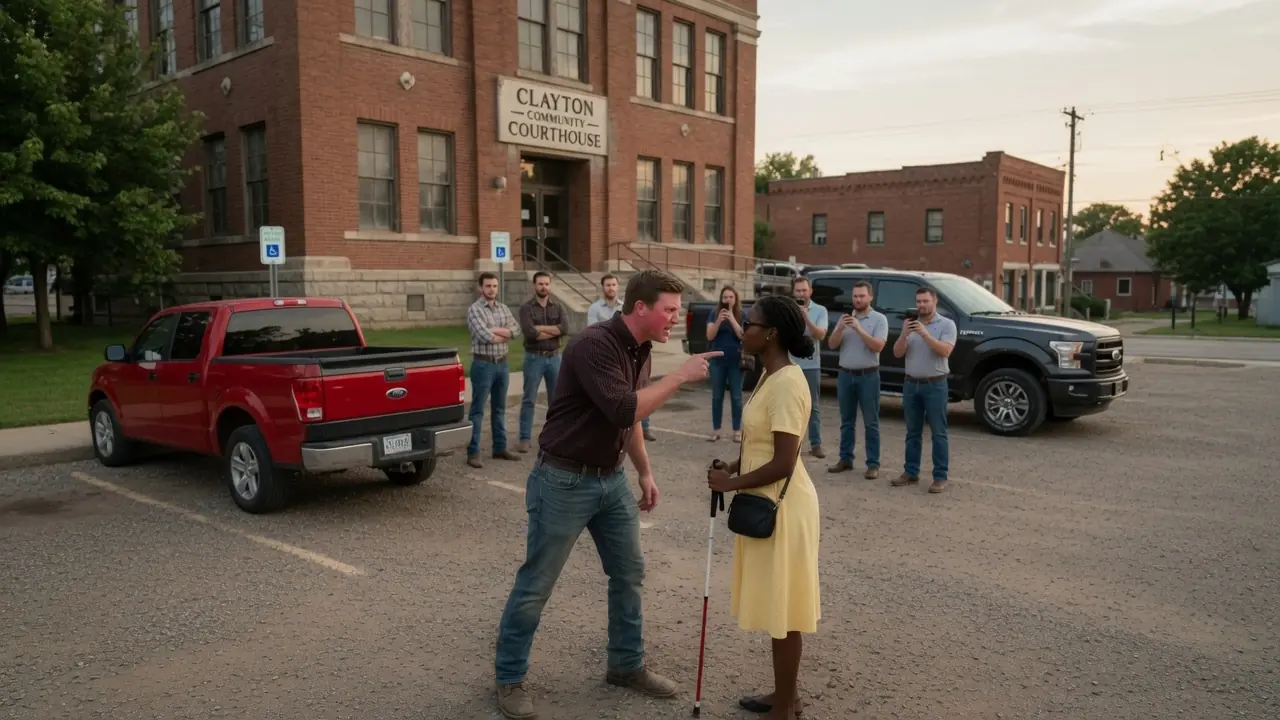
It happened outside the Clayton Community Courthouse on a humid Friday afternoon, in front of thirty-seven people who suddenly found their phones, shoes, handbags, and coffee cups more interesting than the Black woman being surrounded near the handicap ramp.
Maya Sterling stood still while the white cane swung loosely from her right hand.
She was twenty-six years old, Black, slim, soft-spoken, and dressed in a pale yellow blouse, dark jeans, and flat shoes. Her dark glasses covered half her face. Her hair was braided back neatly. To the people in Clayton, Alabama, she was the blind girl who worked at the tenant help desk inside the courthouse annex.
Quiet Maya.
Polite Maya.
Poor thing Maya.
The girl who tapped her way down Main Street every morning at 8:10, counted steps beneath her breath, and smiled when people spoke to her as if kindness could erase pity.
That was what they thought she was.
That was what they were supposed to think.
“Look at her,” Bryce Keller said, loud enough for the parking lot to hear. “Walking around like the world owes her space.”
His friends laughed.
There were five of them.
Bryce Keller, twenty-eight, son of the county commissioner, wide shoulders, expensive boots, and the kind of confidence that came from never being held responsible long enough to learn fear.
Mason Reed, tall and mean, always chewing gum.
Colton Price, broad and slow, with a scar across one eyebrow.
Trey Willis, who filmed everything.
And Owen Sharp, the quiet one, the follower, the one who always looked away right before things got ugly but never left.
They had blocked Maya before.
At the grocery store.
Outside the bus stop.
Once in front of the laundromat, where Bryce had tapped her cane with his boot and said, “Careful, sweetheart. World’s dangerous when you can’t see who hates you.”
Maya had said nothing then.
She had said nothing for four months.
That was part of the job.
The cane was not a normal cane.
It looked like one. White shaft. Red tip. Rubber grip. A small nick near the handle where Bryce had once kicked it against a curb.
But inside, it was reinforced hickory with a carbon core, balanced to the ounce.
Maya had trained with sticks since she was thirteen.
Kali.
Arnis.
Baton defense.
Close-quarters control.
At Quantico, instructors learned not to underestimate the quiet woman who smiled before she put them on the mat.
Maya Sterling was not blind.
She had perfect vision.
She was Special Agent Maya Sterling, FBI Civil Rights Division, embedded in Clayton under deep cover to investigate forced displacement, intimidation, and public corruption connected to Keller Development Group.
Bryce Keller’s father, Commissioner Wallace Keller, had spent six years helping developers push Black families off land their grandparents had owned. Eviction pressure. Fake code violations. Utility cutoffs. Harassment. Lowball purchases after manufactured debt.
Bryce and his friends were the enforcement.
Not officially.
Never officially.
They slashed tires.
Broke windows.
Scared old women at night.
Followed teenage boys home from school.
Put dead raccoons on porches.
Spray-painted warnings on houses.
Nothing spectacular enough to draw national attention.
Everything cruel enough to make people leave.
Maya had come to Clayton as “Maya Reed,” a legally blind administrative clerk assigned to a nonprofit tenant rights program. She answered phones, sorted forms by touch, and let the whole town believe she was harmless.
Every insult was recorded.
Every shove logged.
Every fake smile from Commissioner Keller filed away.
Every text Bryce sent to his crew captured through a phone clone authorized by a federal warrant.
But the case was missing one thing.
A public act of violence tied directly to the intimidation campaign.
Without it, Commissioner Keller could claim ignorance.
Without it, Bryce could be written off as a reckless son.
Without it, the families who had been forced out would still look like people who “chose to sell.”
Maya needed Bryce to do what he had been doing for years.
Only this time, in front of everyone.
And he was about to.
Bryce stepped closer.
“Maya, Maya, Maya,” he said, dragging her name through his teeth. “You keep coming around this courthouse like somebody invited you.”
Maya kept her chin forward, face angled slightly downward the way a blind woman might orient herself to sound.
“I work here, Bryce.”
“Yeah, answering phones for people who can’t pay rent.”
Mason laughed.
“Big career.”
She heard Trey’s phone camera start recording. A soft electronic click. Good.
She heard Colton move behind her. Gravel under heavy boots. Left side, four feet back.
Owen breathing too fast near the ramp rail.
Mason to the right.
Bryce in front.
Trey six feet away, filming.
She mapped them without turning her head.
Bryce leaned in.
“You know what I don’t get?” he said. “How a blind Black girl got the nerve to walk around like she’s better than anybody.”
Someone in the parking lot gasped.
Nobody moved.
Maya said quietly, “Move aside.”
Bryce smiled.
“Or what?”
“I need to get inside.”
“No, you need to learn where you belong.”
Mason reached first.
He grabbed the cane halfway down and yanked.
Maya let him take it.
That was important.
If she held on too hard, the cover would crack.
Mason spun it like a toy.
“Look at this. She’s helpless now.”
Bryce snatched the cane from him and held it above his head.
“Want it back?”
Maya turned her head slightly toward his voice.
“Yes.”
“Say please.”
Several people looked away.
A woman near a red sedan whispered, “Somebody should stop them.”
No one did.
Maya’s jaw tightened once.
“Please give me my cane.”
Bryce laughed.
“See? Manners.”
Then he dropped the cane.
But not into her hand.
He threw it across the parking lot, where it skidded under a pickup truck.
The crowd made a sound.
Not protest.
Discomfort.
That was different.
Maya took one step forward.
Mason stuck out his foot.
She let herself trip.
Her palms hit the pavement first. Her knee followed. Pain flashed up her leg. Her glasses shifted but did not fall.
The laughter came quick and ugly.
Bryce crouched near her.
“You know, my daddy says people like you only understand pressure. You don’t leave when asked nicely, so we got to help.”
Maya stayed on her hands and knees.
She could smell hot asphalt, gasoline, and Bryce’s cologne.
His voice dropped.
“You hear me, blind girl?”
“Yes.”
“Good. Then hear this. You don’t belong in Clayton. You don’t belong near that courthouse. You don’t belong helping those people file complaints. And if you keep showing up, next time you won’t just lose a cane.”
The threat was clear.
Trey’s phone caught all of it.
Maya heard Bryce stand.
Then Colton stepped on her left hand.
Not hard enough to break bones.
Hard enough to make it personal.
Maya closed her eyes behind the dark glasses.
In her mind, six moves arranged themselves.
Break ankle.
Strike knee.
Take Bryce’s elbow.
Disarm Mason.
Sweep Colton.
Trey last.
Six seconds.
Maybe seven.
But Commissioner Keller was still upstairs in a closed-door meeting with two developers and the city attorney. A federal team was parked three blocks away, waiting for her signal. Her handler, Senior Agent Julian Pierce, was listening through the tiny transmitter hidden in the frame of her glasses.
Not yet, Julian had told her that morning. We need Keller tied to the violence. Bryce alone is not enough.
Maya swallowed the pain.
Colton lifted his boot.
Bryce laughed.
“Get your stick, little girl.”
They walked away.
Maya crawled toward the pickup truck while thirty-seven people watched.
One person finally moved.
A young woman named Tasha Bell, twenty-two, courthouse clerk, came running from the steps.
“Maya!”
She dropped to her knees beside her.
“Are you okay? Oh my God, your hand—”
“I’m fine,” Maya said.
“You’re bleeding.”
“I’m fine.”
Tasha reached under the truck and pulled out the cane.
She placed it carefully in Maya’s hand.
Her own hands were shaking.
“I should have done something sooner.”
Maya stood slowly.
“Yes,” she said.
Tasha flinched.
Maya softened her voice.
“But you moved.”
That mattered.
Not enough.
But it mattered.
Inside the courthouse annex, Maya washed her hands in the staff bathroom and watched red water curl down the sink.
Her face in the mirror looked calm.
Dark glasses off.
Eyes sharp.
Seeing everything.
She removed the transmitter from her glasses and placed it near her mouth.
“You got that?”
Julian’s voice came through the earpiece.
“Every word. But the commissioner still hasn’t said enough.”
Maya wrapped a paper towel around her bleeding hand.
“He will.”
“You sure?”
“I’m giving Bryce one more chance to make his father nervous.”
“Maya—”
“He already threatened me in front of witnesses. Bryce will call him. He always does after he performs.”
Julian sighed.
“You’re gambling with your body.”
“No. I’m using what they already think my body is worth.”
Silence.
Then Julian said, quieter, “I hate this part of the job.”
“So do I.”
The call ended.
Maya put the glasses back on.
Blind again.
By sunset, the video was online.
Trey posted it first, because idiots often document their own indictments when they mistake cruelty for entertainment.
The clip showed Maya falling.
Maya crawling.
Bryce laughing.
The caption read:
Courthouse princess lost her magic stick.
By midnight, it had 80,000 views.
By morning, it had split the town in half.
Some people were angry.
Some defended Bryce.
Some said the clip was taken out of context.
Some asked why a blind woman was working at a legal aid desk in the first place, as if disability required permission to earn rent.
A local radio host joked that Maya “found the pavement faster than she found justice.”
That clip was archived too.
Everything was archived.
Two days later, Bryce escalated.
Not in public.
At first.
Maya was walking home from the annex when a black truck rolled slowly beside her.
Bryce’s truck.
She kept walking.
The passenger window came down.
Commissioner Wallace Keller’s voice came out, smooth and heavy.
“Miss Reed.”
Maya stopped.
She faced the sound.
“Commissioner.”
“I saw the video. Ugly business.”
“Yes.”
“I hope you understand boys sometimes get carried away.”
“Your son threatened me.”
A pause.
Then a soft laugh.
“My son worries about this community. We all do.”
Maya said nothing.
Keller continued.
“These tenant complaint forms you keep helping people file are stirring fear. Fear makes people irrational. Irrational people make poor choices. Sell a house too late. Refuse an offer. Lose everything.”
Maya let the silence stretch.
“I don’t understand what that has to do with me.”
The truck idled.
Keller’s voice lowered.
“It means stop helping people who cannot win.”
The line was clean.
Too clean.
Maya tilted her head.
“Is that a threat?”
“No, ma’am. That is advice.”
“From a county commissioner?”
“From a man who knows how things work.”
The window rolled up.
The truck drove away.
Maya stood on the sidewalk, cane in hand, while her earpiece crackled softly.
Julian’s voice came through.
“We got him.”
Maya whispered, “Not enough for the full case.”
“It’s enough to pull you out.”
“No.”
“Maya.”
“He warned me personally. Bryce will finish it now. He’ll want to prove Daddy handled it.”
Julian cursed under his breath.
“You’ve got forty-eight hours.”
“That’s all I need.”
The final attack came at the Clayton Heritage Festival.
It was Saturday evening, hot and loud, with food trucks, folding chairs, gospel music, barbecue smoke, and children running through the town square with snow cones melting down their wrists.
Commissioner Keller stood on a temporary stage under a banner that read:
BUILDING CLAYTON TOGETHER.
Maya almost laughed when she heard the slogan.
Bryce and his crew were gathered near the war memorial.
Mason had a beer hidden in a soda cup.
Colton cracked his knuckles every few minutes like he had seen it in a movie and thought it made him look dangerous.
Trey’s phone was already out.
Owen looked pale.
Maya arrived at 6:40 with Tasha beside her.
Tasha had refused to let her come alone.
“You don’t have to babysit me,” Maya said.
“I know.”
“You still came.”
“I should have stood up faster last time.”
Maya smiled faintly.
“You’re here now.”
Tasha did not know the truth.
That made it hard.
Maya had come to like her. More than she should have in an undercover assignment. Tasha brought her coffee when shifts ran long. Tasha described sunsets in too much detail because she thought Maya couldn’t see them. Tasha once sat beside her on the courthouse steps and said, “You ever get tired of people turning you into inspiration before they know your name?”
Maya had nearly broken cover then.
Instead she said, “Every day.”
That answer was not a lie.
At 7:05, Commissioner Keller finished his speech.
At 7:18, Bryce received a text.
Maya heard the buzz from twenty feet away.
He looked at the screen, then smiled.
Julian’s voice whispered in her ear.
“Message intercepted. From Keller. ‘End this tonight. Make her leave.’”
Maya’s hand tightened around the cane.
“There it is.”
“Maya, tactical team is in position.”
“Hold until I say.”
She left Tasha near the lemonade stand and walked toward the restroom building behind the square.
The route passed through a narrow walkway between the old library and a brick storage shed. Dim light. Fewer witnesses. Close enough to the crowd for sound to carry.
Perfect for cowards.
Perfect for evidence.
Bryce followed in under a minute.
Mason first.
Then Colton.
Then Trey.
Then Owen.
A sixth man joined them this time, someone Maya had seen at two property auctions. Vernon Pike. Older than the others. Armed, most likely.
Maya stopped halfway through the walkway.
The festival noise softened behind her.
Bryce stepped in front of her.
“Going somewhere?”
Maya held the cane vertically in front of her.
“Let me pass.”
Mason laughed.
“You hear that? She still thinks asking works.”
Colton moved behind her.
Trey’s phone light came on.
Owen whispered, “Bryce, man, maybe not here.”
Bryce snapped, “Shut up.”
Vernon stood near the end of the walkway with his arms crossed.
Bryce stepped closer.
“My father told you to stop.”
Maya’s voice was quiet.
“Your father told you to attack me?”
Bryce smiled.
“Don’t put words in my mouth.”
“You just said them.”
His face darkened.
He grabbed her cane.
This time, Maya did not let go.
He yanked.
The cane stayed in her hand.
For the first time, uncertainty crossed his face.
Maya said softly, “Last chance.”
Bryce laughed, but it came out wrong.
“Or what? You going to stare at me through those fake little blind glasses?”
Mason reached for her from the right.
Maya moved.
Not like a blind woman.
Not like a helpless woman.
Like a spring released.
She stepped inside Mason’s reach, struck his wrist with the cane, and heard the sharp crack of pain before he could shout. The cane reversed and hit the inside of his knee. He dropped sideways, crashing into the brick wall.
Bryce froze.
Colton grabbed her from behind.
Maya drove her heel down onto his foot, slammed her elbow back into his ribs, then rotated under his arm and used his momentum to put him shoulder-first into the ground.
Two down.
Three seconds.
Trey stopped recording.
“Keep filming,” Maya said.
The command hit him harder than a strike.
His phone rose again, shaking.
Bryce swung.
Maya ducked, tapped his wrist aside with the cane, then drove the butt end into his stomach. He folded forward. She brought the cane down across his forearm—not hard enough to break, hard enough to make him drop.
Owen backed away, hands up.
“I’m not— I’m not doing this.”
“Then stay down,” Maya said.
He sat on the curb immediately.
Vernon moved last.
His hand went under his jacket.
Gun.
Maya saw the grip.
She also heard Julian in her ear.
“Weapon. Team moving.”
Not yet.
If the team rushed too soon, Vernon might fire into the crowd.
Maya angled her body.
“Don’t.”
Vernon pulled the gun halfway.
Maya threw the cane.
Not swung.
Threw.
It struck his wrist before the pistol cleared the jacket. The gun skidded across the pavement. Maya closed distance, caught the returning cane as it bounced from the wall, and swept Vernon’s legs from under him.
He hit the ground hard enough to lose air.
Mason groaned.
Colton cursed.
Bryce coughed on hands and knees.
Trey was still filming.
Good.
Maya picked up the gun with two fingers, removed the magazine, cleared the chamber, and placed both pieces on the ground far apart.
Then she straightened.
Slowly, she removed her dark glasses.
Trey’s mouth fell open.
Behind him, Tasha stood at the entrance to the walkway.
She had followed.
Her face had gone white.
“Maya?” she whispered.
Maya looked at her.
Not toward her voice.
At her.
Tasha took one step back.
“You can see.”
Before Maya could answer, shouts erupted from the festival.
Plainclothes agents moved in from three directions.
“FBI! Hands where we can see them!”
People screamed.
Bryce tried to run.
He made it two steps before an agent took him down.
Mason rolled onto his stomach with both hands out.
Colton shouted that his shoulder was broken.
Vernon said nothing.
He looked at Maya as if she were a ghost.
Julian Pierce entered the walkway last.
Gray suit, badge out, calm as weathered stone.
He looked at Maya.
“You good?”
She nodded.
“Gun cleared.”
“I saw.”
He gave her a look that said they would argue later.
Then he turned toward Bryce.
“Bryce Keller, you’re under arrest for conspiracy, aggravated assault, witness intimidation, and civil rights violations.”
Bryce stared at Maya.
“You’re not blind.”
Maya stepped closer.
“No.”
His face twisted.
“You lied.”
She looked at him with eight months of memory behind her.
“No, Bryce. I listened.”
Commissioner Wallace Keller was arrested fifteen minutes later on the festival stage.
He was still holding the microphone when two agents approached.
The crowd watched his smile collapse.
“Commissioner Keller,” one agent said, “you are under arrest for conspiracy to violate civil rights, public corruption, wire fraud, and obstruction.”
For once, the town did not look away.
That night, Clayton did not sleep.
Neither did the internet.
Trey’s full video went up first. He posted it to save himself, probably, but it saved the truth too.
The old parking lot clip resurfaced beside the new one.
Then the courthouse ramp footage.
Then doorbell videos from families who had been harassed.
Then leaked text messages.
Then Commissioner Keller’s recorded warning from the truck.
The story changed faster than anyone could control.
Blind Black clerk bullied by commissioner’s son.
Blind clerk fights back.
Blind clerk revealed as FBI agent.
Housing fraud scheme exposed.
By Sunday morning, federal prosecutors had announced charges against Bryce, Mason, Colton, Vernon, and Commissioner Keller. Owen Sharp gave a statement before breakfast. Trey turned over his phone by noon.
Keller Development Group’s accounts were frozen Monday.
By Wednesday, the Department of Justice filed a civil action seeking restitution for thirty-one families pushed out of their homes.
Maya gave no interviews.
She sat in a safe office three counties away while the world argued over a version of her that had never been fully real.
Some praised her.
Some called her deceptive.
Some said the FBI had gone too far by pretending one of its agents was disabled.
Some said the only reason people were angry was because a Black woman had let cruel men believe she was weak and then proved she was not.
Maya read none of it after the first hour.
She cared about the families.
She cared about the files.
She cared about Tasha.
Tasha did not answer her calls for five days.
That was fair.
On the sixth day, Maya found her sitting on the courthouse steps after work, holding two iced coffees.
Maya approached slowly.
No glasses.
No cane.
Just herself.
Tasha looked up.
“You walk different now.”
Maya stopped.
“I know.”
“I keep thinking about all the times I described things for you.”
“I liked when you did.”
Tasha’s face tightened.
“Don’t.”
Maya nodded.
“Okay.”
Tasha looked toward the square.
“You lied about everything.”
“No.”
Tasha laughed bitterly.
“Maya.”
“I lied about my vision. I lied about my name. I lied about why I was here.”
“That sounds like everything.”
Maya sat beside her, leaving space.
“The things I felt were real.”
Tasha did not look at her.
“When Bryce shoved you, I wanted to kill him.”
“I know.”
“When people laughed, I went home and cried because I thought you had to live in a world that refused to see you.”
Maya’s voice lowered.
“I did live in that world. Just not the way you thought.”
Tasha turned then.
Her eyes were wet and angry.
“You let me feel sorry for you.”
“No,” Maya said. “I let you care about me. The pity was yours to examine.”
That landed.
Hard, maybe too hard.
But Tasha did not leave.
For a while, they sat in silence.
Then Tasha handed her one iced coffee.
“I still hate you a little.”
Maya accepted it.
“That’s fair.”
“I’m proud of you too. That makes it worse.”
“I know.”
Tasha wiped her cheek with the back of her hand.
“Were we friends?”
Maya looked at her.
“Yes.”
“Not for the case?”
“No.”
“You swear?”
“I swear.”
Tasha nodded slowly.
“I need time.”
“You can have it.”
“And if I ask questions later, you answer what you can.”
“Yes.”
Tasha stood.
Then hesitated.
“You really can see?”
Maya smiled faintly.
“Yes.”
Tasha shook her head.
“Girl, I described my ugly work shoes to you for ten minutes.”
“They were very ugly.”
Tasha stared at her.
Then, despite herself, laughed once.
Small.
Angry.
Real.
It was not forgiveness.
But it was a door left unlocked.
Six months later, Clayton looked different.
Not because every rotten thing had been fixed.
Small towns do not become honest overnight.
But silence had cracked.
Families came forward.
Mrs. Laverne Hightower, who had signed away her home after Bryce’s crew broke her windows three times.
The Baptiste family, who moved after someone painted threats on their garage.
Eddie and Monique Wells, who had been accused of fake code violations until they sold land that had been in their family since 1948.
Their cases became part of the federal restitution action.
Commissioner Keller pleaded guilty after his son turned on him.
Bryce tried to play victim until prosecutors played recordings of him laughing after attacks.
Mason and Colton took deals.
Vernon Pike received the longest sentence among the crew because of the gun.
Trey avoided prison by testifying and handing over years of videos he had taken because he thought cruelty was entertainment. Those videos became evidence in eleven separate civil claims.
Owen Sharp became a witness nobody liked but everyone needed.
Keller Development dissolved.
The county attorney resigned.
Two judges were investigated.
A land bank was created to help families reclaim property where possible and compensate them where not.
Maya testified in federal court in a navy suit, no glasses, no cane.
When the defense attorney asked whether she had deceived the community, Maya did not flinch.
“Yes,” she said.
The courtroom stirred.
He smiled, thinking he had found a crack.
“And you think that deception was justified?”
Maya looked at the jury.
“I think thirty-one families deserved a chance to prove what was done to them. The people who hurt them depended on being believed over the people they targeted. My cover gave them the confidence to tell the truth out loud.”
The attorney tried again.
“You pretended to be vulnerable.”
Maya’s eyes hardened.
“No. They assumed vulnerability meant nobody would fight back.”
That sentence made the evening news.
But the sentence that stayed in Clayton came later.
A reporter asked Maya outside the courthouse what she wanted people to learn from the case.
She looked toward the square, where she had tapped her cane for months while people watched and did nothing.
“I want people to stop waiting until someone turns out to be powerful before deciding they deserved protection.”
The clip spread.
Not as fast as the fight video.
But deeper.
Church groups played it.
Law schools discussed it.
Disability advocates debated the ethics of her cover, and Maya listened when they criticized it because she understood the weight of using blindness as disguise. She met with advocacy leaders privately and publicly, not to excuse the operation, but to learn from the harm it might have caused.
At one event, a blind activist named Renee Carter asked her directly, “Do you understand that some people will use your case to doubt blind victims who fight back?”
Maya answered, “Yes. And I’m responsible for speaking against that every time my story is told.”
“Will you?”
“Every time.”
And she did.
She made sure every interview included the truth: blind people can fight, disabled people can defend themselves, and the shock should never have been that a woman with a cane survived violence.
The shock should have been that so many people watched the violence begin.
A year after the arrests, Maya returned to Clayton for the opening of the Hightower Tenant Justice Center.
The old courthouse annex had been renovated. Fresh paint. New desks. A community meeting room. Legal aid attorneys. Housing counselors. A wall of photographs honoring displaced families who had fought back.
Tasha ran the front desk now.
Not as a clerk.
As director of community intake.
When Maya walked in, Tasha looked up from a stack of forms.
“Well, look who found her way here without a cane.”
Maya smiled.
“Funny.”
“I try.”
They hugged.
This time, no cameras.
No mission.
No glass between them.
Maya walked through the center slowly. Mrs. Hightower was there, wearing a purple hat and telling anyone who would listen that she had known “that Maya girl was trouble in the best way.”
Children ran between folding chairs.
Old men argued about barbecue near the coffee table.
A community that had once whispered behind blinds now stood in daylight with names attached to their stories.
Near the back wall, there was a glass case.
Inside lay the white cane Maya had carried through the operation.
The cracked one.
The one Bryce had thrown under the pickup truck.
The one he had tried to make into a symbol of weakness.
Below it, a brass plaque read:
Carried by Special Agent Maya Sterling during the Clayton Civil Rights Investigation.
Mistaken for helplessness. Used to uncover truth.
Maya stared at it for a long time.
Tasha came to stand beside her.
“You okay?”
Maya nodded.
“Just thinking.”
“About what?”
Maya looked around the room.
“About how many people saw me fall.”
Tasha’s face softened.
“And?”
“How few helped.”
Tasha lowered her eyes.
“I know.”
Maya touched the glass lightly.
“But one person moved.”
Tasha looked at her.
“You mean me?”
“Yes.”
“I moved late.”
“You moved.”
For a moment, neither spoke.
Then Tasha said, “You know, people still ask me what it felt like when you took off the glasses.”
Maya glanced at her.
“What do you tell them?”
“That I was mad as hell.”
Maya laughed.
“And after that?”
“That I realized the real question wasn’t whether you could see us.”
Tasha looked toward the crowded room.
“It was whether we could see ourselves.”
Maya did not answer.
She did not need to.
Later that evening, after the ceremony, Maya stood outside beneath the old courthouse oak. The sun was setting behind the town square, turning the windows gold.
A little Black girl with two braids approached her shyly.
She held a white cane.
A real one.
Her mother stood behind her, one hand resting on her shoulder.
The girl said, “My mama says you used a cane to beat up bad guys.”
Maya crouched so they were at the same height.
“I used a cane to protect myself.”
“Were you scared?”
Maya thought about the parking lot. The alley. The bruises. The lies. The months of staying still.
“Yes.”
The girl looked surprised.
“But you’re FBI.”
“FBI agents get scared.”
“But you still fought.”
“When it was time.”
The girl considered that.
“Sometimes boys at school take my cane.”
Maya’s face stilled.
The mother looked away, pained.
Maya kept her voice gentle.
“That should never happen.”
“I know.”
“You tell your teacher?”
“They say the boys are just playing.”
Maya looked at the mother.
“We can help with that.”
The mother’s eyes filled.
“You don’t have to—”
“Yes,” Maya said. “We do.”
She stood.
Tasha was already walking toward them with a legal intake form.
That was how change looked sometimes.
Not viral videos.
Not arrests.
Not courtroom reveals.
A form.
A witness.
A phone call.
A child believed before harm became spectacle.
People would tell Maya’s story for years.
They would begin with the parking lot, because stories love cruelty before justice.
They would say bullies stole a blind Black woman’s cane.
They would say they mocked her, tripped her, threatened her.
They would say she did nothing until one night she finally fought back.
They would say the whole town gasped when she removed her glasses and revealed she was not blind at all, but a federal agent who had seen everything from the beginning.
That version was true.
But not complete.
The real story was not only about the fight.
The fight lasted less than twelve seconds.
The real story lasted eight months.
Eight months of listening to slurs and recording them.
Eight months of bruises cataloged in federal reports.
Eight months of letting cruel men believe a Black woman with a cane was safe to hurt.
Eight months of watching neighbors freeze, then lower their eyes.
Eight months of rage held so tightly it became discipline.
That was the strength people never saw in the viral clip.
Not the strikes.
Not the speed.
Not the clean disarm when Vernon pulled the gun.
The strength was every day before that.
Every day Maya Sterling could have broken cover, broken bones, broken the men who touched her, and chose instead to build a case strong enough to protect people who had no badge, no backup, no federal team waiting three blocks away.
Because the truth was simple.
Maya never needed to see to know who the cowards were.
They announced themselves every time they mistook silence for consent.
And when the day finally came for the glasses to come off, Clayton learned what every bully eventually learns too late.
Weakness is not always what it looks like.
Power does not always wear a uniform.
And sometimes the person you think cannot see is the only one who has been watching you the whole time.