Vivian Ashford was standing in my kitchen like she had been born owning it.
White silk blouse.
Cream trousers.
Pearl earrings.
One hand pressed to her chest, the other gripping her phone so tightly her knuckles looked pale.
Behind her, the open pantry door swung slightly from where she had been searching through shelves that did not belong to her. A half-empty mug of tea sat on my kitchen island. My kitchen towel had been folded incorrectly beside it, as if even the fabric needed to obey her standards.
When I walked in through the back door, she turned so quickly the pearls at her ears swung.
For one second, just one, fear passed across her face.
Not fear of me.
Fear of being caught.
Then she remembered who she thought she was talking to, and the fear became outrage.
“There he is,” she said into the phone. “Yes, officer, he just entered through the back door.”
I stopped on the mat and looked at her.
My work boots were damp from the yard. I had been outside repairing the side fence because last night’s storm had knocked two boards loose. My T-shirt was dusty. My hands smelled like cedar, soil, and the metal of old nails.
I was thirty-eight years old, six foot two, Black, tired, and standing in the house I had spent five years rebuilding one cracked wall at a time.
Vivian looked me up and down as if my clothes confirmed every bad thing she had already decided about me.
I set the hammer gently on the small table beside the door.
“Vivian,” I said. “Why are you in my house?”
Her eyes sharpened.
“Your house?”
The way she said it told the whole story.
Two words.
A question.
A verdict.
She lowered the phone slightly but did not hang up.
“This is my daughter’s home.”
“It’s our home.”
She gave a small laugh.
The kind people use when they want insult to sound civilized.
“Oh, Marcus. Please.”
My name is Marcus Bennett.
My wife’s name was Claire.
Was.
That was the word nobody in that house had learned how to survive yet.
Claire had been gone for four months. A drunk driver ran a red light on her way home from the hospital where she worked nights as a pediatric nurse. She died before the ambulance reached the intersection.
For four months, I had been waking up on her side of the bed because my body still reached for her in sleep.
For four months, I had been packing lunches for our daughter, Lily, while trying not to cry over the way Claire used to slice apples into little half-moons.
For four months, I had answered insurance calls, funeral home calls, school counselor calls, and the quiet questions of an eight-year-old girl who still asked why Mommy could not come home if heaven was supposed to be kind.
And for four months, Vivian Ashford had treated my grief like an inconvenience.
At the funeral, she cried loudly enough for everyone to hear.
At the house afterward, she told her sister, “I never understood what Claire saw in him.”
She did not know I was standing in the hallway.
Or maybe she did.
Vivian had never needed privacy to be cruel.
Now she stood in my kitchen calling the police.
I looked at the phone in her hand.
“Who are you talking to?”
“The police.”
“I heard that part.”
“I’m reporting an unlawful occupant.”
For a moment, I said nothing.
The refrigerator hummed.
Rainwater dripped from my jacket sleeve onto the mat.
Outside, the wind moved through the oak tree Claire had planted the week after we bought the place.
Unlawful occupant.
In my own house.
I looked past Vivian and saw two suitcases near the hallway.
Not hers.
Lily’s pink suitcase with the unicorn stickers.
Claire’s old navy travel bag.
Something cold moved through my chest.
“Where is Lily?”
Vivian’s chin lifted.
“She is with my sister.”
“You took my daughter?”
“I removed my granddaughter from an unstable environment.”
I took one step forward.
She raised the phone again.
“Do not come near me.”
My hands stayed at my sides.
Slowly, I breathed in.
Then out.
I had learned that early.
At seventeen, when a store clerk followed me through aisles while my white classmates stole candy three feet away.
At twenty-four, when I was pulled over in a suit and asked whose car I was driving.
At thirty-one, when Vivian first met me and smiled with her mouth but not her eyes.
Claire used to squeeze my hand under dinner tables when her mother said something sharp.
“I’m sorry,” she would whisper later.
“Don’t apologize for her.”
“I know. But I hate that you have to swallow it.”
“I swallow it for you.”
She would look at me then, sad and fierce.
“You shouldn’t have to.”
She was right.
But love sometimes makes you tolerate rooms you would otherwise leave.
Now Claire was gone.
And her mother had come for the last thing we had built together.
I kept my voice even.
“You need to bring Lily back.”
“She is safe.”
“She is my daughter.”
“She is my granddaughter.”
“She is not yours to remove.”
Vivian’s face tightened.
“Claire would never have wanted Lily raised like this.”
That one hit.
Not because it was true.
Because she used Claire’s name like a weapon.
I looked at the kitchen wall where Claire had taped Lily’s latest drawing three weeks before the accident. Three stick figures under a yellow sun. Mommy. Daddy. Me.
Lily had refused to take it down.
“She liked this house,” I said quietly.
Vivian’s eyes flicked toward the peeling paint near the window frame. I had been meaning to fix it. I had fixed almost everything else first.
“She tolerated this house because she was loyal,” Vivian said. “My daughter had a soft heart. Too soft.”
“She loved this house.”
“She loved you,” Vivian snapped, as if admitting it physically hurt. “That does not mean you were good for her.”
The words hung between us.
There it was.
The thing beneath every dinner, every comment, every fake smile, every time she asked if I was “still doing construction work” though she knew I owned a contracting company.
She had never believed I belonged beside Claire.
Not in the wedding photos.
Not at the family table.
Not in this house.
Certainly not raising Lily.
Before I could answer, a car door closed outside.
Then another.
Vivian’s expression shifted into satisfaction.
“Good,” she said into the phone. “They’re here.”
Two police officers came through the open front door a minute later.
Vivian must have unlocked it for them before I arrived.
The first officer was older, heavyset, with tired eyes. His name tag read Ortega. The second was younger, maybe late twenties, nervous in the way newer officers sometimes are when they enter domestic situations and immediately try to guess who is dangerous.
His eyes landed on me first.
Not Vivian.
Me.
I noticed.
Vivian noticed too.
She stepped toward them.
“Officers, thank God. This man is refusing to leave my daughter’s home.”
Officer Ortega looked around the kitchen.
“Ma’am, who owns the property?”
Vivian spoke before I could.
“My daughter did.”
I looked at her.
“Did?”
Vivian did not look back.
“She passed away recently,” she said, voice trembling on command. “And since then, he has been staying here without legal right. I tried to handle this peacefully, but he became aggressive.”
The younger officer shifted his stance.
I felt it.
That small adjustment.
Weight moving.
Hand closer to his belt.
Vivian had said aggressive, and the room changed.
I raised both hands slightly, palms open.
“I have not raised my voice. I have not threatened her. I came in from repairing the fence and found her in my kitchen.”
The younger officer looked at my boots.
The hammer by the door.
The mud on the floor.
He saw a story.
Maybe not the true one.
Officer Ortega turned to Vivian.
“Ma’am, you said this was your daughter’s house?”
“Yes.”
“Do you have documentation?”
Vivian hesitated.
“I have her birth certificate. I have family records. Claire was my daughter.”
“That’s not what I asked.”
Her mouth tightened.
“I am her mother.”
“I understand. But we need to establish who has legal right to the home.”
Vivian pointed toward me.
“He certainly doesn’t.”
I looked at Ortega.
“My name is on the deed.”
Vivian laughed.
Actually laughed.
“Don’t be ridiculous.”
The younger officer looked at me.
“Do you have proof of that, sir?”
“Yes.”
Vivian’s smile thinned.
“Of course he’ll say that. Claire bought this house.”
I looked at her.
“We bought it together.”
“No,” she said. “My daughter bought this house. She worked double shifts at the hospital. She had savings. You moved in and benefited from her discipline.”
Something in me almost broke then.
Not from the insult.
From the effort it took not to answer with everything I had held back for years.
I wanted to tell her about the nights I came home from job sites with my fingers split open and still stayed up sanding the nursery floor because Claire wanted soft oak instead of carpet.
I wanted to tell her I sold my truck to cover the down payment gap because Claire cried when we thought we would lose the house.
I wanted to tell her my contracting company paid the mortgage during Claire’s maternity leave, and again when her father got sick and she flew home every other weekend.
I wanted to tell her that love is not a receipt.
But maybe today it needed to be.
I walked slowly toward the hallway.
The younger officer stiffened.
“I’m getting the folder from my office,” I said.
Officer Ortega nodded.
“Slowly, please.”
I almost laughed.
Not because it was funny.
Because I was in my own house asking permission to retrieve proof I belonged there.
In the office, Claire’s sweater still hung over the back of the chair. I had not moved it. Some days I sat there just to smell the faint trace of her vanilla lotion.
I opened the filing cabinet.
The blue folder was exactly where I kept it.
House.
Inside were the deed, mortgage documents, insurance records, property tax statements, and the notarized survivorship agreement Claire had insisted we sign after Lily was born.
“Just in case,” she had said.
I hated that phrase.
Now it sat in my hands like prophecy.
When I returned to the kitchen, Vivian was still speaking.
“He has been unstable since Claire died. He barely lets me see Lily. He won’t answer my calls. He is isolating her from her family.”
I placed the folder on the island.
“That is not true.”
Vivian turned.
Her eyes dropped to the folder.
For the first time, I saw worry.
I opened it.
The paper made a soft sound against the granite counter.
“Warranty deed,” I said. “Filed with the county recorder five years ago. Marcus Anthony Bennett and Claire Elise Bennett as joint tenants with right of survivorship.”
Officer Ortega stepped closer.
He read silently.
The younger officer read over his shoulder.
Vivian’s face went pale.
“That can’t be right.”
I turned the next page.
“Mortgage agreement. Both names. Property taxes. Both names. Home insurance. Both names.”
Vivian reached for the papers.
I moved them out of her reach.
“No.”
Her eyes flashed.
“That is my daughter’s signature.”
“Yes. It is.”
“You pressured her.”
I stared at her.
Even Ortega looked up.
Vivian seemed to realize how desperate she sounded, but she kept going.
“Claire would never have—”
“Stop,” I said.
It was the first sharp word I had spoken.
The younger officer’s hand moved slightly.
I noticed.
So did Ortega.
He gave him a small look.
The younger officer lowered his hand.
I kept my eyes on Vivian.
“Do not stand in the house my wife and I built and tell me what she would never do.”
Vivian’s lips trembled.
Not with grief now.
With rage.
“She made mistakes.”
“She chose me.”
“She was young.”
“She was thirty-one when we bought this house.”
“She was grieving her father.”
“She was happy.”
“You don’t know what she told me.”
“No,” I said. “But I know what she wrote.”
Vivian froze.
I reached back into the folder and removed an envelope.
It had my name on it.
Marcus.
Claire’s handwriting.
I had opened it once, three weeks after the funeral, and never again. It hurt too much.
I did not give it to Vivian.
I held it.
“She wrote letters before her heart surgery two years ago,” I said. “One for me. One for Lily. One for you.”
Vivian’s face changed.
“You have a letter from Claire to me?”
“Yes.”
“Why didn’t you give it to me?”
“Because at the funeral, you told your sister Claire had wasted her life with me.”
The room went silent.
Vivian looked away.
“I was grieving.”
“So was I.”
She said nothing.
I placed the envelope addressed to Vivian on the island.
It was still sealed.
“I planned to give it to you when I was less angry.”
Her hand hovered over it.
Then withdrew.
Officer Ortega cleared his throat.
“Mrs. Ashford, based on these documents, Mr. Bennett appears to be the lawful owner of the property.”
Vivian looked at him as if he had betrayed her.
“He is not family.”
The words came out before she could dress them.
Not family.
I looked at her.
It was strange how a sentence could still cut even after years of knowing it was coming.
Officer Ortega’s face hardened slightly.
“He was married to your daughter.”
“That does not make him fit to raise Lily alone.”
The younger officer spoke for the first time.
“Ma’am, did you remove the child from this home without Mr. Bennett’s permission?”
Vivian pressed her lips together.
“I took my granddaughter somewhere safe.”
“That is not what I asked.”
Her jaw clenched.
“She wanted to come with me.”
I knew that was not true.
Lily loved her grandmother, but she would not leave the house without her stuffed rabbit, and I had seen the rabbit on the stairs when I came in.
“Where is my daughter?” I asked.
Vivian’s eyes darted.
“Safe.”
Officer Ortega’s voice became firmer.
“Mrs. Ashford, where is the child?”
“With my sister.”
“Address.”
Vivian hesitated.
“Now,” Ortega said.
She gave the address.
The younger officer stepped into the hallway to make a call.
My knees felt weak, but I stayed standing.
Vivian opened the envelope with shaking fingers.
I almost told her not to.
Not in front of us.
Not like this.
But she had brought police into my kitchen. She had tried to erase me from my own home. Whatever Claire had written belonged to her, and maybe the truth had waited long enough.
Vivian unfolded the letter.
Her eyes moved across the first line.
Then the second.
Her face changed.
Not dramatically.
Worse.
Quietly.
Like something inside her had begun to collapse.
She sat down on the barstool without asking.
The kitchen seemed to hold its breath.
She read for a long time.
The officers said nothing.
I looked away because grief deserves privacy even when pride does not.
Finally, Vivian pressed the letter to her mouth.
A sound came out of her.
Small.
Broken.
For the first time since I had known her, Vivian Ashford looked less like a judge and more like a mother who had lost the last argument she was still having with the dead.
She lowered the letter slowly.
Her voice was barely audible.
“She wrote… she wrote that I was too hard on you.”
I said nothing.
Vivian stared at the page.
“She wrote that if anything ever happened to her, I was not to confuse my grief with authority over Lily.”
That sounded like Claire.
Even from the grave, gentle but exact.
Vivian’s eyes filled.
“She said this house was yours. Yours and hers. And that Lily should grow up here if you wanted that.”
My throat tightened.
I had not known that part.
Vivian looked at me, and for once, her face held no practiced superiority.
Only shock.
“She said you were the safest place she had ever known.”
The kitchen blurred.
I turned away.
Not fast enough.
She saw.
The younger officer came back.
“Child is at the sister’s home. Another unit is there. She’s okay. They’re bringing her back.”
My breath left me so hard I had to put one hand on the counter.
Officer Ortega watched Vivian.
“Mrs. Ashford, this is now a custodial interference matter. Mr. Bennett has the right to decide whether to pursue charges.”
Vivian’s face went white.
“Charges?”
“You removed a child from her lawful parent without permission, then called police to remove him from his own home.”
The sentence was clean.
Too clean.
It did not hold the years behind it.
But it was enough.
Vivian looked at me.
“Marcus.”
My name sounded different in her mouth.
Not warm.
Not yet.
But stripped of some old poison.
“I thought…”
She stopped.
Good.
There was no harmless way to finish that sentence.
I thought you were less.
I thought my daughter’s love outranked your rights.
I thought grief gave me ownership.
I thought a Black man in work boots could be frightened out of a house if I sounded respectable enough.
Officer Ortega turned to me.
“Sir?”
The choice sat in front of me.
I could press charges.
Part of me wanted to.
Not because I hated her.
Because she had taken Lily.
Because she had called police into my home and tried to dress racism and class contempt as concern.
Because forgiveness given too quickly sometimes teaches people that harm is negotiable.
Then I thought of Lily.
My daughter had already lost her mother.
She did not need to watch her grandmother led away in handcuffs from the kitchen where Claire used to dance barefoot while making pancakes.
But she also needed to learn that love does not excuse harm.
I looked at Vivian.
“I won’t decide until Lily is home.”
Officer Ortega nodded.
“That’s reasonable.”
Vivian lowered her eyes.
For once, she did not argue.
Twenty minutes later, a police cruiser pulled into the driveway.
I was out the door before it fully stopped.
Lily climbed out of the back seat clutching her stuffed rabbit, face red from crying.
“Daddy!”
She ran into my arms.
I dropped to my knees and held her so tightly she squeaked.
“Are you mad?” she cried.
“No, baby. No.”
“Grandma said we had to go because the house wasn’t safe.”
I closed my eyes.
“It’s safe. I’m here.”
“She said maybe I would live with her for a while.”
I opened my eyes.
Vivian stood in the doorway behind me.
Her face crumpled.
Lily looked at her.
“Grandma, why did you say Daddy might leave?”
Vivian covered her mouth.
There are moments when children ask questions adults deserve to hear but cannot bear.
Vivian stepped forward slowly.
“Lily,” she whispered. “I was wrong.”
Lily clung to my neck.
“About Daddy?”
Vivian nodded.
Tears slid down her face.
“Yes. About your daddy.”
I stood with Lily in my arms.
Vivian looked smaller on the porch.
Older.
Still elegant, but no longer armored by certainty.
“I was angry,” she said. “And sad. And I thought because I was your mother’s mother, I knew best.”
Lily’s voice trembled.
“Daddy knows best too.”
Vivian looked at me.
Then back at Lily.
“Yes,” she said. “He does.”
Officer Ortega watched from the walkway.
The younger officer stood near the cruiser, quieter now, perhaps thinking about how easily he had believed the first version of the story.
Vivian wiped her face.
“I am sorry, Marcus.”
I held Lily closer.
“Sorry for what?”
She swallowed.
“For coming into your home without permission.”
I waited.
“For calling the police.”
I waited still.
“For trying to take Lily.”
My jaw tightened.
Vivian’s voice broke.
“And for thinking my daughter choosing you was something I had the right to look down on.”
That was closer.
Not complete.
But closer.
Lily rested her head on my shoulder.
I looked at Officer Ortega.
“I don’t want her arrested today.”
Vivian closed her eyes.
“But I want a report filed,” I said.
Her eyes opened.
“And I want it documented that Lily is not to be removed from this house without my written permission. Not by Vivian. Not by her sister. Not by anyone.”
Officer Ortega nodded.
“We can document that.”
Vivian looked like the words hurt.
Good.
Some lessons should.
“And Vivian,” I said.
She looked at me.
“You will not come into this house again unless I invite you.”
Her mouth opened.
Then closed.
She nodded.
“Yes.”
“If Lily sees you, it will be with me present until I decide otherwise.”
Another nod.
Slower this time.
“Yes.”
“And you will never again use Claire’s name to erase me.”
That one broke her.
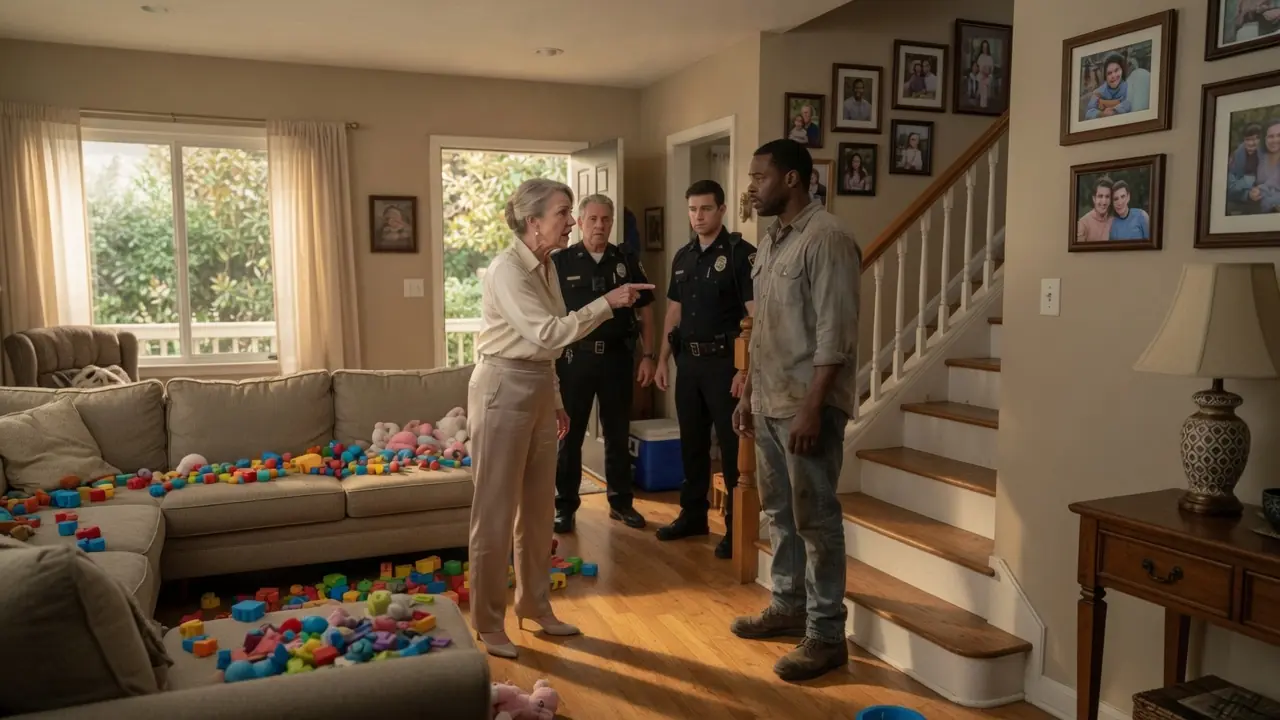
She pressed a hand to her chest, not theatrically now, but as if something there truly hurt.
“I won’t.”
Lily lifted her head.
“Can Grandma still come to my school play?”
I looked at Vivian.
She looked at me.
There was fear in her eyes now.
The right kind.
The fear of losing access to someone she loved because of what she had done.
“We’ll talk about it,” I told Lily.
That was all I could promise.
That evening, after the officers left and Vivian’s sister came to pick her up, the house felt bruised.
Lily sat at the kitchen table eating grilled cheese because neither of us had the energy for real dinner. She placed her stuffed rabbit beside her plate and kept looking toward the front door as if it might open again.
I sat across from her.
“Daddy?”
“Yeah, bug?”
“Was Grandma bad?”
I leaned back.
The easy answer was yes.
The better answer took longer.
“Grandma did a bad thing.”
Lily thought about that.
“Because she misses Mommy?”
“Partly.”
“I miss Mommy and I don’t call the police.”
I almost laughed.
Then I almost cried.
“You’re right.”
She picked at the crust of her sandwich.
“Did Grandma not like you?”
There it was.
The question children feel before adults admit.
I folded my hands.
“I think Grandma had ideas about me that were wrong.”
“Because you’re Black?”
The words landed softly and heavily at once.
I looked at my daughter.
Claire’s eyes.
My skin.
Our child, already seeing more than I wished she had to.
“Some of it, yes,” I said.
Lily frowned.
“That’s stupid.”
“It is.”
“Mommy loved your skin.”
My throat tightened.
“She told you that?”
Lily nodded.
“She said I was made from her moonlight and your brown sugar.”
I covered my mouth and looked away.
Claire.
Always turning the world gentle before handing it to our daughter.
Lily came around the table and climbed into my lap though she was getting too big for it.
I held her anyway.
“Daddy?”
“Yeah?”
“This is our house, right?”
I looked around.
At the cabinets Claire painted pale green.
At the tile I installed badly the first time and better the second.
At the doorway where Lily’s height marks climbed in pencil.
At the plant Claire had somehow kept alive despite my forgetting to water it.
“Yes,” I said. “This is our house.”
“And Mommy’s?”
“Always Mommy’s.”
“And nobody can make you leave?”
I kissed her forehead.
“No one can make me leave you.”
She relaxed then.
Finally.
Later, after I tucked Lily into bed, I returned to the kitchen.
Vivian’s letter lay on the island.
She had left it behind.
Maybe by accident.
Maybe because she could not bear to take it.
I picked it up.
The paper still smelled faintly of her perfume.
Claire’s handwriting filled the page.
Mom,
If you are reading this, something has gone terribly wrong, and I need you to listen to me in a way you sometimes find hard.
Marcus is my husband. Not my mistake. Not my rebellion. Not a phase I grew out of too late. He is the man who held me when I lost patients. The man who learned to make my mother’s soup because I cried for it during pregnancy. The man who sings badly but still sings when Lily has nightmares.
He is not less family because you never learned how to make room for him.
If I am gone, Lily stays with her father unless he asks otherwise. Do not confuse your grief with wisdom. Do not use your fear to take control. And please, Mom, do not make Marcus fight you while he is already mourning me.
The house is his too. It always was.
He built the porch swing you love. He fixed the roof after the storm. He paid the mortgage when I took unpaid leave. He painted Lily’s room yellow because I changed my mind three times and he only complained twice.
I know you think respect must be earned your way. But Marcus earned mine by being gentle when no one was watching.
Love him better than you have.
Or at least do not hurt him worse.
Claire
I sat down before my knees gave way.
Love him better than you have.
That was Claire.
Still asking for the impossible as if people could grow into it by being invited.
Three weeks passed before Vivian saw Lily again.
The visit happened at a park.
Public.
Clear boundaries.
I sat on a bench while Lily showed her grandmother how she could climb the low rope net without help.
Vivian brought no gifts.
That surprised me.
She wore simple clothes.
That surprised me more.
At the end of the visit, she walked over and sat on the opposite end of the bench.
Not too close.
“I started therapy,” she said.
I looked at her.
“Okay.”
“My sister said I should tell you.”
“Your sister is right.”
Vivian watched Lily climb.
“I spent a long time believing concern and control were the same thing.”
I said nothing.
“And I spent longer believing Claire’s life would have been easier if she had chosen someone more familiar to me.”
There it was.
Still careful.
But honest enough to begin.
Vivian looked down at her hands.
“That was prejudice. I called it standards. I called it worry. I called it wanting the best for her. But it was prejudice.”
The park noise moved around us.
Children laughing.
A dog barking.
Leaves shifting.
I looked at Lily, then back at Vivian.
“I appreciate you saying that.”
She nodded, eyes wet.
“I know saying it does not fix it.”
“No.”
“I know you do not owe me forgiveness.”
“No.”
She breathed shakily.
“But I would like to earn permission to be in Lily’s life without poisoning her with my grief.”
That was the first thing she had said since Claire died that sounded more like love than ownership.
“We’ll go slowly,” I said.
Vivian nodded.
“Thank you.”
“Don’t thank me yet.”
A faint, sad smile moved across her face.
“I suppose that’s fair.”
Months passed.
Slowly, Vivian learned how to knock.
That sounds small unless you have lived with someone who thinks blood gives them keys.
She knocked at the front door and waited.
She asked before taking Lily anywhere.
She stopped correcting how I packed lunch.
Mostly.
She still winced when Lily wore mismatched socks, but she kept it to herself.
At Lily’s school play, Vivian sat two rows behind me. When Lily came out dressed as a tree, waving one cardboard branch too enthusiastically, Vivian cried silently into a tissue.
Afterward, she did not rush forward first.
She waited.
I noticed.
Lily noticed too.
“Grandma’s learning,” Lily whispered.
“Yes,” I said. “She is.”
A year after Claire died, we gathered in the backyard beneath the oak tree she had planted.
Just a few people.
Me.
Lily.
Vivian.
Claire’s sister.
Two of Claire’s friends from the hospital.
We tied small yellow ribbons to the lower branches because yellow had been Claire’s favorite color.
Vivian stood beside me, holding a ribbon in trembling fingers.
“I never told you,” she said quietly, “that Claire called me the night you proposed.”
I looked at her.
“She did?”
Vivian nodded.
“She was crying. Happy crying. She said, ‘Mom, he makes me feel safe enough to be myself.’”
My chest tightened.
Vivian’s voice broke.
“I should have listened to her then.”
I tied my ribbon to a branch.
“Yes,” I said.
She nodded.
No defense.
No excuse.
Just the truth.
Lily came over and took both our hands.
One small hand in mine.
One in Vivian’s.
For a moment, grief stood among us without becoming a weapon.
That felt like progress.
Not forgiveness.
Not yet.
But progress.
People later liked to tell the story dramatically.
The mother-in-law called the police on her Black son-in-law.
She tried to have him removed from his own home.
Then the deed came out.
His name was on everything.
The house was his.
The officers turned on her.
The truth humiliated her.
It made a satisfying story that way.
Clean.
Sharp.
Easy to cheer for.
But the real story was messier.
The real story was about a woman who confused grief with ownership.
A man who had to prove he belonged in a house he built.
A little girl who learned too early that racism could wear pearls and call itself concern.
A dead wife whose words arrived late but still told the truth.
And a home that remained standing because love had signed its name in more places than paper.
The deed mattered.
Of course it mattered.
That small legal document stopped Vivian from rewriting my life in front of two police officers.
But the deed was not what made the house mine.
The house was mine because I had carried Claire over the threshold the day we bought it, both of us laughing because the porch light didn’t work.
It was mine because I painted Lily’s nursery yellow at midnight while Claire sat on the floor eating pickles from the jar.
It was mine because I fixed the leaking roof in the rain, because I buried our dog under the maple tree, because I learned which floorboard creaked outside Lily’s room and stepped over it every night.
It was mine because Claire chose me there.
Loved me there.
Built a family with me there.
And when she was gone, it was mine because I stayed.
Not as an unlawful occupant.
Not as an outsider.
Not as the man Vivian Ashford had decided would never be enough.
As a husband.
As a father.
As the one still holding the door open for our daughter when the world tried to make home feel uncertain.
One evening, long after the police report had been filed away and the worst of the whispers had faded, Lily found the blue house folder on my desk.
She pointed at the deed.
“Is that the paper that made Grandma stop?”
I looked at it.
Then at her.
“It helped.”
She frowned.
“But you were Daddy before the paper.”
I smiled.
“Yes, bug.”
“And this was our house before the paper?”
“It was.”
She nodded, satisfied.
Then she skipped out of the room, leaving me alone with the document.
I touched Claire’s signature.
Then mine.
Two names side by side.
Ink could not hold a marriage.
It could not hold grief.
It could not hold all the mornings we survived after she left us.
But it had held the line when someone tried to erase me.
And sometimes, holding the line is where justice begins.