In the spring of 1993, before every student had a phone in their pocket and before every embarrassing moment could be posted online, Westview High School still had its own way of making a boy famous or invisible. A rumor could travel from the gym to the cafeteria before second period. A cruel nickname could stick longer than a report card. And on the red rubber track behind the football field, a runner could either become a hero or disappear into the dust behind someone faster.
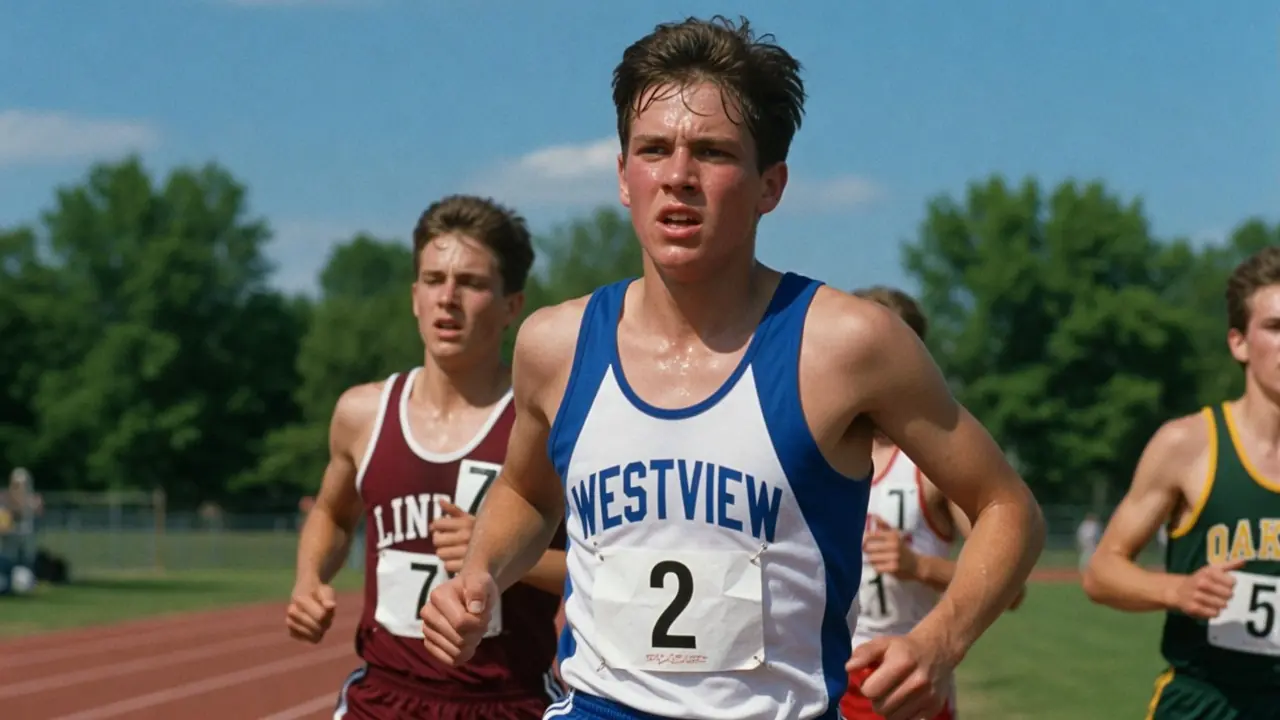
Caleb Reed had never wanted to be a hero. He was seventeen, tall, lean, and quiet, with serious eyes and an old pair of running shoes his mother had cleaned twice because buying new ones would have meant skipping something else. On race days, he wore Westview’s white and blue singlet with the number 2 pinned to his chest. The uniform made him look like he belonged to the team, but most of the team did not make him feel that way.
Westview’s track program belonged, in everyone’s mind, to Tyler Vance. Tyler was the fastest sprinter in school, the boy whose picture hung in the athletic hallway, the boy coaches praised for “natural confidence,” though students knew that confidence often turned into cruelty when adults looked away. He had dark hair, a sharp smile, and a talent for making other boys laugh at someone before they even understood the joke.
Tyler did not like Caleb. At first, Caleb thought it was because he was poor, quiet, and easy to mock. Later, he understood the real reason. Tyler hated anyone who could endure pain without needing applause for it. Caleb ran like that. He trained after practice when everyone else left. He ran in rain, in cold wind, and sometimes along the cracked road behind his apartment complex after dinner, while his mother worked late and his little sister watched cartoons through static on the old television.
To Tyler, running was a crown. To Caleb, running was air.
The trouble began on a Tuesday afternoon before the county qualifying meet. The track team was stretching near the bleachers, and Coach Martin was setting up cones for relay practice. Caleb sat on the lowest bench, tying his right shoe carefully because the lace had started to fray. Beside him, his backpack held a peanut butter sandwich wrapped in wax paper and a folded letter from Northridge Community College about a small athletic scholarship trial.
Tyler walked over with two teammates, Brad Keller and Mike Donnelly. Brad was always laughing too loud, and Mike repeated whatever Tyler said like it was his job. Tyler looked down at Caleb’s shoes and smirked.
“Man, Reed,” Tyler said, “those shoes belong in a museum.”
Brad laughed. Mike pointed at the loose rubber near the heel. “You sure they won’t fall apart before the first turn?”
Caleb kept tying the lace. “They run fine.”
Tyler crouched in front of him, smiling like they were friends. “That’s the sad part. You actually believe shoes are the problem.” He reached out and flicked the side of Caleb’s shoe with two fingers. “Maybe if you had real gear, you’d only lose by five seconds instead of ten.”
A few runners nearby looked over. Nobody said anything.
Caleb pulled his foot back and stood. He was taller than Tyler by an inch, but Tyler carried himself like height was something he could steal from other people. “Move,” Caleb said quietly.
Tyler’s smile sharpened. “Listen to him. Number 2 thinks he’s number 1 now.”
The joke got a laugh from Brad and Mike. Caleb felt the old heat rise in his face, but he did not answer. He had learned that Tyler wanted a reaction more than anything. If Caleb gave him one, Tyler would own the scene.
Coach Martin blew the whistle before it could go further. “Relay group, on the line. Vance, Reed, Keller, Donnelly. Let’s move.”
Tyler stepped away, but as he passed Caleb, he leaned close and whispered, “Try not to embarrass the uniform.”
Caleb looked toward the track. The white lane lines curved ahead of him, clean and quiet. He told himself to breathe. He told himself that one cruel sentence could not decide a race. But the words still followed him to the starting line.
During practice, Caleb ran second leg on the relay. Tyler ran anchor because Tyler always ran anchor. The coach handed Caleb the baton and told him to focus on smooth handoffs, not speed. Caleb nodded, though speed was exactly what he needed to prove.
The first run was clean. Caleb took the baton, accelerated through the curve, and handed off to Brad without losing rhythm. Tyler finished fast, turning his head toward the imaginary crowd as if practice needed a performance. Coach Martin marked something on his clipboard.
The second run was rougher. Brad left early, Mike stumbled, and Tyler snapped at him afterward. “You hand off like you’re carrying groceries,” Tyler said. Mike laughed nervously, even though the insult was aimed at him.
Their shoulders clipped.
Caleb stumbled, caught himself, and nearly dropped the baton. Tyler threw his hands up dramatically. “Watch where you’re going, Reed!”
Coach Martin’s whistle screamed. “Stop. Again.”
Caleb turned, breathing hard. “He stepped into the lane.”
Tyler laughed. “I was standing where I’m supposed to stand. You panicked.”
Brad shrugged. Mike looked away. Coach Martin frowned, uncertain because he had not seen the angle clearly. “Both of you clean it up. We don’t have time for this.”
Caleb wanted to argue. He wanted to point at the lane, at Tyler’s feet, at the smirk Tyler was trying to hide. But he swallowed it. That was what he always did. Swallowed anger became part of his endurance.
After practice, Caleb went behind the equipment shed to cool down alone. The sun was low over the school, turning the bleachers gold and the track dull red. He sat on the grass and rubbed his ankle, which had twisted slightly when he stumbled. It was not serious, but it hurt enough to worry him.
A voice said, “You know he did that on purpose.”
Caleb looked up. Jenna Morales stood nearby with a stopwatch hanging around her neck. She was the team manager, a senior with dark hair, sharp eyes, and a notebook where she recorded splits more accurately than Coach Martin. Jenna had seen more than most people because most boys forgot she was listening.
Caleb looked back at his ankle. “Doesn’t matter.”
“It matters if he keeps doing it.”
“He keeps doing it because everyone keeps acting like it doesn’t matter.”
Jenna sat on the grass beside him, leaving enough space not to crowd him. “Then maybe stop acting like it doesn’t matter too.”
Caleb almost laughed, but there was no humor in it. “Easy for you to say.”
“No,” Jenna said. “It’s not easy. That’s why I’m saying it.”
He looked at her then. Jenna did not look sorry for him, which he appreciated. Pity always made him feel smaller. Her expression was different. She looked angry in a controlled way, like someone waiting for the right moment to open a door.
“I saw the lane,” she said. “I wrote it down.”
Caleb frowned. “You wrote it down?”
“I write everything down.”
For the first time all afternoon, Caleb smiled a little. “That sounds like a threat.”
Jenna smiled back. “Only to people who lie about what happened.”
The county qualifying meet was three days later, on a bright Friday afternoon that smelled like cut grass, sunscreen, and concession stand popcorn. Schools from across the district filled Westview’s field, bringing tents, coolers, folding chairs, and nervous athletes in every color uniform. Parents lined the fence. Coaches shouted schedules. The starter’s pistol cracked every few minutes like punctuation in the warm spring air.
Caleb arrived early with his uniform in a plastic grocery bag and his shoes tied together by the laces. His mother, Diane Reed, had tried to come, but the diner had called her in for an extra shift. She had kissed his forehead before leaving that morning and said, “Run like you’re not asking permission.”
Caleb carried that sentence with him all day.
His little sister, Lily, had drawn a small sign on notebook paper that said GO CALEB GO in purple marker. He folded it and kept it in his bag. Nobody on the team knew about it, and he preferred it that way. Some things were too important to hand to a crowd.
Westview’s relay was scheduled before Caleb’s individual 800-meter race. Tyler walked around with his warm-up jacket unzipped and sunglasses pushed onto his head like he was already being photographed. Brad and Mike followed him, laughing at jokes that had not improved since Tuesday.
When Caleb sat near the team tent to change into his spikes, he froze.
One shoe was missing.
He checked the bag again, then his backpack, then under the bench. His left spike was there. The right one was gone. For a second, his mind refused to understand it. Then he heard laughter behind the tent.
Tyler stood with Brad and Mike near the fence. He held nothing in his hands, but his smile told Caleb everything. “Lose something, Reed?”
Caleb stood slowly. “Where is it?”
Tyler raised his eyebrows. “Where’s what?”
“My spike.”
Tyler looked at Brad. “He’s asking me about his laundry now.”
Mike laughed. Brad tried to look innocent and failed.
Caleb walked toward him. “Give it back.”
Tyler’s expression changed because Caleb’s voice carried too clearly. A few athletes from another school looked over. Tyler lowered his voice. “Careful. You don’t want people seeing you beg.”
“I’m not begging.”
“Then what are you doing?”
Caleb stepped closer. “Giving you one chance to stop being stupid.”
The air tightened around them. Tyler’s smile disappeared. For the first time, Brad did not laugh. Mike shifted nervously.
Coach Martin called from near the track, “Relay team! Check in!”
Caleb’s pulse hammered. Without the spike, he could not run properly. Without the relay, Coach might scratch him from the lineup. Tyler knew exactly what he was doing. He was not just teasing Caleb now. He was trying to take the race from him before it started.
Jenna appeared beside the tent, holding Caleb’s right spike.
“I found this behind the water coolers,” she said loudly.
Everyone turned. Tyler’s face flickered. Caleb took the shoe from her, understanding at once. Jenna’s eyes told him she had seen enough to know where to look.
Coach Martin walked over, frowning. “What’s going on?”
Jenna looked at Tyler. “Caleb’s spike somehow ended up behind the coolers.”
Tyler spread his hands. “Why are you looking at me?”
Jenna lifted her notebook. “Because I watched Brad carry it over there while you blocked the view.”
Brad’s face went pale. Mike muttered, “Dude.”
Coach Martin’s jaw tightened. “Vance. Keller. After the relay, you’re both speaking with me.”
Tyler laughed once, but it sounded forced. “This is ridiculous.”
Coach Martin pointed toward the track. “Move. Now.”
Caleb put on the spike with hands that shook from anger. Jenna crouched beside him and tied the frayed lace tight before he could stop her. “Run first,” she said quietly. “Make them answer later.”
Caleb looked at the track. “I’m tired of later.”
Jenna nodded. “Then make now loud.”
The relay began badly. Mike’s first handoff was slow, and Brad ran like guilt had filled his legs with sand. By the time Caleb received the baton, Westview was in fourth place. Tyler stood ahead in the anchor zone, jaw clenched, furious that the meet had not remained his personal stage.
Caleb ran the third leg like something inside him had been unlocked. The first curve blurred. The crowd became a wall of sound, but he heard none of it clearly. He passed one runner on the outside, then another on the straightaway. His old shoes bit the track. His lungs burned cleanly.
When he reached Tyler, the handoff was perfect despite everything. Tyler took the baton and exploded down the final stretch, catching the leader just before the line. Westview won by half a step.
The team cheered. Coach Martin shouted. Brad jumped as if he had not nearly ruined the race. Tyler raised the baton overhead, drinking in the applause.
But people had seen Caleb’s leg. They had seen who saved the relay.
As Tyler jogged back, he passed Caleb and muttered, “Don’t think this changes anything.”
Caleb was bent over, hands on knees, breathing hard. He looked up. “It changes enough.”
Tyler stopped. “What’s that supposed to mean?”
Caleb straightened. “It means you needed me to win.”
The sentence landed harder than Caleb expected. Tyler’s face tightened, and for one second the great Westview star had no comeback. Then Coach Martin approached, and Tyler turned away.
The 800-meter race came near the end of the meet. By then, the sky had softened into late afternoon, and shadows from the bleachers stretched across the track. Caleb stood in lane two, rolling his shoulders, trying to ignore the ache in his ankle and the anger still pulsing under his skin.
Tyler was not supposed to run the 800. He was a sprinter. But after the relay incident, after Caleb’s words, after the whispers around the team tent, Tyler had walked up to Coach Martin and asked to be entered as a late substitution for an injured runner. Coach hesitated, then allowed it because Tyler was too talented to dismiss and Westview needed points.
Caleb knew why Tyler had done it. He wanted to beat Caleb in Caleb’s race.
The runners lined up. Tyler stood two lanes over, bouncing lightly on his toes. “Try to keep up, Number 2,” he said.
Caleb looked straight ahead. “Try to finish without cheating.”
Tyler’s head snapped toward him. “What did you say?”
The starter raised the pistol.
Crack.
They launched forward.
The first lap moved fast. Too fast. Tyler shot to the front immediately, forcing the pace like it was a 400-meter race. A few runners chased him and faded before the first curve ended. Caleb stayed controlled in the middle pack, letting his breathing settle into rhythm. Coach Rivera from the small boxing gym where Caleb sometimes trained had once told him that angry boys burned hot and empty. Caleb thought of that now.
Tyler looked back once, expecting to see Caleb struggling. Caleb was there, close enough.
The bell rang for the final lap.
Tyler still led, but his shoulders had tightened. The 800 punished arrogance. It gave speed a stage for one lap, then asked the heart what it had left. Caleb began to move on the backstretch, passing one runner, then another. His legs burned. His ankle complained. His lungs felt scraped raw.
At 200 meters left, he reached Tyler’s shoulder.
The crowd rose.
Tyler heard him and panicked. He drifted outward, trying to box Caleb wide. Caleb adjusted without breaking stride. Tyler threw an elbow back, small enough to look accidental, sharp enough to warn him. It brushed Caleb’s chest.
Caleb did not retaliate. Not yet.
He waited until the curve opened into the final straightaway. Then he surged.
The world narrowed to the finish line, Tyler’s shoulder, and the sound of his own breath. Students screamed from the bleachers. Coaches shouted splits. Jenna’s voice cut through everything.
“Go, Caleb!”
Tyler tried to answer, but his stride broke. Caleb passed him with thirty meters left.
For one perfect second, Caleb was alone in front.
He crossed the finish line first.
The crowd erupted, but Caleb barely heard it. He slowed, staggered two steps, and bent forward with his hands on his knees. His chest heaved. Sweat ran down his face. Behind him, Tyler crossed second, furious and gasping.
Coach Martin was already shouting Caleb’s name. Jenna ran toward him with a water bottle, her face shining with disbelief and joy. “You did it,” she said. “You actually did it.”
Caleb took the bottle but did not drink yet. He looked toward the fence, where parents and students were clapping. For a moment, he imagined his mother there, still in her diner uniform, smiling with tired eyes. He imagined Lily waving her purple sign.
Then Tyler shoved him from behind.
It was not huge, but after the race, Caleb’s legs were unsteady. He stumbled forward and nearly fell. The applause faltered. Jenna gasped. Coach Martin shouted, “Tyler!”
Tyler stepped close, breathing hard, face twisted with humiliation. “You think you’re better than me now?”
Caleb turned slowly.
He had beaten Tyler in the race. He could have walked away with that. Maybe that would have been the cleanest ending. But Tyler was not asking about the race. He was asking whether Caleb would still let him own the space after losing it.
Caleb looked at him and said, “No. I just know I don’t have to be less.”
Tyler’s jaw clenched. “You got lucky.”
“Then why are you so scared?”
The words struck something raw. Tyler lunged and grabbed Caleb by the front of his uniform. Several people shouted at once. Coach Martin started running toward them. Brad and Mike froze near the tent.
Caleb moved with the control he had learned from months of training, from hard work, from years of swallowing anger until he understood its shape. He caught Tyler’s wrist, stepped to the side, and turned his body. Tyler’s own momentum carried him forward. Caleb swept him off balance and put him down onto the grass beside the track.
Not brutally. Not wildly. Cleanly.
Tyler landed on his back, stunned, staring up at the sky as if he could not understand how the story had turned so quickly.
Caleb stood over him, chest still heaving from the race. The whole field had gone silent. The golden boy of Westview, the fastest sprinter, the loudest voice, was on the ground in front of everyone.
Caleb spoke clearly enough for the nearest athletes and coaches to hear. “You stole my shoe. You cut into my lane. You shoved me after I beat you. And every time, you expected people to laugh because they always do.”
Tyler blinked up at him, face red.
Caleb took one step back. “I’m done being your joke.”
Coach Martin arrived and put a hand between them, though Caleb had already moved away. “Enough,” he said, breathless. His eyes moved from Tyler on the ground to Caleb standing calmly. “Both of you, with me.”
Tyler sat up, angry and embarrassed. “He attacked me!”
Jenna’s voice cut in immediately. “No, he defended himself.”
Several athletes from other schools nodded. One coach said, “I saw the shove.” Another runner added, “I saw the elbow during the race too.”
For the first time, Tyler’s version did not fill the room before the truth could arrive.
The meet officials reviewed what had happened. Tyler was disqualified from the 800 for unsportsmanlike conduct after the race and removed from the final event. Brad admitted that he had moved Caleb’s spike because Tyler told him it would be funny. Coach Martin looked like someone had handed him a truth he should have noticed much earlier.
Caleb kept his first-place finish.
He also kept his dignity.
By Monday morning, everyone at Westview knew. The story had already become larger than the meet. Some students focused on Caleb winning the 800. Others focused on Tyler hitting the grass. But the people who had been paying attention talked about something else. They talked about how Caleb had spent years being mocked and had finally drawn a line in front of the whole team.
In the hallway, students looked at him differently. Not like he was suddenly popular, exactly, but like he had become visible in a way they could not ignore. A freshman runner nodded at him near the lockers. A girl from chemistry said, “Good race.” Even Mike Donnelly avoided his eyes and mumbled, “That was fast, man.”
Tyler was suspended from the next meet and removed as relay anchor. Coach Martin held a team meeting after school. Caleb expected a lecture about sportsmanship that pretended everyone was equally responsible. Instead, Coach stood in front of the bleachers with his clipboard at his side and looked tired.
“What happened Friday did not start Friday,” he said.
The team went silent.
Coach Martin’s eyes moved across the runners. “It started with jokes I ignored. It started with nicknames I dismissed. It started with the idea that talent gives someone permission to treat teammates like props.” He paused. “That ends now.”
Tyler sat on the lowest bleacher, jaw tight, no sunglasses, no smirk. Brad and Mike sat apart from him. Jenna stood near the fence with her notebook closed for once.
Coach continued. “A team is not built around the loudest athlete. It is built around trust. If you break that trust, I don’t care how fast you are. You will sit.”
No one spoke. Caleb stared at the track, feeling something complicated move through him. He was relieved, but also angry that the truth had needed a public fall before adults named it.
After the meeting, Tyler approached him near the equipment shed. Caleb tensed, ready for another fight, but Tyler stopped several feet away.
“I’m supposed to apologize,” Tyler said.
Caleb looked at him. “Then don’t.”
Tyler frowned. “What?”
“If you’re only doing it because Coach told you to, don’t waste my time.”
Tyler’s face tightened. For a moment, Caleb expected anger. Instead, Tyler looked away toward the track. “You embarrassed me.”
Caleb gave a short laugh. “You embarrassed yourself.”
Tyler’s hands curled at his sides, then loosened. “I know.”
That surprised Caleb more than the apology would have.
Tyler stared at the ground. “I hated that you could run like that and nobody knew. I hated that you didn’t need everyone watching.” His voice was low, rough with pride being dragged out of him. “I thought if I made you small, I’d stay ahead.”
Caleb said nothing. He had learned that silence could sometimes be a cage, but sometimes it could also force the truth to keep speaking.
Tyler swallowed. “I’m sorry for the shoe. And the lane. And all the stuff before.”
Caleb looked at him for a long moment. “I’m not forgiving you today.”
Tyler nodded once. “I know.”
“But if you want to stop being that guy,” Caleb said, “start when nobody is clapping for you.”
Tyler absorbed that quietly. Then he nodded and walked away.
The season continued. Caleb became Westview’s strongest 800-meter runner, and for the first time, Coach Martin built a race plan around him. Jenna recorded his splits, argued with Coach about pacing, and helped him send updated times to Northridge Community College. His mother made it to the next home meet, still wearing her diner shoes, and Lily waved her purple sign so hard the paper tore at the corner.
Caleb won again that day.
Not by much. He had to fight for every step of the final straightaway. But when he crossed the line, he looked into the bleachers and saw his mother crying with both hands over her mouth. Lily screamed like he had won the Olympics.
For Caleb, that was better than any trophy.
Tyler did not cheer, but he did stand with the team. When Brad started to make a joke about another runner’s awkward stride, Tyler said, “Shut up.” It was not noble. It was not enough to erase the past. But Caleb heard it and understood that some changes began ugly and small before they became real.
At the district meet, Caleb ran the race of his life. The stadium was bigger, the competition faster, and the pressure heavier than anything he had faced. He finished second, good enough to advance to regionals and good enough to earn a serious conversation with the Northridge coach.
Afterward, Coach Martin handed him a folded printout of his official time. “You earned this,” he said.
Caleb looked at the numbers. They seemed impossible. “My mom’s not going to believe it.”
Coach smiled. “Then frame it.”
Jenna appeared beside him with her notebook. “I already wrote it down three times, in case anyone tries to lie about it.”
Caleb laughed, and for once, the sound came easily.
On the last day of school, Westview held its spring sports assembly in the gym. Students filled the bleachers, restless and loud, while coaches announced awards. Caleb sat with the track team, wearing his letterman patch for the first time. It had taken him three years to earn something most people assumed belonged only to boys like Tyler.
Coach Martin stepped to the microphone near the end. “This year’s track award for perseverance goes to a runner who reminded this team that quiet effort is still leadership.”
Caleb looked down immediately, already knowing and not wanting to know.
“Caleb Reed.”
The applause rose before he stood. His face warmed as he walked to the front. He accepted the small plaque from Coach Martin and turned toward the bleachers. For a second, he saw the entire school the way he had seen the track during a race. Not as something too large to face, but as a space he could move through without asking permission.
Coach handed him the microphone unexpectedly. Caleb almost refused. Then he saw Lily standing beside their mother near the gym doors, waving her torn purple sign. He took the microphone.
“I don’t have a big speech,” Caleb said.
A few students laughed softly.
He looked toward the track team, then at the rest of the gym. “I used to think staying quiet meant staying strong. Sometimes it does. But sometimes staying quiet just makes it easier for people to pretend they didn’t hear you getting hurt.”
The gym settled.
Caleb’s voice grew steadier. “Running taught me that pain is not always a sign to stop. Sometimes it tells you where the work is. But disrespect is different. You don’t have to carry that just because people call it a joke.”
He glanced once at Tyler, who sat with his hands folded, listening.
“I’m grateful for this award,” Caleb said. “But I hope next year, nobody has to prove they belong by surviving someone else’s cruelty first.”
He handed the microphone back.
The applause that followed was not wild like a race finish. It was slower, heavier, more thoughtful. Caleb returned to his seat, and Jenna whispered, “That was a big speech for someone with no big speech.”
He smiled. “Don’t write that down.”
“Too late,” she said.
Years later, people at Westview still remembered the photo from that spring. Caleb Reed in the white and blue Westview uniform, number 2 on his chest, running hard with another athlete behind him, his face focused not on the boy chasing him but on the road ahead. It looked like a simple race photo if you did not know the story.
But everyone who had been there knew what it meant.
It was the season a quiet runner stopped letting a bully decide how small he should be. It was the season Westview learned that the fastest boy was not always the strongest. It was the season Caleb Reed ran through mockery, sabotage, and fear until the finish line finally belonged to him.
And whenever Caleb thought back to that year, he did not remember Tyler on the ground first. He remembered his mother’s sentence before the meet. Run like you’re not asking permission.
So he did.
He ran like every step was an answer.
He ran like the track had been waiting for the truth.
He ran like number 2 had never meant second place.
And by the end of that spring, no one at Westview High was laughing anymore.