“Get someone else.”
The words cut across the dining room of Maison Laurent as sharply as a knife striking crystal.
Nia Brooks stood beside table twelve with a leather wine list tucked beneath one arm and a tablet in her hand.
The man sitting in front of her did not even bother lowering his voice.
His name was Warren Kingsley.
Everyone in Atlanta knew that name.
Real estate billionaire. Private equity investor. Owner of half the luxury towers rising along the riverfront. A man whose face appeared on magazine covers, charity gala banners, and city redevelopment panels where people discussed neighborhoods they had never lived in.
Tonight, Warren had booked the private glass room at Maison Laurent, one of the most expensive restaurants in the city. The restaurant sat on the top floor of an old bank building, with marble columns, velvet chairs, a wall of rare wine, and floor-to-ceiling windows overlooking downtown Atlanta.
Every table had white linen.
Every glass was polished until it looked invisible.
Every server moved quietly enough to make wealthy guests believe luxury had no labor behind it.
Warren had come with a purpose.
He was hosting investors from Senegal, France, and Morocco for a private dinner. The deal, according to the staff whispers all week, was worth nearly two hundred million dollars.
And Warren Kingsley had just looked at Nia like she was something left on the floor.
“I’m sorry, sir?” Nia asked.
Her voice stayed calm.
That took effort.
Warren leaned back in his chair and looked at her from her braids to her black server jacket to the polished shoes she had been standing in since noon.
“I said get someone else,” he repeated. “I asked for someone who speaks French. Not whatever this is.”
The table went quiet.
So did the tables around them.
A couple near the window stopped cutting into their steaks. The sommelier near the wine wall froze with one hand on a bottle of Burgundy. Two junior servers at the service station exchanged nervous glances and then quickly looked away.
Nia was twenty-nine years old, a Black woman with warm brown skin, neat braids pinned into a low bun, and a black Maison Laurent jacket fitted sharply at the waist. Her name tag was small, gold, and polished.
NIA BROOKS
Senior Server
She had worked at Maison Laurent for three years.
Long enough to know that rich guests rarely insulted loudly by accident.
Warren’s assistant, Oliver, leaned toward him with an anxious smile.
“Mr. Kingsley specifically requested a French-speaking server for tonight’s international guests.”
Nia nodded.
“Yes. That request was assigned to me.”
Warren laughed.
Not softly.
Not politely.
He laughed loud enough to turn heads.
“You?”
Nia’s fingers rested lightly on the edge of her tablet.
“Yes, sir.”
He glanced at the empty wineglasses on the table.
“I’m not asking for someone to read the specials. I need someone who can handle a proper conversation.”
“I can.”
“In French?”
“Yes.”
“In proper French?”
The question landed harder than it needed to.
A few guests looked away.
Not because they did not hear.
Because they had.
Nia felt the old heat rise behind her ribs.
She thought of her grandmother, who had cleaned offices downtown for thirty-two years and used to say, “Baby, don’t spend all your strength proving you’re human. Save some for winning.”
Nia saved it.
Warren reached into his wallet and pulled out a hundred-dollar bill.
He placed it on the white tablecloth between the bread plate and his untouched water glass.
“Here,” he said. “Say one sentence in French. One proper sentence. If it’s good, you can keep that.”
The hundred lay there like bait.
Nia looked at it.
Then at him.
“Sir, I’m not entertainment.”
“No,” Warren said. “You’re staff. And staff performs the task assigned.”
The dining room had gone quiet enough now that the soft piano near the bar sounded too loud.
Important guest.
Public insult.
Staff member caught in the middle.
Money always made cowards explain hesitation as professionalism.
“Is there a problem?” Marcus asked.
Warren did not look at him.
“Yes. Your restaurant assigned me a waitress who apparently believes carrying a wine list makes her an interpreter.”
Nia turned to Marcus.
“I was assigned to the Kingsley private dinner because I speak French, Wolof, and Arabic.”
Warren’s eyes flicked toward her.
For the first time, not amused.
Annoyed.
“Wolof?” he said.
The way he said it told her he had not expected to hear the word from her mouth.
“Yes.”
His smile returned, thinner now.
“Fine. Let’s make it interesting.”
He pulled out his checkbook.
Old-fashioned.
Performative.
Rich men loved props when humiliation was the theater.
“One hundred thousand dollars,” Warren said. “If you can hold a real business conversation with my guests tonight. Not restaurant phrases. Not greetings. A real conversation.”
Oliver’s face went pale.
“Mr. Kingsley—”
“No,” Warren said. “Let’s settle it. If she succeeds, I pay. If she fails, she apologizes to me, to my guests, and to this restaurant for pretending to be qualified.”
One of the junior servers whispered, “Oh my God.”
Nia looked at Marcus.
He looked miserable.
“Nia,” he said quietly, “you don’t have to—”
“Yes,” she said.
The word surprised even him.
Warren’s smile widened.
“There it is. Pride.”
“No,” Nia said. “Clarity.”
Before Warren could answer, the private elevator doors opened at the far end of the dining room.
A group entered, led by a tall Black man in a navy overcoat and a cream scarf. He was in his late fifties, with close-cropped gray hair and intelligent eyes. Beside him walked a woman in an emerald dress, elegant and observant. Two younger associates followed, speaking softly in French.
The man was Amadou Diouf.
Chairman of Diouf Global Infrastructure.
The investor Warren Kingsley had spent six months trying to impress.
Warren stood instantly, his entire face transforming into warmth.
“Chairman Diouf,” he said, stepping away from the table with both hands open. “Welcome to Maison Laurent.”
Amadou shook his hand politely.
“Mr. Kingsley.”
His accent carried Dakar, Paris, and years of boardrooms where every word mattered.
Warren gestured toward Nia without looking at her.
“We had a small staffing issue, but it’s being corrected.”
Amadou’s eyes moved to Nia.
Then to the hundred-dollar bill on the table.
Then back to Warren.
“What kind of issue?”
Warren gave a dismissive laugh.
“A misunderstanding. I requested language support.”
Nia stepped forward.
She looked directly at Amadou and spoke in French.
“Good evening, Mr. Diouf. Welcome to Maison Laurent. Your private dining room is ready. We prepared the quiet corner table your office requested, and the kitchen has removed shellfish from the second course after your assistant updated us this morning.”
The room changed.
Not loudly.
Not dramatically.
But everyone felt it.
Amadou’s eyebrows lifted.
His wife turned fully toward Nia.
One of the associates stopped mid-sentence.
Nia continued, still in French.
“The chef has also prepared a lamb course with preserved lemon and herbs, but if Madame Diouf prefers something lighter after travel, we can replace it with the sea bass without delaying service.”
Amadou looked at Warren.
Then back at Nia.
“You speak beautifully.”
“Thank you, sir.”
“Where did you study?”
Nia smiled slightly.
“At home first. Then wherever life let me.”
Amadou’s wife asked something softly in Wolof.
Nia answered in Wolof.
Not a greeting.
Not a memorized phrase.
A full answer, warm and fluent.
Madame Diouf placed one hand over her heart and smiled for the first time since entering the restaurant.
Warren went still.
The hundred-dollar bill remained on the table.
Forgotten.
Nia turned back to him.
“Would you like me to escort your guests to the private room, Mr. Kingsley?”
The question was polite.
That made it worse.
Warren’s jaw tightened.
“Anyone can memorize a welcome script.”
Amadou looked at him slowly.
The kind of look that made powerful men remember they were not always the most powerful person in the room.
“That was not a script,” Amadou said.
The dining room held its breath.
Warren forced a laugh.
“Of course. I only meant—”
“I know what you meant.”
Silence.
Nia led the party toward the private glass room near the wine cellar entrance. Her hands did not shake until she stepped briefly into the service station to collect the first menu cards.
By then, Warren had recovered enough to pretend the moment had amused him.
He leaned closer to her as she passed.
“Enjoy your little performance. Tonight is still my dinner, my deal, and my guests.”
Nia met his eyes.
“Then I hope you listen better at the table than you did in the dining room.”
For one second, Warren looked like he might say something uglier.
But Amadou was watching.
So he smiled instead.
Cold.
“You’ll do.”
Nia knew men like Warren.
They did not accept embarrassment.
They stored it.
The private dinner began at eight in the glass room overlooking downtown Atlanta. The skyline glittered beyond the windows. White roses filled low bowls along the table. A dedicated wine steward stood near the cellar door. Waiters moved in and out silently with amuse-bouches, warm bread, and chilled water poured from silver pitchers.
Nia stood near the sideboard with a tablet in one hand, translating when needed, directing courses, adjusting timing, solving problems before they became visible.
That was what good service looked like.
Invisible labor.
Invisible intelligence.
Invisible control.
Warren sat at the center of the table, laughing too loudly with Amadou and two French investors. He spent the first twenty minutes trying to recover dominance by acting as if Nia were simply part of the room’s machinery.
But Amadou kept turning to her.
“Nia, would you clarify the municipal bond structure?”
“Nia, how would you phrase that in English?”
“Nia, did Mr. Kingsley say tax abatement or infrastructure credit?”
Each time, she answered clearly.
Each time, Warren’s smile stiffened.
The deal involved a waterfront redevelopment project in Savannah. Hotels, luxury apartments, retail space, shipping access, and a public-private infrastructure package that sounded generous on paper but contained several clauses Nia had noticed while reviewing the event packet earlier that afternoon.
She had not been hired to review the deal.
She had simply read what was placed in front of her.
That was another thing people underestimated.
Servers read.
Hostesses listen.
Bartenders remember.
Drivers hear phone calls.
Cleaners see what executives throw away.
Power leaves evidence everywhere because it rarely notices the people standing nearby.
At 8:47, the real trouble began.
Amadou’s associate, Salma Ndiaye, began speaking in French about the housing clause attached to the waterfront project. Her tone was calm, but formal.
Too formal.
Nia heard it immediately.
Concern.
Not curiosity.
Salma said the relocation guarantees for existing residents did not match what Warren had presented in Dakar.
Warren nodded as if he understood.
He did not.
His French was not nonexistent, but it was shallow. Enough for greetings. Enough for menus. Enough to pretend in front of people too polite to expose him.
“Of course,” Warren said in English. “We’re fully aligned on community impact.”
Salma looked at Nia.
Nia translated carefully.
Then she added, “Ms. Ndiaye is specifically asking whether the written guarantee applies to all current residents or only documented leaseholders.”
Warren waved a hand.
“That’s legal detail.”
Nia did not move.
Amadou’s eyes narrowed.
Salma spoke again.
Nia translated.
“She says many long-term residents may not have formal leases because of family transfers, informal subletting, or inherited occupancy. If the protection applies only to leaseholders, hundreds could be displaced without compensation.”
Warren’s face tightened.
“That’s not tonight’s focus.”
Nia looked at him.
“It appears to be theirs.”
The room around them continued moving—the soft scrape of utensils, the muted hum of the dining room beyond the glass—but the people at the table had gone quiet.
Warren lowered his voice.
“Translate what I say, not what you think.”
“I am translating what she asked.”
“You are inserting yourself.”
“No, sir. You are avoiding the question.”
The words landed too clearly.
Warren smiled in a way that showed no warmth.
“You forget your place fast.”
Nia felt several people turn.
Madame Diouf stopped speaking to the wine steward.
Marcus Ellis, standing near the service entrance, went pale.
Nia held Warren’s gaze.
“No, Mr. Kingsley. I remember exactly where I am.”
Warren laughed under his breath.
“Behind a tray.”
Amadou spoke then.
“Mr. Kingsley.”
Warren turned.
Amadou’s voice was quiet.
“I would like the question answered.”
For the first time that night, Warren had no easy exit.
He looked toward Oliver.
Oliver opened the folder on his tablet, searching frantically.
Salma said something in French, faster now.
Nia translated without looking away from Warren.
“She says your written proposal in Senegal used the phrase ‘community preservation district.’ The English draft here uses ‘priority redevelopment zone.’ Those are not equivalent.”
Warren’s jaw tightened.
“That is a drafting issue.”
Salma replied sharply.
Nia translated.
“She says drafting issues become eviction notices.”
That sentence moved through the table like wind through flame.
Amadou turned to Warren.
“Is she correct?”
Warren did not answer.
He looked at Nia instead.
Anger now.
Open.
“You read the documents?”
“They were in the dinner packet.”
“You had no right.”
“I was assigned to language support. Language includes meaning.”
A woman at the next table outside the glass room whispered, “Damn.”
Warren heard it.
His face darkened.
He stepped close enough that Nia could smell whiskey and expensive cologne.
“You think because you can speak a few languages you belong in this conversation?”
Nia’s voice stayed low.
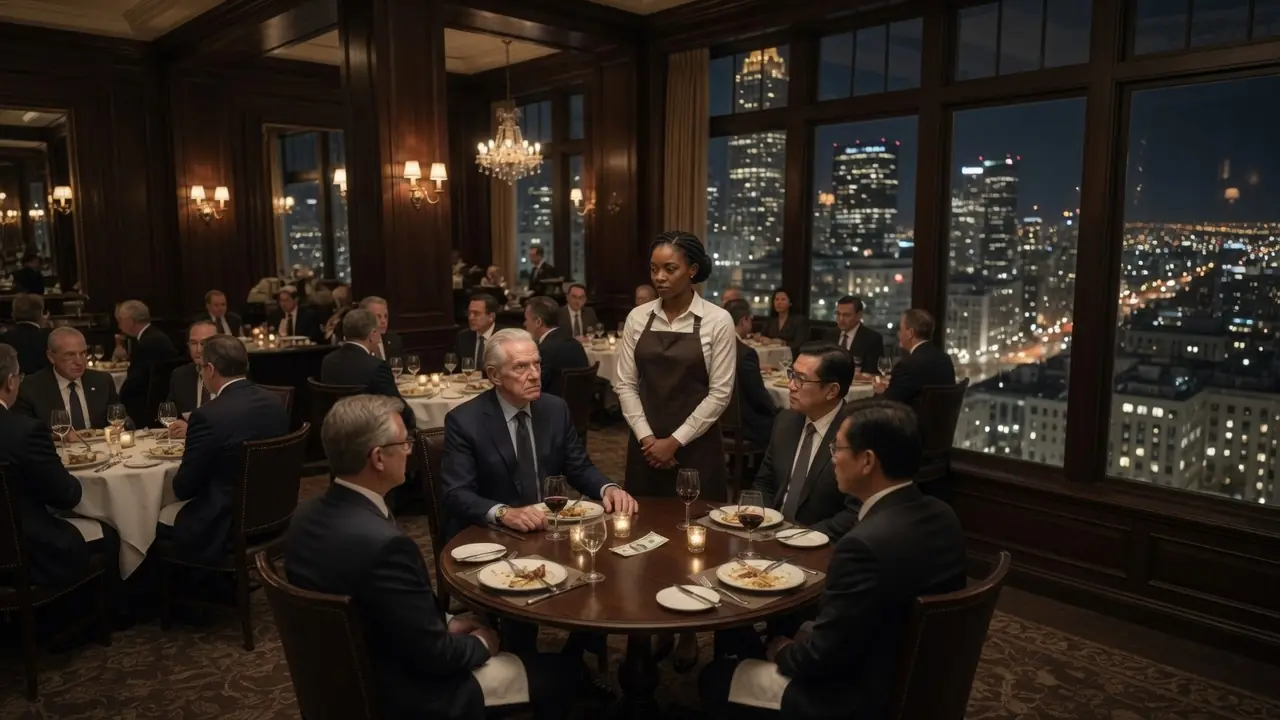
“No. I belong in this conversation because you keep misunderstanding it.”
The room stopped.
Not the whole restaurant, but enough of it.
Enough for Warren to realize the moment had turned public again.
His pride did what pride often does when cornered.
It chose violence without touching.
He smiled at Nia and said, “Your mother must be proud. All that struggle so her daughter could carry plates and talk above her station.”
The words hit the table like a slap.
Nia’s face did not change.
But something in her eyes did.
Madame Diouf drew in a breath.
Marcus took one step forward.
Warren continued, drunk on his own cruelty now.
“What was she? A maid? A cleaner? One of those women who spent her life scrubbing floors so you could stand in a borrowed jacket and pretend to be cultured?”
Nia felt her hand tighten around the tablet.
For a second, she was twelve again, sitting in the back office of a laundromat while her mother worked double shifts after leaving a marriage that had nearly killed her.
Her mother, Yvette Brooks, had cleaned hotel rooms, office bathrooms, and restaurant kitchens. She had worn uniforms with other people’s logos and come home with swollen feet, smelling of bleach, steam, and lavender disinfectant.
She also read poetry in French.
She taught Nia verb conjugations while folding sheets.
She made her repeat Arabic phrases while cooking beans.
She found used language textbooks at church sales and wrote grammar notes in the margins with a red pen.
“My mother,” Nia said, “was a cleaner.”
Warren smirked.
Then Nia stepped closer.
“And she spoke better French than you.”
The silence that followed was complete.
Madame Diouf smiled.
Just slightly.
Nia continued, her voice clear now.
“She also taught me that education does not always arrive with a diploma, and ignorance does not always arrive without one.”
Warren’s face turned red.
Marcus finally moved.
“Mr. Kingsley, that’s enough.”
Warren turned on him.
“No. I’m the client here. I booked this room. I brought these investors. I pay your staff’s wages tonight.”
Nia looked at him.
“No, sir. You paid for dinner. You did not buy the people serving it.”
Amadou set down his glass.
Very carefully.
Then he turned to Nia.
“Ms. Brooks, would you be willing to sit with us for the formal review?”
Warren’s mouth opened.
Amadou did not look at him.
“My team would prefer to proceed with someone who understands both the language and the implications.”
Nia glanced at Marcus.
He nodded once.
Proud and ashamed at the same time.
“Yes, sir,” Nia said.
And just like that, the woman Warren had tried to reduce to a tray became the person sitting between him and the deal he needed.
The seating changed.
That was the first humiliation.
Warren had expected Amadou at his right hand.
Instead, Amadou placed Nia there.
Salma sat beside her.
Oliver sat across from her, sweating through his collar.
Warren sat at the head of the table, but the position no longer gave him control. It only made his discomfort more visible.
For the next forty minutes, Nia translated, clarified, and corrected.
She did not perform.
She did not try to embarrass Warren.
That almost made it worse.
Competence without revenge is harder to dismiss.
When Warren exaggerated the community benefit package, she translated the numbers exactly.
When Oliver tried to soften a displacement risk, she rendered the risk plainly.
When Salma asked whether local minority contractors would receive protected bidding access, Warren said, “We’re open to community participation.”
Nia translated the sentence.
Then Salma asked in French, “Does that mean guaranteed participation or public-relations language?”
Nia paused.
Warren noticed.
“What did she say?”
Nia looked at him.
“She asked if your answer means anything.”
A low sound moved through the table.
Not laughter.
Recognition.
Warren’s anger became something colder.
At 9:42, Salma pulled up a document on her tablet and turned it toward Nia.
“Can you read this clause?”
Nia leaned in.
It was an internal schedule of projected acquisition costs. Most of it was technical. But there was a line near the bottom that made her stomach tighten.
Community resistance mitigation.
Budget: $1.8 million.
She looked at Salma.
Salma’s face told her she already knew.
Nia translated the line into English.
The table went still.
Amadou turned slowly toward Warren.
“What is community resistance mitigation?”
Warren’s face froze.
Oliver looked down.
Nia read the subtext beneath the line.
Private security.
Targeted legal pressure.
Relocation incentives.
Media consulting.
Community liaison payments.
She did not need to say the words loudly.
The people at the table understood.
Amadou’s expression hardened.
“You told me this project would protect families.”
“It will,” Warren said quickly. “This is standard contingency planning.”
“For silencing residents?”
“For managing opposition.”
Salma said something in French, low and furious.
Nia translated.
“She says the word you are looking for is displacement.”
Warren slammed one hand lightly on the table.
“I will not be lectured by a waitress.”
Nia met his eyes.
“Then perhaps listen to your investor.”
Amadou stood.
The table rose with him.
Warren rose too, suddenly afraid.
“Chairman Diouf, let’s not overreact.”
Amadou buttoned his coat.
“No. Let us react exactly enough.”
“Look, every major development has friction.”
“People are not friction.”
Warren’s mouth tightened.
“This is business.”
Amadou looked at Nia.
Then back at Warren.
“That is what worries me.”
The deal did not die loudly.
It died like a candle being pinched out.
Amadou turned to Marcus.
“My party will continue dinner in another private room, if available. Without Mr. Kingsley.”
Marcus nodded immediately.
“Yes, sir.”
Warren’s face went white.
“You can’t be serious.”
Amadou looked at him.
“I came here to invest in a project. I found a man willing to insult staff, misrepresent agreements, and hide harm behind language. That is enough due diligence for one evening.”
He turned to Nia.
“Ms. Brooks, would you join us? As a consultant, not staff.”
Nia did not answer right away.
She looked at Marcus.
This time, he did not hesitate.
“Nia,” he said, “the restaurant will cover your table for the rest of the night. Go.”
She nodded.
Warren stared at her as if she had personally stolen his future.
Maybe she had.
But only because he handed her the key.
The smaller private dining room overlooked the garden terrace instead of the city. It was warmer, quieter, away from the chandeliers and eyes.
For the next hour, Nia sat with Amadou, his wife, Salma, and the associates.
They asked about Atlanta.
Not tourist Atlanta.
Real Atlanta.
Neighborhoods.
Transit.
Housing pressure.
Schools.
Small businesses pushed out by rising rent.
Nia answered what she knew and admitted what she did not.
That seemed to impress them more than pretending.
Near dessert, Amadou asked about her background.
Nia hesitated.
Then she told the truth.
Her mother had cleaned kitchens and hotel rooms in downtown Atlanta. Nia used to sit in laundry rooms and staff corridors after school, doing homework beside carts of towels while workers from Haiti, Senegal, Morocco, Mexico, and Vietnam traded languages over folded sheets, prep tables, and mop buckets.
French from her mother.
Wolof from two Senegalese sisters who worked housekeeping.
Arabic from a Moroccan cook who slipped her honey pastries if she practiced vocabulary.
Spanish from the dish station workers at her first restaurant job.
English from books because books did not care where she lived.
She had been accepted into a graduate program for international urban policy but deferred twice because money kept choosing other emergencies.
Her mother’s medical bills.
Rent.
A broken car.
Life.
Amadou listened without interrupting.
When she finished, Madame Diouf reached across the table and touched Nia’s hand.
“Your mother raised you well.”
Nia looked down.
“She tried.”
“She succeeded.”
That nearly broke her.
At midnight, after the investors left, Nia walked back through the main dining room.
The hundred-dollar bill was still on table twelve.
Someone had placed a water glass over it, as if preserving evidence.
Marcus stood beside the table.
“I should have stopped him sooner,” he said.
Nia looked at him.
“Yes.”
He nodded.
No defense.
No excuse.
That mattered.
“I’m sorry,” he said.
She picked up the hundred-dollar bill, folded it once, and handed it to the junior server who had witnessed everything.
“Put this in the staff emergency fund.”
The young server blinked.
“Are you sure?”
“Yes.”
Marcus watched her.
“Nia, there’s something else.”
From behind his back, he pulled out an envelope.
“Chairman Diouf left this for you.”
Inside was a business card and a handwritten note.
Ms. Brooks,
My firm is opening a U.S. advisory office focused on ethical infrastructure investment. We need people who understand language, culture, and the human cost hidden inside policy. Call me.
Below the note was a second piece of paper.
An offer.
Consulting fellowship.
Full tuition sponsorship for graduate study.
Salary.
Benefits.
Housing stipend.
Nia read it once.
Then again.
The dining room blurred.
For a moment, she saw her mother at thirty-five, tying a scarf over her hair before leaving for the night shift. Saw her hands cracked from chemicals. Heard her voice at the kitchen table, correcting Nia’s French pronunciation while soup simmered thin on the stove.
People will try to make you small, baby.
Let them waste their breath.
You build rooms inside yourself they cannot enter.
Nia pressed the offer to her chest.
The junior server started crying first.
Then the bartender.
Then Marcus cleared his throat and pretended not to.
Warren Kingsley’s deal collapsed by morning.
Not completely.
Men with that much money rarely fall in one clean piece.
But the Senegalese investment group withdrew. Salma’s memo circulated through three international firms. Another investor requested an ethics review. Then the city council delayed the waterfront approval after community organizers obtained the “resistance mitigation” line from a leaked packet.
Warren blamed Nia publicly without naming her.
He called it sabotage by unqualified personnel.
That lasted until a video from Maison Laurent appeared online.
Not the whole thing.
Enough.
Get someone else.
Not whatever this is.
You people confuse confidence with qualification.
The internet did what the dining room had done more quietly.
It stood up.
Within a week, former employees began sharing stories about Warren’s developments. Tenants. Contractors. Assistants. Drivers. Security guards. Restaurant workers. People who had been treated like furniture until one Black waitress made everyone remember furniture can still hear.
Nia did not become famous overnight.
She hated the idea.
But her life changed.
She accepted the fellowship.
She enrolled in graduate school that fall.
Maison Laurent created the Yvette Brooks Language Access Scholarship for restaurant workers and their children. Marcus insisted the restaurant fund it properly, not symbolically. Nia made sure dishwashers, bussers, prep cooks, and cleaning staff got first notice before corporate communications tried turning it into a glossy announcement.
Amadou became her mentor.
Salma became her boss.
The first project Nia worked on was not a tower.
It was a community land trust designed to keep families in place before developers arrived with smiles and displacement hidden in footnotes.
Two years later, Nia returned to Maison Laurent for a conference dinner.
Not as a server.
As the keynote speaker.
The dining room was full of executives, city officials, translators, planners, and students. The topic was ethical development across multilingual communities.
Nia wore a dark blue suit and her mother’s small gold earrings.
At the end of her speech, someone asked what the most important translation skill was.
Nia smiled.
“Listening to what powerful people hope no one understands.”
The room laughed.
Then applauded.
Afterward, she walked alone through the restaurant.
The chandeliers still reflected on the marble.
The wine wall still glowed softly behind glass.
Table twelve had been reset with fresh linen, clean silver, and a small vase of white roses.
She could still see herself there if she looked hard enough. Twenty-nine, tired, steady, standing across from a man who thought her entire worth could be measured by whether she performed on command.
Near the entrance, a young Black girl sat beside her mother at a small waiting bench. She had a notebook in her lap and was moving her lips silently, practicing words from a page.
Nia paused.
“What are you studying?” she asked gently.
The girl looked up.
“French.”
Nia smiled.
“May I hear?”
The girl hesitated.
Then read one sentence.
Her accent was careful.
A little unsure.
Beautiful.
Nia answered in French.
The girl’s eyes widened.
“You speak French?”
“A little.”
Her mother turned and recognized Nia.
Her hand flew to her mouth.
“You’re Nia Brooks.”
Nia laughed softly.
“I am.”
The girl looked between them.
“You’re the lady from the video?”
Nia crouched slightly so they were eye level.
“I’m the lady who had a very strange night at work.”
The girl smiled.
“My mom says you proved people wrong.”
Nia thought about that.
Then shook her head.
“No. I proved myself right. That’s more important.”
The girl considered this seriously.
Then nodded.
Nia reached into her bag and pulled out a card.
On the back, she wrote the scholarship website.
“For when you’re ready.”
The girl took it with both hands.
Not because she knew the gesture.
Because some respect is instinctive when it has been modeled well.
As Nia walked toward the elevator, she saw the old dining room reflected in the glass.
Warren Kingsley’s face red with anger.
The hundred-dollar bill on the table.
Mr. Diouf listening carefully.
Her own hands steady despite everything burning inside.
She had thought that night was about proving she could speak.
It was not.
It was about refusing to let a man turn her silence into agreement.
Outside, Atlanta moved under a bright afternoon sun.
Cars passed.
People hurried.
A valet lifted his hand in greeting.
Nia stepped onto the sidewalk and breathed deeply.
Her mother had once cleaned restaurant kitchens.
Nia had once served wine to people who looked through her.
Now her name was printed on the conference banner above the entrance.
None of those facts canceled the others.
They belonged together.
That was the part men like Warren never understood.
A person can come from work they look down on and still rise higher than the rooms they command.
A woman can wear a server’s jacket and still carry whole languages in her mouth.
A Black girl can grow up between laundry carts, kitchen steam, grocery aisles, and borrowed textbooks, and still become the one person in the room who understands exactly what is being said.
Respect should never require a performance.
But when disrespect demands one, it should be prepared to lose.