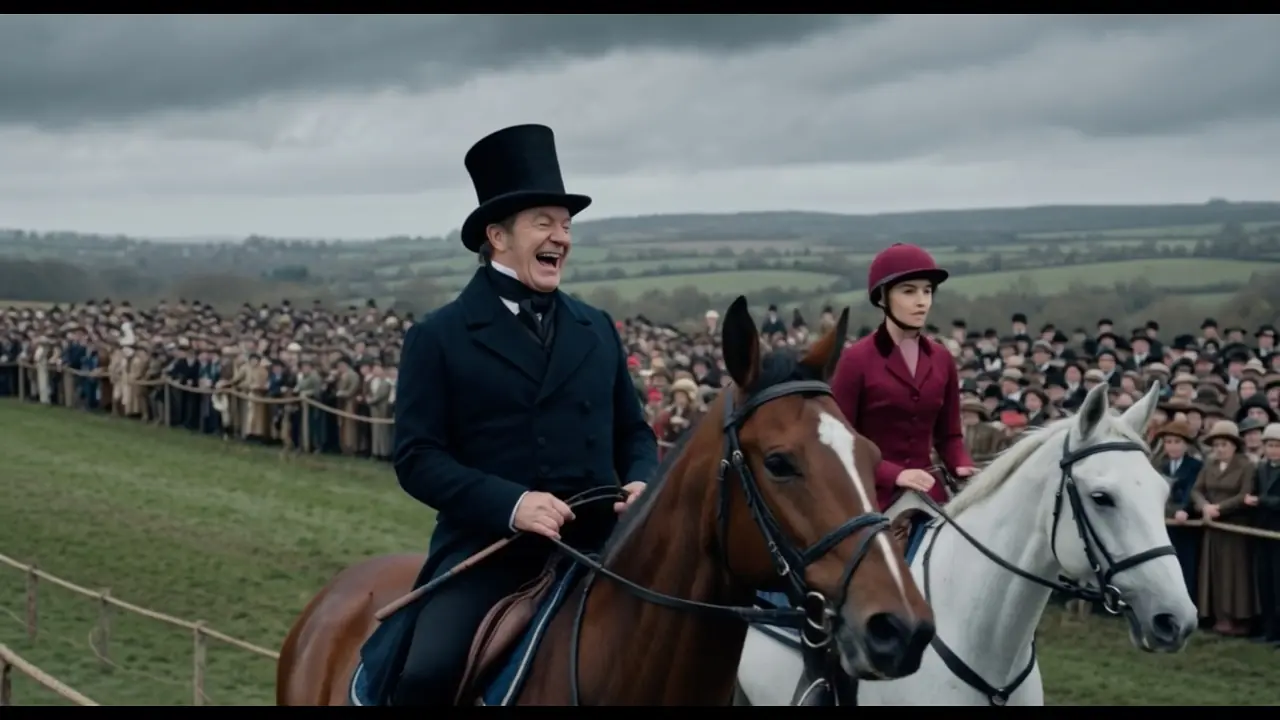
She came to the starting line astride, and the whole field went quiet. It was not a respectful quiet. Lady Beatrice Sinclair had ridden enough to know the difference between the silence of admiration and the silence of a crowd watching something it has decided to disapprove of. And the silence that fell across the assembled gentry at the edge of the Quorndon course on that cold October morning was unmistakably the second kind. 200 people had come to watch the great steeplechase, the county's most significant race, run each autumn across 4 mi of Leicestershire field and fence and water.
And 200 people had just seen a woman take her place at the line, not perched sideways on a side saddle as God and the College of Heralds intended, but astride in a divided habit she had made herself, sitting her horse the way every man in the field sat his. The disapproval moved through the crowd like cold through a house. She had expected it. She'd been expecting it for the 3 weeks since she had entered the race, and she had decided in those 3 weeks that the disapproval was a cost she would pay, because the thing she was doing was worth the cost. And because she had stopped some years ago arranging her life around the comfort of people who had never once arranged theirs around hers.
Her horse was called Harlequin. He was a big-boned bay gelding with a white blaze and the specific settled calm of a horse who had been trained by someone who understood horses. And he had been trained by her over 3 years in the particular way she trained all her horses, which was patiently and from the ground up and with an attention to the animal's actual nature rather than to the conventions of how a lady's horse was supposed to behave. He stood quietly under her at the line while the field assembled around them. 11 other riders, all men, all on the side saddles natural opposite, all watching her with the range of expressions that men wore when a woman did a thing they had decided women did not do.
And at the center of the field, on a tall gray thoroughbred with the bearing of a horse that had never lost a race, sat the Duke of Ashbourne, who had decided to make her the morning's entertainment. He was perhaps 35 with the cold, correct handsomeness of a man who had been the finest gentleman rider in three counties for a decade and had never, in that decade, been given a reason to doubt that the way he did things was the way things were properly done. He sat his gray with the rigid, textbook perfection of the classical seat. Back straight, heels down, hands precisely placed. Every line of him a demonstration of how a gentleman rode.
He had won the great steeplechase four years running. He intended to win it a fifth time. And he had spent the three weeks since Lady Beatrice Sinclair's entry making his opinion of her participation known throughout the county in the specific, public, witty way of a man who finds it amusing to be cruel about a thing he has decided is beneath him. He looked at her now across the assembling field and he said loudly enough for the line to hear, loudly enough for the nearest of the spectators to hear, in the carrying tone of a man performing for an audience he knew was on his side, that he was glad to see Lady Beatrice had at least chosen a sensible mount since she would clearly need every advantage her horse could provide to make up for the deficiencies of her seat. The nearest spectators laughed.
He told the field, warming to it, that he had nothing against a lady taking the air on horseback, and that he was sure Lady Beatrice rode very prettily in the park, but that the great steeplechase was not the park, and that he hoped sincerely that she would have the good sense to pull up before the water jump, where her unfortunate choice of seat was most likely to deposit her in the mud in a manner that would embarrass them all. More laughter. Lady Beatrice Sinclair looked at the Duke of Ashbourne across the cold October field. She did not laugh. She did not flush.
She did not answer the taunt with a taunt of her own, which was what he wanted, because a woman who traded insults at the starting line was a woman who had been drawn into his game, and she had no intention of playing his game. She gathered her reins. She settled Harlequin. And she said, in a voice that was perfectly level and that carried in the silence after the laughter considerably further than she had pitched it, "I will see you at the water jump, Your Grace." The starter raised his flag. If you are new to Moonlight at Mayfair, you have arrived for one of the great rides.
A woman the whole county has decided to laugh at, a duke who has never lost, and 4 miles of Leicestershire that are about to settle the matter. Subscribe before the flag drops, because what happens on this course will change everything. And if you have been here before, you already know. They are laughing now. They will not be laughing at the water jump.
Hold on. She rode astride because her brother had died. This was the thing the county did not know, because she had never told them, because she had decided long ago that her reasons were her own, and that a woman who explained herself to people who had already judged her was a woman performing for an audience that would not be moved by the performance. But it was the truth. And it was the whole of the truth.
And it was the reason she sat her horse the way she did on the cold October morning while 200 people laughed. Her brother James had been the finest rider she knew. He had taught her to ride on the Leicestershire fields where their family had bred and trained horses for three generations. And he had taught her the way he did everything. Generously.
And he had been thrown. And the thing that had killed him was not the fall itself. But the saddle. Not his saddle. He had ridden astride as men did.
The saddle that had killed him belonged to the woman he had been riding beside. A young woman on a side saddle whose horse had bolted at the same fence. And whose side saddle had done the thing that side saddles did when a horse bolted and a rider could not get free of it. It had held her on past the point of safety. Trapped her leg over the fixed pommel.
And dragged her. And James had ridden to catch her bolting horse. And had gone down in the catching under both horses. And had not got up. Beatrice had been 17.
She had spent the years since studying with the specific obsessive attention of a a trying to understand the mechanics of a grief, exactly how the side saddle worked, and exactly why it was dangerous. And she had concluded, not from rebellion, not from vanity, not from any wish to scandalize the county, but from three years of patient, careful, grief-driven study, that the side saddle was a beautiful and deadly convention. That it had been designed to make a woman ornamental rather than secure. That it placed a rider in a position from which, in a true emergency, she could not free herself, could not balance, could not save herself or anyone else. That it had killed the young woman at the fence, and through her, had killed James.
And that it would go on killing women for as long as the convention held. Because the convention valued the appearance of a lady more than the life of one. She had learned to ride astride in secret on the family fields in the years after James died. She had found, exactly as her study had predicted, that astride, she was secure where the side saddle had made her precarious. That she could balance, could recover, could free herself, could do all the things the side saddle prevented.
She had become, riding astride, a better and a safer rider than she had ever been perched sideways. And she had concluded that the convention that called astride unladylike was a convention that preferred dead ladies to unconventional ones. She had entered the great steeplechase to prove it, not to win a race, to win an argument that could not be won any other way. Because the county would never listen to a woman explaining the mechanics of saddle safety in a drawing room. But the county could not ignore a woman who rode astride across 4 mi of fence and water and beat the finest gentleman rider in three counties.
The race was the only argument the county would hear. So she had entered the race. And the Duke of Ashbourne, who knew none of this, who saw only a woman riding astride and had decided she was a vain girl seeking attention, had spent 3 weeks making her the county's joke. She did not hold it against him as much as she might have. She understood, in the clear-eyed way she understood most things, that he could not know what he did not know.
But she did not forgive him for it, either. Because a man who mocked a thing he did not understand was a man who had decided that his not understanding was the thing's fault, rather than his own. And that was a choice. And she did not forgive choices simply because the person making them was ignorant of what the choice cost. She would answer the mockery the only way it could be answered.
She would see him at the water jump. The flag dropped and the field broke and the great steeplechase began. The first half mile was open field and the field of riders ran it as a field of riders ran open ground, bunched, jostling, the horses finding their stride, the riders finding their positions. The Duke of Ashbourne took the early lead as he always did. His gray thoroughbred eating the open ground with the long stride of a horse bred for exactly this.
The Duke sitting it in his rigid textbook perfection. Every line of him correct. Beatrice did not chase the lead. This was the first thing her 3 years of study had taught her and the first thing James had taught her before that. A steeplechase was not won in the first half mile.
It was won across 4 mi of obstacles, and the rider who spent herself chasing the early lead was the rider who had nothing left for the fences that mattered. She settled Harlequin into a steady, economical gallop in the middle of the field, conserving him, riding her own race rather than the Duke's. And she watched the leaders pull ahead and did not panic. Because she had run this course in her mind a hundred times, and she knew where it would be won. It would be won at the fences.
And it would be won specifically in the mud. The first fence came at the half mile, and the field took it in a thunder of hooves and a scatter of turf. Beatrice took it cleanly, Harlequin rising and landing in the smooth, unbroken rhythm of a horse who trusted his rider. And she felt, as she always felt, astride the specific security of a seat from which she could move with the horse rather than against him. She saw, ahead of her, the difference between her seat and the others.
The men on their classical seats rode the fences as the convention taught, rising stiffly, their balance fixed, covering on the landing with a small lurch of riders whose position did not flow with the animal. They were good riders, all of them. But they rode the way they had been taught, and the way they had been taught was a way that fought the horse at the moment the horse most needed to be trusted. She did not fight Harlequin. She flowed with him.
And across the first three fences, she made up ground she had not chased. Not by riding harder, but by riding better. By losing nothing at the obstacles that cost the others length each. By the second mile, she was in the front group. The Duke saw her come up.
She watched him see it. Watched him glance back, expecting to find her where he had left her, at the back of the field, where a woman riding astride belonged in his accounting. And finding her instead three lengths off his flank and gaining. She watched the expression cross his face even at the distance, even in the wind and the speed. The specific involuntary recalculation of a man whose certainty had just encountered a fact it had not predicted.
He pushed his gray harder. This was his first mistake. And she recognized it as a mistake the moment he made it. Because she had spent three years studying exactly this. He pushed the gray to hold his lead.
Spent the horse to keep the woman behind him. And a steeplechase was not won by spending the horse in the second mile. He was riding his pride rather than his race. He was letting her presence three lengths back change the way he rode. And a rider who let his rival change his race was a rider who had already begun to lose it.
She held her own pace. She did not chase. She let him spend the gray. And the rain that had threatened all morning began in the third mile to fall. The rain changed everything.
Which was the thing Beatrice had been counting on. Because the rain was where the convention died. The course of the Great Steeplechase ran in its third mile through the low ground along the Quorn Don Brook. And the low ground in the rain became exactly what low ground became. Deep, slick, treacherous Leicestershire mud.
The kind that turned a fence from an obstacle into a trial that made the landing on the far side a question of whether the horse could find its feet and whether the rider could stay with it through the slither and the recovery. And in the mud the classical seat failed. She watched it fail. She watched the riders ahead of her the men on their textbook seats, their balance fixed, their position correct take the fences in the mud and land in the slick and lurch their rigid seats unable to follow the horses through the scrambling recovery. And she watched two of them come off.
Not at the fences themselves but in the landing in the mud where a horse fought for its footing and a rider whose seat could not flow with the fight was a rider who got left behind as the horse lurched out from under him. The convention that made a man sit correctly was a convention that fixed him in place. And a rider fixed in place in the mud was a rider on the ground. Beatrice flowed. Astride, secure, her balance not fixed but living.
She rode the muddy fences the way she rode everything with the horse rather than against him following Harlequin through the slither and the scramble of each landing staying with him through the recovery that unseated the others losing nothing gaining at every obstacle. The mud that destroyed the convention was the mud her seat was made for. She had known it would be. She had entered the race in October when the rains came precisely because she had known that the mud was where the argument would be won. She came up on the Duke of Ashbourne at the fourth fence of the low ground.
He was still ahead barely. The gray laboring now, spent from the pride driven push of the second mile. And he took the fence in his rigid perfection and landed in the deep mud on the far side. And the grey's feet went the way feet went in that mud. And the Duke's textbook seat could not follow the scramble.
And for one moment one long suspended moment that Beatrice would remember for the rest of her life. The Duke of Ashbourne, the finest gentleman rider in three counties, four times champion of the great steeplechase hung at the very edge of his saddle with his correct, fixed, beautiful seat doing exactly nothing to save him. While his horse fought for its footing beneath him. He did not come off. He was too good a rider to come off, even fixed, even fighting his own seat.
But he lost everything in the recovery. Lost his stride. Lost his rhythm. Lost the lead. And Beatrice Sinclair came over the fence beside him.
Flowed through the mud her seat was made for. Stayed with Harlequin through the scramble that nearly unseated the Duke. And landed and gathered. And went past him. She did not look at him as she passed.
She had said she would see him at the water jump. The water jump was a half mile ahead. The final and most dangerous obstacle of the course. And she intended to keep her word. And she did not have attention to spare for a look.
But she heard him as she passed. Heard over the rain and the hooves and the wind the sound the Duke of Ashbourne made. Which was not a taunt and not a curse. And not anything he would have wanted 200 people to hear. It was the sound of a man watching his certainty come apart.
It was, she thought, the first honest sound he had made all morning. She left him behind in the mud, and she rode for the water jump. The water jump was where the great steeplechase was decided, and it was where, 3 weeks ago, the Duke of Ashbourne had publicly hoped she would have the good sense to pull up. It was the largest obstacle on the course, a wide ditch of water beyond a substantial fence, the kind of jump that demanded a horse commit completely, and a rider commit with it. And the kind of jump where the smallest failure of nerve or balance sent both into the water.
It had unseated riders every year of the race's history. It had, in 2 years, killed horses. It was the obstacle that separated the riders who could from the riders who merely rode. And the Duke had named it specifically in his mockery, because he had been certain it was where a woman riding astride would meet the limit of her grit. Beatrice came to it in the lead, with the field strung out behind her, and the Duke of Ashbourne fighting his spent gray through the mud somewhere in her wake.
And she came to it the way James had taught her to come to the hardest fences, with complete commitment, no hesitation, the decision made long before the horse left the ground. She felt Harlequin's question beneath her, the slight check, the horse's honest assessment of an obstacle that asked a great deal. And she answered it the only way the water jump could be answered, which was with absolute, unhesitating confidence transmitted from her body to his through the secure, living seat that the side saddle would have made impossible. She told him through her hands and her seat and the whole of her committed body that they were going over, that she had no doubt that he could trust her completely. He trusted her completely.
He rose to the water jump in the rain with the full magnificent commitment of a horse who had been trained from the ground up by someone who understood him. And he cleared the fence and the wide water beyond it and landed clean on the far side. And the 200 people at the edge of the course, the 200 people who had laughed at the starting line, who had come to watch a woman embarrass herself, who had sided with tradition and the Duke and the certainty that a stride was unladylike and dangerous and doomed, the 200 people made a sound that was not laughter. It was the sound a crowd makes when it watches something it did not believe was possible. She did not hear the Duke take the water jump behind her.
She did not look back to see whether he made it. She had a half mile of open ground to the finish and a spent field behind her and a horse beneath her who had just cleared the hardest obstacle in the county as though it were nothing. And she rode the final half mile the way she had ridden the whole race economically, completely, with the secure and living seat that the convention had spent 3 weeks calling unladylike. She crossed the finish line of the Great Steeplechase four lengths clear of the nearest rider in the rain, astride, mud-spattered from the divided habit she had made herself, to the white blaze on Harlequin's face. The county had come to watch a woman embarrass herself.
It had watched instead the finest ride any of them had ever seen. The Duke of Ashbourne finished third. He brought his spent gray across the line behind the winner and behind a young man named Carstairs who had ridden a clever conserving race. And he pulled up in the rain and the mud with the specific total silence of a man who had just lost for the first time in five years the race he had been certain he would win. And who had lost it worse to the woman he had spent three weeks making the county's joke.
The aftermath of a steeplechase was a particular kind of chaos. The riders pulling up and dismounting the grooms running to the horses the spectators surging toward the finish the loud overlapping noise of a crowd processing an upset. Beatrice dismounted in the middle of it. Her legs unsteady beneath her in the way legs always were after four hard miles. And she put her hand on Harlequin's neck.
The wet heaving magnificent neck of the horse she had trained from the ground up. And she leaned her forehead against him for a moment in the rain and she thought about James. She thought I did it. I proved it. The argument is won.
She thought you taught me this. And I won it on a horse I trained the way you taught me. Riding the way that would have saved her. And through her you. She did not weep.
She had done her weeping years ago in the long study of the mechanics of a grief. But she stood with her forehead against her horse's neck in the rain for a moment longer than she needed to because the moment was his as much as hers. And then she straightened and she turned to face the county that had laughed at her. The Duke of Ashbourne was walking toward her. The crowd noticed.
The crowd, which had been surging and loud, went quieter as the Duke approached the winner because everyone present understood what the approach was and everyone wanted to hear it. The moment when the man who had mocked her would have to acknowledge in public, in front of the county that had laughed with him, exactly what had happened on the course. She watched him come. She did not arrange her expression into triumph because she had not ridden the race for triumph. And she did not arrange it into magnanimity because she did not yet know whether he deserved magnanimity.
She simply watched him come with the level, clear attention she gave to everything. And she waited to see what kind of man the Duke of Ashbourne would turn out to be when his certainty had been taken from him in front of everyone whose opinion he valued. He stopped in front of her. She had expected perhaps a graceful concession, the practiced, hollow good sportsmanship of a gentleman acknowledging a defeat he intended to explain away later in private to the men who would agree with him that the mud and the rain and the luck of the day had been the real victors. She had expected the version of acknowledgement that cost nothing and changed nothing.
That was not what she received. The Duke of Ashbourne looked at her, mud-spattered, unsteady on her tired legs, her hand still on her heaving horse, and he did not say anything for a long moment. And then he said the thing that told her more than the race itself what kind of man he was underneath the certainty. Because it was not the easy thing and it was not the graceful thing and it cost him visibly a great deal to say. He told her "I have been riding for 30 years and I have never seen anything like that water jump." He told her "I have never in my life seen a horse trust a rider the way that horse trusted you.
And I have spent 3 weeks telling this county that your seat was a danger and a vanity. And I watched you ride that course in the mud and I watched my own seat nearly put me in it at the fence before the water and I understood somewhere in that mud watching you flow through the thing that nearly unseated me that I have been wrong. Not graciously wrong. Not the kind of wrong a man can wave away. Wrong in the specific way of a man who mocked a thing because he had decided his ignorance of it was the thing's fault." He told her in front of the county that had laughed "I owe you an apology.
And I am not going to make it small because the wrong was not small. I made you the joke of three counties for 3 weeks and you answered me by riding the finest race I have ever seen and you did it on the seat I called unladylike. And the truth which I am only man enough to say because you have just made it impossible to say anything else the truth is that your seat is not unladylike. It is better. It is safer and it is more secure and it kept you on your horse through mud that nearly had me off mine.
And every rider in this county who clings to the convention because it is the convention is a rider who has chosen tradition over the evidence of his own eyes. He paused. The crowd was silent now, every one of them. 200 people who had come to watch a woman shamed and were watching instead the finest gentleman rider in three counties dismantle his own certainty in the rain. He told her, "I do not know why you ride astride.
I assumed it was vanity because assuming it was vanity allowed me to mock it. But no one rides the way you ride out of vanity. A woman does not train a horse to trust her like that and study a course like you studied that course and commit to that water jump like you committed to it out of vanity. There is a reason. I do not have any right to ask it, but I find I would very much like to understand it because I have just watched you prove in four miles of mud that I have been wrong about something for 30 years.
And I find I would rather understand why than go on being wrong." Beatrice Sinclair looked at the Duke of Ashbourne in the rain. She had been prepared for the graceful, hollow concession. She had not been prepared for this. For a man who, given the choice between explaining away his defeat and actually facing it, had chosen to face it completely, in public, at the full cost to his pride. She told him, "My brother died." The crowd could not hear her now.
She had pitched it for the Duke alone. She told him about James, the finest rider she knew, who had taught her everything, who had died on a hunting field catching a bolting horse whose rider could not free herself from a side saddle that held her on past the point of safety. She told him she had spent 3 years studying exactly how the side saddle worked and exactly why it was dangerous and that she had concluded it was a beautiful and deadly convention that valued the appearance of a lady over the life of one. She told him she had learned to ride astride because astride was safe and that she had entered the great steeplechase not to win a race but to win an argument that could not be won any other way because the county would never listen to a woman explaining saddle mechanics in a drawing room but it could not ignore a woman who rode astride and won. She told him, "I rode the race to prove that the convention is killing women and that there is a better way and that the better way is being called unladylike by people who would rather have dead ladies than unconventional ones." The Duke of Ashbourne listened to the whole of it in the rain with the specific complete attention of a man who had just learned that the thing he had mocked was not vanity but grief and not rebellion but reason and that the woman he had made the county's joke had been right about something that mattered far more than a race.
He was quiet for a long moment. He told her, "Then you did not win an argument today. You won the first argument. There are many more." She looked at him. He told her, "I am the finest rider in three counties and the county listens to me.
And I have just watched you prove that I have been wrong. He told her, I cannot give you back your brother, but I can do the thing that might keep the next woman's brother from dying the same way, which is to use whatever the county's regard is worth. And after today, it is worth a great deal less than it was this morning, but it is worth something to say what you have just made me understand. That the convention is dangerous. That there is a better way.
That the woman who showed it to me rode the finest race I have ever seen and that any man who goes on calling her seat unladylike after today is a man who watched the truth in the mud and chose tradition over it. He held out his hand, not the gesture of a gentleman to a lady, the offered escort, the condescension of the strong to the assisted, the gesture of one rider to another, the handshake of an equal. He told her, I have been wrong for 30 years and you corrected me in 4 miles. I should like to spend rather longer than that being corrected by you, if you would permit it. There is a great deal I have been certain about and I'm beginning to suspect that my certainty has been the least reliable thing about me.
Beatrice Sinclair looked at the offered hand. She took it. Mud-spattered both of them in the rain in front of the county that had come to laugh and had stayed to watch its finest rider concede that the woman he mocked had been right all along. She told him, it will take longer than 4 miles. He told her, I am, I'm told, a patient man.
Though I am beginning to suspect I have been wrong about that, too. The argument she had come to win was won. But the winning of it was not the end. It was, as the Duke had said, only the first argument. The county did not change overnight.
Conventions did not die because a woman won a steeplechase, however finely. They died slowly in the accumulation of evidence and the slow turning of opinion. And Beatrice had been studying conventions long enough to know that a single victory changed the conversation rather than ending it. But the conversation changed. The Great Steeplechase of 1816 was talked of for years.
The woman who rode astride and beat the Duke of Ashbourne in the mud. And the talk did the work that talk did, which was to make the unthinkable thinkable, and then the thinkable ordinary. And the Duke of Ashbourne did what he had said he would do. This was the thing that surprised the county most, and the thing that surprised Beatrice not at all, because she had seen, in the rain after the race, exactly what kind of man he was underneath the certainty. He used his regard, which had taken a wound on the course and recovered, in the way that the regard of genuinely formidable men recovered, to say, publicly and repeatedly and in the places where it mattered, the thing Beatrice had made him understand, that the side-saddle was dangerous, that there was a better way, that the convention had cost lives and would cost more.
He was mocked for it at first by the men who had laughed with him three weeks before the race and now found him on the other side of the argument. He bore the mockery with the specific equanimity of a man who had discovered in 4 mi of mud that being right was worth more than being agreed with. Which was, Beatrice told him, the most useful thing he had learned all year. They worked together. This was the partnership the race had ignited, and it was not, at first, a romance.
It was the genuine intellectual alliance of two people who had each, separately, arrived at the same truth from different directions, and who found in each other the rare and specific pleasure of a mind that could keep pace. The Duke had 30 years of riding and the county's regard. Beatrice had 3 years of grief-driven study and the finest seat in the county. Together, across the seasons that followed, they did the thing that neither could have done alone. They began, slowly and against considerable resistance, to change how a county thought about how its women rode.
They established a riding school. This had been Beatrice's idea, and the Duke had funded it and lent it his name, and it taught young women to ride astride, safely, with the secure living seat that Beatrice had learned in the years after James died. And it taught them, also, that the convention they were defying was not a moral law, but a dangerous fashion. And that their lives were worth more than their appearance. The school was controversial.
The school was also, within 3 years, full, because mothers who had watched the great steeplechase and remembered the woman in the mud had begun, quietly, to prefer their daughters alive and unconventional to ornamental and at risk. And somewhere in the seasons of the work, the riding school, the slow turning of the county's opinion, the long conversations that began as intellectual alliance and became something more. The partnership born of defiance became the thing that the race had, perhaps, always been going to make it. He told her one evening in the spring after the second great steeplechase, which she had also won, more easily this time, against a field that had begun, some of them, to abandon the convention, that he had spent his whole life being certain about things, and that the certainty had been, he now understood, a kind of armor he had built after a childhood of disorder, a way of making the world predictable and safe by insisting that there was a correct way to do everything, and that he knew it. He told her, "You took the armor apart in 4 miles, and I have spent 2 years discovering that I am better without it.
Less certain, more alive, more often wrong, and far more often right about the things that matter, because I have learned to look at the evidence instead of the convention." He told her, "You did that. You and your brother, and your terrible, magnificent grief, and the seat you learned because the convention killed someone you loved." She told him, "James would have liked you, eventually, after he had finished being furious that you mocked me." He told her, "I should have deserved the fury." She told him, "You did, but you also did the rare thing, which is that you let being wrong change you instead of defending it. That is the thing I did not expect in the rain after the race. I expected the graceful concession that costs nothing. You gave me the ungraceful one that cost everything.
She looked at him. She told him, "That is when I knew you were worth correcting at length." He told her, "And have I been corrected sufficiently?" She told him, "No. There is a great deal left. The convention is not dead. The county is not changed.
There are years of arguments still to win." He told her, "Then I should like to win them with you." He paused, and the certainty was gone from his voice, replaced by the thing that had replaced it in him over 2 years, which was the honest uncertainty of a man who had learned that the things worth wanting could not be commanded into being. He told her, "Not as your ally, not as the patron of your school, as He found the words, the unarmored ones, as the man who watched you ride through the mud that nearly unseated me, and understood, somewhere in that water jump, that I had been waiting my whole life for someone who would prove me wrong about everything, and make me grateful for it." He told her, "Marry me, Beatrice. Not because I have conceded the argument, because I want to spend the rest of my life on the losing side of it, which is, I have discovered, the only side worth being on." Beatrice Sinclair looked at the Duke of Ashbourne in the spring evening. She told him, "That is a strange proposal." He told her, "I am a strange man now. You made me one.
I was a a deal more conventional before you rode through my certainty in the mud. She told him, "Yes." He told her, "Yes?" She told him, "Yes." She took his hand, the rider's handshake, the equals grip, which had been the first honest thing between them in the rain after the race, and had become, across two years, the thing that everything else was built on. She told him, "On one condition." He told her, "Name it." She told him, "We ride to the wedding, both of us, astride." He told her, "The county will be scandalized." She told her, "The county is always scandalized. It is the county's natural condition. I have found it does no harm and a great deal of good to give it something worth being scandalized about." He told her, "Then we ride astride." She told him, "And you will not, on the day, revert to the classical seat to placate your relations." He told her, "I gave up the classical seat in the mud at the water jump, and I have not missed it for a moment." He looked at her.
He told her, "I have not missed any of the things I was certain about. I have only been grateful every day that you took them from me." They were married in the summer, and they rode to the church astride, both of them, and the county was scandalized exactly as predicted, and got over it exactly as predicted, in the way that counties got over things once the things had been done by people the county could not afford to disapprove of for long. The riding school flourished. The convention did not die. Conventions rarely die, they only loosen.
But it loosened year by year in that county, and then in the counties around it as the young women who had learned the secure living seat grew up and rode and survived the falls that the side saddle would have made fatal. And as their mothers and then their daughters came slowly to understand that the woman in the mud at the great steeplechase of 1816 had been right about something that mattered more than appearances. Beatrice rode the great steeplechase every year. She did not always win. The field improved as fields did when the convention loosened and other women began to ride astride.
And the improvement was the truest measure of her victory because a race she could no longer dominate was a race that had become at last a fair one. She had not wanted to win a race. She had wanted to win an argument. And the argument was being won slowly in the only currency that the world accepted, which was the accumulating evidence of women who rode astride and lived. The duke rode beside her.
He had become in the years of their marriage a genuinely excellent rider rather than merely a correct one. Had learned from his wife the secure living seat that flowed with the horse. Had abandoned the textbook perfection that had nearly put him in the mud at the water jump. And had discovered late the specific joy of riding well rather than riding properly. He told her once, years into the marriage, watching their daughter take her first fence astride on a pony Beatrice had trained, that he had spent the first half of his life certain that there was a correct way to do everything.
And the second half discovering that the correct way was usually just the convenient way dressed up as a moral law, and that the people who broke the conventions were usually the people who had looked at the evidence and found the convention wanting. He told her, "I mocked you the first day. I have never been more grateful for anything than for being so completely, publicly, irreversibly wrong." She told him, "I know. You told me so in the rain. It was the moment I decided you were worth the years of correction." He told her, "Am I corrected yet?" She told him, "No." She watched their daughter clear the fence, secure and living and safe in the seat that would keep her alive.
The seat James had taught his sister, the seat that had won the Great Steeplechase and the argument, and in the end, the Duke. She told him, "There is always a great deal left to correct. That is rather the point." The day there is nothing left to correct is the day we have stopped looking at the evidence. He told her, "Then I hope to be corrected for a very long time." She told him, "You will be." She put her hand on his, the rider's grip, the equals hold. She told him, "I have years of it planned." And perhaps that is why this story will not let us go.
Not because a woman won a race, or a Duke was humbled in the mud, or a convention loosened across a county in the years that followed, but because of the water jump, because a woman who had been laughed at by 200 people rode toward the obstacle where they were all certain she would fail and committed to it completely with no hesitation and no doubt on a horse she had trained from the ground up to trust her and cleared it.
And in the clearing won not just a race but an argument that could not be won any other way. She did not ride out of vanity. She rode out of grief and out of reason and out of the three patient years she had spent studying exactly how a beautiful convention had killed her brother and exactly why there was a better way and exactly how to prove it to a county that would never have listened to a woman explaining the mechanics of saddle safety in a drawing room. She could not win the argument with words so she won it with four miles of mud and a water jump and the finest ride the county had ever seen.
And the man who had mocked her did the rarest thing a certain man can do. He let being wrong change him. He stood in the rain in front of the county that had laughed with him and he did not explain his defeat away and he did not make his apology small. He faced completely and at the full cost of his pride the fact that he had been wrong for 30 years and that a woman had corrected him in four miles. And he chose from that moment to spend the regard he had left on the side of the truth she had shown him.
That is what greatness costs in the end. Not the winning the willingness to be wrong publicly and completely and to let the being wrong remake you into something better than the certainty you had before. She rode astride because the convention had killed someone she loved. And she would not let it kill anyone else if she could help it. He mocked her.
And then he watched her ride through the mud. And he understood. And the understanding cost him everything he had been certain of. And he paid it gladly because some certainties are worth more in the losing than in the keeping. They rode to the wedding astride and every young woman in the county who learned the secure living seat and survived the fall that would have killed her sideways was the argument being won again.
One rider at a time. In the only currency the world accepts. Which is the accumulating undeniable evidence of the people who broke the convention. And lived.