She was never meant to be found. For six years, Zvenislava had been shut inside the east wing of Vanfield Manor. No ballrooms, no suitors, no world. Her own family had done it. They called it protection, but the servants whispered something else entirely.
Then Duke Myuslav arrived, and the moment his eyes found hers through that half-open door, everything her family had spent years carefully building began to crack. Why was she really hidden? Because it was never just about her beauty.
Six years is a long time to disappear. Zvenislava had not always lived in silence. There was a version of her that used to run through the lower gardens before sunrise, her dark hair loose and her laughter loud enough to embarrass her mother. That girl existed once, she was certain of it.
But certainty is a fragile thing when you spend enough years being told that the world outside your door is dangerous and that your face is the reason why. She was nineteen now. The East Wing had been her world since she was thirteen, and in that time the manor had shifted around her like a living thing, breathing and rearranging itself while she stayed perfectly still. The servants brought her meals.
Her mother visited twice a week, always composed, always dressed as though she had somewhere important to be. Her brother Ostap never came at all. Nobody explained it cleanly; nobody ever does when the truth is something they are ashamed of. What Zvenislava had pieced together on her own was this: her beauty had drawn attention early, the wrong kind, from men her family could not control and could not afford to offend.
And so, rather than face that problem directly, her family had simply removed her from the equation. A quiet arrangement, a locked door, a story told to the outside world that she was unwell, delicate, and not fit for society. It was easier than the truth, it always is. She had learned to live inside her own mind.
She read everything the servants would bring her. She observed people from the single window that looked out over the eastern path, the one rarely used except for supply deliveries and occasionally guests arriving at the back of the estate to avoid the formality of the front. She had become very good at reading a person from a distance. The way they held their shoulders told her whether they were comfortable with power or performing it.
The pace of their walk told her whether they wanted to be seen. She was standing at that window on the morning everything changed. The carriage that came down the eastern path was not a supply carriage. It was dark, well-maintained, and moving with the quiet confidence of someone who did not need to announce himself.
Two outriders flanked it. There was no house crest on the door, which meant either he was traveling privately or he had reasons not to advertise his name. Zvenislava watched. The man who stepped out was tall and unhurried.
He wore no hat, which struck her immediately, because men of standing always wore hats when arriving at another man's estate. His dark coat was plain, but clearly expensive. He stood for a moment in the gray morning light and looked up at the manor with an expression she could not fully read from where she stood. Not admiration, not calculation either, but something quieter than both.
Then, as if he had felt the weight of her attention, he turned. His eyes found the east wing window, they found her. Zvenislava stepped back from the glass so quickly she knocked against the small table behind her, sending a book to the floor. Her heart was moving strangely, not with fear exactly, though fear was part of it.
It was something closer to the feeling of being genuinely seen for the first time in years and not knowing whether that was something to want. She pressed her back against the wall and listened. Downstairs, she could already hear the shift in the house, footsteps quickening. Her mother's voice was warm and deliberate in the way it only ever became when someone important had arrived.
The particular creak of the front reception doors being opened wider than usual echoed. Zvenislava closed her eyes. She did not know his name yet. She did not know why he had come, what business he had with her family, or why a man of his bearing was arriving through the eastern path like someone who preferred not to be expected.
But she knew one thing with a clarity that surprised her: her family had not told him she was here, and now he had seen her. She had not always been this careful with her own feelings. There was a time early in her confinement when Zvenislava had let herself feel everything fully. The rage of the first month, the grief of the second, and the slow, exhausting process of learning to want less, expect less, and need less until the space between what she desired and what she allowed herself to hope for became so wide she stopped trying to cross it.
She had been thirteen when it started. A dinner, a man her father had invited, a business associate twice her age with a reputation she was too young to understand, but old enough to feel the danger of. He had looked at her the way people look at something they intend to acquire. Her mother had noticed, her father had pretended not to.
And three days later, Zvenislava was moved to the east wing with a carefully worded explanation that the arrangement was temporary, just until certain matters settled down. The matters never settled down. Her father died the following winter and suddenly the temporary arrangement became permanent because now it was not one man her family feared, but the entire question of her future. Without a title, without land, and with debts beginning to surface that no one had warned her about, her beauty became a liability too striking to ignore, not protected enough to be safe.
Her brother Ostap had taken over the estate at twenty-two with more pride than sense, and his solution to every complicated problem was to remove it from sight. She was a complicated problem, so she disappeared. Not violently, not cruelly exactly, just quietly, efficiently, in the way that families erase the things they cannot manage. There were no beatings, no starvation, and no dramatic villains.
There was only the slow suffocation of being told in a hundred small and polished ways that the world was better off not knowing she existed. What they had not counted on was what she would become in the silence. She had read philosophy, history, astronomy, medicine, and languages. She had taught herself to observe people so precisely that she could predict the emotional weather of a room before she entered it.
She had built an entire inner world so rich and detailed that some mornings she woke up surprised to find herself still inside the four walls of the east wing and not somewhere vast and open and free. She was not broken. That was the thing Ostap had miscalculated. He had expected six years of isolation to make her smaller.
Instead, it had made her extraordinarily still. And there is a particular kind of power in a person who has learned to be still without becoming passive. But none of that prepared her for what happened an hour after the carriage arrived. She heard the voices before she understood them.
Her mother was moving through the corridor below with that measured grace she deployed like armor. And another voice was low and unhurried, the kind of voice that did not raise itself to make a point because it had never needed to. Then came footsteps on the east wing stair. Zvenislava's whole body went alert.
Nobody used that stair. It was understood without ever being said aloud that the east wing was not part of any tour of the house, not part of any conversation about the estate, and not part of anything that involved guests. The footsteps stopped outside her door. There was a pause, and in that pause, she could feel the specific quality of someone standing very still and deciding something.
Then her mother's voice came, lower now, careful. "This part of the house is not in use. We can continue to the..." "I saw someone at this window this morning." His voice was calm, but it was not a voice that was accustomed to being redirected.
Silence followed. "The east wing is private," her mother said, and Zvenislava could hear the strain beneath the composure, that hairline fracture in her mother's careful surface that only appeared when something threatened the story she had been maintaining for years. "I am sure it is," the man said. Another pause stretched, longer this time.
Zvenislava stood three feet from the door with her hands pressed flat against the wall behind her and her breathing completely controlled, the way she had trained it to be. She was thinking about what he had said, not asked, not assumed, simply stated with the quiet precision of a man who had spent enough time reading situations to know when something was being hidden from him. He already knew she was there. The question she could not answer was why that felt less like danger and more like something she had not felt in a very long time, something that felt almost like relief.
The door opened. Not forcefully, not with any drama, it simply opened the way things do when the person on the other side has decided that waiting is no longer something they are willing to do. Her mother made a sound, a small controlled sound that was the closest she ever came to panic, and then went very quiet. Duke Myuslav stood in the doorway.
He was taller than she had judged from the window. His eyes were darker, too, a deep gray that moved across the room quickly and professionally, the way a man looks at a space when he is assessing it rather than admiring it. They landed on her and stayed. Zvenislava did not move.
She had decided in the three seconds between hearing the handle turn and the door swinging open that she would not flinch. Six years of careful erasure had not taken that from her. Whatever she was now, she was not someone who flinched. He looked at her for a long moment without speaking.
Then he said quietly, "How long?" It was not a question directed at her. He said it the way a person speaks when they are confirming something they already suspected, filling in the last piece of a shape they had already mapped. He turned slightly toward her mother, who had gone perfectly still in the corridor behind him.
Her mother said nothing. "How long has she been in this wing?" he said again, and this time the quietness of his voice had something beneath it. Not anger exactly, but the particular weight of a man choosing very deliberately not to raise his voice, because raising it would be the lesser form of what he actually felt. Her mother began to speak, something measured, something reasonable, using the familiar architecture of the story she had been constructing for years.
Delicate health, the difficulty of society, a temporary arrangement that had simply extended itself out of care and caution. Zvenislava watched the Duke's face while her mother spoke. He was listening, but he was also watching Zvenislava as he listened. And she understood with a clarity that was almost dizzying that he was not listening to her mother's words so much as measuring them against what he could see in front of him.
He measured them against the books stacked along the wall, against the single window with its worn sill where she had stood for years watching a world that had been told she did not exist, and against her face, which she knew better than to think was unreadable to someone paying the kind of attention he was paying. When her mother finished, he was quiet for a moment. Then he said, "Leave us." Her mother's composure fractured visibly.
"Your Grace, I must insist that..." "I was not asking," he said. The silence that followed was absolute. Zvenislava heard her mother's footsteps retreat down the corridor, each one careful and deliberate, the walk of a woman recalculating everything.
The sound faded, and then it was only the two of them, and the gray morning light coming through the window, and the particular stillness of a room where something is about to be said that cannot be unsaid. He did not move closer, she appreciated that. "You are not unwell," he said. "No," she said.
It was the first word she had spoken aloud to anyone outside her immediate household in longer than she could cleanly remember, and her voice was steadier than she expected it to be. He nodded slowly, as though she had confirmed something that settled a larger question inside him. "My name is Myuslav," he said. "I came here on business with your brother. That business is now secondary."
Zvenislava looked at him. "Secondary to what?" He met her eyes and something in his expression shifted, not softened exactly, but opened slightly, the way a door opens just enough to show there is light on the other side. "That," he said, "depends on what you are willing to tell me."
And beneath the steadiness she had spent six years building, something moved, because he was not asking her what had been done to her, he was asking what she knew. Those were not the same question, and the difference between them meant that whatever had brought Duke Myuslav to Vanfield Manor, it was not coincidence. It never had been. She told him some of it, not everything, not yet.
She told him about the first year, the way the East Wing had been presented to her as temporary, and the way temporary had stretched and calcified into permanent without anyone ever saying so directly. She told him about her father's debts, the ones Ostap had inherited and never fully disclosed to anyone outside the family. She told him about the men who had come sniffing around the estate in the years after her father died, men with money and influence who had expressed interest in her in terms that had more to do with acquisition than affection. She spoke evenly.
She did not perform distress. She had lived inside this story long enough that she could narrate it without bleeding, and she watched him as she spoke the same way he had watched her, carefully measuring what his face did with the information. He was not a man who gave much away, but there were small things. The way his jaw tightened when she mentioned the men who had come to the estate, the slight shift in how he was standing when she described Ostap's involvement, and something that moved through his expression and was gone before it fully formed.
When she finished, he was quiet for a moment. "Your brother has been negotiating a land arrangement with me for the past three months," he said. "The terms he offered involved certain assurances about the estate's stability and its assets." Zvenislava went very still.
"I am an asset." He did not look away. "You were listed as a dependent, not by name. The paperwork described the household as containing one surviving sibling, female, unmarried, in poor health." He paused. "I began to suspect the paperwork was not accurate."
The thing that moved through her then was not shock. She had long since stopped being shocked by what Ostap was capable of. It was something colder and more clarifying, the sensation of a truth she had always half known becoming fully solid in her hands. Ostap had not hidden her to protect her; he had hidden her to control what she was worth.
"He intended to include me in the arrangement," she said, not as a question. "I believe so, yes." She turned away from him and walked to the window. Outside, the eastern path was empty now.
The gray morning had softened slightly, thin light beginning to press through the cloud. She stood there for a moment and let the full shape of it settle. She had survived six years of silence on the understanding that the people who loved her were at the very least afraid for her. Learning that fear had never been the primary motivation reordered something fundamental inside her.
Behind her, she heard him move. He came to stand a few feet away, not beside her, not crowding the moment, just close enough that she was aware of him. "What will you do?" she said quietly, not sure whether she was asking about the land arrangement or about her. "That depends," he said, "on what you want."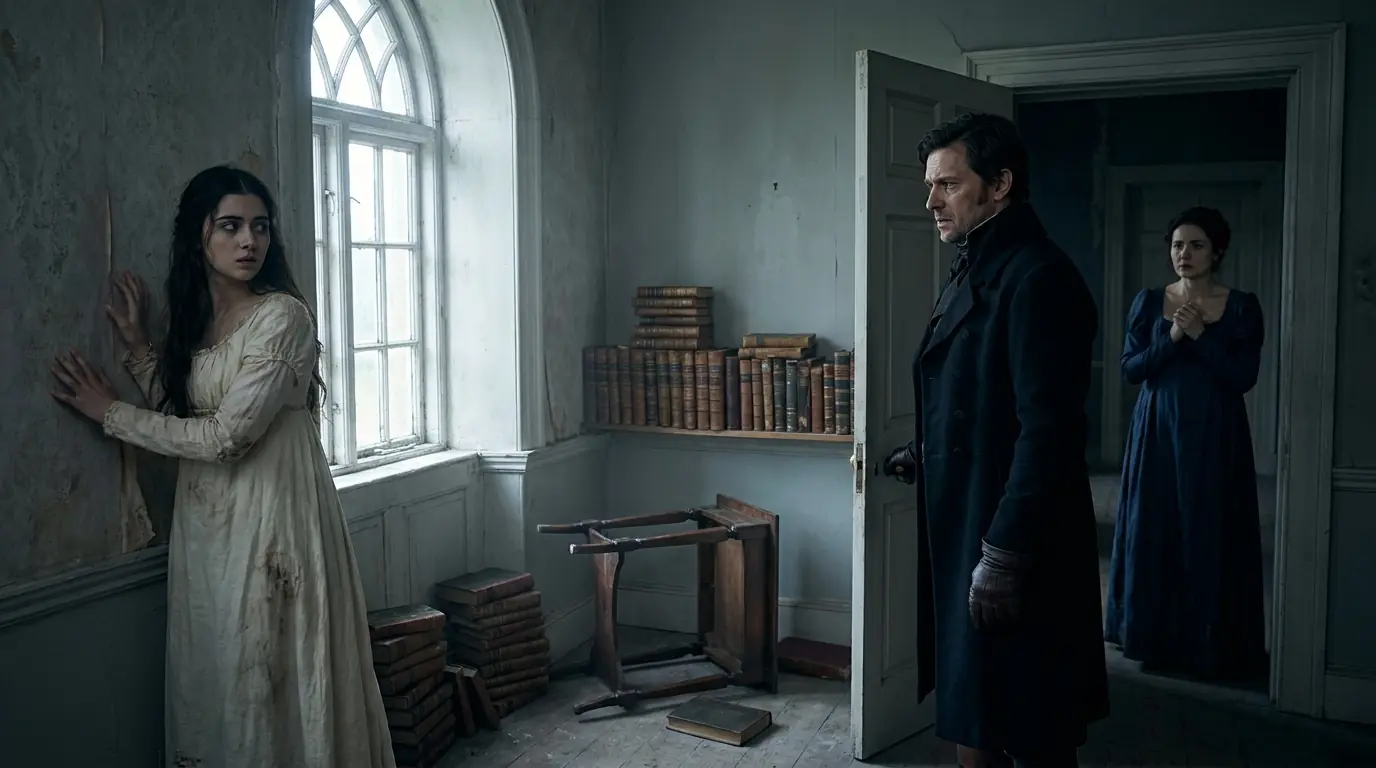
She turned to look at him then. It was a strange thing to be asked that question. Nobody had asked her what she wanted in so long that the question itself felt almost foreign, like a word in a language she used to speak and had nearly forgotten. "I want to leave this room," she said.
"I want Ostap to answer for what he has done, and I want to do it in a way that does not simply trade one form of control for another." Something shifted in his expression, something she was beginning to learn was as close as he came to being moved. "Then we are aligned," he said. She searched his face.
There was something she needed to understand before she trusted any of this. "Why does it matter to you? What happens to me is not your problem. You could dissolve the arrangement with Ostap, walk back to your carriage, and never involve yourself further." He was quiet for a moment that felt longer than it was.
"I could," he said, "but I have spent a great deal of my life watching people be made invisible by the convenience of others. I find I have less patience for it than I once did." It was not a romantic declaration, nor was it the kind of answer that required anything from her. And perhaps that was exactly why it reached her the way it did, moving past the careful architecture she had built around herself and landing somewhere unguarded.
Downstairs, a door opened. Footsteps moved quickly across the floor below—more than one person, purposeful and unhurried. Ostap was home. She moved first, not toward the door, not away from it.
She moved to the small chest beside her bed and opened the lower drawer, the one she had never let the servants touch. Inside, beneath a folded cloth, were papers. Six years of quiet observation had taught her one essential thing about powerful men: they always left a trail. They simply assumed no one in the East Wing was paying close enough attention to follow it.
She had been paying attention since the beginning. There were documents she had asked a sympathetic housemaid to copy for her over the past two years: estate records, correspondence left carelessly in rooms she was not supposed to enter, but sometimes did in the early hours when the house was sleeping, and figures that did not match. There were arrangements described in terms careful enough to suggest the writer knew they would not survive scrutiny. She held them out to Myuslav.
He looked at her before he took them. There was something in his expression she could not entirely name, something between recognition and a kind of quiet gravity, as though he was understanding in real time the full measure of who he was standing in front of. He took the papers and read quickly. She watched him move through them, his eyes precise and unhurried, and she knew from the slight change in his posture when he reached the part she most needed him to see.
"He listed you as collateral," Myuslav said, "against the northern parcel." "Yes." He looked up. "He does not have the legal authority to do that."
"I know," she said, "but I needed someone with standing to say so." A sound came from the stair, and both of them heard it. The particular weight of Ostap's step, which she had memorized over years of listening to the house, was unmistakable. He was moving quickly, which meant someone had told him already.
Her mother, most likely, who had spent years maintaining this arrangement and would not watch it unravel without attempting to manage the damage first. The door opened. Ostap was thirty now, broad across the shoulders with their father's coloring and none of his father's uncertainty. He had always moved through rooms as though he owned them, because he did, and he had spent eight years learning to use that fact as a substitute for actual authority.
He stopped when he saw Myuslav. Whatever he had expected to find in the east wing, it was not this. "Your Grace," he said, and the warmth in his voice was immediate and professional—the voice of a man who had learned to smile before he finished reading a room. "I apologize. I was not aware you had been shown to this part of the house. It is not..."
"I showed myself," Myuslav said. A beat of silence passed. Ostap's eyes moved to Zvenislava, and in that single glance, she saw everything she had always known and could never prove: the calculation, the faint irritation of something disrupted, and beneath it, buried under years of practiced composure, the specific guilt of a man who had told himself so many times that what he was doing was practical, that he had nearly forgotten it was also wrong.
"Zvenislava," he said, and his voice shifted into something gentler, a register she recognized as the one he used when he needed her compliant. "You should rest. You are not well enough for..." "She is in perfect health," Myuslav said. He said it the way he said most things, without raising his voice, without performing authority.
He simply stated it, and the room rearranged itself around the statement. He set the papers on the table between them. "These will need to be addressed. I have dissolved my interest in the northern parcel arrangement. I will also be informing the county solicitor of the discrepancies in the estate filing."
"I would encourage you to correct them voluntarily before that conversation takes place." Ostap stared at the papers, the color having shifted in his face. "You had no right to involve yourself in private family matters," he said, and the gentleness was gone now, the real shape of him visible beneath it. "You involved me," Myuslav said, "when you attached your sister's name to a contract without her knowledge and presented it to me as a legitimate arrangement."
The silence that followed had weight. Zvenislava stood very still and watched her brother understand that the walls he had built around her had just become the walls around him. There was no satisfaction in it, not the bright kind she had sometimes imagined; it was quieter than that, more like the specific relief of a very long-held breath finally released. Ostap left without another word.
The footsteps on the stair were different going down. She stood in the room that had been her world for six years and felt it change around her, not dramatically, not all at once, but in the way rooms do when the reason for being inside them no longer exists. Myuslav did not fill the silence immediately, she had come to appreciate that about him. When he spoke, his voice was different, not the measured tone he used with Ostap, but something with less armor in it.
"You have been building toward this for a long time," he said. "Two years," she said, "since I understood what he actually intended." He was quiet for a moment. "You could have found another way to surface those documents."
"I could have," she said, "but I needed someone who would not simply use them for his own advantage." He looked at her steadily. "And you decided that was me." "I decided," she said, "that you were worth the risk of being wrong."
Outside, the morning had fully arrived. Light moved through the window and across the floor of the east wing for the first time in what felt like years. She was still standing inside it, but for the first time, the door behind her was open, and she had been the one to open it. She did not leave the east wing that day, which surprised her in a way.
She had imagined in the abstract version of this moment she had rehearsed over two years that the first thing she would do once the door was truly open was walk through it and not look back. But when the moment actually arrived, she found herself standing at the window again, watching Myuslav's figure cross the eastern path below, and understanding that freedom, real freedom, was not something you stepped into all at once. It was something you had to learn to trust gradually, the way you trust ice at the edge of a frozen river before you trust it at the center.
She needed a day, just one day, inside the room that had held her to say goodbye to the version of herself that had survived inside it. She spent it quietly. She sorted the books she wanted to keep from the ones she no longer needed. She stood in each corner of the room and looked at it with clear eyes—the way you look at a place you are leaving rather than a place you are trapped in—and found that it changed what she saw entirely.
The room had not been a prison, it had been made into one. Those were not the same thing, and the difference mattered to her. By evening, she felt lighter than she had in years. Myuslav returned the following morning.
He came through the front of the house this time, which told her something had already shifted in how the household understood things. The servants moved differently around him, with the specific deference reserved for someone who has demonstrated authority without cruelty, which is rarer than it should be. Her mother was quiet and careful, present but not intervening—a woman who had spent years curating a situation and was now learning to exist inside one she had not curated. Ostap was not at the house, and she did not ask where he had gone.
Myuslav found her in the lower garden, which was the first place she had walked to that morning, slowly, with the kind of deliberateness of someone relearning how to inhabit their own life. She had stood among the overgrown paths for a long time before she felt like herself again—the self that had existed before all of it, the girl who used to run through this garden before sunrise. She was not that girl anymore, but she was not nothing either. She was something more precise than she had been then, something that had been shaped by stillness into a particular kind of strength.
She heard him before she saw him, his footsteps steady on the gravel path. He came and stood beside her without preamble, looking at the garden the way she had been looking at it, with quiet attention rather than expectation. She had noticed that about him from the beginning: he did not fill silences to fill them, he waited for them to become something. "The solicitor received the documents this morning," he said.
"Ostap will have the opportunity to correct the filings before any formal proceedings. Whether he takes it is his decision." "He will," she said. "He is not brave enough not to." Myuslav was quiet for a moment. "What will you do now?"
It was the same question he had asked her in the east wing, but it meant something different now. Then it had been a question about survival; now it was a question about living. "I want to see things," she said simply. "I want to be in rooms and decide for myself whether to stay or leave. I want to have conversations that are not conducted through a half-open door."
She paused. "I want to learn what I am like when I am not surviving." He nodded slowly. "Those seem like reasonable ambitions." She glanced at him.
There was something she had been sitting with since the previous morning, something she had been too careful to examine fully until now. "You came here on business with my brother. The business is dissolved. There is no practical reason for you to still be here." He looked at her then, steadily, with that gray gaze that she had decided in the past two days was not cold at all, but simply honest.
Most people decorated their expressions to manage what you thought of them, but he did not bother. "No," he said, "there is not." The morning was clear and cool, the garden catching the early light the way it must have caught it every morning for six years while she watched from a window above. She was standing in it now, and that still felt like something worth marking.
"I would like to know you better," he said, "not as a problem I have solved, but as a person." He paused. "If that is something you want." She thought about the version of herself that had spent years shrinking her desires down to nothing, teaching herself not to want anything she could not safely want. She thought about the answer she would have given from behind the glass when wanting felt dangerous.
Then she thought about what she had said to him—that she had decided he was worth the risk of being wrong. She had already decided, she simply had not said it plainly yet. "It is something I want," she said. The garden was very quiet around them.
Somewhere at the far end of the path, a bird moved through the branches of the overgrown hedge and was gone. The morning continued, unhurried and open, the way mornings do when they are not yet carrying the weight of anyone's plans. She did not know what would come next. She did not know what shape her life would take once she had fully stepped into it.
But standing there in the garden she had watched from a distance for six years, beside a man who had looked at the east-wing window and simply refused to look away, she felt for the first time in longer than she could remember that what came next was genuinely hers to decide. That was enough for now, more than enough.