The door had been locked too long. He was to be married at dawn but neither of them moves. The door had been locked too long. He was to be married at dawn. The candles had burned down an inch since he first came to find her.
Since he climbed the servant stair with the specific purposelessness of a man who has told himself he is going to say goodbye and knows even as he tells himself that goodbye is not why he came. The storm pressed against the windows with a low rhythmic insistence and somewhere below them the ballroom was still warm with the sounds of the evening's celebration. Violin crystal the careful laughter of 200 people assembled to toast his future. Assembled to toast her. Lady Constance Vane who was at this moment receiving their congratulations in the ballroom with the composed perfect grace of a woman who had always understood that certain victories required patience and that patience had its rewards.
And here three floors above the celebration was the Duke of Ashbrook. Edmund Cavendish 31 years old heir to an estate a title and 40 years of family expectation. His palm braced against the carved wood of the doorframe. His forehead almost touching hers. His wedding ring his father's ring worn as a promise of the engagement catching the firelight with every breath he drew.
Her name was Clara Marsh. She was not aristocracy. She was the daughter of the late estate librarian which meant she had grown up in the library at Ashbrook Hall which meant she had read everything which meant she had the kind of intelligence that rooms either welcomed or feared depending on the room. She had been engaged as a correspondent secretary 3 years prior, and she had been excellent at it. And she had understood from the beginning with the clear-eyed precision of a woman who has no illusions about the structure of the world she inhabits that the position was all she was going to have, and that the position was enough, and that the way Edmund Cavendish looked at her across his father's library was something she she was going to be disciplined about.
She had not been disciplined about it. Neither had he. Three years of almost, of conversations that went longer than correspondence required, of hands that reached for the same book, of evenings when the library stayed lit past midnight, and neither of them mentioned it in the morning. Three years of the specific, accumulating weight of two people who have found the person they were made to be with in a world that has made that finding impossible. And now, one night before his wedding, her back lightly against the carved door, his palm beside her head, their foreheads almost touching.
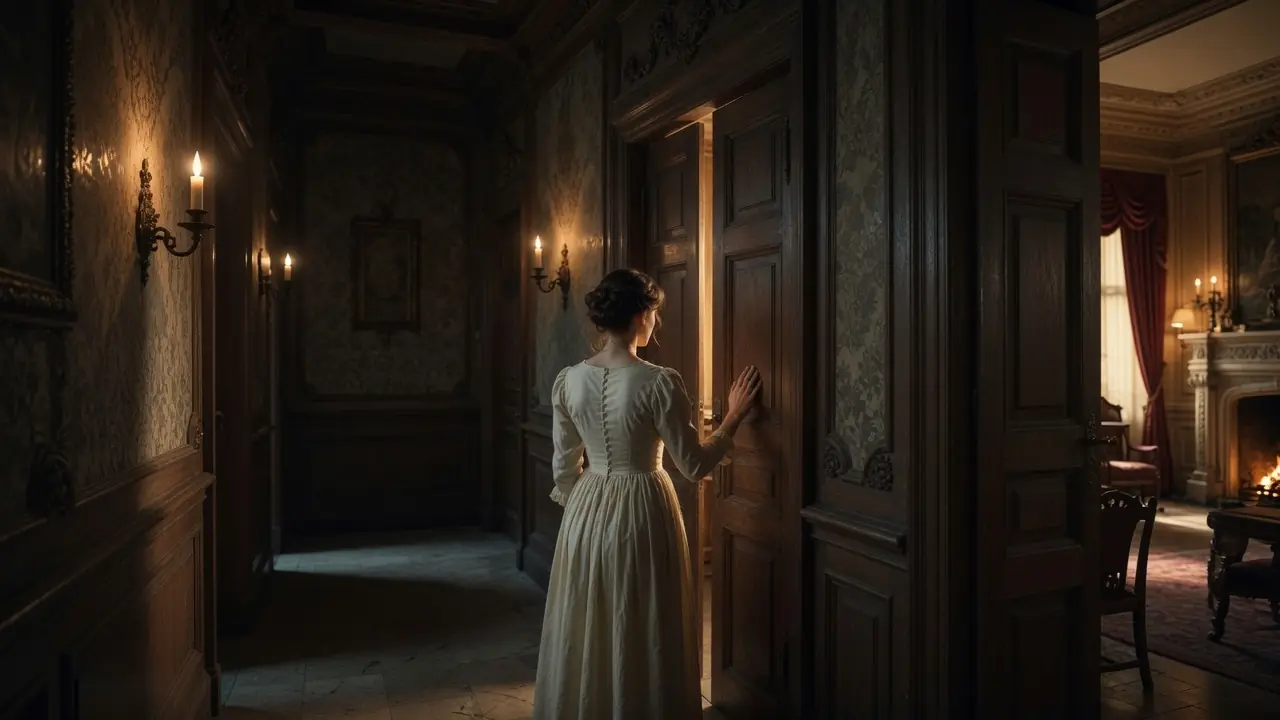
"This is madness," she whispered. But neither of them moved. Downstairs, they celebrated his future. Upstairs, he was about to destroy it. And then, a knock.
The knock was not soft. It had the specific authority of a knock that expects to be answered. Clara moved first. She pressed back against the door, creating the inch of distance that propriety required, and drew one breath, controlled, through her nose. Edmund stepped back.
The ring caught the light again as he lowered his hand. "Your Grace." The voice outside was Thomas, his valet, the only member of the household who knew which stair Edmund had taken, and who had followed him with the patient resignation of a man who has served this family for 20 years and has, in that time, learned to manage the inconvenient reality that the Cavendishes, at intervals, felt things. Edmund looked at Clara. She looked at him with the specific expression she had, the one that was not quite control and not quite devastation, but somewhere in the exact geography between them where most of her important feelings lived. "A moment," Edmund said.
His voice was entirely steady. She had always hated how steady he could make his voice. He stepped further back. He straightened his coat. He looked at her one more time with his full, unguarded attention, the face he showed no one else, the one without the performance, without the careful assembly of a man managing the expectations of an estate and a title and 200 celebrating guests, the face she had been trying not to love for 3 years and had not managed.
"I shouldn't have come," he said. "No," she said. "I couldn't." He stopped. "I know," she said. "I know why you came." "Clara." "Edmund." She said his name the way she had always said it, the name she was not supposed to use, his given name, the one his family used and his fiance used, but that sounded different when she said it, that had always sounded different, and both of them had known this and neither of them had said it directly because saying it directly would have required dealing with what it meant.
"You should go." He looked at her for one more moment. Then he went to the door and opened it. And Thomas was there with his face arranged in the professional neutrality of a man who has seen nothing, and Edmund went with him down the back stair, and Clara listened to the footsteps until they were gone. Then she sat down on the edge of the bed, her bed, in her small room at the top of the east wing, and pressed her hands flat against her thighs and breathed. Tomorrow he was going to marry Lady Constance Vane.
The wedding was at 8:00 in the morning in the cathedral 3 mi from the estate. The guests were staying in the house. The breakfast had been arranged. The flowers were already at the church. Edmund had signed the settlement documents on Thursday.
She had told herself it was because positions of this quality were not easily found, which was true. She had told herself it was because leaving would itself be conspicuous, which was also true. She had not told herself the actual reason because the actual reason did not bear examination. She began, that night, to pack her trunk. The morning of the wedding arrived the way mornings always do, without asking permission, gray and certain in the October light.
Clara did not go to the cathedral. She was not expected to. She was staff, not a guest, and the household staff remaining at Ashbrook Hall had their own morning's work in preparing for the wedding breakfast upon the party's return. She moved through the house with the careful efficiency of someone who has decided that the best way to survive the day is to occupy every moment of it with a task that is not thinking. She cataloged correspondence in the library.
She organized the files that had accumulated over the summer. She did not look out the window toward the cathedral spire, which was visible on a clear day from the east window, and which today, in the October mist, was not visible at all. At half past 10:00, the carriages returned. She heard them on the gravel, the specific sound of a wedding party arriving, the voices, the movement. She kept her eyes on the correspondence in front of her.
She heard the hall fill with sound and then she heard Lady Constance's voice, clear, carrying, entirely composed, saying something to the housekeeper about the arrangement of the dining tables. Clara had not heard Lady Constance's voice very often. Their paths crossed rarely. Lady Constance did not use the library. She did not read for pleasure, which was not a deficiency, simply a preference, in which Clara had thought about more than was useful.
What she heard in Lady Constance's voice was capability, intelligence of a different kind from her own, social, strategic, exquisitely calibrated to the specific demands of the world she moved in. Lady Constance knew how to arrange a room, manage an impression, navigate the invisible political architecture of aristocratic society with the sure-footedness of someone who had been training for it since birth. She would make, Clara understood with a clarity that was almost physically painful, an excellent duchess. The library door opened. Edmund came in.
He was still in his wedding clothes, the dark coat, the white waistcoat, the formal precision of a man who had just stood in a cathedral and said the words that made everything irrevocable. His face was the managed one, the assembled one. He closed the door behind him. "You didn't come," he said. "I wasn't expected to," she said.
"No," he said, "but I looked." She set down the correspondence. She looked at him, really looked at him, without the careful angle she had been using for 3 years, the sideways look that let her see without being fully seen. She looked at him directly. "Edmund," she said, "you should be at your wedding breakfast." "I know," he said. "Then go." He didn't move.
"I need to tell you something," he said, "before before the day continues. I need you to know that what I said last night you didn't say anything last night," she said. "What I almost said," he corrected, "what I came there to say." He paused. The managed expression cracked slightly, not much, just enough to show what was underneath it, which was not what men in his position were trained to show. "I have not stopped.
I want you to know that I have tried to stop and I have not managed it and I am aware that this is not I am aware of what I am and what I owe and what today means. But I could not be in the same house on the same day and not tell you that I" "Don't," she said. "Clara, don't say it," she said. Her voice was very steady. It was costing her considerably.
"Because if you say it I will not be able to hold what I'm holding and I need to hold it. I need to hold it because you are married now, today, this morning, and I have to." She stopped. She looked at the window. "You need to go back to your wife and I need to finish packing my truck." A silence. "Packing," he said.
"I've accepted a position in Edinburgh," she said. "I wrote last month. I received the confirmation on Tuesday." She had not planned to tell him this way. She had planned a note left with the housekeeper, delivered after she was already gone. "I leave on Thursday." Edmund said nothing for a long moment.
"You were going to leave without telling me," he said. "Yes," she said. Another silence. "That was the right decision," he said, very quietly. "I know," she said.
He looked at her with the unguarded face one more time. Then he left. She listened to his footsteps on the stone corridor and the sound of the celebration beginning to fill the house from the dining room and the distant voice of Lady Constance managing the morning with perfect efficiency. And she turned back to the correspondence and picked up her pen and held it over the paper and did not write anything for a long time. The wedding breakfast lasted 4 hours.
Clara remained in the library for all of them. She was interrupted twice by staff with queries, routine, quickly resolved, and once by the estate's land steward who needed a document from the files, and she found it for him, and he thanked her and left, and the library was quiet again. It was Lady Constance who came in the third time. Clara had not expected this. She rose from her chair, the instinct of a woman who understands the social grammar of rooms, and who rises when a person of superior rank enters.
And Lady Constance said, without preamble, "Please sit." Clara sat. Lady Constance was 28 years old. She was tall, with a particular quality of stillness that suggested not passivity, but the specific stillness of someone whose internal life was entirely managed. She was dressed in the wedding white of the morning, which was still immaculate 4 hours later, which told Clara something about how Lady Constance moved through the world. She sat in the chair across the desk with the composed ease of a woman who has sat in thousands of rooms exactly like this one and found all of them satisfactory.
"You are Miss Marsh," she said. "The correspondence secretary." "Yes," Clara said. "I have read some of your work," Lady Constance said. "The estate correspondence. You write with considerable precision." "Thank you," Clara said.
"I will need a correspondence secretary," Lady Constance said. "The position will involve social correspondence primarily, invitations, responses, charitable committee letters. It is different from what you do here, but I believe the skills are transferable. She paused. I am offering you the position.
Clara looked at her. You are offering me a position, she said carefully. A silence. Your grace, Clara said, because Lady Constance was the Duchess now. The title had been conferred that morning in the cathedral, and the title required acknowledgement.
I have already accepted position in Edinburgh. I leave Thursday. Lady Constance looked at her with a specific quality of attention that told Clara this woman was considerably more perceptive than she was presenting herself as being. Edinburgh, she said. That is a long way from Ashbrook Hall, Lady Constance said.
Yes, Clara said. Another silence. Longer. Miss Marsh, Lady Constance said, with the particular precision of a woman who has arrived at the exact sentence she intended to arrive at from the moment she entered the room. I hope Edinburgh suits you very well.
She stood. She looked at Clara one more time. Not hostilely, not warmly, with the specific neutral clarity of a woman who has assessed a situation and arrived at her conclusions and chosen, for reasons of her own, not to act on them in the way she could have. She left. Clara sat very still for a long time.
The ballroom that evening was the excess that celebrations required. The wedding dinner, 100 guests, the house transformed by candlelight into its own best version of itself. Clara was not at the dinner. She ate in the kitchen with the senior staff, which was entirely normal, and she listened to the sounds of the celebration from below, and told herself that by Thursday, she would be on a train, and by Friday, she would be in Edinburgh, and by this time next month, she would be building a life at the correct distance from the life she could not have. She almost made it through the evening without incident.
It was 11:00. The dinner had moved into dancing. Clara was crossing the rear corridor from the kitchen to the east stair, a route that did not pass through any public rooms, the servants' geography of a house that maintained two parallel worlds simultaneously, when Edmund came around the corner from the opposite direction. He had been drinking. Not excessively.
He was Edmund. He did not do things excessively. He was constitutionally incapable of excess. But enough that the managed expression had softened slightly at its edges. They stopped.
Four feet apart. "The service corridor," he said, "very sensible." "I was going upstairs," she said. "Yes," he said. "So was I." "Then I'll take the other stair," she said. She turned.
"Clara." Not a request. Not an order. Just her name. In his voice, at 11:00 in the service corridor with the sound of the violin drifting from the ballroom two rooms away. She stopped walking.
"I'm sorry," he said. "About this morning. I should not have come to the library. I said I would not, and I came anyway, and I made your position I made the day harder. I'm sorry." She didn't turn around.
"You're forgiven." "That was very quick." "I've had a long day," she said. "I've been forgiving you things all day. I've become efficient at it." A silence. Then quietly, "What things?" She turned around. She looked at him.
"Looking for me at the cathedral," she said. "Coming to the library. Saying what you said." She paused. "Standing in this corridor right now." He looked at her with the unguarded face. Three years of conversations that ran long, of evenings in the library, of the slow accumulation of everything between them that had no name it was permitted to use.
All of it visible in his expression, doing nothing to help either of them. "I know what you're going to say," he said. "I know, and you're right. All of it." "Then go back to your wedding dinner," she said. "I will," he said, "in a moment." He looked at her, and she looked at him, and the violin played downstairs, and neither of them moved.
And then, from the ballroom end of the corridor, a door opened, and the sound expanded, and Lady Constance came through it. She saw them. The specific quality of what she saw, two people standing in a service corridor, not touching, not close, entirely proper in every measurable way, was exactly the thing that required no measuring. She was a woman of considerable social intelligence. She did not need touch or proximity.
She needed the expression on her husband's face when he looked at someone else, and she had seen it now, and she had also seen Clara understood in the half second before composure returned to all three of them that she had been right in her assessment that morning. "Edmund," Lady Constance said. Her voice was entirely controlled. "Lord Harrington is asking for you." "Of course," Edmund said. His voice was entirely controlled also.
He looked at Clara once more. Then he walked past Lady Constance into the ballroom, and Lady Constance looked at Clara for a moment with the expression of a woman who has had a hypothesis confirmed and is deciding what to do with the confirmation. And then she followed her husband into the ballroom, and the door closed, and the sound contracted again. Clara went upstairs. She did not sleep.
The next morning, the temperature of the house had changed. It was subtle, the kind of thing you only felt if you were paying attention, and Clara was always paying attention. The particular way the housekeeper did not quite meet her eyes at breakfast. The way two of the parlor maids had a conversation that stopped when she passed. The specific quality of the silence in the room she moved through, which was not the normal silence of a house at morning, but the slightly pressurized silence of a house where something has been said.
Lady Constance had not made a scene. Clara was certain of this. A scene was not in Lady Constance's toolkit. It was too uncontrolled, too useful to gossip. What Lady Constance had done was considerably more precise.
She had said something to someone with the careful economy of a woman who understood how to move information through a household without ever being the person who could be blamed for moving it. What had been said, Clara could not know exactly. What she knew was that the quality of the rooms had changed. At 10:00, Edmund's private secretary came to the library with a message. The Duke wished to speak with her at 2:00 in the estate office regarding the transition of her responsibilities before her departure on Thursday.
The professional framing was careful. She recognized it as Edmund's work. She sent back a confirmation. At noon, she went to the garden, not for pleasure, for air, because the East Wing was beginning to feel small. The garden in October was past its best.
The beds cleared, the roses cut back, the lawn soft and slightly gray under the cloud cover. She walked the path between the yew hedges with her hands folded and her steps deliberate and her mind doing the thing it did when she could not stop it, the accounting. The adding up of the situation's parts and what they produced. She heard footsteps on the gravel behind her. Not Edmund.
She knew his step. These were lighter, more purposeful. Lady Constance fell into step beside her. They walked for a moment in silence. Two yew hedges on either side.
The October garden around them. Two women in a situation that neither of them had designed and both of them were required to navigate. "I owe you an explanation." Lady Constance said. Clara said, "You don't." "Perhaps not." Lady Constance said, "but I am going to offer one anyway, because I think you are a woman who prefers honesty to comfort and because I find the situation warrants it." Clara said nothing. "I was not unaware," Lady Constance said, "of the nature of the thing I was marrying into.
I want to be clear about that. I am not a naive woman. I was aware that Edmund Cavendish had an attachment. I chose not to investigate it in detail because I decided it was not relevant. The attachment was not the basis of the marriage I was making and the marriage I was making was not dependent on it not existing." Clara looked at the garden.
"That is a very measured position." she said. "It is the position of a woman who has been raised to make particular kinds of decisions and who has made them." Lady Constance said. "I do not say it with pride. I say it as a fact. A pause.
What I said this morning to the housekeeper was not intended to damage you. I want you to believe that because it is true. I was managing my own distress in the only way available to me and it was not well done." Clara stopped walking. She turned to face Lady Constance. "What did you say?" she said.
Lady Constance looked at her directly. "I said that the correspondence secretary was leaving at the end of the week and that her replacement should be found promptly. I said it in front of the housekeeper and the parlor maid and I said it with more emphasis than the statement required. A pause. I am telling you this because I believe you know the household well enough to have understood the atmosphere today and because I find it I find I cannot be comfortable with having done it and not acknowledged it.
A silence. "Why?" Clara said. "Why tell me?" Lady Constance was quiet for a moment. "Because," she said, "you are clearly a woman of considerable intelligence and personal integrity and the situation you are in is not of your making any more than it is of mine and because I have had 24 hours to consider what kind of duchess I intend to be and I find that I do not intend to be the kind who uses her position to manage her discomfort through the suffering of people with less protection than she has." Clara looked at her. "That is also a very measured position," she said.
"It is the only kind I know how to hold," Lady Constance said. She turned and walked back toward the house. Clara stood in the October garden and looked at the yew hedges and the gray sky and felt, with the particular clarity of someone who has had every illusion they were still maintaining stripped away in a single morning, the full unadorned reality of where she was. She needed to leave. Not Thursday.
Tomorrow. She went to Edmund's office at 2:00. She had prepared what she was going to say. She was going to say that she intended to leave tomorrow rather than Thursday and that she would ensure all current correspondence was in order before she left and that she was grateful for the position and wished the household well. She had the sentences arranged.
She had the tone calibrated. Edmund was at his desk when she came in. He looked up and immediately put down his pen with the attention of a man who has been waiting for this moment and has also been dreading it. "Sit down," he said. "I would rather stand," she said.
"I won't be long. I wanted to tell you in person that I intend to leave tomorrow rather than Thursday. The correspondence is in order. I can write a summary of the outstanding items this afternoon." Edmund looked at her. "Clara," he said.
"The transition will be straightforward," she said. Holt has a good grasp of the routine correspondence. The Edinburgh position is "Stop," he said. She stopped. "What happened this morning?" he said.
"With Constance has been resolved," Clara said. "Lady Ashbrook spoke to me directly. It is resolved." He looked at her with the expression she had been refusing to look at directly for 2 days. She looked at it now because she was leaving tomorrow and because the particular cruelty of careful averting of eyes had exhausted her. "She spoke to you?" he said.
"Yes." "What did she say?" "She apologized," Clara said. "And she explained herself honestly. She is She is a more admirable woman than I had permitted myself to recognize." A pause. "I think you have married someone exceptional." Edmund said nothing. "I think," Clara continued with the specific, measured steadiness of a woman dismantling herself from the inside and not permitting it to show, "that she will make you a very good duchess and you will make her a very good duke and that Ashbrook Hall will be extremely well managed and that in 10 years the library will probably have a properly organized catalog for the first time since my father attempted it in 1871." And her voice did something.
She stopped. Edmund stood up. "Don't," she said. He sat back down. "I am not going to cry," she said.
Her voice was entirely steady now at the cost of everything she had. I'm going to finish what I came to say. I'm going to go upstairs and finish packing my trunk. And tomorrow morning I'm going to get in the carriage that takes the post to the village station and I am going to leave. And and you are going to let me.
Because it is the right thing. Because it is the only thing that has any integrity left in it. He looked at her. Is that what you want? He said.
It is what I have chosen, she said. That's not what I asked. She looked at him for a long moment. Edmond, she said. Very quietly.
What I want and what is right or not the same thing. I am old enough to understand the difference. I am asking you to help me do the right thing by not making it harder than it already is. He said nothing. She nodded once.
She turned and walked to the door. Clara. She stopped. She did not turn. I have never, he said, in my life been more certain of anything than I am of you.
She stood at the door. She breathed. I know, she said. She went upstairs. She did not hear them arguing.
She heard the aftermath at 7:00 in the evening when the house was settling toward dinner and the guests who had remained for the day were in the drawing room. She heard the specific quality of the silence in the corridor outside Edmond's study that follows a significant conversation. She heard Lady Constance's footsteps on the stone. Precise. Measured.
Not accelerated. Which told her the conversation had not become a scene. And then the drawing room door closing. Then nothing. She was in the library.
She had told herself she was retrieving the notes for the correspondence summary. She was, in truth, sitting in the chair she had occupied for 3 years and allowing herself one last hour of the room that had been, in many ways, the primary location of her adult life. The library door opened. Edmund came in. He looked not disheveled.
He was constitutionally incapable of dishevelment, but stripped of something. The managed expression entirely gone. Both expressions gone, in fact. The managed one and the unguarded one. What she saw was simply a man.
"She knows," he said. "I suspected she knew," Clara said. "Not what she suspected," he said. "What she knows. I told her." Clara looked at him.
"You told her?" "I told her everything," he said. "What I felt. What the last three years had been. I told her that the marriage was, that I had entered it with the intention of honoring it, and that I believed I was capable of honoring it, and that I had been wrong about being capable." He sat down. Not at the desk, in the chair across from her.
The chair a guest would use. As though he was not certain of his right to the room anymore. "She was She was extraordinary. She was so entirely composed and precise. And she asked me one question." "What question?" Clara said.
"She asked me whether I loved her," he said. "Not whether I respected her, or admired her, or intended to be faithful. Whether I loved her." A silence. "What did you say?" Clara said. "I said that I believed I could come to love her," he said.
"That I had not that I had not arrived there yet. That I was sorry." He paused. "She said that she had known the answer before she asked it. That she had known it at the wedding breakfast yesterday morning, and had made a choice to proceed anyway. And that she was reassessing whether that had been the correct choice." Clara sat very still.
"Edmund," she said. "What are you telling me?" "I am telling you," he said, "that I have spent three years being certain of something and doing everything in my power not to act on it. And I have acted on it anyway in every way except the direct one. And the cost of the indirect version to you, to Constance, to the household, to everyone, is higher than the cost of the direct one would have been. He looked at her.
I am telling you that I should have said this three years ago and two years ago and every moment in between. And I didn't because I was I was afraid of what it required. Of losing the estate, of my father's judgment, of the world's opinion. He paused. And I have spent two days watching you pack a trunk and prepare to get into a carriage tomorrow morning and leave.
And I cannot. "Edmond," she said. Her voice was not steady this time. "You are married." "I know," he said. "You were married yesterday morning in a cathedral.
I know. Whatever you feel, whatever we both feel, does not change what." "The settlement has not been registered with the solicitors," he said. She stared at him. "The document signing is a private arrangement. The formal registration is the legal step.
Constance and I married yesterday with the understanding that the solicitors would register the full settlement documents this week." He paused. "Constance said in the conversation she said that she would not object to a dissolution. That she entered the marriage with certain understandings and that those understandings have been revised." He breathed. "She said she had no interest in being the woman who held a man against his will in a marriage that was already structurally a fiction." Clara was very still. "She said that," she said.
"She said a great many things," he said. "She is as you said, she is remarkable. She is going to be absolutely fine. She is going to have the kind of life she is suited to with someone who is capable of being present for her in the way she deserves, and she knows this. And she has She has chosen it with a composure I find." He stopped.
"I will be in her debt for the rest of my life." Clara looked at him. The firelight, the bookshelves, the room where she had grown up and grown into herself and found in the person across the desk the thing she had not known she was looking for. Three years of careful angles and managed distance and the accumulated weight of everything that had been felt and not said. "Edmund," she said, "what are you asking me?" He looked at her. "I am asking you," he said, "not to get on the carriage tomorrow." It was not simple.
She had not let herself believe it would be simple, which was fortunate because the following weeks were the specific, complicated, unglamorous difficulty of two people attempting to do a painful thing honestly in a world that was watching and had opinions. The dissolution was quiet. Lady Constance's family did not make a scene. Lady Constance had apparently spoken to them with the same clear, managed directness she had deployed throughout, and while there was displeasure, there was not war. The social cost was real.
The drawing rooms that cooled, the club memberships that became complicated, the invitations that did not arrive. Edmund received all of this with the specific equanimity of a man who has made a decision he believes in and finds the social cost of it easier to sustain than the alternative. Clara had not stayed at Ashworth Hall during this period. She had not thought it appropriate, and Edmund had agreed. And she had gone to her mother's sister in Bath with the explanation that she was between positions, which was true, and had spent 6 weeks there in the complicated, clarifying quiet of distance.
They wrote letters, long ones, the kind that contain the things that are easier to write than to say. The full accounting of 3 years, the things they had not said, the questions that needed answers before either of them could be certain that what they were building was real rather than the romantic fever of a crisis finally expressed. She wrote him difficult things. About what it had been to watch him arrange his life around a future that excluded her. About the specific daily management of feeling something she could not name aloud.
About what it had cost. He wrote her difficult things. About his father's expectation and how thoroughly it had governed him. About the specific cowardice of choosing comfort over honesty. About the morning of the wedding and the look on her face when he had come to find her in the library and what it had taken to leave and whether he had been right to leave or whether he had simply chosen the familiar path one more time when the unfamiliar one was available.
She wrote back that she thought he had not been right and also that she understood it and also that she was not certain the distinction mattered anymore. He wrote back that it mattered to him. She found that she loved him for that. He came to Bath on a Thursday in November. He came with no announcement.
He wrote only that he was coming on the Thursday if she was willing to see him and she wrote back that she was willing and he arrived on the morning coach with the specific appearance of a man who has been traveling since before dawn and has found this acceptable because the destination warranted it. She met him at the door of her aunt's house. October had become November and the air was colder and the morning was clear and Edmund Cavendish stood on her aunt's front step in his traveling coat with his in his hand and looked at her with the unguarded face she had been cataloging for 3 years and would she understood now be cataloging for the rest of her life. "You wrote." he said "that the distinction might not matter." "I wrote that I was uncertain whether it mattered." she said. "I have been thinking about it for 3 weeks." he said.
"I believe it matters. I believe the difference between choosing the right thing and choosing the convenient thing is the difference between a life that's real and one that isn't. I chose the convenient thing for 3 years. I chose the real thing when it cost me something. And I would like he paused "I would like to continue choosing it in the specific form of asking you properly whether you would be willing to marry me." She looked at him.
"You have recently dissolved a marriage." she said. "You have recently dissolved a marriage." she said. "Yes." he said. "Which is why I'm asking rather than assuming. The world will have opinions." "The world has opinions about everything." he said.
"I have found I am less afraid of them than I was." A pause. "Are you?" She thought about it honestly. "I am somewhat afraid of them." she said. "But I am more afraid of getting on a train to Edinburgh." He looked at her. "Then don't." he said.
She looked at him. 3 years of almost and 6 weeks of letters and a November morning in Bath with the clear autumn light making everything look sharper than it usually did. "All right." she said. "All right, you'll marry me." "All right, I won't get on the train." she said. "The other part requires a conversation." "Then come and have the conversation." he said.
He held out his hand. She took it. Without gloves this time. She was standing in the doorway of her aunt's house in Bath and had not expected to need them. His hand was warm and she felt the warmth of it and she thought, there it is, the real thing.
She went to get her coat. The wedding was in January, not the cathedral, a small church near the estate, the one the household staff attended, the one where her father had been christened, and where she had sat every Sunday for the years of her childhood, a room that knew her, a room that had no echoes of October mornings and abandoned celebrations. 50 people, Edmund's sister, who had been quietly and consistently supportive throughout, Mrs. Holt, the housekeeper, who had arrived in her best dress, and had shaken Clara's hand with the warmth of a woman who had been wanting to do so for 3 years, the estate steward, a scattering of friends and local families who had made their decisions about the situation, and had made the decision to be present. Lady Constance was not there.
She was, by January, in London, which was where she preferred to be, and she had sent a letter, brief, correct, and this was the thing Clara had not expected, genuinely warm. She had written, "I believe you will be very good for him. He is a better man when he is not performing. I hope you will not permit him to perform." Clara had read this four times and decided it was the most gracious thing she had ever received, and intended to live up to it. The morning of the wedding was clear and cold.
Clara stood at the church door in the January light in a dress the color of winter cream, not white, not the elaborate construction of a first formal wedding, but beautiful in the specific way that things are beautiful when they are exactly suited to their person and their moment. Her hair was dressed with small pale flowers that were not in season and had been sourced by Edmund's sister with the cheerful determination of someone who was enjoying all of this enormously. She could hear the organ from inside the church. She could hear Edmund's voice, not the words, just the register of it, talking to someone in the vestibule. She stood in the January morning and breathed.
The fear she had expected to feel was not there. In its place was something she could only describe as the specific, settled certainty of someone who has made a decision that was neither convenient nor safe, and has made it anyway. And has found that making it has produced a steadiness she had not known she was capable of. She was not performing anything. She was simply herself at a church door on a January morning about to marry a man she had loved for 3 years and had been honest with, finally, for 6 weeks, and had found in the honesty was worth every complicated, unglamorous, real thing that had led to this moment.
The organ shifted. She walked in. Edmund turned when she reached the end of the aisle. His face did the thing, the unguarded thing. She She let herself look at it directly, as she had been letting herself look at it for 2 months now, and she found it, as she found it every time, extraordinary.
"Hello," he said, very quietly, just for her. "Hello," she said. The vicar began. Outside, the January morning continued its ordinary rotation. The village, the bare trees, the cold air, the distant sound of the bells marking the hour from the church tower above them.
And inside, two people who had found each other in a library and lost each other and found each other again were making promises with the full, clear, unperformed knowledge of exactly what the promises cost and exactly why the cost was worth it. Afterward, on the church steps in the winter light, with the small gathering around them and Edmund's sister already crying, and and Mrs. Holt managing not to with visible effort, Edmund took her hand. No gloves this time. Neither of them.
Just the warmth of it. Just the real weight of it. And she looked at him, and he looked at her, and the bells continued their ringing. Not the cathedral bells. The small church bells.
The ones that had always been there. The ones that knew her. This time, she was exactly where she was supposed to be.