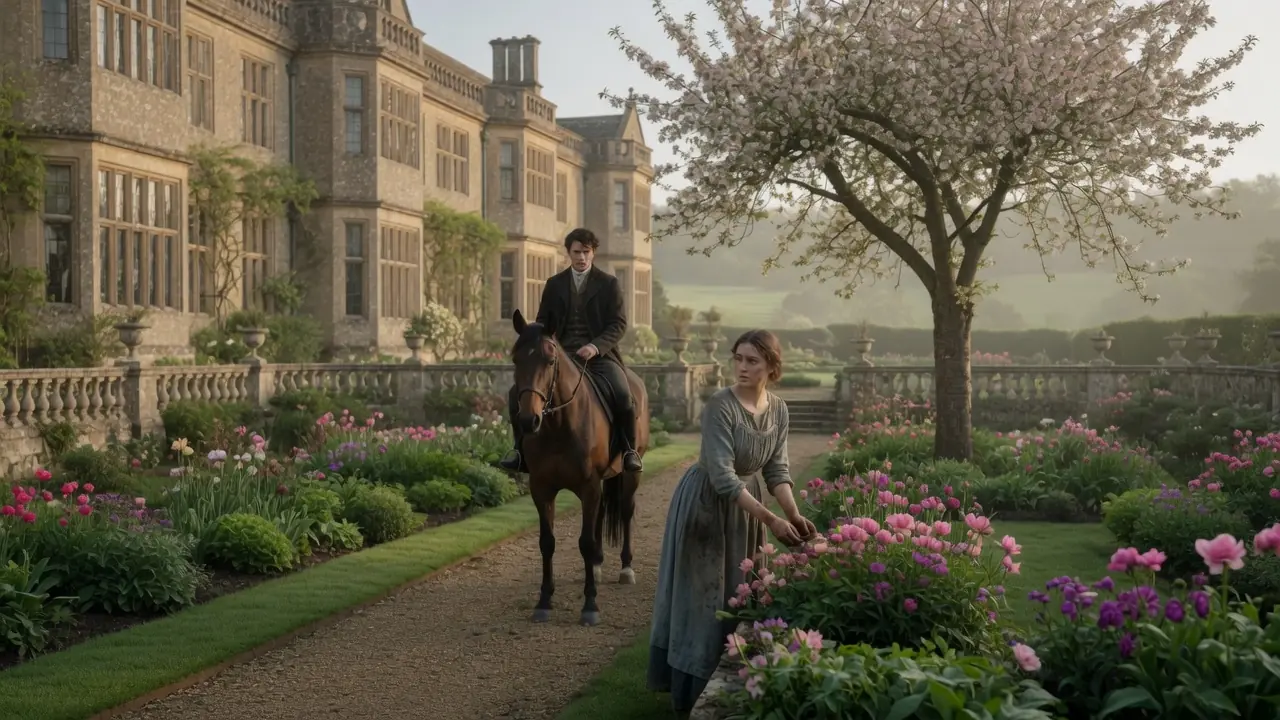
I am going to open this one on a June afternoon in the year 1819 in the gravel sweep before a great honey-colored house in Wiltshire at the precise moment a young man made the most expensive mistake of his life and the loveliest as it turned out though it would be the better part of a month before he understood that and a good deal of squirming in between. His name was Daniel Ash, Viscount Carrick and he had come to Marley Hall to court an heiress. He arrived on horseback a little dusty, a little early and rather more nervous than he would have admitted to a living soul. And he came up the long drive between the lime trees and into the gravel sweep and there kneeling in the border beneath the front windows with her sleeves pushed up and a smear of earth across one cheek and a battered straw hat keeping the sun off was a young woman in a plain brown gown planting out something green from a flat of seedlings at her knee. Now, you and I are going to look at that young woman very carefully in a moment because the whole of this story lives in who she actually was.
But the Viscount of Carrick did not look at her carefully. The Viscount of Carrick gave her exactly the glance a tired anxious gentleman gives to a servant who happens to be in his eye line which is to say almost none at all and he swung down off his horse and he looped the reins over his arm and he walked across the gravel toward her with the easy unthinking authority of a man who has never once in his life had to wonder whether the people around him would do as he said. "You there." He said not unkindly. I want to be fair to him. He was not unkind only thoughtless which in the young and well-born can look very much the same.
Be a good girl and have someone see to my horse would you and run and tell your mistress that Viscount Carrick has arrived. She is expecting me." And the young woman in the brown gown sat back on her heels and looked up at him from under the brim of her battered straw hat and something moved at the corner of her mouth that he was too preoccupied to notice. "Of course, sir." She said. "Good girl. And here, here is the moment.
Here is the thing I have brought you all this way to witness." The Viscount of Carrick reached into his waistcoat pocket and drew out a shilling and pressed it into her earth-stained hand and closed her dirty fingers around it with his own clean ones and said, "For your trouble. See the horse is rubbed down properly. He's come a long way." And he turned and walked toward the great front door of Marley Hall perfectly satisfied that he had handled the small business of his arrival with grace. And I am going to stop us right there. I am going to freeze him just like that.
The Viscount of Carrick 10 steps from the door mightily pleased with himself. A shilling lighter because I cannot bear to let the moment pass without making absolutely certain you have understood it. He has just tipped a shilling to the woman who owns the house. He has just told the heiress of Marley, the mistress of 900 acres, the lady of the great honey-colored house he is about to walk into, the very woman he has traveled three counties to court, to run along and fetch her mistress. He has called her a good girl.
He has pressed a coin into her hand and asked her to see to his horse and she is kneeling in her own flower bed in the dirt with that shilling warm in her fist watching him walk toward her own front door and she is deciding right now in this frozen instant exactly what she is going to do about it. Sit with that. Hold it because I am going to tell you everything that comes of it. But first, you know the arrangement you and I. Before I unfreeze him, find the subscribe button and press it.
It is free, it takes a moment, and it means the next story finds you the very moment I have it ready. And there is always a next, and they are always worth the having. And if you will not subscribe, then you owe me one, and I will tell you frankly that I am very patient about my debts, and I never, ever forget who owes me what, especially not a shilling. Now, come back with me only a little way to who that woman in the brown gown actually was, and why she did not, that June afternoon, simply stand up and tell the Viscount of Carrick exactly whose flower bed he was standing in. Her name was Susanna Marley, and she owned everything the Viscount could see, and a great deal that he could not.
And she had owned it in her own name and her own right since she was three and twenty years old. That last part is unusual enough that I must explain it, because it is the root of the whole tangle. Great estates in those days did not as a rule come to women. They were tied up in entails that sent them marching down the male line to sons, to nephews, to remote and astonished cousins. And a daughter, however beloved, was generally got a dowry and married off, and that was the end of her claim.
And so, at three and twenty, Susanna Marley became one of the very few women in England to hold a great estate entirely in her own hands. And she discovered, very quickly, two things about that condition, and you must understand both of them. The first was that she loved it. She had grown up at her father's elbow, tramping the land, learning the home farm and the tenant farms and the timber and the drainage and the long slow arithmetic of an estate that is run well. And where another heiress might have handed the whole business to a steward and gone up to London to spend the proceeds, Susanna Marley rolled up her sleeves and ran it herself.
She knew every field by name and every tenant by name and every one of their children by name. She kept the books. She walked the boundaries. She planted out her own borders with her own hands because she liked the feel of the earth and saw no reason to deny herself a pleasure merely because it left dirt under her nails. She dressed, most days, for the work and not for show, in plain brown gowns and a battered straw hat because you cannot stake out a new asparagus bed in silk, and Susanna Marley had long ago decided that she would rather do the thing she loved in the wrong clothes than sit idle in the right ones.
So, that is the first thing. She did not look like an heiress because she did not spend her days being one. She spent her days being a farmer who happened to own a great house. And the second thing, the second thing, is the wound at the center of her, and it is why she did not stand up that June afternoon and put the viscount right. The second thing Susanna Marley discovered, on becoming the outright owner of a great fortune, was that she would never again, as long as she lived, be entirely certain that anyone wanted her.
Because they came. Oh, they came. From the moment the will was read, they came. The suitors, the fortune hunters, the younger sons and the impoverished lords, and the smooth charming gentlemen with their debts and their fine manners, all of them suddenly and ardently devoted to Miss Susanna Marley. All of them gazing into her eyes and praising her wit and her grace and her this and her that, and every single one of them, underneath, gazing past her at 900 acres of Wiltshire.
She had learned to see it, the flick of the eye toward the house, the way the compliments arrived a half beat too smooth, the particular warmth that is not warmth at all, but appetite dressed in warmth's clothing. She had endured six years of it. She had been, by the age of nine and twenty, courted by more men than she could number, and wanted, she was quite sure, by not one of them. For what is there to want in a woman once a man has seen the house behind her? The house is so very large, it blots her out entirely.
She had grown tired, not bitter. Susanna was not a bitter woman. She had too much to love for that, too much earth under her nails, and too many tenants' children whose names she knew. But tired and weary and resigned in her quieter moments to the strong likelihood that she would run Marley alone all her life and be buried in the Marley ground at last unmarried and unknown, having been wanted by everyone and loved by no one, which is the particular loneliness that great wealth visits on the people who hold it, and is a colder loneliness than poverty's, because no one will ever believe you have the right to feel it. So, when the letter had come a fortnight before, a perfectly civil letter from a Viscount Carrick conveying his compliments and the hope that he might wait upon Miss Marley, a connection having been suggested by mutual acquaintance, and so forth and so on, all of it perfectly correct and all of it, to Susanna's weary eye, perfectly transparent.
She had felt the old tiredness settle over her like a wet shawl, and she had thought, "Another one, another smooth gentleman come to court the acres." And she had very nearly written back to put him off entirely. But she hadn't, and instead, she had done a thing that she had never done before, a small, wicked, defensive thing born of six years of being hunted, and it is the thing that set this whole story rolling. She had decided that before she submitted to one more performance of devotion, she would, for once, see the man as he truly was, with his guard down, before he ever got the chance to put on his courting face. She had told her household that when the Viscount of Carrick arrived, the mistress would be unfortunately called away on estate business and unable to receive him for some days, and that he was to be made very welcome as a guest in the meantime. And that she, Susanna, in her brown gown and her straw hat, would simply be about the place while he was there, and that not one soul at Marley was to give her away.
The household had loved it. I will not pretend they didn't. The servants of a great house see everything, and they had watched the fortune hunters parade through Marley for six years, and had grown to despise them on their mistress's behalf. And the notion of watching one more smooth gentleman caught in empty drawing room while the real Miss Marley studied him from behind a flower bed, struck them as the finest entertainment to come to Wiltshire in years. They had agreed to a man and a woman, and so when the Viscount of Carrick rode up the drive a little early and a little dusty and found a woman in a brown gown kneeling in the border and took her for a servant and tipped her a shilling and told her to fetch her mistress, Susanna Marley, kneeling in her own flower bed with his coin warm dirty fist, did not stand up and correct him.
She closed her fingers around the shilling, and she smiled to herself under the brim of her hat, and she thought, "Well then, my lord, let us see exactly who you are." She had no idea, none whatsoever, what she was about to find out. And neither, I promise you, did he. Before I let them get on with it, you must know the truth about the Viscount, because it is not at all what Susanna assumed. And the gap between what she assumed and what was true is the whole engine of this story. Daniel Ash, Viscount Carrick, was indeed come to court an heiress for her money.
There is no use pretending otherwise. It was the plain fact, and he knew it, and he hated it more than I can easily tell you. For Daniel had not been raised to be a fortune hunter. He had been raised to be a country gentleman of comfortable means, the only son of a kind and feckless father, with three younger sisters he adored and a mother he loved in a modest pretty estate called Ashford Carrick that had been in his family 400 years. And then his father had died suddenly of an apoplexy at the dinner table, mid-sentence.
And Daniel at six and twenty had inherited the title and the estate. And beneath the estate, like rot beneath a pretty floor, the truth that his kind feckless father had spent 30 years quietly drowning the family in debt. Mortgages on mortgages, loans against the timber, the farms, the very roof. Ashford Carrick was, when Daniel got it, perhaps two bad harvests from the auction block, and with it would go not only 400 years of his family, but the futures of his three sisters, who had no dowries left and no prospects without them, and his mother, who had nowhere on earth to go. Daniel had spent 3 years fighting it.
He had economized until there was nothing left to economize. He had sold what could be sold. He had farmed the home acres himself, like a tenant, to save a steward's wage, and it had not been enough, because you cannot economize your way out of a debt that size. And at last, the family's man of business had sat him down and told him the truth that the eldest sons of failing houses have been told since houses began. "My lord, you must marry money.
There is no other way. Your sisters are depending on it, whether they know it or not." And so Daniel Ash had gone, with self-loathing in his heart, into the marriage market, to sell the one thing he had left to sell, which was an old title and a handsome face and 400 years of name, in exchange for the fortune that would save the people he loved. A connection had been suggested, a Miss Marley of Wiltshire, immensely rich, the outright owner of a great estate, unmarried at nine and twenty, and therefore, the man of business had implied, delicately, perhaps not in a position to be over particular. Daniel had flinched at that, at the cold arithmetic of it, at the implication that a woman of nine and twenty was a kind of bargain. But he had written his civil letter, and he had ridden three counties, and here he was, in the gravel sweep before her great honey-colored house, about to do the most dishonorable thing he had ever done in his life, which was to make a woman believe he loved her in order to get his hands on her money.
He hated it. Every mile of the road he had hated it. And the thing he hated most, the thing that sat in his chest like a swallowed stone, was the dishonesty of it. For Daniel Ash was, at bottom, an honest man. It was nearly the only thing his ruinous father had managed to leave him intact, and the prospect of spending the rest of his life performing a love he did not feel to a woman he did not know, who would never know she had been deceived, struck him as a kind of slow poison he was about to drink for his sister's sake and go on drinking until he died.
That is the man who tipped Susanna Marley a shilling. Not a villain, not a cad, a decent man at the worst crossroads of his life, so sick at heart over the dishonest thing he had come to do that he could barely look the great house in the eye, which is, as it happens, precisely why he had not looked carefully at the woman in the brown gown. He had not been able to look at much of anything. He had been staring down the barrel of his own dishonor. And now you understand the trap that is about to spring and the beauty of it and why it was the loveliest mistake of his life.
For Daniel Ash believed he had to lie to Miss Marley, the heiress, and he believed there was no one at Marley he had to lie to at all, no one who mattered, no one who could see him, no one in the world it could cost him anything to be honest with, except a servant, a good girl in a brown gown kneeling in the dirt, of no consequence whatsoever, to whom a tired and heartsick gentleman might say absolutely anything, because what could it matter what he said to the help? He came upon her again the next morning in the walled kitchen garden. He had spent a wretched night. He had been received at Marley with every courtesy, shown to a fine room, fed an excellent dinner, attended by a grave and faintly amused butler, and informed, with many apologies, that Miss Marley had been most unfortunately called away to a matter of business at her far farms, and would not be able to receive him for some days. But that he must treat Marley as his own and want for nothing in the meantime.
And Daniel, who had braced himself to begin the hateful performance at once, had found himself instead with a reprieve, alone in a beautiful house with several days in which to do nothing but dread. So, he had risen early and gone walking, the way troubled men do, to outpace the stone in his chest, out across the dewy park and through a gate in an old brick wall, into a kitchen garden the size of a small field, all espaliered fruit and ordered beds and the green smell of growing things. And there, again, was the woman in the brown gown, up to her wrists in the soil, thinning a long row of carrots. She looked up. "Good morning, sir.
You're abroad early." And Daniel Ash, who had no one in the world to talk to and a stone in his chest the size of a fist, did the thing that changed everything. He talked to her. He did not mean to. He meant to nod and walk on, as a gentleman does past a servant, but she had a frank, easy, unbothered way about her. She did not simper or bob or flutter the way servants did at the gentry.
She spoke to him as one person speaks to another with a directness he had not met in years, and the morning was soft and the garden was kind, and the stone in his chest was so very heavy, and she was, after all, no one. Safe, of no consequence, a good girl thinning carrots, who would forget him the moment he was gone. "I'm a poor guest, I'm afraid," he heard himself say. "I keep early hours because I sleep badly." "Bad conscience or bad bed?" she asked, not looking up from her carrots. It startled a laugh out of him, the first in weeks.
"Conscience, since you ask." "Ah." She thinned another seedling. "Those are worse. A bad bed you can stuff with fresh straw." And Daniel, leaning on the warm brick wall in the early sun, watching this odd, frank woman work, found the stone in his chest shift a little, and found that he wanted, more than he had wanted anything in months, to set it down. And here, at last, was someone it could cost him nothing to set it down in front of. So he did.
Not all at once, but over that morning, and the next, and the one after. For he found himself returning to the kitchen garden each morning, as though it were the only honest place at Marley, which, though he did not know it, was very nearly the truth. Daniel Ash told the woman in the brown gown the whole of it. He told her about his father and the debts and the rot beneath the pretty floor. He told her about his sisters, Kitty and Anne and little Grace, and how their futures hung on him like millstones he could not set down.
He told her about Ashford Carrick and its 400 years and how he could not be the one to lose it. And then, on the third morning, leaning on the wall with his head down, he told her the worst of it, the thing he had told no one. "I have come here to court your mistress," he said, "for her money. That is the whole truth of it, and I am ashamed to say it aloud, but it is easier said to you than thought alone. He turned the words over like stones.
I have never met her. I am told she is rich and unmarried and nine and twenty, and the implication was that she might therefore be grateful for an offer, and I am to ride down here and gaze into her eyes and make her believe I have lost my heart to her, when in truth I have lost nothing to her but myself respect. And I am to do it because if I do not, my sisters have no future and my mother has no home. He shut his eyes. Do you know what the worst of it is?
Not that I must marry for money. Men have done worse for less. The worst of it is the lie. That some poor woman will spend her whole life believing herself loved by a man who married her bank. That I shall have to perform a feeling I do not have every day until one of us dies and she will never know.
I cannot His voice caught. I have always thought myself an honest man. It is nearly the only thing I had left to think well of, and I have come here to spend it on a lie. The garden was very quiet. A blackbird sang somewhere along the wall.
And the woman in the brown gown had gone quite still over her row of carrots with her face turned away because Susanna Marley, who had endured six years of smooth gentleman performing devotion to her acres, and had braced herself to endure one more, had just heard a man she believed to be a fortune hunter confess to a servant he thought was no one that the thing he could not bear was the lie. That the woman he was sent to deceive would never know she was unloved, and that this, her unknowing, her undefended trust, was the part he could not stomach. In six years, not one of them had ever once thought of her as a person who might be deceived. They had thought of her only as a fortune to be won, and here was a man who did not know she could hear him breaking his heart over the wrong of deceiving her. Susanna Marley knelt in her own kitchen garden with a shilling still sitting on her dressing table upstairs and felt the wet shawl of her old tiredness slide, for the first time in six years, clean off her shoulders.
And felt, in its place, something she had given up on so completely that she scarcely recognized it. Hope, the dangerous thing, the luxury she had told herself she could not afford. "Perhaps," she said carefully to her carrots, "you should tell her the truth." He laughed, low and bitter, "and lose her, and the money, and my sister's future in a single honest sentence? There is no room in my life for that particular luxury. I cannot afford to be honest.
That is what it is to be poor, you know, in my sort of way, not the want of bread, but the want of the right to tell the truth." "And if she would rather have your honesty than your performance, then she would be a woman in a thousand," said Daniel Ash. "And I should not deserve her, and it does not signify, because no such woman exists, and certainly no such heiress." He pushed off the wall. "Forgive me. I have unburdened myself shamefully on a stranger who only came out to thin her carrots. You are a good listener, better than the parson, and you don't make me pay for it in sermons." "I charge a shilling," said Susanna.
He stopped, and then he laughed again, properly this time, the bitterness gone out of it, and he said, "I begin to think that was the best shilling I ever spent." And he walked back toward the house, lighter than he had come, and never once suspected that he had just told the heiress of Marley that he could not bear to lie to her. And behind him, in the green and ordered garden, Susanna Marley sat back on her heels and put her dirty hands over her face and discovered that she had a very great problem indeed. Because the man she had set out to study with a cold and weary eye had turned out to be the first honest one in six years, and she was, against every defense she had ever built, beginning to fall in love with him. And he thought she was the gardener. Now it became a tangle, and I will not pretend otherwise, and Susanna's conscience knew it was a tangle even as she went on tangling.
For the days went by, and Miss Marley remained conveniently absent at her far farms, and Susan remained delightfully present about the grounds, and the Viscount of Carrick, with nothing to do but wait and dread, spent more and more of his time in the company of the frank brown-gowned woman who had become, somehow, the only person at Marley he wished to see. They walked the boundaries together. She knew the land astonishingly well for a gardener's girl, he thought, and could name every field and every tenant. And he put it down to a clever servant's pride in a place she loved, never dreaming it was the pride of ownership. They argued about drainage and timber and the right way to manage a hop field.
She beat him at chess in the long evenings, for the household had taken to including odd capable Susan in the drawing room of an evening, which Daniel found charmingly informal and never questioned. She made him laugh. She made him think. She made the stone in his chest, day by day, grow lighter until some mornings he forgot it was there at all. And Daniel Ash, Viscount Carrick, who had come to Marley to court a rich heiress he had never met, fell slowly, helplessly, and with mounting horror, in love with a penniless servant in a brown gown.
I call it horror, and I mean it, because for Daniel, it truly was a horror. And you must feel the full weight of his trap to understand the choice that is coming. Here was a man whose entire family, three doweless sisters, a homeless mother, 400 years of name, depended absolutely upon his marrying money. And he had ridden three counties to do exactly that, and the money was right here, the great house and all its acres, his for the courting. And instead of courting it, he had gone and lost his heart to the one woman at Marley who had not a penny to her name, a gardener, a nobody, a good girl with earth under her nails.
And every hour he spent with her made the hateful necessary task he had come for more impossible, and his honest heart more divided until he could hardly look at the great house without flinching, because the great house was his duty and his salvation and his sisters' only hope, and the woman in the garden was the thing he actually wanted, and a man cannot serve both. It came to its head one warm evening at the end of his second week in the rose arbor at the bottom of the garden in the long gold light. They had walked there after dinner, the two of them, as they had fallen into the habit of doing, and they had been quiet a while among the roses. And then Daniel, who had been wretched all day, who had received that morning a letter from his sisters full of innocent hope that their brother's important visit would set everything to rights, Daniel turned to her in the gold light and said, with the recklessness of a man at the end of his rope, "I have to tell you something, and it is madness, and I am going to tell you anyway, because I have not been able to tell the truth in 3 years, and I find I cannot stop once I have started with you. He took a breath.
Susan, I came here to marry your mistress's fortune. You know it. I told you so myself. And I cannot do it. Not because I am too good.
God knows I am not. But because in 2 weeks of thinning your carrots and losing at your chess and walking your boundaries, I have done the one thing I had absolutely no right to do, which is to fall in love with you. A servant. A woman with nothing. The single most ruinous choice a man in my position could possibly make.
Susanna's heart had stopped entirely. I have lain awake every night this week, he went on, low and fast, trying to find a way out of it. And there is none. And I have stopped looking for one because I would rather have no way out than a way that costs me you. So, I am going to do the maddest thing a poor man ever did.
I am going to go to your mistress when she returns and I am going to tell her, honestly, that I cannot court her because my heart is given elsewhere and I will not add her to the list of people I have lied to. And then, I am going to come back to this garden and I am going to ask you, penniless, both of us, with my family ruined and my sister's futures on my conscience till I die, I am going to ask you to be my wife. And we shall be poor together. And it will be a disaster. And I do not care.
I would rather be ruined honestly with you than saved by a lie with anyone else. He stopped, out of breath, terrified, and stood there in the gold light among the roses, having just thrown away, knowingly, deliberately, with his eyes wide open, his family's salvation, his sister's dowries, 400 years of his name, for a gardener's girl with dirt under her nails and not a shilling to her own. And Susanna Marley stood before him with her hand pressed to her mouth, and tears standing in her eyes, because she was the woman in a thousand he had sworn did not exist. And she was the heiress whose fortune he had just renounced for love of her. And she was both at once.
And he did not know. And she had to tell him now, this instant, before he sacrificed one thing more for a poverty that did not exist. And the worst of it, the thing that broke her heart even as it mended it, was that he had passed. He had passed the test she had never quite admitted she was setting. He had been offered a fortune, and had turned from it toward a penniless woman, freely, with everything to lose, certain he was choosing ruin.
No fortune hunter whoever lived would have done it. She was, for the first time in her life, certain, beyond any possible doubt, certain to the bottom of her soul, that she was loved for herself, because the man before her had chosen her believing she was nothing, and had counted the cost, and had chosen her anyway. She had spent six years sure she could never know such a thing. And here it was. And she had got it by a lie.
And now she had to undo the lie. And she was so afraid of what it would do to him that she could hardly speak. "Daniel," she said, "don't ask me yet. There is something I have to tell you, and you are going to hate me for it. And I am going to tell you anyway, because you have just taught me that the truth is worth any cost." She drew a breath that shook.
"I am not the gardener." He did not understand at first. Of course he didn't. It is not the sort of thing a mind reaches for. "I don't. What do you mean you're not the gardener?" "I mean," said Susanna Marley, and made herself look him full in the face for it, because he deserved to have it straight that there is no Susan the gardener.
There never was. I am Susanna Marley. This is my house. Those are my acres. I am the heiress you were sent to court and I have known it every moment from the shilling onward and I let you believe I was a servant and I have stood in my own garden for 2 weeks and let you pour out your heart to me thinking I was no one and it was the cruelest most dishonest thing I have ever done in my life.
And I have hated myself for it more with every day and I would undo it if I could and I cannot and you have every right in the world never to forgive me. The gold light lay over the roses. Somewhere the blackbird sang. And I will tell you the look that went across Daniel Asher's face in that moment was a terrible thing to watch because it was so many things at once. There was the shock plain and reeling.
There was the swift backward rush as he replayed every word he had said to her, every confession, every unguarded shameful honest thing he had poured into the ear of a woman he thought was nobody. All of it spoken in fact to the very heiress he had been so desperate not to deceive. And there was rising up under the shock the beginning of a hurt so deep that Susanna felt it like a blow. The hurt of a proud honest man who has just discovered that the one place he believed he had been truly safe, truly unwatched, truly free to be himself had been a stage all along and his most private heart an entertainment. "Two weeks," he said very quietly, "you let me.
Every morning in the garden you knew. You knew who I was. You let me tell you I'd come to deceive you and you let me." His voice cracked. "I told you things I have told no living soul. I made a fool of myself at your feet for a fortnight, and you knew, and you said nothing, and you let me walk into this arbor just now and throw away my family's future for love of a woman who does not exist.
While you what? Watched? Was it amusing, Miss Marley? Did your household enjoy it? The fortune hunter who fell for the maid?
Daniel, was any of it real? And there it was, the heart of his hurt. The thing that mattered more to him than the fortune or the foolishness. Or was I being studied, tested? Was the whole of it a performance you arranged to see what the desperate lord would do?
And Susanna Marley, who had every reason to flinch from that and no defense against it, because it was, at the start, exactly true, did not flinch. "Yes," she said. "At the start, that is exactly what it was, and I will not lie to you about it. Not now, not ever again. I have been hunted for my money for six years, Daniel.
Six years of smooth gentlemen gazing into my eyes and past my shoulder at my house. I had stopped believing any man alive could want me, me, the woman, not the acres. And when your letter came, I was so tired, so sick of being a fortune with a face attached, that I did a wicked, defensive, cowardly thing. I decided to watch you with your guard down before you could put on your courting face. So, I let you take me for a servant.
That part is true, and it is shameful, and I own it." She stepped toward him, tears running freely now. But then I heard you, Daniel, in the garden. I heard a man who'd come to court a fortune break his heart over the wrong of deceiving the woman attached to it. Over my unknowing, my undefended trust, the very thing every other man saw only as the easy mark. In six years, not one of them ever once thought of me as a person who could be wronged, and you couldn't think of me as anything else.
And somewhere between the carrots and the chess and the boundaries, the study turned real, and I stopped watching you and started started loving you. And I knew I had to confess, and I was so afraid of losing the first honest thing that had ever come to me that I put it off and put it off one more cowardly day and one more until you walked into this arbor and offered to ruin yourself for a gardener. And then I could not let you sacrifice one thing more for a poverty that doesn't exist, not for one more second. And so I am telling you now the whole ugly truth, and you may do with it whatever you like. She stood before him, the heiress in her brown gown, stripped of every defense.
"You wanted to know if any of it was real," she said. "Here is your answer, and it is the only thing I am sure of in the whole sorry tangle. You were real. Every word you said to me in that garden was real, and I knew it was real because you said it believing it could never profit you to a woman you thought was no one. And just now, in this arbor, you turned your back on my entire fortune for love of a penniless girl freely, counting the cost, choosing ruin with your eyes open.
Do you understand what you have given me, Daniel? You are the only man in six years, the only man in my whole life, who ever chose me believing I had nothing. You have made me certain of the one thing I thought I could never know. I deceived you abominably, and I am more sorry than I can say. And in deceiving you, I learned that you are the one honest man who ever wanted me for myself.
Both of those things are true. I will spend my life atoning for the first if you will let me, but I could not let you go on thinking your love was real and your loss was certain when only one of those was true. For the love is real, Daniel, on both sides, and the loss is not real at all. The choice he made next is the measure of the man, and it is why this is a love story and not a tragedy. So, let me tell it to you carefully.
He stood a long moment in the gold light with the whole astonishing wreck of it settling around him, the deception and the relief and the hurt and the joy, all warring at once across his honest face. And I will not pretend the hurt vanished in an instant because it did not. He was a proud man, and he had been made to feel a fool in the one place he'd thought himself safe, and that does not heal in a heartbeat. And Susanna knew it and bore it and did not look away. But, Daniel Ash was, above all things, an honest man, and an honest man, faced with a hard truth, does the honest sum.
And the honest sum was this, that a woman, weary past bearing of being wanted for her money, had done a cowardly thing to protect a heart that had been hunted for 6 years. And that in the doing of it, she had given him, by accident, the rarest gift one person can give another, which is the certainty of being truly seen. And that he had, not an hour past, been willing to throw away everything he had for love of her when he believed her penniless, which meant his own heart was not in question and never would be by either of them ever again. "Let me be sure I have it," he said at last, and his voice was unsteady, but it was not cold. "An hour ago, I was a ruined man in love with a penniless gardener, prepared to disgrace my family for her.
And now, I am a man in love with that same woman, the very same. Not one thing about her changed but the dress and the deed to the land, who happens, it turns out, to be the answer to every trouble I have. Is that the shape of it? That is the shape of it, Susanna whispered. And you may hate me for the road we took to get here, and I will not blame you.
Hate you? He let out a breath that was half a laugh and half something nearer to weeping. Susanna, you have just told me that I cannot possibly be a fortune hunter because I chose you when I believed you had nothing, and you watched me do it. Do you understand what you have given me? I came here to spend my honesty on a lie and to loathe myself for the rest of my life as a man who married a bank.
And you have made it impossible. You have arranged it wickedly, unforgivably, gloriously, so that the one woman in England with a fortune is also the one woman in England who knows, beyond any doubt either of us could ever raise, that I did not come for it. You have not robbed me of my honesty. You have handed it back to me whole. He shook his head, the wonder breaking over him.
We are the only courting couple in the history of England who can be entirely certain, both of us, that we are loved for ourselves and nothing else. You, because I chose you with nothing. Me, because you watched me do it. There is not another pair in the kingdom who can say as much. And he crossed the last of the gold distance between them, this honest ruined man who was not ruined after all, and he took her earth-stained hands in his, the hands he'd first seen kneeling in the dirt, the hands he'd pressed a shilling into a fortnight before, and he said, "I came to this house meaning to ask the heiress of Marley to marry me for her money and to despise myself forever.
Instead, I am going to ask the gardener of Marley to marry me for herself and mean every word. And they are the same woman, and I have never in my life been so glad of anything. Marry me, Susanna, not the fortune. I'd take you without a penny, and we both know it now, which is the whole joy of it. Just you, the frank, impossible woman who beat me at chess and let me make a fool of myself among her carrots and gave me back my honor by stealing it first.
Marry me. And Susanna Marley, heiress, Gardener, the most hunted and the least known woman in three counties, who had given up on being loved for herself and had got it at last by the most roundabout and least deserving road imaginable, laughed through her tears and lifted those earth-stained hands to his face and said, "Yes." "On one condition." "Anything." "You owe me a shilling," said Susanna Marley, "for the conversations. I charge a shilling, you'll remember. You've had a fortnight's worth, and you've only paid for the one." And Daniel Ash put back his head and laughed, the stone gone from his chest forever, and kissed her among the roses in the gold light. And it was, by every account of those who later heard the tale, the best shillings' worth either of them ever had.
And that, my dear listeners, is where I leave them, in a rose arbor at the bottom of a Wiltshire garden, a ruined lord who was not ruined and a hunted heiress who was, for the first time in her life, simply and entirely seen. The two of them having arrived at the one certainty that money makes nearly impossible, that each was wanted wholly for themselves. They were married before the autumn, and it astonished the county, which had long since written Miss Marley off as a confirmed spinster, too sharp and too odd ever to wed, and which never did learn the whole truth of how it came about, for the household of Marley kept its mistress's secrets to the grave, and only smiled when asked. Daniel's sisters got their dowries and made good matches, and adored their sharp, brown-gowned sister-in-law, who taught the youngest of them, little Grace, to thin carrots and read a turning field. Ashford Carrick was saved, its 400 years secured, though Daniel always said and meant it, that he would have let it go to the auctioneers without a backward glance for the woman in the garden.
And Susanna always said she knew it, which was exactly why she'd never had to. They ran Marley together, side by side, for the rest of their long lives, and the Viscountess of Carrick never did give up her brown gowns, or her battered straw hat, or the dirt under her nails. And the new fortune hunters who came sniffing after the great Marley estate in the years that followed were forever mistaking her for the gardener, and being tipped a shilling for their trouble by the lady of the house, who found it funnier every single time. And it is said that the very first shilling, the one Daniel pressed into her dirty hand on a June afternoon before he knew her, was kept always on the mantelpiece at Marley in a little glass case, the most treasured coin in a house full of gold, for it was the price of the conversation that saved them both, and it bought, as Susanna liked to say, the only honest courtship in the whole of England.