The cottonwood leaves barely moved, but the whole yard felt like it was holding its breath.
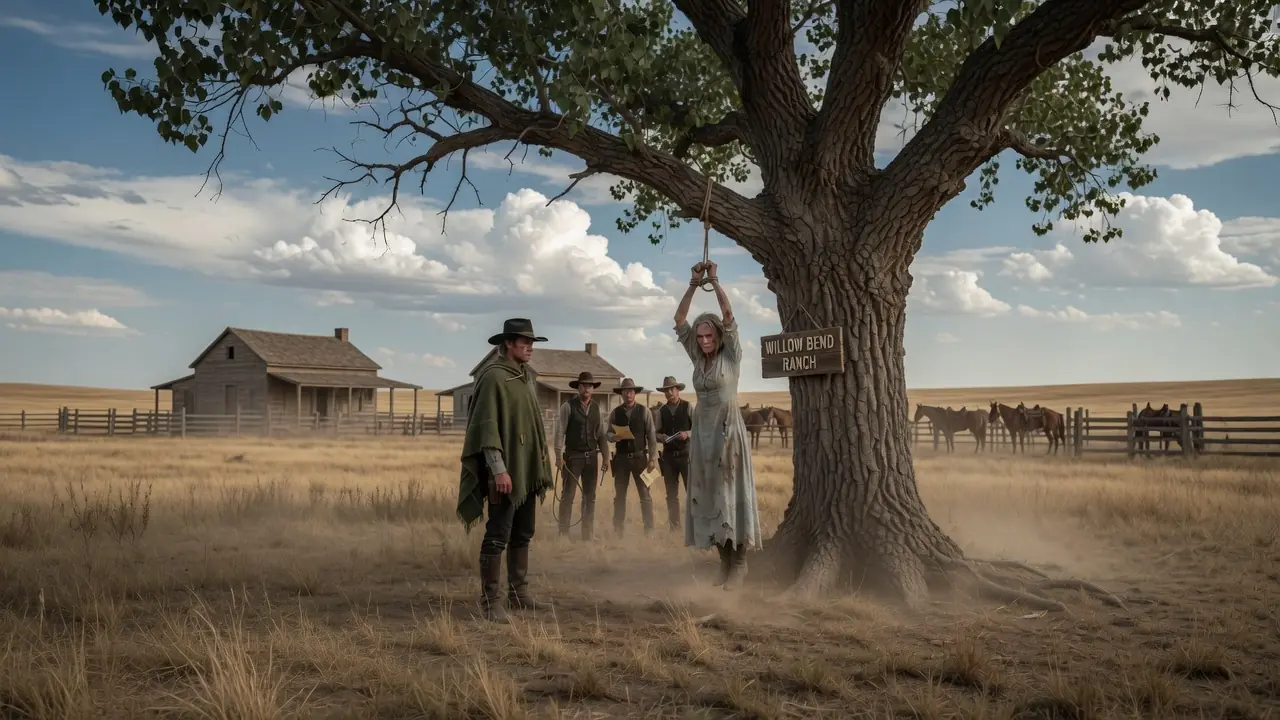
Ellen Vard stood beneath that tree, wrists bound tight, surrounded by men who smiled like they had already won.
Kansas heat hung in the air thick as lamp smoke, and the dust tasted bitter on the tongue.
Four hands wanted her signature.
Four more wanted her silence.
A whip cracked, and the sound carried clear across Willow Bend Ranch.
Then a gunshot answered it.
Sharp.
Clean.
Final.
No one cheered.
That is how fear works.
And the rider on the ridge, the one those men did not recognize, was the last person they expected to see again.
It was the summer of 1883, on a patch of Kansas prairie most maps did not bother naming. Folks there had learned to keep their eyes down and their mouths shut because the wrong word could cost a man his job, his horse, or his grave.
Willow Bend Ranch sat a few miles off the freight road, where the grass went pale and the wind never quite stopped scraping against the fence rails.
Ellen Vard was a widow.
Not the kind of widow from a poem.
The kind from a hard winter and a harder spring.
Her husband was buried on that land, and she had kept the place alive with two hands and the kind of stubbornness the West carved into a person when mercy ran out.
That stubbornness was exactly why those men had come.
They arrived with papers and a local deputy who would not meet her eyes. They came with smiles and a deal that was not a deal at all.
“Sign the deed, Ellen,” they said, “and you will still sleep in your own bed tonight.”
Ellen did not ask for mercy.
She had learned mercy was a coin that rarely spent.
She only said one thing, quiet as a match struck in wind.
“No.”
That word made them angry because men like that did not fear guns first.
They feared being told no by someone they had already decided was smaller than them.
They tightened the ropes.
They shoved her.
They dragged her into the yard beneath the old cottonwood. They meant to make an example. They meant to do it where neighbors could see.
Across the fence line, a few townsfolk lingered like a bad conscience, pretending they were only passing by.
Nobody moved.
Nobody spoke.
Ellen’s face was bruised. Her gray hair had half slipped from its pins. But her eyes still had that rancher look, the one that said, You can knock me down, but you cannot own me.
The leader, a broad man named Cyrus Holt, tipped his hat like he was being polite.
“Your husband is in the ground,” he said. “If you do not sign, you will be joining him.”
Ellen lifted her chin.
Her voice did not rise.
But it did not break either.
“My husband is buried here,” she said. “And so is my word.”
The West was not always lawless.
Sometimes it was worse.
Sometimes it was lawful and crooked at the same time.
Then the ridge spoke.
Not with a sermon.
Not with a shout.
With one gunshot that snapped the moment in half.
The whip split in Cyrus Holt’s hand, leather dropping uselessly into the dust.
Every head turned.
A rider sat on the ridgeline, cut dark against the sun. Horse still. Hat low. Face hidden, like the day itself did not have permission to see him clearly.
He did not rush.
He did not grandstand.
He started riding down slow and deliberate, like a man who had already decided how this would end.
His voice carried flat as prairie stone.
“That hand touches her again, and you will lose it.”
The four men stared up at him.
They were not scared of the law.
They were scared of recognition.
Because the rider coming down that ridge did not wear a badge, but he carried himself like a man who had once had one and thrown it away for a reason.
One of Holt’s men tried to play brave and reached for his revolver.
A shot rang out, and his gun jumped from his hand into the dust like it had decided it wanted no part of what was coming.
The crowd scattered fast and quiet, the way people do when they know the next minute might stain them forever.
Ellen stared at the rider as he came through the gate. Her hands were tied, but she managed to press one wrist against her dress, protecting something hidden there like a mother protecting the last match in rain.
Fifteen years.
Fifteen long years.
Before she could see his eyes, before she could hear his full voice, she already knew.
Her son had come home.
Two of the men rode away hurt and shaking, the kind of hurt that changes a man’s habits if he has any sense.
The other two left their guns behind.
That told the whole story.
A man does not abandon his gun unless he has met something that scares him more than death.
By sundown, Willow Bend Ranch was quiet again.
Inside the house, lantern light flickered over rough wood walls and a kitchen table scarred by years of meals, arguments, and empty places.
Ellen sat with a wet cloth pressed to her cheek because pride did not stop bruises from swelling.
Across from her sat a man who looked carved out of long roads and bad nights.
He was her son, Gideon Vard, and he had not been home in fifteen years.
He had not changed the way most men changed. His face carried more scars now, and his eyes carried more distance, but the silence was the same, the kind that settled around a person like a second coat.
Ellen poured coffee into a tin cup and slid it across the table.
“You still drink it black?”
It was not really a question.
Gideon nodded once.
Ellen’s mouth almost smiled.
“You always did.”
Then she stared at the cup like it might confess something if she waited long enough.
Outside, wind rattled the porch boards, and a loose shutter clicked soft and steady like a metronome for grief.
Some families do not talk about pain because they are tough.
Others do not talk because the words would open a door they do not trust themselves to close.
Fifteen years earlier, another chair had sat at that same table.
A girl had laughed in it, bright-eyed, stubborn, quick with her hands.
Gideon’s little sister, Elsie, used to steal the last piece of cornbread and run for the door while their mother pretended to be angry and their father tried not to smile.
Funny thing about grief.
Years pass.
Faces fade.
But small moments stay like footprints in wet earth that never quite dry.
Then one day, Elsie vanished along Mercy Road, the stretch that ran past the livery stable, the freight spur, and a little dip where cottonwoods grew.
No warning.
No answers.
Gideon spent half his life chasing those answers through mining camps, rail depots, and frontier towns where nobody remembered names, only rumors.
Every trail ended the same way.
Dust.
Silence.
Nothing.
Ellen reached under the table and pulled out a small wooden box.
It was not fancy.
It was not polished.
It was the kind of box a ranchwoman keeps because it holds the last pieces of a life she refuses to lose.
She set it between them carefully.
“I suppose it is time,” she said.
Gideon stared at it, jaw tight, like he was bracing for a punch he had been dodging for years.
Ellen opened the lid.
Inside were three things.
A faded photograph.
An unopened letter.
And a yellowed transportation receipt creased with age.
Gideon picked up the receipt first because men who have been hurt learn to touch paper before they touch memory.
His eyes stopped on a stamped name near the bottom.
The Golden Lily.
He had never heard it before, but something about it felt wrong. Very wrong. Like a snake you do not see until you have already stepped near it.
Ellen’s fingers trembled as she reached for the letter.
“A young woman brought these here six days ago,” she said.
Gideon’s head lifted, sharp as a hawk hearing a rabbit in grass.
“What young woman?”
Ellen swallowed.
“A girl named Ruth Hale.”
The room fell quiet, the kind of quiet that lets you hear the lantern hiss.
Gideon’s expression darkened.
“And where is she now?”
Ellen stared into the flame.
Then she shook her head slowly.
“I do not know. She said men were following her, and she left before dawn.”
Then Ellen said the thing she had not told anyone.
Not the neighbors.
Not the preacher.
Not the deputy who pretended he was helping.
“Before Ruth left,” Ellen whispered, “she claimed she had seen Elsie’s name in a ledger.”
Gideon froze.
For fifteen years, every rumor had led nowhere. Every clue had died. Every witness had vanished.
But this felt different.
Because for the first time in a very long time, hope had walked through his front door.
And now it was missing too.
Somewhere beyond the darkness of the prairie, Ruth Hale had disappeared.
And she might be carrying the only trail that still mattered.
The trail began at sunrise.
Gideon left Willow Bend Ranch before the morning heat settled over the grass. Ellen stood on the porch and watched him ride away, and neither of them said goodbye.
People who spend years losing things learn not to trust goodbyes.
The only clue Ruth left was a stable receipt from a freight depot nearly twenty miles east, with a wax seal pressed too hard, like the hand that stamped it had been shaking.
The road wound through tall grass and abandoned homesteads where chimneys stood alone like grave markers.
Dust followed Gideon’s horse like a shadow.
Near noon, he found fresh wagon tracks.
Three horses.
Heavy load.
Moving east in a hurry.
Not ranchers.
Not merchants.
Men who did not want to be remembered.
He dismounted near a dry creek bed and searched the brush the way a man searches his own mind: slow, stubborn, refusing to quit.
Tangled under a thorn bush, he found a piece of blue fabric torn clean.
Recent.
Ruth.
The trail ran another six miles, then ended at an abandoned rail station, a lonely building under a burning Kansas sky.
Boarded windows.
Collapsed roof.
Silent track stretching toward the horizon.
Too silent.
Gideon tied off his horse and approached on foot, one hand near his revolver, the other steadying himself against the wind.
A sound drifted out from inside.
Muffled.
Strained.
He pushed the warped door open.
Darkness swallowed most of the room, but he saw enough.
Three men.
The kind with dust in their cuffs and meanness behind their smiles.
A young woman tied to a chair.
Lantern light flickered above her like a nervous eye.
They turned too late.
Gideon moved fast.
Not flashy.
Not the kind of fast that belongs to boys.
It was the fast of a man who had learned the price of hesitation.
A shot shattered the lantern, and the room fell into deeper shadow, broken only by moonlight cutting through gaps in the boards.
Another shot hit a pistol before it cleared leather.
The third convinced the last man to dive for cover and reconsider his entire day.
Less than twenty seconds later, the room went quiet again.
Ruth stared at Gideon, terrified, exhausted, alive.
For a moment, neither spoke.
Gideon cut the ropes at her wrists, careful because he had seen what rough hands did to people who had already suffered enough.
“They said you would come,” Ruth whispered.
“You took your time.”
Gideon frowned.
He did not like being predicted.
“What?”
Ruth looked away, and the truth showed in her silence before she spoke it.
“Girls have been disappearing for years,” she said, her voice holding the tired edge that should not belong to someone young. “You spent fifteen years looking for one.”
The words landed hard.
Gideon’s jaw tightened.
“My sister is why I am here,” he said.
And he meant it.
Ruth nodded once.
“That is what I am afraid of.”
The way she said it made the room feel smaller.
Outside, wind pushed against the station walls, and the old track sang a low metallic note like a warning you could feel in your teeth.
Ruth reached under her torn coat and pulled out several folded pages.
Ledger pages.
Old.
Stolen.
Dangerous.
Gideon unfolded them slowly.
Rows of names, dates, and destinations were written in neat ink that did not match the ugliness of what they meant.
One line caught his eye, and his breathing stopped.
Elsie Vard.
Not listed among the dead.
Not listed among the missing.
Listed among the transferred.
And the date beside the entry was far newer than it should have been.
Ruth watched the color drain from Gideon’s face.
“I told your mother the truth,” she said quietly.
Gideon looked up.
“What truth?”
Ruth swallowed.
Then spoke the words that changed everything.
“I saw her name more than once.”
The air grew heavy.
People do not spend fifteen years hiding a dead girl.
They spend fifteen years hiding a secret.
They rode back to Willow Bend Ranch after dark.
No words for most of the ride.
Gideon rode ahead.
Ruth followed behind.
Both carried ghosts, just different kinds.
Lantern light glowed from the farmhouse windows when they reached the gate.
Ellen stepped onto the porch before they even dismounted. Her eyes found Ruth first, and relief washed across her face so fast it almost looked like pain.
No questions.
No speeches.
She simply opened the door.
Sometimes kindness looks exactly like that.
Inside, coffee simmered on the stove, and the smell filled the room, rich and steady, like something refusing to leave.
Gideon spread the ledger pages across the table. Ruth sat opposite him, hands wrapped around a cup she had not earned comfort from yet.
For hours, they studied names, routes, and strange marks in the margins while the wind worried the shutters.
Then a horse screamed outside.
Sudden.
Sharp.
A heartbeat later, gunfire cracked in the night, and a bullet shattered the window.
Everybody dropped.
Gideon grabbed Ruth and pulled her behind the stove because in that moment, she was not evidence.
She was a human being.
Three riders fired from the darkness.
Not trying to rob them.
Trying to silence them.
The attack lasted less than a minute. Then the riders vanished, leaving hoofprints and a message carved into the fear they had tried to plant.
Someone knew about the ledger.
Maybe someone had known for decades.
Ellen, steady as old wood, quietly mended a torn shirt while listening to the night settle again. Every so often, she pointed at a familiar name on the page.
A ranch owner.
A mechanic.
A deputy.
People who looked respectable in daylight.
Monsters are easier to recognize when they look like monsters.
These names looked like neighbors.
That frightened Ruth more than any gunman.
Near midnight, someone knocked at the door.
Soft and careful.
Three knocks.
A pause.
Then one more.
Ellen opened it without flinching, and that alone said she had been through enough storms to recognize a certain kind of rain.
A woman stood outside holding a lantern.
Middle-aged.
Calm.
Dressed in black, with the posture of someone who ran a house full of secrets and kept them from spilling.
Her name was Beatrice Crowe, owner of the boarding house in Mercy Junction, the nearest town worth a railroad whistle.
Beatrice stepped inside and, without a word, set a folded railway timetable on the table.
“I think you need to see this,” she said.
Gideon unfolded it.
Several departures were marked in pencil, and one route stood out.
Mercy Junction southbound into New Mexico Territory.
Departure in three days.
Silence settled over the room.
Ruth pointed to a ledger entry.
The train number matched exactly.
A chill moved through her.
Someone was preparing another transfer.
Another shipment.
Another group of girls.
Gideon leaned back in his chair, and his face showed nothing.
But his eyes changed.
For the first time since coming home, he was not looking backward.
He was looking ahead.
Toward a target.
Toward a fight.
Toward answers.
Then Ruth’s finger paused on a note scribbled in the margin.
Just three words hidden between numbers, hidden so well most folks would miss them.
She noticed because she had seen that handwriting before.
The color drained from her face.
Ellen noticed immediately.
“What is it?”
Ruth swallowed.
“Someone inside the network is feeding information to us,” she whispered.
The room went still.
Beatrice stared at her.
Gideon said nothing.
Outside, wind brushed the cottonwood branches soft as a warning.
If somebody inside that organization wanted them to find these clues, then somebody else already knew they were looking.
And somewhere between Willow Bend Ranch and Mercy Junction, a trap might already be waiting.
The next morning began with rain.
Not much.
Just enough to darken the dust around the ranch.
Ellen stood on the porch watching drops disappear into thirsty earth like the land was swallowing evidence.
Gideon studied the ledger pages again.
The same names.
The same routes.
The same feeling that something larger was hiding beneath the surface.
By noon, Beatrice led them into Mercy Junction.
The town looked busy.
Wagons rolled down Main Street. Cowboys drifted between saloons. Freight workers unloaded crates from rail cars. Life moved forward as if nothing terrible had ever happened there.
But Ruth knew better.
Some of the girls listed in that ledger had walked those same streets.
Many had never walked back.
Beatrice’s boarding house sat near the edge of town, close enough to the tracks that you could hear the iron sing when a train rolled through.
Inside, it smelled like boiled coffee, damp wool, saddle soap, and the faint sweetness of pipe tobacco that never really left old wood.
A bell above the door jingled when they entered, and that small sound made Ruth flinch.
It was the kind of flinch a person learns when a simple sound can mean a door closing behind them.
Beatrice did not fuss.
She did not ask for a story.
She only nodded toward a back room where a telegraph key sat on a desk, and the operator, a skinny man with ink on his fingers, kept his eyes down like he had been trained.
Beatrice spoke low.
“This town has two kinds of truth. The kind you say out loud, and the kind you send in dots and dashes, hoping it arrives before someone does.”
Gideon watched the room like a man counting exits.
Ruth watched the floor like a woman counting footsteps.
Ellen watched them both.
She had spent years waiting for her boy to come home, and now he was home and still walking away.
Their destination sat near the courthouse lantern, a modest brick building with faded federal markings above the entrance.
The office belonged to Judge Alistair Wynn, one of the few magistrates still willing to challenge powerful interests in the territory.
He was older than Gideon expected. Gray-haired, sharp-eyed, tired in the way a man becomes tired from losing battles without surrendering.
While the judge searched files, Ellen reached across the desk and brushed dust from Gideon’s sleeve the same way she had when he was ten.
Gideon pretended not to notice.
But he did not pull away.
Some wounds on the frontier never show on the outside.
They show in empty chairs at supper.
Judge Wynn studied the ledger pages, then removed his spectacles.
“You are looking at a business,” he said.
Ruth frowned as if the word itself tasted wrong.
“A business?”
“An evil one,” the judge said. “But a business all the same.”
He leaned back, and the chair creaked slow and tired.
“Here is something worth knowing about certain frontier railroads. They connected opportunity to the West.”
His finger tapped the ledger once.
“They also connected criminals.”
He tapped again.
“Move a person a hundred miles and somebody might recognize her. Move her a thousand miles with new papers, a new name, and enough money changing hands, and she disappears.”
Outside, a train whistle echoed through town.
Long.
Lonely.
Uncomfortable.
Like the sound itself was ashamed of what it carried.
The judge reached into a locked drawer and removed a thin federal file.
Gideon’s eyes narrowed.
“What is that?”
Judge Wynn opened it. Inside were reports, witness statements, shipping records, fragments of old investigations.
Then he placed one yellowed page on the desk.
One name sat near the center.
Elsie Vard.
Gideon froze, staring as if the page might burn through the table.
The judge watched his reaction carefully.
“I found that report three years ago.”
Gideon’s pulse hammered.
“What does it mean?”
The judge hesitated.
For the first time, uncertainty crossed his face.
“That is what troubles me.”
The room felt colder despite the Kansas heat outside.
“Every victim in these records disappears,” he said, tapping the page once. “Except her. Your sister’s name keeps appearing in places it should not.”
Another train whistle moaned somewhere beyond the courthouse wall.
Then the judge said the thing none of them were ready to hear.
“I do not think someone was hiding her from the organization,” he said. “I think someone inside the organization was protecting her.”
That sentence sat in the room like a rattlesnake in the corner.
Quiet.
Dangerous.
Impossible to ignore.
The argument started before sunset.
Judge Wynn wanted to wait.
Beatrice wanted more witnesses.
Even Ruth wanted one more day.
Just one more day.
Gideon refused all of them.
“Every day we wait, another train leaves,” he said.
The room fell silent because nobody could argue with that, but nobody looked convinced either.
Beatrice folded her arms.
“Or every day we wait gives us a better chance.”
Gideon shook his head.
“No.”
He said it too quickly.
Too sharply.
The old wound was talking now.
Not reason.
Not patience.
Fear.
Fear of losing another sister.
Fear of arriving too late again.
Ruth stood.
“If you are going, I am going.”
Gideon did not answer.
That was answer enough.
By midnight, they were moving toward the Golden Lily without backup, without enough preparation, exactly the way Gideon had spent fifteen years handling every problem alone.
That was where the West punished pride.
Not with lightning.
Not with sermons.
With consequences that arrived quiet and sure.
They reached the edge of town where the Golden Lily sat.
Modest brick.
Clean windows.
A place that looked respectable from the outside if you did not know what respectability could hide.
Music drifted out soft and lazy, like a lullaby for men who did not want to remember their own names.
Gideon’s hand tightened once, then loosened.
Ruth’s breathing changed, shallow and controlled, like she was forcing herself to stay human.
Gideon slipped inside first.
The air changed immediately.
Perfume.
Sweat.
Cigar smoke.
Polished wood.
And the faint metallic bite of fear that never quite left a place like that.
A man in a smooth suit watched them from the far end.
Expensive watch.
Confident smile.
The kind of man who believed money could outlive truth.
Gideon asked questions the wrong way.
Hard.
Direct.
Because he was running on pain, not strategy.
And pain is loud.
By the time he realized the room was shifting around him, it was already too late.
Ruth was grabbed in the back corridor, fast and quiet. A hand clamped over her mouth, and another pulled her into a side room that smelled like bleach and old lies.
Gideon turned and saw nothing but moving shadows and a doorway that closed like a verdict.
Within minutes, Ruth was gone.
The ledger pages were gone.
And every witness inside the Golden Lily suddenly claimed nothing illegal had ever happened there.
Nothing at all.
No matter what Gideon said.
No matter how his eyes burned.
Judge Wynn’s federal request was suspended before noon the next day.
Too many important names were involved.
Too many powerful men stood to lose.
Mercy Junction looked away again because looking away was easier than admitting it had been living next to a grave.
That evening, Gideon returned to Willow Bend Ranch.
For the first time in years, he had no plan.
Ellen sat beside him on the porch as darkness settled over the fields, and neither spoke for a long time.
“You have always carried everything alone,” Ellen said quietly.
It was not accusation.
It was grief with a steady voice.
Gideon stared toward the horizon.
She was not wrong.
For fifteen years, he had chased ghosts by himself and trusted nobody.
And now Ruth was paying the price for that mistake.
Then hoofbeats echoed out of the dark.
Fast.
Urgent.
A rider approached like his horse was running from fire, and the animal nearly collapsed when it reached the gate.
The rider carried a note.
Single folded page.
Nothing more.
Gideon opened it.
Three words were written across the top.
We know her.
Beneath that line was another.
When Gideon read it, his face changed in a way Ellen would never forget.
She is still alive.
The note changed everything.
Not because Gideon trusted it.
He did not.
A man survives fifteen years by learning that paper can lie as easily as people.
But somebody inside that network wanted him to know one thing.
Elsie mattered.
And powerful men only protect two kinds of people.
Assets.
Or threats.
The following morning, Judge Wynn arrived at the ranch carrying unexpected news.
Ruth had escaped.
Not rescued.
Escaped.
She had slipped away during a transfer between safe houses south of Mercy Junction.
And she was not alone.
Two young women had escaped with her.
That fact mattered because witnesses could be silenced.
Three witnesses were much harder.
By afternoon, Beatrice had gathered more former workers, rail laborers, and a bookkeeper whose conscience had finally grown heavier than his fear.
For years, everyone had whispered.
Now people were beginning to talk.
Gideon listened as plans formed around him.
Normally, he would have left.
Normally, he would have ridden out alone and settled matters with a revolver because that was his flaw.
Always had been.
But this fight was bigger than one gun.
Bigger than one man.
Bigger than even his own grief.
Ellen handed him a cup of coffee on the porch and said something that felt like a rope thrown to a drowning man.
“The West has enough lonely graves.”
Gideon stared across the fields.
Then nodded.
For once, he stayed.
By noon the next day, Main Street in Mercy Junction was crowded.
Word had spread.
Judge Wynn called a public hearing under federal authority, and the courthouse lantern hung over the square like an eye that finally decided to look.
Shopkeepers, cowboys, rail workers, and men who claimed not to care but came anyway packed in shoulder to shoulder.
At the center stood the owner of the Golden Lily, a smooth man named Victor Harrow, with an expensive watch, a confident smile, and eyes that still believed money could outlive truth.
Then Ruth arrived.
The crowd parted as she walked forward, bruised, exhausted, unbroken.
Silence followed her because courage makes noise unnecessary.
One by one, witnesses stepped forward.
Stories emerged.
Names emerged.
Payments emerged.
Then came the moment that changed the crowd.
The missing ledger appeared.
Not a copy.
The original.
A nervous former accountant had hidden it beneath a church floorboard months earlier and finally brought it forward.
Every bribe.
Every shipment.
Every signature.
Written in black ink for everyone to see.
Victor Harrow’s smile disappeared, and for the first time, fear reached his eyes.
Ruth stepped forward.
The square fell silent again.
She looked directly at the men who had hunted her, the men who sold women like property, the men who expected her to stay afraid.
Her voice carried across Main Street, clear and steady.
“I am not going back.”
No shouting followed.
No grand speech.
She simply stood her ground.
Somehow, that was stronger.
Then Judge Wynn revealed the final piece: a collection of hidden notes written years earlier by Elsie Vard.
Not records of surrender.
Records of resistance.
For years, Elsie had secretly documented names, routes, and crimes from inside the organization, helping victims escape whenever she could.
The crowd stared in stunned silence.
The missing girl from Mercy Road had not simply survived.
She had fought back.
And suddenly, everyone wanted the answer to the same question.
If she had built this secret record, where was she now?
The truth arrived quietly.
Not with gunfire.
Not with revenge.
Just a letter.
Three days after the hearing, Judge Wynn rode out to Willow Bend Ranch carrying a weathered envelope wrapped in oilcloth.
Gideon knew what it was before the judge spoke because some things a person simply feels.
The letter had been found inside an abandoned rail office near Coyote Pass in New Mexico Territory, hidden beneath a loose floorboard, forgotten by everyone except time.
The handwriting belonged to Elsie.
There was no doubt.
Ellen recognized it immediately, and her hands trembled as she unfolded the pages.
For a long time, nobody spoke.
The only sound was wind moving through cottonwood branches, soft and steady, like the world trying to be gentle for once.
The letter told a story nobody had known.
Years ago, after being taken from Mercy Road, Elsie survived.
She endured things no child should endure, but she never stopped fighting.
When opportunities came, she helped other girls escape.
When records crossed her desk, she copied names.
When routes changed, she documented them.
The hidden notes that exposed the organization began with her, page after page, year after year, until eventually the network discovered what she was doing.
The final pages were brief.
She knew they were coming.
She knew she might not survive.
But she also knew the records were already hidden and the truth was already moving beyond their reach.
At the very end came one final sentence written for her family, written for a mother who kept a ranch alive and a brother who kept chasing a horizon that never answered.
If you ever find this, do not spend your life looking for me. Spend it protecting someone who still has time left.
Ellen lowered the letter, and tears rolled silently down her face.
Gideon looked toward the prairie.
Toward the horizon he had chased for fifteen years.
For the first time, the search was over.
Elsie was gone.
She had been gone for many years.
But she had not vanished.
She had mattered.
More than that, she had made a difference.
In the weeks that followed, arrests spread across Kansas and into New Mexico Territory.
Rail officials were investigated.
Corrupt deputies lost their badges.
Victor Harrow, owner of the Golden Lily, faced federal charges.
The ledger became impossible to bury.
That was the second layer of justice.
Not one villain.
An entire system dragged into daylight.
Ruth stayed at Willow Bend Ranch for a while, not because she had nowhere to go, but because now she had a choice.
One evening, while helping repair a fence, she smiled and said, “I choose my own life.”
Gideon nodded.
Nothing more needed to be said.
Summer faded toward autumn.
That old cottonwood still stood in the yard, the same tree where cruel men had tried to break a widow’s spirit.
But the ropes were gone now.
In their place hung a lantern.
Every night, its light stretched across the ranch, steady and warm, a quiet reminder that endings can change, even out here.
Sometimes, Gideon thought about that cottonwood more than he meant to.
At the beginning of the story, it had watched people look away while a woman stood alone.
At the end, it watched a family sit at supper with coffee, work-worn hands, and a little more peace than they had been given.
Out on the frontier, justice rarely arrived all at once.
Sometimes it came as truth.
Sometimes it came as courage.
Sometimes it came as a young woman choosing her future.
And sometimes it came as a mother standing under a cottonwood, refusing to sign away the last piece of land her family had left, while the son everyone feared came riding down from the ridge at last.