Some insults vanish the moment they leave a man’s mouth.
Others strike dry wood and start fires that burn through generations of lies.
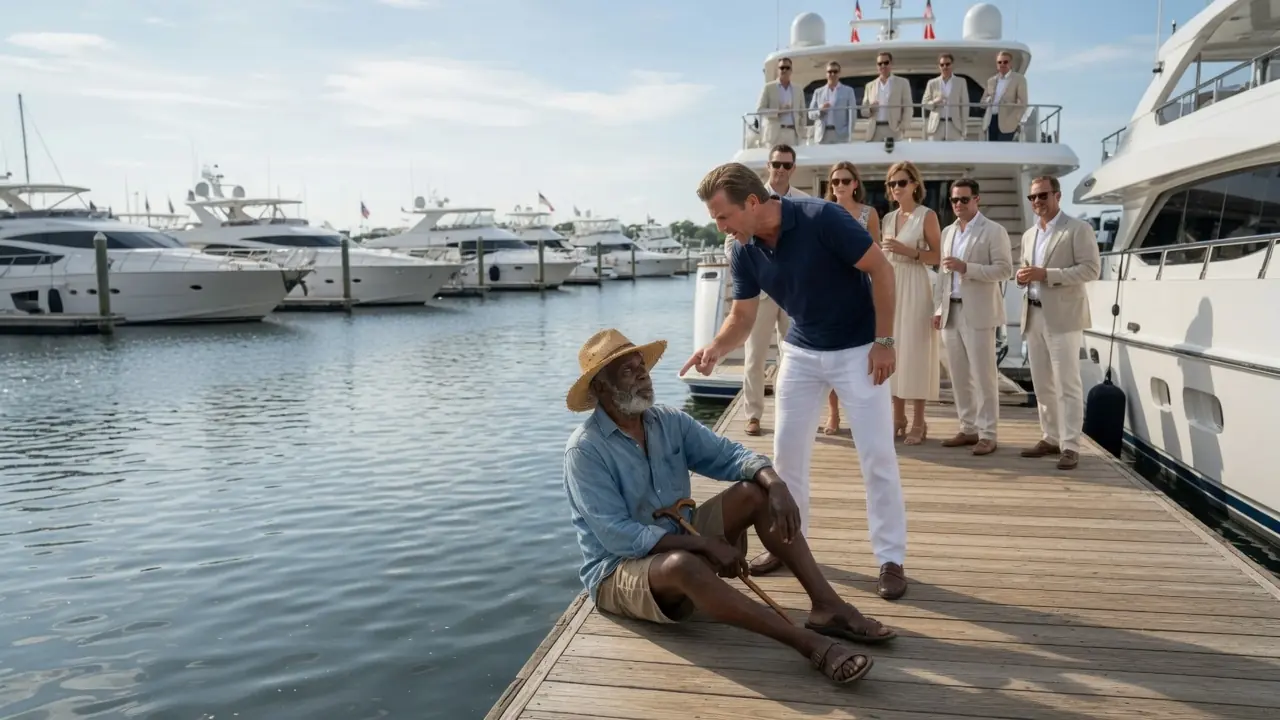
That Saturday afternoon began with sunlight, salt air, and the soft clatter of water tapping against the hulls of yachts worth more than most people’s homes. I sat alone on a weathered bench at one of the most exclusive yacht clubs on the Carolina coast, wearing an old straw hat, faded khaki shorts, a blue button-down shirt with the sleeves rolled to my elbows, and sandals my daughter had begged me to throw away for the last three summers.
The breeze carried the smell of diesel, expensive cologne, sunscreen, and ocean water. White sails moved lazily in the distance. Seagulls circled above the harbor. Somewhere near the clubhouse, a jazz band was warming up for an evening fundraiser.
For a few quiet minutes, I had exactly what I came for.
Peace.
Then Preston Vale stepped off his yacht like the dock belonged to his bloodline.
He was tall, white, handsome in the polished way money makes possible, with sunglasses pushed into his blond hair and a linen shirt that probably cost more than my first car. Behind him, four guests laughed on the deck of his yacht, holding champagne glasses and looking around the marina with the easy boredom of people who had never wondered if they were welcome anywhere.
Preston saw me.
His eyes dropped to my old sandals.
Then to my hat.
Then to my hands, dark and lined from decades of work.
The disgust arrived before the words did.
He walked toward me with the confidence of a man who had never been corrected by anyone he considered beneath him.
“Hey,” he snapped. “You can’t sit here.”
I looked up slowly.
“Afternoon to you too.”
His mouth curled.
“This is a private yacht club.”
“I know.”
“Then why are you here?”
The dock grew quieter.
A couple walking near the fuel station slowed down. A young deckhand tying lines near a cruiser looked over, then quickly looked away. Two women in white tennis skirts stopped pretending they were not listening.
I rested both hands on my cane.
“Because I chose to sit down.”
Preston laughed once, sharp and ugly.
“That’s cute. But people like you don’t get to choose where they belong.”
There it was.
Not yet the worst thing he would say, but the shape of it was already clear.
I had heard versions of that sentence my whole life.
In hotel lobbies.
At banks.
Outside restaurants.
At country clubs where I came as a guest and was mistaken for help.
At boardrooms where men read my name on the agenda and still looked past me when I entered.
People like you.
Words that always pretended to mean class, dress, behavior, anything except what they really meant.
A Black man in old clothes had sat too comfortably near rich white boats, and Preston Vale could not tolerate the image.
He stepped closer.
“You’re making my guests uncomfortable.”
One of his guests, a woman in a wide-brimmed hat, looked down into her glass.
Another man gave a small laugh, as if cruelty was more acceptable when treated as entertainment.
I looked past Preston at the water.
“The ocean has been making men uncomfortable longer than either of us has been alive.”
His face hardened.
“Security!” he shouted.
The word cracked down the dock.
Two security guards near the gate turned. One reached for his radio. The other began walking toward us, not quickly, but with the tired purpose of a man expecting another rich person’s inconvenience to become his problem.
Preston pointed at me.
A few people gasped.
Some looked ashamed.
Most did nothing.
That was always the part I remembered most clearly about moments like that. Not the insult. Not even the face of the person delivering it. The silence around it. The careful turning away. The sudden fascination with phones, shoes, sunglasses, cups, anything except the human being being stripped down in public.
I stood.
The old boards creaked beneath my sandals.
Preston smiled as if standing proved I was obeying.
I looked at him.
“The water belongs to everyone, son. A man with a yacht should still know how to show respect.”
His smile widened.
“Respect? I don’t owe respect to freeloaders.”
Then he leaned closer and lowered his voice just enough to pretend he had not said the quiet part loudly.
“You people always find a way to sneak into places that weren’t built for you.”
The dock went still.
Even the gulls seemed to lift away from the sound.
One of the security guards stopped walking.
The younger one beside him swallowed hard.
Preston’s guests no longer laughed.
I did not move.
I had learned long ago that anger was not always a shout. Sometimes it was the discipline to let a man finish exposing himself.
So I smiled.
Not because it was funny.
Because I already knew what was coming.
At the far end of the marina, a man appeared near the clubhouse doors.
He was not walking.
He was running.
His polished shoes struck the wooden dock so hard the sound carried over the water. Behind him came two senior security officers and a woman in a navy blazer holding a tablet against her chest.
It was Nathaniel Cross, Harbor Director of Belle Isle Yacht Club.
The moment Preston saw him, his face lit with satisfaction. He folded his arms and lifted his chin like a man watching the world arrive to confirm his importance.
He thought Nathaniel had come to protect his pride.
His guests.
His yacht.
His version of the marina.
The crowd parted as Nathaniel approached.
But the closer he came, the more people noticed his face.
He was pale.
Breathless.
Terrified.
Preston pointed toward me before Nathaniel could speak.
“There he is,” he said, his voice turning smooth and official. “This man is trespassing, harassing members, and refusing to leave club property.”
Nathaniel stopped between us.
For one second, he looked at me.
His eyes lowered.
Not in disgust.
In respect.
Then he turned toward Preston.
“Mr. Vale,” he said, his voice tight, “you need to stop talking.”
Preston blinked.
“What?”
Nathaniel swallowed.
“This man is not trespassing.”
Preston laughed.
“Then what is he doing sitting beside my slip?”
Nathaniel looked as though he would have paid anything to be somewhere else.
“Because he owns it.”
The dock went silent.
Preston’s smile faded slowly.
Nathaniel continued.
“He owns the slip.”
A pause.
“Along with the controlling interest in this yacht club.”
For a moment, even the ocean seemed to hold still.
Preston stared at him.
“That’s impossible.”
“No, sir,” Nathaniel said. “It is not.”
Then he turned toward me.
“Mr. Samuel Baptiste is the majority owner of Belle Isle Harbor Holdings.”
A gasp moved down the dock.
The woman in the wide-brimmed hat lowered her champagne glass.
Someone whispered, “That’s him?”
Another voice answered, “The Baptiste family?”
Preston looked at me again.
This time, he really looked.
Not at the hat.
Not at the faded shirt.
Not at the sandals.
At me.
His mouth opened, but no words came out.
I stepped closer, slowly, calmly.
“My father helped build the first pier here with borrowed tools and hands split open from salt and rope,” I said. “My mother cooked stew for dockworkers in a church basement when they couldn’t afford lunch.”
Preston’s face tightened.
“This club was not born rich,” I continued. “It was built by men and women you would have called trash.”
Nathaniel looked down.
Several workers near the fuel dock bowed their heads.
I turned toward the crowd.
“When I bought the land back, I promised myself this harbor would never become a place where dignity depended on clothing, skin, or the size of a man’s boat.”
Then I looked at Preston.
“And today, you proved I had not watched closely enough.”
Preston’s jaw clenched.
“This is ridiculous.”
I nodded toward his yacht.
“Your lease agreement includes a conduct clause.”
Nathaniel lifted the folder in his hand.
Preston’s confidence cracked.
“You harassed a guest,” Nathaniel said. “You used discriminatory language. You ordered security to remove the owner of the harbor.”
The crowd murmured.
Preston snapped, “I didn’t know who he was.”
I smiled sadly.
“That is the problem, son.”
For the first time, something like uncertainty crossed his face.
Then he straightened, trying to recover the version of himself that had walked off the yacht ten minutes earlier.
“Mr. Baptiste,” he said, forcing my name like it tasted unpleasant, “this clearly got out of hand.”
“It did.”
“I was reacting to a security concern.”
“No,” I said. “You were reacting to an old Black man sitting too comfortably in a place you thought belonged to men like you.”
A few people looked away.
Truth has a way of making bystanders feel accused, even when it is only describing what they watched.
Preston’s cheeks reddened.
“You’re twisting this.”
“No,” I said. “You showed the whole dock who you are when you thought nobody important was watching.”
That landed harder than shouting would have.
His guests began stepping away from him.
A man in a navy blazer whispered, “Preston, just apologize.”
Preston ignored him.
Nathaniel turned a page in the folder.
“There is also another issue.”
Preston’s eyes flashed.
“What issue?”
Nathaniel hesitated.
I already knew.
For eight months, my legal team had been investigating irregular fuel accounts, unpaid dock fees, shell companies tied to three premium slips, and false repair invoices connected to one particular vessel.
Every road led back to Preston Vale.
But we had been missing one final piece.
Then he made the mistake of yelling in public.
Nathaniel said, “Your vessel registration lists a holding company currently under investigation.”
Preston’s face went white.
“That’s private.”
“No,” I said. “Fraud committed on my property is not private.”
The senior security officers moved slightly closer.
Preston’s guests stepped farther away.
Then I looked at the yacht behind him.
Its name gleamed across the stern in gold letters.
BLACK TIDE.
My chest tightened.
Preston noticed my stare and smirked despite himself.
“Like the name?” he said bitterly. “Cost more than that outfit you’re wearing.”
The dock inhaled.
I looked at the letters for a long moment.
Then I said, “My father’s boat was called Tide Runner.”
The smirk faded.
“He was refused dockage on this coastline sixty years ago,” I said. “Same water. Different sign. Same kind of man standing in his way.”
Preston looked away.
For the first time, shame almost touched him.
Almost.
Nathaniel handed me a sealed envelope.
“We found this in the old boathouse archives this morning,” he said softly.
My name was written on the front.
In handwriting I had not seen since childhood.
My father’s.
My hand shook as I opened it.
Inside was a yellowed letter and a faded black-and-white photograph.
The photograph showed my father standing on the original pier with a hammer in one hand. Beside him stood a young white man in polished shoes and a pale summer suit.
I stared.
The young man had Preston’s eyes.
Nathaniel spoke quietly.
“That is Alistair Vale. Preston’s grandfather.”
Preston froze.
“What are you talking about?”
I read the letter.
Each word felt like a stone dropping into deep water.
My father, Joseph Baptiste, had once partnered with Alistair Vale to expand the harbor. My father provided land access, labor, local fishing contracts, permits, and trust. Alistair promised capital and legal connections.
Then Alistair stole the documents.
Changed ownership filings.
Moved the harbor through three shell companies.
And tried to push my family out entirely.
My father fought for years.
He won back some land.
Not all.
I looked at Preston.
“Your grandfather tried to steal this harbor from my family.”
Preston shook his head.
“That has nothing to do with me.”
Nathaniel opened another folder.
“It does if your current holding company is still using those disputed filings to claim slip rights.”
The crowd erupted in whispers.
Phones recorded every second.
Preston stepped backward.
“You can’t prove that.”
I lifted the final page from the envelope.
My father had written one last line at the bottom.
If the Vales ever return smiling, check the deed before you shake their hand.
I closed my eyes.
For a moment, I felt my father beside me.
The same steady presence I had felt as a boy when he taught me knots with hands scarred from rope burn. The same voice that told me never to confuse a rich man’s confidence with truth.
Then Nathaniel’s phone rang.
He listened.
His face changed.
“Samuel,” he whispered. “The courthouse just confirmed it.”
I turned toward him.
Nathaniel swallowed.
“The disputed parcels never legally transferred.”
Preston’s mouth fell open.
Nathaniel looked directly at him.
“Mr. Baptiste does not just own the marina.”
A pause.
“He owns the slip beneath your yacht.”
Preston’s arrogance collapsed all at once.
He looked from Nathaniel to me, then back at the yacht behind him.
“That’s impossible,” he whispered.
But this time, no one believed him.
I stepped closer.
“You called me trash on land your family tried to steal.”
His guests stared at him with open disgust.
One of them quietly stepped off the yacht.
Then another.
Then another.
Within seconds, Preston stood almost alone.
The security officers moved forward.
Nathaniel spoke firmly.
“Mr. Vale, your lease is terminated pending investigation. Your vessel will be held until legal review is complete.”
Preston shouted, “You can’t do this.”
I looked past him at the ocean.
For years, I had thought revenge would feel hot.
Instead, it felt quiet.
Like a door closing.
“I can,” I said. “But I won’t do what your family did.”
He stared at me.
“You will get a lawyer,” I said. “You will get due process. You will get the dignity you denied me.”
That broke him worse than cruelty would have.
Because mercy made him smaller than punishment ever could.
Two weeks later, investigators uncovered a chain of forged filings tied to Vale companies. Preston’s business collapsed under lawsuits, fraud charges, and public outrage. Fuel accounts had been manipulated. Maintenance invoices had been inflated. Old harbor rights had been used to secure loans on property that had never truly belonged to him.
But the greater shock came one month later.
I renamed the marina.
The gold sign at the entrance no longer read Belle Isle Yacht Club.
It read Josephine Baptiste Harbor.
My mother’s name.
Below it, I added one line:
The ocean belongs to everyone who arrives with respect.
On opening day, dockworkers, fishermen, yacht owners, children, boat mechanics, local families, and old captains stood together beneath a bright coastal sun.
No velvet rope.
No guest list designed to flatter the insecure.
No policy that turned dignity into a luxury item.
A reporter from Charleston asked me why I still wore the old straw hat.
I smiled.
“Because people show you who they are when they think you are nobody.”
The quote ran in the paper the next morning.
People loved it.
They put it on posters, shared it online, painted it on a mural near the bait shop.
But they did not understand the whole of it.
I did not wear the hat for drama.
I wore it because it had belonged to my father.
He had worn it on the day Alistair Vale shook his hand and lied to his face.
He had worn it on the day the first court filing arrived.
He had worn it on the day he told my mother, “They can take boards and paper, but they cannot take water from a man’s memory.”
For years, I thought my father had lost.
Now I understood he had simply left the fight unfinished for me to pick up.
A week after the renaming ceremony, Preston Vale requested a private meeting.
Nathaniel told me I did not have to accept.
I accepted anyway.
Not because I owed Preston anything.
Because I wanted to see whether humiliation had taught him anything beyond resentment.
He arrived without sunglasses this time. No linen shirt. No entourage. No champagne laughter behind him. He wore a plain gray suit and looked smaller without people around to reflect his importance back at him.
We met in the old harbor office overlooking the docks.
He did not sit until I told him to.
That was new.
For nearly a minute, he looked at his hands.
Then he said, “I did not know what my grandfather did.”
“I believe you.”
His head lifted, surprised.
“But you benefited from it,” I said.
His face tightened.
“That is not the same thing.”
“No,” I agreed. “It is not the same thing. But pretending benefit has no history is how men like your grandfather keep winning after they are dead.”
He looked toward the window.
Outside, a group of children were learning to tie knots near the junior sailing dock. One of them was a small Black boy in orange life vest and red sneakers, laughing as a white-haired instructor helped him loop a rope correctly.
Preston watched them for a long time.
“My father told me this place was always ours,” he said.
“My father told me the same.”
That silenced him.
Two families had carried opposite truths for sixty years.
Only one had documents hidden in a boathouse to prove it.
Preston swallowed.
“I’m not here to ask for the yacht.”
“Good.”
“I’m not here to ask for the slip either.”
“Better.”
He looked at me then.
“I’m here because my daughter saw the video.”
I said nothing.
“She’s thirteen,” he continued. “She asked me why I talked to you that way.”
The first honest pain crossed his face.
“I didn’t have an answer I could stand to hear myself say.”
For a moment, he looked less like Alistair Vale’s grandson and more like a man who had heard his child’s disappointment and found it heavier than public shame.
I leaned back.
“What answer did you give her?”
He looked down.
“I told her I was arrogant.”
“That’s part of it.”
“I told her I was cruel.”
“That’s another part.”
His jaw flexed.
Then, so quietly I almost missed it, he said, “I told her I was racist.”
The room settled around the word.
Not accusation.
Not debate.
Admission.
A small thing, maybe. Late. Insufficient. But not nothing.
I looked out at the water.
“What did she say?”
“She said, ‘Are you going to stop?’”
I turned back toward him.
“And?”
He breathed once, unsteady.
“I told her yes.”
I studied him.
“I hope you meant it.”
“So do I.”
The meeting ended without forgiveness.
People confuse acknowledgment with absolution because they want discomfort to be brief. I was not interested in giving Preston a clean ending because he had finally learned how to say an ugly word about himself.
But when he stood to leave, I said, “Your daughter asked the right question.”
He paused at the door.
“Yes,” he said. “She did.”
After he left, Nathaniel came in.
“He apologize?”
“Sort of.”
“Did you accept?”
“Not yet.”
Nathaniel nodded.
“Good.”
I laughed.
It surprised both of us.
For months after that, the harbor changed in ways both large and small.
We rewrote the membership policies.
Not the polite kind of rewrite that adds a paragraph about inclusion while keeping the same locked doors in place. A real rewrite. Day passes for local families. Apprenticeships for young mechanics. Sliding-scale youth sailing classes. Mandatory bias training for security and member services. A conduct clause with teeth.
Some old members left.
They said the harbor had lost its exclusivity.
I told Nathaniel to send each of them a thank-you note for proving the policy worked.
New people came.
Fishermen whose families had worked the coast for generations but had never been invited past the gate. Retired teachers who wanted to sit by the water. Teenagers who had only seen yachts from the wrong side of a fence. Grandmothers who brought folding chairs and thermoses of sweet tea and watched their grandchildren learn how wind could fill a sail.
One afternoon in late August, I saw an elderly Black woman standing near the entrance, staring at the new gold sign.
Josephine Baptiste Harbor.
She wore a yellow dress and white gloves, though it was too hot for gloves.
I walked over.
“Can I help you, ma’am?”
She looked at me.
“My husband used to work here when it was just three docks and a bait shed.”
“What was his name?”
“Leon Price.”
I smiled.
“I knew Mr. Leon. He taught me how to clean a flounder without wasting half the fish.”
Her face opened.
“You’re Samuel Baptiste.”
“Yes, ma’am.”
She touched the sign with two fingers.
“Your mother fed my children more than once.”
For a second, the harbor blurred.
“My mother fed half this coastline,” I said.
“She did,” the woman replied. “And never once made us feel poor while doing it.”
That was the line that stayed with me.
Not the reporter’s quote.
Not the legal victory.
Not Preston’s humiliation.
My mother never made people feel poor while helping them.
That was dignity.
Not marble docks.
Not gold letters.
Not yacht names.
Dignity was being seen without being measured first.
By autumn, the lawsuit against Vale Holdings had moved into federal court. Lawyers used words like restitution, fraudulent continuity, historical title defect, and damages. Reporters loved the idea of old maritime theft colliding with modern luxury fraud. They called it a reckoning.
I called it paperwork finally catching up with memory.
Preston’s yacht remained impounded for months. BLACK TIDE sat silent in its former slip, a floating symbol of everything he thought he owned and did not.
One morning, I stood on the dock looking at it while workers prepared to remove the gold lettering.
Nathaniel stood beside me.
“You want to keep the boat?”
“No.”
“Sell it?”
“Eventually.”
“What will you rename it?”
I watched the workers scrape the first letter from the stern.
For a long time, I said nothing.
Then I smiled.
“Tide Runner.”
Nathaniel looked at me.
“Your father’s boat.”
“Yes.”
The renamed vessel did not become mine.
I donated it to the harbor’s youth program.
By the following spring, children who had never stepped on a yacht were learning navigation aboard a boat once used by a man who thought old Black men in sandals did not belong on docks.
My father would have liked that.
My mother would have laughed until she had to sit down.
The day the youth program launched, I wore the straw hat again.
A boy named Caleb, no more than ten, pointed at it.
“Mr. Baptiste, why do you always wear that old hat?”
I looked around.
At the water.
At the docks.
At the children in life jackets.
At the sign bearing my mother’s name.
At the slip my father had fought for.
At the horizon beyond the harbor, where the ocean stretched wide and indifferent to human arrogance.
“Because it reminds me to pay attention,” I said.
“To what?”
“To how people treat someone they think has no power.”
He considered that with the seriousness only children can bring to simple truths.
Then he nodded.
“My grandma says that’s how you know their heart.”
“Your grandma is wise.”
“She says that too.”
I laughed.
The boy ran back toward the others.
The waves rolled gently against the docks.
For the first time in years, I felt them answer back.
People still ask me about that day sometimes.
They ask if I knew Preston Vale would expose himself.
I tell them no.
A man’s cruelty belongs to him until he chooses to spend it in public.
They ask if I planned the whole thing.
No.
I had come to sit by the water.
To listen to the gulls.
To remember my father.
To feel close to my mother in a place that once tried to spit our family out and later learned to carry her name in gold.
But when Preston called me trash in front of an entire marina, when he looked at my Black skin, my old clothes, my sandals, and decided all of it made me disposable, he did more than insult me.
He opened a door.
Behind it stood my father’s letter.
My mother’s memory.
His grandfather’s theft.
His own fraud.
A harbor full of witnesses.
And the truth, waiting patiently for the right tide.
That is the thing about dignity.
People can question it.
Mock it.
Refuse to recognize it.
Call security on it.
Try to escort it out.
But dignity does not leave just because arrogance points toward the gate.
Sometimes it sits quietly on a dock in an old straw hat, watching the water, waiting for the harbor director to come running.