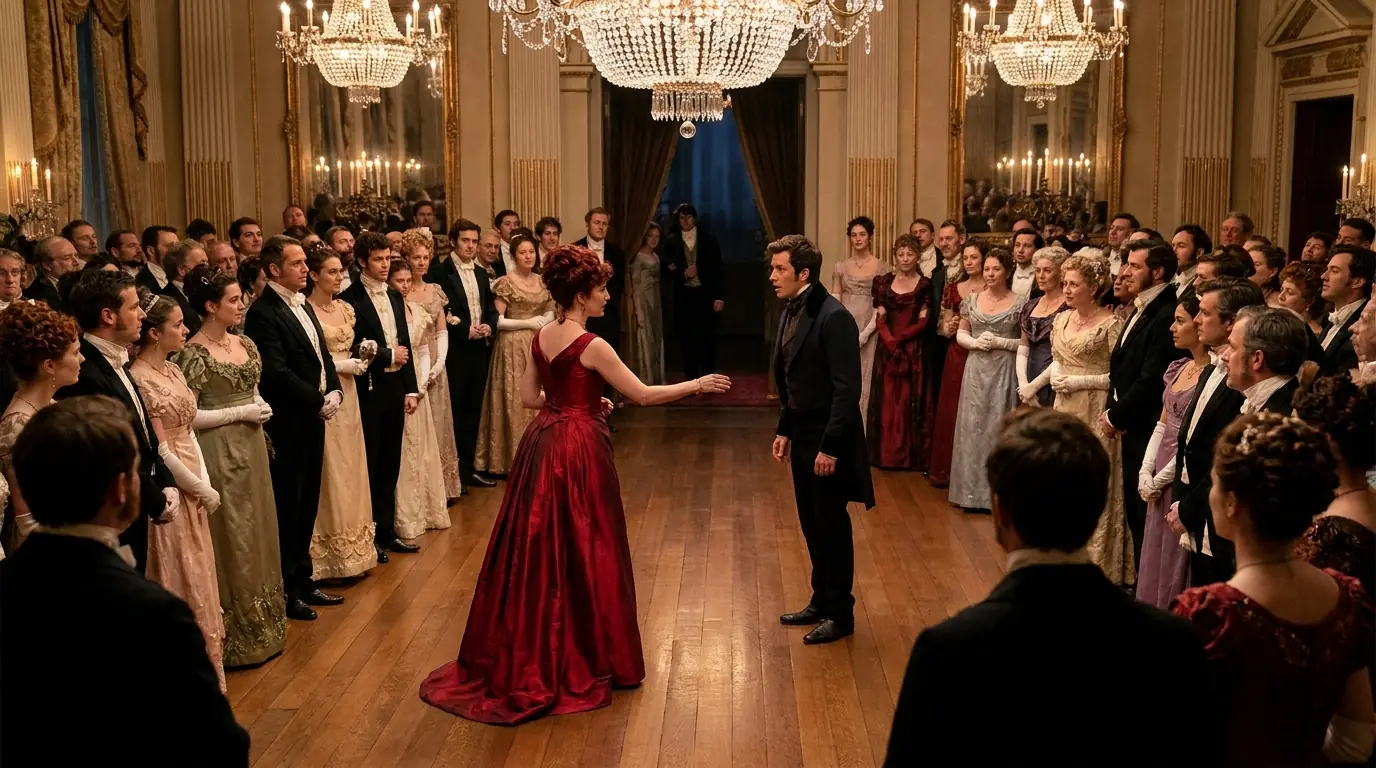
She walked the length of the Wexley ballroom in a ruby silk gown past 300 witnesses and stopped in front of the man no woman in London had spoken to in two years.
Your Grace, she said. Her voice was low and entirely steady. I came to ask for the first dance.
The orchestra had not yet begun. The candles in the chandelier above her trembled in their wax. Behind her, Lady Marchmont's fan stopped mid-flutter. Somewhere by the punch table, a glass touched marble too sharply and rang.
The Duke of Wexley, who had been standing in the alcove behind a column of carved oak, half hidden, half watching, the way he had stood at every ball his sister forced him to attend, did not move for a full breath.
Then he moved. He stepped out of the shadow into the candlelight and the room saw him properly for the first time that season.
Edmund Ashbourne was 27 years old, broad through the shoulder in a way no tailoring could disguise, dark-haired, gray-eyed, with a thin pale scar running the underside of his jaw where a horse had thrown him at 16.
He was beautiful in the cold, exhausted way that people pointed at and whispered about in carriages on the way home. He had been called the cursed duke for two years in pamphlets, in card rooms, in the cruel dressing rooms of women who had never met him.
He looked down at the woman in ruby silk and said very quietly, You should not have done that.
I know, said Lady Annabelle Wharton. She did not lower her eyes.
Her hair was the color of dark autumn copper, tucked low at the nape with a single jet pin, and her hands, the hands of a woman who had spent the last 14 months copying her father's manuscripts in a Bath sick room, were ungloved, which was a small scandal in itself.
She offered him the right one. The orchestra struck the first note of the opening waltz. Three hundred guests held their breath.
Edmund Ashbourne took her hand. He had not touched the gloved or ungloved hand of an unmarried Englishwoman since the third broken engagement 18 months ago.
He had forgotten how warm a living hand could be through ballroom silk. Her fingers closed on his with the deliberateness that made him understand she had calculated this. Every step across the room, every angle, every witness.
She had not stumbled into him. She had aimed.
Lady Annabelle, he said. Her name surprised him as it left his mouth. He had not realized he knew it.
If you stay on this floor with me, by morning every paper in town will have your name in it.
They already have my name, she said. She inclined her head a quarter inch, the smallest of acknowledgements.
I returned to London four days ago, Your Grace. The papers have done their work. What they have not yet decided is what to do with me. I would like to give them a story.
He nearly laughed. He had not laughed inside this house in a year.
What story? he said.
That you are not what they say you are.
The waltz began. He led her into the turn because his body had been trained from childhood to lead a waltz and could do it without his consent.
His left hand settled at the small of her back with a precision that surprised her. He danced as cleanly as a man who fought, all weight and economy, no theater.
The room watched. The room would watch them for the next four minutes whether they spoke or not, and they both knew it.
Why? he said, low against her hair. Are you doing this?
Because my father wrote to you for nine years, she said. Because you wrote to him for nine years. Because I read every one of your letters before I posted his replies.
And the man who wrote those letters is not a man who could be cursed.
He missed a step. It was a small miss, a fractional hesitation that no one across the room would have noticed. But she felt it through her palm, and she felt him correct it.
And she felt him understand who she was.
Mary Annabelle, he said. The two syllables of his late correspondent's signature, the ones he had read at the end of Sir Cuthbert Wharton's last six letters.
M.A.
My father's hand failed in March, she said. I wrote the last six in his name. I lost him in July.
I am sorry, he said.
I know.
They turned through the chalk dust on the polished floor. The candle smoke and the perfume of late blooming roses brought from the orangery wove together into something that smelled, he thought distantly, like grief and like courage.
He was holding the hand of a woman who had read every honest word he had written for nearly a decade, and he had not known she existed.
What do you want? he said.
I want to know why you have let three women in three years break their engagements with you in public, when a single sentence from you would have ended the rumor.
I want to know who is paying them and why, and what you are protecting.
She paused. The waltz turned them again, slower.
And after that, I want a great many other things. But we will not discuss those tonight.
The cursed Duke of Wexley, who had stood through 11 balls in two years like a man waiting to be struck, looked down at her and felt, for the first time in 18 months, a sensation that was not exhaustion, and was not dread.
It was, he realized, hope. And it was a deeply unwelcome thing.
My lady, he said, you are going to ruin yourself for me.
That, said Annabelle Wharton, remains to be seen.
The orchestra rose into the second movement. They did not speak again until the dance ended.
Across the ballroom, against the east window, a tall, fair-haired man in a peacock blue coat watched them turn, and his beautiful face went very still.
His name was Lord Cedric Ashbourne, and he was the Duke of Wexley's younger half-brother, and he had not expected this.
He set his glass down on the windowsill carefully, the way a man does when he is calculating exactly how much trouble has just walked into his evening.
The waltz ended. Edmund bowed over her hand. She curtsied, a slow, level curtsy, eyes never leaving his, and walked away from him through a crowd that parted as if she carried a torch.
By the time Lady Wharton reached her aunt's chair near the orangery doors, the orchestra was already two notes into the second dance, and not one of the gentlemen who had crowded that corner half an hour earlier was anywhere near it.
Her aunt, Lady Selby, was 64 years old and had not been surprised by anything in London since 1798.
Tonight, she took one steady look at her niece's face and said, Well, you have made certain of it now.
I have, Annabelle said. You will sleep at my house tonight, not at Wharton House. There is a difference between brave and unprotected.
Yes, Aunt.
Lady Selby was already rising, fan closed, eyes on the doors.
And Annabelle, she added very softly as the older woman's gloved hand closed on her niece's wrist with surprising strength.
If he was worth nine years of your father's letters, he is worth what you just did.
But please understand, there is somebody in this house tonight who has spent two years building the curse. He is here. He has seen you. He will move before breakfast.
I know, said Annabelle. She had counted on it.
They left the ballroom three minutes later through the side passage behind the orangery into a cold October night smelling of wet leaves and wood smoke.
And Annabelle did not look back at the lighted windows of Wexley House. She did not need to. She could feel the eyes of the room behind her, and one pair more, sharper, colder, calculating, that had not belonged to the Duke at all.
The carriage door closed. The horses moved.
Somewhere above them in a high window, a hand drew a curtain aside, watched the carriage roll into the dark, and let the curtain fall.
It had begun.
The footman delivered it to Annabelle in the small library where she had been since six that morning copying out the fourteenth of her father's unfinished essays in a steady, unhurried hand.
She did not look up immediately. She finished the sentence, wiped her pen, and only then took the card.
Wexley.
No first name, no address, no penciled note on the back.
Edmund Ashbourne had walked it to her door himself.
He is in the morning room, my lady, said the footman with the carefully blank face of a servant whose household had not received an unannounced duke in its history.
Lady Selby thought you should see him alone.
Did she?
Lady Selby is in the parlor, my lady, with the door open. She wished me to mention that.
Annabelle allowed herself a single sharp breath of laughter. She set the pen down.
Tell His Grace I will be there in four minutes.
She did not change her gown. She wore a workaday morning dress of dark amber wool, the cuffs turned back from ink-stained fingers. Her hair pinned in the same low knot she'd worn last night and every morning before.
She wanted him to see her as she actually was. She'd used the ballroom for spectacle. She did not need to use any other room.
When she came in, he was standing by the window looking down into Mount Street.
He turned. Daylight was less forgiving than candlelight had been. He looked older in it. There were thin lines at the outer corners of his eyes and the fatigue she'd glimpsed last night had set deeper.
He was still beautiful in a way that made her chest tight and she was annoyed with her own chest.
Your Grace.
Lady Annabelle. He bowed. He held a folded paper in his left hand.
Forgive me. I considered for two days whether to call.
And?
I decided your name was already in the papers regardless, so I might as well give them something accurate to print.
What is in your hand?
He looked at it as if he had forgotten he held it, then crossed the room and laid it on the small mahogany desk in front of her.
It is a letter, he said. It was delivered to me this morning by a hand I do not know.
It instructs me, politely, to remove myself from London and from any further association with you. It threatens to publish certain papers concerning the Wexley estate if I do not.
She unfolded the letter. The handwriting was clerical, the seal anonymous wax, the paper good.
She read it twice. The second time she read it, a small cold thing moved into her ribs and stayed there.
You knew the letter would come? she said.
I knew something would come. I did not know what.
This is the third letter of its kind.
The fourth.
She set the page down very gently as if it might shatter.
Sit down, she said.
He did not sit. He went to the fire instead, set his back to it, and crossed his arms.
His coat was indigo wool, plain, not the satin he had worn last night. And his hands, broad, flat-knuckled, marked across one wrist with an old riding scar, were ungloved like hers.
They looked like the hands of a man who had stopped pretending.
My lady, he said. I came to tell you a story I have not told to anyone in two years.
I will tell it once. After that, you will decide whether you wish to be in this room with me again. And I will be bound by your decision.
Then tell it.
So he told her.
He told her about Eleanor Bramley, the first fiancée, who had broken with him in April two years ago after receiving, he discovered later, a folded note slid under her bedroom door at three in the morning claiming the duke's late mother had hanged herself after bearing a son who was not legitimate.
He told her about Caroline Forester, the second, who had withdrawn six months after, citing private misgivings.
And who had, he learned only this summer, been shown a forged confession in his own handwriting, describing an indiscretion that had never occurred.
He told her about Lady Frances Hatley, the third, last spring, who had simply wept when he came to her father's house and said she could not, would not, could never explain why.
Only that she begged him never to ask her for an explanation, because the answer would do harm to people she loved.
And you said nothing, said Annabelle.
To say something would have required them to confirm what had been said to them. None of them would have.
Caroline went mad with it. Frances went into the country.
You let London call you cursed.
I let London call me what it wished, he said. His voice was even, the way a man's voice is even when something inside him has been split for a long time, and he has stopped flinching at the seam.
It was the price of letting them go.
And you did not look for who was doing it.
I looked. I have a man in Lincoln's Inn who has spent 18 months looking. He has nothing I can use in court.
What does he have that you cannot use in court?
The Duke looked at her for a long moment.
He has a name.
She waited. He did not say the name.
She set her hands flat on the desk and waited. The fire snapped behind him. Outside in Mount Street, a dray rumbled past. A tinker's bell rang twice. The clock on the mantel ticked through 14 of its own steady seconds.
It is my brother, said Edmund Ashbourne.
My half-brother, Cedric. The son my father raised in this house alongside me from the time I was eight.
The son my father loved best. The son who will inherit Wexley if I die without issue.
And if I marry, will not.
Your brother, she said.
Yes.
Has been writing to your fiancées.
And if my man is correct, has been paying their families.
Forester's father lost a great deal at Hazard the year before Caroline broke with me.
Hatley's eldest son was bought out of debt three weeks before Frances came to me weeping.
And Eleanor Bramley?
Eleanor was lost two years ago this winter after the birth of her child to another man. A good man, a country surgeon.
I'm told she was happy at the end. I'm also told she never mentioned my name again after the broken engagement.
Which is the kindest thing she could have done for me.
The cold thing in Annabelle's ribs sharpened. She'd been raised by a scholar in a house where evidence was the only currency.
She had read enough of the Wexley letters her father kept in a locked drawer to know that the man across the room from her had spent a decade building his interior life out of botany and Roman roads and the slow patient correspondence of a stranger's father because his actual house had become a place where he could not safely trust the man who slept three rooms down the hall.
Your Grace, she said. Would you be very offended if I asked you a practical question?
Please.
How much of the estate has been moved into entail? Not the entail you cannot break, but new instruments since your father was lost to you.
A small flicker of something, surprise or relief, went across his face.
You read the law.
My father had me read the law alongside the Latin. He believed an unmarried English woman with no brothers ought to know what she was likely to lose.
Three properties, he said. All since 1813. All under instruments drafted by a solicitor I did not retain. Cedric did.
Their names?
Holcombe, near Bristol. Marshfield, in Northamptonshire. And the smaller of the two London houses. The one in Half Moon Street.
Holcombe? she said slowly. There was a copyhold dispute attached to Holcombe in 1809. My father reviewed it for the previous Duke.
Yes.
There would be papers in our library. In my father's hand.
There may be.
And those papers, if they exist, would describe how Holcombe was originally settled. And on whom?
Yes.
She rose. She crossed to the small bell pull beside the fireplace and rang it twice, sharply. The way a woman summons a footman who is to be sent on a real errand and not a polite one.
Your Grace, she said over her shoulder. I'm going to require approximately three days.
After that, I believe I will have something we can use.
Edmund Ashbourne, who had stood at 11 balls like a man waiting to be struck, looked at the back of Lady Annabelle Wharton's head as she stood at the mantel and gave instructions to a footman in a quick, practical voice.
And felt the second deeply unwelcome sensation in three days.
He realized, with a flat sort of astonishment, that he had walked into this room intending to release her honorably.
And that he was not going to be permitted to do it.
My lady, he said when the footman had gone.
She turned.
You have been alone with this for two years, she said. You will not be alone with it any longer.
Is that understood?
Yes, he said. He did not try to argue. He had been raised by women who did not wish to be argued with when they had used that voice.
Good. Now, sit down.
My aunt will bring tea because she is incapable of allowing a duke to remain on his feet in her morning room for longer than 10 minutes.
And you will tell me everything your man in Lincoln's Inn has gathered. Every receipt, every name, every fact, however small.
He sat. He talked for two and a quarter hours.
Lady Selby brought the tea herself with a silver pot and four sandwiches no one ate and stayed for exactly long enough to satisfy the proprieties before retreating to the parlor with the door pointedly open.
Edmund spread papers across the desk. Bank drafts traced to Cedric's solicitor. A copy of the forged confession sent to Caroline. A list of Hatley debts settled in cash.
Annabelle read them in the same patient unhurried way she had copied her father's essays, making small marks in pencil at the margins.
When he ran out of papers, she had filled half a sheet with notes in a small, level hand.
And she was not finished thinking. She looked up.
There is one thing missing.
Tell me.
Cedric is 40,000 a year in debt of his own. My man has not been able to confirm a figure.
I can.
She tapped the pencil once against the desk.
My cousin, Gerald Wharton, sits in the Bank of England. He owes my father a favor from 1817 and now owes me.
By Friday, I will know the figure to within 100 pounds.
And I will know who his largest creditor is.
Cedric is not paying these women out of charity. He is paying them out of the next inheritance.
Yours.
Edmund went very still.
He is borrowing against the title. He is borrowing against your death or your continued solitude. Either suits him.
The fire made a small sound like a question.
My lady, said Edmund Ashbourne very carefully, do you understand what you are walking into?
I understand that for nine years I read letters from a man who described at length and with great kindness the satisfaction of repairing a Roman well in a tenant's south field.
I understand that no man capable of writing those letters could have done what was attributed to him.
I understand that I am 26 years old, that I have no brothers, that my father is gone, and that I have spent the last 14 months in a sick room in Bath being polite to people I did not respect.
I am tired of being polite, Your Grace. I am very tired of it.
Annabelle.
It was the first time he had used her name without a title. It came out softer than he had intended.
She looked at him. The autumn afternoon had moved far enough across the sky to put a clean band of gold light along her cheekbone, and he saw, unwilling, exactly how she would look at 30 and at 40.
And the small fierce knowledge that he wanted to be present to see it shook him.
Yes, she said.
I came here to release you from any obligation you might feel.
I cannot ask you to stay in this. Cedric is more dangerous than you understand.
I ask only... I ask that you let me leave London and that you do not see me again until this is done, however long it takes.
Annabelle closed her notebook.
No, she said.
Your Grace, you may leave London if you wish, but you will go to Wexley.
You will permit me to follow you in three days with my notes and Mr. Carrick from Lincoln's Inn. Yes, I have already written to him.
And you will allow my aunt to chaperone the entire arrangement for as long as it requires.
You will not ride about the countryside alone because that is precisely the sort of foolishness gentlemen mistake for honor.
Do we understand each other?
He almost smiled. The smile did not quite arrive. But it had been on the way.
Yes, my lady.
Good.
Now finish your tea. It is going cold. And my aunt's housekeeper will be unbearable for a week if you do not.
He drank his tea.
When he stood to go an hour later, the autumn light had thinned into the long, low, copper and violet glow of an October dusk. And the fire had burned to a low red.
He took his hat from the footman. At the door of the morning room, he paused and turned as if he had to say one more thing or it would not.
Lady Annabelle.
Yes.
Thank you for the dance.
She let herself smile then. A small, private smile that had nothing in it of the ballroom.
And inclined her head a quarter inch in the same level acknowledgement she had given him three nights before.
Your Grace, she said. The dance was the easy part.
He laughed. It was a short, surprised laugh. The kind a man makes when he has not laughed in a year and his body remembers the shape of it before his mind does.
Annabelle heard it. She would carry the sound of it back to her father's library and through the next four days of preparation and on the fifth morning when she rose at dawn to begin the journey to Wexley, it would still be the first thing she thought of.
She did not know yet that Lord Cedric Ashbourne, by then, had already moved.
Wexley Hall stood three miles inland from the Hampshire coast on a low ridge of ash and oak behind iron gates and a long avenue of beeches whose leaves in October were the color of old amber.
Annabelle saw it for the first time at half past four in the afternoon from the window of the Selby traveling carriage with her aunt asleep against the cushions opposite and Mr. Carrick, her father's old solicitor's grandson, 28 and serious-eyed, sitting upright across from her with a leather case across his knees.
That is a great deal of house, said Mr. Carrick.
It is, said Annabelle.
The carriage swung between the gates. Beech leaves spun into the windows.
At the top of the avenue, a man stood on the front steps with his hands behind his back.
And although she had only seen him in a ballroom and a London morning room, Annabelle knew the line of his shoulders before she could see his face.
He had been waiting on the step for an hour.
He came down the gravel as the carriage stopped. He helped her aunt down first with a courtesy so complete that Lady Selby afterwards admitted she had not expected to be charmed by a duke before tea.
Then handed Annabelle down himself. His hand under her elbow was warm and very steady.
He held her arm a beat longer than the descent required.
My lady.
Your Grace.
You came.
I said I would.
He did not let go of her elbow at once. His thumb moved very slightly across the wool of her sleeve and then he released her and they walked up the steps.
The hall inside Wexley was vast, vaulted, and lit by candle stands rather than chandeliers.
Edmund kept fewer servants than his rank required and lived in two wings rather than four.
The portraits on the long wall were of Ashbournes from 400 years.
The third from the end was of his mother, the late Duchess, painted at 20 in a green silk gown with a small jet brooch shaped like an oak leaf at her throat.
Annabelle stopped in front of the portrait.
That brooch, she said. My mother's.
It is the brooch in the locket Cedric wears.
Edmund went still beside her.
What?
At the ball. At your sister's ball two nights before ours.
He was wearing a small gold case at his watch chain. It was open. There was a miniature of a brooch, that brooch, set in it as a memento.
I assumed he kept it after her death.
My mother was buried wearing that brooch.
A small, cold silence.
Then, said Annabelle, we know who opened her grave.
Edmund Ashbourne closed his eyes for one full breath.
Annabelle watched him absorb the information and the way his jaw set, without theater, without curse, told her almost everything she needed to know about the man she had come for.
Mr. Carrick, he said. He did not turn around.
How long do you require to prepare your papers?
Three full days, Your Grace, with access to your library.
You shall have it.
Lady Selby, my housekeeper has prepared the south wing for you.
Lady Annabelle, you have the room next to your aunt's. Dinner is at seven.
Cedric is expected the day after tomorrow.
Annabelle looked at him. You wrote to him?
I wrote to my brother three days ago, yes.
I told him I had become engaged to Lady Annabelle Wharton, that the announcement would be in The Times by Tuesday, and that I expected him at Wexley to congratulate me in person before he read about it.
You did not consult me.
I did not wish to consult you. I wished to put you in the open.
He turned now and looked at her and his gray eyes were as steady as she had ever seen them.
If we are to do this, my lady, we are not going to do it from behind a door.
He has had the dark for two years. He will not have it any longer.
It was, she realized, the first time he had decided something for both of them.
She did not, surprisingly, mind.
She inclined her head in the same quarter-inch acknowledgement and went upstairs to her room.
It rained that evening.
She found Edmund in the library after dinner. The library at Wexley was the room he had described in nine years of letters to her father.
A long, low gallery of oak shelves, two fireplaces, a bay window over the rose garden, a desk piled in the disordered way of a man who used books rather than displayed them.
She had walked the length of it in her mind a hundred times.
To stand in it now was a strange, half-dizzy thing, like recognizing a face in a crowd.
He was at the bay window, his back to the door, one arm braced against the frame.
He did not turn when she came in. He had heard her footsteps in the corridor.
You have read this room before, he said.
I have.
Tell me what you remember.
The wallpaper above the south fireplace is foxed in a small triangle near the cornice. You wrote that in 1816. You said it looked like a hare's ear.
I'm pleased it is still there.
He laughed again, a short, real laugh.
It is.
She crossed the room and stood beside him at the window. The rain came in soft slants against the glass.
Below in the dark, lantern light from the stables ran along wet leaves and slate roofs.
Somewhere in the wet garden, a fox called once and went quiet.
He did not look at her. He looked at the rain.
I have to ask you something, he said.
And I have to ask it before anything else happens between us.
Ask.
Did you walk across that ballroom because you wanted to or because you had read my letters and decided I was a project worth saving?
Annabelle did not answer at once.
She thought about lying. She thought about lying very seriously for a full second.
Then she discarded it.
Both, she said.
He turned his head at last.
Both, she said again, quietly, evenly.
I came to London because my father had gone and I was free for the first time in my adult life.
I came to your sister's ball because I had read every letter you had written to my father and I had decided that if you were, as you wrote yourself, I wished to know you.
I asked you for that dance because in the carriage on the way, I lost my nerve at the door and the only way I could think to recover it was to do something I could not undo.
So, I did it.
The project came first. The wanting came in the dance.
He looked at her for a long time.
I do not know whether to thank you or to send you away.
You will not send me away.
No.
Then thank me later. After Cedric.
She did not move closer. He did not reach for her.
They stood half a pace apart at the bay window of his library with the autumn rain running silver down the glass between them and her shoulder almost against his arm.
Neither of them looked at the other again. They did not have to.
Good night, Your Grace, she said.
Good night, Annabelle.
She walked the length of the library and out and she did not look back.
He stayed at the window for a long time after she had gone.
He could still feel the warmth where she had stood beside him in the half pace of air between them.
The next two days they worked.
They worked in the library from breakfast until past midnight.
Mr. Carrick set up a small writing table in the bay window and laid out his papers in careful columns.
Lady Selby presided from a wing chair by the south fireplace, knitting and making sharp interjections at intervals.
The property deeds for Holcombe she had seen drafted in 1809 by an attorney who had since been disbarred for a separate matter.
The second Mrs. Forester had been her schoolfellow and was, she said, a perfectly silly woman with one virtue, which is that she keeps every letter she has ever received.
She would write to me, said Lady Selby, if I asked.
She would write me anything I wished.
Aunt, my dear, I am 64.
The time for delicacy ended with His Majesty's regency.
Carrick, dictate.
Mr. Carrick dictated. Lady Selby wrote.
By Tuesday afternoon, a letter went south by express to Mrs. Forester at Brighton, asking, with the casual cruelty of a fellow old woman, whether her Caroline still had the unsigned letter that had arrived at Forester House on the 18th of October two years previous.
By Tuesday evening, Annabelle and Edmund had isolated between them the financial signatures across all four blackmail attempts and matched three of them to the same hand at Coutts.
By Wednesday morning, Mr. Carrick's grandfather rode back from London to confirm the hand at Coutts belonged to a clerk named Thomas Pell.
And Thomas Pell had been Lord Cedric Ashbourne's private secretary since 1817.
It was Annabelle who looked up from the page first.
We have him, she said.
Edmund, across the desk, did not look up at once.
He had been holding a pen motionless against the unfinished line of a letter for nearly a minute.
He set the pen down very carefully.
We have him, he agreed.
He raised his head.
He looked at Annabelle across the cluttered desk in the autumn morning light.
And Annabelle, who had not, in 14 months of her father's illness, in three days at Wexley, in nine years of reading his letters, allowed herself to want anything she could not also obtain by patience and labor, felt an unfamiliar pulling, undeniable shift inside her chest.
She set the page down.
Your brother, she said carefully, arrives tomorrow afternoon.
He does.
He will not know that we have him.
He will not.
Then we have until tea time tomorrow to decide how many people will be in the room when we tell him.
He thought about it.
He thought about it the way he thought about everything she had seen him think about, without theater, without rush, with the slow, complete attention of a man who had been alone with a problem for a long time and had stopped expecting anyone else to help him solve it.
Six, he said.
You, me, Lady Selby, Mr. Carrick, the Bishop of Winchester, who is my godfather, and who arrived this morning at my request, and Cedric.
Witnesses without an audience.
He will resist. He will not be allowed to resist into a room of strangers.
And after?
After, my lady, we will see what kind of man he becomes when the dark is taken away from him.
She nodded.
She did not, at that moment, know whether she was nodding at the plan or at the man. It did not matter.
They were the same nod.
Lord Cedric Ashbourne arrived at Wexley at three the next afternoon in a curricle drawn by two grays.
He was 31 years old, six inches shorter than his elder half-brother, fair-haired, blue-eyed, beautiful with the kind of beauty that draws every eye in a room and makes the eye, after a moment, want to look away again.
He wore a peacock blue riding coat.
He smiled at the housekeeper as he gave her his hat. He smiled at the footman as he was shown into the drawing room.
He did not smile when he saw who was in it.
Edmund stood at the fireplace. Annabelle stood beside the desk.
Lady Selby occupied the wing chair, her knitting in her lap, her shrewd black eyes on Cedric.
Mr. Carrick stood at the window with a leather portfolio open against his arm.
The Bishop of Winchester, 81, white-haired, formidable in a plain black traveling coat, stood by the south door, hands folded, watching.
Edmund, said Cedric.
Cedric.
You wrote to me of an engagement. I assumed the announcement would be a private matter.
I assumed the same of certain letters delivered to certain ladies between 1817 and 1819, said Edmund.
I see we have both been mistaken.
The drawing room was very quiet for one full breath.
Cedric Ashbourne, beautiful Cedric, who had spent two years building a curse out of the dark, did the thing Annabelle had come 140 miles to see him do.
He looked, for half a second, at the side door behind him.
He measured the distance. He measured the witnesses.
He measured what was in his brother's face, and then in the bishop's, and only last and longest in the face of the woman he had not expected to be in this room at all.
Then his charming, beautiful, calculating face composed itself, and he smiled.
Edmund, he said pleasantly, I have no idea what you mean.
Mr. Carrick, said Edmund.
Mr. Carrick crossed the carpet in five even paces. He laid the leather portfolio on the small inlaid table between Cedric and the fire, opened it, and turned the first paper.
The bank draft drawn on Coutts, signed by Thomas Pell, dated the 3rd of April, 1818, for 200 guineas, paid into the personal account of Mr. Aloysius Forester, face up, so that Cedric could read it without bending.
Cedric did not bend.
This proves nothing, he said. Mr. Pell is a clerk. He has many employers.
He has one, said Annabelle.
It was the first time she had spoken in his presence.
Cedric Ashbourne turned his attention on her in full for the first time since the ball, and she saw, with a clarity that did not surprise her, exactly what kind of man he was.
My lady, he said, and his beautiful smile sharpened.
I do not believe we have been introduced.
We have not.
My name is Annabelle Wharton.
I am the daughter of Sir Cuthbert Wharton, who reviewed the Holcombe copyhold for your father's brother in 1809.
I am the woman whose engagement to your brother you intended, three nights ago, to break by Friday morning.
I am the author of the letter currently in your inside coat pocket.
The one in which you arranged for Mrs. Caroline Forester to receive a forged confession in your brother's hand.
I am, Mr. Carrick, the second sheet, please.
The witness who can match the handwriting on the directing of that letter to the hand on this list of Coutts disbursements signed by your secretary on your authority, traced and verified by the Bank of England this morning by my cousin, Mr. Gerald Wharton, at my request.
I am also, sir, the woman who currently owns the original of your private letter to Mrs. Forester offering her 400 guineas to ensure her daughter never forgave your brother.
Mrs. Forester wrote to my aunt by express on Tuesday.
The packet arrived an hour before you did.
The drawing room held its breath.
Cedric Ashbourne, beautiful Cedric, did not move.
His blue eyes had not left her face.
His smile had not faltered.
But Annabelle, who had spent 14 months reading failing men and nine years reading the letters of a duke who had taught himself not to flinch, saw the half second when his charming face went behind the eyes perfectly white.
My lady, he said softly, you are very well informed.
Yes.
And you intend to ruin me.
No.
It surprised him. He had not expected it.
The smile twitched.
No?
You are going to ruin yourself.
You are going to write, in this room, in front of these witnesses, a full confession of what you did to Eleanor Bramley, to Caroline Forester, and to Frances Hatley.
You are going to add to it a written acknowledgement that the entail instruments drafted by Mr. Pell against the Holcombe, Marshfield, and Half Moon Street properties since 1813 were drafted on your direction and contained provisions that could not lawfully bind the Duke.
You are going to sign this confession in front of the Bishop of Winchester.
You are going to deliver yourself of your own accord on the next ship to Boston, where my cousin Gerald has, as it happens, a connection in the cotton trade who is willing to employ a literate Englishman of moderate means.
You will live, sir.
You will not return.
And the curse, as the papers will eventually phrase it, will lift quietly because the man who set it has gone.
And the man it was set against is, by then, married.
Cedric Ashbourne looked at his brother.
Edmund.
Yes.
You allowed her to plan this.
I did not allow her anything.
She planned it on her own.
I'm here to ensure you do not strike her on her way out.
Cedric breathed out.
The long, controlled breath of a man who has, for the first time in his adult life, encountered a situation he cannot manage by charm.
And if I refuse?
Then, said the Bishop of Winchester in a voice that had ended ecclesiastical careers, you will instead be tried before the House of Lords on three counts of forgery, two counts of grave disturbance, yes, sir, the brooch, and the matter of certain bank drafts your secretary will not, when offered immunity, refuse to swear to.
And you will not, sir, be living anywhere when it is over.
Cedric Ashbourne sat down.
He sat down because his legs gave under him.
Annabelle watched the moment without satisfaction.
She had never wanted satisfaction.
She had wanted simply the dark taken away.
Edmund did not move from the fireplace.
He did not take a step toward his brother.
Because Cedric did not need a brother in that moment.
And neither did the man who had been called the cursed Duke of Wexley for two years.
Mr. Carrick set the inkstand and a fresh sheet of paper on the table.
Cedric Ashbourne wrote his confession.
It took an hour and 27 minutes.
He did not look up from the paper while he wrote.
The Bishop watched him. Lady Selby knitted.
Annabelle stood by the desk with her hands at her sides, very still.
Edmund stood at the fireplace with his eyes on his brother.
He did not move once.
The fire burned down.
The October light moved down the carpet and along the wall.
When Cedric finished, he laid the pen down.
Mr. Carrick read the confession aloud, slowly, in front of the Bishop.
And at each point he asked, Is this your hand, my lord? Is this true, my lord?
And at each point Cedric Ashbourne said, Yes.
In a voice no one would have recognized as his.
The Bishop signed as witness.
Mr. Carrick signed as witness.
Lady Selby, to her dry amusement, signed as witness.
Annabelle did not sign.
She had decided in advance she would not, because the thing was about three women who were not in the room, and she wished it to be a man's matter on the page, even if it had been her work behind it.
Edmund signed last.
Cedric stood up.
I will be on the four o'clock packet from Portsmouth tomorrow, he said, quietly.
He looked at Annabelle for the last time.
My lady.
My lord.
You are going to be a remarkable duchess.
I am going to be the duchess my husband already deserves, she said. Your opinion, sir, is not material.
He inclined his head once, very slightly.
He left the room.
He did not look at his brother on the way out.
The drawing room remained very quiet for a long moment after the door closed.
Lady Selby resumed her knitting.
The bishop unfolded a handkerchief, blew his nose with the dignity of an 81-year-old churchman, and said briskly, Edmund, tea.
Edmund went to ring the bell.
When Annabelle finally allowed herself to sit down in a small chair by the bay window, the autumn light was already beginning to thin.
Her hands, she noticed in a distant way, were trembling.
Edmund saw it.
He did not draw attention to it.
He simply walked across the room, set a cup of tea by her elbow, and remained there, standing, his hand briefly on the back of her chair.
A steadiness, a presence, a thing she could lean against without naming it.
She did not look up.
Thank you, she said.
No, my lady, said Edmund Ashbourne.
Thank you.
He left his hand where it was.
That evening, after the bishop had been driven to the inn at Botley with his confession and his witness statements, after Lady Selby had retired with a brandy and the steady satisfaction of a woman who had assisted in the destruction of an unworthy man, after Mr. Carrick had organized his papers and gone to bed early, after the household had quieted and the rain had returned in long, soft gusts against the windows, Annabelle went again to the library.
The fire was low.
The bay window was dark.
He was in the wing chair beside the south fireplace, in shirt sleeves and waistcoat. His coat across the back of a second chair, a glass of port untouched on the small table at his side.
He looked, at last, like a man who had set something down.
She closed the door behind her.
He looked up.
Annabelle.
Edmund.
It was the first time she had used his name.
She crossed the carpet and stopped in front of him.
He set the port aside and stood.
He was very tall in shirt sleeves, broader than he had looked in evening coats, and the firelight caught the underside of his jaw, where the old scar ran.
He did not say anything.
She lifted her hand.
She did not lift it slowly or deliberately, or with any of the calculation she had used three weeks ago in his sister's ballroom.
She simply lifted it, and laid the palm flat against the side of his face, against the scar, and let it rest there.
He closed his eyes.
He did not move for a long time.
When he opened his eyes, he did not reach for her.
He did the smaller, more careful thing that surprised her.
He turned his face into her hand until his lips brushed the inside of her wrist, the place where her pulse beat against the skin, and stayed there.
I was going to ask you, she said quietly, whether you minded that I told my aunt I would be married before Christmas.
I do not mind.
Good.
Annabelle.
Mm.
I love you.
I know, she said. I have known since the moment you asked me whether I had walked across the ballroom as a project.
I love you, also.
We may sit down now, please, because I have been on my feet for nine hours, and your sister's ballroom feels considerably further than 140 miles tonight.
He laughed, the third real laugh of his adult life, and she heard it in the long quiet room, and felt the answering laugh begin somewhere under her own ribs.
And they sat down by the south fireplace together in the wing chair and the small chair beside it, his hand in hers across the armrest, and watched the rain run silver across the dark bay window.
They did not kiss until the next morning at dawn in the rose garden before the household was up.
He was the one who stopped.
She was the one who reached for him.
They were both of them surprised after by how quiet a thing it had been, not sweeping, not violent, nothing like a ballroom story.
A long careful kiss in a damp October garden between two grown people who had decided already on each other.
He set his forehead against hers.
Mine, he said.
Yours, she said.
The mist on the box hedges around them lifted slowly.
Far off in the woods, a single rook called.
They were married six weeks later in the chapel at Wexley by the Bishop of Winchester who refused to charge a fee claiming it was the most enjoyable wedding he had performed since the king's accession.
The ceremony was small.
Lady Selby cried once briefly into a black lace handkerchief and afterwards complained the lace had been a mistake.
Mr. Carrick gave the bride away.
The Duke wore a deep indigo coat.
The bride wore a quiet ruby silk gown, the same dress she had walked across the Wexley ballroom in, returned to its trunk and unwrapped only for this.
With no jewels except a small jet brooch shaped like an oak leaf returned that morning to the family by an apologetic clerk at Coutts.
Cedric did not attend.
He had, as agreed, sailed from Portsmouth on the four o'clock packet six weeks before.
He sent a single letter from Boston a year later, brief and unsigned in the family hand, which Edmund read and then put away unanswered in the locked drawer with the other family papers.
He never wrote again.
It was mid-March before the first of the broken fiancées' families called at Wexley.
Caroline Forester had married a country surgeon two summers before.
Frances Hatley was engaged at last to a Welsh barrister, of whom she had been quietly fond for years.
Both came with their husbands and their fathers to thank the Duke for the publication of the bishop's statement and the quiet exoneration of all three.
Edmund received them in the library by the bay window in a grave and gentle voice.
Annabelle sat by the south fireplace and did not interrupt, only handed over at the end of each visit a small folded paper with practical settlements that Mr. Carrick had drawn up in advance.
A sum that would not heal what could not be healed, but would ease in their daughters' households what could be eased.
When the third visit ended, Edmund came across the long low gallery and stood beside her at the fire.
Annabelle.
Yes.
You spent your father's inheritance.
Half of it.
You will not regret it.
Now.
He kissed the top of her head where the autumn copper hair had begun in the months of marriage to be tucked low at the nape with a small jet pin and a small extra carelessness.
And he went back to his desk.
That summer, the south wing of Wexley was reopened.
By autumn, three more servants had been hired.
By October, a year after the Wexley ball, Annabelle was four months expecting and the house, which had been too quiet for two years, was no longer.
It was the third Tuesday in October, 12 full months from the night she had walked across his sister's ballroom in ruby silk, that Edmund found her in the library after dinner.
The bay window was already dark.
The autumn rain had returned, soft in long slants against the glass.
She was at the south fireplace with her father's last unfinished essay on her knee and a pencil between her fingers, frowning over a Latin clause.
He sat down in the wing chair across from her.
Annabelle.
Mm.
Look at me.
She looked up.
The firelight caught the scar under his jaw.
His gray eyes were steady, the way she had first seen them at Mount Street, when he had been a man at the end of two years of dark and had walked into her aunt's morning room intending to release her honorably.
He was not that man anymore.
His shoulders sat lower.
The exhaustion at the corners of his eyes had eased.
He was 28 years old now and he laughed in the house at least once a day and the staff had stopped lowering their voices in the corridors when he passed.
Tell me, he said, what you remember of this room from my letters.
She set the essay aside.
The wallpaper above the south fireplace, she said, is foxed in a small triangle near the cornice.
You wrote in 1816 that it looked like a hare's ear.
I'm pleased it is still there.
And what else?
That the bay window in autumn smells of wood smoke and wet rose.
That the third book on the second shelf is your father's atlas and that you keep your mother's letters behind it.
That on the desk, in the second drawer down, is a small locked box you have never opened because the key was buried with her.
He listened.
When she finished, he stood, walked across the long, low gallery to his desk, opened the second drawer down, and lifted out the small wooden box.
He brought it to her at the south fireplace, laid it in her lap, and produced from his waistcoat pocket a small key.
This morning at breakfast, he said, Mr. Carrick brought me two packages.
The first was from Coutts, the brooch returned by the clerk Pell.
The second came an hour later by the country post from my mother's old solicitor in Winchester, to whom she had given a sealed envelope two days before her last morning, with instructions that it be opened on the announcement of my marriage, and the contents delivered only to my wife in her first autumn at Wexley.
He read of our wedding in The Times in November, and waited, as she had asked, until the season turned.
Inside the envelope was this key.
Annabelle looked down at the key.
You did not open it.
It was not for me to open.
Edmund, open it.
She did.
Inside the small wooden box, on a square of faded silk, was a folded letter, two pressed sprigs of dried hawthorn, and a small jet brooch, identical to the one in the portrait above the long wall, identical to the one Cedric had taken from his mother's grave, and worn at his sister's ball, identical to the one Annabelle had worn on her wedding morning.
It was the original.
The one Cedric had stolen had been, all along, a clever copy.
Edmund's mother had hidden the true brooch the year before her last winter.
The letter was in his mother's hand.
It was undated.
It read,
For my son's wife, whoever she may be, whenever she may come.
I have not met you, but I have known, since the year of his birth, that he would need someone of unbreakable mind, because he is a man capable of taking on dark and standing under it for years, rather than spending the people he loves.
I leave you this.
Wear it on the day he laughs again.
Helena Ashbourne, late Duchess of Wexley.
Annabelle read it twice.
The fire snapped against the south chimney.
The autumn rain came soft against the bay window.
Edmund knelt by her chair, his hand on the arm beside her hand, and he did not say anything.
He did not need to.
The brooch lay on the silk between them.
The letter lay open on her knee, and somewhere in the room, already, a recognition was at work that could not be stopped.
Edmund.
Yes.
I think she would have liked me.
She would have loved you.
I think she would have written to me.
She did, he said, very quietly.
Just now.
Annabelle folded the letter very carefully and set it back into the silk-lined box, and laid the small jet brooch, shaped like an oak leaf, on top of it, and closed the box.
She kept the box on her knee.
She put her free hand into his, where it lay on the chair arm beside her, and she leaned her head sideways against his shoulder, where he knelt by the wing chair.
And they sat that way for a long time without speaking.
A duke and a duchess, a husband and a wife, a man who had once stood in the alcove of every ballroom in London, and a woman who had walked the length of one of them in ruby silk to ask him for the first dance.
By the south fireplace at Wexley, on the third Tuesday of October in the long quiet light of an autumn evening while the rain came soft against the bay window and a fire burned slowly down to embers in a house that for the first time in a great many years had everyone in it that it was supposed to have.
Outside in the dark, somewhere over the rose garden a single rook called once and went quiet.