There is a particular suffocating kind of silence that falls when a heart shatters in a crowded room. It was the height of the London season, the air thick with the scent of crushed roses and expensive French perfume when Lord Arthur Pendleton pulled Gabriella into the shadows of the conservatory.
She expected a proposal. Instead he looked at her with a chilling dispassionate sneer and said the words that would alter her destiny forever. I am marrying your sister. Be reasonable, Gabriella. Beside Beatrice you are simply nothing.
He left her in the dark entirely unaware that the most powerful man in England had witnessed the entire exchange.
Gabriella Somerset had spent the entirety of her 20 years mastering the art of being invisible. In the grand echoing halls of Highfield Manor, a sprawling estate nestled in the rolling green hills of the English countryside, invisibility was not merely a habit. It was a survival mechanism.
She was the second daughter of Lord Charles and Lady Margaret Somerset. In the brutal mathematics of high society, a second daughter with merely passable features and a quiet disposition was a liability, especially when the firstborn was a veritable goddess.
Beatrice Somerset was the sun around which the entire household revolved. Where Gabriella possessed hair the color of toasted almonds and eyes the murky shade of a stormy sea, Beatrice spun gold from her scalp and held the clear piercing blue of the summer sky in her gaze.
Beatrice was loud, vivacious and demanding. Gabriella was the shadow, the afterthought, the girl who sat in the corner of the library with a dusty volume of poetry while her mother fussed over Beatrice's latest silk gowns imported directly from Paris.
Stand up straight, Gabriella, her mother, Lady Margaret would often snap, waving a dismissive hand adorned with family emeralds. You slump like a weary housemaid. If you cannot be beautiful, you must at least attempt to be elegant. Though heaven knows who will take you off my hands once Beatrice makes her match.
It was into this suffocating dynamic that Lord Arthur Pendleton, the Viscount of Aimsbury, first stepped. Arthur was everything a young lady of the ton was trained to desire. He was wealthy, titled and possessed a roguish charm that manifested in a crooked smile and a lock of dark hair that perpetually fell across his forehead.
He had come to Highfield Manor for a week-long hunting party hosted by Lord Charles, a distraction before the grueling social demands of the London season began. Beatrice conveniently was absent. She had been sent to Bath with a wealthy great aunt to recover from a mild bout of winter influenza, leaving Gabriella as the sole daughter in residence.
Without her sister's blinding light to eclipse her, Gabriella found herself for the very first time being seen. It began subtly. Arthur would linger in the drawing room after dinner, taking the seat beside her while the older men smoked their cigars.
He asked her about the books she read. He listened, truly listened when she spoke of her love for the wild moors and the history of the ancient ruins bordering their estate. You have a fascinating mind, Miss Gabriella, Arthur had murmured one afternoon, finding her alone in the rose garden.
The winter frost had just begun to thaw, leaving the air crisp and biting. He had taken off his riding gloves, his bare fingers brushing against hers as he handed her a fallen snow-dusted blossom. It is a rare thing to find a woman who prefers the quiet truth of nature to the loud gossip of a ballroom.
Gabriella's heart, unaccustomed to such attention, had fluttered wildly against her ribs. Over the next five days, a secret romance bloomed between them. There were stolen glances over the morning porridge, accidental brushes of shoulders in the narrow corridors and hastily scribbled notes tucked into the pages of the books she left on the parlor tables.
Arthur wrote of her gentle spirit, her profound intelligence, and his absolute certainty that he had found a kindred soul. He promised her that upon their arrival in London for the season, he would speak to her father. He promised her a future.
For a month, Gabriella lived in a state of quiet, delirious joy. She packed her modest trunks for London with trembling hands, dreaming of a modest country estate with Arthur, a life far away from her mother's scrutinizing glares and the exhausting expectations of society.
Then Beatrice returned. The carriage from Bath arrived three days before the Somerset family was to depart for their London townhouse. Beatrice burst through the grand oak doors of Highfield Manor like a conquering queen returning from a glorious campaign.
She was more radiant than ever, her skin glowing with health, her golden hair swept up in a sophisticated new style. Gabriella felt the temperature in the room shift the moment her sister arrived. The servants, the dogs, even their stern father seemed to gravitate toward Beatrice's magnetic pull.
But Gabriella clung to her secret. She had Arthur, Arthur who loved her mind, Arthur who knew her soul.
The Somerset family traveled to London opening their lavish Mayfair townhouse just in time for the first major events of the season. Arthur's first visit was expected on a Tuesday afternoon.
Gabriella spent two hours arranging her hair, choosing her best day dress, a modest lavender muslin that she hoped brought out the color in her eyes. When the butler announced Lord Aimsbury, Gabriella descended the stairs, her heart beating a frantic rhythm against her corset.
She paused at the threshold of the drawing room, an eager smile trembling on her lips. Arthur stood by the fireplace. He looked incredibly handsome in his tailored dark blue coat and immaculate cravat, but he was not looking at the door. He was not looking for Gabriella.
His eyes were fixed wide and completely captivated on the center of the room. There sat Beatrice, draped over a velvet chaise lounge in a gown of vibrant crimson that should have been too daring for the afternoon, yet looked spectacular on her.
She was laughing at something their mother had said, tossing her golden head back exposing the long, elegant column of her neck. Arthur's expression was one of absolute, unadulterated hunger.
Gabriella stepped into the room. Lord Aimsbury, she said, her voice sounding entirely too thin. Arthur blinked, pulling his gaze away from Beatrice with visible effort.
He looked at Gabriella and the warmth, the secret connection that had defined their days at Highfield, was entirely absent from his eyes. It was as if he were looking at a stranger, a terribly plain, uninteresting stranger.
Ah, Miss Gabriella, he said, his tone polite and utterly distant. He immediately turned back to Beatrice. And you must be the famous Miss Beatrice Somerset. Your beauty, I must confess, has been vastly understated by the rumors.
Beatrice smiled a slow, feline curving of her lips. She extended a hand, allowing Arthur to bow over it, his lips lingering just a fraction of a second too long against her knuckles. You flatter me, my lord.
Gabriella stood by the door, entirely forgotten as the ice began to form in her veins. The shadow had returned and the sun was burning brighter than ever.
The ensuing three weeks were a master class in slow, agonizing torture. Arthur Pendleton became a fixture at the Somerset townhouse. He brought flowers, he secured invitations to the most exclusive soirees, and he drove Beatrice through Hyde Park in his open carriage for all of London to see.
Gabriella was forced to endure it all. She sat in the carriage opposite them, a silent chaperone, watching the man who had written her poetry now whisper scandalous jokes into her sister's ear.
She watched Beatrice toy with him, batting her eyelashes and accepting his adoration as her divine right. At night, Gabriella reread the letters Arthur had given her at Highfield. You are my sanctuary, Gabriella, he had written in bold, slashing ink, a rare pearl among common stones.
She tried to convince herself that Arthur was simply playing a game, fulfilling a social obligation by courting the eldest daughter first. But the rational, observant part of her mind knew the truth.
He had been enchanted by Gabriella only when there were no other options. The moment he was presented with perfection, he had discarded her without a second thought.
The breaking point arrived at the annual Somerset ball, a grand affair meant to officially launch Beatrice into the marriage mart and secure the most advantageous match possible. The house was transformed into a glittering wonderland of thousands of beeswax candles, mountains of hothouse flowers, and the finest musicians in the city.
Gabriella wore a pale blue silk gown, an older dress of Beatrice's that had been hastily altered to fit her frame. It was entirely unremarkable, which suited Gabriella perfectly.
She spent the first two hours of the ball clinging to the perimeter of the room, hiding behind large potted ferns and engaging in polite, forgettable conversation with elderly dowagers. She watched Arthur and Beatrice dance the waltz.
They were a stunning couple moving in perfect, arrogant synchronization. Beatrice was practically glowing with triumph, knowing the eyes of the entire ton were upon her.
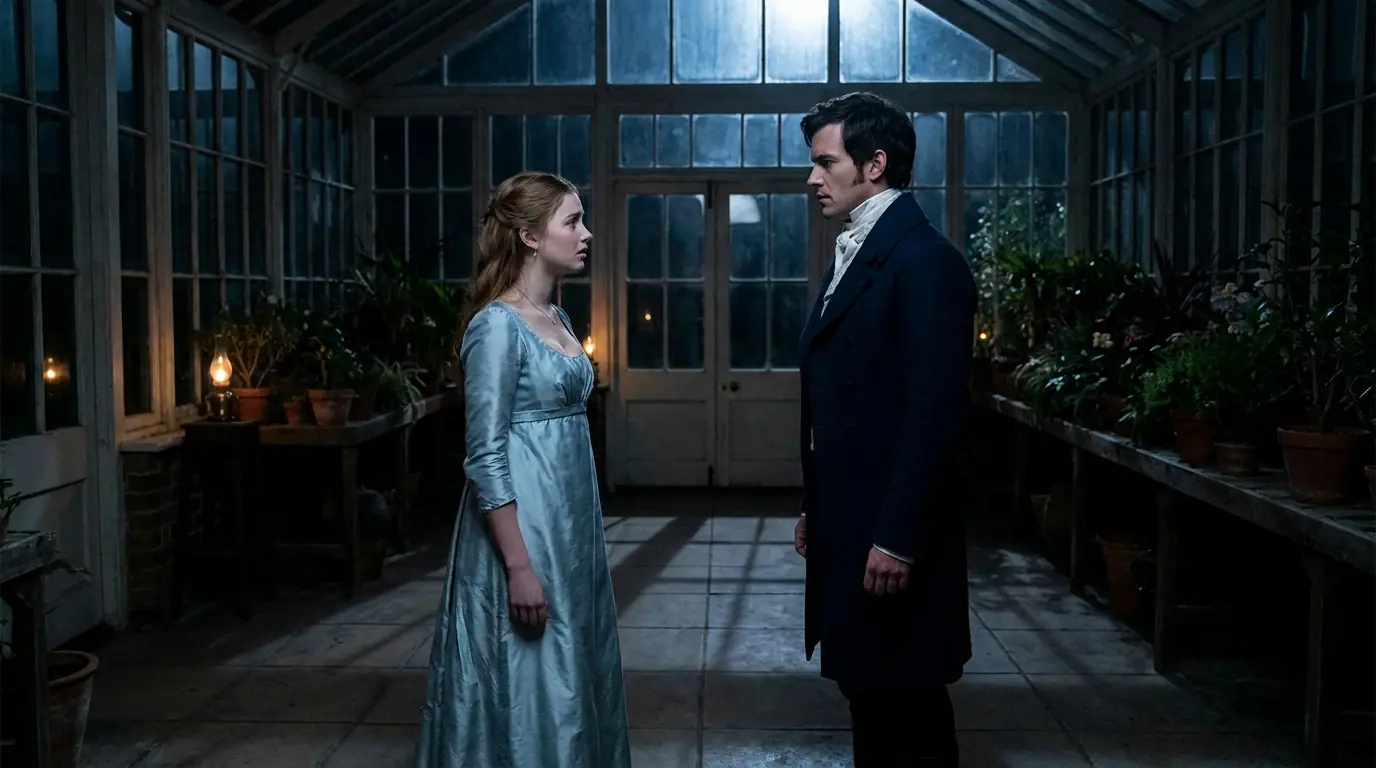
Unable to bear the sight any longer, Gabriella slipped out of the ballroom and navigated the quiet corridors toward the glass conservatory at the rear of the house. It was her sanctuary, a place of damp earth and blooming orchids where the oppressive noise of society could not reach her.
She stepped into the cool, humid air, closing her eyes and taking a deep breath. Hiding, Gabriella?
Gabriella gasped, her eyes flying open. Arthur stepped out from behind a towering cluster of broad-leafed palms. He held a crystal glass of amber liquid, his eyes slightly glazed from the wine, but his posture rigid.
Lord Aimsbury, she said, her voice trembling despite her desperate attempt to keep it steady. I was merely seeking some air. I did not realize you had left the ballroom.
Beatrice is resting her feet. She is surrounded by a dozen admirers, naturally, Arthur said, taking a step toward her. The moonlight filtering through the glass roof cast harsh, angular shadows across his face, making him look cruel and unfamiliar.
Gabriella swallowed the lump in her throat. This was the first time they had been truly alone since Highfield. A pathetic, dying ember of hope flared in her chest. Perhaps he was going to apologize. Perhaps he was going to explain that this was all a terrible misunderstanding.
Arthur, she whispered, dropping the formal title. Why are you doing this?
He sighed, an irritated sound that cut her to the bone. He took another sip of his drink and looked at her, truly looked at her for the first time in weeks. His gaze swept over her pale blue dress, her unadorned hair, her pale anxious face.
Don't make this difficult, Gabriella, he said, his voice dripping with patronizing exhaustion. You are a smart girl, smarter than most. You must understand the way the world works.
The world? She repeated, her voice cracking. You promised me in the garden? In your letters?
I was bored, he snapped, his composure slipping. I was trapped in the country for a week with nothing but old men and dogs. You were convenient, a pleasant distraction, but you cannot possibly have believed that the Viscount of Aimsbury would marry the plain second daughter of a heavily indebted baron when the most beautiful woman in England was an option.
The words struck her like physical blows. She stepped back, her back hitting the cool glass of the conservatory wall. You told me you loved my mind, she whispered, a tear finally betraying her and escaping down her cheek.
Arthur let out a short harsh laugh. A man does not marry a woman for her mind, Gabriella. He marries her for how she elevates him. Beatrice is a diamond. She will make me the envy of every lord in London. She will secure my place in the highest echelons of society. What could you possibly offer me?
He stepped closer, invading her space, towering over her. His breath smelling of heavy wine washed over her face. I am marrying your sister, he stated, delivering the final crushing blow. I plan to ask your father for her hand tomorrow. Be reasonable, Gabriella. Look in the mirror beside Beatrice. You are simply nothing.
He didn't wait for a response. He turned on his heel and strode out of the conservatory, leaving Gabriella alone in the damp dark.
She collapsed onto a wrought iron bench, her hands covering her face as the sobs racked her body. It was not just the loss of Arthur that broke her. It was the brutal, undeniable confirmation of everything her mother had always told her.
She was worthless. She was invisible. She was nothing.
What Gabriella did not know, what she could not have possibly seen through the blur of her tears, was that the conservatory had a second entrance. Standing in the shadows of the archway leading to the gardens, entirely still and completely silent, was a tall figure cloaked in immaculate black eveningwear.
He had heard every single word. And as he watched the young woman weep on the bench, his dark piercing eyes narrowed with a dangerous calculating intensity.
To say that Alexander Sterling, the Duke of Westmore loathed London society would be a gross understatement. He viewed the town with the same detached clinical disdain a scientist might reserve for a particularly foul-smelling species of beetle.
At 32, Alexander was fabulously wealthy, possessing a dukedom that spanned vast territories across the north and a reputation that terrified most men and thrilled most women. He was known as the Iron Duke, not for military prowess, but for his cold unyielding demeanor and his ruthless efficiency in Parliament and business.
He rarely attended social functions, despising the sycophantic lords and the desperate calculating mothers shoving their daughters into his path. He'd only attended the Somerset ball because Lord Charles owed him a substantial sum of money, and Alexander wanted to assess the state of the man's household before deciding whether to call in the debt and ruin him.
He had wandered into the gardens to escape the oppressive heat of the ballroom, seeking the quiet of the conservatory, only to stumble upon Lord Aimsbury's vile display of cruelty.
Alexander had remained in the shadows, his face an unreadable mask, as he watched the Viscount shatter the quiet girl in the pale blue dress. He recognized Arthur Pendleton, a vain lightweight fool with a gambling habit and an inflated sense of self-importance.
Alexander had no patience for bullies, but it was the girl who caught his attention. She did not scream. She did not rail against her fate. Even in her utter devastation, there was a quiet tragic dignity to her grief.
Beside Beatrice, you are nothing, the fool had said. Alexander remembered seeing Beatrice Somerset earlier in the evening. She was loud, ostentatious, and exactly the sort of decorative empty-headed creature Alexander despised.
This girl weeping on the bench possessed a subtle hidden grace. He did not step forward to comfort her. He was not a man given to sentimentality.
Instead, he filed the interaction away in his sharp strategic mind, turned, and vanished into the night.
A week later, the season reached its zenith with the Duchess of Devonshire's annual masquerade ball. It was the most coveted invitation in London. The sheer scale of the event was staggering.
The grand ballroom of Devonshire House was draped in crimson velvet and gold silk, illuminated by 10 magnificent crystal chandeliers. Gabriella attended only because her mother forced her to.
You cannot sulk in your room forever, Gabriella, Lady Margaret had scolded. Arthur and Beatrice's betrothal will be announced in the Times tomorrow. You must be seen supporting them or society will talk.
So, Gabriella had donned a deep emerald gown, a color her mother insisted was too harsh for her complexion, and a simple black half mask, taking her customary place along the wall.
The ballroom was a sea of swirling colors, laughter, and polite deceit. Gabriella watched Arthur and Beatrice hold court near the orchestra. Beatrice wore a gown of spun silver, her golden hair interwoven with pearls, her laughter ringing out over the music.
She looked every inch the future viscountess. Arthur stood beside her, his chest puffed out with pride, accepting the congratulations of his peers.
Gabriella felt hollow. The raw agony of the conservatory had calcified into a dull heavy ache. She wished she could fade into the velvet drapery behind her and disappear entirely.
Suddenly, a strange hush began to ripple through the crowded room. It started near the grand entrance doors and spread like a wave cutting through the music and the chatter. Couples stopped dancing. Aristocrats paused mid-sentence. Heads turned.
Gabriella stood on her tiptoes, peering through the crowd. Standing at the top of the marble staircase, looking down at the assembly with an expression of supreme boredom, was the Duke of Westmore.
He was not wearing a mask. He didn't need one. His severe handsome face, framed by dark hair lightly touched with silver at the temples, was instantly recognizable to everyone in the room.
He wore stark, impeccably tailored black, a sharp contrast to the colorful peacocking of the other men. His mere presence demanded absolute silence and deference.
A collective whisper hissed through the room. The Duke of Westmore is here.
Gabriella watched, fascinated, as the most powerful people in England parted like the Red Sea to let him pass. He descended the stairs with the slow, deliberate grace of an apex predator entering a pen full of sheep.
Lady Margaret, standing nearby, practically vibrated with excitement. Heavens above! she hissed to Lord Charles. The Duke of Westmore! He never attends these things. Charles, go and see if you can introduce Beatrice to him. Aimsbury is a viscount, but a duke!
Gabriella watched her father puff up and begin to move toward Beatrice and Arthur, clearly intending to intercept the Duke.
Alexander Sterling moved through the crowd, ignoring the deep bows and the flirtatious curtsies. He didn't look left or right. His dark piercing gaze was locked onto a specific target.
Gabriella realized with a jolt that he was walking in a perfectly straight line toward the wall where she was standing. Panic flared in her chest.
She glanced behind her, expecting to see a prominent duchess or a famous beauty she was accidentally blocking. There was no one, only the wall.
She looked back. The Duke was 10 paces away. Five paces. The room held its collective breath.
Arthur and Beatrice, who had stepped forward to greet him, were left standing awkwardly as the Duke walked straight past them without so much as a glance. Arthur's face flushed a deep ugly red.
Alexander stopped directly in front of Gabriella. Up close, he was terrifyingly magnificent. He was at least a foot taller than her, his shoulders broad, his eyes the color of dark polished mahogany.
They were the coldest, sharpest eyes Gabriella had ever seen. Yet, as they looked down at her, she saw a flicker of something she could not name.
Gabriella forgot how to breathe. She forgot how to curtsy. She stood frozen, a plain girl in a dark corner suddenly caught in the blinding spotlight of the highest echelons of power.
The silence in the ballroom was absolute. Even the orchestra had stopped playing.
Alexander Sterling, the Iron Duke, slowly raised his hand, offering it to the girl in the emerald gown. His voice, when he spoke, was a deep resonant baritone that carried perfectly in the quiet room.
Miss Somerset, he said, his eyes holding hers with an intense magnetic command. I believe they are about to play a waltz. Will you do me the profound honor of joining me?
The silence in the grand ballroom of Devonshire House was so profound that Gabriella could hear the wax dripping from the magnificent chandeliers above. Hundreds of eyes, the most critical, judgmental eyes in all of Britain, were fixed upon her.
She stared at the large gloved hand extended toward her. Alexander Sterling, the Duke of Westmore, waited with an expression of terrifying patience.
Behind the Duke, Gabriella caught a glimpse of her sister. Beatrice's face was a mask of absolute unadulterated shock. Her lips parted in disbelief.
Beside her, Lord Arthur Pendleton looked as though he had been physically struck. The smug confidence wiped completely from his aristocratic features.
Your Grace, Gabriella whispered, her voice barely carrying over the sound of her own frantic heartbeat. I believe there has been a mistake. You surely intended to ask my sister.
I am entirely unaccustomed to making mistakes, Miss Somerset, Alexander interrupted, his voice a low rumbling command that sent a shiver down her spine. And I assure you, my eyesight is perfectly intact. I asked you.
He did not wait for her to gather her shattered wits. Alexander stepped forward, taking her trembling hand in his firm grasp, and seamlessly drew her onto the polished marble floor.
As if broken from a spell, the orchestra conductor frantically tapped his baton, and the sweeping melancholic strains of a Viennese waltz filled the cavernous room.
Gabriella had danced the waltz before, but never like this. Alexander did not dance. He commanded the space. He moved with the fluid predatory grace of a panther, sweeping her into the center of the room.
The other couples, recovering from their shock, hastily joined them, but they instinctively kept a wide berth, leaving the Duke and the plain Somerset girl in a clear, expanding circle of isolation.
You are shaking, Miss Somerset, Alexander observed, his dark eyes scrutinized her face, missing nothing.
I am terrified, Your Grace, Gabriella answered with a candor that surprised even herself. Half the women in this room are currently plotting my demise, and the other half are questioning my sanity and yours.
A sharp, surprisingly genuine bark of laughter escaped the Duke's lips, a sound so rare it caused heads to turn all over again. Let them question. The opinions of sheep are of no consequence to the wolf.
Gabriella looked up at him, her initial terror slowly giving way to a strange, intoxicating fascination. Up close, the harsh lines of his face were softened by the candlelight, though his eyes remained fiercely intelligent.
Why are you doing this, Your Grace? We have never been introduced. I am nobody.
Ah, Alexander said softly, his hand tightening marginally on her waist as he steered her into a sweeping turn. There is that word again. Nothing. Nobody.
Gabriella stiffened, her breath catching in the throat. The memory of the damp conservatory and Arthur's cruel sneer came rushing back with sickening clarity.
How do you know? I have excellent hearing, Miss Somerset, and dislike for damp conservatories, he replied smoothly, his gaze never leaving hers. I also possess a profound disdain for fools.
Lord Aimsbury is a fool of the highest order. He looks at a library and sees only the gold lettering on the bindings, entirely ignoring the profound truths written on the pages within.
Gabriella's eyes widened. He had heard. He had heard everything.
The humiliation threatened to swallow her whole, but then she looked into his eyes. There was no pity there, only a fierce, burning recognition.
You hid in the shadows because you believed you belonged there, Alexander continued, his voice dropping to an intimate murmur, meant only for her. But I know the truth about shadows, Gabriella. They are where the real power is consolidated. The sun blinds. The dark reveals.
For the first time in her life, Gabriella did not feel the urge to shrink away. The crushing weight of Arthur's rejection, the lifetime of her mother's dismissive remarks seemed to momentarily evaporate under the heat of the Duke's undivided attention.
As the music swelled to its crescendo, Alexander leaned in just a fraction of an inch. Tomorrow, he stated, not a request, but a decree, I will call upon you at 3:00. Be prepared to ride.
The final chord struck. Alexander executed a flawless, sweeping bow, kissed the back of her gloved hand with a touch that seared right through the silk, and turned away.
He walked straight out of the Devonshire House ballroom, leaving a wake of absolute chaos in his absence.
Gabriella stood in the center of the floor, the emerald gown suddenly feeling like armor. She looked toward the edge of the room. Beatrice was glaring at her with a venom so pure it was almost physical.
Arthur looked pale and entirely undone. For the first time in her 20 years, Gabriella smiled a small, dangerous, genuine smile, and turned her back on them both.
The fallout the next morning was nothing short of seismic. Before the sun had fully risen over Mayfair, the Somerset townhouse was besieged.
The knocker on the front door sounded like a rapid-fire drumline. The butler, Higgins, appeared in the breakfast room carrying a silver salver overflowing with heavy, perfumed calling cards and a staggering array of floral arrangements.
Lady Margaret, wearing a lavish silk morning wrapper, dropped her toast. Who are those for? she demanded, her eyes darting toward Beatrice, who sat at the end of the table looking uncharacteristically haggard. Did Lord Aimsbury send a peace offering?
No, my lady, Higgins replied, his usually stoic face betraying a hint of profound confusion. These are for Miss Gabriella.
The silence in the breakfast room was deafening. Gabriella, who had been quietly eating a boiled egg, looked up.
Higgins approached and presented the tray. The cards were a veritable directory of the most exclusive inner circle of the ton.
Good heavens, Lord Charles muttered, leaning over to inspect a heavy card embossed with gold. That is the crest of Lady Sally Jersey, the grand patroness of Almack's herself. She has never once acknowledged our family's existence.
There is also a note from the Duchess of Richmond and an invitation to tea from Lady Melbourne, Higgins added respectfully.
Beatrice let out a sharp, hysterical laugh. This is a prank. It must be. A cruel joke orchestrated by someone who saw that spectacle last night.
It is no joke, Beatrice, Lady Margaret said, her voice entirely changed. She looked at Gabriella not with a mixture of disappointment and boredom, but with the calculating gleam of a merchant who had just discovered a vein of solid gold in a previously barren mine.
The Duke of Westmore danced with her. He touched her in front of the entire peerage. Gabriella is suddenly the most interesting creature in London.
At precisely 3:00, a massive, midnight-black phaeton, drawn by four perfectly matched, aggressive black stallions, pulled up to the Somerset residence. The crest of the Duke of Westmore gleamed on the carriage doors.
Arthur Pendleton, who had arrived 20 minutes earlier to formally request Beatrice's hand from Lord Charles, was standing in the drawing room window. When he saw the Duke's carriage, his face drained of all color.
He actually came, Arthur muttered, looking nervously at Beatrice.
Gabriella descended the stairs wearing a simple, dark navy riding habit. She looked composed, entirely unlike the weeping girl in the conservatory just a week prior.
She walked past her sister and Arthur without a single word, stepping out into the crisp London air.
Alexander stood by the carriage holding the reins of the massive beasts himself. He wore a dark gray riding coat and a severe expression that vanished the moment he saw her.
He handed the reins to a tiger and stepped forward to assist her into the carriage. You look remarkably calm for a woman who has just overturned the entire social hierarchy of the city, Alexander observed as he climbed in beside her and took the reins.
I spent the morning reading a very detailed treatise on the military tactics of Alexander the Great, Gabriella replied smoothly. I decided it was time I learned how to wage war.
Alexander let out another of his rare, startling laughs as he flicked the reins, sending the carriage surging forward toward Hyde Park.
Their entrance into Rotten Row, the fashionable riding path of the park, was akin to throwing a stone into a still pond. Carriages slowed to a crawl. Promenading lords and ladies stopped dead in their tracks to stare.
The Iron Duke, who famously rode alone and despised company, was taking the plain, overlooked Somerset girl for a public turn.
They passed the legendary Arthur Wellesley, the Duke of Wellington himself, riding his famous horse Copenhagen. Wellington, a man notoriously difficult to impress, offered Alexander a respectful nod, his sharp eyes lingering on Gabriella with clear curiosity.
They are all staring, Gabriella murmured, keeping her posture perfectly straight.
Let them, Alexander replied, his focus on the path ahead. Let us discuss business, Gabriella. Your father, Lord Charles, is a man of ambitious tastes, but remarkably poor financial acumen.
Gabriella frowned, turning to look at his sharp profile. What do you mean?
I mean that your father has heavily mortgaged Highfield Manor and this London townhouse to fund your sister's debut. He is currently drowning in debt. Debt, I might add, that is almost entirely held by the Bank of England, which through various holding companies I effectively control.
Gabriella felt a cold knot form in her stomach. Are you threatening my family, Your Grace?
Alexander, he corrected her smoothly. And no, I'm not threatening them. I am presenting you with a reality. Your father is three months away from ruin. Aimsbury's fortune will barely cover the interest on the loans, assuming the fool even goes through with the marriage now that his prize has been overshadowed.
He pulled the massive horses to a gentle halt near the Serpentine lake, turning to face her fully. The cool breeze ruffled his dark hair, and the intensity in his eyes pinned her to the leather seat.
I am a man who appreciates a good investment, Gabriella, Alexander said softly. I listened to you in the conservatory. I have watched you endure the insufferable cruelty of your family with a grace they do not deserve.
You possess an intellect that is entirely wasted in drawing rooms and a quiet fire that I find intensely captivating.
He reached out his large, gloved hand, gently capturing hers. I will forgive your father's debts entirely, Alexander proposed, his voice a low, vibrating hum that seemed to resonate in her very bones.
I will secure Highfield Manor for you in your own name. In exchange, you will grant me the exclusive right to court you.
Gabriella stared at him, her mind racing. A fake courtship to humiliate Arthur and my sister?
I do not play games, Gabriella, Alexander replied, his jaw tightening. There is nothing fake about my intentions. I want you to be my Duchess, but I know you do not trust easily, so we will begin with a courtship.
I will show you the world as it should be seen, and I will give you the power to utterly crush anyone who ever made you feel like you were nothing.
Gabriella looked down at their joint hands, then back toward the path where a familiar, open carriage was frantically trying to catch up to them. It was Arthur and Beatrice, their faces strained with a mixture of desperation and fury.
Gabriella looked back at the Iron Duke, the most powerful man in England, who was offering her not just a lifeline, but an empire.
Very well, Alexander, she said, her voice steady and ringing with a newfound authority. Let the courtship begin.
The transformation of Gabriella Somerset was not marked by a sudden magical acquisition of beauty, but rather by the terrifying dawn of authority.
Within 48 hours of their carriage ride through Hyde Park, Alexander Sterling's solicitors arrived at the Somerset townhouse. They brought with them ironclad documents that legally transferred the deed of Highfield Manor along with a substantial trust directly into Gabriella's name.
Lord Charles, sweating profusely and entirely out of his depth, signed the papers without a word of protest. He had no choice. Alexander had quietly bought up every single one of the Baron's outstanding promissory notes from the city's most ruthless money lenders.
Lady Margaret's reaction was a study in whiplash. The woman who had spent 20 years ignoring her second daughter suddenly treated her as though she were made of spun glass.
Oh, Gabriella, darling, Lady Margaret cooed one afternoon, sweeping into the drawing room where Gabriella was reviewing estate ledgers, a gift from Alexander, who insisted she understand exactly what she now owned. Madame DuPray has arrived with the new silks. We must ensure your wardrobe reflects your elevated station. A future duchess cannot wear last season's muslin.
Gabriella did not look up from the leather-bound ledger. She carefully dipped her quill into the inkwell and noted a discrepancy in the grain yields.
Send Madame DuPray away, Mother. I have already commissioned my wardrobe from a private tailor in Bond Street recommended by His Grace. And please, do not call me darling. It sounds entirely unnatural coming from you.
Lady Margaret's mouth opened and closed like a landed fish, but she did not dare object. The balance of power had shifted so violently that the matriarch was entirely unmoored.
Beatrice, meanwhile, was unraveling. The engagement to Lord Arthur Pendleton, which was supposed to be the triumph of the season, had turned to ashes in her mouth.
Society is a fickle beast, and the ton had immediately lost interest in the viscount and his beautiful bride the moment the Iron Duke laid his claim on the plain sister. Invitations to Aimsbury and Beatrice began to dry up, replaced by desperate pleas for the Duke and the new heiress of Highfield to attend dinners and soirees.
The true test of Gabriella's new reality came two weeks later. At Carlton House, the lavish, opulent residence of George, the Prince Regent, an invitation to dine with Prinny was the highest social validation one could receive in England.
Gabriella wore a gown of deep midnight blue velvet, entirely devoid of the frills and lace that Beatrice favored. Around her neck rested a single flawless sapphire suspended on a platinum chain, a gift from Alexander that felt heavy and cool against her collarbone.
When they entered the Prince Regent's extravagant Chinese drawing room, the murmurs were deafening. Alexander kept her hand tucked firmly into the crook of his arm, his mere presence a shield against the probing, jealous eyes of the aristocracy.
During dinner, to the absolute shock of the table, the Prince Regent engaged Gabriella in a lengthy discussion regarding the recent archaeological discoveries in Greece, a topic heavily debated in the papers.
I am told, Miss Somerset, the Prince Regent said, his famously flushed face leaning forward, that you find the marbles brought back by Lord Elgin to be a fascinating study.
I find them tragic, Your Royal Highness, Gabriella replied smoothly, feeling Alexander's warm, supportive gaze on her. To separate art from the architecture it was meant to breathe life into is a disservice to history. It is rather like tearing a page from a brilliant novel and expecting it to tell the whole story.
The table went dead silent. Disagreeing with the Prince Regent, even philosophically, was social suicide.
But George stared at her for a moment, blinked, and then let out a booming, delighted laugh. By God, Westmore! the Prince declared, raising his glass. You have found yourself a woman with a mind. Keep her away from the politicians, or she'll have us all out of a job.
Gabriella smiled, a genuine, warm expression that illuminated her face.
Across the table, obscured by an arrangement of silver candelabra, sat Arthur Pendleton. He had managed to secure an invitation through a distant royal cousin, but Beatrice had been excluded, a slight that had reportedly caused a screaming match at the Somerset house.
Arthur watched Gabriella with a hollow, haunted expression. The girl he had dismissed as nothing was captivating the future king of England. She was radiant, confident, and utterly unreachable.
Later that evening, as the guests moved to the gallery to observe the Prince's art collection, Gabriella slipped into a quiet alcove to catch her breath. The corset and heavy velvet were beginning to feel stifling.
You played him perfectly. Gabriella stiffened. Arthur stepped out of the shadows, his face pale, his dark eyes wide and frantic. He smelled sharply of brandy and desperation.
Lord Aimsbury, Gabriella said, her voice dropping to a glacial chill. You are standing entirely too close.
Gabriella, please, Arthur whispered, taking another step forward and blocking her exit. You must listen to me. I made a mistake. A terrible, unforgivable mistake.
I was blinded by your sister's superficiality. But seeing you tonight, hearing you speak, I realized what a fool I have been. It is you I want. It was always you.
Gabriella stared at him. A month ago, these words would have mended her shattered heart. Now they sounded pathetic, entirely stripped of the power they once held.
She looked at the man who had crushed her in the conservatory and saw him for what he truly was. A weak, opportunistic coward who chased whatever object held the highest value in the eyes of other men.
You do not want me, Arthur, Gabriella said, her voice eerily calm. You want the woman who commands the Duke of Westmore's attention. You want the woman who charms the Prince Regent.
You are a man who shops for a wife the way one shops for a racehorse, looking only for the prize money she might win you.
Arthur reached out, desperately trying to grab her hands. That is not true. I love you, Gabriella. Leave the Duke. He's a cold, ruthless monster. He does not know your heart the way I do. Marry me. I will break my engagement to Beatrice tomorrow.
If you touch me, a voice colder than the deepest winter ice echoed through the alcove, you will find yourself missing both of your hands.
Arthur practically leapt backwards, slamming into a marble bust.
Alexander Sterling stood at the entrance of the alcove, his broad shoulders blocking the light. He did not look angry. He looked lethal.
Your Grace, Arthur stammered, his bravado instantly crumbling. I was merely offering my congratulations to Miss Somerset.
You were begging, Alexander corrected smoothly, stepping into the space and pulling Gabriella to his side. And you were doing it poorly.
A word of advice, Aimsbury. When a man gambles away his inheritance at White's Club and is teetering on the edge of debtors prison, he should not attempt to steal from a duke. The consequences are generally fatal.
Arthur's face drained of the last vestiges of color. He looked at Gabriella, then at the terrifying countenance of the Duke, and fled the alcove without another word.
Gabriella looked up at Alexander. You knew about his debts.
I know everything, Gabriella, Alexander murmured, his harsh features softening as he looked down at her. He gently brushed a stray lock of hair from her cheek. Are you unharmed?
I am entirely whole, she said, realizing with a sudden, breathtaking clarity that it was true.
Arthur's betrayal no longer hurt. It was merely a stepping stone that had led her here into the arms of a man who saw her not as a shadow, but as an equal.
The destruction of Beatrice Somerset was not orchestrated by Alexander, nor was it planned by Gabriella. It was entirely self-inflicted, born of a vanity so profound it bordered on madness.
The climax of the season was the highly anticipated opening night of Mozart's Don Giovanni at the Theatre Royal, Covent Garden. The entire peerage was in attendance, turning the tiers of velvet-lined boxes into a glittering showcase of wealth and status.
Gabriella sat in the Duke of Westmore's private box, positioned directly across from the royal enclosure. She wore a gown of rich crimson, a daring, vibrant color she would never have touched a month prior.
Alexander sat beside her, his chair angled so that he could watch her profile as she became lost in the music.
Three boxes down, crammed into a less prestigious tier, sat Lord Charles, Lady Margaret, Beatrice, and a visibly sweating Arthur Pendleton.
During the intermission, the corridors of the theater became a crowded promenade. Alexander had stepped away to speak with Lord Byron, who was causing his usual stir near the stairwell.
Gabriella remained in the box, sipping a glass of iced lemonade, when the door violently swung open.
Beatrice stood on the threshold. She looked magnificent in pale pink silk, but her face was distorted with a feral, ugly rage.
How did you do it? Beatrice hissed, stepping into the box and closing the door behind her.
Gabriella set her glass down slowly. How did I do what, Beatrice?
Do not play the innocent with me, Beatrice spat, her hands clenching into fists. You poisoned him against me. You whispered your vicious little lies into the Duke's ear, and now society treats me like a leper.
Arthur's creditors are practically beating down our door, and he blames me because my dowry won't cover his gambling debts.
I have not spoken a single word about you to anyone, Beatrice, Gabriella said calmly, remaining seated. I haven't needed to. Your actions speak loudly enough for themselves.
You plain, wretched little mouse, Beatrice snarled, stepping closer, her eyes flashing with a dangerous desperation. You think you have won. You think the Duke actually loves you.
He is using you as a novelty. The moment he tires of your intellect, he will discard you just like Arthur did, and I will make certain of it.
Beatrice lunged forward, grabbing a heavy silver candlestick from the side table. It was a manic, unthinking act of pure jealousy.
She didn't intend to strike Gabriella. She intended to hurl it through the glass pane of the box, creating a scandal that would drag Gabriella into the mud with her.
But before Beatrice could even raise her arm, Gabriella stood up. She did not flinch. She did not cower.
With a speed and precision she didn't know she possessed, Gabriella reached out, clamped her hand over Beatrice's wrist, and twisted it sharply downward.
Beatrice gasped in pain, dropping the candlestick with a muffled thud onto the plush carpet.
Listen to me very carefully, Beatrice, Gabriella whispered, her voice a low, terrifying echo of Alexander's commanding tone. For 20 years you took the sun and left me in the dark.
I accepted it because I believed I was nothing, but you made a grave miscalculation. In the dark one learns to see everything.
Gabriella tightened her grip on her sister's wrist, forcing Beatrice to look directly into her eyes. You are a beautiful, empty shell, Gabriella continued, her words precise and merciless.
You have no kindness, no loyalty, and no mind of your own. You relied entirely on your reflection in the mirror, and now the glass is shattered.
If you ever attempt to threaten me, or embarrass me, or speak my name in public again, I will have the Duke's solicitors seize this townhouse and cast you and our parents into the street. Do you understand me?
Beatrice was trembling, her blue eyes wide with genuine terror. She had expected the meek, weeping sister of Highfield Manor. She had found a queen.
Yes, Beatrice choked out, tears of humiliation spilling over her eyelashes.
Gabriella released her wrist with a flick of disgust. Then get out.
Beatrice stumbled backward, practically throwing herself out the door of the box, weeping hysterically.
A moment later, Alexander stepped out from the shadows of the adjacent corridor. He walked slowly into the box, his eyes fixed on Gabriella.
He had seen the entire exchange through the partially open door. He did not speak immediately.
He walked to the small table, picked up the fallen candlestick, and set it back in its rightful place.
Then he turned to Gabriella, who was standing with her chest heaving, the adrenaline slowly draining from her veins.
I leave you alone for five minutes, Alexander murmured, a distinct gleam of awe in his dark eyes, and you conquer your demons without my assistance.
I told you, Gabriella said, a small, shaky smile touching her lips. I have been reading military tactics.
Alexander closed the distance between them. He reached out his large hands, gently framing her face.
The cold, ruthless mask of the Iron Duke was entirely gone, replaced by a raw, burning vulnerability that made Gabriella's heart stop.
You are the most magnificent creature I have ever encountered, he said, his voice dropping to a rough whisper. I offered you a courtship to protect you, Gabriella.
I offered you an alliance, but I am a selfish man. I no longer want an alliance.
He leaned down, his forehead resting against hers. I want your heart, he confessed, the words tearing out of him.
I want your brilliant mind and your fierce spirit, and I want you by my side until the day I die. Marry me, Gabriella, not as a business arrangement. Marry me because you love me.
Gabriella looked up into the eyes of the man who had seen her when the rest of the world looked away. She saw the truth there, absolute and unyielding.
The shadow she had lived in for so long was finally permanently banished, replaced not by the blinding, superficial sun, but by the steady, enduring light of a genuine fire.
Yes, she whispered, her hands coming up to grasp his lapels. Yes, Alexander, I will.
When the Duke of Westmore kissed her, the music of Don Giovanni swelling in the background, it was not a conquest. It was a surrender from both of them.
And as they stood wrapped in each other's arms in the velvet-lined box, the high society of London ceased to exist. They had won the board.
The formal announcement of the betrothal between Alexander Sterling, the Duke of Westmore, and Miss Gabriella Somerset appeared in both The Times and the Morning Post the following Tuesday.
It was a brief, elegantly worded paragraph that effectively detonated whatever fragile remnants of the old social order still existed.
The immediate casualty of this explosion was Lord Arthur Pendleton. With the protective halo of the Somerset family's supposed favor completely extinguished, Arthur's creditors descended upon him with the ruthlessness of starving wolves.
Word had leaked, likely through the discreet channels controlled by the Duke's men, that the Viscount of Aimsbury had been unequivocally rejected by the future Duchess.
His credit, which had been surviving purely on the promise of Beatrice's now non-existent dowry and his own inflated bravado, evaporated overnight.
It culminated in a profoundly ugly scene outside the esteemed banking house of Coutts and Company on the Strand. Arthur, having been denied an extension on a massive promissory note by Mr. Thomas Coutts himself, stumbled out onto the pavement only to be met by a pair of aggressive bailiffs.
He was publicly stripped of his customized phaeton and very nearly dragged to the Fleet Prison for debt, saved only by a desperate, last-minute loan from a distant, resentful uncle.
When news of Arthur's near arrest reached the Somerset townhouse, the reaction was swift and brutal.
Lady Margaret, whose entire worldview was constructed on the shifting sands of wealth and appearance, promptly barred Arthur from the house.
The man is a pauper, Beatrice, Lady Margaret shrieked in the drawing room, her voice carrying through the mahogany doors to where Gabriella sat quietly reading in the library.
He has nothing. You cannot possibly marry a man who does not even own his own carriage. You would be a laughingstock. He is a Viscount.
Beatrice wept, pacing the floorboards in a rumpled morning gown. The golden girl had lost her luster. Her eyes were red-rimmed, and her once perfect hair was limp.
And my reputation is ruined. No one else will have me after the spectacle at Covent Garden. I am tied to him.
Gabriella closed her book. She had listened to their bickering for three days. It was time to end the pathetic charade.
She stood, smoothed the skirts of her lavender day dress, and opened the library doors. Her mother and sister froze, turning to look at her with wide, fearful eyes.
Gabriella was no longer their blood. She was their landlord, their financier, and their absolute sovereign.
You will both cease this incessant shouting, Gabriella commanded, her voice steady and chillingly calm.
Gabriella, darling, Lady Margaret began, attempting a sickly sweet smile that faltered immediately.
Be silent, Mother, Gabriella said, not raising her voice a fraction. Lady Margaret's mouth snapped shut.
Gabriella turned her gaze to her sister. You will not marry Lord Aimsbury, Beatrice. Not because he is poor, but because he is a coward.
He would sell you the moment your beauty faded, or a better offer presented itself.
What am I to do, then? Beatrice cried, a genuine note of despair cracking her voice. I am a pariah.
You are going to Bath, Gabriella stated flatly. You and Mother will depart at the end of the week.
You will live quietly. I have arranged a modest, but comfortable allowance for you both through the Duke's solicitors. It will be sufficient to keep you in good standing, but you will not have the funds for lavish gowns or extravagant parties.
Lady Margaret gasped, her hand flying to her chest. Bath? Banished to the country? But the season?
Your season is over, Gabriella interrupted. Father will remain here in London to manage whatever minor affairs he still possesses under the strict supervision of my accountants.
If you attempt to return to London without my explicit permission, or if I hear a single whisper of you attempting to contact Arthur Pendleton, the allowance will be severed entirely. You will be left to fend for yourselves. Is that perfectly clear?
Beatrice looked at her younger sister, the shadow she had ignored, the girl Arthur had dismissed as nothing, and finally truly understood the magnitude of her defeat.
She slumped into a velvet armchair, burying her face in her hands. Yes, Beatrice whispered into her palms. It is clear.
Gabriella felt no triumph, only a profound, settling peace. She turned and walked out of the drawing room, leaving the remnants of her past behind her.
In the grand foyer, Alexander was waiting. He wore his customary black coat, his dark eyes tracking her every movement as she approached.
He offered his arm. Is the house in order, my future Duchess?
Gabriella slipped her hand into the crook of his arm, leaning slightly into his solid strength. The house is perfectly quiet, Alexander. Take me away from here.
They were married a month later at St. George's, Hanover Square. It was not the ostentatious, crowded spectacle that Beatrice had always dreamed of, but an affair of quiet, overwhelming power.
Only the highest echelons of the Ton were invited. The Prince Regent attended, a rare honor, bringing with him a priceless diamond parure as a wedding gift for the bride.
Gabriella wore a gown of heavy ivory silk, embroidered with subtle silver threading that caught the light with every step.
When she walked down the aisle, her gaze was fixed solely on the tall, imposing figure waiting for her at the altar. Alexander watched her approach with an intensity that made the rest of the congregation entirely irrelevant.
When he took her hand, his fingers tightened around hers, a silent vow that ran far deeper than the words spoken by the Archbishop.
Following the ceremony, they did not linger in London. They boarded the Duke's private carriage and began the long journey north to Sterling Hall, Alexander's ancestral seat in Yorkshire.
It was a staggering estate, a massive fortress of gray stone overlooking the wild, rolling moors that Gabriella had always loved.
The moment the carriage breached the grand iron gates, the estate staff, numbering over 200, were lined up to greet them.
Alexander stepped down first, turning to offer his hand to his new bride. As Gabriella stepped onto the gravel drive, a profound silence fell over the staff.
They had heard the rumors of the Iron Duke's sudden marriage to an unknown, plain girl.
Alexander did not introduce her with a speech. He simply placed her hand on his arm, looked at his fiercely loyal steward, and said, Mr. Harrison, you will address Her Grace with the same absolute authority you grant me. Her word is law on these grounds.
Yes, Your Grace. Welcome to Sterling Hall, Your Grace, the steward bowed deeply, followed instantly by the rest of the staff.
Gabriella looked up at the towering turrets of the castle, and then out toward the untamed expanse of the moors. She was a world away from the suffocating drawing rooms of Mayfair and the cruel whispers of her family.
That evening, after a quiet supper in their private chambers, Alexander found Gabriella standing on the balcony overlooking the darkened landscape.
The wind was fierce, whipping her unbound brown hair around her shoulders, but she did not look cold. She looked entirely alive.
Alexander stepped behind her, wrapping his arms around her waist, and pulling her back against his chest. He buried his face in the curve of her neck, inhaling the scent of lavender and rain that always seemed to cling to her.
Are you afraid of the dark, Gabriella? he murmured, his deep voice vibrating against her skin.
Gabriella leaned back into him, covering his large hands with her own. She thought of the conservatory in London, of the crushing despair she had felt in the shadows, and of the man who had stepped out of them to offer her the world.
No, she answered, turning her head to press a soft kiss to his jaw. I am not afraid of the dark, Alexander, because the dark is where I found you.
He turned her in his arms, his eyes burning with a fierce, absolute devotion. He kissed her a deep, consuming kiss that sealed the doors on her past forever.
The girl who was nothing had ceased to exist. In her place stood the Duchess of Westmore, a queen of her own making, ruling a heart that the rest of the world had thought entirely made of iron.
In the brutal mathematics of high society, value is too often calculated by superficial beauty and fleeting wealth. Gabriella Somerset was told she was a zero in this equation, a shadow meant to be ignored while the sun, her sister Beatrice, blinded the world.
But shadows possess their own gravity. While Beatrice and Arthur traded in the fragile currency of vanity, Gabriella cultivated a mind and spirit that could withstand the harshest of winters.
Alexander Sterling, a man who saw through the glittering facade of the Ton, recognized her true worth, not as a decorative pawn, but as a queen capable of matching his formidable intellect and commanding his fiercely guarded heart.
Ultimately, the story of the Iron Duke and his Duchess proves that those who are dismissed as nothing often possess the very substance required to rule everything.