I am Clarabel, second housemaid at Ravensmere Hall.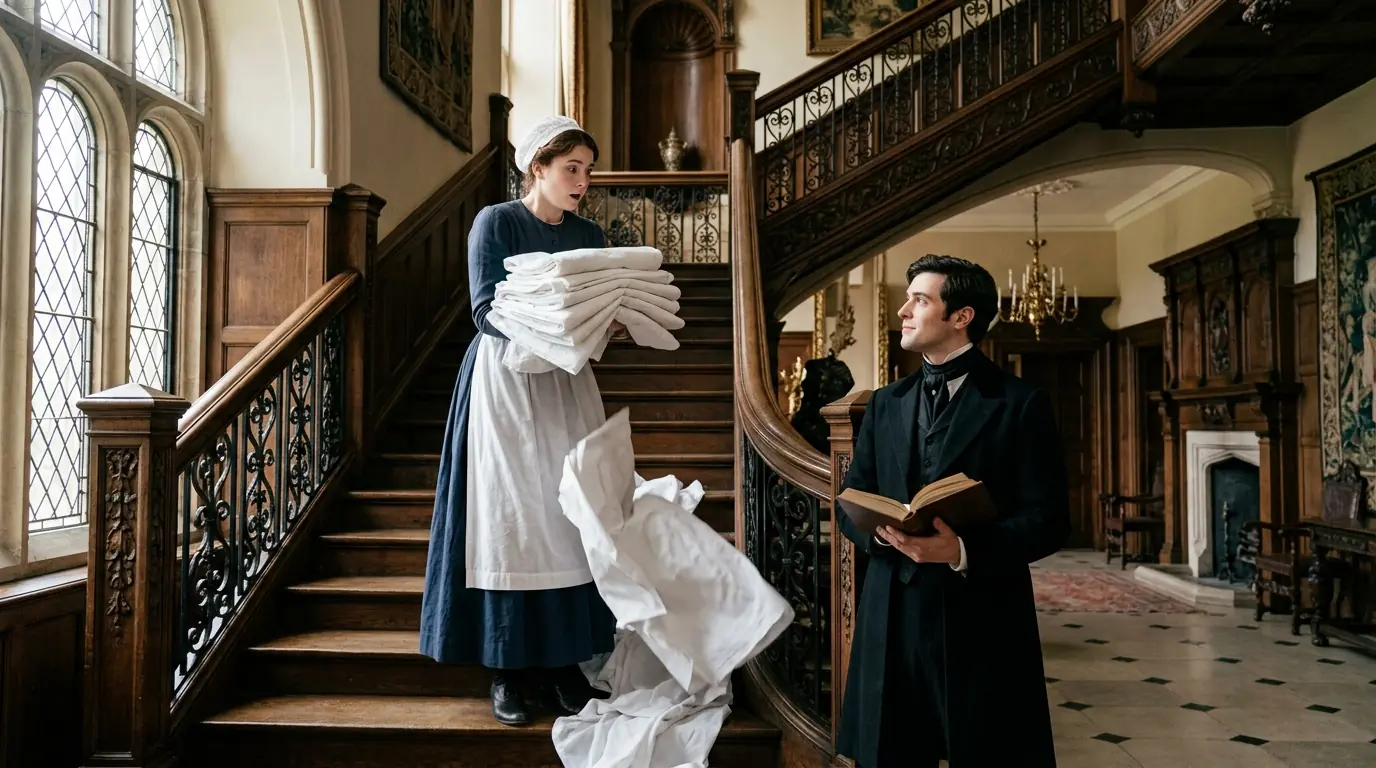
I have worked at Ravensmere Hall for four months, and in those four months, I have learned exactly three things:
-
The Duke of Ravensmere has not spoken to anyone in six years.
-
The Duke of Ravensmere has not smiled at anyone in six years.
-
The Duke of Ravensmere is, without question, the most infuriating man in England.
He does not hear. He does not answer. He does not even look at you when you speak. He just sits there in his black coat with his perfect face, like a marble statue that has been personally offended by the existence of dust.
And he is offended constantly by everything: a candle flame too high, a curtain fold too loose, soup not hot enough, soup too hot, a chair an inch out of place. He notices all of it. He writes notes about all of it. He has opinions about dust—Clara dust. And I, Clarabel, second housemaid, have to clean around him every single day.
So I complain constantly, right to his face, because he cannot hear me. I have a name for him; I have had it for months. I call him my "handsome tyrant."
Today, I was carrying a tower of clean sheets down the staircase. He was at the bottom of it: book open, world ignored, same as every morning. So I did what I always do: I looked right at him. I did not bother to lower my voice—why would I? He cannot hear me.
I greeted him cheerfully: "Good morning, my handsome tyrant."
And then he smiled.
I saw it, clear as daylight. His mouth curved only a little, barely enough to disturb his severe face, but it was there.
I froze. My foot caught the stair. The sheets went flying. I did not even notice; I was too busy staring at the Duke of Ravensmere, who had just smiled at a joke he was not supposed to hear.
He did not look at the sheets. He did not look at the noise. He did not look at the mess. He looked at me, at my mouth, at the words I had just said.
Oh, no.
Ravensmere Hall had been quiet for six years. Not peaceful—quiet. There's a difference. Peace sits by the fire and lets people breathe; quiet at Ravensmere pressed against every wall like a hand over a mouth.
The Duke's accident had made it so. A blast at the old glasshouse had taken his hearing when he was twenty-six. Some said lightning struck the furnace; some said a servant left gas lamps open; some said the old Duke's ghost had finally objected to chrysanthemums. Whatever the cause, Lord Sebastian Vale became the Duke of Ravensmere three months later when his father died of a fever. He inherited a title, an estate, and a silence everyone else treated as death with better tailoring.
He could speak—that surprised many visitors. His voice was low and controlled, though he used it rarely. He could read written notes. He understood a handful of signs. He could read lips if a speaker faced him clearly. But the family solicitor insisted he read only simple phrases.
The solicitor was wrong.
I learned that by accident, as I learned most things at Ravensmere. My cousin had pulled me from a milliner's shop where I sewed ribbons until my fingers had personal grudges. I was quick with stairs, decent with needles, and able to remember which guests took sugar, which took none, and which deserved salt. Mrs. Kettle valued these skills; Lady Portia Vale did not.
Lady Portia was the Duke's cousin, a blonde widow with pearls for every hour of the day and a smile that never reached anywhere useful. She had lived at Ravensmere since the accident, helping manage invitations, charities, and the Duke's public life. Everyone said she was devoted; I thought devotion should not sound so much like counting keys.
Lord Edmund Vale, another cousin, visited often. He was handsome in a damp, pale way, and spoke to servants as if we were furniture that had failed to become chairs. He stood to inherit if Sebastian never married, or if certain legal papers made him appear unfit. Those papers were whispered about in pantries and corridors.
The Duke never reacted. He did not react when Lord Edmund called him "poor Sebastian" from three feet away. He did not react when Lady Portia told a caller that a deaf man felt less deeply because sound no longer stirred the heart. He did not react when the old rector patted his shoulder and shouted slowly into his face, "Do you understand, tea?"
The Duke only watched.
At first, I thought him cold. Then I began to notice small things: he moved a vase before a maid bumped it with her elbow; he rang for more coal before Mrs. Kettle wrote the need on her slate; he sent broth to an old footman after reading pain around the man's mouth; he returned a laundry list to me once with a spelling correction and a tiny note at the bottom: Curtains are spelled with an 'e' only if they are committing fraud. I laughed in the linen room for five minutes.
After that, I began calling him names under my breath, because affection is dangerous and insults are safer. I muttered, "My silent tyrant," when he rejected three arrangements of blue curtains. I whispered, "My freezing tyrant," when he ordered windows open to air the drawing room in February. I called him "my handsome tyrant" on the day of the sheets because he had sat in a shaft of pale winter light like a man carved to ruin weaker women, and because I had no discipline.
His smile told me discipline would now be required.
For the next two days, I tested him. This was unwise. I knew it was unwise while doing it, which made me no better than a person who tastes jam after being told it is glue.
In the morning room, I stood behind him with a dust cloth and whispered, "If His Grace can hear this, he should blink twice."