At an Arizona defense testing range, the midday sun hammered concrete and steel. Thirteen professional snipers, all men, stood shoulder to shoulder. One by one, they knelt behind high-powered rifles. Thirteen shots boomed across the desert. Thirteen misses.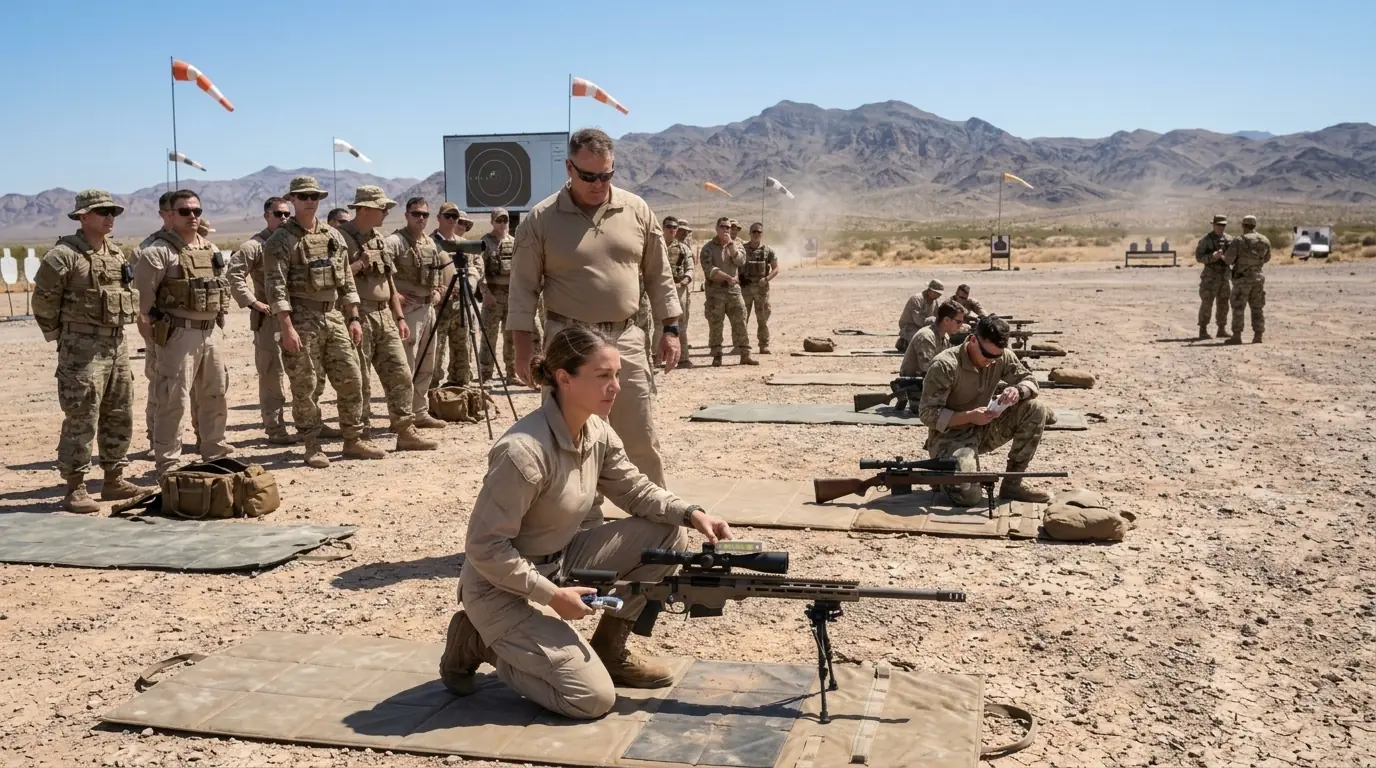
General Ryan Carter pulled off his shades, jaw clenched. “Any shooters left?” Dead quiet. Then a cool, unshaken female voice sliced through the heat. “May I have a turn, sir?”
Every head snapped around. A woman walked out from the supply tent. Plain uniform, zero patches, zero fame, just quiet certainty. Dawn cracked over the Arizona post. Captain Emily Brooks woke without an alarm.
Thirty-two years old, medium height, brown hair twisted into a tight knot. Nothing about her screamed special. That's the point. She brewed black coffee in a dented steel pot. No sugar, no cream, just fire and fuel.
While it brewed, she knocked out fifty push-ups on the icy barracks floor. Then sit-ups, then stretches that tug at old scars nobody mentions. From under her bunk, she dragged out a battered rifle case. Inside was an M2010 sniper rifle retired 3 years back. The weapon was no longer listed on her official inventory.
It did not matter to her. Every morning, she broke it down, cleaned every part, and put it back together in four minutes flat. Muscle memory never slept. She drank her coffee standing at the window, watching the sun gild the mountains. The rifle gleamed on her cot.
By 0600 hours, she was dressed and striding across the training yard to the logistics office where she kept supply chains humming and ammo counts perfect. Not sexy, not combat, just vital. A squad of soldiers jogged past, young guys with fresh fades and loud jokes. One whistled, “Hey, coffee girl, any donuts today?”
Another piled on, “Inventory princess.” Emily kept walking, boots crunching gravel, but her eyes, anyone paying attention, would see them track motion like a hawk. She clocked the tiny hitch in the third guy's left knee. She noted the way the fourth favored his right shoulder, read wind speed from the fluttering flags, and judged the distance to the range from the echo of practice rounds. She saw it all.
At the ammo depot, a rookie dropped a crate. Rounds spilled everywhere, mixed calibers, different grains, chaos. “Damn,” the kid muttered, dropping to his knees. Emily knelt beside him. No word, she sorted the rounds by caliber, grain, and maker in under 30 seconds.
She placed each one exactly where it belonged. The rookie gawked. “How did you do that?” “Physics,” Emily said simply. She stood, brushed dust from her palms, and walked away.
Staff Sergeant Lopez, watching from the doorway, squinted. That wasn't luck. That was schooling. Deep schooling. He filed it away but stayed quiet.
It was intentional sabotage meant to make her miss her deadline and look incompetent in a non-combat role. Without saying a single word, Emily walked to the nearest workbench, pulled out a fresh manifest sheet, and began rewriting the entire inventory from memory. The rapid, rhythmic scratching of her pen against the ledger paper was the only sound, each entry a stark, silent rebuke to their petty malice. She didn't check her notes or consult the physical stock. The count, batch numbers, expiration dates, and total weight flowed perfectly onto the new form, accurate down to the last digit.
When the armorers finally sidled past, pretending to leave, she simply placed the completed, spotless manifest exactly where the ruined one had been, a full 5 minutes ahead of schedule. The silence that followed her action was heavy, with a grudging, resentful acknowledgement of her competence far more potent than any shouted argument. Later that morning, Emily sat in a briefing room with 15 other officers. Major Powell clicked through slides up front. “The 4,000-meter trial,” he declared. “An experimental extreme-range program. We’re picking shooters for elite training.” Names flashed on the screen. Top-tier snipers, match winners, combat vets with confirmed kills at crazy distances. Emily’s name never appeared.
Without glancing her way, Major Powell told Captain Brooks, “These are combat billets only. No supply officers.” She nodded once, no pushback, no whine, but her hands on the table tightened for half a heartbeat. Just outside the briefing room, Staff Sergeant Lopez, the officer who'd seen her quick work with the spilled ammo, intercepted her path. He was a barrel-chested man, his uniform straining over hard muscle, bearing a reputation earned in places the media never talked about. “Brooks,” he rumbled, keeping his voice low but tight with professional condescension. “You think that nod fooled anyone? I saw you sort those rounds. Good logistics work—for a support role.”
He stepped closer, his shadow falling over her. “But this is combat. The 4,000-meter trial is not about counting. It is about discipline under impossible conditions. You do not have the experience for the calculations when the wind turns vicious, Captain.
Do not embarrass the command by stepping outside your lane. Go count boxes. Leave the impossible to the professionals.”
Emily didn't flinch. She simply tilted her head, her gaze penetrating and utterly devoid of malice. “Sergeant,” she said, her tone cool and level, “the stomach for the math is the only thing that separates a shooter from a gambler, and my math is perfect. If the range opens up, I’ll see you on the mat.”
She didn't wait for his response, walking past him and leaving the senior sniper standing alone, a vein ticking visibly in his temple, unsure if he'd just been threatened or promised a public humiliation. After the meeting, she walked back to quarters alone. The sun was brutal now, white and mean. She passed the range where the chosen shooters were warming up. She did not slow down.
Back in her room, she opened her wall locker. Under folded uniforms and standard gear sat a small cedar box. She lifted the lid gently. Inside, a faded photo of five soldiers in desert camo. Younger Emily grinning rare, surrounded by her squad.
Beneath the picture, a silver casing etched with coordinates and a date. Afghanistan, 2016. She shut the box, slid it back into shadow. Some memories stayed buried. Two days later, the whole base packed the extreme range lane.
General Ryan Carter stood in front of hundreds uniform sharp despite the furnace heat. Behind him, a giant screen showed a target 4,000 meters away, almost 2.5 miles. “This isn’t ego,” Carter began, his voice carrying over the troops. “This is about stretching what human beings can do. The Phantom training program needs shooters who can make impossible shots under impossible conditions.”
He swept an arm toward the range. “Four thousand meters. Wind, heat, mirage, and an enormous ballistic drop. One round. Whoever rings steel earns the slot.”
Before the first shooter even touched the rifle, a nervous colonel approached General Carter, pulling him aside near the command trailer. The colonel's face was pale beneath his tan. His voice a frantic whisper. “General, sir, we need to cancel this distance now. The range-control data shows a fourteen-degree temperature inversion over the second mile, creating an unstable mirage.
Our simulations say the margin of error at 4,000 meters is nearly impossible to manage. This is not a trial, sir. It is a spectacle of failure, and it may shatter the morale of every elite shooter here.”
Carter listened. His eyes fixed on the distant target, almost invisible against the heat haze. He reached into his breast pocket, pulled out a worn photograph of his Kandahar fire team, and tucked it back in without a word. He turned to the colonel, his voice a low, hard rasp that tolerated zero dissent. “Impossible is exactly what Phantom needs, Colonel.
If they cannot face this range, they cannot face the threat. If the rules of physics seem broken, we need to find the shooter who can write a new rule. The distance stays. Every miss today is a lesson they would rather learn here than in a hot zone.”
The colonel swallowed hard, glanced from the general to the impossible distance, and retreated without another argument, the absolute finality of Carter's resolve hanging in the desert air. 13 elite snipers step up. Men with medal racks, trophy cases, operators with three-digit body counts. The crowd watched in hushed respect as the first shooter settled in. He was meticulous, checking the wind and humidity before adjusting his scope with surgical precision.
He breathed, steadied, and fired. The report cracked. 4 seconds of nothing. Then the spotter, “Miss, two meters left.”
The shooter stands annoyed but cool. The second sniper took the mat, faster, cockier, ex-Marine scout with ice in his veins. He fired, “Miss, three meters right.”
The snipers were not simply missing the steel. They were failing to even hold the same square meter. The spotter's calls, high 1.5 right 0.8, dead vertical left two. One charted a dizzying pattern of dispersion, a visible map of the desert's chaotic manipulation. Captain Diaz watching from the periphery muttered to Lieutenant Parker, “They’re fighting a kaleidoscope,” Captain Diaz muttered. “Look at the mirage near the 3,000-meter mark. It is not merely bending the light; it is making the target appear to breathe with the heat pockets. You cannot calculate for something that changes during the bullet’s flight.”
A renowned competitive shooter, a man who lived by his charts threw his logbook onto the ground in frustration. The heavy paper fluttering open to pages of useless data. His teammate knelt gently retrieving the book, his expression one of profound professional defeat. “It’s the Coriolis effect,” one shooter whispered, a tremor in his voice. “We adjusted for spin, but the density shift is disrupting the vertical plane.
It is too complex. The target might as well be on another planet.” The collective realization settled over the elite crew. This wasn't about equipment or skill anymore. It was a physics problem, too dense, too dynamic, and too cruel for human calculation.
The third shooter missed, then the fourth and fifth. Each brings different gear, different voodoo, different swagger. Each misses. The crowd's buzz fades to nervous quiet. The sixth, seventh, and eighth shooters missed as well.
By the tenth miss, whispers rippled through the crowd. Conditions must be rigged. Maybe the target's busted. Maybe this is a psych out. General Carter watched stone-faced, arms folded.
The eleventh missed, then the twelfth and thirteenth. Captain Diaz, the final shooter, lowered his rifle in frustration. He's rung steel at 3,200 meters before. This should be doable, but it isn't. Carter scans the formation. “Anyone else?” Nobody breathed. The best shooters on the post had all failed. Who'd step up now? The silence dragged on.
Then from the back row, a voice. “May I try, sir?” Heads swiveled. Confusion spreads like wildfire. Emily Brooks threaded through the crowd.
She's in everyday utilities. No plate carrier, no tricked out rifle. Lieutenant Parker actually laughed out loud. You for real right now? Captain Diaz smirked.
She doesn't even rate a combat badge. Maybe she'll shoot the moon. Someone snorts. Chuckles spread. Emily kept walking, eyes locked forward.
As Emily reached the firing line, Captain Diaz, still stewing from his humiliating miss, spoke up with a malicious edge. “Wait a minute, General. If she is going to make a spectacle, let us at least make it fair. That CheyTac has a fresh zero. Brooks, the supply clerk, has not fired a precision round in three years.
She probably could not tell the difference between a mil-dot and a donut. I demand that she use my rifle.” He gestured toward his heavily customized, personally tuned long gun, a masterpiece of expensive engineering that required weeks to master. General Carter started to intervene, but Emily cut him off, her voice slicing through the tension like cold steel. “No, sir,” she said, addressing Carter while keeping her eyes fixed on Diaz. “His rifle is tuned to his breath control and his visual habits. It is his equation. I brought my own.”
She reached into a small canvas pouch she carried, not her journal, but a specific kit. From it, she produced a single high-tolerance micrometer and a miniature spirit level. She carefully placed the level on the CheyTac scope rail and then with uncanny speed used the micrometer to check the exact distance of the locking lugs on the rifle's bolt, the heart of its accuracy. She glanced at Diaz, her expression utterly flat. “I know this weapon down to its smallest tolerances,” she said. “If I miss, it will not be the rifle’s fault.” The raw, undeniable confidence of her physical inspection, the way she treated the foreign weapon like an extension of her own nervous system, snapped the laughter out of the crowd's lungs. Diaz could only watch his challenge neutralized by her sheer intimidating professionalism. General Carter studies her. Something scratches at memory, something he can't grab.
Her face rang a bell, but from where? “Captain Brooks,” he said slowly. “You understand that this is 4,000 meters, with shifting wind and mirage distorting everything beyond the midpoint?” Emily answered calmly. “Yes, sir. I understand.”
The crowd hushed. Carter held her stare for a long moment, then tipped his chin. “One round, Captain. Do not waste it.”
Emily stepped to the line. The rifle waiting is a CheyTac Intervention, brand new, foreign, not her old M2010. She lifted it, felt its balance, and cycled the bolt. Trigger crisp, glass clear around her. Troops whispered and grinned. “This will be rich.” A supply clerk outshooting elite snipers—the thought amused the crowd, but Emily tuned them out. She pulled a small leather journal from her pocket, flipped to pages crammed with scribbled dope wind formulas, density tables, Coriolis charts. She studied the wind flags, then the heat ripples dancing over the berm. Her gaze traced invisible rivers in the air.
She drew one round from her pocket, rolled it in the sunlight and checked its balance. Custom loaded, perfectly balanced. She seated it with ritual care. The crowd leaned in despite themselves. Emily dropped prone, settled the stock and peered through the scope.
The sun scorched the firing line. Sweat beaded on everyone except her. Breathing slow, metronome steady. Heart rate 58 bpm. The desert noise the murmuring crowd, the thrum of generators all coalesced into a loud buzzing backdrop that most snipers try to eliminate with deep concentration.
But Emily didn't try to eliminate it. She processed it, absorbing every vibrational input. As she settled into the absolute perfect point of tension, that sweet spot between full relaxation and taut control, her senses intensified beyond the realm of normal perception. The faint woo woo woo of a helicopter engine miles away told her the pressure gradient was dropping slightly north of the range. The dry papery rattle of a tumbleweed snagged on the fence behind her indicated a new lower ground level gust not visible on the flags.
She felt the micro vibrations of the concrete slab through the cheek rest, sensing the subtle thermal shift in the pad beneath her body. Her skin read the air density against her exposed forearms like Braille translating invisible dynamic pressure differentials into pure raw data. This wasn't observation, it was communion. For a fraction of a second, the entire complex ecosystem of the desert became a single perfectly legible three-dimensional blueprint of the bullet's inevitable path. That single silent moment of complete sensory absorption was the core of her Viper ability, the reason she never needed the electronics everyone else relied upon.
The wind shifted. Without relying on the electronics around her, Emily accounted for the gusts, heat distortion, air density, spin drift, and the Earth’s rotation. Years of practice compressed the calculations into instinct. She settled behind the rifle, slowed her breathing, and waited for the quiet instant between heartbeats. Then she fired.
Crack like judgement day. Recoil familiar, almost kind. The bullet leaped forward, a copper-jacketed prayer arcing across 2.5 miles of desert. The crowd froze. The round climbed, peaked, and fell.
Wind pushed, but her calculations held. Gravity pulled, but she had accounted for it. Time stretched, and then came a faint metallic ring. Faint but pure. Metal kissing metal.
Spotter whispers, Hit. Then shouts, Hit bull's-eye. The formation erupted, but Emily remained composed. She engaged the safety, set the rifle down, and gently removed her hearing protection. Hands rock steady, face serene.
General Carter stepped up staring at the jumbo screen. The cheer from the troops was deafening, a sudden cathartic explosion of sound, but it didn't last. As Emily sat up calmly disconnecting herself from the rifle, a strange absolute silence fell over the firing line, dominated by the heavy panting breathing of the 13 elite shooters. Captain Diaz, still kneeling by his untouched gear, was visibly shaking, his face drained of color as he stared at the screen's dead center hole. Lieutenant Parker, who'd mocked her mercilessly, walked 3 ft behind the firing line and simply vomited into the gravel, the humiliation a physical gut punch.
The shock wasn't just that she hit the target, it was how clean the hit was, proving their collective failure wasn't due to impossible conditions, but due to their own comparative inadequacy. Staff Sergeant Lopez, the man who had warned her to stay in her lane, slowly picked up the logbook the competitive shooter had thrown down, and with a grim reverence smoothed out the crumpled pages, recognizing that every equation he had ever relied upon had just been rendered obsolete. Emily didn't spare any of them a glance. She simply removed her ear protection, adjusted the knot of her hair, and waited for the general to speak her composure, a silent devastating indictment of their swaggering noisy efforts. The hole sat dead center, the cleanest 4,000-meter shot Carter had ever witnessed. “How did you account for all of that?” he asked, his voice carrying. Emily met his eyes. “Physics, sir. Wind, heat, mirage, density, and repetition.”
Lieutenant Parker looked sick. Nothing standard about that. Emily’s face did not move. Just math and reps. “Where did you get that experience?”
Carter asked. Emily paused. “Afghanistan, sir. Operation Silent Guardian, 2016. I was the overwatch shooter covering your team.”
Carter froze. The general’s eyes widened. Memory slammed home. Kandahar province. His platoon pinned in a mud-walled maze eating fire from three rooftops.
They were done. Then from nowhere, enemy gunners started dropping. 1 2 3. Perfectly placed shots from a ghost they never spotted. Command later said, “Phantom unit.
Call sign Viper One.” “They never said the shooter was a woman,” Carter breathed. “You pulled us out of the fire.”
Emily nodded once. The crowd had gone church-quiet, but now the silence held reverence. Carter did something rare. He smiled, warm and genuine. He snapped a salute. “Welcome back, Viper One.” Emily returned it. Razor crisp around them. Slowly, soldiers started to clap. One, then ten, then hundreds.
Not mockery, not shock, respect. The sound rolled like artillery across the sand. Three days later, the post felt changed. Emily still clocked in at logistics, still ran ammo spreadsheets and gear manifests. But when she crossed the grinder, troops nodded.
Some offered salutes even outside her chain. The jokes had died overnight. Lieutenant Parker found her at the depot, hands clasped behind his back, sheepish. “Captain Brooks,” he said, “I owe you an apology.” Emily looked up from her tablet. “For what?” “For doubting you. For laughing.” She weighed it, then nodded. “Apology accepted. You did not know. Still, it was weak.”
He shifted his boots. “Could I ask you something?” “Go ahead.” “How do you shoot like that? I have trained for ten years and never seen anyone calculate that quickly.”
Emily set the tablet down. “You trained for ten years. I calculated and practiced for fifteen. Every shot is an equation.”
She broke down wind, distance, temperature, density, and rotation in broad terms. “The feeling is not magic. It is repetition—thousands of hours reading terrain and learning how conditions change. Drill until the math becomes instinct.”
Parker nodded slowly, absorbing every word. “There is no secret,” Emily continued. “Just work. Most people want the trophy, not the grind.”
She lifted the tablet and returned to work. Parker lingered, then walked away, considering her words. That afternoon, General Carter called her to his office. Sparse room. Flag in corner, framed ops on walls, desk buried in intel.
Carter stood when she entered. At ease, Captain. He pointed to a chair. Sit. Emily sat ramrod straight.
Carter opened a drawer, lifted out a small cedar box, and placed it between them. “I did some digging,” he said. “Phantom Cell, 2014 to 2017. Forty-seven confirmed engagements beyond 1,500 meters, seventeen missions, and zero friendly casualties. You were the primary shooter.”
Emily stayed quiet. “Then the unit folded after the Kabul mission. Most operators transferred to other teams, but you stopped. You requested a supply assignment. Why?”Emily studied her boots. “I was done, sir.” “Done with what?” “Done taking lives.”
The truth hangs heavy. Carter nodded slowly. “I understand. But that shot three days ago was not luck.” “That was surgical.” “Muscle memory does not retire,” Emily said quietly. “No,” Carter agreed. “It does not.”
He opened the cedar box. Inside lay a plain silver star. No ribbon, no fanfare. “This is not official,” he said. “No cameras, no parade.
Phantoms do not receive those, but I wanted you to wear it anyway.” He pinned it himself. “For duty beyond expectation, and for lives saved in the dark.”
Emily touched the star and felt its weight. “Thank you, sir.” Carter sat. “One more thing.”
He slid a folder across the desk. “We are rebuilding the Phantom program. New rules, new missions, new blood. We need someone to shape them—someone who knows precision is discipline, not noise.”
Emily opened the folder, inside dossiers on fresh faces, hungry eyes. “You want me to teach?” she asked. “I want you to command them, train them, and forge them into something the military has never fielded.”
She studied the photos. So young, so sure, so blind to the bill. “When do I start?”
Carter smiled. “0600 hours tomorrow.” Emily shut the folder, stood, and saluted. As she reached the door, Carter called, “Captain Brooks.”
She turned. “For what it is worth, I am sorry it took me years to see you.” Emily’s expression softened slightly. “You see me now, sir. That is enough.”
She left. Carter watched the door, then glanced at the framed photo on his desk. His fire team in Kandahar, 2016. All of them were alive because of a phantom he had only just recognized. One week later, dawn was cold and clean over the memorial wall on the east fence.
Black granite drank the sunrise names etched deep, troops who never rotated home. Emily stood alone, breath fogging, her fingers traced letters she knew by heart. Sergeant Tyler Reed, Specialist Mia Wong, Corporal Jacob Holt, Lieutenant Ryan Quinn, her Phantom Squad, her family the ones lost in Kabul. Three years back, bad intel walked them into a kill box built for twice their number. Emily on overwatch a mile out glassed her friends dying.
She dropped 12 tangos that day, cooked her barrel cherry red shot till her fingers split, till dustoff bird screamed in, but she couldn't save them all. Four names on that wall belonged to her memories. She pressed her forehead to stone. “I’m sorry,” she whispered. “So damn sorry.”
Wind kicks up swirling dust and creosote smell. Flag snaps overhead. Boots crunch gravel behind her. She doesn't turn. General Carter steps beside her eyes on the names. “I read the after-action report. You held that ridge alone for forty-three minutes against a force twice your size. Four of your people still died, but fourteen more would have without you.” Emily's jaw locks. Math doesn't numb the ache. No. Carter said softly. It doesn't.
They stand shoulder to shoulder, two soldiers who know winning and bleeding share the same foxhole. “Why come back to this life?” Carter asked. “You had quiet. You were safe in supply.”
Emily finally met his eyes. “Because those four up there did not get a vote. They would want the mission to keep breathing. Train the next ones. Keep the wall shorter.” Carter nodded. That's why I tapped you. I know. The ceremony's in an hour. he said.
I know that, too. She drew a breath, stepped back and squared her uniform, quickly brushed away her tears. “They would have been proud of that shot,” Carter said. “Reed would have complained that I took too long calculating,” Emily answered with a faint smile. “Wong would have complained about the heat.
Holt would have bet a month’s pay on the exact impact.” Her smile faded at Quinn’s name. “Quinn would have told me to stop haunting yesterday. Solid advice. He gave it better than he followed it.”
She touches granite once more. An hour later, the parade deck fills with dress blues. Small affair, no press, no civilians, just troops who get it. General Carter at the podium, Emily to his right hating every eye. “We rarely shine light on work performed in the shadows,” Carter began. “We rarely thank victories won without headlines. But today we honor Captain Emily Brooks, Viper One, for service that redefined what was possible.” He turns to her. “Captain Brooks represents what we hope every soldier becomes: skill without swagger, power without pride, and accuracy without cruelty. She has saved lives most of us will never count, and now she will forge the next Phantom generation.”
Polite applause rolls. Carter dropped his voice just to her. “That shot last week was not about steel. It proved that greatness does not shout. It simply lands.”
He stepped back and saluted crisply. Emily returned it, then faced the formation. “I am no hero,” she said clearly. “I am a soldier who learned to aim true. The real heroes are carved behind you.
They moved toward danger when others could not. I only kept the list of losses shorter.” She paused. “If I teach you one thing, it is this: precision is mercy. Discipline can prevent another life from being lost.
When we train, I will not make killers. I will make professionals—exact, controlled, and respectful of the weight of every decision.” The deck became church-quiet again. “We start at dawn,” Emily said. “Be ready to sweat.
Be ready to miss. Be ready to outgrow every limit you brought.” She stepped back. The flag overhead shone bright against the endless blue. That night after ribbons and handshakes, Emily returned to her quarters.
She packed uniforms, gear, keepsakes. Two duffels and a rifle case. Traveling light was an old ghost’s habit. Never carry more than you could run with. A knock sounded at the door.
General Carter stepped in holding a thick folder. “Your orders,” he said, handing over the folder. “The paperwork says Special Operations Training Command.” “Reality says Phantom Cell,” Emily finished. “New name, same mission.
Elite shooters, no-win assignments, and no public credit.” She opened it. Schedules, syllabi, five mug shots. Three guys, two women, all hungry. “These are my people?”
she asked. “Your fire team. You will break their bad habits, build their discipline, and turn them into something extraordinary.”
Emily studied the faces. Cocky. Good. “Arrogance without skill fills body bags. Quiet victories are the hardest, General,” she said, her voice dropping. “They do not fill the gap in your memory when things go wrong. They do not pay the price of command.” She reached into her pocket and pulled out the spent casing, the one etched with the Kandahar coordinates she always carried. She didn't offer it, just held it, letting Carter see the dull gleam of the empty shell. “This is the price—a piece of the past that never leaves.
If I take these five, you must guarantee that they understand the cost of every decision, not merely the mechanics. No shortcuts. No compromise on the discipline that keeps their names off a wall.”
Carter didn't need to ask whose coordinates were etched there. He knew the memory she carried. He walked around the desk, stopping beside the flag, and placed his hand on the heavy folded corner of the training folder. “Captain Brooks, they will be your legacy, not your debt. The cost has already been paid.
Now it is time to build the armor.” He waited until she nodded a silent, profound acceptance of the command's singular, terrifying burden. “And you think I can fix that?”
Carter locked eyes with her. “I think you can show them what mastery, discipline, and silent professionalism look like.” Emily nodded slowly. “One rule.” “Name it.” “My command, my rules. No cameras and no ego. We win quietly, or we do not win.” “Deal.”
She closed the folder. “When do I leave?” “The aircraft departs in two hours. The site is classified. You will have full authority once you land.” “Perfect.” Carter offered his hand. “Thank you, Captain, for putting the uniform back on and trusting the mission again.”
Emily gripped it firmly. “Do not make me regret round two.” “I will try not to.”
Two hours later, a C-130 sat on the runway engines whining awake. Emily crossed tarmac, duffel slung, rifle case in hand. The sun bled out, sky bruised purple and gold. The desert swallowed the horizon. She climbed the ramp, claimed a canvas seat in the belly, buckled in.
The turboprops howled. The plane lumbered forward and lifted into the sky. From her pocket, Emily pulled one casing silver etched with Kandahar numbers. She held it to the dying light, watched it glow, then pocketed it, rested her head against the cold fuselage, and closed her eyes. The aircraft climbed into the darkness.
Somewhere ahead, five rookies waited to learn what phantom means. And Emily Brooks, Viper One, was going to burn the lesson into their bones. Phantoms were not supposed to be real, but their presence was never forgotten.