For six Christmases, Jack Callahan had managed to make December 25 feel like any other day.
That required discipline.
He rose before dawn.
Fed the cattle.
Broke ice from the water trough.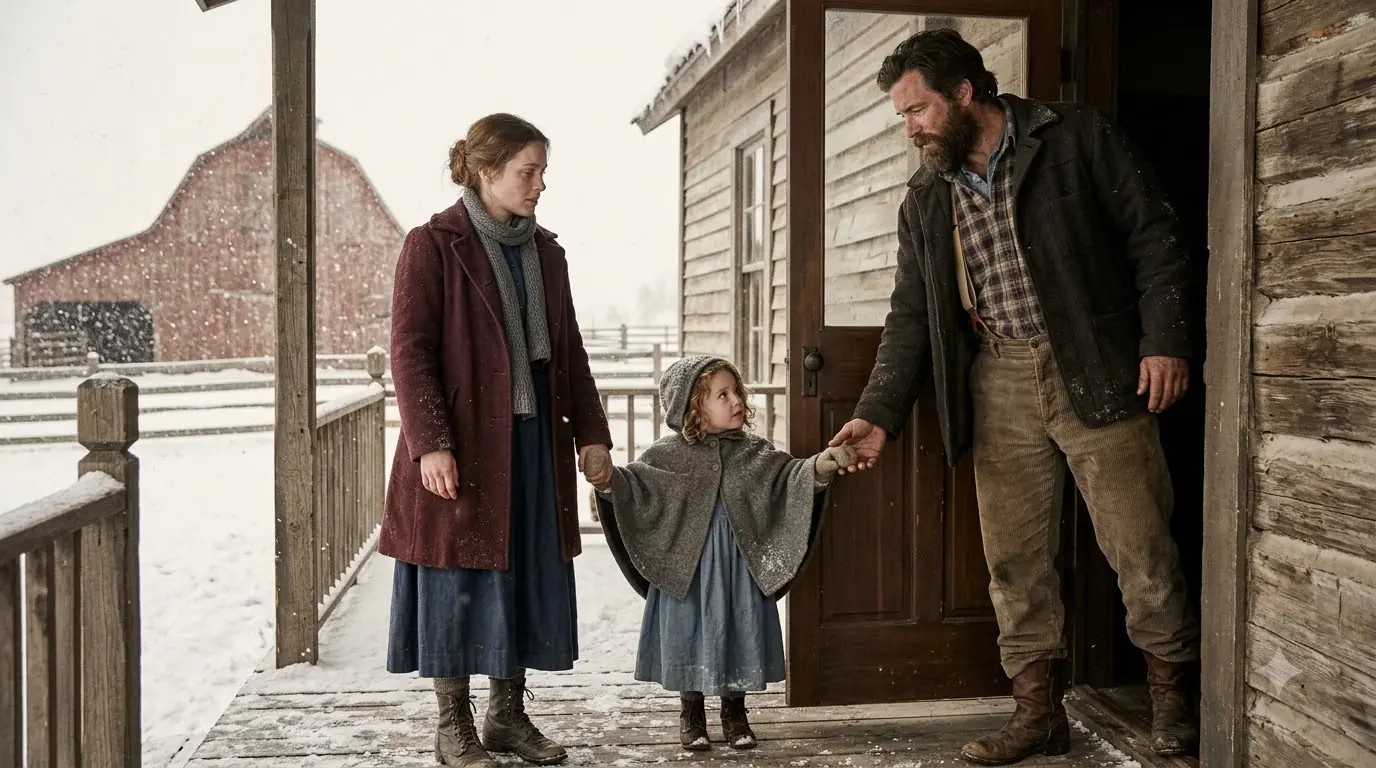
Checked fence lines.
Carried firewood.
Repaired whatever could reasonably be repaired, then invented things to repair when the work ran out.
By nightfall, exhaustion usually accomplished what whiskey could not.
It stopped him from thinking.
Christmas had once been Jack’s favorite day of the year.
That was before Mary.
Before Lucy.
Or, more accurately, before losing them.
The farmhouse had been different then.
Not larger.
Not richer.
Just alive.
Mary Callahan had been incapable of moving quietly through a kitchen. She hummed while she cooked, talked to herself while she baked, and scolded utensils as if spoons and pans possessed personalities.
Lucy had been worse.
At four years old, she seemed determined to make every room louder than the last.
She would race through the house wearing wool stockings, dragging a wooden horse by a string while demanding that her father lift her high enough to touch whatever object she had decided was beyond her reach.
At Christmas, that object was always the highest branch of the evergreen.
“Higher, Daddy.”
“You're already taller than me.”
“Higher.”
“If I lift you any higher, you'll be living on the roof.”
Lucy would laugh.
Mary would stand in the doorway with flour on her cheek and say:
“Don't encourage her.”
Jack always encouraged her.
Then one winter morning, Mary and Lucy traveled into town to visit Mary’s sister.
They never returned.
A wagon overturned on an icy ridge.
By the time help arrived, there was nothing anyone could do.
People came to Jack afterward.
Neighbors.
Friends.
The pastor.
Men he had worked beside for years.
Women carrying casseroles nobody expected him to eat.
They said the things people say when language is too small.
God has a plan.
They're together.
Time will help.
You must stay strong.
Jack discovered he hated nearly all of those sentences.
So he stopped giving people opportunities to say them.
He worked.
Then worked more.
Over time, neighbors learned not to invite him to Christmas dinner.
Jack learned how to spend twenty-four hours without saying another person's name.
The farmhouse adjusted around him.
Lucy’s room remained untouched.
Mary’s cookbooks collected dust.
The dining table became a place for tools, receipts, and feed invoices.
Jack ate standing at the stove more often than sitting down.
Every December he cut enough wood to last until spring, even when the shed was already full.
It gave him something to do.
In December of 1887, however, the woodpile could not protect him from Sarah Collins.
He met her four days before Christmas.
Snow had begun shortly after noon.
Not heavy.
Just enough to turn the road pale.
Jack was carrying a sack of grain from the wagon when he noticed two figures standing beyond his front gate.
A woman.
And a child.
The woman was young.
Late twenties, perhaps.
She wore a charcoal wool coat too thin for Wyoming winter, a faded burgundy dress beneath it, and a gray scarf wrapped around her throat.
Chestnut hair had been pinned into a loose bun, though the wind had freed several strands.
She held the hand of a tiny girl wrapped in a worn gray cape.
The child looked about three.
Golden-brown curls.
Blue eyes.
Boots that seemed half a size too large.
Jack lowered the grain sack.
The woman lifted one hand.
“Mr. Callahan?”
He approached slowly.
“Yes?”
“My name is Sarah Collins.”
Jack waited.
Sarah looked uncomfortable.
Not frightened.
Proud.
There was a difference.
“I heard at Parker’s store that you were looking for someone to prepare Christmas dinner.”
Jack almost corrected her.
He had not been looking.
Mrs. Parker had apparently decided he should.
Three days earlier, while buying coffee and nails, Jack made the mistake of mentioning that his stove smoked badly whenever he tried roasting anything larger than a rabbit.
Mrs. Parker asked what he intended to eat for Christmas.
Jack said:
“Whatever doesn't burn.”
Apparently she interpreted that as an advertisement.
“I wasn't exactly looking,” Jack said.
Sarah’s expression fell.
Only for a second.
Then she recovered.
“I understand.”
She started turning away.
Jack noticed the little girl's boots.
Snow had soaked through one seam.
Then he noticed Sarah's hands.
Red with cold.
“Wait.”
Sarah stopped.
Jack looked toward the farmhouse.
Then back.
“You cook?”
“Yes.”
“Well?”
She almost smiled.
“Well enough that people have paid me for it.”
“How much?”
“For what?”
“Christmas dinner.”
Sarah hesitated.
Jack had no idea what such work should cost.
He said:
“Twenty dollars.”
Sarah's eyes widened.
Too much, apparently.
Jack realized that too late.
He nearly reduced it.
Then saw her expression.
Not greed.
Relief.
Raw enough that she looked away quickly.
“Twenty?”
“Yes.”
“I provide the food.”
“Yes.”
“And I cook.”
“Yes.”
“Nothing else?”
Jack frowned.
“What else would there be?”
Sarah held his eyes for a moment.
Then nodded.
“Nothing.”
Jack glanced at the child.
“And she comes with you.”
Sarah immediately straightened.
“She doesn't cause trouble.”
“I didn't say she did.”
“I can't leave her.”
“I didn't ask you to.”
Sarah relaxed slightly.
The girl stared at Jack.
Jack looked down.
She moved half behind her mother.
“What's her name?”
“Gracie.”
Jack's chest tightened.
Children’s names still did that sometimes.
He hated that.
“Hello, Gracie.”
She did not answer.
Sarah said:
“She's shy.”
Jack nodded.
“Christmas morning?”
“Early.”
“How early?”
“Before sunrise, if you need.”
Jack almost said no.
Nobody should walk that road before sunrise with a three-year-old in winter.
“Eight.”
Sarah looked relieved.
“Eight.”
Jack walked back toward the barn.
Sarah called:
“Mr. Callahan?”
He turned.
“Thank you.”
Jack had no answer.
He simply nodded.
Then watched mother and child disappear down the snowy road.
The farmhouse felt different when he entered.
Not warm.
Not yet.
But expectant.
That evening, Jack stood in the kitchen and looked around as though seeing the room through someone else's eyes.
Dust near the high shelves.
One chair with a loose leg.
Cupboard doors slightly crooked.
A blackened stove.
A table covered with receipts.
He spent two hours cleaning.
Then hated himself for caring.
He carried the receipts into his study.
Fixed the chair.
Scrubbed the stove.
The next morning he drove into town.
Mrs. Parker saw him enter the general store and smiled like someone who knew she had committed a successful crime.
“You found her.”
Jack stopped.
“You sent her.”
“I mentioned you might need help.”
“You told her I was hiring.”
“I improved the truth.”
Jack glared.
Mrs. Parker kept smiling.
“What do you need?”
Jack placed a list on the counter.
Flour.
Sugar.
Butter.
Coffee.
Potatoes.
Carrots.
Onions.
Fresh beef.
Apples.
Cinnamon.
Nutmeg.
Eggs.
Milk.
Yeast.
Mrs. Parker read it.
Then looked at him.
“You feeding the county?”
“Christmas dinner.”
“For three?”
Jack hesitated.
“Maybe.”
That smile returned.
“Don't.”
“I didn't say anything.”
“You're thinking loudly.”
She filled the order.
As Jack loaded the wagon, Mrs. Parker handed him a paper-wrapped package.
“What is this?”
“Ribbon candy.”
“I didn't order candy.”
“It's for the little girl.”
Jack stared.
Mrs. Parker became serious.
“She likes peppermint.”
“How do you know?”
“Sarah sometimes brings her here.”
Jack nodded.
Then put the package into the wagon.
Not because he cared.
Because returning it would be rude.