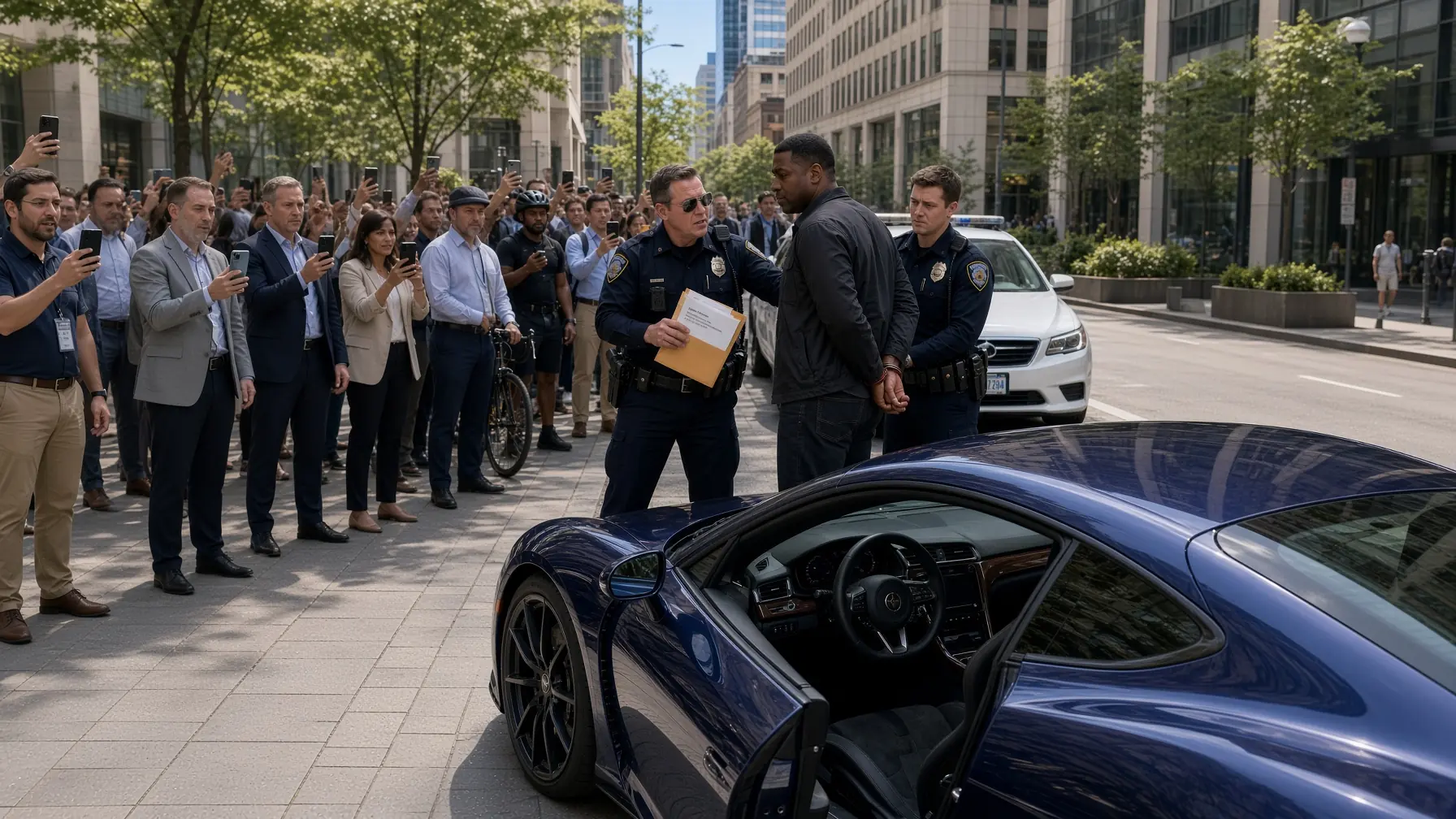
“Step out of the vehicle.”
The command cut across the boulevard before the engine had fully settled into silence.
Julian Mercer kept one hand resting lightly on the steering wheel and the other visible near the center console. The car around him was almost too quiet, its cabin wrapped in black Alcantara, brushed titanium, and deep walnut trim polished until it looked like still water. Morning light slipped through the windshield and caught the silver edge of the watch on his wrist.
Outside the window, Officer Calvin Rourke stood with mirrored sunglasses, one hand close to his holster, staring at the car as if the machine itself had committed a crime.
“You expect me to believe this belongs to you?” Rourke asked.
Julian did not answer immediately.
He had learned a long time ago that silence made certain men uncomfortable. Not because it was rude, but because it refused to perform fear for them. He exhaled slowly, then reached toward the glove compartment with a movement so careful it looked practiced because it was.
“Don’t move,” Rourke snapped.
Julian froze.
Pedestrians had already begun to slow along the sidewalk. A cyclist stopped near the curb. A woman carrying coffee lifted her phone before she even understood what she was filming. Someone behind the small crowd muttered, “Of course they stopped him. Look at that car.”
Julian heard it.
He did not look back.
Because he knew the stop was not really about the car.
It had never been only about the car.
The coupe sat low and sharp beneath the morning sun, painted a deep obsidian blue that shifted toward violet when light moved across its hood. It was a one-off executive prototype, hand-built under a restricted internal program and worth more than most houses on that street. The public would not see the production version for another nine months.
Julian knew that because he had approved every inch of it.
The steering ratio.
The battery architecture.
The leather stitching.
The shape of the vents.
The way the doors closed with a soft, expensive certainty.
But to Officer Rourke, the car presented a simpler story.
A Black man.
A half-million-dollar machine.
A city street.
A question he believed his badge gave him permission to answer before asking.
Julian rolled the window down another inch.
“Officer, I just took delivery of this vehicle from the Mercer Auto Gallery three blocks behind us. The paperwork is in the glove compartment. If you allow me to retrieve it, you can verify ownership immediately.”
Rourke tilted his head.
“Mercer Auto Gallery?”
“Yes.”
“You’re saying they handed you this car?”
Julian held his gaze.
“Yes.”
Rourke laughed once.
Not loudly.
That would have been too honest.
It was a small laugh, made for the people watching.
“Step out.”
Julian did.
Slowly.
He was forty years old, tall, broad-shouldered, and dressed far more simply than people expected of men with his money. A charcoal polo, dark jeans, espresso-brown loafers, and a light jacket with a nearly invisible crest stitched near the inside pocket. Nothing flashy. No diamond chain. No chauffeur. No assistant standing beside him with a leather folder.
He had chosen simplicity on purpose.
That morning was supposed to be private.
He had wanted to pick up the prototype himself, drive it alone through the city, feel the machine on real pavement, and remember why he had entered the car business in the first place. He wanted five quiet miles before the meetings, before the investors, before the launch calendar, before everyone else told him what the car represented.
Instead, he stood on the sidewalk with phones pointed at him while an officer looked him up and down like an accusation.
“I want to speak with your supervisor,” Julian said.
Rourke’s mouth tightened.
“You don’t make demands here.”
“I’m making a lawful request.”
“You’re making trouble.”
Julian went still.
He had heard versions of that sentence since he was a teenager in South Harbor, Baltimore, long before anyone knew his name. Back then, he had been a skinny kid selling bottled lemonade outside the bus depot before school, counting quarters to help his mother keep the lights on. People called that hustle when other boys did it on television.
When Julian did it, security told him to move along.
His mother, Nadine Mercer, cleaned office buildings at night and worked a cafeteria line during the day. She raised Julian and his younger sister in a two-bedroom apartment where the radiator knocked all winter and the hallway light flickered so often nobody bothered reporting it anymore. Nadine had no inheritance to give him, no connections, no safety net.
Only one sentence, repeated until it became law inside him.
“Never let someone else’s small imagination become your ceiling.”
Julian carried that sentence through every year that followed.
At fifteen, he washed cars behind a repair shop for cash.
At seventeen, he could identify the sound of a failing alternator before most customers knew something was wrong.
At twenty-two, he started a mobile detailing service out of a borrowed van with bad brakes and a handwritten logo taped to the side.
By thirty, he owned five luxury detailing studios.
By thirty-five, he had bought his first dealership.
By forty, Mercer Automotive Holdings controlled 142 high-end dealerships, four restoration centers, a prototype engineering division, and the electric fleet contract for three major cities.
The showroom Rourke had just mentioned?
Julian owned it.
The car behind him?
Julian’s company built it.
The police cruiser parked at the curb?
Serviced under a municipal maintenance contract signed by Mercer Automotive six months earlier.
None of that mattered yet.
Because Officer Calvin Rourke had already decided what he was seeing.
The morning had started at the Mercer Auto Gallery on Orum Avenue, a glass building in the financial district where wealth was designed to whisper. No blinking signs. No loud banners. Just a spotless structure of steel, stone, and glass, with vehicles positioned like sculptures beneath precise white light.
Julian walked in through the front doors at 9:04 a.m.
He wore no suit.
No entourage.
No visible security.
The receptionist’s smile hesitated before becoming professional.
The security guard near the entrance straightened slightly and watched him for three seconds too long. A couple near the espresso bar turned, looked at Julian, then stepped a little closer to each other. It was subtle enough for deniability and clear enough for anyone who had lived under it.
Julian had seen that look in luxury hotels, first-class lounges, private clubs, charity galas, and boardrooms where his money had arrived before his body.
Are you sure you belong here?
He never answered the look.
He simply continued walking.
At the center of the showroom, beneath a ring of overhead lights, sat the car.
The Mercer Veylan X1 prototype.
Obsidian blue paint.
Satin-black wheels.
Hand-stitched interior.
A powertrain that had taken three years, sixty engineers, and two near-disastrous investor meetings to bring to life.
Julian stood in front of it for a long moment.
Not as a buyer.
As a man looking at a piece of his own history made metal.
Then the floor manager approached.
His name was Graham Ellison, forty-eight, polished, narrow-faced, and dressed in a black suit that looked more expensive than his courage. He held a tablet against his chest and offered Julian the kind of smile that said service was available but respect would require proof.
“Looking for pre-owned inventory?” Graham asked.
Julian kept his eyes on the car.
“I’m here to pick up the Veylan X1.”
Graham’s expression tightened.
“That vehicle is not available for public viewing.”
“I know.”
“It’s an executive delivery.”
“I know that too.”
Graham paused.
“And your name?”
“Julian Mercer.”
The silence changed.
Graham looked down at the tablet.
His thumb moved faster than before.
When the name appeared, his face lost color with impressive speed.
“Mr. Mercer,” he said. “I apologize. I didn’t realize—”
Julian turned toward him then.
“That’s usually the problem.”
Graham swallowed.
The paperwork came quickly after that.
Too quickly.
No celebratory photograph.
No polished delivery speech.
No champagne.
No cheerful congratulations like Julian had watched staff offer other clients for vehicles worth a third as much.
Just a printed packet, a key, a tight apology, and a room full of employees suddenly pretending they had not been watching.
Near the delivery bay, a young sales coordinator stood with a clipboard held close to her chest. Her name tag read Hannah Price. She was twenty-four, new to the showroom, and uncomfortable in a way that made her more honest than the people above her.
She had printed the final packet.
She had checked Julian’s executive registration.
She had seen Graham’s face before and after the name appeared.
When Julian passed her, she said softly, “Congratulations, Mr. Mercer.”
He looked at her.
It was the only sincere sentence anyone in the showroom had given him.
“Thank you, Hannah.”
She seemed startled that he knew her name.
Then he stepped into the prototype, closed the door, and let the engine wake beneath him.
For three minutes, the drive felt like peace.
The car moved through the boulevard with controlled silence, the steering alive beneath his hands, the electric torque smooth and immediate. Julian let himself breathe. He forgot Graham’s forced apology. Forgot the security guard. Forgot the couple by the espresso bar.
Then the lights appeared in his mirror.
Blue.
Red.
Authority arriving behind him because the world could not let him have even five quiet minutes.
Now he stood beside the car while Officer Rourke circled it.
Another patrol car pulled up.
The second officer, Mason Bell, younger and visibly uncertain, stepped out and looked first at the car, then at Julian, then at the growing crowd. His hand hovered near his radio but did not key it yet.
Rourke held out a hand.
“Keys.”
Julian looked at him.
“For what purpose?”
“To secure the vehicle.”
“The vehicle is already secured.”
Rourke leaned closer.
“You want to do this the hard way?”
Julian reached into his jacket slowly and removed the key card.
Bell stepped forward.
“Officer Rourke, maybe we should just run the VIN and the paperwork.”
Rourke did not look at him.
“Secure the suspect.”
The word moved through the crowd.
Suspect.
A woman near the curb said, “He showed him papers.”
Someone else whispered, “That car has to be stolen.”
Phones lifted higher.
Julian felt the first hand on his shoulder.
Then the second.
He did not resist.
He had learned the brutal arithmetic of public survival early. A raised voice could become aggression. A flinch could become resistance. A hand pulled away could become threat. Calm was not weakness.
Calm was strategy.
Bell cuffed him gently enough to reveal he knew the scene was wrong.
The metal still closed.
Rourke took the delivery packet from the passenger seat and scanned it as if truth were an inconvenience printed on expensive paper.
“Lucien—” he started, then corrected himself. “Julian R. Mercer.”
“That is my name.”
“Business cards and fake contracts can be printed anywhere.”
“That document came from the showroom.”
Rourke waved toward the building behind them.
“Then we’ll ask.”
He did not move to ask.
Instead, he spoke into his radio.
“Possible grand theft auto. High-value prototype. One male suspect detained.”
Julian closed his eyes for half a second.
Not because he was afraid.
Because he felt the old exhaustion rising through his chest.
The exhaustion of being asked to prove the obvious.
The exhaustion of being wealthy enough to own the room and still Black enough to be questioned at the door.
The exhaustion of dignity being treated like a luxury upgrade rather than a right.
Then a voice cut through the crowd.
“Stop. He did not steal that car.”
Everyone turned.
Hannah Price was pushing through the gathered people, still wearing her white showroom blouse and red name tag. Her face was pale, but her steps were firm. Graham Ellison appeared behind her near the showroom entrance, moving slower, looking as if he had already realized the damage was larger than he could manage.
Hannah reached the curb and pointed toward the delivery packet in Rourke’s hand.
“I printed those documents. I processed the executive delivery. That vehicle is registered under Julian Mercer through Mercer Automotive Holdings.”
Rourke frowned.
“And you are?”
“Hannah Price. Sales operations coordinator, Mercer Auto Gallery.”
Bell looked at her.
“You’re saying this man owns the car?”
“I’m saying he owns the company that owns the car.”
A sound rippled through the crowd.
Not quite a gasp.
Something more satisfying.
The sound of assumption losing its grip.
Graham finally reached them, sweat shining along his temple.
“Officer,” he said, voice strained, “there has been a mistake.”
Julian opened his eyes.
He looked at Graham.
“I’m tired of being called a mistake.”
The sentence was quiet.
It landed harder because of that.
Bell looked down.
Hannah’s jaw tightened.
Rourke’s face flushed.
“We were following procedure,” he said.
Julian turned slightly, wrists still cuffed behind him, jacket creased from the search.
“No,” he said. “Procedure verifies. Prejudice assumes.”
The crowd reacted.
A few murmurs.
One low clap that stopped quickly.
Rourke’s pride, already cracking, chose the worst possible place to stand.
He grabbed the delivery packet, ripped several pages free, and threw them into the street.
Registration forms, prototype release papers, insurance verification, and engineering custody documents scattered across the concrete like white birds shot from the sky.
Someone shouted, “He just threw the paperwork.”
Another voice said, “I’m recording all of this.”
Rourke stepped toward the car and kicked the lower edge of the driver-side door with the side of his boot.
The sound was small.
The consequence was not.
Julian looked at the mark.
Then at the officer.
“You will regret that.”
Rourke sneered.
“I don’t take threats from men in borrowed clothes.”
Julian’s face changed.
Not with rage.
With finality.
He slowly reached into the inner pocket of his jacket.
Bell stiffened.
“Don’t,” Rourke warned.
Julian stopped, then looked at Bell.
“My business card holder. Left inner pocket. You can retrieve it if your partner is afraid of paper.”
The crowd nearly laughed, but the tension held it down.
Bell hesitated, then carefully removed the black leather card holder and handed it to Julian.
Julian opened it with cuffed hands as best he could and placed one matte-black card on the hood of the Veylan X1.
Gold lettering caught the sunlight.
Julian R. Mercer
Chairman & Chief Executive Officer
Mercer Automotive Holdings
Executive Policy Affairs Line
Rourke stared at the card.
His mouth moved once.
No sound came.
The crowd found the name faster than he did.
Someone searched it.
Someone else read aloud.
“That’s him. Mercer Automotive. Forbes cover last year.”
“He owns the dealerships.”
“Mercer supplies the city patrol fleet.”
“Wait, that’s the CEO?”
The livestreams multiplied.
Captions began forming in real time.
Police detain Black CEO in his own prototype car.
Officer kicks car designed by company that services city fleet.
Showroom employee confirms identity.
Julian did not smile.
He looked at Bell.
“Remove the cuffs.”
Bell looked at Rourke.
Rourke did not answer.
Bell removed them anyway.
The metal opened around Julian’s wrists, leaving red lines against his skin.
He rubbed neither wrist.
Instead, he straightened his jacket, walked to the papers scattered in the road, and began picking them up himself.
That image did more damage than any speech.
A billionaire CEO collecting his own ownership documents from dirty pavement while two armed officers watched and a crowd filmed.
Hannah stepped forward and helped.
Then a man from the crowd.
Then the woman with the coffee.
Within seconds, several strangers were gathering the papers, handing them back carefully, some with eyes down, ashamed of having watched too long before helping.
Julian took the last page from Hannah.
“Thank you.”
Her voice was quiet.
“I should have come sooner.”
“You came.”
That was all he said.
Then he pulled out his phone.
The first call was short.
“Detective Marisol Vega. It’s Julian Mercer. I’m on Orum Avenue outside my gallery. I need you here now.”
The second call was shorter.
“Elaine, freeze all municipal fleet privileges pending legal review. Effective immediately.”
The third call went to his general counsel.
“Start preserving every city contract, every maintenance request, every body-camera request, and every prior complaint involving vehicle stops connected to this district.”
Rourke found his voice again.
“You don’t have authority over police procedure.”
Julian looked at him.
“No. But I have authority over my company, my contracts, and my money. You would be surprised how quickly procedure improves when the people funding the equipment stop pretending misconduct is unrelated to business.”
A black SUV arrived six minutes later.
Detective Marisol Vega stepped out in plain clothes, badge visible at her belt. She was in her forties, sharp-eyed, and known inside the department for saying things in rooms where other people preferred silence. Behind her came two internal affairs investigators.
Vega looked first at Julian’s wrists.
Then at the dented door.
Then at the papers.
Then at Officer Rourke.
“What happened here?”
Nobody answered quickly enough.
So the crowd did.
“He showed paperwork.”
“She works at the showroom and confirmed him.”
“The officer threw the documents.”
“He kicked the car.”
“He cuffed him after the papers matched.”
Hannah lifted her chin.
“I processed the delivery. Mr. Mercer’s ownership and executive custody were verified before the car left the showroom.”
Vega looked at Bell.
“Did you verify the VIN?”
Bell swallowed.
“No.”
“Did you run the title?”
“No.”
“Did you contact the showroom before detaining him?”
“No.”
“Why not?”
Bell looked toward Rourke.
Rourke said, “We had reasonable suspicion.”
Vega’s eyes did not move.
“Based on what behavior?”
Silence.
Julian watched the question do its work.
It was always the question people avoided.
Not what did you imagine?
Not what did you feel?
Not what did he look like?
What behavior?
Rourke did not answer.
The police chief arrived twenty minutes later, not with sirens, but with visible worry. Chief Daniel Harrow stepped from an unmarked sedan, his tie slightly crooked, forehead shining, already aware that the scene had gone far beyond a simple street stop.
“Mr. Mercer,” he began, “I sincerely apologize for what happened today.”
Julian lifted one hand.
“I’m not here for an apology.”
The chief stopped.
Julian held up his phone.
“Your department has received twelve formal complaints in the past fourteen months related to high-value vehicle stops involving Black drivers. Five were dismissed without interview. Three involved handcuffs before verification. One involved a teenager outside Westgate Mall who was restrained because officers said he looked suspicious near a luxury car.”
Harrow’s face tightened.
Julian continued.
“Mercer Automotive currently maintains your department’s electric patrol fleet, sponsors your youth outreach program, and provides discounted service infrastructure under a public-private safety grant.”
A murmur passed through the crowd.
“As of now,” Julian said, “all sponsorships, nonessential fleet privileges, and voluntary maintenance discounts are frozen pending an independent audit.”
The chief swallowed.
“Mr. Mercer, we can discuss—”
“We are discussing it.”
Julian’s voice remained even.
“That money will be redirected into an independent legal defense and reporting fund for drivers stopped without cause.”
Rourke scoffed.
“You can’t just punish a whole department because your feelings got hurt.”
Julian turned toward him.
“You are still confusing dignity with feelings.”
That quieted the street.
Julian looked back at the chief.
“Officer Rourke is to be suspended pending investigation. All stop data for the past twelve months will be audited externally. Body-camera footage connected to complaints will be preserved immediately. And every officer in this district will be trained on verification standards for vehicle ownership before escalation.”
Harrow looked at Detective Vega.
She gave him nothing.
No rescue.
No softer path.
The cameras were still recording.
The car door still bore the mark.
Julian’s wrists still showed red.
Finally, the chief nodded.
“Effective immediately.”
The first clap came from somewhere near the bike lane.
Then another.
Then the sound spread, not like celebration, but like a crowd exhaling after being forced to witness what they had helped make possible by standing still.
Julian did not smile.
He turned toward the Veylan X1.
Detective Vega opened the driver’s door for him.
Before stepping in, Julian looked back at the crowd.
“This is not revenge,” he said. “This is a receipt.”
Then he got into the car, closed the door, and drove away slowly, leaving the street louder behind him than he had found it.
The investigation began before sunset.
Rourke’s body camera showed the stop from the first command. It showed the delivery paperwork being presented. It showed Bell suggesting verification. It showed Rourke escalating anyway. It showed him throwing documents into the street, kicking the prototype door, and referring to Julian’s clothing as borrowed.
The department tried to describe the event as a misunderstanding in its first draft statement.
Detective Vega refused to sign off on it.
So did Julian’s legal team.
So did the city attorney once Mercer Automotive froze the contracts and reporters began asking why a department already under complaint review was receiving private grant support without stronger accountability terms.
Within forty-eight hours, the word misunderstanding disappeared.
It was replaced by improper detention and failure to verify.
That was closer.
Still not enough.
An independent audit found a pattern.
Black drivers in luxury vehicles were stopped at nearly five times the rate of white drivers in comparable areas. Officers frequently used vague language like suspicious ownership indicators, nervous behavior, or inconsistent appearance. In multiple cases, drivers had valid ownership documents available before handcuffs were applied.
One complaint involved a Black doctor driving a new Porsche home from the hospital.
Another involved a retired teacher in a Mercedes her late husband had bought her.
Another involved a college student driving his father’s BMW to pick up groceries.
Each report had been closed with no policy violation.
Each became part of the new review.
Officer Calvin Rourke was suspended first.
Then fired.
Later, after review of prior stops showed falsified or exaggerated suspicion language, his peace officer certification was revoked pending state proceedings.
Officer Mason Bell remained on duty after discipline and retraining, though Julian’s statement included one sharp sentence about him.
Hesitation is not the same as courage, but it can still become the place where courage begins.
Bell framed that sentence and kept it in his locker.
Hannah Price left the showroom floor and was promoted into operations compliance within three months. Graham Ellison resigned before the internal review of showroom bias was completed. The security guard at the front door was reassigned after footage showed him shadowing several Black customers in the weeks before Julian’s delivery.
Julian did not spare his own company.
That surprised people most.
He ordered an internal audit of every Mercer Auto Gallery in the country, reviewing customer treatment, sales follow-up, denied test-drive requests, financing delays, and complaint handling. The results embarrassed the company badly enough that several executives suggested keeping the report private.
Julian refused.
“If the truth is ugly inside our own house,” he said in the board meeting, “we clean the house. We don’t dim the lights.”
The report was released publicly.
It cost the company millions in short-term damage control.
It also changed the industry conversation.
Mercer Automotive established a customer dignity standard across all dealerships. Every denied test drive required written cause. Every ID request had to be tied to a policy applied equally. Every delivery experience had to be audited by demographic data, not feelings. Anonymous shoppers were sent to showrooms monthly, and managers lost bonuses if bias patterns appeared.
People called it dramatic.
Julian called it overdue.
One week after the stop, he stood in the gymnasium of Frederick Douglass High School in South Harbor, the same neighborhood where he grew up.
No suit.
No security speech.
No corporate backdrop.
Just Julian in a plain white shirt, standing before several hundred students sitting on folding chairs and gym bleachers beneath banners faded by years of pep rallies.
He did not talk about revenge.
He did not talk about the prototype.
He did not talk about money except to say that money without memory could become another costume.
Instead, he told them about selling lemonade outside the bus depot.
About washing luxury cars he could not imagine owning.
About standing in rooms where people assumed he was staff.
About the morning he had been handcuffed beside a car his own company had built.
A boy in the front row sat with his hoodie pulled low and his arms folded.
Julian noticed him early.
That kind of posture usually meant the world had already disappointed the kid, and he had decided indifference was safer than hope.
Julian stopped mid-sentence and looked directly at him.
“When someone looks at you and sees less than you are,” he said, “do not spend your whole life begging them to see clearly.”
The boy looked up.
Julian continued.
“Build so honestly, work so deeply, and stand so firmly that the truth does not need permission to enter the room.”
The boy’s arms loosened.
Not much.
Enough.
Afterward, students lined up for photos and questions.
A little girl with two long braids waited until the crowd thinned, then approached holding a notebook against her chest.
“Mr. Mercer,” she asked, “is it true you own all those car stores?”
“A lot of them,” Julian said.
“And you made that blue car?”
“My team and I did.”
“Did you feel scared when the police stopped you?”
He paused.
“Yes.”
Her eyes widened.
“But you looked calm.”
“That’s not the same thing.”
She thought about that.
Then asked, “How do you get people to respect you?”
Julian knelt so he was closer to her eye level.
“You start by not letting disrespect tell you who you are.”
She nodded slowly, as if storing the sentence for a day she already knew might come.
Outside the school, the Veylan X1 waited by the curb.
The mark on the driver-side door had been repaired.
Julian had almost asked the body shop to leave it.
In the end, he chose not to.
The damaged panel had been removed, preserved, and mounted in the lobby of Mercer Automotive’s compliance center with a small plaque beneath it.
Prototype Door Panel
Orum Avenue Stop
Verification Must Precede Force
Some executives hated it.
Julian liked that they hated it.
A year later, Mercer Automotive launched the Veylan publicly.
The commercial did not show Julian driving through mountain roads or standing in a designer suit beside the car. Instead, it opened with hands building the vehicle: stitching leather, installing wiring, polishing metal, checking software, testing brakes. At the end, Julian’s voice came in over a shot of the car moving through an ordinary city street.
Power is not what you own.
Power is what you choose to protect.
The ad became famous.
So did the policy reforms attached to it.
The city accepted the independent audit recommendations. The police department adopted a new verification rule for high-value vehicle stops. Before detaining a driver solely on suspicion of theft, officers had to document specific behavior, run available ownership evidence, and explain any escalation over the radio.
A new field appeared in the digital report system.
Ownership evidence reviewed.
The case could not close without it.
Simple.
Boring.
Powerful.
One Friday afternoon, nine months after Orum Avenue, a rookie officer stopped a Black teenager in a silver luxury sedan outside Westgate Mall after a caller claimed the car looked stolen. The teenager said it was his mother’s car. He showed the insurance card, registration, and a text from his mother. The officer called the number, verified it, apologized, and cleared the call in six minutes.
No cuffs.
No crowd.
No viral video.
Julian heard about it from Detective Vega.
“That,” he said, “is the point.”
Years passed.
People still told the story of Julian Mercer and the prototype coupe.
Some told it like a dramatic twist.
The cops arrested a Black man in a supercar, then found out he owned the whole automotive empire.
Some told it like a corporate power move.
A CEO froze city contracts and forced reform.
Some told it like a public humiliation of a bad officer.
Julian disliked all three versions.
They made the lesson too small.
The real story was not that Officer Rourke stopped the wrong Black man.
There should never have been a right Black man to treat that way.
The real story was not that Julian was rich enough to fight back.
It was that no one should need wealth, contracts, lawyers, livestreams, or a matte-black business card to be treated with basic dignity on a public street.
The papers were real before anyone clapped.
The ownership was real before Hannah spoke.
The car was his before the crowd searched his name.
His humanity was not created by the title CEO.
That morning only proved how many people needed proof before they were willing to see it.
Julian kept the Veylan X1.
Not as a trophy.
As a reminder.
Sometimes he drove it late at night through South Harbor, past the old bus depot where he had sold lemonade, past the repair shop where he had washed cars until midnight, past the apartment building where his mother had taped cardboard over a broken window one winter because the landlord would not answer.
He would park near the curb and sit for a while.
No cameras.
No speech.
No applause.
Just the quiet hum of a machine he had once imagined from the wrong side of locked doors.
One evening, his mother rode with him.
Nadine Mercer was older now, slower in movement but still sharp enough to make board members nervous when Julian brought her to events. She ran one hand along the dashboard, approving the stitching with a seriousness that made him laugh.
“This is yours?” she asked.
“Our company’s.”
She gave him a look.
“Boy, don’t correct me when I’m proud.”
He smiled.
“Yes, ma’am.”
She looked out the window as they passed the old bus terminal.
“You remember what I told you?”
“Never let someone else’s small imagination become your ceiling.”
She nodded.
“And?”
Julian glanced at her.
“There was an and?”
“There is always an and.”
He laughed softly.
Nadine looked forward through the windshield.
“And when you break through that ceiling, do not build another one over somebody else.”
Julian said nothing for a moment.
Then he nodded.
“I’m trying.”
“I know.”
They drove in silence after that.
The good kind.
The kind that holds more than words.
At Mercer Automotive’s annual leadership meeting the following year, Julian opened with no charts and no revenue slide. He stood before executives, managers, engineers, and dealership leaders from across the country and placed the old matte-black business card on the podium.
“This card saved me nothing,” he said.
The room went still.
“It only revealed what people should have known before reading it.”
He looked across the hall.
“If our customers need the right clothes, the right speech, the right zip code, or the right last name before we treat them with respect, then we are not selling luxury. We are selling permission.”
No one spoke.
“Mercer Automotive will never be in the permission business.”
That line became company doctrine.
Not because it sounded good.
Because people were fired when they violated it.
That mattered more.
Years later, Hannah Price became director of national delivery standards. Detective Marisol Vega became deputy chief and helped design the city’s vehicle-stop verification model. Mason Bell became a training officer and told recruits about the day he hesitated too long. Calvin Rourke became a name in policy training, stripped of swagger and reduced to a case study.
Julian kept moving.
New factories.
New scholarship programs.
New dealership reforms.
New mistakes too, because no company becomes clean simply because its founder learned pain early.
But the standard remained.
Verification before force.
Dignity before status.
Respect before recognition.
And somewhere in South Harbor, a girl with two braids kept a sentence in a notebook until it became part of her own life.
Do not let disrespect tell you who you are.
Julian never knew that part.
Most good echoes return where we cannot hear them.
On the fifth anniversary of the Orum Avenue stop, Julian drove the Veylan X1 to Frederick Douglass High again. No announcement. No press. Just a quiet visit to fund a new automotive lab and meet the first students enrolled in the Mercer Mobility Program.
A boy asked him if the car was fast.
Julian said yes.
Another asked if he had ever crashed one.
Julian said no, not physically.
A girl asked if rich people still got disrespected.
Julian looked at her for a long second.
“Yes,” he said. “But money can make people apologize faster. That is not the same as justice.”
The room quieted.
“What is justice then?” she asked.
Julian looked toward the auto lab, where students were learning to diagnose battery systems, code sensor modules, and rebuild motors that once would have seemed too expensive to touch.
“Justice,” he said, “is when the next person does not need my money to be believed.”
That was the clearest answer he had.
And maybe the only one that mattered.
The morning on Orum Avenue had begun with an officer demanding he step out of a car he owned.
It ended with contracts frozen, policies rewritten, careers changed, and a company forced to examine its own house.
But the heart of it was smaller.
A man wanted to drive a car.
A showroom doubted him.
A police officer accused him.
A young employee told the truth.
A crowd finally saw what had been in front of them.
And a business card, small enough to fit in a jacket pocket, exposed the lie behind every uniformed assumption on that street.
Julian Mercer did not become powerful that morning.
He had already built power.
What changed was how he chose to use it.
Not to crush.
Not to show off.
Not to buy silence.
But to make silence impossible.
Because true power is not the ability to make people fear your name.
It is the discipline to use your name so the next person does not have to fear theirs.