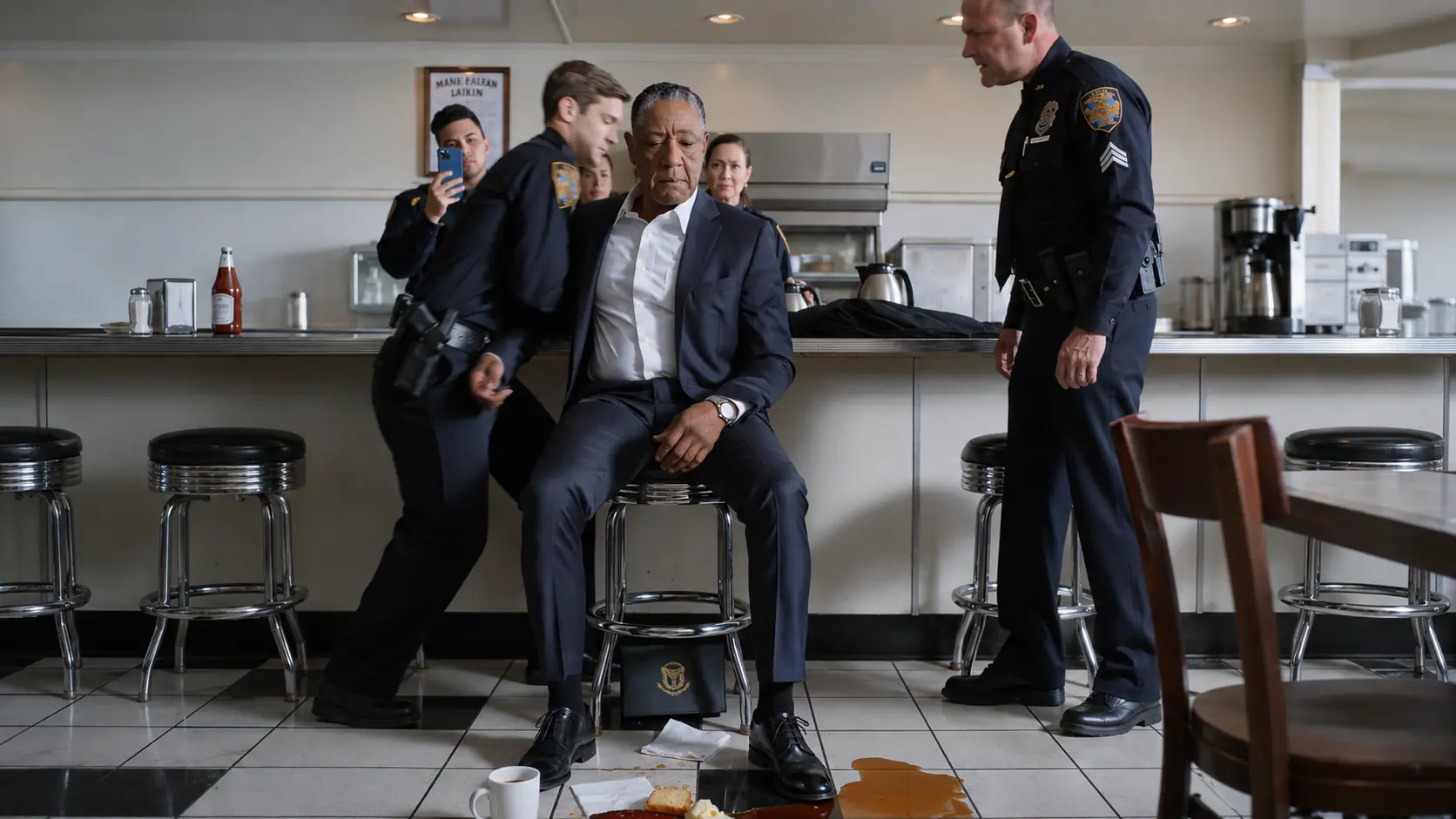
Officer Cole Maddox tipped the plate with two fingers.
The meatloaf slid first.
Then the mashed potatoes.
Then the gravy spilled across the black-and-white diner floor in a slow brown streak that reached the toe of Judge Elias Vance’s polished shoe.
For one breath, nobody inside Harper’s Lunch Room moved. Not the waitress standing behind the counter with a coffee pot in her hand. Not the trucker in the back booth. Not the old couple sharing pie near the window. Not the teenage dishwasher half-hidden beside the swinging kitchen door.
Maddox looked down at the ruined lunch and smiled.
“Go on,” he said. “Eat it from there.”
Elias Vance sat on the counter stool with both hands resting calmly beside his coffee cup. He was fifty-five, Black, tall, straight-backed, and dressed in a navy blazer over a pressed white shirt. His briefcase sat between his shoes, scuffed at the corners but expensive in the way old leather becomes expensive when it has survived too many important rooms.
He did not look at the food.
He looked at the officer.
“I won’t be doing that.”
Maddox’s smile disappeared.
“What did you say?”
“I said I won’t be eating off the floor.”
Officer Trent Bell, younger and eager to laugh whenever cruelty needed company, stepped closer and grabbed Elias by the arm.
“You heard him,” Bell said. “Move.”
Elias did not resist.
But he did not rise either.
His eyes drifted to the folded white napkin beside his coffee cup. Beneath it sat a small black leather card holder. It had been there the whole time, half-hidden in plain sight, the edge of a gold seal just visible if anyone in the diner had been looking for dignity instead of trouble.
No one had noticed.
Not yet.
Maddox leaned close, his breath hot with coffee and chewing tobacco.
“You people come into a place like this and forget where you are.”
Elias turned his head slowly.
“I know exactly where I am.”
That was true.
He knew the counter.
He knew the town.
He knew the road outside, the church on the corner, the courthouse two blocks away, the narrow sidewalk where his grandfather had once stood in the rain after being told he could not sit inside.
He had come to Millstone, Virginia for that counter.
Not for a case.
Not for politics.
Not for a speech.
For a promise.
Millstone was the kind of town travel magazines called historic and Black families called complicated.
It sat between old tobacco fields and horse country, with brick storefronts, hanging flower baskets, antique shops, and a courthouse square polished enough to hide what had happened beneath its own trees. Harper’s Lunch Room had been open since 1956. Locals bragged about the meatloaf, the peach pie, and the fact that the stools at the counter were still original.
That last detail mattered to Elias.
His grandfather, Isaiah Vance, had come home from Korea in 1953 with a limp, two medals, and the belief that wearing his country’s uniform might change how his country saw him. Nine years later, in 1962, he walked into Harper’s, sat at the counter, and ordered meatloaf.
They told him the back door was for people like him.
Isaiah did not fight.
Not that day.
He stood, walked outside, and ate a sandwich from a paper bag while rain ran off his hat brim. Years later, when Elias was a boy in Baltimore, his grandfather told the story without bitterness, which somehow made it hurt more.
“Baby,” Isaiah said from his porch chair, “one day you’ll be somebody they can’t send out back. When that day comes, go sit at that counter. Order the meatloaf. Finish it for both of us.”
Elias was eleven when he promised.
Forty-four years later, he finally came back to keep it.
He had not planned for anyone to notice him.
That was why he drove alone.
No clerk.
No marshal.
No assistant.
No cameras.
He had been confirmed to the federal bench sixteen days earlier by a Senate vote that made the news for exactly one cycle before another scandal swallowed the country’s attention. At three o’clock that afternoon, he was scheduled to be ceremonially robed at the federal courthouse in Richmond.
The robe was in his briefcase.
So was the Constitution his grandfather had given him when he graduated law school.
So was the black-and-white photograph of Isaiah Vance in uniform, young and proud, the kind of picture that seems to carry a whole generation’s restraint in one still face.
Elias had only wanted lunch first.
A quiet meal.
A kept promise.
At 12:22 p.m., he parked his silver Audi in Harper’s gravel lot and stepped into the heat.
Ruth Harper looked up from behind the register.
She was sixty-eight, with silver hair, strong hands, and the tired patience of a woman who had spent most of her life carrying plates for people who believed friendliness was included with the bill.
“Seat yourself, hon.”
“Thank you.”
Elias chose the stool closest to the window.
The same one, if his grandfather’s memory had been right.
He placed his briefcase between his feet, folded his blazer across his lap for a moment, then changed his mind and put it back on. The courtroom had taught him to respect certain rituals. His grandfather had too.
Ruth poured coffee.
“What can I get you?”
“The meatloaf special.”
“Mashed potatoes or fries?”
“Mashed potatoes.”
“Green beans?”
“Yes, ma’am.”
“Cornbread?”
Elias paused.
His grandfather had mentioned cornbread.
“Yes,” he said softly. “Cornbread.”
Ruth smiled faintly.
“Good choice.”
As she walked away, Elias removed his small leather card holder and placed it beside the coffee, then covered it with the linen napkin out of habit. He did not think about it. In his line of work, credentials came out only when necessary. The less people knew, the more freely they told you who they were.
His phone buzzed.
Judge Whitaker.
He silenced it.
Another message appeared.
Robing ceremony moved to 3:30. Safe travels, Judge.
Elias smiled slightly.
First-day jitters, he thought.
He looked around the diner.
Three booths were occupied. Two older men sat near the back, whispering over coffee. A trucker in a faded Atlanta Braves cap worked through a plate of eggs and ham. A mother tried to keep her little girl from blowing straw wrappers across the table. Near the kitchen door, a teenage dishwasher watched Elias for half a second, then looked away.
There was no open hostility at first.
Only attention.
That old, familiar attention.
A Black man in a small town diner wearing good shoes, carrying a good briefcase, sitting at a counter where people had once been trained to notice such things.
Elias had lived with that attention his entire life.
He had worn Army green as a young JAG officer and still been asked if he was maintenance. He had stood in federal court as a prosecutor while a defense lawyer handed him his own exhibit boxes, assuming he was staff. He had entered country clubs for bar association events and been directed toward the service entrance by people who later called it an honest mistake.
He had learned not to let every insult become the center of the day.
Some insults were just weather.
But some became evidence.
The bell over the door rang again.
Two officers entered.
Officer Cole Maddox came first. He was in his early forties, broad through the neck, pale, thick in the middle, with the heavy walk of a man who believed every room had to adjust around him. His badge was polished, his boots were polished, and his eyes were not. They moved across the diner with appetite.
Officer Trent Bell followed behind him.
Twenty-six, nervous, trying to look tougher than he was. His uniform was too new. His voice, when he spoke, tried too hard. He watched Maddox like a younger dog waiting to learn when to bark.
The cruiser outside sat crooked across two parking spaces.
Engine running.
Lights off.
Maddox stopped near the door and lowered his sunglasses.
He looked at Ruth.
Then the booths.
Then the counter.
His eyes landed on Elias and stayed there.
Ruth’s hand tightened around the coffee pot.
She knew Maddox.
Everybody in Millstone knew Maddox.
He had been the kind of officer who turned routine calls into stories people told each other quietly afterward. Too rough with young men on bicycles. Too quick to search trucks with out-of-state plates. Too comfortable calling people by names that did not belong on any report.
Fourteen complaints had been filed.
None had survived review.
Sergeant Warren Pike handled most of them.
That was how Millstone worked.
Maddox walked up behind Elias’s stool and leaned against the counter.
“Afternoon.”
Elias set down his fork.
“Afternoon, Officer.”
“We got a call.”
“No, you didn’t.”
The diner went still.
Maddox blinked once.
“What?”
Elias turned slightly on the stool, calm as a man adjusting in a courtroom chair.
“I said no, you didn’t. You walked in, saw me, and decided to create one.”
Bell’s eyes widened.
Maddox laughed once, sharp and humorless.
“You got a mouth on you.”
“I have lunch in front of me.”
“Not anymore, maybe.”
Elias looked at him directly.
“What can I do for you, Officer Maddox?”
The officer’s expression changed.
He had not expected his name to be used before he introduced himself.
His badge was visible, but men like him preferred being noticed only on their own terms.
“You got ID?”
“May I ask the basis?”
“The basis is I asked.”
“That is not a legal basis.”
Bell shifted closer.
“Sir, just show the ID.”
Elias looked at him.
“Young man, you’re standing beside a bad decision. You still have time to step away from it.”
Bell’s face reddened.
Maddox smiled.
“Lawyer talk.”
Elias took a sip of coffee.
“Something like that.”
“You a lawyer?”
“Yes.”
“Figures.”
Maddox stepped closer.
“You think that makes you special?”
“No.”
“You think you can come into my town, sit at this counter, and talk down to me?”
“I think I ordered the meatloaf.”
Ruth, standing behind the counter, made a small sound that might have been fear or a warning.
Maddox heard it and turned on her.
“You got something to say, Ruth?”
She looked at Elias, then at the officers.
“This man hasn’t bothered anybody.”
“That wasn’t my question.”
Her mouth closed.
Elias placed his napkin beside the plate and folded his hands.
“Officer, am I being detained?”
Maddox’s jaw shifted.
There it was.
The question every officer with a weak case hates.
“You will be if you keep running that mouth.”
“Then I am free to continue my lunch.”
“No,” Maddox said. “You’re free when I say you’re free.”
He turned to Bell.
“Pat him down.”
Bell hesitated.
“Cole—”
“Pat him down.”
Elias stood slowly.
Palms open.
He had been in uniform long enough to understand escalation. He had been in court long enough to understand records. He allowed Bell to perform the search, sloppy and nervous, while Maddox stood close enough to enjoy the discomfort.
Bell found nothing.
“He’s clean.”
“Of course he’s clean,” Maddox said. “Men like this make sure somebody else carries it.”
Elias’s eyes lifted.
“What did you say?”
Maddox leaned closer.
“You heard me.”
The diner had gone silent except for the low country song playing from the ceiling speaker.
At the back booth, the trucker in the Braves cap slid his phone out below table level.
Ruth saw him.
So did the teenage dishwasher, Milo Reed, who reached quietly into his apron pocket and touched his own phone.
Bell did not notice.
Maddox did.
He pointed toward the trucker.
“Put that away.”
The trucker hesitated.
Elias spoke without turning.
“Recording public officials performing public duties is lawful.”
Maddox stared at the back of his head.
“You really don’t know when to shut up.”
“No,” Elias said. “I know exactly when not to.”
That was when Maddox made it personal.
He stepped behind Elias, leaned near his shoulder, and spoke loudly enough for the diner to hear.
“You know, my daddy used to say this town changed too much when people like you started thinking counters were for everybody.”
Ruth’s face went pale.
Elias did not move.
Maddox continued.
“Maybe your kind forgot where lunch belongs.”
He hooked his finger beneath the plate.
Meatloaf, potatoes, green beans, gravy, cornbread.
All of it hit the floor.
The little girl in the booth gasped.
Her mother covered her mouth.
Bell laughed because Maddox laughed.
But the laugh came late and thin.
The trucker raised his phone higher now.
Milo began recording from the kitchen door.
A woman near the window, Grace Tolliver, a retired schoolteacher who had spent thirty years telling children to stand up straight and tell the truth, pressed record with both hands trembling.
Maddox looked down at the ruined food.
“Go on,” he said. “Eat it from there.”
Elias stayed seated.
“Lick it up,” Maddox said. “Every bite.”
Elias looked at the gravy spreading toward the base of the stool.
For one second, he thought of his grandfather outside this same diner, rain dripping from his hat, sandwich going soft in the paper bag.
He thought of the promise.
Sit where they wouldn’t let me sit.
Order the meatloaf.
Finish it for both of us.
The old anger came then.
Not hot.
Cold.
The kind of anger that can build a career, pass a bar exam, survive officer training, stand before a jury, bury a father, raise children, read case law until dawn, and still keep its hands folded neatly on a diner counter.
Elias looked up.
“I am not eating from the floor.”
Maddox’s hand moved to his cuffs.
Bell grabbed Elias’s arm.
“We’re taking you outside.”
“On what charge?”
“Disorderly conduct.”
“For refusing to eat off the floor?”
“For refusing a lawful command,” Maddox snapped.
“That was not a lawful command.”
Maddox stepped around to the front of the counter and saw the briefcase between Elias’s feet.
“What’s in the bag?”
“My property.”
Maddox picked it up.
Elias’s voice sharpened.
“Do not open that briefcase.”
Maddox smiled.
“Or what?”
He clicked the latches.
The sound was small.
But Elias felt it in his chest.
Maddox opened the case and reached inside.
First, he pulled out the robe.
Black.
Heavy.
Freshly pressed.
Folded with care.
He held it up by the shoulders.
“What is this? You preaching later?”
Bell laughed again.
“Maybe he’s in a choir.”
Elias said nothing.
Maddox tossed the robe over the counter like laundry.
Then he reached deeper and found the book.
A pocket Constitution.
Leather-bound.
Old.
The corners worn soft.
On the inside cover, in faded ink, Isaiah Vance had written:
For Elias. Know what they owe you. Know what you owe it.
Maddox flipped it open.
“Cute.”
“That belonged to my grandfather,” Elias said quietly. “Put it back.”
Maddox looked at him.
Then at the book.
Then he dropped it into the gravy.
Ruth whispered, “Oh, Lord.”
The book landed open.
One page bent under the weight of mashed potatoes.
The little framed photograph fell from the briefcase next. Isaiah Vance in uniform, young, upright, eyes fixed on a future he would not live long enough to see. The frame hit the floor and cracked.
That was the moment Elias stopped giving Maddox chances.
He looked at the photograph.
Then at the book.
Then at the robe.
Then slowly toward the napkin.
“Officer Maddox,” he said, voice steady, “I want you to listen very carefully. I am going to ask your supervisor to join us.”
Maddox snorted.
“My supervisor already knows me.”
“I’m sure he does.”
As if summoned by that sentence, the door opened again.
Sergeant Warren Pike walked in.
He was fifty-seven, gray-haired, soft around the stomach, and had the weary confidence of a man who had cleaned up after bad cops for so long he had convinced himself cleaning was leadership. He took one look at Maddox, one look at Elias, one look at the food on the floor.
Then he sighed.
Not at the officers.
At the inconvenience.
“What happened?”
Maddox answered quickly.
“Uncooperative subject. Refused ID. Resisted pat-down. Got disorderly.”
Pike nodded as if he had heard enough.
He approached Elias.
“Sir, you’re going to come down to the station with us.”
“No.”
Pike blinked.
“No?”
“No.”
Bell’s grip tightened.
Elias did not look at him.
“Remove your hand from my arm, Officer Bell.”
Pike leaned forward.
“You don’t give orders here.”
Elias took another sip of coffee.
Then set the cup down gently.
“Sergeant Pike, I am going to give you one opportunity to keep this from becoming worse for you than it already is.”
Maddox laughed.
Pike did not.
Something in Elias’s voice made the older man pause.
Elias turned his eyes to the folded napkin.
“There is a card holder beneath that napkin. I want you to lift the napkin yourself. Before you do, I want all three officers to activate body cameras and confirm aloud that they are recording.”
Maddox shook his head.
“You think some business card is going to scare us?”
Elias looked at Pike.
“Lift it.”
The diner held its breath.
Ruth stood with both hands over her mouth.
The trucker filmed openly now.
Grace Tolliver filmed from the window booth.
Milo filmed through the gap in the kitchen door.
Pike stared at the napkin like it had become dangerous.
Then he lifted it.
The black leather card holder sat open.
Inside, under the diner’s fluorescent lights, was a federal judicial commission embossed with the seal of the United States. Beside it was a small silver-and-blue lapel pin bearing the seal of the federal judiciary. The engraved words were clean and impossible to misunderstand.
The Honorable Elias Vance
United States District Judge
Eastern District of Virginia
Pike’s face emptied.
He read it once.
Then again.
His lips moved, but no sound came out.
Bell saw it next.
His hand fell from Elias’s arm like it had burned him.
Maddox leaned forward, squinting.
Then the color left his face.
The same man he had called out of place. The same man he had ordered to eat from the floor. The same man whose grandfather’s Constitution he had dropped into gravy was not a trespasser, not a drifter, not a criminal, not whatever ugly story Maddox had decided to write over him.
He was a federal judge.
And not just any judge.
A newly confirmed United States district judge on his way to his own robing ceremony.
Elias picked up the card holder and placed it inside his blazer.
Then he stood.
Slowly.
Fully.
The entire diner seemed to rise with him.
“My name,” he said, “is Elias Nathaniel Vance. Sixteen days ago, I was confirmed by the United States Senate to serve as a judge of the United States District Court for the Eastern District of Virginia.”
No one moved.
“The robe Officer Maddox threw onto this counter is the robe I am scheduled to wear at my ceremonial robing in Richmond this afternoon. The Constitution he dropped onto this floor was given to me by my grandfather in 1987. The photograph he broke is of Master Sergeant Isaiah Vance, United States Army, Korean War veteran, born nine miles from this diner.”
His voice remained steady.
That made it harder to bear.
“In 1962, my grandfather sat at this counter and was told to eat out back. I came here today to keep a promise I made to him as a child. I came to order meatloaf and finish the meal he was denied.”
Maddox’s mouth opened.
“Your Honor, I didn’t—”
“Do not finish that sentence.”
Maddox stopped.
Elias looked at Pike.
“Sergeant, you are now going to call Chief Marlowe on his direct line. You will tell her that Officer Maddox, Officer Bell, and you have just detained, searched, degraded, and harassed a sitting federal judge in a public diner. You will tell her food was thrown on the floor, federal judicial property was mishandled, a family heirloom was damaged, and multiple witnesses recorded the entire incident.”
Pike swallowed.
“Yes, Your Honor.”
“You will preserve body-camera footage, dash-camera footage, radio logs, dispatch records, internal messaging, and every prior complaint involving these officers.”
Pike’s hands shook.
“Yes, Your Honor.”
Elias turned to Maddox.
“And you will not say one word to any witness in this diner.”
Maddox nodded too fast.
“Yes, sir.”
Elias’s eyes hardened.
“Your Honor.”
Maddox looked as if the correction struck him physically.
“Yes, Your Honor.”
Pike stepped outside to make the call.
The gravel crunched under his shoes the same way it had crunched under Isaiah Vance’s shoes when he walked away sixty-three years earlier.
Inside the diner, Ruth Harper slowly picked up the pocket Constitution from the floor. Gravy stained one corner. She held it like something sacred and brought it to Elias with tears in her eyes.
“I am sorry,” she whispered.
Elias took it carefully.
“For what you did today?”
Her chin trembled.
“For what I didn’t do sooner.”
That answer mattered.
He nodded once.
Milo, the dishwasher, came forward next with the cracked photograph.
“I’m sorry, Your Honor. I got the whole thing on video.”
Elias took the frame.
“Thank you.”
Milo blinked.
“For recording?”
“For not looking away.”
Twenty minutes later, Chief Angela Marlowe arrived in a black unmarked SUV.
She was in her early sixties, tall, precise, and known in the region as a chief who preferred quiet competence to public drama. But when she stepped into Harper’s and saw the robe on the counter, the ruined food on the floor, the witnesses still filming, and a federal judge standing beside three terrified officers, her face changed in a way no one forgot.
She walked to Elias.
Stopped.
Did not extend a hand.
“Your Honor,” she said. “Chief Angela Marlowe. I received Sergeant Pike’s call. I am profoundly sorry.”
Elias looked at her.
“Chief Marlowe, I need three things in this room, in front of these witnesses.”
“Yes, Your Honor.”
“These three officers are to surrender badges, weapons, and radios immediately. They are relieved of duty pending criminal and internal investigation. They will not return to the station unsupervised. They will not contact one another. They will not contact witnesses.”
Marlowe turned.
“Maddox. Bell. Pike. Weapons, badges, radios. On the counter.”
Bell obeyed first, hands trembling.
Pike followed, face gray.
Maddox froze.
“Chief, you don’t understand. I didn’t know who he was.”
Marlowe’s voice turned cold.
“That is the problem, Cole. You did not know who he was, so you treated him like he was nobody.”
Maddox had no answer.
His badge hit the counter with a small metallic sound.
Then his weapon.
Then his radio.
Three badges lay beside the diner coffee cups and the folded robe.
The image would later run on front pages across the country.
The FBI arrived next.
Special Agent Nadine Cole, Civil Rights Division, walked in with two agents and a face that suggested friendship would not matter today even if she and Elias had once tried cases in the same courthouse.
She looked at the floor.
At the Constitution.
At the photograph.
At Elias.
“Federal investigation opens now,” she said. “Statement when you’re ready.”
“After the robing,” Elias said. “I’m already late for a promise.”
By the time Elias walked out of Harper’s, news vans were pulling into the gravel lot.
Nobody knew whether Ruth had called them, or the trucker, or the schoolteacher, or the teenager, or someone watching the videos spread online in real time. It did not matter. Microphones rose as Elias stepped into the sunlight with his briefcase in one hand and his grandfather’s cracked photograph in the other.
A reporter shouted, “Judge Vance, what do you want people to understand?”
Elias stopped.
He looked directly into the nearest camera.
“What happened in that diner happens every day to people who do not carry a federal commission under a napkin,” he said. “Do not wait until the victim has a title before you decide the cruelty matters.”
Then he got into his car and drove to Richmond.
He was two hours late.
The courtroom waited.
When Elias entered in his black robe, carrying the damaged Constitution and his grandfather’s cracked photograph, the room stood. Judges, clerks, family members, prosecutors, defenders, friends, and strangers rose in silence.
No one clapped at first.
It felt too serious for applause.
Then his sister began.
One clap.
Then another.
Then the courtroom filled with sound.
Elias placed the photograph on the bench before he sat.
That image traveled faster than the diner videos.
A federal judge in robes.
A cracked photograph of a Black soldier beside the gavel.
A Constitution stained faintly at the corner.
The headline the next morning read:
Judge Robed Hours After Diner Humiliation.
By the end of the week, the combined videos had passed sixty million views.
The country saw Maddox tip the plate.
They heard the command to eat from the floor.
They saw the badge under the napkin.
They saw Chief Marlowe take three badges and three guns.
The Department of Justice opened a formal investigation into Millstone Police Department. Internal files were subpoenaed. Complaints were unsealed. Body-camera archives were reviewed. Officers’ private messages were pulled after a warrant revealed a group chat where Maddox, Bell, Pike, and others mocked residents, used racial language, and discussed which drivers were “easy stops.”
The rot spread wider than one diner.
Fourteen complaints against Maddox.
Nine against Pike for covering excessive force.
Six against Bell in only two years.
Every one dismissed.
Every one signed off through the same review chain.
Ruth Harper testified before the federal grand jury.
She wore a blue dress and carried herself like someone tired of being afraid.
“I watched Officer Maddox treat people like that for years,” she said. “Not always that bad. Not always that loud. But enough. And I poured coffee and kept quiet. I am not proud of that.”
Calvin Rees, the trucker in the Braves cap, testified next.
“I recorded because my daughter told me to always record police if something feels wrong,” he said. “I wish I had started sooner.”
Grace Tolliver testified for two hours.
She remembered every word.
Teachers often do.
Milo Reed, the dishwasher, was seventeen when he testified. His voice shook, but he did not change his story once.
“My grandma says silence helps the wrong person,” he told the jury. “So I didn’t want to help the wrong person.”
Officer Bell cooperated late.
Too late to save his career.
But soon enough to open the department wider.
He admitted that Maddox routinely invented suspicious-person calls when he wanted to search someone. He admitted Pike changed complaint language before filing reports. He admitted officers used the phrase “floor lunch” in a group chat after similar humiliations.
When prosecutors showed that message to the jury, several jurors looked away.
Maddox took the stand against his attorney’s advice.
He claimed he did not see color.
The prosecutor played the diner video.
Then the group chat.
Then Ruth’s testimony.
Then the clip of Elias saying, “I know exactly where I am.”
Maddox had no answer that survived the sound of his own voice.
The verdict came eleven months after the diner incident.
Cole Maddox was found guilty of deprivation of rights under color of law, obstruction, conspiracy, evidence tampering, and falsifying police records. He was sentenced to twelve years in federal prison and permanently barred from law enforcement.
Warren Pike was convicted of conspiracy and obstruction for burying complaints and falsifying internal records. He received seven years.
Trent Bell received three years after cooperating, plus a lifetime ban from police work.
Millstone Police Department entered a federal consent decree.
Mandatory body cameras.
Independent complaint review.
Public reporting of stops and searches.
Civilian oversight with subpoena power.
No internal complaint could be closed by the direct supervisor of the accused officer.
Ruth Harper was appointed to the oversight board.
So was Calvin Rees.
So was a local pastor who had filed three complaints in ten years and never received a real response.
The state legislature passed what newspapers called the Vance Act.
All body-camera and dash-camera footage involving alleged racial bias had to be preserved for ten years. Departments with repeated dismissed complaints against the same officer had to submit records for state review. Citizens who recorded police misconduct were protected from retaliation under state law.
Elias did not attend the bill signing.
He had court.
That was not a statement.
It was who he was.
Justice did not become less urgent because his name was on a law.
One year later, Elias Vance returned to Harper’s Lunch Room.
The silver Audi parked between the same lines.
The bell over the door rang the same way.
But the diner had changed.
Not completely.
No place changes completely in a year.
But the counter was full. A Black family sat near the register. A Latino contractor ate pie beside an old white farmer. Two college students shared fries in a booth. Ruth Harper no longer worked behind the counter. She sat near the window drinking coffee as a customer for the first time in her adult life.
Above the register hung a framed photograph.
Master Sergeant Isaiah Vance.
Korean War veteran.
Born near Millstone.
Denied service at this counter in 1962.
Honored here in 2027.
Elias stood beneath it for a long moment.
Ruth rose slowly.
“Your Honor.”
“Ruth.”
“Marshall said you’d come back.”
“Who’s Marshall?”
“The new cook,” she said, smiling through tears. “He makes better meatloaf than I ever did.”
Elias laughed softly.
That surprised him.
He sat at the same stool.
A young waitress approached with a coffee pot.
“What can I get you, sir?”
“Coffee,” Elias said. “And the meatloaf special.”
“Mashed potatoes?”
“Yes.”
“Green beans?”
“Yes.”
“Cornbread?”
Elias looked up at his grandfather’s photo.
“Yes,” he said. “Cornbread.”
When the plate arrived, he did not eat right away.
He placed the damaged Constitution beside the coffee cup. The stain on the corner had faded, but not disappeared. He placed the cracked photograph beside it. Then he sat still for a moment, letting the meal become larger than food.
Ruth watched from the booth.
Calvin Rees had driven in for the occasion and sat near the door.
Milo Reed, now enrolled in community college, stood by the register with his phone in his pocket this time.
No one recorded.
No one needed to.
Elias picked up his fork and took the first bite.
Meatloaf.
Mashed potatoes.
Gravy.
A little too much salt.
Exactly right.
His eyes closed for one second.
Somewhere in memory, a young soldier in 1962 finally sat down at the counter.
Somewhere in memory, the rain stopped.
People would tell the story afterward as if the federal commission under the napkin was the turning point.
It was not.
The commission only revealed power.
The videos revealed conscience.
Ruth telling the truth mattered.
Calvin recording mattered.
Grace refusing to forget a single word mattered.
Milo’s shaking hands mattered.
The judge had authority, yes.
But justice needed witnesses.
That was the part Elias carried most deeply.
A town was not changed because one powerful man had been humiliated.
A town changed because ordinary people finally decided humiliation was not ordinary anymore.
The plate had hit the floor.
The Constitution had been stained.
The photograph had cracked.
But the promise survived.
And when Elias Vance finished that meal, paid full price, left a tip large enough to make the young waitress cry, and walked back into the Virginia sunlight, he knew one thing his grandfather had tried to teach him long before the law gave him a robe.
Dignity does not come from the seat they let you take.
It comes from knowing you deserved to sit there all along.