“Nice cover. What are you really moving in this van?”
Officer Grant Miller pointed toward the open side door as if he had already discovered a crime.
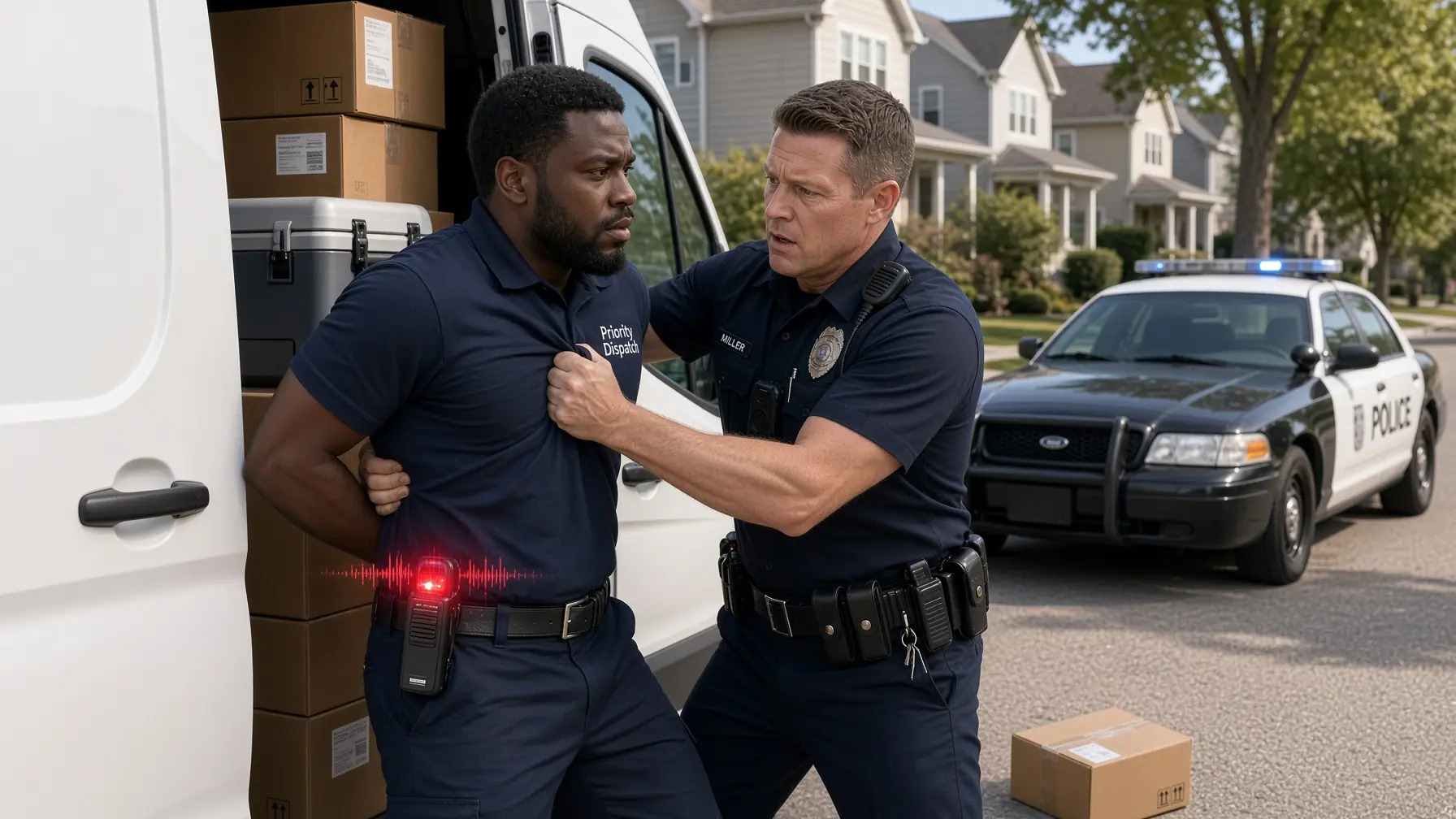
I stood beside the white delivery van holding a sealed cardboard package against my chest.
The afternoon sun was bright enough to reflect off the row of clean suburban windows behind us. Somewhere down the street, a lawn sprinkler clicked in steady circles. A dog barked from behind a cedar fence. Nothing about the neighborhood suggested danger.
Yet Officer Miller was looking at me like he had found exactly what he had been hoping to find.
My name is Marcus Cole.
I was thirty-two years old.
Black.
Six-foot-two.
Athletic build.
Navy courier uniform.
Package scanner clipped to my belt.
And at 2:17 that afternoon, I had exactly nineteen minutes to get the locked medical cooler inside my van to County Medical Center.
Nineteen minutes was not the point at which the patient died.
Real transplant logistics are more complicated than movie countdowns.
But every unnecessary minute mattered.
And Officer Grant Miller was wasting them.
“Everything’s registered,” I said. “Check the scanner.”
His eyes moved toward my hand.
I made the mistake of reaching toward my belt.
Not fast.
Not aggressively.
Just enough to touch the scanner.
Miller exploded.
“Quit reaching!”
His hand grabbed the front of my polo.
Before I could answer, my back slammed into the side of the van.
The cardboard parcel dropped from my hand and landed on the pavement.
My shoulder hit metal hard enough to knock the air from me.
Then Miller twisted my right arm behind my back.
“Hands where I can see them!”
“You have one of them behind me,” I said through clenched teeth.
That was apparently the wrong answer.
His grip tightened.
“Don’t get smart.”
Behind him, Officer Ryan Shaw walked toward the open van.
Shaw was thirty-seven, white, stocky, with a brown buzz cut and an expression that made the whole thing look entertaining.
He leaned into the cargo area.
Inside were six sealed parcels arranged in transport bins.
One insulated medication container.
And the medical cooler.
White.
Hard-sided.
Tamper-sealed.
Digital temperature display glowing green.
Red label across the top:
PRIORITY TRANSPLANT MATERIAL — DO NOT DELAY
Shaw reached for it.
That was when my voice changed.
“Don’t touch that cooler.”
Miller shoved me harder against the van.
“What did you say?”
I ignored him.
“Officer Shaw, stop.”
Shaw looked back over his shoulder.
“Or what?”
“Or you may compromise a transplant shipment.”
He laughed.
“Sure.”
Then my scanner spoke.
I had accidentally hit the side trigger when Miller grabbed me.
The screen activated.
A calm synthetic voice sounded from my belt.
“Priority transplant delivery — County Medical Center. Receiving unit: Surgical Transplant Services. Delivery window active.”
Everything stopped.
Shaw’s hand froze two inches above the cooler latch.
Miller’s grip loosened.
The scanner continued.
“Chain of custody verified. Courier: Marcus Cole. Medical transport clearance active. Do not interrupt cold-chain transfer.”
For the first time since he approached me, Officer Miller had nothing to say.
I turned my head just enough to look at him.
“You want to let go now?”
Thirty-one minutes earlier, I had been sitting in the parking lot of the Central Regional Donor Network drinking warm coffee and checking signatures.
That part of my job was boring.
It was also the part that kept people alive.
Everybody likes to imagine transplant medicine as surgeons standing beneath bright lights while dramatic music plays.
The truth is that a successful transplant often depends on hundreds of people whose names the recipient never learns.
Lab technicians.
Dispatchers.
Drivers.
Flight crews.
Nurses.
Coordinators.
People moving blood samples at 3:00 a.m.
People carrying paperwork through rain.
People checking refrigerator temperatures every fifteen minutes.
And couriers.
People like me.
My employer was called Meridian Critical Logistics.
We moved everything from high-value pharmaceuticals to blood products, transplant tissue, clinical trial materials, and time-sensitive surgical components.
Most days I looked exactly like any other delivery driver.
That was intentional.
We did not drive around with giant signs advertising that something medically valuable might be inside.
My van was GPS tracked.
Temperature monitored.
Cargo compartments alarmed.
Certain shipments were digitally sealed.
Every stop was logged.
Every door opening recorded.
Every custody transfer required verification.
The cooler in my van that afternoon contained a donor kidney.
It had been recovered earlier that day at a regional hospital forty-six miles away and accepted by County Medical Center for a recipient who had been waiting almost four years.
Her name was not on my paperwork.
It should not have been.
I knew only what I needed to know.
Recipient case number.
Hospital.
Receiving physician.
Custody deadline.
Preservation parameters.
That was enough.
I had made that route dozens of times.
Never casually.
My father had been on the transplant waiting list once.
He never received one.
Heart failure took him when I was twenty-three.
That was part of why I applied to Meridian years later.
Not because I thought carrying coolers made me part of the surgical team.
It didn’t.
But I understood what those containers represented.
Somebody’s worst day becoming somebody else’s second chance.
You handle that carefully.
You do not improvise.
You do not stop for coffee.
You do not leave the vehicle unsecured.
And you definitely do not let two curious police officers open a sealed cooler on the side of a suburban street because they think a Black delivery driver looks suspicious.
The stop happened because of a house.
At least, that was what Officer Miller claimed later.
I had delivered a specialty medication package to 1834 Willow Creek Lane.
The recipient required a signature.
I parked legally.
Hazards on.
Walked to the door.
Verified the customer’s identity.
Scanned the package.
Returned to the van.
A marked police cruiser was already behind me.
I assumed they wanted around.
I waved once and moved toward the driver’s door.
That was when Miller stepped out.
“Hold up.”
I stopped.
“Yes, officer?”
“What are you doing here?”
“Delivery.”
He looked at the van.
“No company logo.”
“Contract vehicle.”
“Who do you work for?”
“Meridian Critical Logistics.”
Never heard of it, his expression said.
Instead he asked:
“What are you delivering?”
“Customer shipments.”
“What kind?”
“Medical and commercial.”
He looked past me into the van.
The side door was still open because I had been reorganizing the next stop.
“That’s a lot of packages.”
“Yes.”
“You have invoices?”
“Digital manifests.”
“You got anything illegal in there?”
I almost smiled.
“No.”
His partner got out then.
Officer Shaw.