At 11:16 on a Wednesday night, Sergeant Daniel Mercer saw a black SUV moving north along Reynolds Road and decided he did not like the way it looked.
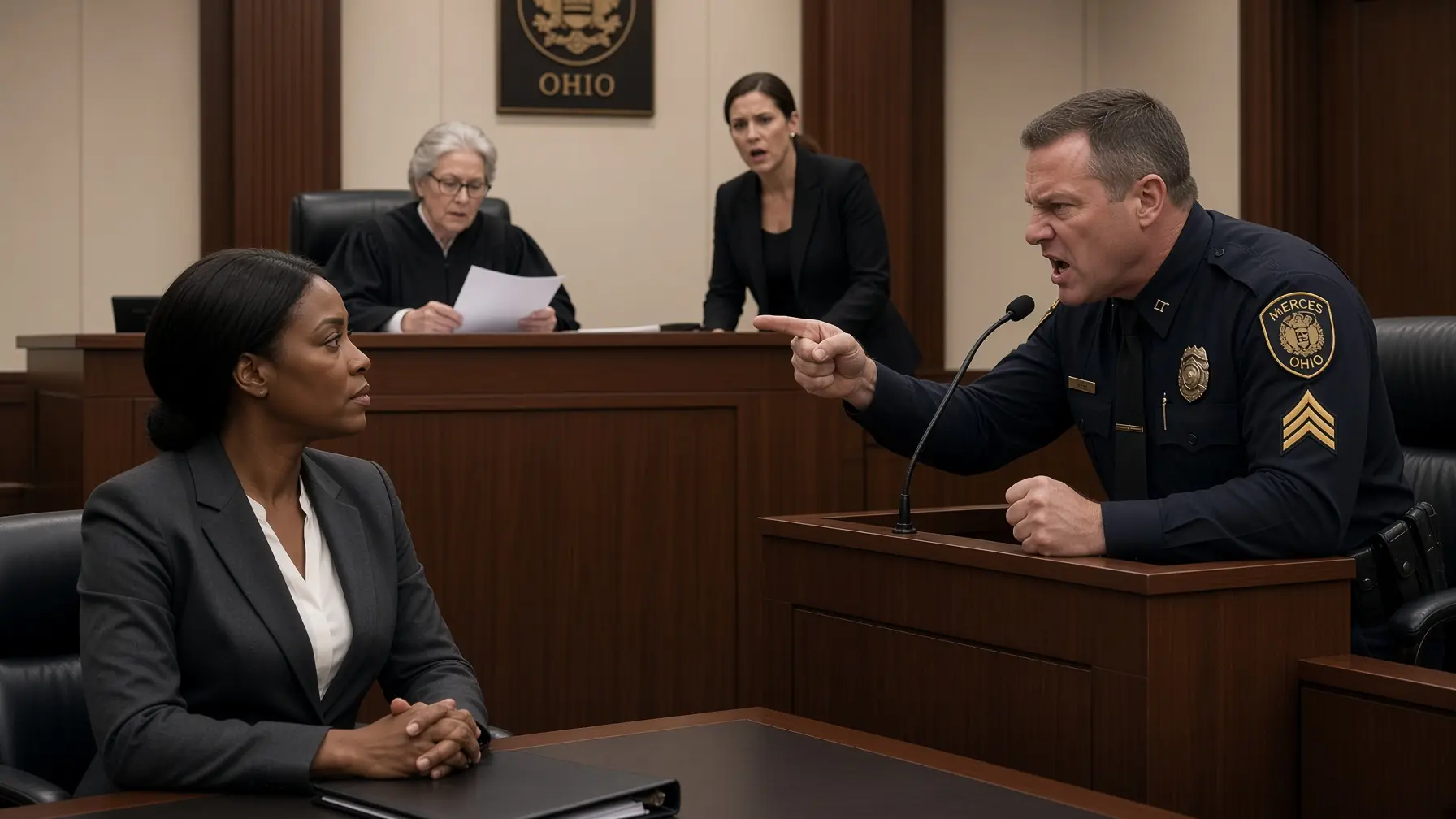
That was the beginning.
Not speeding.
Not running a red light.
Not crossing a center line.
Not nearly striking another vehicle.
Just an unfamiliar black SUV on a mostly empty road in Toledo, Ohio.
Mercer had been parked in the shadow of a closed tire shop for nearly forty minutes.
The shift was dragging.
No serious calls.
No accidents.
Nothing requiring the authority he wore so comfortably on his chest.
He sat behind the wheel of his cruiser drinking lukewarm coffee and scrolling through his phone when the SUV passed.
Government plates.
Clean vehicle.
Dark windows, though still within legal tint.
Mercer put down the phone.
He watched the taillights.
Then pulled out.
A few seconds later, red and blue lights filled Lieutenant Colonel Adrienne Wallace’s rearview mirror.
Adrienne noticed immediately.
She was forty-five years old and had spent more than two decades in military logistics, enough of those years in difficult places that flashing lights on an empty road did not make her panic.
They made her assess.
Speed?
Normal.
Lane position?
Normal.
Signals?
Yes.
Seat belt?
On.
She reduced speed, signaled right, and pulled onto a wide shoulder beneath a streetlight.
Then she placed the SUV in park and set both hands on the steering wheel.
Calm.
Visible.
Predictable.
The cruiser stopped behind her.
Adrienne watched through the side mirror as the officer stepped out.
Tall.
White.
Early fifties.
Heavy through the shoulders.
Flashlight in one hand.
The other resting close to his duty weapon.
He approached her driver’s side window.
No greeting.
“License and registration.”
Adrienne lowered the window halfway.
“Officer, may I ask why I was stopped?”
The flashlight rose directly into her eyes.
“You were drifting.”
“I was?”
“Between lanes.”
Adrienne replayed the last mile in her head.
She had not been.
Mercer continued.
“Looked like possible impairment.”
Adrienne blinked once against the light.
“I haven’t consumed alcohol tonight.”
“License and registration.”
This time louder.
Adrienne felt the first warning in her stomach.
Not fear exactly.
Recognition.
She had seen this kind of interaction before.
An officer had decided what the situation was before speaking to the person inside it.
Adrienne reached slowly toward the center console.
“My identification is in my wallet.”
“Keep your other hand where I can see it.”
“It is.”
She removed her driver’s license.
Then reached toward the glove compartment.
“Registration is inside.”
“Slow.”
Adrienne opened it.
Government paperwork.
Vehicle assignment sheet.
She passed the documents through the window.
Mercer looked at the registration.
Then at the plate.
“This government?”
“Yes.”
“What agency?”
“Department of Defense.”
His eyes moved toward her.
“You military?”
“Yes.”
“What branch?”
“Army.”
He handed nothing back.
Instead he studied her driver’s license again.
“Where are you coming from?”
“A planning meeting.”
“Where?”
“South of here.”
“Where exactly?”
Adrienne looked at him.
“Is that relevant to the traffic stop?”
Mercer’s expression changed.
A small tightening around the mouth.
“You got something to hide?”
“No.”
“Then answer the question.”
Adrienne kept her voice level.
“I am asking how the location of my meeting relates to an allegation that I drifted between lanes.”
Mercer took one step closer.
“I’m investigating possible impaired driving.”
“I understand.”
“Do you?”
“Yes.”
He stared at her.
Then said:
“Step out of the vehicle.”
Adrienne did not move.
“On what grounds?”
Mercer leaned down.
“I gave you an order.”
“I heard you.”
“Then step out.”
“I’m asking you to explain why you believe a field sobriety investigation is necessary. I have not been drinking, and I have complied with every request.”
“You’re refusing a lawful order.”
“No.”
Her voice remained quiet.
“I’m asking for clarification.”
That was when Mercer reached for the door handle.
Adrienne’s jaw tightened.
He opened the door himself.
“Out.”
For the first time, Adrienne’s pulse accelerated.
Not because she intended to resist.
Because she understood how quickly calm encounters could become something else once an officer became personally offended by questions.
She took out her phone.
Tapped record.
Placed it visibly in her left hand.
“Just so we’re clear,” she said, “I’m documenting the remainder of this interaction.”
Mercer’s eyes moved toward the phone.
For perhaps half a second, hesitation crossed his face.
Then pride overruled judgment.
“Do whatever you want.”
Adrienne stepped out.
She wore civilian clothes.
Dark trousers.
Low boots.
A charcoal coat over a blue blouse.
No visible rank.
No ribbons.
No uniform.
Nothing that told Mercer she had coordinated military logistics under rocket warnings overseas, supervised hundreds of soldiers, or briefed officers far senior to him without raising her voice.
To him, she was simply a Black woman beside a road who had asked too many questions.
“Stand over there.”
Adrienne complied.
Mercer ordered her through field sobriety exercises.
She followed every instruction.
Heel to toe.
Turn.
Return.
One-leg stand.
No stumble.
No missed count.
No slurred speech.
No odor of alcohol.
Nothing.
Still, Mercer kept searching for a reason to justify the escalation he had already chosen.
“How much sleep have you had?”
“Enough.”
“You seem irritated.”
“I am being investigated for impairment when I am not impaired.”
“That sounds defensive.”
Adrienne looked at him.
“That sounds accurate.”
Mercer did not like that answer.
Twenty minutes after the stop began, he finally returned her license and registration.
Then he handed her a citation.
FAILURE TO MAINTAIN MARKED LANE.
Adrienne looked down at it.
Then at him.
“Where did I cross the lane line?”
Mercer nodded toward the paper.
“Court date’s there if you want to argue.”
“I asked where.”