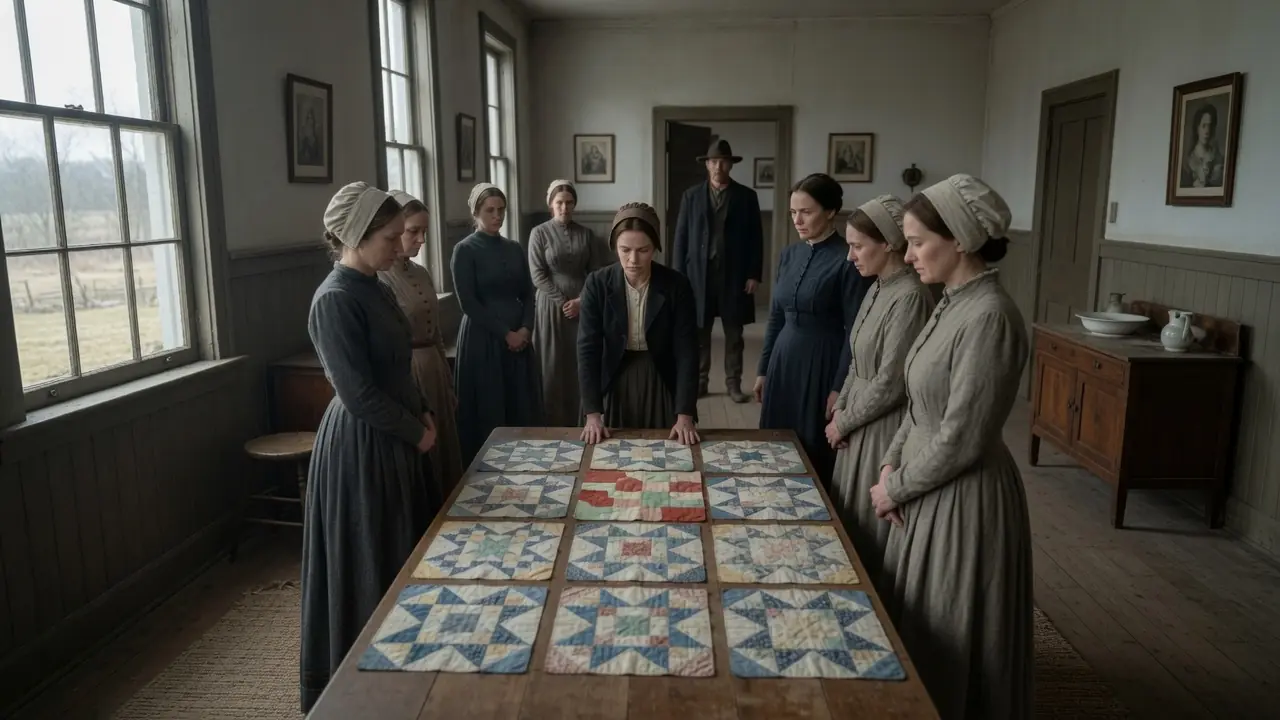
The sewing circle met on the second Tuesday of every month in the back room of the Methodist church. On this particular Tuesday in late October, the women of Harland County had laid out 12 finished squares on the long table to admire and adjust before the final assembly. Netty Doyle arrived late, which was already a problem because late meant drawing attention. Drawing attention meant the women had a moment to look before she could set anything down quietly and slip into place.
She had her square folded in her coat pocket, a 6-inch piece of warm brick-colored broadcloth she had cut from an old skirt belonging to her mother, pieced with cream and sage the way she had worked it out in her head on four separate nights when sleep wouldn't come. She set it on the table. Nobody spoke for a beat too long.
"Oh, Netty." That was Johanna Fletcher, who said things the way a schoolteacher circles a wrong answer, circling it clearly with patience, as if the error itself was the lesson. "We agreed on blue."
The 12 squares on the table were blue. Blues and ivory with small bursts of pale yellow. They were handsome and careful, and they matched the way a church choir matches, everyone reading from the same sheet. Netty's square was the color of dried leaves, of a woman's old skirt, of brick on the south side of a building that had caught 40 years of afternoon sun.
"I misunderstood." She kept her hands flat on the table, one on each side of the square. She hadn't misunderstood. She had made the thing she meant to make in the colors that felt true.
And she was standing now at the table understanding that it was going to cost her. "We could put it on a different project," Johanna said. "It's lovely work. It just doesn't fit here."
There were nine women in the room. Netty counted the sounds: a chair scraping, two quiet intakes of breath, the specific silence of people who have decided not to say anything. She folded her square. She put it back in her coat pocket.
The church had a side door that led out onto the narrow alley between the building and the dry goods store. Netty came through it because she was not ready for the front steps where two men from the sale barn were talking to the pastor. She moved along the alley wall with her hands in her pockets and her square a warm, flat weight against her ribs.
A man was leaning against the fence at the alley's end, reading a folded sale notice, a horse tied loose to the post beside him. He looked up when she came through, not in the way of someone startling, but the way of someone who had been aware of the door for some time and had already decided not to make anything of it.
She recognized him by the hat more than the face. Gideon Stone bought cattle for a livestock firm in Lexington and came through Harland County three or four times a year. A quiet man, people said, though they said it in the way they said it about men whose quiet made them slightly uncomfortable.
"Evening," he said. She said good evening and kept walking. Gideon spoke again. "That was yours."
"The square," he said. "The different one." She stopped. She did not turn around right away.
When she did, his expression was steady and plain. "I came in to get my sister," he said. "I could see through the door."
"Then you saw it get put back in a pocket."
That was worse than anything Johanna Fletcher had said. Netty understood this clearly. A compliment aimed wrong lands harder than criticism because you have to figure out what to do with it. Her face went warm.
"Good evening, Mr. Stone," she said. She walked past him and did not look back.
The house had been her parents' before it was hers, and nobody in Harland County had quite decided whether that made her fortunate or difficult. Three days later, a small bundle of fabric scraps appeared on her porch. They were tied with twine. There was no note, just four pieces of cloth: a dark wine-colored flannel, a strip of faded canvas the color of wheat in August, a piece of worn brown corduroy, and a bit of soft gray wool that had been a coat once, and a good one.
She stood on the porch with the bundle in her hands and looked up and down the road. Nobody visible. The twine was tied in the same flat cattleman's knot Gideon Stone had used on his reins by the alley fence. She went inside and set the scraps on the kitchen table and did not touch them for the rest of the evening.
The next morning, she looked at them with the light different. The flannel was a man's shirttail piece. You could tell by the way it had been hemmed. The canvas had a stain near one edge that had been carefully trimmed around.
These were scraps in the old sense, pieces of things that had been used and lived in, that had given what they had to give and had a little left over. She made a second square.
Gideon Stone's sister was Margaret Lacy. She had been Margaret Stone before she married a tobacco farmer 10 years ago, and she now ran the household and the books both. Her husband had taken to his chair after a back injury that was real, but not, in Margaret's private opinion, as disabling as he made it seem. Margaret was a member of the sewing circle and was in many ways the reason Netty had joined it three years ago.
She was plainspoken and funny and didn't waste good silence with bad talk. At the next circle meeting, Margaret looked at Netty's second square and said nothing for a moment that meant something.
"Where'd you get that flannel?"
"It came to me," Netty said.
Margaret's mouth pressed together in the direction of a smile. "I expect it did."
The second square sat beside the first on the workroom table. The other women gathered, and there was a quiet that had shifted somehow from the quiet of the last meeting, less like disapproval and more like attention. The two squares together made something the 12 matching blues didn't make on their own. They made you feel that somewhere behind the quilt people had lived.
"Well," said Johanna Fletcher after a long look. She did not add anything to this, which was unusual and felt like a verdict.
November came in cold. Gideon Stone came back through Harland County on the 8th, which was earlier than anyone expected. He stopped at the feed store for supplies and at the church to leave something for his sister. He stopped also at Netty Doyle's porch.
She heard the horse before she saw him. She was at the kitchen window and did not go to the door immediately. She went to the door after he had been standing on the porch for what she judged was long enough to be respectful of his time.
He held up a small folded cloth, dark teal, soft, the kind of thing that had once been a good Sunday waistcoat and had worked its way down through many years to its present condition. "I found another piece," he said. "I thought about mailing it, but I was coming this direction."
She held the door open. He stepped inside and looked at the room carefully without appearing to. It was the kind of looking that takes in a lot without drawing attention to the fact. The kitchen was clean, and the fire was adequate.
In the good room, there was a quilt frame set up, the two odd squares pinned in place beside eight blue ones, looking like strangers who had been led in out of the cold. He walked to the frame and looked at the squares the way he probably looked at cattle, with consideration rather than opinion.
"You're keeping them all," he said.
"They asked me to use only the two as accents. I thought that was reasonable."
"Is it what you'd have chosen?"
She took a moment. "It might be what I'd have chosen without help."
He turned from the frame. He had his hat in both hands, which she had noticed was the position he took when he had more to say and was deciding whether to say it. "My sister has things," he said. "From the farm, from my mother's house. Pieces. If you wanted more, she could bring them to the circle."
"That's Margaret's choice to make."
He put his hat back on. "I'll mention it."
He left the teal waistcoat cloth on the table by the door. Margaret Lacy arrived at the next circle meeting with a flour sack, actual flour sack fabric, the kind that came in prints and that farm women had been sewing into everything since before anyone could remember. She also brought a strip of dark red wool that had been their father's Sunday coat and a length of faded chambray that had been a dress belonging to their mother, gone many years now.
She set these on the table without ceremony. "Gideon thought they might be useful," she said, and sat down and threaded her needle. Nobody voted on it that day, which was how the matter passed.
By December, the quilt had 16 squares. Nine were blue and ivory to pattern, and seven were things people had brought from their own houses, their own histories, their own coats and curtains, and worn-out Sunday clothes. The design could not be called a pattern anymore. It was more like a record.
The women of the circle had begun, without declaring they were doing so, to fight softly over who would contribute the next odd piece. Caroline Webster brought a bit of faded rose from her grandmother's wedding dress. The schoolteacher, Miss Elkins, brought dark green wool from an old teaching coat she had kept for 20 years for no reason she could name.
Johanna Fletcher brought nothing yet. She came to every meeting and looked at the quilt and said less and less, which in Johanna's case meant something.
The storekeeper's wife, Fanny Becker, told her husband on a Thursday that the women over at the Methodist church were making the strangest quilt she'd ever heard of. Netty Doyle had started it, and Gideon Stone had something to do with it, though exactly what was hard to say. Her husband said he didn't see what was strange about a quilt.
Fanny told him that some quilts matched and some quilts didn't. A quilt that didn't match was either a mistake or a statement, and this one had started as a mistake and become a statement. Gideon Stone had been by the Doyle place twice now, bringing pieces of old cloth the way some men brought flowers, which was either practical or romantic, depending on how you looked at it.
Her husband said it sounded practical to him. Fanny looked at him the way she had looked at him for 15 years and said that was exactly what she expected him to say.
It was Johanna Fletcher who raised it, which was almost a relief because Johanna at least had the decency to raise things directly. She came by on a Wednesday afternoon, not a circle day, which meant she had decided to come rather than found herself there by habit. She accepted a cup of tea and set it down without drinking, and looked at the quilt frame in the good room.
"People are talking," Johanna said.
Netty waited. Gideon had been seen at the house twice. Neither of them was married. In Harland County, that was enough for people to build a story, whether there was timber for it or not.
Johanna held her cup with both hands and said as much plainly, because she was not a woman who softened things she thought needed saying.
"There isn't anything behind it," Netty said.
"I believe you. But the pieces he's brought, people know where they came from. Men's clothes, Netty. His mother's chambray through Margaret. People aren't foolish."
"People are frequently foolish," Netty said. "That's different from wrong."
Johanna set her cup down. The sound was quiet and deliberate. "The reverend has asked whether the quilt is still a circle project," Johanna said. "Or whether it has become something else."
Netty looked at the frame, at the 12 squares now in place, nine blue and three that were not. The teal, the wine flannel, the corduroy. She thought about the piece she had not yet used, the soft gray wool which was still in her work basket waiting.
"What did you tell him?" Netty asked.
Johanna answered without hesitation. "I told him the quilt belonged to the women of this circle and that the circle had made its decisions. That a man donating old cloth to a charity project was no different from a man donating money to the building fund and that we didn't question those men's intentions."
Netty was quiet for a moment. "I could stop, tell him the project is complete as it is." She already understood that she would not. If she stopped now, the quilt would become exactly what people said it was.
If she continued, it might remain what it had started to be. Johanna looked at her, the specific look of a woman assessing whether another woman is serious.
"Is that what you want?"
Netty did not answer immediately. She looked at the quilt frame, at the gray space waiting in the fourth row where she meant to put the last piece.
"It's a record of what people kept," she said.
It was the first time she had said this aloud, and it landed a little strangely, as if it had been said to her by someone else and she was trying it back. Johanna Fletcher was quiet for the rest of the visit. When she stood to leave, she looked at the frame once more and at the gray square of wool still in the work basket and at Netty standing beside it.
"Continue the project," she said.
That was all. She left her tea half-finished on the table, which Netty chose to take as a gesture of haste rather than disapproval. By the following Sunday, she understood it had been neither. Johanna had simply run out of things to criticize and couldn't find a comfortable way to say so.
Gideon Stone came back through Harland County in January, which was unusual. He generally stayed closer to Lexington when the roads were difficult. He stopped at the Doyle place on a morning when the temperature was low enough that his breath showed white and the fence posts had ice along their upper edges.
Netty was splitting kindling in the side yard. She did not stop when he rode up because the kindling was wanted. He tied his horse and, without asking, picked up the second hatchet, which was leaning against the woodpile, and began splitting from the other end of the block.
They worked like that for the better part of an hour. The pile grew. When it was sufficient, she straightened and looked at it with satisfaction and looked at him with considerably more caution.
"You didn't need to do that," she said.
He set the hatchet down. "The piece I sent in November, the teal. Did it go in?"
"Fourth row, second from the left. Margaret's chambray is next to it."
He looked at the house rather than at her. "I've been thinking about the quilt," he said. He said it in the manner of a man who had been thinking about considerably more than a quilt.
"What it is, I mean. What you made it into."
She waited.
"It's a record of what people kept," he said. "Not what they bought new. What they kept."
She had not thought of it in those words. She had thought of it in feeling rather than in words. But the words, once said, fit what she'd been feeling so precisely that she felt briefly seen in a way that was both welcome and unsettling.
"Yes," she said. "That's a good thing to make."
She looked at the woodpile. "Come in and get warm before you go."
He came in. The quilt was finished in March. 22 squares in all. No two alike except in the quality of the work.
Everything sewn well. Everything that had been worn out before being cut into something worth keeping. Johanna Fletcher had finally brought a piece, a length of dark navy from her late husband's uniform coat, folded carefully and set on the table without a word. Nobody acknowledged it directly.
That was the right thing to do. The circle held a small supper to mark the finishing. The quilt was hung over the back of a long pew so everyone could see it properly. Netty's original brick and sage and cream square sat in the center, which was not where it had been planned.
It had moved there over the course of the project the way certain things move to the center of their own accord by being returned to often enough.
Gideon Stone came to the supper. He came, he said, because his sister had asked him to carry something over. This was true. The something was a covered dish which Margaret had made him transport across a cold road with the specific instruction that he was not to let it tip.
He set the dish on the table and stood at the back of the room with his hat in his hands and looked at the quilt. Margaret looked at the center square and said nothing at all, which from her was nearly applause.
"Mr. Stone."
He turned. Netty Doyle was standing at his elbow with a cup which she held out to him in the direct, no-ceremony way she had. "There's coffee," she said.
He took the cup. They both looked at the quilt.
"That's yours," Gideon said. "In the center."
"It was a committee decision. I was outvoted."
"You went along with it."
"I was persuaded," she said.
He drank his coffee. She stood beside him and watched people move around the quilt, reaching out to touch pieces they recognized. A hand on the chambray, a finger tracing the navy wool, a child pressing her palm flat against the brick broadcloth in the center as if testing whether it was warm.
"I'll be back through in April," Gideon said. It was a statement of schedule. The way he said it meant slightly more than schedule, though not by much, enough to be acknowledged, not enough to require an answer if no answer was wanted.
She looked at the child, who had moved away from the quilt now and was looking up at both of them with the plain assessment children perform on adults in proximity.
"There's a loose board on the porch," Netty said. "I've been meaning to see to it."
"I could look at it when I come through."
"That would be practical," she said.
The child went to find something to eat. The room moved and settled around them, warm with lantern light and the smell of the covered dishes. People who had known each other long enough to argue comfortably were already debating where to put the quilt when it wasn't displayed, and who would keep it, and whether it belonged to the circle or to all the people whose cloth was in it. That was a question that was going to take some time to answer.
In April, Gideon Stone rode in on a morning when the weather had turned and the first leaves were coming. He fixed the porch board. It took less than an hour. The wood was sound underneath.
Afterward, he sat at the kitchen table with coffee, and Netty sat across from him, and they talked about practical matters for a while. At some point, the talk ran down to a comfortable place where neither of them needed to add to it right away. He had his hat on the table. She had both hands around her cup.
"I've been thinking," he said, "that a man could arrange to come through Harland County more regularly if there was reason."
She looked at her cup.
"I'm not asking about the fence or anything that needs fixing." He stopped. He tried again. "There's reason, is what I mean. If you see it."
She set her cup down and looked at the window, at the yard, at the morning coming in flat and clean across the kitchen floor. "There's a cup," she said, "if you want one. When you come through."
He understood this. He picked up his hat and turned the brim in his hands and set it back down.
"Then I'll come through," he said.
Outside, a chicken moved through the yard with absolute indifference to everything happening inside the kitchen. A dog that belonged to the neighbor was working its way along the fence. The fire in the stove clicked once and settled. She reached across the table and set his cup in front of him, the coffee still warm.
They sat there until the morning was well along. He came through on the first Saturday of May and then the first Saturday of June, and then, without anyone deciding it was to be so, on most Saturdays after that. He repaired the gate latch in May and helped rehang the barn door in June. In July, he brought a load of fence posts that the place genuinely needed, though he had been looking for an occasion to bring them since April.
The visits were not secret. Nothing in Harland County stayed secret past a second occurrence, and these were on the third and fourth and fifth before summer was fully established. Fanny Becker told her husband. He asked if it still seemed practical.
She told him that was no longer the relevant question. Margaret said nothing directly, which was its own form of commentary. She had the look about her of a woman who had done something useful and was allowing it to settle without drawing attention to the doing.
Johanna Fletcher passed Netty after church one Sunday in late June, paused, and said, "He's steady." Then she walked on. It was the whole of what she had to say on the subject, and it was enough.
On a Saturday in late August, Gideon came earlier than usual and stayed on the porch after the work was done, looking at the yard in the way a man looks at a thing he is trying to find the right words for. Netty brought out two cups and set one beside him and waited.
"I'd like to ask the reverend," Gideon said, "if you're willing."
She looked at the yard. He kept his hands on his hat.
"Not to come through anymore," he said. "To stay."
A late summer morning, the air already carrying the first suggestion of change, the garden still green but quieter than it had been a month before. She thought of the quilt, finished now and folded in the cedar chest in the good room. She thought of the cup she had just set down beside him without being asked.
She picked up her cup and held it in both hands. "I'm willing," she said.
He put his hat on. "Then I'll go speak to him this week."
He left on good terms and came back on Wednesday with the date set, the third Saturday of September at the Methodist church, which was the same church where a wrong-colored square had once been folded back into a coat pocket with nine women counting the silence.
The wedding was small, which suited them both. The reverend kept it plain. There were perhaps 30 people in the pews, which in Harland County was not small so much as select. Margaret sat in the second row and did not cry, but her hands stayed folded too carefully in her lap for the duration, which amounted to the same thing.
The quilt hung at the back of the sanctuary. This had been Margaret's doing, arranged quietly in the week before, and nobody had objected when it went up. Not the reverend, not Johanna Fletcher, not the women who had brought their own cloth to the project and now saw it on the wall on a different kind of occasion than any of them had planned for.
It hung the way things hang when they have earned their place without apology, without explanation, simply present. Netty's original square was in the center, brick and sage and cream, the color of dried leaves, of an old skirt, of 40 years of afternoon sun on a south-facing wall. No longer wrong, no longer debated, just the center, where it had ended up by being returned to often enough.
They moved into Netty's house, which had already learned the sound of his boots on the porch. He brought what he had, which was not a great deal, but was solid and useful, and included a good stove. She made room for it without ceremony, which was the way she made room for most things. The quilt went on the wall of the sitting room, where the morning light from the east window reached it first.
In October, when the sewing circle met again on its second Tuesday, Netty arrived on time. She sat at the table with the other women. There was no square in her coat pocket, and no particular tension in the room, and the work that needed doing was done in the ordinary way of things.
Afterward, walking home through weather that had finally turned cool, she could see the lamp already lit in the window. Gideon was in ahead of her. The stove would be warm. There would be coffee if she wanted it, and the quilt on the wall and the square at the center of it catching what light remained.
She went in.