The last family that employed Clara Hartwell dismissed her for refusing to force a frightened child to recite while a headmaster held a cane beside his face.
6 months later, the Earl of Blackmere would place his only son's silence in her hands and warn her that the boy might be cursed.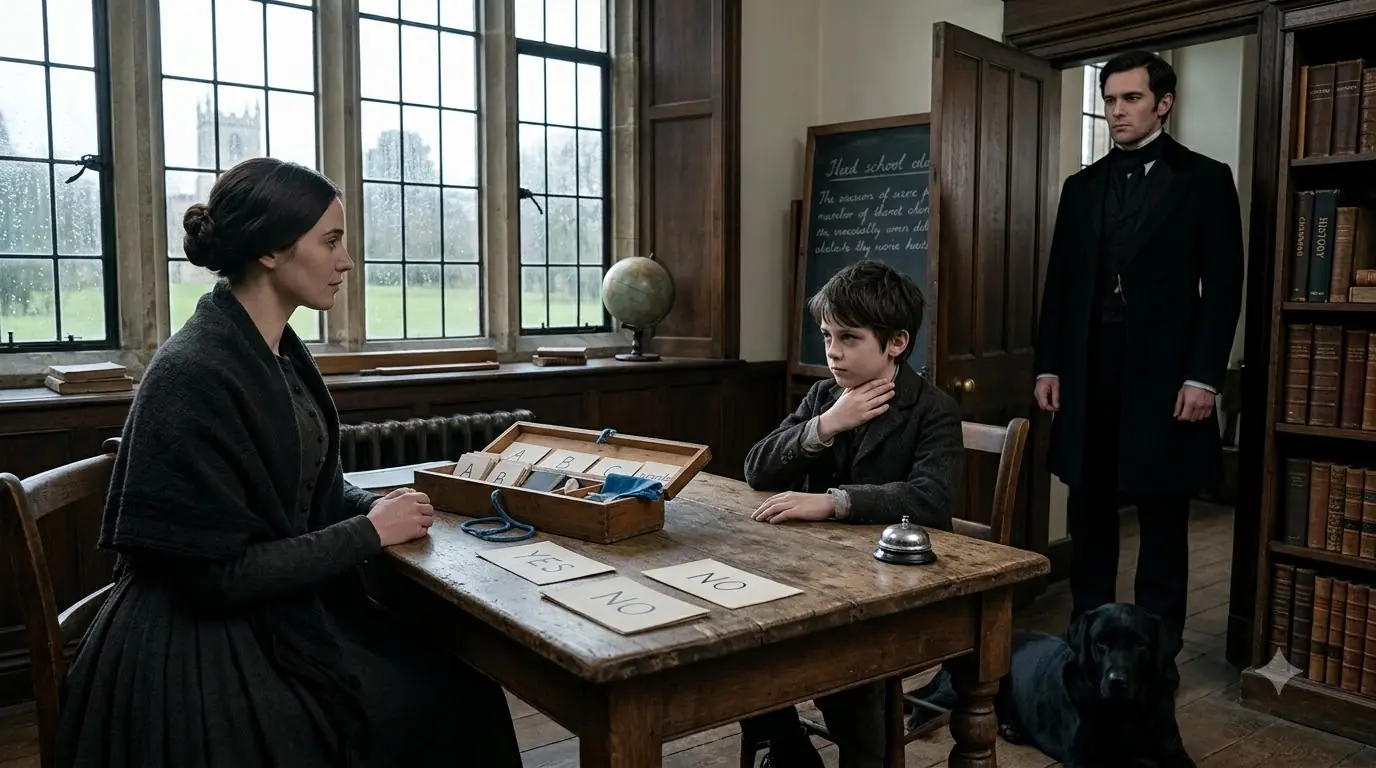
Clara had learned that respectable people used the word "cursed" when they did not wish to say frightened, injured, or inconvenient. She had also learned that powerful men used the word "governess" when they wanted an educated woman to obey them without asking questions.
On the morning Clara arrived at Blackmere Hall, rain had turned the Northumberland road into a dark ribbon of mud. The hired carriage stopped beneath an archway of black stone, and Clara stepped down with one traveling case, one carpet bag, and a narrow wooden box secured with a faded blue cord.
The coachman glanced at the box. "Books?" he asked.
"Something more dangerous," Clara said.
The man looked alarmed.
"Letters," she added.
He looked relieved, though Clara was not certain the distinction was justified.
Blackmere Hall stood beyond the courtyard, severe without being ugly. Its long windows reflected a gray sky. Smoke drifted from the chimneys, and a chapel bell tower rose above the eastern wing, its iron cross black against the rain.
The house was not the grandest Clara had ever entered. It was the most controlled. The gravel in the courtyard had been arranged into exact lines. Horses stood square in the stable yard. Servants crossed the entrance hall with the quiet efficiency of people who had learned that every movement might be observed. Even the clock seemed afraid of being late.
A thin man in a black coat approached her. "Miss Hartwell?"
"Yes."
"I am Mr. Gresham, his lordship's steward." His eyes moved to the wooden box. "His lordship has already read your references," he said.
"That is unfortunate."
Mr. Gresham blinked. "Why?"
"Because he may think they described me."
Before he could decide whether she was joking, a broad woman with silver hair entered the hall.
"Miss Hartwell," she said, "I am Mrs. Bell, the housekeeper. You are the sixth."
"The sixth governess in four years? That is more turnover than the house has bedrooms."
Mrs. Bell's mouth moved slightly. "Master Henry is not a bad boy."
"That is an unusual thing to say before I have accused him."
"You will hear otherwise."
"From whom?"
"Almost everyone."
Mrs. Bell led Clara upstairs. The corridor was lined with portraits of dead Vales, all of them wearing the expression of people who had never been contradicted while alive.
At the end of the hall was a small schoolroom with tall windows overlooking the east lawn. A black dog lay beneath the table. A boy sat beside the window. He was 9 years old, narrow-shouldered and pale, with dark hair that fell over his forehead. His clothes were perfectly arranged, but one sleeve had been rolled higher than the other. His left hand rested against his throat.
On the table before him lay a grammar book, a Bible, three volumes of history, and a silver bell.
Clara looked at the bell. Henry noticed; his fingers tightened against his throat. Clara did not touch it.
Mrs. Bell lowered her voice. "Master Henry has not spoken since the night Lady Rosamund died."
"How long ago was that?"
"5 years."
"And everyone believes he is cursed?"
Mrs. Bell looked toward the chapel tower. "People believe many things when a child refuses to give them an explanation."
Henry turned from the window. His eyes were not vacant. They were watchful. He looked at Clara as if he had already decided she would disappoint him and wished to save time.
Mrs. Bell left them alone. Clara set her wooden box on the table and removed her gloves.
"Good morning, Master Henry."
He did not answer.
"That is acceptable. I often find mornings overrated."
The boy stared at her. The dog raised its head. Clara sat opposite him, but not too close.
"Your father has asked me to teach you."
Henry glanced at the books, then at the silver bell.
"Not today," Clara said. "Today I am only going to learn what you already know."
He looked suspicious.
Clara opened her wooden box. Inside were small cards, pieces of slate, wooden letters, colored stones, and a narrow strip of blue cloth. Henry leaned forward despite himself.
Clara placed two cards on the table. One said YES; the other said NO.
"You may point," she told him. "You may write. You may use the dog if he has better manners than the adults in this house."
The dog wagged his tail once.
Henry pointed to NO.
"Do you not want to use the cards?"
He pointed to YES.
"Do you understand me?"
YES.
"Do you want me to leave?"
NO.
Clara nodded. "Excellent. We have already reached an agreement. That is more than most married couples manage before breakfast."
Henry looked down so quickly that she almost missed the small change around his mouth. He had nearly smiled.
The door opened. A tall man entered the schoolroom. He was in his mid-30s, dark-haired, broad-shouldered, and dressed in a black frock coat without unnecessary decoration. His face was composed in the manner of a man who had spent years making sure no one could tell what he felt.
Henry's back became rigid. Not fear—vigilance.
"Lord Adrian Vale," Clara said. "My lord."
His gaze moved from the cards to the books, then to the bell. "You have begun without the curriculum."
"The curriculum was already here. I am not responsible for its appearance."
His eyes rested on her. "You have been in the room for less than 10 minutes, and already the books are making a poor impression."
Henry looked between them. Adrian's expression did not change.
"Miss Hartwell, I did not hire you to entertain my son."
"No, you hired me because four other governesses failed."
"I hired you because your former employer said you were intelligent."
"That was generous of him. He dismissed me before he had time to become sentimental."
Adrian looked at Henry. "He has not spoken in 5 years."
"I was told every physician who has examined him believes the condition is psychological. Every priest who has visited believes it is spiritual. Three governesses believed it was deliberate defiance. And what do you believe?"
Adrian's gaze shifted to the silver bell. "I believe something happened on the night his mother died."
"That is not the same as believing he is cursed."
"I have never called him cursed."
"You have allowed everyone else to call him that."
A silence settled over the room. Henry looked at Clara.
Adrian's voice became colder. "You have been here 12 minutes."
"Then you have already received excellent value from the appointment."
The corner of his mouth almost moved. Almost.
"What happened at your last position?" he asked.
"I refused to force a child to recite while he was afraid."
"That is not what your reference says."
"My reference says I was insubordinate."
"Was that untrue?"
"No, I was insubordinate. The headmaster ordered me to strike the boy. I refused."
"Why?"
"Because bruising a frightened child is an inferior substitute for teaching him."
Adrian studied her. "You speak very confidently for a woman whose employment ended 6 months ago."
"Employment is temporary. Regret can last longer."