The rain was coming down sideways the morning Nathan Reed walked out of Voss Aerodyne with a cardboard box in his arms.
Inside the box were three things: a cracked coffee thermos, a stack of handwritten flight notes, and a picture his daughter had drawn of a blue airplane with yellow stars on the wings. His employee badge lay on top, cut cleanly in half by the same man who had smiled while calling him a liability.
Behind him, through the glass wall of the executive conference room, people were still laughing.
Not everyone.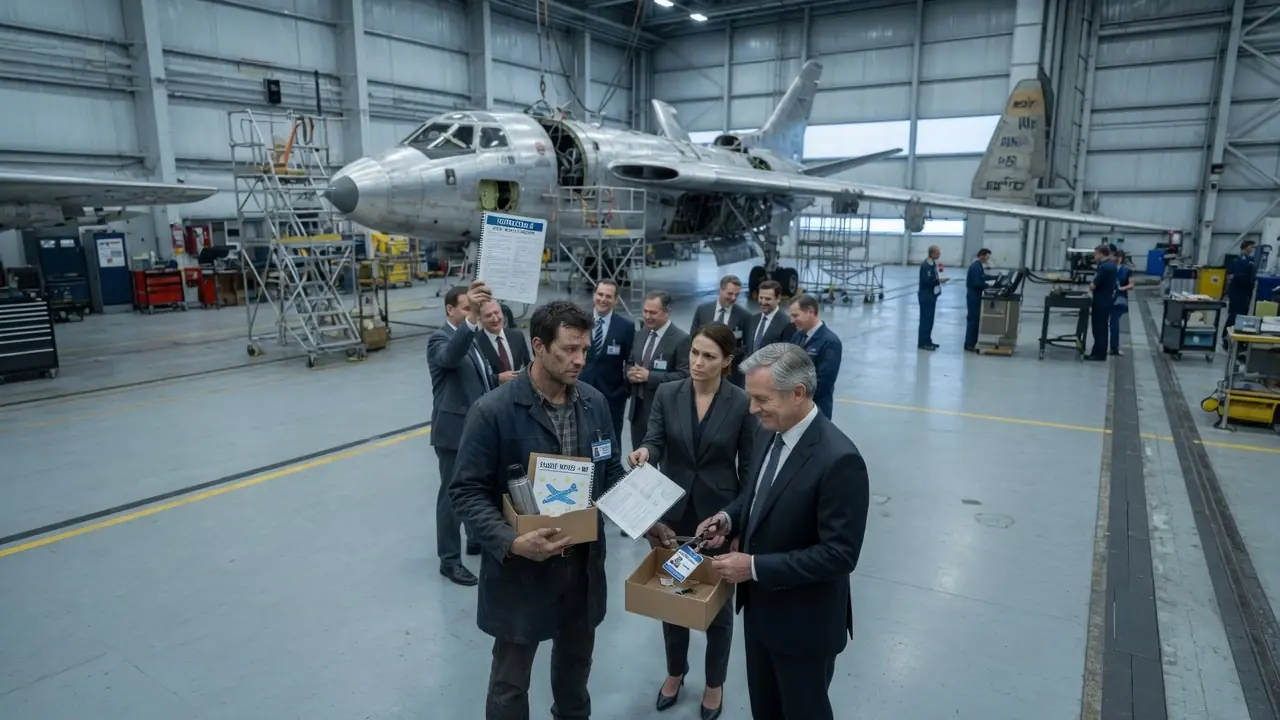
Some engineers looked down at the table. Some mechanics stared at the floor as though shame had weight. But the people who mattered most, the ones with polished shoes and stock options, smiled like they had removed a problem from the building.
Nathan did not turn around.
He stepped out into the Seattle rain, held the box tighter against his coat, and walked toward the parking lot. His phone buzzed before he reached his truck. The screen showed a video call from his eight-year-old daughter, Lily.
“Daddy, are you coming home early?” she asked.
Her face filled the screen, her hair half brushed, one sock missing, the way it always was on school mornings.
Nathan looked at the factory behind him, at the logo of Voss Aerodyne shining silver above the entrance, and felt something inside him settle into place.
“Yeah, bug,” he said softly. “I’m coming home early.”
One year later, the same company would call him back.
Not as an employee.
Not as a man asking to be believed.
As the only person in America who could keep its billion-dollar fleet from being grounded.
But on the day he was fired, Nathan Reed was just a single father in an old engineer’s coat, carrying out the warning nobody had bothered to read.
The meeting had started at 9:00 a.m. in the glass room above the main assembly floor.
Below them, workers moved between half-built control modules and testing rigs, the steady hum of aviation manufacturing rising through the walls. Voss Aerodyne had been building aircraft systems for nearly seventy years, and the company liked to talk about legacy the way some families talked about blood.
Nathan had requested that meeting five times.
He had written emails.
He had filed internal risk forms.
He had sent data packets to the certification team.
Every time, the answer had come back the same way: not now, too late in the cycle, too costly to delay, already reviewed, already cleared.
So that morning, he walked into the conference room carrying the complete technical report himself.
At the head of the table stood Madeline Voss, the thirty-six-year-old chief executive who had inherited the company from a father everyone feared and a grandfather everyone still quoted. She was brilliant on camera, disciplined with investors, and proud in a way that made apology seem like a language she had never learned.
Beside her sat Graham Ellery, the chief financial officer.
Graham had silver hair, careful hands, and the calm expression of a man who always seemed to know which chair would matter before anyone else sat down. He wore loyalty like a tailored suit, but Nathan had worked around machines long enough to know that a smooth surface could hide a crack.
Madeline did not ask Nathan to sit.
That was the first sign.
The second was that Graham had already placed Nathan’s employee file on the table.
“Mr. Reed,” Madeline said, voice cool and controlled. “You have delayed certification on the Horizon-9 stabilization module for nearly three weeks.”
Nathan placed the report on the table.
“I delayed nothing. I identified a failure condition that has not been properly tested.”
Graham smiled faintly.
“A failure condition that no one else can reproduce.”
“That is not true,” Nathan said. “The raw simulation logs reproduce it under crosswind correction at low altitude. I’ve included the full output in section six.”
Madeline still did not look at the report.
That told him more than anger would have.
“You are a senior safety engineer, not the head of this company,” she said. “You do not get to hold up a global launch because you dislike the results.”
Nathan kept his hands still.
“I don’t dislike the results. I don’t trust them because they were altered.”
The room changed.
A director leaned back in his chair.
Graham’s eyes sharpened, though his smile remained.
Madeline’s face went flat.
“That is a serious accusation.”
“It’s a serious problem.”
“No,” Graham said smoothly. “The problem is that one overworked single father with a savior complex has decided he knows more than the entire certification division.”
A few people laughed.
Nathan heard it.
So did everyone else.
Madeline should have stopped it.
She did not.
Instead, she turned the blade herself.
“Voss Aerodyne cannot afford to keep paying a man who confuses personal instability with professional judgment,” she said. “You have become disruptive, Nathan. And frankly, we do not have room for a useless single father who makes fear more expensive than facts.”
The sentence entered him quietly.
That was the strange thing.
The worst insults sometimes do not hit like a slap. They slip in like cold water and fill the spaces where a person is trying very hard to remain composed.
Nathan thought of Lily waiting at home with spelling homework and a lunchbox she always forgot to empty.
He thought of his wife, Mara, gone three years now from a drunk driver on a rainy road outside Tacoma.
He thought of all the mornings he had braided Lily’s hair wrong, packed snacks too late, answered emails at midnight, and still walked into that plant before sunrise because planes did not care how tired a man was.
Then Graham reached across the table.
He picked up Nathan’s badge and cut it in half with a pair of metal shears.
The snap sounded louder than it should have.
“There,” Graham said. “Problem solved.”
Nathan looked at the two broken halves on the polished table.
Then he looked at Madeline.
“One day you’ll need the last page of that report,” he said.
Madeline’s jaw tightened.
“That day will not come.”
Nathan took the report back.
He did not argue.
There are rooms where the truth is not rejected because it is weak. It is rejected because accepting it would make too many powerful people responsible for what they ignored.
So he left.
The Horizon-9 flaw was not dramatic on paper.
That was what made it dangerous.
Most flights would never trigger it. Most pilots would never feel it. On a calm day, under normal corrections, the system behaved exactly the way Voss promised it would.
But Nathan had not spent fifteen years in flight safety trusting normal conditions.
He had started as a mechanic at a regional airfield, crawling under planes in winter rain, learning the difference between a system that passed inspection and a system a tired mechanic would trust with his own family inside. Later he became a test pilot assistant, then a certification engineer, then the man people quietly asked to check systems when the official numbers looked too clean.
He understood that aircraft did not fail in the center of perfect conditions.
They failed at the edge.
In the narrow place where weather, pressure, altitude, human reaction, and machine correction all arrived at once.
The Horizon-9 module had a hidden problem in its balancing algorithm. If an aircraft hit a strong crosswind at low altitude while already correcting for a steep approach, the system could misread its own adjustment. It would not violently roll the plane at first. It would nudge.
Then correct the nudge.
Then overcorrect the correction.
In the wrong hands, in the wrong storm, in the wrong ten seconds, that gentle mistake could become fatal.
Nathan had found it by accident during a late-night simulation.
Then he had tried to prove himself wrong.
That was what honest engineers did.
He ran the test again.
Then again.
Then with different wind values, different load assumptions, different pilot inputs.
The flaw remained.
It waited patiently inside the numbers like a splinter under skin.
He reported it to Graham Ellery because that was the chain of command. Graham thanked him, asked for the files, and said the executive team would review the issue carefully.
Two days later, the official logs came back clean.
Too clean.
Nathan knew altered data when he saw it.
The timestamps had been rebuilt. Several test outputs were missing. One simulation set had been renamed and placed in a folder where no inspector would think to look unless he already knew it existed.
He asked for an independent review.
That was when the mood around him changed.
Meetings moved without him.
Emails stopped including him.
A rumor started that Nathan had been “having a hard time” since his wife died and was letting anxiety affect his judgment. Nobody said it directly to his face, which made it worse. Cowardice in a corporate office often wears the perfume of concern.
On his last night at Voss, before the firing, Nathan stayed in the lab until almost 2:00 a.m.
The building was mostly empty.
The test rigs glowed blue in the dark.
He copied the raw simulation files, the original blueprint notes, the access logs, and every message he had sent warning about the flaw. He backed them up twice and placed one drive inside the lining of Lily’s old backpack because no thief in corporate aviation would think to search a child’s unicorn bag.
He did not know then that those files would one day become worth more than the entire conference room that had laughed at him.
He only knew the truth needed a witness.
After he was fired, Voss Aerodyne erased him quickly.
That was what companies did when a firing made them uncomfortable.
His email disappeared by noon.
His name came off the internal directory.
Graham told several industry contacts that Nathan had been let go after “erratic behavior connected to disputed testing practices.” It was not a formal accusation. It was worse. It was soft enough to repeat without proof and poisonous enough to close doors.
Nathan applied to three companies.
None called back.
One hiring manager, a man he had known for years, finally took his call and said, “Nate, off the record, people are nervous about you.”
People.
That word did so much dirty work in business.
People say.
People hear.
People worry.
No one names the person who started the fire, but everyone smells smoke and refuses to stand too close.
For three months, Nathan took contract work where he could find it. He repaired avionics for small carriers, inspected aging cargo planes, and fixed ground systems at an airfield so small the vending machine still sold expired candy. During the day, he worked. At night, he helped Lily with school projects and pretended the bills on the counter did not make his chest tight.
One evening, Lily found him at the kitchen table staring at a spreadsheet.
“Are we poor?” she asked.
Nathan looked up.
Children had a talent for asking the question adults spent all day avoiding.
“No,” he said.
“Are we almost poor?”
He almost laughed.
Then did not.
“We’re in a hard season.”
She climbed into the chair beside him and placed one of her drawings on the table.
It showed him standing beside a huge airplane with a toolbox in one hand and a cape on his back.
“You fix things,” she said. “So fix it.”
That was how Reed Vector Aviation began.
Not with a billion-dollar plan.
Not with a speech.
With a tired father, a child’s drawing, and a refusal to let powerful people decide what his name meant.
Nathan still owned several patents from work he had done before Voss, smaller flight correction tools most companies had ignored because they were not flashy. He also had the original Horizon-9 data and enough knowledge of overlooked aviation infrastructure to see what the boardroom people missed.
The future of aviation did not belong only to the companies selling the aircraft.
It belonged to the people who could maintain them, diagnose them, supply rare parts, certify software fixes, and keep a carrier flying when everyone else said the risk was too expensive.
He called two former colleagues.
One was a retired systems engineer named Carla Mendez, who had been pushed out of a major aerospace firm for refusing to sign a rushed certification. The other was Leon Bishop, a maintenance director with thirty-two years in hangars and a reputation for telling executives the truth even when they hated hearing it.
They met in a rented hangar outside Spokane with bad heating, a leaking roof, and one coffee maker that sounded like it was preparing for death.
Nathan laid out the plan.
Carla listened with narrowed eyes.
Leon leaned back in a metal chair and said, “You’re talking about building the part of the industry nobody respects until it fails.”
Nathan nodded.
“Exactly.”
Leon grinned.
“I’m in.”
Their attorney, Amara Cho, joined two weeks later.
She had once represented whistleblowers in aviation safety cases and had the unsettling habit of reading contracts as if they had personally offended her. She discovered that several old patents tied to flight balancing and emergency control logic had been neglected by companies too proud to realize their value.
Nathan bought them quietly.
One by one.
A maintenance software firm in Ohio.
A parts warehouse in Nevada.
A small diagnostic lab in Montana that had better engineers than customers.
A bankrupt supplier holding rights to a sensor package every modern stabilizer would soon need.
None of it made headlines.
That was the advantage.
People in expensive rooms rarely notice what quiet people are building until the foundation under their own building changes hands.
The first year nearly broke him.
He slept in the hangar office twice a week.
He took calls from school while negotiating supplier contracts.
He learned how to speak to investors without sounding like a man who hated investment.
He hired people with inconvenient records: engineers who had raised alarms, inspectors who had refused to rubber-stamp bad data, mechanics who had been called slow because they checked their work twice.
At Reed Vector, caution was not a personality flaw.
It was company policy.
Word spread first in maintenance bays.
Then dispatch offices.
Then regional airline boards.
If you had a system problem no one could explain, Reed Vector would find it.
If you needed a part everyone else said was unavailable, Reed Vector probably knew which warehouse had six of them under the wrong label.
If your fleet had a safety concern and you wanted someone to tell you the truth before the regulator did, you called Nathan Reed.
He did not become rich all at once.
Nobody does, not honestly.
But the company grew fast because it solved problems people could not ignore.
Within a year, Reed Vector Aviation controlled a network of maintenance shops, rare-parts suppliers, safety software patents, and emergency certification teams that quietly supported hundreds of flights a day.
Then Aviation Ledger published the profile.
The headline spread before Nathan finished making Lily’s breakfast.
The richest man in American flight safety is the engineer Voss Aerodyne fired last year.
Lily read the headline on his phone.
“Daddy, are we rich-rich?”
Nathan looked at the eggs burning in the pan.
“We’re still eating toast this morning.”
“But rich-rich?”
He smiled.
“Maybe paperwork rich.”
She considered that.
“Can paperwork buy better cereal?”
“Yes.”
“Then I like paperwork.”
That same morning, Madeline Voss walked into the glass conference room at Voss Aerodyne and found the headline waiting on the wall screen.
For a moment, she did not understand what she was seeing.
Nathan Reed stood in the photograph wearing a dark jacket beside a Reed Vector aircraft, his hand resting on the nose cone, the same calm expression on his face that had irritated her so much a year earlier. Under his name was a number large enough to make the directors fall silent.
Graham Ellery laughed first.
Too quickly.
“That can’t be our Nathan Reed.”
No one answered.
Because it was.
The useless single father.
The unstable engineer.
The man whose badge Graham had cut in half.
The man they had dismissed as a problem had become the most important safety infrastructure owner in American aviation.
Then the second piece of news arrived.
The federal aviation authority had issued an urgent inquiry into the Horizon-9 stabilization module. Two carriers had reported irregular crosswind corrections during low-altitude approach testing. No crash had happened yet. No lives had been lost.
Yet.
But the agency wanted answers within forty-eight hours.
If Voss could not produce a credible corrective plan, every Horizon-9 contract would be frozen.
Madeline turned to her engineering team.
“Fix it.”
No one moved.
That silence told her more than any report.
Finally, a young engineer named Peter Lang said what everyone in the room was trying not to know.
“The correction path Nathan Reed proposed is the fastest way.”
Graham’s face hardened.
“That man created this crisis.”
Peter looked terrified.
But he did not take it back.
“No, sir. He documented it.”
Madeline felt something shift inside the room.
Not loyalty.
Not yet.
Doubt.
Doubt was small at first, but once it entered a boardroom, it moved like smoke. It drifted into corners, under doors, behind every polished sentence, until everyone had to breathe it.
Then Amara Cho’s formal notice arrived.
Reed Vector Aviation held patents directly tied to emergency flight balancing logic used in Horizon-9. Voss Aerodyne might already be infringing on several of them. If Voss continued shipping the module without negotiating a technical and legal agreement, Reed Vector had grounds to seek an injunction.
Madeline read the message twice.
Then a third time.
Voss did not merely need Nathan’s help.
Voss needed his permission to keep selling the product it had fired him for questioning.
Graham pushed her hard to sign a rescue financing deal with a private equity firm called Black Meridian Capital.
He said Voss could survive the inquiry if it had enough liquidity, enough legal cover, enough public relations muscle. He said Reed Vector was trying to exploit their vulnerability and that Madeline had to move quickly before panic spread.
But the more Graham spoke, the less solid he sounded.
For the first time, Madeline noticed how often his advice required her not to read the technical files herself.
She thought of Nathan standing in that room one year earlier.
Read the last page.
The words returned like a door opening in the dark.
Madeline asked for the original report.
Graham said it had been archived.
She asked again.
He said legal should handle it.
She turned to her assistant.
“Find it.”
By evening, she was sitting alone in her office with Nathan’s old report open in front of her.
The last page contained a log table.
She read the entries slowly.
Then read them again.
The data had been altered after Nathan’s final submission.
The access permissions traced to Graham Ellery’s office and a secondary external account connected to Black Meridian Capital.
For one long minute, Madeline did not move.
The city lights beyond her window blurred into streaks.
The truth was not complicated.
She had chosen the wrong man to trust because he had spoken in the tone she found easiest to believe.
Nathan had spoken in warnings.
Graham had spoken in solutions.
She had mistaken comfort for competence.
The next morning, Madeline requested a meeting with Nathan Reed.
He did not answer personally.
Amara Cho did.
“If Voss Aerodyne wishes to meet with Mr. Reed,” she said, voice clean and unhurried, “please submit a formal request through our office.”
Madeline closed her eyes.
The reversal was almost elegant in its cruelty.
A year earlier, she had refused to give Nathan ten minutes.
Now she had to ask for his time like any other company in crisis.
Two days later, Madeline Voss arrived at Reed Vector Aviation with Graham, three directors, and a legal team that had grown twice as cautious since reading the patent notice.
Reed Vector’s headquarters did not look like old money.
There were no marble floors, no portraits of dead founders, no chandelier meant to remind visitors who had history on their side. Instead, there were hangars, testing labs, logistics screens, repair bays, and a runway where aircraft moved with disciplined purpose.
The place felt alive.
Not decorative.
Useful.
Workers nodded at Nathan’s name with respect, not fear. Engineers argued openly over data. Mechanics walked through executive corridors with tablets in their hands and grease on their sleeves. Nobody seemed embarrassed by work.
That unsettled Madeline more than she expected.
Voss Aerodyne had always treated the factory floor as something leadership looked down upon from glass.
At Reed Vector, the floor was the source of authority.
A security director led them to a conference room overlooking the main hangar. Graham muttered about the lack of ceremony. Nobody responded.
Then Nathan entered.
He wore a simple white shirt with the sleeves rolled to his forearms.
No tie.
No expensive performance.
No need to prove the room belonged to him.
It did.
Madeline stood.
“Nathan.”
“Ms. Voss.”
The formality stung.
She deserved it.
Graham tried to take control first.
“Mr. Reed, we are here because both companies have a shared interest in preventing market disruption.”
Nathan looked at him.
“No. You are here because your product is unsafe under certain conditions and you ignored the person who told you.”
Graham’s face tightened.
Madeline placed one hand on the table.
“Graham.”
He turned toward her, surprised by the warning.
Nathan sat.
Amara Cho placed a slim folder in front of him.
“I want to make something clear before we discuss any technical support,” Nathan said. “This does not begin with ‘miscommunication.’ It does not begin with ‘unfortunate disagreement.’ It begins with the truth.”
He reached into the folder and removed two pieces of plastic.
His old employee badge.
Still cut in half.
He placed them on the table.
The room went very still.
“I kept this,” Nathan said, “because sometimes a company cuts out the one part of itself still trying to keep it honest.”
No one laughed this time.
Madeline looked at the broken badge and felt the old conference room rise around her again. Her own voice returned to her memory, cold and cruel. Useless single father. Personal instability. Disruptive.
She had not only fired him.
She had made an example of him.
And everyone in the factory had understood exactly what the example meant.
Speak up, and this happens.
Amara laid out the documents.
Patent ownership.
Debt positions.
Maintenance dependencies.
Customer overlap.
Technical control points.
It became clear within minutes that Reed Vector had not accidentally grown powerful. Nathan had built the company exactly where the aviation industry was most fragile. If he pulled support, Voss could not fix Horizon-9 quickly enough to survive the regulatory freeze.
Graham tried to dismiss the patent claims.
Amara smiled politely and opened another folder.
That smile was not friendly.
It was a door locking.
Nathan asked for the old report to be displayed.
Madeline nodded.
The last page went onto the screen.
The access logs appeared in clean rows.
Nathan explained them without drama.
“This is the original submission time. This is the altered dataset. This is the internal access tied to Mr. Ellery’s authorization. This is the external login associated with Black Meridian Capital.”
Graham stood abruptly.
“This is fabricated.”
“No,” Nathan said. “It is preserved.”
Amara added, “From three independent backups.”
A director whispered something under his breath.
Madeline heard only one word.
God.
Nathan moved to the technical issue next.
He described the crosswind failure in plain language, not because the room was stupid, but because the truth did not need ornament. He explained the low-altitude correction loop, the overcompensation risk, and the software pathway needed to prevent the system from fighting the pilot at the worst possible moment.
One of Madeline’s own engineers, an older woman named Denise Rowe, studied the diagrams.
Then she looked up.
“He’s right.”
Graham turned on her.
“Denise.”
She held his gaze.
“He was right a year ago too.”
That ended the last comfortable lie in the room.
Graham began blaming pressure, deadlines, investor expectations, and Madeline’s insistence on launch targets. The more he spoke, the more he exposed himself. A man who had spent a year building a story now found every sentence pulling thread from the same coat.
Then the wall screen lit up with an incoming call.
Black Meridian Capital.
The room watched as Victor Harlan, Black Meridian’s managing partner, appeared with a smile smooth enough to leave no fingerprints.
“Madeline,” he said, “I understand things are becoming complicated. We are prepared to move forward immediately with the acquisition package.”
Nathan looked at the screen.
“Before or after the federal inquiry grounds Horizon-9?”
Victor’s smile paused.
Only for a second.
But Nathan had built a career reading small failures before they became disasters.
Amara presented the chain.
Black Meridian had quietly acquired Voss debt months earlier. Graham had coordinated with them while suppressing the Horizon-9 flaw. The more crisis Voss faced, the cheaper the company would become. Black Meridian did not intend to save Voss Aerodyne.
It intended to buy the bones.
Madeline sat back slowly.
For the first time since taking the chief executive seat, she felt not young, not powerful, not underestimated.
Simply foolish.
The man beside her had led wolves to the door and called it strategy.
Victor began speaking again, but Madeline raised a hand.
“End the call.”
The screen went black.
Graham looked at her.
“Madeline, you are making a mistake.”
She looked back at him.
“No. I made it last year.”
That was the first honest thing she had said all day.
Nathan did not smile.
Madeline expected him to enjoy this. She almost wanted him to. It would have made him easier to resent. But he looked only tired, as if watching a crash unfold in slow motion did not feel satisfying simply because he had warned everyone about the cliff.
“What do you want?” Madeline asked.
Nathan’s answer was ready.
“First, my termination record is corrected publicly. Not buried in HR language. Corrected.”
Madeline nodded.
“Second, Graham Ellery is suspended immediately and all communications with Black Meridian are preserved for investigation.”
Graham cursed under his breath.
“Third, every Horizon-9 unit is frozen until Reed Vector completes an independent safety overhaul.”
“That will cost us millions,” one director said.
Nathan looked at him.
“Grounded aircraft cost money. Failed aircraft cost lives.”
No one argued after that.
“Fourth,” Nathan continued, “any engineer, mechanic, or inspector at Voss who raises a documented safety concern gets protected authority to stop the line pending review. No retaliation. No career assassination. No whisper campaigns about instability.”
Madeline looked down.
That condition was the one that reached deepest.
Because it was not about Nathan anymore.
It was about everyone who had learned from his humiliation.
She asked to speak with him alone.
They walked into the hangar where rain tapped softly against the high metal roof. Aircraft sat under work lights, their panels open, their systems exposed. Mechanics moved around them with calm precision. There was no boardroom gloss here, only work that either held or failed.
Madeline folded her arms against the chill.
“Why didn’t you expose us a year ago?”
Nathan looked across the hangar.
“Because nobody would have believed me.”
“I might have.”
He turned to her.
“No. You wouldn’t have.”
She absorbed that.
He was not being cruel.
That made it worse.
“I was a fired engineer with a daughter to feed,” he said. “You had a family name, a board, a CFO, and a story ready to explain me away. If I spoke then, I would have been called bitter. So I built enough power that the truth could survive being spoken.”
Madeline’s throat tightened.
“I’m sorry.”
Nathan was quiet for a moment.
“Sorry is a beginning. Not a repair.”
“I know.”
“Do you?”
The question was plain.
She deserved it.
He continued.
“You did not just fire me. You taught every honest person in that building that truth was dangerous. You turned safety into disloyalty. That is the damage you have to fix.”
Madeline looked through the hangar doors toward the runway.
The rain had eased.
A small aircraft rolled slowly beneath gray light, steady and alive because someone had done their work correctly.
“I thought leadership meant carrying the company name forward,” she said.
Nathan shook his head.
“Leadership means listening when the person below you says the plane is not safe.”
For once, she had no answer.
That evening, Voss Aerodyne suspended Graham Ellery.
By morning, federal investigators had requested records from both Voss and Black Meridian. The acquisition offer disappeared. Victor Harlan released a statement about market conditions and strategic timing, which was how men like him said retreat without admitting fear.
Madeline stood before the Voss factory workers two days later.
No glass room.
No board table.
She stood on the factory floor, close enough that the mechanics could see her hands shake.
“One year ago,” she said, “I fired Nathan Reed and called him useless.”
The floor went silent.
“I was wrong. More than wrong. I allowed pride, pressure, and misplaced trust to silence the man who was trying to protect this company and the people who fly with our systems.”
She looked toward the assembly line.
“I also sent a message to every engineer, mechanic, and inspector here that honesty could cost you your livelihood. That message ends today.”
Nathan stood at the edge of the floor, not beside her.
Not as a prop.
He had refused that.
Reed Vector would oversee the Horizon-9 overhaul, but he would not let Voss use his face as a quick cure for its sickness.
Repair did not work that way.
Over the next six months, Horizon-9 was rebuilt from the inside.
Software logic changed.
Testing standards widened.
Independent review became mandatory.
Engineers received line-stop authority. Mechanics no longer had to send concerns through managers whose bonuses depended on silence. Inspectors were given direct reporting access to Reed Vector and the regulator during the restructuring period.
Some Voss executives resigned.
Some were removed.
Some stayed and learned that authority felt different when the people below them were allowed to speak without fear.
Nathan returned to the old conference room only once.
The table had been replaced, but he still knew where Graham had cut his badge. Memory has a way of marking surfaces no renovation can fully clean.
Madeline met him there with the final safety certification.
The corrected one.
She handed it to him without ceremony.
He read the last page.
Then signed.
For a moment, neither spoke.
Finally, Madeline said, “I wish I had read it the first time.”
Nathan closed the folder.
“So do I.”
There was no forgiveness scene.
No handshake that made the past disappear.
No easy ending where humiliation became useful because everything worked out.
Some things should not have to happen for people to learn.
But the aircraft were safer.
The workers were safer.
And the truth, at last, had a place in the building.
That counted for something.
On the anniversary of his firing, Nathan stood outside Reed Vector’s main hangar while Lily chased a paper airplane across the pavement. She was nine now, taller, louder, and convinced she would one day design aircraft that looked like dragons.
His phone buzzed with a message from Leon.
First overhauled Horizon-9 units cleared final inspection. Clean run.
Nathan read it twice.
Then put the phone away.
Lily ran back holding the paper airplane.
“Daddy, did you win?”
He looked at her.
Then at the runway.
Then at the gray sky beginning to open into blue.
“I don’t think that’s the right word.”
She frowned.
“You beat the mean people.”
“Some of them.”
“You fixed the planes.”
“With a lot of help.”
“So what is the word?”
Nathan thought of the badge cut in half, the report no one read, the company that nearly lost itself, and the people who finally had permission to tell the truth before metal left the ground.
“Useful,” he said.
Lily tilted her head.
“That’s a boring word.”
He smiled.
“Sometimes the best ones are.”
A Reed Vector test aircraft lifted from the runway behind them, rising cleanly through the last edge of cloud. Its wings held steady against the wind. No drama. No failure. No hidden correction fighting the pilot in the most dangerous seconds of flight.
Just a machine doing what honest people had made it to do.
Nathan watched until it became a small shape against the sky.
A year earlier, they had laughed while he carried a cardboard box into the rain.
Now planes flew safer because he had refused to let their laughter become the truth.
Forbes could call him the richest man in aviation.
The industry could call him a genius.
Voss could call him partner.
But when Lily slipped her hand into his and asked if they could go home for dinner, Nathan knew the title that mattered most had never changed.
He was still her father.
Still the man who fixed things.
Only now, no one could call that useless and expect the sky not to answer.