Maya Torres stood in the employee breakroom, staring at her reflection in the small cracked mirror hanging on the wall. Her black uniform was crisp and clean, her hair pulled back in a tight bun. She looked professional, presentable, exactly what the Grand View estate required of its staff. But inside, she felt like she was slowly disappearing. 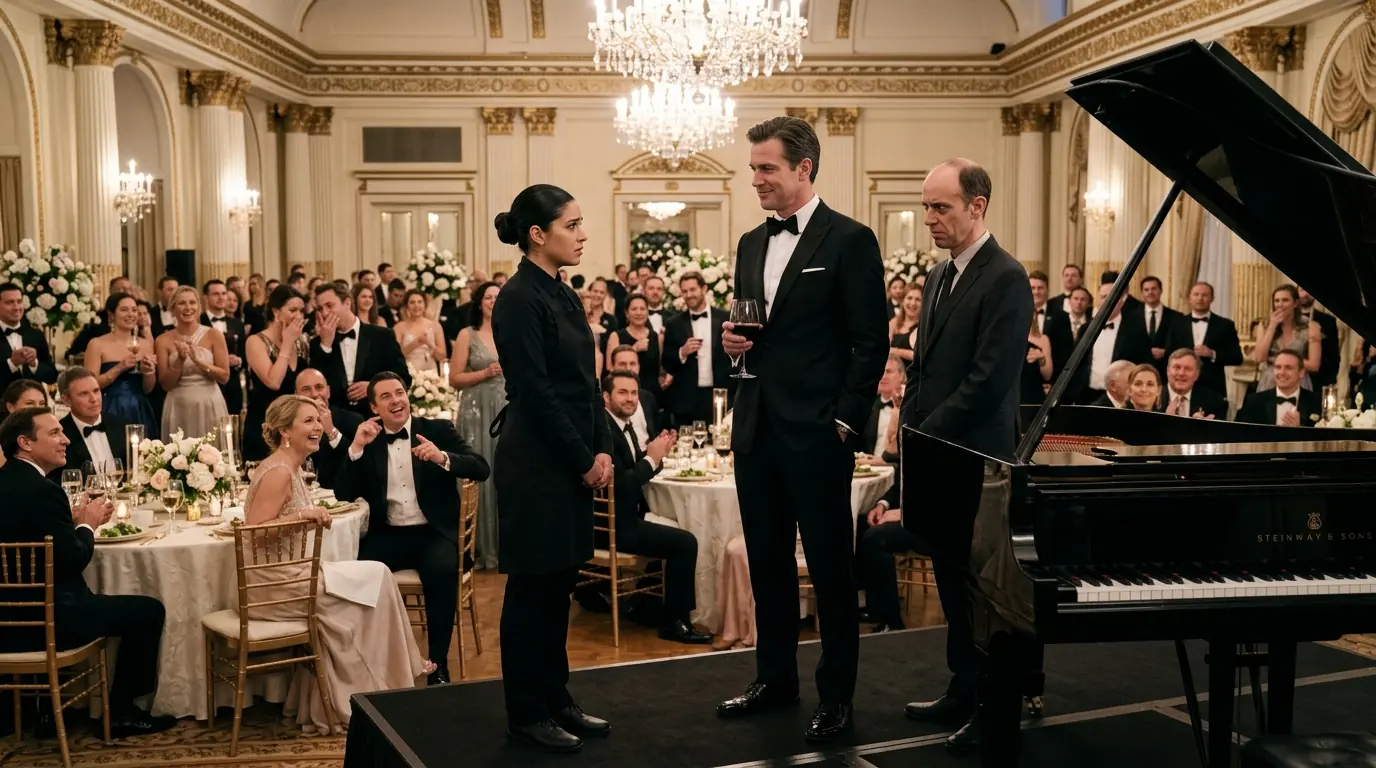
It was Friday evening, and the Grand Ballroom was being prepared for another extravagant event. Maya had been working at the Grand View estate for almost 2 years now, and in that time she'd served at countless parties, weddings, and charity galas. Each event was more lavish than the last, with guests who wore watches that cost more than she made in a year.
She grabbed her notepad and pen, took a deep breath, and pushed through the swinging doors into the service corridor. The sound of her footsteps echoed off the marble floors as she made her way toward the ballroom.
The Grand View estate was one of those places that made you feel small. Everything was oversized and dramatic. Crystal chandeliers hung from ceilings that seemed impossibly high. Gold-trimmed mirrors reflected endless versions of yourself. Fresh flowers filled massive vases in every corner, their perfume mixing with the scent of expensive cologne and wine.
Tonight's event was a charity gala for some cause Maya hadn't bothered to learn about. She discovered early on that it didn't really matter what the cause was. These events all followed the same pattern. Rich people gathered to write checks that made them feel good about themselves, ate expensive food, drank vintage wine, and went home feeling like they'd saved the world. Meanwhile, Maya and the other staff worked 12-hour shifts for barely enough money to cover rent.
Maya was 24 years old, though some days she felt twice that age. Her feet ached constantly from standing all day. Her back hurt from carrying heavy trays. Her face hurt from maintaining the pleasant, invisible smile that servers were expected to wear. But the physical pain was nothing compared to the other kind of pain, the one that lived somewhere deeper.
As she entered the ballroom, she paused for just a moment, taking in the scene. Round tables covered in white silk tablecloths filled the space, each one decorated with elaborate centerpieces. The lighting was dim and romantic, casting everything in a golden glow.
On the far side of the room, a small stage had been set up with a beautiful grand piano. A hired musician was already there playing soft classical music that most guests wouldn't even notice.
But Maya noticed. She always noticed.
Music had been her whole world once. When she was a little girl growing up in a small apartment with her mother and two younger brothers, the upright piano in their living room had been her escape. It didn't matter that the piano was old and slightly out of tune, or that they could barely afford lessons. When Maya sat at those keys, everything else disappeared. The cramped apartment, the bills her mother worried about, the sounds of the city outside their window—all of it faded away. There was only the music.
She'd been good, too. Not just good, exceptional. Her teachers had told her mother that Maya had a rare gift, that with proper training, she could have a real future as a concert pianist. They'd helped her apply for scholarships, and when she was 18, Maya had been accepted to the prestigious Riverside Conservatory of Music. It had felt like a dream come true.
College had been the happiest time of her life. She'd spent hours every day practicing, her fingers flying over the keys, learning pieces by Mozart, Chopin, Rachmaninoff. Her professors had praised her technical skill and emotional depth. She'd performed in student recitals, her heart racing with excitement and fear. After each performance, she'd felt truly alive in a way that nothing else could match.
But dreams cost money, and scholarships only covered so much. By her third year, the financial pressure had become unbearable. Her mother was working two jobs, but still struggling. Her brothers needed help with their own school expenses. Maya had taken out student loans, but they weren't enough. She'd started working part-time jobs, fitting in shifts between practice sessions and classes. Sleep became a luxury she couldn't afford.
Then her mother got sick. Nothing life-threatening, but enough that she couldn't work for several months. Maya had to make a choice. She could continue pursuing her degree while her family struggled, or she could step up and help.
Really, it wasn't a choice at all.
She'd withdrawn from the conservatory just one year shy of graduating. The student loans still had to be paid back, degree or not. She'd found work at the Grand View estate, where the pay was decent and the tips could be good if you served the right tables. She'd told herself it was temporary, just until she got her family back on solid ground, just until she saved up enough to return and finish her degree.
That was 2 years ago.
Her mother was healthy again. Her brothers were doing well. But Maya was still here, still wearing this uniform, still carrying trays of champagne to people who didn't see her as a person at all.
The worst part wasn't the exhaustion or the low pay or even the rude customers. The worst part was walking past that piano every single night and feeling something inside her die a little more. She never touched it. She didn't even let herself look at it for too long. It hurt too much.
"Maya, stop daydreaming and start setting up table 7."
The sharp voice of her manager, Mr. Peterson, cut through her thoughts. He was a thin man with a permanent scowl, always stressed about something, always ready to criticize the staff.
"Yes, sir. Sorry, sir."
Maya hurried over to table 7 and began arranging the place settings with practiced efficiency. Dinner plate, salad plate, bread plate, fork, knife, spoon, all aligned perfectly. Wine glass, water glass, folded napkin. She'd done this thousands of times. She could probably do it in her sleep.
Other servers moved around her, everyone working quickly and quietly. They all knew the routine: be invisible until you're needed. Be polite but not familiar. Never, ever draw attention to yourself. The guests were the stars of the show; the staff were just props in the background.
As Maya worked, the guests began to arrive. They came in laughing and chatting, air-kissing friends they'd probably seen just yesterday. The women wore gowns that cost more than Maya's car, diamonds glittering at their throats and wrists. The men wore perfectly tailored tuxedos, their shoes polished to a mirror shine. They moved through the space like they owned it, which in a way they did. This was their world; Maya was just working in it.
She recognized some of the faces from previous events. There was the tech entrepreneur who never said thank you, the fashion designer who always sent her food back, the lawyer who'd once snapped his fingers at Maya like she was a dog.
And then there was tonight's host, Richard Westbrook, a real estate billionaire whose face appeared regularly in business magazines. He stood near the entrance, greeting guests with a wide smile and firm handshakes, his ego filling the room even more than his 6'3" frame.
Maya picked up a tray of champagne flutes and began circulating through the crowd.
"Champagne?" she offered with a smile that didn't reach her eyes.
Hands reached out without looking at her, taking glasses without acknowledgement. She was a moving table, nothing more.
As the evening progressed, Maya fell into the rhythm of service: take orders, deliver food, refill drinks, clear plates, smile, nod, apologize when someone complained.
The pianist continued playing throughout dinner, his music creating a pleasant ambiance that no one really listened to. Maya tried not to listen either, but she couldn't help it. She heard every note, every phrase, every tiny mistake he made. It was torture and comfort all at once.
Around 9:00, as dessert was being served, Maya noticed the pianist getting up from his bench. He looked pale, his hand pressed against his stomach. He spoke briefly with the event coordinator, then quickly left through a side door.
The music stopped abruptly, leaving an awkward silence in its wake.
Maya was in the kitchen loading dirty plates when she heard Mr. Peterson calling her name urgently. She hurried back into the ballroom, wondering what had gone wrong now. Her manager's face was red and flustered, sweat beading on his forehead.
"Maya," he said in a low, urgent voice, "the pianist is sick. He had to leave. Mr. Westbrook is furious that there's no music. I remembered you mentioning once that you studied music. Can you play the piano?"
Maya's stomach dropped. "I... I'm working. I'm a server."
"I know that," Mr. Peterson snapped. "But we have an emergency. Just play something simple. Background music, please."
Before Maya could respond, Richard Westbrook himself approached, his voice booming across the ballroom. "What's the holdup? Where's our music?"
And that was when Maya's carefully constructed walls began to crumble, and a night she would never forget began to unfold.
Richard Westbrook wasn't the kind of man who accepted inconvenience. He'd built his fortune on controlling every aspect of his business empire, and he expected the same level of control in every area of his life. When things didn't go according to plan, someone always paid the price.
"What do you mean there's no pianist?" His voice carried across the ballroom, causing several guests to turn and look. "I paid good money for this event to be perfect. This is unacceptable."
Mr. Peterson stammered something about the musician being ill, but Westbrook wasn't interested in excuses. His face had turned red, and Maya could see the vein pulsing at his temple. This was a man used to getting his way, and right now he was not getting his way.
"Sir, perhaps we could play recorded music," Mr. Peterson suggested weakly.
"Recorded music? At a gala of this caliber?" Westbrook looked at him like he'd suggested serving fast food for dinner. "Absolutely not. This is a charity event attended by some of the most influential people in the city. We will have live music, or heads will roll."
It was at that moment that Mr. Peterson made a decision that would change everything. "Sir, we do have someone who can play. Maya here studied music at the conservatory. She can fill in."
Maya's blood ran cold. Every head in the nearby area turned to look at her. She opened her mouth to protest, but no words came out. She could only shake her head slightly, her heart pounding.
Westbrook's eyebrows raised as he looked her up and down, taking in her server's uniform, her practical shoes, her hair pulled back in a simple bun. A slow smile spread across his face, but it wasn't a kind smile. It was the smile of someone who'd just found an unexpected source of entertainment.
"The waitress," he said, loud enough for surrounding tables to hear. "Our waitress plays piano." He turned to his nearby guests. "Well, isn't this interesting?"
Murmurs spread through the crowd. People were setting down their forks, turning in their chairs to see what was happening. Maya felt like she was under a spotlight, even though the lighting hadn't changed. Her face grew hot with embarrassment.
"I... I don't think that's appropriate," Maya managed to say, her voice barely above a whisper. "I'm working. I should get back to serving."
"Nonsense," Westbrook boomed. He'd had several glasses of wine with dinner, and his inhibitions were lower than usual. "If you can play, then play. Consider it part of your service duties tonight. We need music, and apparently you're our only option."
Some of his friends at the nearby table laughed. It was a sound Maya would never forget—that casual, dismissive laughter. To them, this was amusing: the help performing for their entertainment, like a trained animal doing tricks.
"Please, sir, I really don't think—" Maya tried again.
"Are you refusing?" Westbrook's tone shifted, becoming harder. "Because if you're unable to help us in our time of need, perhaps we need to reconsider your employment here."
The threat hung in the air. Maya looked desperately at Mr. Peterson, hoping he would intervene, would tell Westbrook that this wasn't part of her job description. But her manager only nodded at her urgently, his eyes pleading. He needed to keep the client happy, and if that meant sacrificing Maya's dignity, so be it.
"Come on, don't be shy," someone called out from the crowd. More laughter followed.
"Play us something," another voice added. "Let's see what our server can do."
The other servers had stopped what they were doing, watching the scene unfold with a mixture of sympathy and relief that they weren't the ones being put on the spot. Maya felt utterly alone—surrounded by people, but completely isolated.
"I studied classical music," Maya said quietly, trying one last time to make them understand. "That's not really appropriate for a dinner event. I wouldn't want to disturb anyone's conversations."
"Oh, I think we'd all enjoy a little concert," Westbrook declared. He was playing to the crowd now, enjoying being the center of attention. "Besides, how good could you really be? You're a waitress, not a concert pianist. Just play something simple. Background music. That's all we're asking."
The condescension in his voice was clear. He didn't believe she could actually play. None of them did. To them, she was just a server who'd maybe taken a few piano lessons as a kid and was now exaggerating her abilities. They expected her to sit down and fumble through some basic tune while they smiled and pretended to be impressed before going back to their conversations.
Maya's hands were shaking. She wanted to run, to simply walk out of the ballroom and never come back, but she needed this job. Her rent was due in a week. She still had student loans to pay. Her brother needed help with his textbooks for next semester. She couldn't afford to lose this income.
"Fine," she whispered.
"What was that?" Westbrook cupped his ear mockingly. "Speak up."
"I said, fine. I'll play."
Maya's voice was stronger this time, though it still trembled slightly.
Applause broke out, but it wasn't the respectful applause given to performers. It was the amused applause people give to something they find entertaining in an unexpected way, like when a child tries to do something grown-up—patronizing and belittling.
Maya set down the tray she'd been holding and began walking toward the piano. Each step felt like she was walking through mud. The distance from where she stood to the piano couldn't have been more than 30 feet, but it felt like miles. Every eye in the room was on her. She could hear whispers, giggles, the clink of glasses as people settled in to watch the show.
"This should be interesting," she heard someone say.
"I hope she knows more than chopsticks," another voice joked, followed by laughter.
As she approached the piano, Maya's mind was racing. Part of her was screaming to turn around and walk out with whatever dignity she had left. But another part, a part she'd tried to bury for 2 years, was stirring to life. That part remembered what it felt like to sit at a piano and lose herself in the music. That part remembered the power of a perfect performance, the thrill of hitting every note exactly right, the way a difficult passage could send electricity through your entire body when you finally mastered it.
She reached the piano bench and stood there for a moment, her hand resting on the polished wood. The Steinway grand piano was beautiful, the kind of instrument she used to dream about owning. Its black surface gleamed under the lights, perfectly maintained, tuned to perfection. She could see her reflection in its polished surface, and for a moment she barely recognized herself.
Behind her, someone called out, "Play 'Twinkle, Twinkle, Little Star'!"
The comment was met with roaring laughter. Others joined in with their own suggestions, each more mocking than the last.
"How about 'Happy Birthday'?"
"Do you know 'Mary Had a Little Lamb'?"
"Can you play with one finger?"
The laughter grew louder. These people with their expensive clothes and their expensive lives were having fun at her expense. They'd probably forget about this moment within a week—just another amusing anecdote to share at their next party.
But for Maya, this moment would define something.
She sat down on the bench, her server's uniform feeling suddenly constraining. She adjusted the bench height, a movement so automatic that her muscles remembered it even after 2 years. Her hands hovered over the keys, trembling slightly. She could feel tears threatening to fall, but she blinked them back. She wouldn't give them the satisfaction of seeing her cry.
The room had quieted somewhat, waiting for her to begin. She could feel their expectations, their assumptions about what she was capable of. They expected mediocrity. They expected her to confirm their beliefs about who she was and where she belonged in the world's hierarchy.
For 2 years, Maya had made herself small. She'd accepted her place. She'd swallowed her pride and her dreams because she'd needed to survive. She'd told herself that her music career was over, that she'd had her chance and lost it, and that was just how life worked sometimes.
But sitting at this piano, feeling the smooth ivory keys under her fingertips, something shifted inside her. A spark of anger ignited, burning away the fear and humiliation.
They wanted a show. They wanted to be entertained by the waitress. Fine. She would give them exactly what they asked for, but not in the way they expected.
Maya closed her eyes and took a deep breath. When she opened them again, her hands had stopped shaking. Her spine straightened, her shoulders rolled back. She placed her fingers on the keys with the confidence of someone who'd spent 10,000 hours at a piano, who knew this instrument better than most people knew their own names.
The room waited. The mocking smiles remained on their faces, ready to break into laughter at the first wrong note. They had no idea what was about to happen.
Maya's fingers pressed down on the first chord. And in that moment, everything changed.
The sound that came from the piano wasn't tentative or uncertain. It was powerful, precise, and absolutely perfect. The opening notes of one of the most difficult pieces in the classical repertoire filled the ballroom. And suddenly, no one was laughing anymore.
She had chosen Rachmaninoff's Piano Concerto No. 2. And she was about to remind every person in that room that talent doesn't care about your job title, your social class, or what uniform you're wearing. Talent simply is, and it cannot be diminished by circumstances. The humiliation they'd intended for her was about to become their own.
The first chord rang out clear and strong, cutting through the buzz of conversation like a knife. It was bold, commanding, impossible to ignore—the kind of sound that demanded attention not through volume alone, but through sheer presence and confidence.
Maya's fingers found their rhythm immediately, muscle memory taking over where conscious thought would have failed her. It had been 2 years since she'd played seriously, but her hands remembered. They remembered every scale she'd practiced until her fingers ached, every exercise she'd repeated until the patterns were burned into her brain, every piece she'd learned and loved and lived inside of.
The opening measures of Rachmaninoff's Piano Concerto No. 2 are not gentle. They don't ease you in or give you time to adjust. They announce themselves with power and complexity, demanding technical precision and emotional depth from the very first note. It's the kind of piece that separates serious pianists from amateurs. The kind of piece you don't attempt unless you really know what you're doing.
Maya knew exactly what she was doing.
Her right hand carried the melody while her left hand provided the rich, rolling accompaniment that Rachmaninoff was famous for. The notes cascaded from the piano in waves, each phrase building on the last, creating a sound that was both melancholic and triumphant. Her fingers moved across the keys with a speed and accuracy that came from years of dedicated practice, from countless hours spent perfecting her craft.
The conversations in the ballroom didn't just quiet down; they stopped completely. It happened in stages, like dominoes falling. The tables closest to the piano fell silent first, forks frozen halfway to mouths, wine glasses held motionless in the air. Then the silence spread outward table by table as people turned to see where this incredible music was coming from.
Within 30 seconds, the entire ballroom was silent except for the piano. 300 people, all of them struck speechless by what they were hearing.
Maya was no longer thinking about the guests or their mocking laughter or the humiliation she'd felt just moments before. When she played, everything else disappeared. It always had. This was why she'd fallen in love with music in the first place—this ability to lose herself completely in sound, to exist purely in the moment, connected to something larger than herself.
Her body moved with the music, swaying slightly as her hands traveled up and down the keyboard. Her face, which had been tight with embarrassment and anger, relaxed into an expression of pure concentration. She navigated the difficult passages with ease, her fingers dancing over the keys, hitting every note with crystal clarity. The rapid runs that would trip up lesser pianists flowed from her hands like water. The complex chords that required fingers to stretch across multiple octaves came naturally, effortlessly.
This was who she really was. Not the tired waitress in the uniform. Not the girl who'd given up her dreams. This was Maya Torres: the pianist who'd been told she was exceptional, who'd had professors predict great things for her future, who'd felt most alive when she was making music.
Richard Westbrook had stopped mid-conversation, his mouth literally hanging open. The smile had completely vanished from his face, replaced by shock. The woman he'd been talking to had turned in her chair, her diamond necklace catching the light as she leaned forward, transfixed by the performance.
At table 7, a woman in a red dress had tears forming in her eyes. She was a music teacher herself, and she recognized immediately what she was witnessing. This wasn't just good playing; this was extraordinary. This was conservatory-level, competition, career-making talent. And it was coming from their waitress.
The man who'd suggested she play "Twinkle, Twinkle, Little Star" looked like he wanted to disappear into the floor. His face had gone pale, and he'd set down his wine glass with a hand that shook slightly. He glanced around, hoping no one remembered that it had been him who'd made that joke, but several people near him definitely remembered, and their expressions made it clear what they thought of his comment.
Now Maya transitioned into the second movement of the piece, her playing becoming more tender and introspective. This section required a different kind of skill: not just technical proficiency, but emotional intelligence—the ability to make the piano sing, to draw out each note's full potential, to create phrases that spoke directly to the heart. Many pianists could play the notes correctly, but few could make you feel them the way Maya did.
Her fingers caressed the keys now rather than attacking them, drawing out a melody so beautiful it seemed almost fragile. The ballroom's acoustics were perfect for this kind of music, carrying every subtle nuance to every corner of the room. You could have heard a pin drop. No one coughed. No one whispered. No one moved. They were all held captive by the music.
Mr. Peterson stood near the kitchen doors, his face a mixture of astonishment and calculation. He was already thinking about the implications of this moment, about how he'd completely underestimated one of his employees, about how this could have been avoided if he'd just known who he was dealing with.
The other servers had stopped working entirely. They stood along the walls, many of them with tears in their eyes, watching their coworker reveal herself to be someone completely different from who they thought she was. Some of them felt proud, as if Maya's moment was somehow also theirs. Others felt guilty for the times they'd complained about shifts or gossiped about customers, realizing that Maya had been carrying something so much heavier all along.
The music swelled again, building toward the climactic third movement. Maya's hands flew across the keyboard now, attacking the dramatic, technically demanding passages with fierce precision. Octaves thundered from the bass notes. Arpeggios sparkled in the upper register. Her hands crossed over each other, moved in contrary motion, stretched to reach chords that seemed impossible. And through it all, she never faltered, never hesitated, never missed a single note.
This was more than just a performance. This was a statement. This was Maya telling everyone in that room exactly who she was and what she was capable of. Every note was a declaration of her worth, her talent, her right to be seen as more than just a server. The humiliation they'd intended for her had become her moment of triumph. And with every measure she played, she reclaimed a piece of herself that she'd thought was lost forever.
A renowned music critic named Dr. Helen Chen sat at table 12, her trained ear recognizing not just the technical difficulty of what she was hearing, but the interpretation, the emotional depth, the artistic maturity that took years to develop. She'd reviewed hundreds of concerts in her career, heard countless pianists at the world's finest concert halls, and what she was hearing right now belonged in that conversation. She pulled out her phone, not to record the music, but to make notes, already composing the review in her head.
Near the back of the room, a concert promoter named James Woo leaned forward, his mind racing. He made his living discovering talent, but he'd never expected to find it at a charity gala, and certainly not wearing a server's uniform. He was already thinking about his calendar, about venues, about the conversation he would need to have with this young woman as soon as she finished playing.
But Maya was aware of none of this. She was inside the music now, completely absorbed in bringing Rachmaninoff's masterpiece to life. Her fingers navigated the rapid scales that ran up and down the piano. Her arms lifted for the powerful chords that required her full weight behind them. Sweat beaded on her forehead from the physical exertion, because yes, playing at this level was athletic, demanding stamina and strength as well as artistry.
The final section approached, the triumphant conclusion that required both hands working in perfect synchronization, playing patterns so complex that they looked like a blur to anyone watching. Maya's hands were steady, her rhythm perfect, her touch controlled even as the volume and intensity increased. The music built and built, layer upon layer of sound, until it seemed impossible that it was coming from just one person and one instrument.
And then, with a final cascade of notes that rang out like bells, like celebration, like freedom itself, Maya played the last chord. It resonated through the ballroom, sustained by the pedal, gradually fading into silence.
For three heartbeats, no one moved. No one breathed. The silence was absolute, heavier somehow than it had been before the music started, as if the room itself needed a moment to recover from what it had just experienced.
Maya's hands remained on the keys, her eyes still closed, her chest rising and falling with deep breaths. She'd poured everything into that performance: every frustration from the past two years, every dream she'd buried, every moment she'd felt invisible or dismissed or less than—it had all come out through the music, transformed into something beautiful and powerful and undeniable.
Then the silence shattered.
The applause began as a crack of thunder and built into a roar. Every single person in that ballroom rose to their feet as one, their hands coming together in an ovation that shook the crystal chandeliers overhead. The sound was deafening, overwhelming, a physical force that washed over Maya like a wave.
She opened her eyes, and for the first time in 2 years, she allowed herself to feel what she'd been hiding from: not just the pain of lost dreams, but the joy of her gift, the pride in what she could do, the truth of who she really was.
The transformation in the room was complete and instantaneous. Where moments before there had been condescension and mockery, now there was only stunned reverence. The same people who had laughed at the idea of their waitress playing piano now couldn't take their eyes off her, as if seeing her for the first time.
Maya stood beside the piano, her hands still trembling slightly, though now from the adrenaline of performance rather than fear. The applause seemed to go on forever, wave after wave of sound crashing over her. She'd performed in recitals before back at the conservatory, but this was different. Those audiences had expected excellence. These people had expected nothing, which somehow made their reaction more powerful.
Slowly, the applause began to fade, but people remained standing, as if sitting down would somehow diminish what they'd just witnessed. The silence that followed was completely different from the silence that had come before her performance. That silence had been empty, waiting to be filled with mockery. This silence was full, pregnant with meaning, heavy with the weight of realization.
Richard Westbrook was the first to approach. He walked toward the piano with careful steps, his earlier confidence replaced by something that looked almost like humility. The wine-fueled arrogance had evaporated, leaving behind a man who'd just been confronted with his own assumptions about the world and found them severely lacking.
"That was..." he started, then stopped, struggling to find words adequate to the moment. "I don't know what to say. I had no idea. No one told me." He paused again, seeming to realize that the problem wasn't that no one had told him; the problem was that he'd never bothered to ask, never bothered to see his staff as people who might have depths and talents beyond their job descriptions.
"I apologize," he said finally, and the words seemed to cost him something. Men like Richard Westbrook didn't apologize often. "I treated you poorly. I was wrong."
Maya looked at him—this powerful man who minutes ago had threatened her job, who'd mocked her and made her the center of a humiliating spectacle. Part of her wanted to say something cutting, to make him feel even a fraction of what she'd felt. But she found she didn't have the energy for anger anymore. She'd poured it all into the music, and what remained was just exhaustion and a strange sense of lightness.
"Thank you," she said simply, because her mother had raised her to be gracious even when people didn't deserve it.
Others began approaching now, creating a small crowd around the piano. A woman in a silver gown reached out to touch Maya's arm gently. "My daughter is studying piano," she said, her voice thick with emotion. "I'm going to tell her about you. About tonight. Sometimes we all need reminding that talent and worth aren't determined by circumstances."
Dr. Helen Chen, the music critic, pushed through the crowd with purpose. She was a small woman in her 60s with sharp eyes that missed nothing.
"That was an extraordinary performance," she said without preamble. "Your interpretation of Rachmaninoff was mature beyond your years. The technical execution was flawless, but more importantly, you understood the emotional core of the piece. That's rare. Very rare." She handed Maya a business card. "I write for the National Music Review. I'd like to interview you, if you're willing. I think people need to hear your story."
Maya took the card with shaking hands, unable to quite process what was happening. 20 minutes ago, she'd been serving dessert. Now, a nationally respected music critic was asking to interview her.
"I..." Maya's voice cracked. "I'm not sure what to say."
"Say yes," Dr. Chen said with a small smile. "Don't let this moment pass. You have a gift, and the world deserves to hear it."
Before Maya could respond, another man approached. James Woo, the concert promoter, had the eager energy of someone who'd just spotted a rare opportunity.
"Miss Torres, is it? I'm James Woo. I manage the Riverside Concert Series, among other venues. I would very much like to discuss the possibility of featuring you in one of our upcoming programs."
"I don't... I'm not currently performing," Maya said, the words sounding absurd even as she spoke them. She'd just performed, and it had been glorious.
"Then perhaps it's time to start again," James said gently. "Talent like yours doesn't come along often. It would be a crime to waste it."
The crowd around her continued to grow. People wanted to shake her hand, to tell her how moved they'd been, to apologize for their earlier assumptions. Maya felt overwhelmed, dizzy with the sudden reversal of fortune. It was too much, too fast.
Mr. Peterson hovered at the edge of the crowd, his face pale. He'd worked at the Grand View estate for 15 years, and in all that time, he'd never seen anything like this. He'd treated Maya like every other server, never bothering to learn anything about her beyond whether she showed up on time and did her job adequately. Now, he was realizing that he'd had someone exceptional working for him all along, and he'd never once noticed.
Maya's fellow servers watched from their positions along the walls, their expressions a complex mixture of emotions. Some looked genuinely happy for her, proud that one of their own had shown up the wealthy guests who usually treated them like furniture. Others looked resentful, wondering why Maya had hidden her talent, or why she'd been blessed with abilities they didn't have. A few looked thoughtful, perhaps wondering what hidden depths they might have, what dreams they'd set aside to make ends meet.
The pianist who'd left earlier had returned to collect his things. He stood near the doorway, forgotten by everyone, watching the scene around Maya with a professional's appreciation. He was good at his job, skilled at providing pleasant background music, but he knew he'd never play like that. What he'd just witnessed was in a different category entirely. He felt no jealousy, only a kind of awe at getting to witness such raw talent in such an unexpected setting.
One of the guests, a middle-aged man who'd been particularly loud in his mockery before Maya played, tried to slip out of the ballroom unnoticed, but his wife caught his arm, her expression cold. "Don't you want to congratulate her, dear? I believe you were very interested in her performance earlier. What was it you suggested she play? 'Mary Had a Little Lamb'?" The man's face turned red, and he mumbled something about needing fresh air before hurrying away. His wife watched him go with disgust before turning to join the crowd around Maya, wanting to distance herself from her husband's behavior.
Maya accepted the congratulations and business cards with a grace she didn't feel inside. She was a mess of conflicting emotions: relief that she'd proven herself, anger at having been put in that position in the first place, fear about what came next, joy at having played again after so long, grief for the two years she'd lost, pride in what she'd accomplished tonight.
Through it all, her eyes kept drifting back to the piano—the beautiful Steinway that had been her salvation tonight. She'd spent two years avoiding pianos, afraid that touching one would break her heart all over again. But playing tonight hadn't broken her. It had put pieces back together that she hadn't even realized were missing.
A young server named Tommy approached cautiously during a brief gap in the crowd. He was 19, working his way through community college, always tired, but always friendly.
"That was amazing, Maya," he said quietly. "I had no idea. You never said anything."
"I know," Maya replied. "I guess I was trying not to think about it."
"But why? If I could play like that, I'd want everyone to know."
Maya considered the question. Why had she hidden it? Part of it was self-protection: talking about her music career felt like prodding a wound that hadn't healed. Part of it was pride: she didn't want pity from her coworkers. Part of it was fear: as long as she didn't try to play professionally, she couldn't fail at it again.
"Sometimes it's easier to not want things," she said finally. "When you stop hoping, you stop being disappointed."
Tommy looked at her with eyes older than his 19 years. He said, "I get that, but tonight you hoped again, didn't you? And look what happened."
Before Maya could respond, the crowd surged forward again with more people wanting to speak with her. But Tommy's words stayed with her. She had hoped again tonight. Not consciously, not deliberately, but somewhere in that moment when she'd placed her fingers on the keys, she'd allowed herself to hope that she was still who she used to be, that her gift hadn't disappeared, that she still had something valuable to offer the world. And the world had answered back with a resounding yes.
The event coordinator, a stressed woman named Patricia who'd been on the verge of a nervous breakdown when the pianist left, now wore an expression of almost religious gratitude. The crisis had been averted, and more than that, transformed into something memorable that the guests would talk about for years. Richard Westbrook had already told her that Maya's performance had made the evening, that it had given his charity gala the kind of unique moment that money couldn't buy.
Patricia approached Maya when there was a brief lull. "Thank you," she said simply. "You saved us tonight. If there's anything I can ever do for you, please let me know."
Maya nodded, accepting the thanks, but her mind was elsewhere. She was thinking about the piano in her tiny apartment, the old upright that had been her mother's, the one she hadn't touched in 2 years. She was thinking about the pieces she used to love playing, the composers who'd spoken to her soul. She was thinking about the conservatory, about the degree she'd been so close to finishing.
Maya woke up the next morning to the sound of her phone buzzing incessantly on her nightstand. She'd gotten home around 2:00 in the morning, exhausted and emotionally drained from the events at the gala. Her fingers still ached slightly from playing—a good ache, the kind she'd forgotten existed. She'd fallen asleep almost immediately, her uniform still draped over the chair where she'd tossed it.
The buzzing continued, not just one notification, but a constant stream of them, like her phone was having some kind of seizure. Groggily, she reached for it, squinting at the bright screen in the darkness of her bedroom.
The first thing she saw made her sit up straight, suddenly wide awake. Her phone showed 47 missed calls, 63 text messages, and her social media notifications had stopped counting at 99+.
With shaking hands, she opened her messages.
The first one was from her mother: Maya, you need to call me right now. You're on the internet. Everyone is calling me.
The next was from her former roommate from the conservatory: OMG, Maya, I just saw you playing at that gala. The video has 500,000 views already. Call me!
Video? What video?
Maya's stomach dropped as she opened her social media app. The first thing she saw was her own face looking back at her. Someone had posted a video from last night with the caption: "Mystery waitress stuns wealthy guests with incredible piano performance after they mocked her."
The video had been posted by someone named Jennifer Chen, one of the guests at the gala. Maya clicked on it with trembling fingers.
The footage was shaky at first, clearly shot on a phone, but the audio was surprisingly clear. It showed Maya approaching the piano, the crowd's laughter audible in the background. Then it showed her sitting down, the moment of hesitation, and then the first powerful notes erupting from the piano.
The video was 6 minutes long, capturing most of her performance. The person filming had zoomed in on her face at several points, catching the tears on her cheeks, the intense concentration, the way she seemed to disappear into the music. The final shot showed the standing ovation, the entire ballroom on their feet, and Maya's stunned expression as she turned to face them.
The view count read 2.3 million, and it was still climbing.
Maya felt like she couldn't breathe. 2.3 million people. 2.3 million strangers had watched her most vulnerable moment, had watched her humiliation and her triumph, had seen her crying at a piano in her work uniform.
The comment section was overwhelming. Thousands and thousands of comments, more appearing even as she watched:
-
"This made me cry. Pure talent can't be hidden."
-
"The fact that they made her play as a joke and she shut them up so completely is the best thing I've seen all year."
-
"Classical musicians work their whole lives for this level of skill. She's incredible."
-
"Anyone know her name? Someone needs to get her a record deal immediately."
-
"The way the room went completely silent. You can hear the exact moment they realized they messed up."
-
"I'm a professional pianist and this performance is legitimately world-class. How is she working as a waitress?"
There were negative comments too, of course—people questioning whether the video was staged, whether she was really a waitress or an actress, people criticizing the guests for their initial behavior, people criticizing Maya for crying. The internet was the internet, after all. But the overwhelming majority of comments were supportive, amazed, moved by what they'd seen.
Maya scrolled through her text messages, trying to process them all: friends from high school she hadn't heard from in years, her old piano teacher Mrs. Rodriguez who'd retired and moved to Arizona, classmates from the conservatory. Even her landlord had texted to ask if that was really her in the video.
Her phone rang in her hand, making her jump. It was her mother. Maya answered with a shaky, "Mom?"
"Maya, baby, what's going on? Your aunt sent me a video and I've been trying to call you for an hour. Is that really you playing at some fancy party?"