Eleanor Whitcomb did not flinch when the wine hit her face. She stood still, hands at her sides, the red spreading across her plain blue dress like a wound the whole room could see. And they laughed.
Every last one of them laughed. She had walked into that supper hall carrying nothing but what was left of her dignity. And Clara Bellamy had decided even that was too much.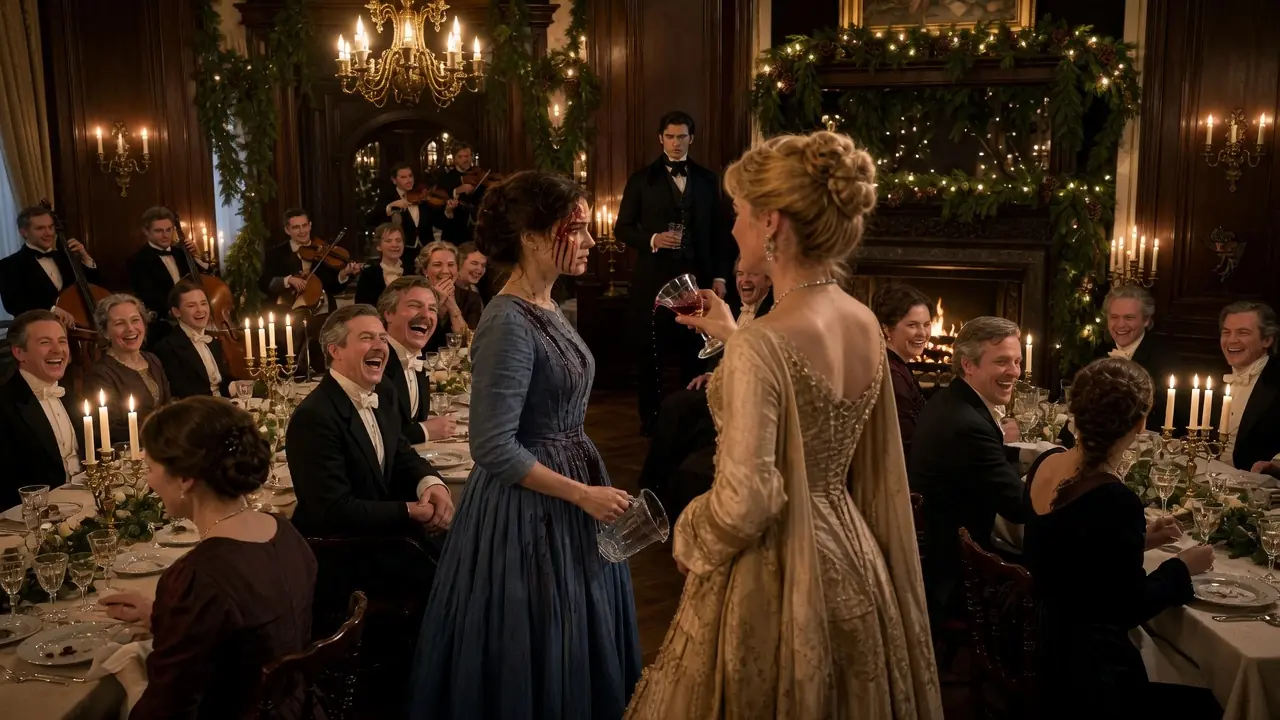
But nobody in that room noticed the man by the far wall who had stopped breathing. The last honest thing Eleanor Whitcomb owned was her posture. She had sold her mother's pearl earrings in November.
She had let the parlor fire go cold in December to save what little coal remained. She had sewn the torn hem of her blue dress three times with thread so thin it was nearly invisible. And she had ironed that dress herself on a board set up in the kitchen, the same kitchen where two years earlier a cook and two housemaids had worked.
But she still stood straight. Grace Whitcomb, her mother, had told her that when a family loses everything else posture is the last inheritance. Eleanor had held on to it the way a drowning woman holds on to a rope.
Not because it changed anything, but because letting it go would have meant admitting the fall was permanent. The Haverfield winter supper was held on the third Friday of January in a candlelit hall on Beacon Street that smelled of pine boughs and roasted meat, and the particular kind of perfume that wealthy women wore when they wanted other wealthy women to know they were wealthy. Eleanor was not a guest.
She had been hired to assist the musicians carrying their cases from the carriage to the hall, keeping the narrow corridor near the instruments clear, refilling the water pitchers set at the back of the room. It was quiet work, invisible work, the kind of work that a woman from a fallen family took without complaint because the alternative was asking her mother to go without supper, a second week running. She had arrived early before the guests and had done everything asked of her without speaking more than was necessary.
The musicians liked her.
Old Mr. Hartley, who played the violin, had offered her a piece of shortbread from his coat pocket, and said, "Miss Whitcomb, you are a finer assistant than most men I've hired at full wage." She had thanked him and meant it.
Kindness, she had learned, came in small denominations now, and she had learned to count every one. By eight o’clock, the hall was full. Boston's better families had gathered in their winter finery.
The men in dark coats and high collars, the women in silk, the colors of cream and rose and deep bottle green, Eleanor moved along the edges of the room, invisible in the way that working women are always invisible at such gatherings, carrying a water pitcher in both hands, head down, steps quiet, she had almost made it to the far corridor when she heard the voice.
“Well, Eleanor Whitcomb.” She stopped.
Clara Bellamy stood three feet away with two women at her side and a glass of red wine loose in her fingers, held with the casual certainty of a woman who has never once worried about spilling anything, because there had always been someone else to clean it up. Clara was 26, blonde, the daughter of a merchant family that had done very well in the last decade, and had spent the last decade making sure everyone knew it. She and Eleanor had attended the same school once when Eleanor's family still had a name worth putting on an enrollment form.
Clara had not liked Eleanor then. Clara did not like Eleanor now. The difference was that now Eleanor could not afford to ignore her.
“I heard you were working supper halls,” Clara said, not quietly.
“I didn’t quite believe it until this moment.” Eleanor kept her hands on the pitcher.
“Good evening, Clara.” “Miss Bellamy,” Clara corrected with a smile that went nowhere near her eyes.
“We’re not schoolgirls anymore, though I suppose you’ve remembered that, given the situation.” She glanced at Eleanor’s dress, at the carefully mended sleeves, at the plain fabric that had once been a reasonable shade of blue and was now something close to gray.
The two women beside Clara made sounds that were not quite laughter, not quite pity, and were, in fact, neither.
“I have work to finish,” Eleanor said.
She started to move. That was when the wine hit her. It was not an accident.
Eleanor had known enough accidents in her life. Her father's horse throwing a shoe on the wrong road. The letter that arrived 3 days too late.
The investment that collapsed the week before Christmas. And accidents had a different quality. They had a moment of stillness before them.
A breath of pause. The fraction of a second in which the world had not yet decided what it was going to do. This had no pause.
Clara's hand moved with the precision of intention. The glass tilted. The wine came across Eleanor's face and neck and down the front of her dress in a single cold wave, and the room went quiet for exactly one heartbeat before the laughter started.
“Oh dear,” Clara said, her voice perfectly even.
“How clumsy of me.” The laughter was not loud.
It was the kind of laughter that is worse than loud, low, and private shared between people who understood each other completely. Eleanor heard it from three directions. She heard one man make a quiet comment she could not catch and another woman murmur something behind her fan.
She heard the particular silence of people who were not laughing but were not speaking either, which is its own kind of participation. The wine ran down her jaw. It dripped from her chin.
It spread through the blue gray fabric of her dress in a bloom of dark red that she already knew with the dull certainty of someone who has learned to calculate ruin quickly would not wash out entirely. She did not move. She did not cry.
Her hands tightened on the water pitcher until her knuckles ached and she stood exactly where she was because the only power she had in this moment was the power of not giving Clara Bellamy what she was waiting for.
“The fallen girl,” Clara said, turning just slightly to include the room in the remark, who forgot she was poor.
Three more people laughed, and then a voice came from the far side of the hall, and it was not loud, and it was not theatrical, but it had the particular quality of a voice that is accustomed to being listened to, and so the room listened.
“Cruelty does not become respectable because it is done in a fine room.” Eleanor turned.
She had seen Nathaniel Ashford once from a distance at a merchants' assembly two autumns ago before everything changed. He was the kind of man that Boston discussed in abstractions. His family's ships, his mother's charitable work, the Ashford name on half the good buildings in the city.
She had not formed a particular impression of him beyond that he was tall and that he had not seemed to be listening to the speeches. How was listening now? He was standing perhaps 15 feet away with a glass of water, not wine, she noticed in one hand, and his dark eyes were on Clara Bellamy with an expression that was not anger and was not contempt, and was something considerably more dangerous than either.
It was the look of a man who has made a judgment and will not be revising it. Clara's smile faltered. Just slightly, just enough.
“Mr. Ashford,” she started.
“I believe you’ve made your point, Miss Bellamy,” Nathaniel said.
He did not raise his voice. He did not need to. Whatever it was, he crossed the room in the direction of Eleanor, not hurrying, not making a performance of it.
When he reached her, he said quietly enough that only she could hear, "There is a side corridor behind the string musicians.
There are clean cloths there that the kitchen staff use. You need not stay in this room a moment longer than you choose to." Eleanor looked at him. I have work to finish.
He looked at the pitcher in her hands. The pitcher is empty. She looked down.
He was right. She had gripped it so hard for so long that she had not felt it shift in weight. She could not have said when it had run dry.
"Thank you," she said, because she had been raised to say thank you, even when she was standing in a ruined dress in a room full of people who had just laughed at her, and because she could not think of anything else that would not come out wrong.
He nodded once and stepped back. She walked to the corridor. She did not cry until she was through the door and out of sight, and even then it was only for the length of three long breaths, because she had learned to be efficient about grief.
What Nathaniel Ashford did not tell Eleanor Whitcomb that evening. What he would not tell her for some time was that he had seen her before. Four days earlier during a hard January rain that had turned the road outside the Carlisle stable into a river of freezing mud.
He had been sitting in his carriage waiting for his driver to sort out a problem with one of the wheels. The carriage from the Haverfield household had been stopped ahead of them, similarly delayed. Several well-dressed travelers stood under the overhang of the stable, complaining to each other about the delay.
In the road, a stable boy, 12 or 13 years old, Nathaniel had estimated had slipped in the mud while trying to lead a horse to shelter. The boy had gone down hard. His ankle turned beneath him, and the horse had skittered sideways and pulled the lead rope from the boy's hand.
The travelers under the overhang had glanced at the situation and turned back to their conversation. A woman had come out of the second carriage. She was plainly dressed and she had no overhang to stand under and she did not hesitate for even a moment.
She went to the boy first crouching in the mud beside him without looking at her dress and she had said something to him that Nathaniel could not hear over the rain but which made the boy nod and stop panicking. Then she had gone after the horse moving slowly speaking quietly and brought it back to the boy who was still sitting in the mud. and she helped the boy get to his feet and guided them both to the shelter of the stable. Then she had walked back to her carriage.
Mud on her shoes, mud on her skirt, rain on her face. She had not looked to see whether anyone had watched. She had not said anything to the travelers under the overhang.
The driver did not. He had asked the stablekeeper, who had told him only that the woman had come from one of the carriages bound for the Haverfield household. He had thought about it for 4 days, and then he had walked into the Haverfield supper and seen Clara Bellamy pour wine across the face of the same woman, and he had understood in the immediate and particular way that a man understands a thing.
He has been turning over in his mind that the world was a great deal smaller and a great deal more unjust than he generally let himself admit. Eleanor's mother was awake when she came home. Grace Whitcomb was always awake when Eleanor was out late.
She had stopped pretending she was simply reading or simply resting and had started simply sitting in the chair near the window with a lamp and her hands folded in her lap because honesty she had told Eleanor was also one of the things they had left. She looked at Eleanor's dress in the lamplight. She said nothing for a moment.
Then, "Come and sit." "I'm all right," Eleanor said.
"I didn't ask whether you were all right.
Come and sit." Eleanor sat. Her mother brought a cloth dampened with cold water and pressed it to the wine stain on Eleanor's collar and worked at it in silence for a moment, and Eleanor let herself be still, because there are very few people in the world in whose company you are permitted to simply be still. and she had learned not to waste such moments.
"Was it Clara Bellamy?" Grace asked.
Eleanor looked at her mother.
"How did you know?" "Because you'd have told me immediately if it had been a stranger." Grace kept working at the stain.
"Clara Bellamy has resented you since you were 14 years old and won the recitation prize she'd expected to win.
A small woman keeps small scores." "It doesn't matter," Eleanor said.
Of course it doesn't. Grace set down the cloth. What matters is whether you stood straight.
I stood straight. Good. Her mother sat back.
Then she has nothing. They were quiet for a while. The lamp burned low.
Outside, the January wind came under the door, and Eleanor felt it on her ankles, and thought about the coal they did not have, and the dress that was not going to be fully clean again, and the laughter she was still hearing in the back of her mind with the clarity of something recorded.
"There was a man," she said, "who said something." Nathaniel Ashford.
Her mother was very still for exactly one moment. Then, what did he say? That cruelty doesn't become respectable because it's done in a fine room.
Grace Whitcomb looked at her daughter for a long time. That, she said finally, is a man who has thought carefully about what respectable means. Eleanor did not answer.
She was too tired to argue and not certain she would have disagreed. The letter arrived two days later, carried by a man in the Ashford household livery, addressed in a clean, unhurried hand to Miss Eleanor Whitcomb and Miss Grace Whitcomb both. It was not long.
Dear Miss Whitcomb and Miss Whitcomb, I write to ask with your permission whether I might call upon you at your convenience. I have no particular agenda beyond introduction, and I am aware that such a request coming without prior acquaintance may seem irregular. I hope you will accept that I mean it in the plainest possible spirit.
Yours respectfully, Nathaniel Ashford. Eleanor read it three times. Then she handed it to her mother without speaking.
Grace read it once. She said it on this table. What do you think?
She asked. I think Eleanor said carefully that a man like that doesn't write letters without reasons he's chosen not to say. No, her mother agreed.
Men like that generally don't. And I think that if we say yes, the whole city will have a theory about why within a week. The whole city already has a theory about you, Eleanor.
They've had one since your father died. One more theory is not going to change the weight of what we carry. Grace looked at her.
The question is, what you think of the man? Eleanor thought of the supper hall. She thought of the stillness in his voice and the way he had crossed the room without hurrying and the fact that he had told her the pitcher was empty rather than simply taking it from her as if the information mattered more than the convenience.
She thought of the word choose. You need not stay a moment longer than you choose to and the quiet weight of it. I think she said slowly that he said a true thing in a room full of people who are not saying true things.
That's a place to start. her mother said. Write back. Eleanor wrote back.
Julian Harrow appeared 3 days after the letter, which was either coincidence or wasn't. And Eleanor was no longer young enough to believe in coincidences that convenient. He came to the cottage door on a Wednesday morning hat in hand.
The same Julian she had known for 3 years before her family fell. the same dark hair, the same way of standing with his weight slightly back, as if he were always on the verge of leaving, which Eleanor now understood was because he usually was.
Eleanor, he said, "Not Miss Whitcom." "Ellanor," she did not invite him in.
She stood in the doorway with her arms at her sides and looked at him with the particular attention of a woman who has spent the last 2 years learning to read the difference between what people said and what they meant. Julian, she said, I heard about the supper. He said what Clara did.
I'm sorry. It was unworthy of her. Yes.
Eleanor said it was. He turned his hat in his hands. I also heard that as there's word around the city that Nathaniel Ashford has made inquiries about you.
Has he? Eleanor. He took a half step forward.
I want you to be careful. Men like Ashford, they have their own reasons for things. You don't always know what they are.
That's generally true of most people. She said he had the decency to look briefly uncomfortable. I only mean you've been through a great deal.
I wouldn't want to see you taken advantage of. Eleanor looked at him for a long moment. Julian Harrow, who had courted her for 8 months with great warmth and had stopped appearing at her door approximately 3 weeks after her father's debts became public knowledge.
Julian Harrow, who had not written, who had not called, who had accepted the invitations to supper, that stopped including the Whitcombs without any recorded objection.
"That is very thoughtful of you," she said in a tone that meant the opposite of nothing and the opposite of gratitude.
"Ill keep it in mind." She closed the door.
She stood in the narrow hallway of the cottage with her back to the closed door and her eyes on the far wall, and she breathed in and out until the particular hot tightness behind her eyes resolved itself into something colder and cleaner. Then she went to the table and looked at the letter she was drafting for Mr. Ashford, and she picked up her pen, and she continued writing. Whatever came of it, she had already decided one thing with absolute clarity.
She would not be choosing her future based on the fears of a man who had chosen his past so easily. Nathaniel Ashford arrived on a Thursday morning exactly when he said he would. Eleanor had expected many things from a man of his position, a representative sent ahead, a card left at the door, perhaps a note to reschedule because something more important had come up.
What she had not expected was the man himself on time alone, except for the driver who stayed with the carriage, standing at the door of their rented cottage on Millbrook Lane, with his hat in his hand and no performance of any kind about him. Grace Whitcomb opened the door. She looked at him for a long moment with the measuring expression she had once reserved for men who came to discuss her husband's business, and Nathaniel looked back at her without flinching or filling the silence with unnecessary words.
Mr. Ashford, Grace said. Miss Whitcomb, he said, thank you for receiving me. Come in, she said.
Mind the step. He minded the step. Eleanor was in the sitting room standing near the window with her hands folded in front of her, wearing her second best dress, which was also her best dress now that the blue one was beyond full rescue.
She had not primped. She had not arranged the room beyond its usual arrangement. She had made the decision deliberately and without great comfort that she was not going to perform ease she did not feel and she was not going to apologize for a cottage that was clean and honest and small.
Nathaniel came in looked at her once and said good morning Miss Whitcomb. Good morning, she said. Please sit.
He sat. Grace brought tea, which was the last of the good leaves, and set it on the table between them, and then sat herself because Grace Whitcomb was not the kind of mother who left a room when a man came calling, and Nathaniel did not look as though he had expected her to. They talked for an hour and a half.
He asked about the musicians she worked with, not with condescension, but with what seemed to be genuine curiosity, the kind of questions a man asks when he has actually thought about what he wants to know before asking it. He told her when she asked that he had three ships currently in port and two at sea, and that the shipping business was less romantic than people imagined and considerably more governed by weather and contract law. He said this with the flat honesty of someone describing his work rather than selling it.
Grace asked him at one point with the directness that Eleanor had inherited from her and had sometimes found uncomfortable, but was grateful for now. Mr. Ashford, you are one of the most well-connected men in Boston. You could call on a great many families.
Why are you calling on this one?
There was a short silence, not evasive, thinking, "Because he said, I saw your daughter do something I have not seen anyone do in a considerable length of time, and I wanted to know whether it was who she was or simply who she was that particular afternoon." Grace looked at him.
"And have you determined which?" I'm determining it now, he said.
Grace said nothing, but she refilled his tea.
After he left, Eleanor stood at the window and watched the carriage pull away and said without turning around, "What do you think?" "I think," her mother said that he asked three questions about your work and only one about your father's estate.
Eleanor turned. And and the question about your father's estate was whether the legal settlement had been handled fairly, which is not the question a man asks when he is calculating your liabilities. Grace picked up the teacups.
It is the question a man asks when he wants to know whether someone wronged you. Eleanor stood with that for a moment. Then that could mean several things.
Yes, her mother said it could. She carried the cups to the kitchen. Over her shoulder, she added, "But it doesn't mean nothing." "Boston decided within a week what it meant." Eleanor heard it at the market on Tuesday, not directed at her, but close enough to be intended for her to hear, which was its own particular cruelty, the kind that gave itself an exit when challenged.
Two women from the Haverfield Circle talking near the ribbon stand with their voices just at the edge of carrying. She staged the whole thing is what I heard. The wine, the wine, the tears, all of it.
Clara was provoked is what people are saying. Clara doesn't need much provoking. A pause.
No, but still. You don't go from carrying water pitchers to receiving Nathaniel Ashford in a fortnight unless something was arranged. The whole Whitcomb business, the father's debts, the sympathetic story.
It's very convenient. For whom? for a girl with nothing who wants something. Eleanor did not stop walking.
She had learned in the last two years that stopping was a kind of confirmation and she gave them nothing to confirm. She bought the thread she had come for and walked home at her regular pace and breathed through her nose the whole way because the alternative was letting them see that the words had hit somewhere real. And she refused to give that away, but they had hit somewhere real.
She sat at the kitchen table when she got home and put the thread down and pressed her palms flat on the table and stared at the grain of the wood and let herself feel just for a moment the full weight of what it meant to have your actions read backwards by people who had already decided what you were. That was when she heard the knock. Not at the front door, at the kitchen door, which meant it was someone who knew the cottage layout, which meant it was someone who had been here before.
She opened it. Lydia Crane was 22, the youngest daughter of a Beacon Hill family that had never been rich enough to be truly powerful and had compensated by being genuinely decent, which Eleanor had always respected, even when their acquaintance was slight. Lydia was breathing quickly, as if she had walked faster than usual.
"I heard them," Lydia said.
"At the market, I heard what they said." "So did I," Eleanor said.
"It's not true." Lydia's voice had the particular edge of someone who has been holding something in.
I was at the supper. I was standing twelve feet from Clara when she did it. There was no provocation.
She saw you. She decided and she did it. It was as cold as anything I have ever seen.
Eleanor looked at her. Lydia, you know what it will cost you to say that. I know what it cost you when I don't.
They looked at each other on the threshold of the kitchen door. Come in, Eleanor said finally. I'll put the kettle on.
Lydia came in. Julian returned on Friday. This time, he didn't bother with the hat-in-hand approach.
He knocked with the confidence of someone who had decided that the thoughtful former suitor routine hadn't worked and was trying something more direct. Eleanor opened the door. He looked at her with an expression she recognized, studied concern, layered over something more calculating beneath it, like wallpaper over damaged plaster.
I've been hearing things, he said. People hear a great many things in this city, Eleanor said. About Ashford's intentions about your, he paused, response to his visits.
He has called once, Eleanor said properly with my mother present in the afternoon.
Once so far, Julian said, "Was there something specific you needed, Julian?" He stepped closer.
"Not aggressively.
Just close enough to make the conversation feel private, which she understood was a technique." "Elanor, I was a coward after your father died. I know that.
I'm not going to pretend otherwise." She said nothing, "But I'm telling you that Ashford is not.
He's not what people think he is. His mother controls more of that family's money than anyone acknowledges. He makes decisions that look noble and serve his own interests.
The shipping contracts he holds have ruined smaller merchants. He's not Julian, she said it quietly. Stop.
He stopped. You want me to believe that you have come to warn me? She said out of concern for my benefit.
She looked at him steadily. I'm going to suggest to you that whatever you have actually come for it would be better said plainly because the version you are giving me is not the one that makes sense. Julian looked at her for a moment.
Something shifted behind his eyes. Not guilt exactly but the recognition of someone who has been seen more clearly than they intended. I made a mistake.
He said when your father died I panicked. I was young and I panicked and I am trying. You were not young, Eleanor said.
You were 24 and you didn't panic. You calculated and your calculation came out against us and you left. That is what happened and it is done.
His jaw tightened. I wish you well, Julian, she said genuinely. But do not come to this door again unless you have something true to say.
She closed the door. She stood in the hallway for a moment with her eyes closed and the sound of her own heartbeat loud in her ears. Then she heard her mother's voice from the sitting room.
Was that Harrow again? Yes. A brief pause.
He'll be back. I know, Eleanor said. Good, Grace said.
Better to know the direction trouble is coming from. The second call from Nathaniel came 8 days after the first, this time with a note sent ahead by a morning messenger. If it is convenient, I would like to call again this Thursday.
I have something I would like to ask your opinion on, if you are willing. Elellaner read the note standing at the kitchen counter and was aware in a way that was more irritating than pleasant that something in her chest had shifted when she saw the handwriting. She wrote back, "Thursday is convenient.
He arrived again on time. He sat down and refused a second cup of tea because he said he was already on his third of the morning, which was such a completely normal human thing to say that Eleanor felt some tight thing between her shoulders ease slightly. He pulled a folded paper from his coat.
I have a contract dispute, he said, with a merchant in Charles Town who has, in my estimation, misread the terms in a way that benefits him significantly. My solicitor has drafted a response. But the solicitor writes, he paused, looking for the word impressively.
Impressively, in the manner of a man who wants to appear knowledgeable rather than be understood, Nathaniel said, I want someone to read it who will tell me if it actually makes sense. Eleanor looked at him. You want me to read your legal correspondence?
You wrote two letters, he said, that managed to be entirely clear about a complicated situation while remaining completely civil. That is a more specific skill than most people credit. She was quiet for a moment.
Then she held out her hand for the paper. She read it twice. She put it down.
Your solicitor has buried the critical term in the third paragraph behind two sentences that have no bearing on the argument. If the Charles Town merchant reads it quickly, which people do, he will miss the point and think the letter is about shipping dates rather than penalty clauses. Nathaniel looked at her.
Can you tell me how to fix it? Move the third sentence of the third paragraph to the second sentence of the second paragraph, she said. Then remove the first sentence of the fourth paragraph entirely.
It says nothing. He wrote it down, he said without looking up from his notes. Your father was a merchant.
He was. You learned to read contracts. I learned to read everything, she said.
When the estate was being settled, I read every document they put in front of my mother before she signed it. By the third week, I understood more about our debts than the solicitor seemed to. He looked up.
There was something in his face. Not pity, she realized with a small shock. It was something closer to respect.
"Did it help?" he asked.
"Not enough," she said honestly.
"But it helped some," he nodded.
He folded the paper and put it back in his coat.
Then he said, "Miss Whitcomb, I am going to be direct with you because I think you prefer it and because I find I don't have much patience anymore for conversations that take 40 minutes to say a thing that could be said in four." I do prefer it.
She said the city is talking about you. You know that. Yes.
Some of what they're saying is Clara Bellamy's work. Some of it is simply the way this city treats women who don't have money or a husband to stand between them and opinion. He met her eyes.
I cannot stop it immediately. I can make it worse by appearing to be doing something that looks like rescue because people in this city dislike nothing more than feeling that someone is being made respectable by association rather than character. Eleanor said very carefully.
What are you suggesting? I'm suggesting that you and I continue to meet as we have been plainly properly with your mother present and that we give the truth time to do what truth eventually does. He paused.
That is a significant thing to ask because in the meantime you will hear things that are unkind. I am aware of that. Eleanor looked at him for a long moment.
Mr. Ashford, she said, I have been hearing unkind things for 2 years. I have not stopped standing up in the morning. She picked up her teacup.
Truth taking its time is an inconvenience I am already acquainted with. Something crossed his face that might have been the beginning of a smile. It was brief, but it was real.
Good, he said. And then, because he was Nathaniel Ashford, and apparently this was simply how he was, he said nothing further on the subject and asked her instead whether she thought the spring shipping season would open early given the mild January. And they talked about weather and trade and the price of Virginia tobacco for another half hour, while Grace sat in the corner and kept her expression perfectly neutral.
At church the following Sunday, Eleanor sat in her usual pew, second from the back on the left, the pew they had claimed when they first rented the cottage, because they had wanted somewhere out of the way, and she was aware in the quiet before the service began, of the particular stillness of women who were deciding whether to acknowledge her. Three of them turned away before making eye contact. She counted.
She had gotten very good at counting. Then she heard a rustling beside her, and Lydia Crane sat down in the pew, placed her prayer book in her lap, and stared straight ahead at the pulpit with the determined serenity of someone who has made a decision and is at peace with it.
"Good morning," Lydia said quietly.
"Good morning," Eleanor said.
They did not look at each other. They did not need to. From across the aisle, Clara Bellamy watched the two of them with an expression that Eleanor registered in her peripheral vision and chose not to give the dignity of a direct look.
She could feel the weight of Clara's attention like a hand pressed flat against her back, steady and unpleasant, and trying to push her off balance. She sat straight. She kept her eyes on the pulpit.
She breathed in the particular way her mother had taught her slowly down to the bottom of the lungs, the kind of breath that doesn't let anyone see it. And then the minister began to speak, and Eleanor let the words wash over her. And she was aware beneath the words and beneath the counting and beneath the weight of Clara's gaze from across the aisle of something that was not quite hope, but was the shape of it.
She had Lydia beside her. She had her mother at home. She had a man who had asked her opinion on a legal contract and written down what she said.
The city was talking, but Eleanor Whitcomb was still in her pew, still sitting straight, and the people who wanted her gone had been wanting that for 2 years and had not yet succeeded that she thought was something worth counting to. Julian came back the following Wednesday, and this time he did not knock at the door. He found her at the market, which was not a coincidence because Julian Harrow had never had a coincidence in his life that wasn't manufactured.
He fell into step beside her as she was selecting dried beans from a merchant stall, moving with the practiced ease of a man who had done this sort of thing before, positioned himself alongside someone so naturally that objecting would look like the overreaction. I've been hearing more, he said. You should find better things to do with your time, Eleanor said.
She did not stop looking at the beans. Clara is planning something, he said, for the Haverfield spring assembly. Something that will be harder to recover from.
Eleanor's hand paused over the beans just for a fraction of a second. Long enough. Julian noticed.
She saw him notice. I'm not threatening you, he said quickly. I'm telling you because you should know.
What is she planning? I don't know exactly, but she's been speaking to people who knew your father, merchants he owed money to, people who might be willing to say things." Eleanor put the beans in her basket. She looked at Julian with the flat clarity she had developed over 2 years of learning exactly how much people could take from you if you let them see that their words had weight.
"And why?" she said.
"Are you telling me this?" He opened his mouth, closed it.
The honest answer was fighting with the prepared answer. And she could see the struggle in his face. And she waited because she had learned that waiting was the most powerful thing she could do.
Because because he said finally, I don't want to see her destroy you. That Eleanor said quietly is the first true thing you have said to me in 2 years. She looked at him for a moment longer.
Thank you for it. She walked away. She did not tell him that by the time she reached home, she had already decided what needed to be done and that it had nothing to do with hiding.
It had to do with a letter. She sat at the kitchen table and she thought about what Nathaniel Ashford had said. Truth eventually does what truth does.
And she thought about Lydia and her steady gaze and her presence in that pew. And she thought about her mother who had told her that fear was not the same as wisdom.
And then she picked up her pen and she wrote, "Dear Mr. Ashford, I have been giving considerable thought to something you said about truth taking its time.
I find I agree in principle. However, I have recently learned that certain people are not willing to allow truth the time it needs. A lie told in public must be answered in public or it fills the space that truth has not yet occupied.
I believe it is time to stop waiting. I would welcome your thoughts if you are willing. She signed it.
She sealed it. She gave it to the morning post. And for the first time in two years, Eleanor Whitcomb went to bed that night, not bracing for what was coming, but deciding what she was going to do about it.
Nathaniel's reply came the next morning faster than she had expected, which told her something she filed away carefully. Miss Whitcomb, I agree entirely. I will speak with my mother today.
N Ashford. Four words of substance, no ornamentation. Eleanor read it twice, put it in the drawer beneath her sewing kit, and went to tell her mother they had been invited to dinner.
Grace Whitcomb sat very still for a moment when Eleanor told her.
Then she said, "The Ashford house?" "“Yes.
Front door or back?”" Eleanor looked at her. He didn't specify. Grace nodded slowly.
"Then we'll find out what kind of man he is.
Margaret Ashford's reply to her son's request came within the hour of his asking. Because Margaret Ashford was a woman who made decisions the way other people breathed without visible effort and without second-guessing. Nathaniel found her in her study already writing the guest list.
"Who do you want present?" she asked without looking up.
"Everyone involved in the rumor," Nathaniel said. the Haverfield family, the Bellamies, Lydia Crane, two or three families who have been neutral and whose opinion still carries weight and Julian Harrow.
Nathaniel was quiet for a beat. Yes. Margaret put her pen down.
She looked at her son with the expression she reserved for situations that required her full attention rather than simply her competence. Nathaniel, I need to ask you something plainly. Go ahead.
Is this about Eleanor Whitcomb's reputation, or is this about Eleanor Whitcomb? The silence lasted exactly long enough to answer the question without him saying a word. Margaret picked her pen back up.
All right, she said. Thursday evening, I'll need the Whitcomb's address to send the formal invitation. Millbrook Lane, Nathaniel said, the cottage at the end.
His mother wrote it down. She did not remark on the fact that he knew the address without checking. Some pieces of information spoke for themselves.
The invitation arrived at Millbrook Lane on Tuesday, delivered by the same man in Ashford livery, addressed this time to Miss Eleanor Whitcomb and Mrs. Grace Whitcomb in Margaret Ashford's own handwriting. It was formal gracious and left no interpretive room whatsoever about whether the Whitcombs were being invited as guests or as anything else. Eleanor read it and felt something she hadn't felt in long enough that she almost didn't recognize it.
Not hope. Something harder than hope. Something that had edges.
Determination. Grace read it after her. She addressed me first.
She said, "Yes, older women generally don't do that unless they mean it." Eleanor said nothing because her mother was right and they both knew it.
We'll need to press your green dress. Grace said the collar can be redone with the good linen. Mother, I am not sending my daughter to Margaret Ashford's table looking like she has been defeated, Grace said in the tone that ended conversations.
Go find the linen. Eleanor went to find the linen. Clara Bellamy received her invitation on the same Tuesday and read it three times in the sitting room of her family's house on Chestnut Street. before she fully understood what she was looking at.
Her mother found her standing at the window an hour later with the card still in her hand. Clara, what is it? Margaret Ashford has invited us to dinner Thursday.
Her mother's face brightened. An Ashford dinner was an Ashford dinner. How wonderful.
Eleanor Whitcomb will be there. The brightness dimmed. Ah.
Clara put the card down on the windowsill with great precision the way she handled things. She was trying not to crush. Nathaniel has arranged it.
She said the whole thing. He's making a statement. She paused.
He's making her a statement. Clara, you should perhaps consider. I'll go, Clara said flatly.
Of course, I'll go. Not going is worse than going. Not going says I have something to hide.
She turned from the window. I have nothing to hide. Her mother looked at her with the cautious expression of a woman who loved her daughter and was not always certain her daughter deserved it.
"What you did at the Haverfield supper was a social correction," Clara said.
The Whitcomb girl had no business being in that room in that capacity without understanding what that meant for the people who were there as guests.
"I made a point." "You made a scene," her mother said quietly.
Clara picked up the invitation card again. Thursday, she said. Fine.
Julian heard about the dinner from three separate people before Wednesday noon because Boston was that kind of city. He sat with the information for an afternoon and then went to see Clara. He found her in her garden, which was where Clara went when she was thinking in the particular way she didn't want anyone to observe.
She was walking in small circles near the rose beds that had not yet bloomed, and she stopped when she saw him. You've heard, she said. Everyone has heard, Julian said.
Claraara, what are you going to do? Go to dinner, she said. Behave perfectly.
Let Ashford make his little gesture. She crossed her arms. It changes nothing.
She's still ruined. A dinner doesn't restore a family name. Julian looked at her.
He had known Clara for 4 years, had understood her for considerably less of that time, and was understanding her less with every passing week. Clara, the merchants you spoke to, the ones who knew Thomas Whitcomb. What exactly did you ask them to say?
Clara was still because Julian said carefully. If you ask them to say something that isn't true and Nathaniel Ashford finds out his solicitors are better than anyone in this city. I asked them to confirm what they remembered.
Clara said what they remembered or what you suggested they remembered. She turned away from him. You're being dramatic.
I'm being precise, Julian said. And it came out harder than he intended and he didn't pull it back. There's a difference and I think you know it and I think you should think very carefully before Thursday about where that difference puts you.
Clara kept her back to him. If the Whitcomb father was defrauded, Julian started, he made poor decisions. Clara, he made poor decisions.
She repeated with enough force to make it clear the conversation was finished. Julian looked at the back of her head for a moment. Then he put his hat on.
"All right," he said.
"“Thursday, then.” He left." He stood on the street outside the Bellamy house and breathed the late February air and felt the specific discomfort of a man who knows he is standing close enough to something dishonest that the proximity has begun to mark him.
He thought about what Eleanor had said.
"The first true thing you have said to me in two years." He thought about the look on her face when she said it.
Not grateful, not warm, simply honest, simply clear. The look of a woman who had decided she knew exactly where the ground was and intended to stand on it. He walked home in the cold, and for the first time since he had turned away from the Whitcomb family, he was not sure which side of this he was on.
Thursday came with the clean, cold certainty of a day that knows it means something. Eleanor dressed in the green dress with the redone collar and Grace dressed in her better black. And they arrived at the Ashford House on Louisburg Square at precisely the invited hour, which was 7:00.
And the door was opened by a man in household livery who said, "Miss Whitcomb, Mrs. Whitcomb, please come in," and stepped back to admit them through the front door.
Eleanor felt her mother's hand press briefly against her arm from behind, barely a touch, just a moment, and then they were inside. Margaret Ashford was at the foot of the main staircase, and she crossed to them before she crossed to anyone else in the room, which was already occupied by perhaps 14 people, all of whom watched this moment with the collective attention of an audience that knows it is watching something that will be discussed later. Margaret took Grace Whitcomb's hand in both of hers.
Mrs. Whitcomb, she said. I am very glad you have come. Grace said with a steadiness that Eleanor would remember the rest of her life.
Thank you for the kindness of the invitation, Mrs. Ashford. Margaret turned to Eleanor. She looked at her with a directness that was nothing like cruelty and everything like assessment.
"Miss Whitcomb," she said.
"My son speaks well of you.
I intend to form my own opinion, and I expect you understand that.
I would want nothing less." Eleanor said.
Margaret's expression shifted by precisely one degree in the direction of approval. Good. She turned to bring them into the room.
Come and let me introduce you properly. Across the room, Eleanor saw Clara. Clara was standing near the fireplace, dressed beautifully, her face composed into the smooth surface she wore in public, the way other women wore jewelry.
Their eyes met for one instant. Clara looked away first. Eleanor noted it.
She noted it the way she noted the pitcher being empty and Julian's manufactured coincidences with the quiet, careful attention of a woman who has learned that small things said as much as large ones. Nathaniel was beside her in under a minute, not rushing, not making a scene of it, simply appearing at her left with the quiet coordination of a man who had thought about where he needed to be and had been there. Miss Whitcomb, he said.
Thank you for coming. Thank you for the courage of asking, she said, and she meant it as a plain statement of fact rather than a compliment. He understood the difference.
She saw him understand it. Are you ready? He said quietly.
I've been ready, she said, for considerably longer than this evening. He almost smiled. Then he turned and guided them toward the table.
He seated Eleanor at his right hand. There was a moment, a single collective intake of breath that was not audible, but was nonetheless entirely present that moved through the room at the sight of it. Right hand, most honored place.
Not ambiguous, not deniable, not something that could be explained away as courtesy. Clara's expression didn't change. That was how Eleanor knew it had landed.
Dinner moved through its courses with the surface civility of a room full of people who were all acutely aware of what was underneath the surface. The conversation was careful, the wine was good, and Margaret Ashford ran her table with the skill of a woman who had hosted difficult evenings before, and understood that the hostess sets the temperature. Julian sat three seats down and said very little, which was itself a kind of speaking.
It was between the second and third courses that Nathaniel did the thing that Eleanor had not anticipated. He said calmly without raising his voice in the middle of a conversation about Boston Harbor Commerce. I've been reviewing some shipping records from 3 years ago before the Whitcomb Estate was settled.
The table shifted, not physically, but the attention in the room gathered itself like water finding its level. Clara did not move. It appears, Nathaniel said, still in the same even tone, that a significant portion of the Whitcomb investment loss was not from poor judgment, but from a contract that was misrepresented at execution.
The merchant who brokered that contract. He paused with the precision of a man who knows exactly how long to hold a pause, had business ties to another family that profited considerably when the Whitcomb estate was liquidated. The room was very quiet.
Margaret Ashford said with the same calm she had brought to every other moment of the evening. Which family? Nathaniel.
He looked at Clara. Not dramatically. Simply factually the way a man states a documented thing.
The Bellamy trading concern.
He said, "The records are with my solicitor." Eleanor had known something was coming.
She had not known this. She sat completely still and let the words settle and looked at her plate for exactly the two seconds it took her to bring herself back to level. Then she looked up.
Clara's face had done something it almost never did. It had gone uncertain. That is a very serious allegation, Clara said, and her voice was entirely controlled and entirely wrong.
The way a thing sounds when its control is costing something, it is a documented fact. Nathaniel said there is a difference. He picked up his fork.
I thought given that several of the people in this room were affected by the rumors surrounding Miss Whitcomb that they deserve to understand its origins. Lydia Crane from her position four seats down leaned forward slightly. She had been waiting for her moment with the patience of someone who had rehearsed this and she took it cleanly.
"I was at the Haverfield supper," she said to no one in particular and to everyone completely.
I was standing close enough to see what happened between Miss Bellamy and Miss Whitcom. There was no provocation on Miss Whitcomb's part. None.
I am willing to put that in writing for anyone who asks. The man beside Lydia, Mr. Haverfield himself, whose supper it had been looked at his plate. Then he looked at Clara.
Then he looked at his plate again. His wife made a small sound that was not agreement and was not disagreement, but was the sound of a woman calculating. Julian said nothing, but his jaw moved just slightly the way it did when he was deciding whether he was going to say something.
And Eleanor watched him decide not to and felt the last residue of anything she had once felt for him dissolve away like salt in water.
Clara said, "Lydia, you were across the room.
I was twelve feet away." Lydia said, "I know the difference between twelve feet and across the room, Miss Bellamy.
I was watching because I already suspected what you were going to do. The word already landed in the room like a stone dropped into still water. Already not stumbled upon, anticipated, known.
Clara's face went very careful. Furthermore, Lydia continued with the steadiness of someone who had decided that having come this far, she would go the full distance. You said to Miss Whitcomb that she had forgotten she was poor.
I heard that clearly. I would like to know what kind of woman says that to another woman who is carrying a water pitcher in a room full of people who are supposed to be her betters. The silence that followed was the kind that changes things.
Mrs. Haverfield set her fork down. Mr. Haverfield cleared his throat. Clara sat in the particular stillness of someone who is trying to determine whether damage can be contained and is discovering that it cannot.
After the third course, Eleanor excused herself for a moment and stepped into the hallway because she needed three breaths in a row that were not being observed. She stood near the window at the far end and pressed one hand flat against the wall and breathed. The door opened behind her.
She expected Nathaniel. It was Margaret. The older woman came and stood beside her, not close enough to crowd her, and looked at the same stretch of wall Eleanor was looking at.
You are holding up remarkably well, Margaret said. I have had practice. Eleanor said.
Margaret was quiet for a moment. Then my son told me about the stable boy. Eleanor turned to look at her in the mud.
Margaret said, "In January, while people with warmer coats stood undercover, Eleanor said nothing.
I have raised Nathaniel to look for character." Margaret said, "Not rank, not fortune, character.
It is a more specific thing to look for, and it is harder to find." She glanced at Eleanor. He found it. Eleanor felt something press against the inside of her chest that she was not going to allow to become tears.
She breathed through it.
"Mrs. Ashford," she said carefully, "I do not want anyone to think that I am here because of what Mr. Ashford can provide.
Nobody who matters thinks that," Margaret said crisply.
"And the people who say it have revealed considerably more about themselves tonight than they have about you." She straightened.
"Come back to the table, Miss Whitcomb.
The evening is not finished." Eleanor looked at this woman, this precise, powerful, careful woman who had greeted her mother first and seated her daughter at the right hand and let the truth do its work in a room full of people who had preferred a different version of events. Thank you, Eleanor said, and this time she meant it without reservation. Margaret gave her one short decisive nod.
Don't thank me, just come back in. Eleanor came back in. She walked through the doorway into the room where Clara Bellamy sat with diminished authority and Julian Harrow sat with diminished certainty, and 14 people were in the process of revising their understanding of a story they had been told badly.
She sat back down at Nathaniel Ashford's right hand. She picked up her fork and the evening continued. The dinner ended at 9, which was earlier than such evenings usually concluded, and everyone in the room understood why without anyone saying it.
There was only so long a gathering could sustain the weight of what had been said before the social architecture of it began to crack under the pressure of people needing to process privately what they had just witnessed publicly. Margaret Ashford said her farewells at the door with the same composure she had maintained all evening, which Eleanor was beginning to understand was not a performance, but simply the woman's natural register. Clara left with her mother, who had not said much after the third course, and whose silence had spoken at considerable volume.
Julian left without making eye contact with anyone, which was its own kind of statement. Lydia squeezed Eleanor's hand in the hallway before she went. She didn't say anything.
She didn't need to. The Whitcombs were the last to leave, which was not accidental. Margaret had asked them to stay a moment, and they had, and Nathaniel had stood in the entrance hall with his coat still on the chair, and talked with Grace Whitum about Virginia, while Eleanor stood nearby and was aware in the quiet peripheral way she had learned to be aware of things that mattered, that this was not small talk.
He was asking her mother about home, about before, about who they had been when they had been whole. and he was asking because he wanted to know, not because he was feeling silence. Grace answered him with a careful fullness that told Eleanor her mother had decided something tonight that she had not yet decided when they arrived. When they finally stepped outside into the cold, Eleanor and her mother walked the first block in silence.
Then Grace said without preamble, "His mother told you something in the hallway." "It was not a question." "She told me he looks for character," Eleanor said.
Grace walked two more steps. Margaret Ashford did not earn her position in this city by being a foolish woman.
"No," Eleanor agreed.
"And she came to find you herself.
She didn't send someone." "No," Eleanor said again.
They walked the rest of the way home without speaking further because they were both thinking the same things and had been doing that long enough to know when words were unnecessary. The morning after the dinner, Boston started talking in a different direction. Eleanor felt it before she could have proven it.
The particular shift in the quality of acknowledgement she received when she was out the way. One woman at the dry goods merchant nodded to her instead of looking past her. The way the conversation near the ribbon stand stopped being the kind that wanted her to hear it.
It was not warmth. It was not restoration. It was something earlier than those things.
Something like the moment before a door opens when you can feel the air change pressure on the other side. Lydia told her two days later that three families who had been refusing invitations that included Eleanor's name had quietly reversed that position. I don't know if it will hold, Lydia said honestly.
But it's moved. It's moved. Eleanor repeated.
That's something. Yes, Eleanor said. It is what she did not say to Lydia.
What she had not said to anyone was that the morning after the dinner she had sat at the kitchen table before her mother was awake, and she had held both hands flat on the wood, and she had breathed, and she had let herself feel for exactly the length of 3 minutes the full and unguarded truth of what she wanted, not what was wise, not what was cautious, what she actually wanted in the private interior that she kept very carefully managed and very carefully hidden. She wanted to stop being afraid of wanting things. She folded that back up after 3 minutes and put it away because wanting things was not the same as having the ground under them solid enough to stand on, and she was not yet sure the ground was solid.
Nathaniel came to Millbrook Lane 4 days after the dinner. He had sent no note ahead this time, which was the first time he had arrived without one. And Eleanor noticed the difference and what it might mean, and chose not to read too much into it before she saw his face.
His face. When Grace opened the door, was the face of a man who had something specific to say, and had thought carefully about how to say it, which she recognized because it was the same face he had worn when he pulled the contract out of his coat pocket.
"May I come in?" he said.
Of course, Grace said and stepped back. He sat. He did not accept te.
He looked at Eleanor and said, "The solicitor has filed the documentation with the county record.
The contract misrepresentation is now a matter of official record. It doesn't reverse the estate settlement that would require litigation. And I want to be honest with you about the limits of what's possible, but it corrects the public record.
Your father's name is attached to a documented fraud, not to poor judgment." Eleanor's hands were very still in her lap. There's more, he said. The Bellamy Trading Concern has formally withdrawn from two charitable board positions they held in the city.
The withdrawal was described as voluntary. It was not voluntary. Grace made a sound that was very small and very controlled.
I want to be clear, Nathaniel said, looking at Eleanor steadily, that I did not do this to manufacture a debt between us. I did it because it was the true account of what happened and because your father deserved to have the true account on record regardless of anything else. Eleanor looked at him for a long moment.
She felt something behind her sternum that was warm and heavy and entirely inconvenient and entirely real. I know why you did it, she said. Good, he said.
A silence settled that was not uncomfortable. It was the kind of silence that has weight because it contains things that both people are aware of and are approaching carefully. Mr. Ashford, Eleanor said, I need to ask you something that may be presumptuous.
Go ahead. What do you expect from this from? She gestured slightly, meaning the dinner, the records, the visits, all of it.
From any of it? He looked at her with the directness she had come to understand was simply his natural mode. I expect nothing, he said.
I want something. Those are different. Her heart did a thing she decided not to examine.
What do you want? To know you better, he said. To know whether what I think I've seen in you is what's actually there and whether you would be willing to be known in return.
That is all I'm asking for at this moment. He paused. The rest would depend on what we found.
Eleanor sat with that. It was the most honest thing anyone had said to her about their intentions in longer than she could immediately calculate. That is, she said carefully, a very reasonable thing to ask.
I'm a reasonable man, he said with such complete seriousness that she almost laughed, and the almost laugh surprised her enough that she pressed her lips together to keep it contained, and she saw him see it, and something in his expression shifted by exactly the same fraction. It had shifted the night she told him. Truth taking its time was an inconvenience she was already acquainted with.
Grace Whitcomb from her chair in the corner said nothing. But she was looking at her sewing with the very particular focus of a woman who is deliberately not looking at the two people in the center of the room. What Eleanor did not know yet was what Margaret Ashford had been doing since Thursday evening.
Margaret had a way of moving through the world that was less like force and more like water, finding the lowest point. Quiet, persistent arriving where it meant to arrive without announcing itself along the way. In the 4 days since the dinner, she had paid calls on three women whose opinions shaped the social weather of Beacon Hill.
She had not said anything inflammatory about Clara Bellamy. She had not needed to. She had simply described in her precise and measured way what she had observed at her own table.
The facts, the documents Nathaniel solicitor had confirmed the quality of Eleanor Whitcomb's conduct throughout an evening that would have undone someone with less character. She had also on Friday morning sent her carriage to Millbrook Lane. Grace Whitcomb had opened the door to find Margaret Ashford herself on the step, which was not how social calls usually operated between their respective positions, and which told Grace everything she needed to know before a word was spoken.
"I would like to speak with you," Margaret said, about your husband, about what you know.
Grace opened the door wider.
"Come in, Mrs. Ashford." They sat for 2 hours.
Margaret asked questions and Grace answered them. And by the end of it, Margaret had a clear and documented understanding of the sequence of events that had preceded Thomas Whitcom's financial collapse. The broker, the contract, the specific misrepresentation, the timing of the Bellamy profit.
You knew all of this, Margaret said, not accusingly. I knew it, Grace said. I had no power to act on it.
Margaret was quiet. You have been sitting with this for 2 years. We have been surviving.
Grace corrected with the plainness of a woman who has earned the right to that word. Knowing the truth of something and having the means to prove it are very different positions. Margaret looked at the woman across the table from her.
This woman who had kept her household together kept her daughter's posture straight, kept the truth in her mind like a coal banked against the cold. And Margaret Ashford, who had not cried in what she estimated was 11 years, felt something press at the back of her eyes that she addressed immediately and firmly.
"I would like to help," she said.
"If you'll permit it," Grace Whitcomb looked at her for a moment with the same measuring expression that Eleanor had inherited directly.
"Mrs. Ashford," she said, "I have spent 2 years not permitting pride to become foolishness.
I'm not going to start now." Margaret nodded once.
"Good." They shook hands across the kitchen table, which was not a thing that women of their respective positions typically did, and which both of them found exactly right.
Eleanor found out about the visit from her mother that evening after Nathaniel had gone. Grace told her flatly without preamble, the way she told Eleanor all important things. Eleanor sat with it for a moment.
"She came here herself," Eleanor said.
Yes.
To this cottage, to this kitchen, Grace said, "We had the last of the good tea." Eleanor looked at her hands.
"Mother, this is this is becoming something very large." "Yes," Grace said.
"I'm not sure I know how to stand inside something this large." Grace looked at her daughter with the full weight of everything she knew about her. the three breath grieving and the straight posture and the careful counting and the three minutes at the kitchen table before sunrise.
Eleanor, she said, you have been standing inside something very large for 2 years. You have been doing it alone and in a much smaller dress and with considerably less help. Eleanor looked up.
The size of it has changed, Grace said. You have not. Eleanor breathed in slowly down to the bottom of the lungs. the way she had been taught.
"All right," she said.
"All right," her mother agreed.
But it was not all right yet. Not entirely. And Eleanor knew it before the knock came.
It was Saturday, 4 days after the dinner, nine o’clock in the morning, and the knock was hard, and without preliminary, the knock of someone who has decided not to be careful. She opened the door. Clara Bellamy stood on the step of Millbrook Lane without a companion, without her usual composure, entirely intact, and with the specific look of a woman who has spent 4 days losing ground and has decided to try something direct.
Eleanor did not speak. She waited.
“You think you’ve won?” Clara said.
“I think the record has been corrected,” Eleanor said.
"Those aren't the same thing." Clara's jaw tightened.
“My family’s name—”
“Your family’s name is attached to a documented misrepresentation of a contract that collapsed another family,” Eleanor said with perfect evenness. “That is not something I did to you, Clara.”
“That is something your family did to mine.”
“It was business,” Clara said, and the words came out harder and less certain than she intended. “My father trusted the man who brokered that contract,” Eleanor said.
He trusted him because he had no reason not to. And because your family's profit depended on him continuing to trust. That is not business.
That is deliberate. Clara looked at her. Something moved behind her eyes that was not quite guilt and not quite fear, and was perhaps the particular discomfort of seeing yourself plainly in a mirror you had arranged to face away from.
"What do you want?" Clara said, "From all of this?
What is it that you actually want?" Eleanor looked at the woman who had thrown wine across her face in a room full of people and called her a fallen girl who had forgotten she was poor. She looked at her with the full clear knowledge of everything that had happened between that moment and this one. Nothing from you, Eleanor said.
I want nothing from you, Clara. “What I want, I am finding for myself.”
She closed the door.
She stood with her back against it. Her hands were not quite steady and her heart was not quite even and she breathed through it until both settled. Then she went to the window and watched Clara walk back down Millbrook Lane and she noted the particular quality of the walking.
Not the walk of a woman who has confronted someone and won, but the walk of a woman navigating the specific terrain of understanding that what she thought she could take from someone was never actually hers to take. It was the last time Clara Bellamy came to Millbrook Lane. That afternoon, Nathaniel arrived, this time with a note, and this time the note had been sent only an hour ahead, which was becoming its own kind of language.
He came in, sat down, and looked at Eleanor with the directness she had come to orient herself by. “Clara came here this morning,” he said. Eleanor looked at him.
“How did you know?”
“Because I know Clara Bellamy,” he said, "And I know that she runs out of patience on approximately this schedule when she is losing." He paused.
"“Are you all right?”" "Yes," Eleanor said.
And then, because he had asked plainly, and she had decided some time ago that she would answer him plainly.
"It was harder than I expected, not what she said, the fact of her being here in this place." She looked at her hands.
This cottage is the one thing that has been entirely mine. Having her in the doorway of it felt wrong. Nathaniel was quiet for a moment.
He was looking at her with the expression she had cataloged in the past weeks. Not soft, not sentimental, but present. Fully present in the way that some people simply never are.
I'm sorry, he said that she came here. You couldn't have stopped her. No, he agreed.
But I'm still sorry. They sat in silence for a moment. The afternoon light came through the window, and Eleanor felt the weight of the past weeks pressing against the present moment, and was aware acutely of how much had changed in a very short time, and how uncertain all of it still felt beneath the surface, the way new ice feels when you've stopped trusting the cold.
"Mr. Ashford," she said.
"Nathaniel," he said.
"I think we've earned it by now." She looked up at him.
If you're willing, he said with the careful precision of a man who does not assume. She saw this quiet, precise, honest man who had crossed a room without hurrying and told her a pitcher was empty and written down what she said and filed documents on her father's behalf because the true account deserved to be on record regardless of anything else. “Nathaniel,” she said, just to see how it felt.
It felt she thought like ground that would hold. He nodded once and something in the room settled into a new configuration. Quiet and solid and real.
The way a thing feels when it stops being a question and starts being the beginning of an answer. Spring came to Boston the way it always did. Not gently, not all at once, but in arguments.
Cold mornings that gave way to warm afternoons, then cold again, as if the season hadn't fully committed to its own arrival. Eleanor noticed it the way she had learned to notice everything in the past months, not as backdrop, but as fact. The ice on the lane outside the cottage had been gone for 2 weeks.
The light lasted longer. Things were changing, and for the first time in 3 years, the changing did not feel like loss. She was at the kitchen table when Nathaniel's note arrived, and she knew from the weight of it before she opened it that it contained more than the usual few lines.
It did. Eleanor, the spring assembly at Faneuil Hall has been confirmed for the 14th of April. My mother has secured our family's place on the guest list as she does each year.
I would like you and your mother to attend as guests of the Ashford family, not as companions, not as acquaintances, as guests. Formally listed, publicly noted. I am aware of what I am asking.
I am asking it because I believe it is time and because I believe you are ready and because I want you beside me in the room where this city first decided what you were worth. If you say no, I will understand it. If you say yes, I will be at your door at seven o’clock on the 14th.
Nathaniel Eleanor read it twice. Then she set it on the table and pressed her palms flat on either side of it and looked at the words for a long moment. She heard her mother come in from the back.
Grace stopped when she saw Eleanor's face.
"What is it?" Eleanor slid the letter across the table.
Grace read it. She set it down. She sat.
She folded her hands on the table and looked at her daughter with the expression she wore when she was thinking something she intended to say carefully.
"Elanor," she said.
"What do you want to do?" "I want to say yes," Eleanor said.
I've wanted to say yes since I opened it. Then why aren't you writing back? because wanting something and knowing it's wise are still two different places for me.
Eleanor said, "I'm trying to determine whether they're the same place this time." Grace was quiet for a moment.
Then 3 years ago, your father walked into a contract meeting knowing that something felt wrong and he talked himself out of trusting his instincts because he was afraid of looking foolish. She met Eleanor's eyes. I have thought about that nearly every day since.
Eleanor looked at her mother.
"Trust what you know," Grace said.
"“Write back,”" Eleanor pulled the letter toward her, turned it over, and wrote on the back of it in the margin.
"Yes, 7:00.
We will be ready." She sent it back with the same messenger who had waited at the door. The next 10 days were the longest she had passed since the estate settlement, which was its own kind of measure. Not because they were bad, because they were full of something she hadn't had enough practice with anticipation that didn't have dread inside it.
Lydia came on a Tuesday and helped Eleanor rework the collar of the green dress for the second time this time with a narrow edging that Lydia had brought from her own sewing box without being asked. They worked in the kitchen and talked about everything except what they were both thinking about.
And when Lydia finally said quietly while threading a needle, "He's going to ask you, you know." Eleanor did not pretend not to understand.
"I know," Eleanor said.
"Are you afraid?" Eleanor considered the question honestly.
"Not of him," she said.
"Of the size of the life, of being seen that clearly by that many people and not being enough." Lydia put the needle down.
Eleanor, you stood in a room where someone threw wine in your face and you did not cry and you did not break and you did not leave. That is the measure of you. That was always the measure of you.
She picked the needle back up. The size of the life will simply have to expand to fit. Eleanor looked at her friend.
This woman who had sat beside her in a church pew without being asked and spoken truth at a dinner table with her voice steady and felt a gratitude that was too large for any words she had available.
"Thank you," she said, "for all of it since the beginning." Lydia glanced up.
"I sat next to you at church," she said.
"You're the one who stood in the doorway with Clara Bellamy without flinching.
Don't thank me for watching you do the hard parts." Eleanor laughed. It was a real laugh, unguarded, the kind she had not heard from herself in long enough that it almost startled her. Lydia smiled at the sound of it.
There, she said, "That wear that to the assembly." Margaret Ashford came to Millbrook Lane on the 12th, 2 days before the assembly unannounced in the way she had come to be unannounced, which Eleanor had understood was its own form of respect, the shorthand of women who no longer needed the formality of announcement between them.
She sat at the kitchen table. She drank the tea Grace made. She did not soften what she had come to say.
"There will be people at the assembly on Friday who have not yet revised their opinion," she said.
Some of them will not revise it regardless of what they see. I want you to know that before you walk in so you are not surprised by it in the room. Eleanor nodded.
I know there will also be people who have revised it entirely. Margaret continued. And there will be the third kind.
The people who were never certain who went along with the current because going along is easier than standing still. Those people are watching to see what you do, how you carry yourself, whether you look like someone who knows she belongs in the room. And if I don't feel like I belong, Eleanor said.
Margaret [clears throat] looked at her with the directness that she shared with her son, and that Eleanor had come to find studying rather than severe. Then you do what I did when I walked into my first Ashford dinner as a 22-year-old woman from a merchant family that had more respectability than money, she said. You decide that belonging is not something the room grants you.
It is something you bring with you. Eleanor sat very still for a moment. You brought it to my table.
Margaret said on the worst possible evening in the most scrutinized chair in the room you brought it. Friday is the same room with better weather. Grace from the other end of the table said quietly.
She's right. Eleanor. Eleanor looked at these two women.
Her mother who had kept the coal banked and the truth intact for 2 years. and this precise woman who had come to a cottage kitchen on Millbrook Lane because she had decided the Whitcombs deserved to be sought out rather than waited upon. And she felt something inside her that was not uncertainty and was not fear and was not the careful hoarded caution she had lived inside for 3 years. It was something older than any of that, something she had been before the fall.
"All right," she said.
Friday. Nathaniel arrived at seven o’clock exactly which she had expected. What she had not expected was the particular quality of his expression when the door opened.
Not formal, not composed for public consumption. Simply present, simply looking at her.
He said, "You look well." She said, "You're on time." He almost smiled.
"I'm always on time." "I know," she said.
I've noticed. Grace came out and Nathaniel greeted her with the warmth he had developed toward Eleanor's mother, which was not performed, and which Grace received with the quiet acknowledgement of a woman who had cataloged every interaction carefully, and found the sum of them consistent. They went to the carriage.
Margaret was already inside, composed and upright, and she gave Eleanor one look that communicated everything she had said on Wednesday without repeating a word of it. The carriage moved. Nobody spoke very much.
The silence was not strained. It was the silence of people who have said what needed saying and have arrived at the edge of something that words could not fully prepare for. Eleanor looked out at the dark and breathed down to the bottom of her lungs and felt the particular solidity of the seat beneath her and the carriage around her and the people in it beside her.
And she thought about the winter supper, the cold wine, the laughter from three directions, the empty pitcher, the single voice from across the room. And she thought about how far that moment was from this one, and how much of the distance she had covered herself. Most of it, she thought.
Most of it she had covered herself. Faneuil Hall was lit and full when they arrived, and the arrival of the Ashford carriage was noted in the way that the Ashford carriage was always noted, which was immediately, and by everyone. Eleanor was aware of it the moment she stepped out the particular shift in the air of a crowd that has redirected its attention, she stood straight.
She put her hand on Nathaniel's arm because he offered it and because she had decided she was done refusing things she actually wanted out of an abundance of caution that had outlived its usefulness. They walked in together. The room did what rooms do.
It absorbed them, redistributed its attention, resumed its conversations. But Eleanor felt the moment of it the precise second when the assembly understood what it was looking at. Not a ruined girl, not a charity case, not a woman who had caught a wealthy man by engineering a dramatic scene at a winter supper, which was the story that had been told about her for months in rooms like this one.
A woman who had been chosen clearly, publicly, deliberately. The first person to greet them was Mrs. Haverfield, which was either coincidence or wasn't, and Eleanor had stopped believing in convenient coincidences.
Mrs. Havverfield said, "Miss Whitcomb, how lovely.
With the specific warmth of a woman who has decided to get on the right side of a thing and is doing it with some grace, and Eleanor thanked her and meant it in the limited way, one means such things, when the warmth is recent, and its origins are practical." The second person was a woman.
Eleanor did not know a Mrs. Aldrich from Cambridge, who had apparently heard the account of the dinner from three separate people, and who said without preamble, "You must be Miss Whitcomb.
I've been wanting to meet you with the unself-conscious curiosity of someone who did not have a social position to recalculate and was simply interested. Eleanor found her immediately the most comfortable person in the room. She saw Julian from across the hall approximately 20 minutes in.
How was standing near the far windows with two men she recognized vaguely from the merchant community, and he saw her at approximately the same moment she saw him, and the experience of being seen by him from this distance, and this configuration, her hand on Nathaniel Ashford's arm. Margaret Ashford at her left. The room reorganized around a different understanding of who she was was written on Julian Harrows face with a clarity that would have been painful to observe if Eleanor had felt anything more complicated than a quiet, resolved finality.
She looked at him. She did not look away first, and she did not look away dramatically. She simply finished looking, and then she turned back to the conversation she had been having because there was nothing left there that required her attention.
Nathaniel, who had not appeared to be watching, said quietly near her ear.
"All right, yes," she said.
And this time, it was entirely true. The twist came an hour into the evening from a direction she had not anticipated. She was standing with Lydia and Mrs. Aldrich near the refreshment table, when she heard a voice.
She recognized the merchants' voice, older, with the flat vowels of a man who had come up through trade rather than inheritance. and she turned slightly and saw a man named Horace Webb who had been one of her father's business associates and who had she had believed confirmed something damaging about her father's decisions to Clara Bellamy's people. He was walking toward her. She did not move.
Lydia felt the shift in her and moved slightly closer the way she did without making a production of it. Horace Webb stopped in front of Eleanor. He was a large man with a weathered face and the expression of someone who has been carrying something he wants to put down.
"Miss Whitcomb," he said.
"Mr. Webb," she said.
He turned his hat in his hands, the same gesture Julian had made at her door, she noticed, and thought that guilt had a physical vocabulary that was remarkably consistent.
"I want to I owe you an accounting," he said.
"Of what I said, to the people who came asking about your father." Eleanor kept her face still.
Go ahead. I said that Thomas Whitcomb had made poor decisions.
He said, "I said it because the woman who came asking framed the question that way, and I answered it the way it was framed rather than the way it was true." He stopped.
"The truth is that your father was one of the most careful men I knew.
He trusted Bellamy's broker because I told him the man was sound, because I had used him myself and had no reason to think otherwise." He met her eyes. Your father's ruin began with my recommendation. I have known that since the day he died, and I have not said it to anyone who mattered until now.
The silence between of them was very full. Mr. Webb, Eleanor said carefully. Why are you telling me this tonight?
Because Nathaniel Ashford's solicitor came to see me last week, he said, and asked me to make a sworn statement. and I realized that I had a choice between the statement being the first honest accounting or the second. He looked at the hat in his hands. I preferred to say it to you first.
Eleanor looked at this man, this large, weathered, uncomfortable man who had carried a true thing for 2 years and was only now setting it down. And she felt something that surprised her. Not anger, not even the complicated relief she might have expected.
Something simpler, something that was almost mercy.
"Thank you," she said, "for saying it." He nodded once heavily and moved away.
Lydia exhaled beside her.
"Did you know?" she whispered.
"No," Eleanor said.
"“Are you all right?”" Eleanor thought about her father.
She thought about him carefully and briefly, the way she had learned to, in the way that didn't open more than she could close again. She thought about him trusting a man's recommendation and making a careful decision on careful grounds and being destroyed by it. And she thought about the record now held in a county office that said what had actually happened.
And she thought about this man's sworn statement that would add to that record. Yes, she said. I'm all right.
She meant it in the way she always meant it. now, not as a performance, but as an accounting of actual facts. She was standing. She was breathing.
The ground was under her feet. She was all right. Nathaniel found her 20 minutes later near the edge of the room where the air was slightly cooler, and he stood beside her without saying anything for a moment, which was one of the things she had come to understand about him, that he knew the difference between a silence that needed filling and a silence that needed keeping.
Webb found you, he said. You sent him. I asked the solicitor to contact him, he said.
I didn't know what Webb would do with it. That was his choice. Eleanor turned to look at him.
You have been very careful, she said, the entire time to make sure that the things that happened happened because people chose them, not because you arranged them. He looked at her. Yes.
Why? because he said, "You have spent 3 years having things done to you that you didn't choose.
I didn't want to be another person who moved the pieces of your life around without asking." The hall was full of noise and music, and the movement of a hundred people going about their evening, and Eleanor stood in it, and felt the full weight of what he had just said, settle into her like something she had been waiting to hear for longer than she had known she was waiting.
"Nathaniel," she said.
"Eleanor." She looked at him squarely.
I am not afraid anymore, she said. Of the size of the life, of being seen, of wanting what I actually want. She paused.
I thought you should know that. Something moved in his face, real and unguarded, the kind of expression she had seen from him only in the brief, undefended moments between one careful thing and the next. Then I would like to ask you something, he said.
Ask it. Not here, he said. Not in the middle of all of this.
He glanced at the room at the hundred people and the candles and the noise of Boston's assembled opinion. Will you come into the garden for a moment? She looked at him.
She thought about the first night when he had told her there was a corridor behind the musicians, and she did not have to stay in the room a moment longer than she chose to. She thought about the choice she was making now, not being shepherded, not being arranged, but choosing to follow because she wanted to. Yes, she said.
They went out into the April air which was cool and clean and smelled like the river and new grass and they stood together in the quiet outside the noise of the hall and Nathaniel Ashford turned to face her. I have been thinking, he said about the best way to say this, and I have concluded that there isn't one, so I am going to say it plainly. I prefer plain, she said.
I know you do. He looked at her steadily. I want to marry you, Eleanor.
Not because the city has come around. Not because the record has been corrected. Not because of anything that has happened in the last three months.
I want to marry you because I saw you kneel in the mud in January for a boy you didn't know. And I have not been able to stop thinking about who you are since that moment. He paused.
That is the whole of it. Eleanor stood in the April dark and felt three years of careful managing and precise breathing and counted kindnesses and straight posture press against the inside of her chest all at once. And she let it she let it all be there at the same time.
The loss and the survival and the counting and this moment which was the furthest point yet from the beginning of the fall. She thought about her mother saying trust what you know. She thought about Lydia saying that is the measure of you.
She thought about Margaret, saying, "Belonging is something you bring with you." She thought about her father's careful hands on a contract he had trusted, because he had been given good reason to trust it. And she thought about how she had his hands, and how she had learned to be careful with them, and how she had also learned that careful was not the same as closed.
"Yes," she said.
I was very still for a moment.
Then, "Yes, yes," she said again.
And this time, it came out with something underneath it that was not careful at all, warm and certain, and entirely completely real. He reached out and took her hand, which was the first time he had done so, and held it with the particular firmness of a man who does not reach for things casually, and does not let go of them without reason. They stood in the garden for a while.
The music from inside moved through the walls. Boston carried on its evening around them, entirely unaware that in the April air outside Faneuil Hall, two people had found each other in the plainest and most honest way available to them, not through arrangement or calculation, or the permission of anyone whose opinion had mattered too much for too long, but through the accumulated weight of true things said and done and chosen one after another until the sum of them became a life. Inside, Grace Whitcomb was standing near the refreshment table with Margaret Ashford, and Margaret said without looking toward the garden door.
I imagine they'll be back in a few minutes, Grace said without looking either, "I imagine so." They stood in companionable quiet for a moment.
"Your daughter," Margaret said, is the most specifically herself person I have met in a considerable number of years.
Grace Whitcomb smiled. It was the full smile, the one she didn't give to rooms. The one she kept for things that actually deserved it.
“I know,” she said. She always has been, even when the world tried very hard to convince her otherwise. Three weeks later, Eleanor Whitcomb walked into the same Boston society that had laughed at her in January, and she walked in as Nathaniel Ashford's intended, with her mother on one side and Lydia Crane just behind. and she walked through the front door because that was the only door she intended to use from this point forward.
She did not seek out Clara Bellamy. She did not need to. Clara was there and Eleanor saw her and Clara saw Eleanor.
And what passed between them was not triumph and not forgiveness. It was something simpler and more permanent. It was Eleanor Whitcomb no longer needing anything from Clara Bellamy at all.
Not her approval, not her remorse, not even the satisfaction of her discomfort. The account was settled. The record was corrected.
The rest was Clara's to carry. Julian Harrow left Boston in April, which people remarked upon, and which Eleanor did not. He had made his calculations, and they had not worked out, and that was between him and his arithmetic.
Eleanor established a small relief fund in the summer for families who had lost their footing to fraudulent contracts, or for workers injured when the people responsible for their safety chose profit instead, she named it quietly without ceremony, and she ran it with the same methodical attention she had brought to reading her mother's legal documents in the months after her father died. It was not dramatic work. It was patient work.
It was the kind of work that a woman does when she has survived something and understood it and decided that the understanding was worth something to someone else. The stable boy's name was Thomas. She had found that out from the keeper at the Carlisle stable.
She had sent the family money for his medical care anonymously in February. She never told anyone, including Nathaniel, though she suspected he had figured it out because he was that kind of man. The spring assembly came and went.
Summer arrived fully this time, committed the way the season finally commits when it has made up its mind. The river smelled like green and warm stone. The cottage on Millbrook Lane went back to the landlord with every surface clean, because Grace Whitcomb left every place she had lived as well as she had found it.
And a woman's circumstances were not the measure of her standards. And Eleanor Whitcomb, who had stood in a room with wine on her face and refused to fall, who had counted kindnesses in small denominations and kept her posture when she had nothing else to keep, who had written a letter to a man who had told her the truth, and said, "I believe it is time to stop waiting." Eleanor Whitcomb walked into the rest of her life with her eyes open and her hands steady, and the full knowledge of what she was worth. She had never needed Boston's permission to know it.
She had simply needed the time to make certain she believed it herself.